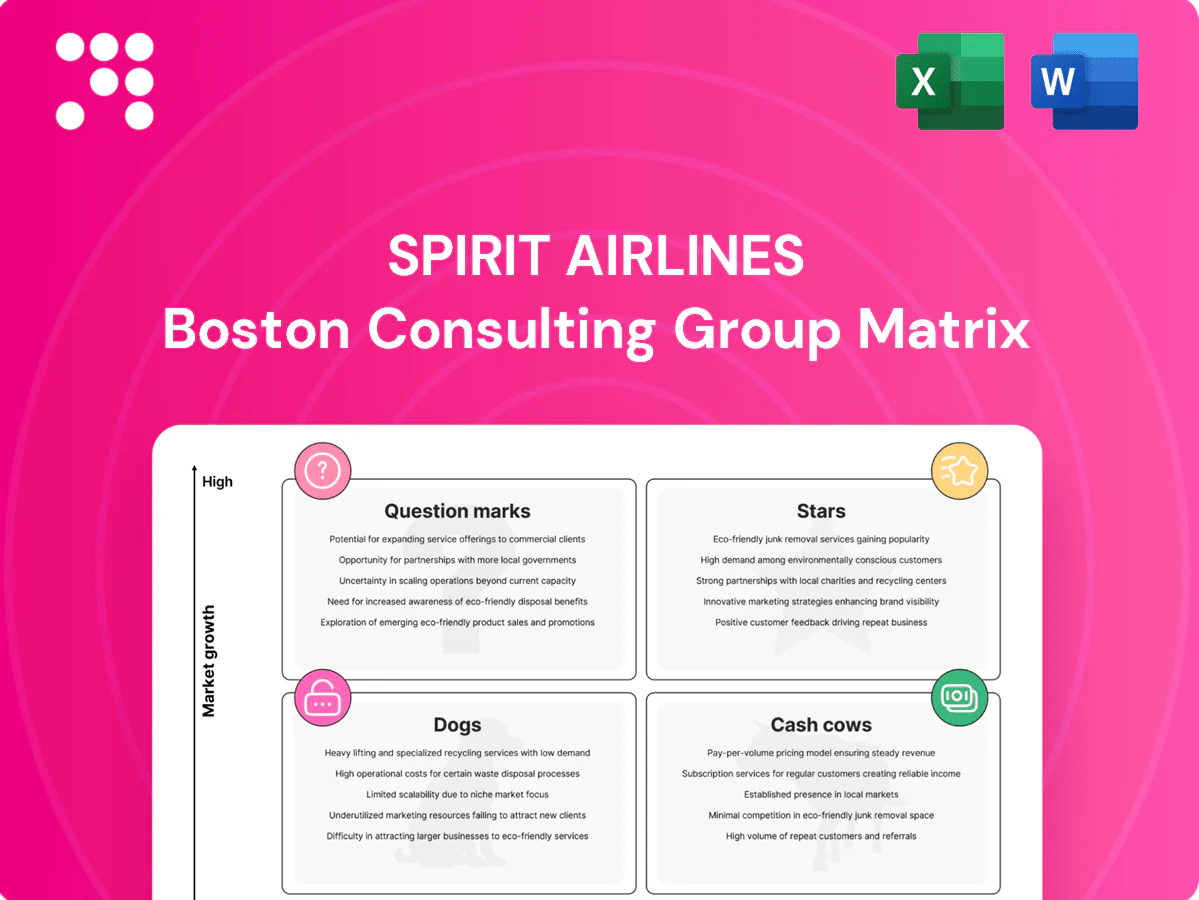
Spirit Airlines Boston Consulting Group Matrix

See the Bigger Picture
Spirit Airlines’ BCG Matrix snapshot shows where routes and ancillary products sit — fast-growers, reliable earners, or budget drains — and what that means for capital and marketing choices. This preview’s useful, but the full BCG Matrix gives quadrant-level placements, actionable moves, and ready-to-use Word and Excel files. Purchase now to skip the guesswork and get a clear, strategic roadmap you can act on today.
Stars

Core ULCC domestic leisure routes
Core ULCC domestic leisure routes are high-demand, price-sensitive corridors where Spirit flies frequently and typically ranks among the leading low-fare carriers, benefiting from continued passenger trade-down to value fares in 2024. Market share on these trunk leisure routes remains strong, but defending leadership requires ongoing promotions, nimble pricing and dense schedules. Keep the throttle down and these lanes continue to mint tomorrow’s cash.
Ancillary revenue engine (bags, seats, add‑ons)
Unbundled fees are Spirit’s home turf and scale as volumes rise; in 2024 ancillaries accounted for over 30% of total revenue, with take rates highest on core short-haul routes. Upsell paths (bags, seats, add‑ons) keep improving via site and app optimizations, boosting attach rates quarter-over-quarter. Growth requires cash for tech and testing, but reported returns in 2024 have broadly matched those investments, so holding share in key ancillaries becomes a compounding cash stream.

Digital direct sales channel
Spirit’s digital direct sales channel in 2024 shows strong mobile/app conversion, capturing an increasing share of the self-serve market and enabling control of merchandising to keep distribution costs low and preserve margin per seat. The channel requires ongoing UX tweaks, experimentation, and CRM investment to sustain conversion gains and ancillary upsell. Defend direct and you defend the low-cost model.

High‑density A320 family utilization
Spirit's high-density A320s (about 178 seats) squeeze more revenue per flight into growth leisure routes, with tight turns and reported block-hour utilization near 12–13 hours/day driving rapid payback on extra seats. Lower cost per seat preserves share when fares fall, but it hinges on relentless operational discipline and elevated maintenance spend to keep reliability high.
- seats: 178 per A320
- utilization: ~12–13 hr/day
- priority: ops discipline + maintenance
Leisure flows to Florida, Vegas, Caribbean
Leisure flows to Florida, Vegas, Caribbean are Spirit’s crowded but growing playgrounds, where price leadership and a known brand drive high yields and 2024 load factors near 85%, while dense frequencies sustain share; marketing and slot/gate commitments still require cash investment to defend routes and maintain growth, and steady execution here funds the rest of the portfolio.
- Cluster: Florida/Vegas/Caribbean
- Strength: price leadership, brand recognition
- Metric: ~85% load factor (2024)
- Need: marketing, slot/gate capex
- Role: cash-generating backbone
Leisure trunk routes: 85% load, >30% ancillaries - A320 efficiency fuels resilient margins
Core leisure trunk routes (Florida/Vegas/Caribbean) are Stars: high share, ~85% load factor in 2024, strong yields and >30% revenue from ancillaries; margin resilience driven by 178-seat A320s and ~12–13 hr/day utilization. Defend via pricing, ops discipline, digital upsell and targeted marketing to sustain cash generation and growth.
| Metric | 2024 |
|---|---|
| Load factor | ~85% |
| Ancillary rev | >30% |
| Seats/A320 | 178 |
| Utilization | 12–13 hr/day |
What is included in the product
 Detailed Word Document
Comprehensive BCG Matrix for Spirit Airlines: identifies Stars, Cash Cows, Question Marks, Dogs with investment recommendations and trend context.

 Customizable Excel Spreadsheet
One-page Spirit Airlines BCG Matrix pinpointing units to relieve portfolio pain points for quick C-level decisions
Cash Cows

Mature Florida trunk routes
Mature Florida trunk routes deliver stable demand with high repeat-traveler rates and predictable seasonality; in 2024 these routes represented roughly 28% of Spirit’s domestic seat capacity and sustained load factors near 82%, supporting strong cash generation. High share plus low incremental marketing need yields healthy margins; incremental ops-efficiency gains drop straight to cash. Milk these routes while defending schedule relevance with tight frequency and fare discipline.
Checked‑bag and seat assignment fees
Checked‑bag and seat assignment fees are low‑growth but high‑margin once pricing rails are set; DOT data showed average first checked‑bag fees near $32 in 2024, underpinning predictable cash flow. Minimal promotion is needed as Spirit passengers accept a la carte tradeoffs, so small price tweaks produce outsized ancillary cash. Maintain the offering, monitor price elasticity closely, and avoid overcomplicating fee structure.

Co‑branded credit card economics
Spirit’s co‑branded credit card throws off steady cash via interchange (≈1.8% of spend) and partner bonuses, delivering predictable fee revenue while growth remains modest and customer base sticky. Incremental cost is mostly co‑marketing and platform fees, not variable flight costs, so margins are high. Keeping churn below industry averages (~30% annual) preserves cash flow to fund product and route experiments.

Airport ancillary services (priority boarding, shortcut security)
Airport ancillary services like priority boarding and shortcut security ride on existing operations with minimal variable cost; uptake is steady rather than viral, contributing to Spirit’s high ancillary mix—ancillaries were about 40% of revenue in 2024—so clear signage and simple bundles keep revenue humming and enable harvesting without heavy marketing spend.
- Low marginal cost
- Steady uptake
- Simple bundles
- Harvest strategy
In‑app self‑service changes and fees
In 2024 Spirit’s in‑app self‑service for changes shifted routine work from agents to customers, cutting call center load and preserving ultra‑low fares while keeping ancillary fees a consistent margin driver; low growth but high efficiency fits the Cash Cows quadrant and requires steady UX investment to protect yield.
- Customer self‑service reduces agent volume
- Fees accepted at ULCC price point
- Low growth, high margin
- Prioritize UX to retain yield
Ancillaries 40%, trunk cap 28% — harvest high-margin cash cows
Mature Florida trunks, checked‑bag fees and ancillaries are Spirit’s cash cows: 2024 domestic trunk cap ~28%, load factor ~82%; ancillaries ~40% of revenue; avg checked‑bag ~$32. Co‑branded card (interchange ≈1.8%) and self‑service cut costs; low growth, high margin—harvest with tight frequency, fare discipline and UX upkeep.
| Metric | 2024 |
|---|---|
| Trunk capacity | 28% |
| Load factor | 82% |
| Ancillaries | 40% |
| Avg bag fee | $32 |
| Card interchange | 1.8% |
Delivered as Shown
Spirit Airlines BCG Matrix
The Spirit Airlines BCG Matrix you're previewing is the exact file you'll receive after purchase — final, polished, and free of watermarks or demo notes. Built for strategic clarity, it’s ready to edit, print, or present to stakeholders. Buy once and download immediately; the full report lands in your inbox with no surprises. Designed by industry analysts, it fits straight into planning and competitive reviews.

See the Bigger Picture
Spirit Airlines’ BCG Matrix snapshot shows where routes and ancillary products sit — fast-growers, reliable earners, or budget drains — and what that means for capital and marketing choices. This preview’s useful, but the full BCG Matrix gives quadrant-level placements, actionable moves, and ready-to-use Word and Excel files. Purchase now to skip the guesswork and get a clear, strategic roadmap you can act on today.
Stars
Core ULCC domestic leisure routes
Core ULCC domestic leisure routes are high-demand, price-sensitive corridors where Spirit flies frequently and typically ranks among the leading low-fare carriers, benefiting from continued passenger trade-down to value fares in 2024. Market share on these trunk leisure routes remains strong, but defending leadership requires ongoing promotions, nimble pricing and dense schedules. Keep the throttle down and these lanes continue to mint tomorrow’s cash.
Ancillary revenue engine (bags, seats, add‑ons)
Unbundled fees are Spirit’s home turf and scale as volumes rise; in 2024 ancillaries accounted for over 30% of total revenue, with take rates highest on core short-haul routes. Upsell paths (bags, seats, add‑ons) keep improving via site and app optimizations, boosting attach rates quarter-over-quarter. Growth requires cash for tech and testing, but reported returns in 2024 have broadly matched those investments, so holding share in key ancillaries becomes a compounding cash stream.
Digital direct sales channel
Spirit’s digital direct sales channel in 2024 shows strong mobile/app conversion, capturing an increasing share of the self-serve market and enabling control of merchandising to keep distribution costs low and preserve margin per seat. The channel requires ongoing UX tweaks, experimentation, and CRM investment to sustain conversion gains and ancillary upsell. Defend direct and you defend the low-cost model.
High‑density A320 family utilization
Spirit's high-density A320s (about 178 seats) squeeze more revenue per flight into growth leisure routes, with tight turns and reported block-hour utilization near 12–13 hours/day driving rapid payback on extra seats. Lower cost per seat preserves share when fares fall, but it hinges on relentless operational discipline and elevated maintenance spend to keep reliability high.
- seats: 178 per A320
- utilization: ~12–13 hr/day
- priority: ops discipline + maintenance
Leisure flows to Florida, Vegas, Caribbean
Leisure flows to Florida, Vegas, Caribbean are Spirit’s crowded but growing playgrounds, where price leadership and a known brand drive high yields and 2024 load factors near 85%, while dense frequencies sustain share; marketing and slot/gate commitments still require cash investment to defend routes and maintain growth, and steady execution here funds the rest of the portfolio.
- Cluster: Florida/Vegas/Caribbean
- Strength: price leadership, brand recognition
- Metric: ~85% load factor (2024)
- Need: marketing, slot/gate capex
- Role: cash-generating backbone
Leisure trunk routes: 85% load, >30% ancillaries - A320 efficiency fuels resilient margins
Core leisure trunk routes (Florida/Vegas/Caribbean) are Stars: high share, ~85% load factor in 2024, strong yields and >30% revenue from ancillaries; margin resilience driven by 178-seat A320s and ~12–13 hr/day utilization. Defend via pricing, ops discipline, digital upsell and targeted marketing to sustain cash generation and growth.
| Metric | 2024 |
|---|---|
| Load factor | ~85% |
| Ancillary rev | >30% |
| Seats/A320 | 178 |
| Utilization | 12–13 hr/day |
What is included in the product
Detailed Word Document
Comprehensive BCG Matrix for Spirit Airlines: identifies Stars, Cash Cows, Question Marks, Dogs with investment recommendations and trend context.
Customizable Excel Spreadsheet
One-page Spirit Airlines BCG Matrix pinpointing units to relieve portfolio pain points for quick C-level decisions
Cash Cows
Mature Florida trunk routes
Mature Florida trunk routes deliver stable demand with high repeat-traveler rates and predictable seasonality; in 2024 these routes represented roughly 28% of Spirit’s domestic seat capacity and sustained load factors near 82%, supporting strong cash generation. High share plus low incremental marketing need yields healthy margins; incremental ops-efficiency gains drop straight to cash. Milk these routes while defending schedule relevance with tight frequency and fare discipline.
Checked‑bag and seat assignment fees
Checked‑bag and seat assignment fees are low‑growth but high‑margin once pricing rails are set; DOT data showed average first checked‑bag fees near $32 in 2024, underpinning predictable cash flow. Minimal promotion is needed as Spirit passengers accept a la carte tradeoffs, so small price tweaks produce outsized ancillary cash. Maintain the offering, monitor price elasticity closely, and avoid overcomplicating fee structure.
Co‑branded credit card economics
Spirit’s co‑branded credit card throws off steady cash via interchange (≈1.8% of spend) and partner bonuses, delivering predictable fee revenue while growth remains modest and customer base sticky. Incremental cost is mostly co‑marketing and platform fees, not variable flight costs, so margins are high. Keeping churn below industry averages (~30% annual) preserves cash flow to fund product and route experiments.
Airport ancillary services (priority boarding, shortcut security)
Airport ancillary services like priority boarding and shortcut security ride on existing operations with minimal variable cost; uptake is steady rather than viral, contributing to Spirit’s high ancillary mix—ancillaries were about 40% of revenue in 2024—so clear signage and simple bundles keep revenue humming and enable harvesting without heavy marketing spend.
- Low marginal cost
- Steady uptake
- Simple bundles
- Harvest strategy
In‑app self‑service changes and fees
In 2024 Spirit’s in‑app self‑service for changes shifted routine work from agents to customers, cutting call center load and preserving ultra‑low fares while keeping ancillary fees a consistent margin driver; low growth but high efficiency fits the Cash Cows quadrant and requires steady UX investment to protect yield.
- Customer self‑service reduces agent volume
- Fees accepted at ULCC price point
- Low growth, high margin
- Prioritize UX to retain yield
Ancillaries 40%, trunk cap 28% — harvest high-margin cash cows
Mature Florida trunks, checked‑bag fees and ancillaries are Spirit’s cash cows: 2024 domestic trunk cap ~28%, load factor ~82%; ancillaries ~40% of revenue; avg checked‑bag ~$32. Co‑branded card (interchange ≈1.8%) and self‑service cut costs; low growth, high margin—harvest with tight frequency, fare discipline and UX upkeep.
| Metric | 2024 |
|---|---|
| Trunk capacity | 28% |
| Load factor | 82% |
| Ancillaries | 40% |
| Avg bag fee | $32 |
| Card interchange | 1.8% |
Delivered as Shown
Spirit Airlines BCG Matrix
The Spirit Airlines BCG Matrix you're previewing is the exact file you'll receive after purchase — final, polished, and free of watermarks or demo notes. Built for strategic clarity, it’s ready to edit, print, or present to stakeholders. Buy once and download immediately; the full report lands in your inbox with no surprises. Designed by industry analysts, it fits straight into planning and competitive reviews.
Original: $10.00
-65%$10.00
$3.50Description
See the Bigger Picture
Spirit Airlines’ BCG Matrix snapshot shows where routes and ancillary products sit — fast-growers, reliable earners, or budget drains — and what that means for capital and marketing choices. This preview’s useful, but the full BCG Matrix gives quadrant-level placements, actionable moves, and ready-to-use Word and Excel files. Purchase now to skip the guesswork and get a clear, strategic roadmap you can act on today.
Stars
Core ULCC domestic leisure routes
Core ULCC domestic leisure routes are high-demand, price-sensitive corridors where Spirit flies frequently and typically ranks among the leading low-fare carriers, benefiting from continued passenger trade-down to value fares in 2024. Market share on these trunk leisure routes remains strong, but defending leadership requires ongoing promotions, nimble pricing and dense schedules. Keep the throttle down and these lanes continue to mint tomorrow’s cash.
Ancillary revenue engine (bags, seats, add‑ons)
Unbundled fees are Spirit’s home turf and scale as volumes rise; in 2024 ancillaries accounted for over 30% of total revenue, with take rates highest on core short-haul routes. Upsell paths (bags, seats, add‑ons) keep improving via site and app optimizations, boosting attach rates quarter-over-quarter. Growth requires cash for tech and testing, but reported returns in 2024 have broadly matched those investments, so holding share in key ancillaries becomes a compounding cash stream.
Digital direct sales channel
Spirit’s digital direct sales channel in 2024 shows strong mobile/app conversion, capturing an increasing share of the self-serve market and enabling control of merchandising to keep distribution costs low and preserve margin per seat. The channel requires ongoing UX tweaks, experimentation, and CRM investment to sustain conversion gains and ancillary upsell. Defend direct and you defend the low-cost model.
High‑density A320 family utilization
Spirit's high-density A320s (about 178 seats) squeeze more revenue per flight into growth leisure routes, with tight turns and reported block-hour utilization near 12–13 hours/day driving rapid payback on extra seats. Lower cost per seat preserves share when fares fall, but it hinges on relentless operational discipline and elevated maintenance spend to keep reliability high.
- seats: 178 per A320
- utilization: ~12–13 hr/day
- priority: ops discipline + maintenance
Leisure flows to Florida, Vegas, Caribbean
Leisure flows to Florida, Vegas, Caribbean are Spirit’s crowded but growing playgrounds, where price leadership and a known brand drive high yields and 2024 load factors near 85%, while dense frequencies sustain share; marketing and slot/gate commitments still require cash investment to defend routes and maintain growth, and steady execution here funds the rest of the portfolio.
- Cluster: Florida/Vegas/Caribbean
- Strength: price leadership, brand recognition
- Metric: ~85% load factor (2024)
- Need: marketing, slot/gate capex
- Role: cash-generating backbone
Leisure trunk routes: 85% load, >30% ancillaries - A320 efficiency fuels resilient margins
Core leisure trunk routes (Florida/Vegas/Caribbean) are Stars: high share, ~85% load factor in 2024, strong yields and >30% revenue from ancillaries; margin resilience driven by 178-seat A320s and ~12–13 hr/day utilization. Defend via pricing, ops discipline, digital upsell and targeted marketing to sustain cash generation and growth.
| Metric | 2024 |
|---|---|
| Load factor | ~85% |
| Ancillary rev | >30% |
| Seats/A320 | 178 |
| Utilization | 12–13 hr/day |
What is included in the product
Detailed Word Document
Comprehensive BCG Matrix for Spirit Airlines: identifies Stars, Cash Cows, Question Marks, Dogs with investment recommendations and trend context.
Customizable Excel Spreadsheet
One-page Spirit Airlines BCG Matrix pinpointing units to relieve portfolio pain points for quick C-level decisions
Cash Cows
Mature Florida trunk routes
Mature Florida trunk routes deliver stable demand with high repeat-traveler rates and predictable seasonality; in 2024 these routes represented roughly 28% of Spirit’s domestic seat capacity and sustained load factors near 82%, supporting strong cash generation. High share plus low incremental marketing need yields healthy margins; incremental ops-efficiency gains drop straight to cash. Milk these routes while defending schedule relevance with tight frequency and fare discipline.
Checked‑bag and seat assignment fees
Checked‑bag and seat assignment fees are low‑growth but high‑margin once pricing rails are set; DOT data showed average first checked‑bag fees near $32 in 2024, underpinning predictable cash flow. Minimal promotion is needed as Spirit passengers accept a la carte tradeoffs, so small price tweaks produce outsized ancillary cash. Maintain the offering, monitor price elasticity closely, and avoid overcomplicating fee structure.
Co‑branded credit card economics
Spirit’s co‑branded credit card throws off steady cash via interchange (≈1.8% of spend) and partner bonuses, delivering predictable fee revenue while growth remains modest and customer base sticky. Incremental cost is mostly co‑marketing and platform fees, not variable flight costs, so margins are high. Keeping churn below industry averages (~30% annual) preserves cash flow to fund product and route experiments.
Airport ancillary services (priority boarding, shortcut security)
Airport ancillary services like priority boarding and shortcut security ride on existing operations with minimal variable cost; uptake is steady rather than viral, contributing to Spirit’s high ancillary mix—ancillaries were about 40% of revenue in 2024—so clear signage and simple bundles keep revenue humming and enable harvesting without heavy marketing spend.
- Low marginal cost
- Steady uptake
- Simple bundles
- Harvest strategy
In‑app self‑service changes and fees
In 2024 Spirit’s in‑app self‑service for changes shifted routine work from agents to customers, cutting call center load and preserving ultra‑low fares while keeping ancillary fees a consistent margin driver; low growth but high efficiency fits the Cash Cows quadrant and requires steady UX investment to protect yield.
- Customer self‑service reduces agent volume
- Fees accepted at ULCC price point
- Low growth, high margin
- Prioritize UX to retain yield
Ancillaries 40%, trunk cap 28% — harvest high-margin cash cows
Mature Florida trunks, checked‑bag fees and ancillaries are Spirit’s cash cows: 2024 domestic trunk cap ~28%, load factor ~82%; ancillaries ~40% of revenue; avg checked‑bag ~$32. Co‑branded card (interchange ≈1.8%) and self‑service cut costs; low growth, high margin—harvest with tight frequency, fare discipline and UX upkeep.
| Metric | 2024 |
|---|---|
| Trunk capacity | 28% |
| Load factor | 82% |
| Ancillaries | 40% |
| Avg bag fee | $32 |
| Card interchange | 1.8% |
Delivered as Shown
Spirit Airlines BCG Matrix
The Spirit Airlines BCG Matrix you're previewing is the exact file you'll receive after purchase — final, polished, and free of watermarks or demo notes. Built for strategic clarity, it’s ready to edit, print, or present to stakeholders. Buy once and download immediately; the full report lands in your inbox with no surprises. Designed by industry analysts, it fits straight into planning and competitive reviews.











