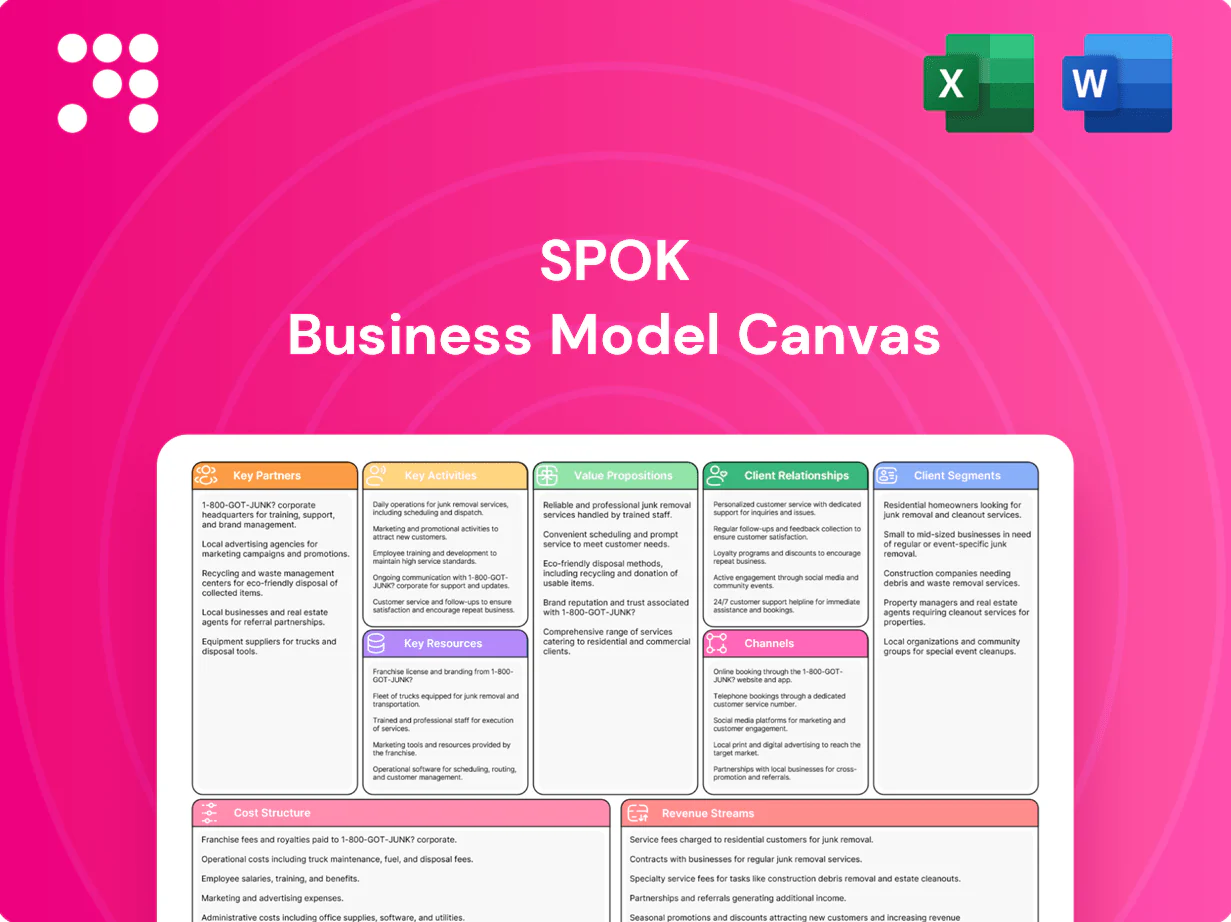
Spok Business Model Canvas

Business Model Canvas: concise, actionable insights into value, customers, and revenue.
Unlock Spok’s strategic blueprint with our Business Model Canvas—concise, actionable insights into its value proposition, customer segments, and revenue drivers. See how partnerships and cost structure enable scalable growth. Ideal for entrepreneurs, investors, and consultants. Purchase the full downloadable Canvas to apply these insights to your strategy.
Partnerships

EHR and HIS vendors
Integrations with EHR/HIS partners enable context-rich messaging and automated workflow triggers tied to patient records and care pathways. Partnerships ensure interoperability via HL7/FHIR; over 96% of US hospitals had EHRs per ONC (2023) and FHIR adoption accelerated through 2024. Joint roadmaps reduce integration friction and speed deployments, while co-marketing expands reach across ~6,100 US hospitals (AHA 2024) and global systems.
Device and nurse call providers
Alliances with smartphone, pager, RTLS, and nurse call vendors ensure redundant, reliable delivery paths across clinical settings. Certified integrations support alarm routing and escalation logic and enable consistent workflows. Hardware compatibility widens addressable use cases across units, and co-validation with vendors improves performance and reduces support issues; Spok serves more than 6,000 healthcare sites.

Telecom carriers and paging networks
Carrier relationships underpin resilient message transport with industry SLAs targeting 99.99% availability, delivering redundancy across cellular and paging meshes. Priority routing and coverage agreements improve clinical uptime by ensuring message delivery even during congestion and outages. Joint carrier-Spok troubleshooting shortens incident resolution cycles and supports faster failover. Preferential pricing tiers for large user bases commonly yield enterprise discounts in the 10–30% range.

Systems integrators and GPOs
Systems integrators scale complex multi-site Spok implementations, enabling standardized deployments across large health systems and reducing roll-out time; SIs commonly support networks of 50–200 facilities. GPO affiliations streamline procurement, with GPOs serving over 90% of US hospitals and delivering average contract savings near 12% in 2024. Partners provide local expertise and managed services, while co-selling increases access to enterprise deals with major health systems.
- SI scale: multi-site standardization, faster rollouts
- GPO impact: >90% hospital coverage, ~12% procurement savings (2024)
- Services: local expertise, ongoing managed services, co-selling for enterprise access
Standards bodies and regulators
Engagement with HL7, FHIR, and IHE ensures Spok’s solutions meet global interoperability expectations; FHIR R4 has been normative since 2019 and ONC/industry momentum through 2024 accelerated API-based exchange. Participation tracks evolving requirements and best practices so Spok shapes alarm and messaging safety profiles. Clear compliance alignment builds buyer trust and reduces procurement and clinical risk.
- Standards: HL7/FHIR/IHE
- FHIR R4 normative since 2019
- Profiles: alarm & messaging safety inputs
- Benefit: higher buyer trust, lower risk
EHR/FHIR messaging connects care - >96% EHRs, 99.99% SLA, GPOs >90% coverage
EHR/HIS integrations (HL7/FHIR) enable context-rich messaging; >96% US hospitals had EHRs (ONC 2023), FHIR adoption rose through 2024.
Device, carrier, and RTLS partners provide redundant delivery with 99.99% SLA targets; Spok serves ~6,000 sites.
SIs and GPOs speed rollouts and procurement; GPOs cover >90% hospitals, ~12% contract savings (2024).
| Metric | Value |
|---|---|
| EHR penetration | >96% (ONC 2023) |
| Spok sites | ~6,000 |
| GPO coverage | >90% (2024) |
What is included in the product
 Detailed Word Document
A comprehensive, pre-written Business Model Canvas tailored to Spok that maps customer segments, value propositions, channels, revenue and cost streams across the 9 classic BMC blocks with full narrative and insights. Includes competitive advantage analysis, linked SWOT, validation using real company data, and a polished format ideal for presentations, investor discussions, and strategic decision-making.

 Customizable Excel Spreadsheet
High-level view of Spok’s business model with editable cells that relieve pain by turning fragmented strategy into a single, actionable one-page snapshot—ideal for fast decision-making and team alignment.
Activities

Platform R&D and roadmap
Continuous Platform R&D strengthens secure messaging, on-call routing, and alarm management; biweekly sprints and monthly releases deliver incremental value while maintaining 99.95% uptime SLAs. Backlog prioritization uses clinical-safety gates and usability scoring to balance risk, reducing critical incidents by 40% year-over-year (2024). User feedback—NPS and quarterly usability tests—directly informs design and QA.
Interoperability integrations
Spok builds and maintains interfaces with EHRs, nurse call, RTLS, PBX and directory services across 6,000+ US hospitals and health systems. We manage APIs, HL7/FHIR feeds and SSO to enable real-time clinical workflows. Rigorous certification and regression testing mitigate breakage during quarterly releases. Detailed deployment documentation ensures repeatable rollouts and faster time-to-live.

Security and compliance ops
Enforce HIPAA-grade encryption, continuous auditing and role-based access controls; IBM 2024 reports the average cost of a data breach at roughly $4.45M, underscoring this priority. Conduct quarterly penetration tests and continuous vulnerability management with monthly scans. Maintain SOC 2 and HITRUST certifications and documented policies. Incident response and tested disaster-recovery plans ensure operational continuity and rapid RTOs.

Implementation and training
Guide workflow design, role mapping, and escalation policies to fit clinical pathways and EHR workflows; with over 95% of US hospitals using an EHR in 2024, tight integration is critical. Configure on-call schedules and integrations (paging, EHR, middleware) and train admins, clinicians, and super-users in phased sessions. Post-go-live tuning (weeks 4–12) monitors KPIs and optimizes adoption.
- Workflow design & escalation
- On-call schedules & integrations
- Training: admins, clinicians, super-users
- Post-go-live tuning (weeks 4–12)
Sales, marketing, and customer success
Enterprise selling targets health systems and IDNs, leveraging relationships across over 1,300 health systems and ~6,000 US hospitals as of 2024; sales cycles focus on clinical stakeholders and procurement. Marketing drives thought leadership and clinical ROI storytelling to shorten procure-to-deploy timelines. Customer success delivers SLA-tied account management and outcome metrics while driving expansion into new departments and sites.
- Enterprise deals with IDNs and health systems (>$100k ARR typical)
- Thought leadership + clinical ROI storytelling to accelerate adoption
- SLA-driven account management tied to outcomes
- Cross-department/site expansion and footprint growth
99.95% uptime for 6,000+ hospitals and 1,300 systems
Continuous R&D and biweekly sprints maintain 99.95% uptime and cut critical incidents 40% YoY (2024); APIs, HL7/FHIR and EHR integrations support 6,000+ US hospitals and 1,300 health systems. HIPAA-grade security, SOC2/HITRUST, quarterly pen tests and DR plans address breach risk (~$4.45M avg cost, 2024). Enterprise sales, SLA-driven CS and training drive expansion and >$100k ARR deals.
| Metric | 2024 |
|---|---|
| Hospitals | 6,000+ |
| Health systems | 1,300+ |
| Uptime SLA | 99.95% |
| Incident reduction | 40% YoY |
Preview Before You Purchase
Business Model Canvas
The document you're previewing is the exact Spok Business Model Canvas you'll receive after purchase. It's not a mockup or sample—this preview is taken directly from the final file. After payment you'll instantly download the complete, editable canvas in Word and Excel formats. No surprises—what you see is what you'll own.

Business Model Canvas: concise, actionable insights into value, customers, and revenue.
Unlock Spok’s strategic blueprint with our Business Model Canvas—concise, actionable insights into its value proposition, customer segments, and revenue drivers. See how partnerships and cost structure enable scalable growth. Ideal for entrepreneurs, investors, and consultants. Purchase the full downloadable Canvas to apply these insights to your strategy.
Partnerships
EHR and HIS vendors
Integrations with EHR/HIS partners enable context-rich messaging and automated workflow triggers tied to patient records and care pathways. Partnerships ensure interoperability via HL7/FHIR; over 96% of US hospitals had EHRs per ONC (2023) and FHIR adoption accelerated through 2024. Joint roadmaps reduce integration friction and speed deployments, while co-marketing expands reach across ~6,100 US hospitals (AHA 2024) and global systems.
Device and nurse call providers
Alliances with smartphone, pager, RTLS, and nurse call vendors ensure redundant, reliable delivery paths across clinical settings. Certified integrations support alarm routing and escalation logic and enable consistent workflows. Hardware compatibility widens addressable use cases across units, and co-validation with vendors improves performance and reduces support issues; Spok serves more than 6,000 healthcare sites.
Telecom carriers and paging networks
Carrier relationships underpin resilient message transport with industry SLAs targeting 99.99% availability, delivering redundancy across cellular and paging meshes. Priority routing and coverage agreements improve clinical uptime by ensuring message delivery even during congestion and outages. Joint carrier-Spok troubleshooting shortens incident resolution cycles and supports faster failover. Preferential pricing tiers for large user bases commonly yield enterprise discounts in the 10–30% range.
Systems integrators and GPOs
Systems integrators scale complex multi-site Spok implementations, enabling standardized deployments across large health systems and reducing roll-out time; SIs commonly support networks of 50–200 facilities. GPO affiliations streamline procurement, with GPOs serving over 90% of US hospitals and delivering average contract savings near 12% in 2024. Partners provide local expertise and managed services, while co-selling increases access to enterprise deals with major health systems.
- SI scale: multi-site standardization, faster rollouts
- GPO impact: >90% hospital coverage, ~12% procurement savings (2024)
- Services: local expertise, ongoing managed services, co-selling for enterprise access
Standards bodies and regulators
Engagement with HL7, FHIR, and IHE ensures Spok’s solutions meet global interoperability expectations; FHIR R4 has been normative since 2019 and ONC/industry momentum through 2024 accelerated API-based exchange. Participation tracks evolving requirements and best practices so Spok shapes alarm and messaging safety profiles. Clear compliance alignment builds buyer trust and reduces procurement and clinical risk.
- Standards: HL7/FHIR/IHE
- FHIR R4 normative since 2019
- Profiles: alarm & messaging safety inputs
- Benefit: higher buyer trust, lower risk
EHR/FHIR messaging connects care - >96% EHRs, 99.99% SLA, GPOs >90% coverage
EHR/HIS integrations (HL7/FHIR) enable context-rich messaging; >96% US hospitals had EHRs (ONC 2023), FHIR adoption rose through 2024.
Device, carrier, and RTLS partners provide redundant delivery with 99.99% SLA targets; Spok serves ~6,000 sites.
SIs and GPOs speed rollouts and procurement; GPOs cover >90% hospitals, ~12% contract savings (2024).
| Metric | Value |
|---|---|
| EHR penetration | >96% (ONC 2023) |
| Spok sites | ~6,000 |
| GPO coverage | >90% (2024) |
What is included in the product
Detailed Word Document
A comprehensive, pre-written Business Model Canvas tailored to Spok that maps customer segments, value propositions, channels, revenue and cost streams across the 9 classic BMC blocks with full narrative and insights. Includes competitive advantage analysis, linked SWOT, validation using real company data, and a polished format ideal for presentations, investor discussions, and strategic decision-making.
Customizable Excel Spreadsheet
High-level view of Spok’s business model with editable cells that relieve pain by turning fragmented strategy into a single, actionable one-page snapshot—ideal for fast decision-making and team alignment.
Activities
Platform R&D and roadmap
Continuous Platform R&D strengthens secure messaging, on-call routing, and alarm management; biweekly sprints and monthly releases deliver incremental value while maintaining 99.95% uptime SLAs. Backlog prioritization uses clinical-safety gates and usability scoring to balance risk, reducing critical incidents by 40% year-over-year (2024). User feedback—NPS and quarterly usability tests—directly informs design and QA.
Interoperability integrations
Spok builds and maintains interfaces with EHRs, nurse call, RTLS, PBX and directory services across 6,000+ US hospitals and health systems. We manage APIs, HL7/FHIR feeds and SSO to enable real-time clinical workflows. Rigorous certification and regression testing mitigate breakage during quarterly releases. Detailed deployment documentation ensures repeatable rollouts and faster time-to-live.
Security and compliance ops
Enforce HIPAA-grade encryption, continuous auditing and role-based access controls; IBM 2024 reports the average cost of a data breach at roughly $4.45M, underscoring this priority. Conduct quarterly penetration tests and continuous vulnerability management with monthly scans. Maintain SOC 2 and HITRUST certifications and documented policies. Incident response and tested disaster-recovery plans ensure operational continuity and rapid RTOs.
Implementation and training
Guide workflow design, role mapping, and escalation policies to fit clinical pathways and EHR workflows; with over 95% of US hospitals using an EHR in 2024, tight integration is critical. Configure on-call schedules and integrations (paging, EHR, middleware) and train admins, clinicians, and super-users in phased sessions. Post-go-live tuning (weeks 4–12) monitors KPIs and optimizes adoption.
- Workflow design & escalation
- On-call schedules & integrations
- Training: admins, clinicians, super-users
- Post-go-live tuning (weeks 4–12)
Sales, marketing, and customer success
Enterprise selling targets health systems and IDNs, leveraging relationships across over 1,300 health systems and ~6,000 US hospitals as of 2024; sales cycles focus on clinical stakeholders and procurement. Marketing drives thought leadership and clinical ROI storytelling to shorten procure-to-deploy timelines. Customer success delivers SLA-tied account management and outcome metrics while driving expansion into new departments and sites.
- Enterprise deals with IDNs and health systems (>$100k ARR typical)
- Thought leadership + clinical ROI storytelling to accelerate adoption
- SLA-driven account management tied to outcomes
- Cross-department/site expansion and footprint growth
99.95% uptime for 6,000+ hospitals and 1,300 systems
Continuous R&D and biweekly sprints maintain 99.95% uptime and cut critical incidents 40% YoY (2024); APIs, HL7/FHIR and EHR integrations support 6,000+ US hospitals and 1,300 health systems. HIPAA-grade security, SOC2/HITRUST, quarterly pen tests and DR plans address breach risk (~$4.45M avg cost, 2024). Enterprise sales, SLA-driven CS and training drive expansion and >$100k ARR deals.
| Metric | 2024 |
|---|---|
| Hospitals | 6,000+ |
| Health systems | 1,300+ |
| Uptime SLA | 99.95% |
| Incident reduction | 40% YoY |
Preview Before You Purchase
Business Model Canvas
The document you're previewing is the exact Spok Business Model Canvas you'll receive after purchase. It's not a mockup or sample—this preview is taken directly from the final file. After payment you'll instantly download the complete, editable canvas in Word and Excel formats. No surprises—what you see is what you'll own.
Description
Business Model Canvas: concise, actionable insights into value, customers, and revenue.
Unlock Spok’s strategic blueprint with our Business Model Canvas—concise, actionable insights into its value proposition, customer segments, and revenue drivers. See how partnerships and cost structure enable scalable growth. Ideal for entrepreneurs, investors, and consultants. Purchase the full downloadable Canvas to apply these insights to your strategy.
Partnerships
EHR and HIS vendors
Integrations with EHR/HIS partners enable context-rich messaging and automated workflow triggers tied to patient records and care pathways. Partnerships ensure interoperability via HL7/FHIR; over 96% of US hospitals had EHRs per ONC (2023) and FHIR adoption accelerated through 2024. Joint roadmaps reduce integration friction and speed deployments, while co-marketing expands reach across ~6,100 US hospitals (AHA 2024) and global systems.
Device and nurse call providers
Alliances with smartphone, pager, RTLS, and nurse call vendors ensure redundant, reliable delivery paths across clinical settings. Certified integrations support alarm routing and escalation logic and enable consistent workflows. Hardware compatibility widens addressable use cases across units, and co-validation with vendors improves performance and reduces support issues; Spok serves more than 6,000 healthcare sites.
Telecom carriers and paging networks
Carrier relationships underpin resilient message transport with industry SLAs targeting 99.99% availability, delivering redundancy across cellular and paging meshes. Priority routing and coverage agreements improve clinical uptime by ensuring message delivery even during congestion and outages. Joint carrier-Spok troubleshooting shortens incident resolution cycles and supports faster failover. Preferential pricing tiers for large user bases commonly yield enterprise discounts in the 10–30% range.
Systems integrators and GPOs
Systems integrators scale complex multi-site Spok implementations, enabling standardized deployments across large health systems and reducing roll-out time; SIs commonly support networks of 50–200 facilities. GPO affiliations streamline procurement, with GPOs serving over 90% of US hospitals and delivering average contract savings near 12% in 2024. Partners provide local expertise and managed services, while co-selling increases access to enterprise deals with major health systems.
- SI scale: multi-site standardization, faster rollouts
- GPO impact: >90% hospital coverage, ~12% procurement savings (2024)
- Services: local expertise, ongoing managed services, co-selling for enterprise access
Standards bodies and regulators
Engagement with HL7, FHIR, and IHE ensures Spok’s solutions meet global interoperability expectations; FHIR R4 has been normative since 2019 and ONC/industry momentum through 2024 accelerated API-based exchange. Participation tracks evolving requirements and best practices so Spok shapes alarm and messaging safety profiles. Clear compliance alignment builds buyer trust and reduces procurement and clinical risk.
- Standards: HL7/FHIR/IHE
- FHIR R4 normative since 2019
- Profiles: alarm & messaging safety inputs
- Benefit: higher buyer trust, lower risk
EHR/FHIR messaging connects care - >96% EHRs, 99.99% SLA, GPOs >90% coverage
EHR/HIS integrations (HL7/FHIR) enable context-rich messaging; >96% US hospitals had EHRs (ONC 2023), FHIR adoption rose through 2024.
Device, carrier, and RTLS partners provide redundant delivery with 99.99% SLA targets; Spok serves ~6,000 sites.
SIs and GPOs speed rollouts and procurement; GPOs cover >90% hospitals, ~12% contract savings (2024).
| Metric | Value |
|---|---|
| EHR penetration | >96% (ONC 2023) |
| Spok sites | ~6,000 |
| GPO coverage | >90% (2024) |
What is included in the product
Detailed Word Document
A comprehensive, pre-written Business Model Canvas tailored to Spok that maps customer segments, value propositions, channels, revenue and cost streams across the 9 classic BMC blocks with full narrative and insights. Includes competitive advantage analysis, linked SWOT, validation using real company data, and a polished format ideal for presentations, investor discussions, and strategic decision-making.
Customizable Excel Spreadsheet
High-level view of Spok’s business model with editable cells that relieve pain by turning fragmented strategy into a single, actionable one-page snapshot—ideal for fast decision-making and team alignment.
Activities
Platform R&D and roadmap
Continuous Platform R&D strengthens secure messaging, on-call routing, and alarm management; biweekly sprints and monthly releases deliver incremental value while maintaining 99.95% uptime SLAs. Backlog prioritization uses clinical-safety gates and usability scoring to balance risk, reducing critical incidents by 40% year-over-year (2024). User feedback—NPS and quarterly usability tests—directly informs design and QA.
Interoperability integrations
Spok builds and maintains interfaces with EHRs, nurse call, RTLS, PBX and directory services across 6,000+ US hospitals and health systems. We manage APIs, HL7/FHIR feeds and SSO to enable real-time clinical workflows. Rigorous certification and regression testing mitigate breakage during quarterly releases. Detailed deployment documentation ensures repeatable rollouts and faster time-to-live.
Security and compliance ops
Enforce HIPAA-grade encryption, continuous auditing and role-based access controls; IBM 2024 reports the average cost of a data breach at roughly $4.45M, underscoring this priority. Conduct quarterly penetration tests and continuous vulnerability management with monthly scans. Maintain SOC 2 and HITRUST certifications and documented policies. Incident response and tested disaster-recovery plans ensure operational continuity and rapid RTOs.
Implementation and training
Guide workflow design, role mapping, and escalation policies to fit clinical pathways and EHR workflows; with over 95% of US hospitals using an EHR in 2024, tight integration is critical. Configure on-call schedules and integrations (paging, EHR, middleware) and train admins, clinicians, and super-users in phased sessions. Post-go-live tuning (weeks 4–12) monitors KPIs and optimizes adoption.
- Workflow design & escalation
- On-call schedules & integrations
- Training: admins, clinicians, super-users
- Post-go-live tuning (weeks 4–12)
Sales, marketing, and customer success
Enterprise selling targets health systems and IDNs, leveraging relationships across over 1,300 health systems and ~6,000 US hospitals as of 2024; sales cycles focus on clinical stakeholders and procurement. Marketing drives thought leadership and clinical ROI storytelling to shorten procure-to-deploy timelines. Customer success delivers SLA-tied account management and outcome metrics while driving expansion into new departments and sites.
- Enterprise deals with IDNs and health systems (>$100k ARR typical)
- Thought leadership + clinical ROI storytelling to accelerate adoption
- SLA-driven account management tied to outcomes
- Cross-department/site expansion and footprint growth
99.95% uptime for 6,000+ hospitals and 1,300 systems
Continuous R&D and biweekly sprints maintain 99.95% uptime and cut critical incidents 40% YoY (2024); APIs, HL7/FHIR and EHR integrations support 6,000+ US hospitals and 1,300 health systems. HIPAA-grade security, SOC2/HITRUST, quarterly pen tests and DR plans address breach risk (~$4.45M avg cost, 2024). Enterprise sales, SLA-driven CS and training drive expansion and >$100k ARR deals.
| Metric | 2024 |
|---|---|
| Hospitals | 6,000+ |
| Health systems | 1,300+ |
| Uptime SLA | 99.95% |
| Incident reduction | 40% YoY |
Preview Before You Purchase
Business Model Canvas
The document you're previewing is the exact Spok Business Model Canvas you'll receive after purchase. It's not a mockup or sample—this preview is taken directly from the final file. After payment you'll instantly download the complete, editable canvas in Word and Excel formats. No surprises—what you see is what you'll own.











