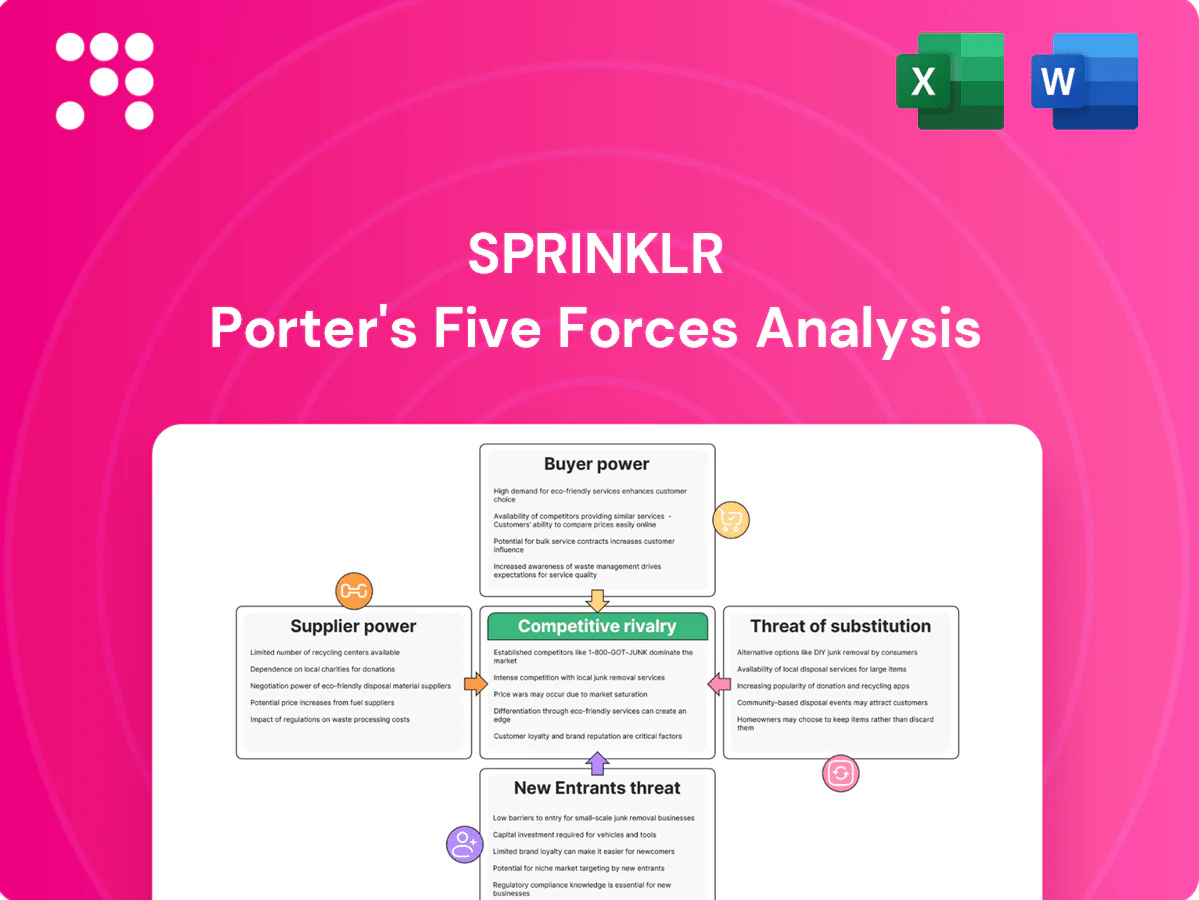
Sprinklr Porter's Five Forces Analysis

Elevate Your Analysis with the Complete Porter's Five Forces Analysis
Sprinklr faces moderate buyer power, high competitive rivalry, and evolving substitute threats as AI reshapes enterprise CX; supplier and entrant pressures are nuanced by platform scale. This snapshot highlights key dynamics influencing Sprinklr’s strategy and valuation. Unlock the full Porter's Five Forces Analysis to access force-by-force ratings, visuals, and actionable recommendations.
Suppliers Bargaining Power

Dependence on hyperscale clouds
Sprinklr depends on hyperscalers (AWS, Azure, GCP) for compute, storage and AI acceleration; the top three held roughly 65% of global cloud market in 2024, giving suppliers pricing leverage. Concentration enables vendor-driven term changes, while multi-cloud designs and multiyear contracts reduce exposure. Service outages or sudden cost spikes (e.g., ~20%) can compress SaaS gross margins and threaten SLA commitments.
Platform and API gatekeepers
Access to Meta (family ~3B users as of 2024), YouTube (>2B), WhatsApp (~2B), TikTok (~1.5B) and X (~550M) is essential, making these platforms powerful suppliers; Sprinklr's functionality depends on their data flows. API changes and rate limits — notably X's paid API moves in 2023 — can sharply raise costs or degrade features. Preferred partner status lowers but does not remove dependency, and continual policy shifts force ongoing compliance costs and supplier influence.

Third-party data and AI tooling
Language models, NLP tooling, and data enrichment providers are critical inputs to Sprinklr Unified-CXM analytics, and 2024 enterprise contracts with major LLM vendors increasingly use token-based pricing and usage tiers that can compress unit economics.

App stores and ecosystems
Distribution via cloud marketplaces and CRM/ERP integrations imposes platform fees (commonly 15–30% on app stores) and AWS Marketplace transaction fees around 20%, while listing prominence and certification processes create soft power that affects visibility and deal velocity; ecosystem alignment can speed deals but typically constrains pricing freedom, and co-sell incentives (often up to ~20% in 2024 programs) can steer roadmap priorities.
- Fees: 15–30% common on app stores
- AWS marketplace fees ~20%
- Market influence: ~60% of enterprise deals shaped by marketplaces (2024)
- Co-sell incentives ~20% impact roadmap
Specialized services partners
Implementation partners and BPOs shape Sprinklr’s delivery capacity for large enterprises, with 2024 IDC data showing enterprise CX spend rising about 8% YoY, increasing demand for scalable partner delivery. Scarce expert talent commands premium rates and scheduling leverage, while robust partner networks reduce exposure to any single supplier. In-house success teams can offset supplier reliance but add higher fixed costs.
- Delivery capacity: partners drive scale
- Talent scarcity: premium rates + scheduling power
- Network strength: diversifies supplier risk
- In-house teams: higher fixed cost trade-off
Suppliers wield leverage: 65% cloud share, 15–30% fees, CX +8% YoY
Suppliers hold meaningful leverage: hyperscalers ~65% cloud share (2024) drive compute pricing; Meta/YouTube/WhatsApp/TikTok/X (user bases 3B/2B/2B/1.5B/550M in 2024) control data access; LLM token pricing and marketplace fees (15–30%, AWS ~20%) compress margins; partner/talent constraints and CX spend +8% YoY (2024) raise delivery costs.
| Supplier | Metric (2024) |
|---|---|
| Hyperscalers | 65% cloud market |
| Social platforms | Users: 3B/2B/2B/1.5B/550M |
| Fees | 15–30% apps; AWS ~20% |
| CX spend | +8% YoY |
What is included in the product
 Detailed Word Document
Tailored Porter's Five Forces analysis for Sprinklr that uncovers competitive intensity, customer and supplier power, threat of substitutes and new entrants, and identifies disruptive forces and strategic levers influencing pricing, profitability, and market positioning.

 Customizable Excel Spreadsheet
A one-sheet Sprinklr Porter's Five Forces summary that instantly highlights competitive pressure and relief points with a customizable spider chart—perfect for quick decisions and slide-ready reporting.
Customers Bargaining Power

Enterprise procurement leverage
Large global brands run competitive RFPs and push hard on price, SLAs and data rights, forcing Sprinklr to concede on margins and contract terms. Multi-year, multi-module deals raise average contract value but routinely trigger volume discounts and tiered pricing. Referenceability and robust security posture (SOC 2/ISO 27001) are table stakes in negotiations. Enterprise procurement cycles of 6–12 months elongate sales and intensify concessions.
High but manageable switching costs
Deep integrations, historical interaction data and trained workflows create significant switching friction for Sprinklr customers, slowing vendor turnover. The unified-CXM architecture increases cross-module lock-in, gradually reducing buyer power as platform breadth grows. GDPR-style data portability rules can lower barriers if enforced, enabling easier migration. Competitive bake-offs at renewal still keep pricing under regular market pressure.

Availability of credible alternatives
Customers can pick integrated suites such as Salesforce, Adobe and Oracle or best-of-breed platforms like Sprout, Khoros, Hootsuite and Medallia. Comparable feature parity across these vendors as of 2024 lets buyers press for favorable commercial terms. Vertical-specific requirements—healthcare, finance—narrow viable options and reduce buyer leverage. Demonstrated ROI and strong outcomes at renewal weaken substitution threats.

Price sensitivity in macro cycles
- Budget scrutiny: Gartner 2024 — median marketing spend ~9.5% of revenue
- Buyer demands: consolidation, fewer seats, outcome-based pricing
- Countermeasures: productivity/deflection metrics showing 3–6 month payback
- Go-to-market: land-and-expand requires rapid time-to-value
Integration and compliance requirements
Enterprises demand seamless connectors to CRM, data lakes, identity graphs and security tooling, making integration and compliance central to purchase decisions; regulatory and data residency requirements increase delivery complexity and implementation timelines. Vendors with broad certifications materially lower buyer risk and shrink customer bargaining power, while gaps in compliance or connectors shift leverage to buyers during contracting.
- Integration depth: drives procurement decisions
- Compliance breadth: reduces buyer leverage
- Certification coverage: key risk mitigator
- Gaps in connectors/compliance: increase customer bargaining power
Buyers win pricing concessions even as SOC2/ISO27001 lock-in raises switching costs
Buyers force concessions on price, SLAs and data rights (Gartner 2024 median marketing spend 9.5% of revenue), but deep integrations and certifications (SOC2/ISO27001) create strong switching costs. Cross-module lock-in reduces buyer power over time, yet renewals and comparable 2024 feature parity keep pricing pressured. Land-and-expand must show 3–6 month payback to win expansions.
| Metric | 2024 Value |
|---|---|
| Median marketing spend | 9.5% |
Preview Before You Purchase
Sprinklr Porter's Five Forces Analysis
This Sprinklr Porter's Five Forces analysis provides a thorough assessment of competitive rivalry, buyer and supplier power, threats of new entrants and substitutes, and strategic implications for platform growth. The document shown is the same professionally written analysis you'll receive—fully formatted and ready to use. No mockups or placeholders; you’ll get instant access to this exact file after purchase.

Elevate Your Analysis with the Complete Porter's Five Forces Analysis
Sprinklr faces moderate buyer power, high competitive rivalry, and evolving substitute threats as AI reshapes enterprise CX; supplier and entrant pressures are nuanced by platform scale. This snapshot highlights key dynamics influencing Sprinklr’s strategy and valuation. Unlock the full Porter's Five Forces Analysis to access force-by-force ratings, visuals, and actionable recommendations.
Suppliers Bargaining Power
Dependence on hyperscale clouds
Sprinklr depends on hyperscalers (AWS, Azure, GCP) for compute, storage and AI acceleration; the top three held roughly 65% of global cloud market in 2024, giving suppliers pricing leverage. Concentration enables vendor-driven term changes, while multi-cloud designs and multiyear contracts reduce exposure. Service outages or sudden cost spikes (e.g., ~20%) can compress SaaS gross margins and threaten SLA commitments.
Platform and API gatekeepers
Access to Meta (family ~3B users as of 2024), YouTube (>2B), WhatsApp (~2B), TikTok (~1.5B) and X (~550M) is essential, making these platforms powerful suppliers; Sprinklr's functionality depends on their data flows. API changes and rate limits — notably X's paid API moves in 2023 — can sharply raise costs or degrade features. Preferred partner status lowers but does not remove dependency, and continual policy shifts force ongoing compliance costs and supplier influence.
Third-party data and AI tooling
Language models, NLP tooling, and data enrichment providers are critical inputs to Sprinklr Unified-CXM analytics, and 2024 enterprise contracts with major LLM vendors increasingly use token-based pricing and usage tiers that can compress unit economics.
App stores and ecosystems
Distribution via cloud marketplaces and CRM/ERP integrations imposes platform fees (commonly 15–30% on app stores) and AWS Marketplace transaction fees around 20%, while listing prominence and certification processes create soft power that affects visibility and deal velocity; ecosystem alignment can speed deals but typically constrains pricing freedom, and co-sell incentives (often up to ~20% in 2024 programs) can steer roadmap priorities.
- Fees: 15–30% common on app stores
- AWS marketplace fees ~20%
- Market influence: ~60% of enterprise deals shaped by marketplaces (2024)
- Co-sell incentives ~20% impact roadmap
Specialized services partners
Implementation partners and BPOs shape Sprinklr’s delivery capacity for large enterprises, with 2024 IDC data showing enterprise CX spend rising about 8% YoY, increasing demand for scalable partner delivery. Scarce expert talent commands premium rates and scheduling leverage, while robust partner networks reduce exposure to any single supplier. In-house success teams can offset supplier reliance but add higher fixed costs.
- Delivery capacity: partners drive scale
- Talent scarcity: premium rates + scheduling power
- Network strength: diversifies supplier risk
- In-house teams: higher fixed cost trade-off
Suppliers wield leverage: 65% cloud share, 15–30% fees, CX +8% YoY
Suppliers hold meaningful leverage: hyperscalers ~65% cloud share (2024) drive compute pricing; Meta/YouTube/WhatsApp/TikTok/X (user bases 3B/2B/2B/1.5B/550M in 2024) control data access; LLM token pricing and marketplace fees (15–30%, AWS ~20%) compress margins; partner/talent constraints and CX spend +8% YoY (2024) raise delivery costs.
| Supplier | Metric (2024) |
|---|---|
| Hyperscalers | 65% cloud market |
| Social platforms | Users: 3B/2B/2B/1.5B/550M |
| Fees | 15–30% apps; AWS ~20% |
| CX spend | +8% YoY |
What is included in the product
Detailed Word Document
Tailored Porter's Five Forces analysis for Sprinklr that uncovers competitive intensity, customer and supplier power, threat of substitutes and new entrants, and identifies disruptive forces and strategic levers influencing pricing, profitability, and market positioning.
Customizable Excel Spreadsheet
A one-sheet Sprinklr Porter's Five Forces summary that instantly highlights competitive pressure and relief points with a customizable spider chart—perfect for quick decisions and slide-ready reporting.
Customers Bargaining Power
Enterprise procurement leverage
Large global brands run competitive RFPs and push hard on price, SLAs and data rights, forcing Sprinklr to concede on margins and contract terms. Multi-year, multi-module deals raise average contract value but routinely trigger volume discounts and tiered pricing. Referenceability and robust security posture (SOC 2/ISO 27001) are table stakes in negotiations. Enterprise procurement cycles of 6–12 months elongate sales and intensify concessions.
High but manageable switching costs
Deep integrations, historical interaction data and trained workflows create significant switching friction for Sprinklr customers, slowing vendor turnover. The unified-CXM architecture increases cross-module lock-in, gradually reducing buyer power as platform breadth grows. GDPR-style data portability rules can lower barriers if enforced, enabling easier migration. Competitive bake-offs at renewal still keep pricing under regular market pressure.
Availability of credible alternatives
Customers can pick integrated suites such as Salesforce, Adobe and Oracle or best-of-breed platforms like Sprout, Khoros, Hootsuite and Medallia. Comparable feature parity across these vendors as of 2024 lets buyers press for favorable commercial terms. Vertical-specific requirements—healthcare, finance—narrow viable options and reduce buyer leverage. Demonstrated ROI and strong outcomes at renewal weaken substitution threats.
Price sensitivity in macro cycles
- Budget scrutiny: Gartner 2024 — median marketing spend ~9.5% of revenue
- Buyer demands: consolidation, fewer seats, outcome-based pricing
- Countermeasures: productivity/deflection metrics showing 3–6 month payback
- Go-to-market: land-and-expand requires rapid time-to-value
Integration and compliance requirements
Enterprises demand seamless connectors to CRM, data lakes, identity graphs and security tooling, making integration and compliance central to purchase decisions; regulatory and data residency requirements increase delivery complexity and implementation timelines. Vendors with broad certifications materially lower buyer risk and shrink customer bargaining power, while gaps in compliance or connectors shift leverage to buyers during contracting.
- Integration depth: drives procurement decisions
- Compliance breadth: reduces buyer leverage
- Certification coverage: key risk mitigator
- Gaps in connectors/compliance: increase customer bargaining power
Buyers win pricing concessions even as SOC2/ISO27001 lock-in raises switching costs
Buyers force concessions on price, SLAs and data rights (Gartner 2024 median marketing spend 9.5% of revenue), but deep integrations and certifications (SOC2/ISO27001) create strong switching costs. Cross-module lock-in reduces buyer power over time, yet renewals and comparable 2024 feature parity keep pricing pressured. Land-and-expand must show 3–6 month payback to win expansions.
| Metric | 2024 Value |
|---|---|
| Median marketing spend | 9.5% |
Preview Before You Purchase
Sprinklr Porter's Five Forces Analysis
This Sprinklr Porter's Five Forces analysis provides a thorough assessment of competitive rivalry, buyer and supplier power, threats of new entrants and substitutes, and strategic implications for platform growth. The document shown is the same professionally written analysis you'll receive—fully formatted and ready to use. No mockups or placeholders; you’ll get instant access to this exact file after purchase.
Original: $10.00
-65%$10.00
$3.50Description
Elevate Your Analysis with the Complete Porter's Five Forces Analysis
Sprinklr faces moderate buyer power, high competitive rivalry, and evolving substitute threats as AI reshapes enterprise CX; supplier and entrant pressures are nuanced by platform scale. This snapshot highlights key dynamics influencing Sprinklr’s strategy and valuation. Unlock the full Porter's Five Forces Analysis to access force-by-force ratings, visuals, and actionable recommendations.
Suppliers Bargaining Power
Dependence on hyperscale clouds
Sprinklr depends on hyperscalers (AWS, Azure, GCP) for compute, storage and AI acceleration; the top three held roughly 65% of global cloud market in 2024, giving suppliers pricing leverage. Concentration enables vendor-driven term changes, while multi-cloud designs and multiyear contracts reduce exposure. Service outages or sudden cost spikes (e.g., ~20%) can compress SaaS gross margins and threaten SLA commitments.
Platform and API gatekeepers
Access to Meta (family ~3B users as of 2024), YouTube (>2B), WhatsApp (~2B), TikTok (~1.5B) and X (~550M) is essential, making these platforms powerful suppliers; Sprinklr's functionality depends on their data flows. API changes and rate limits — notably X's paid API moves in 2023 — can sharply raise costs or degrade features. Preferred partner status lowers but does not remove dependency, and continual policy shifts force ongoing compliance costs and supplier influence.
Third-party data and AI tooling
Language models, NLP tooling, and data enrichment providers are critical inputs to Sprinklr Unified-CXM analytics, and 2024 enterprise contracts with major LLM vendors increasingly use token-based pricing and usage tiers that can compress unit economics.
App stores and ecosystems
Distribution via cloud marketplaces and CRM/ERP integrations imposes platform fees (commonly 15–30% on app stores) and AWS Marketplace transaction fees around 20%, while listing prominence and certification processes create soft power that affects visibility and deal velocity; ecosystem alignment can speed deals but typically constrains pricing freedom, and co-sell incentives (often up to ~20% in 2024 programs) can steer roadmap priorities.
- Fees: 15–30% common on app stores
- AWS marketplace fees ~20%
- Market influence: ~60% of enterprise deals shaped by marketplaces (2024)
- Co-sell incentives ~20% impact roadmap
Specialized services partners
Implementation partners and BPOs shape Sprinklr’s delivery capacity for large enterprises, with 2024 IDC data showing enterprise CX spend rising about 8% YoY, increasing demand for scalable partner delivery. Scarce expert talent commands premium rates and scheduling leverage, while robust partner networks reduce exposure to any single supplier. In-house success teams can offset supplier reliance but add higher fixed costs.
- Delivery capacity: partners drive scale
- Talent scarcity: premium rates + scheduling power
- Network strength: diversifies supplier risk
- In-house teams: higher fixed cost trade-off
Suppliers wield leverage: 65% cloud share, 15–30% fees, CX +8% YoY
Suppliers hold meaningful leverage: hyperscalers ~65% cloud share (2024) drive compute pricing; Meta/YouTube/WhatsApp/TikTok/X (user bases 3B/2B/2B/1.5B/550M in 2024) control data access; LLM token pricing and marketplace fees (15–30%, AWS ~20%) compress margins; partner/talent constraints and CX spend +8% YoY (2024) raise delivery costs.
| Supplier | Metric (2024) |
|---|---|
| Hyperscalers | 65% cloud market |
| Social platforms | Users: 3B/2B/2B/1.5B/550M |
| Fees | 15–30% apps; AWS ~20% |
| CX spend | +8% YoY |
What is included in the product
Detailed Word Document
Tailored Porter's Five Forces analysis for Sprinklr that uncovers competitive intensity, customer and supplier power, threat of substitutes and new entrants, and identifies disruptive forces and strategic levers influencing pricing, profitability, and market positioning.
Customizable Excel Spreadsheet
A one-sheet Sprinklr Porter's Five Forces summary that instantly highlights competitive pressure and relief points with a customizable spider chart—perfect for quick decisions and slide-ready reporting.
Customers Bargaining Power
Enterprise procurement leverage
Large global brands run competitive RFPs and push hard on price, SLAs and data rights, forcing Sprinklr to concede on margins and contract terms. Multi-year, multi-module deals raise average contract value but routinely trigger volume discounts and tiered pricing. Referenceability and robust security posture (SOC 2/ISO 27001) are table stakes in negotiations. Enterprise procurement cycles of 6–12 months elongate sales and intensify concessions.
High but manageable switching costs
Deep integrations, historical interaction data and trained workflows create significant switching friction for Sprinklr customers, slowing vendor turnover. The unified-CXM architecture increases cross-module lock-in, gradually reducing buyer power as platform breadth grows. GDPR-style data portability rules can lower barriers if enforced, enabling easier migration. Competitive bake-offs at renewal still keep pricing under regular market pressure.
Availability of credible alternatives
Customers can pick integrated suites such as Salesforce, Adobe and Oracle or best-of-breed platforms like Sprout, Khoros, Hootsuite and Medallia. Comparable feature parity across these vendors as of 2024 lets buyers press for favorable commercial terms. Vertical-specific requirements—healthcare, finance—narrow viable options and reduce buyer leverage. Demonstrated ROI and strong outcomes at renewal weaken substitution threats.
Price sensitivity in macro cycles
- Budget scrutiny: Gartner 2024 — median marketing spend ~9.5% of revenue
- Buyer demands: consolidation, fewer seats, outcome-based pricing
- Countermeasures: productivity/deflection metrics showing 3–6 month payback
- Go-to-market: land-and-expand requires rapid time-to-value
Integration and compliance requirements
Enterprises demand seamless connectors to CRM, data lakes, identity graphs and security tooling, making integration and compliance central to purchase decisions; regulatory and data residency requirements increase delivery complexity and implementation timelines. Vendors with broad certifications materially lower buyer risk and shrink customer bargaining power, while gaps in compliance or connectors shift leverage to buyers during contracting.
- Integration depth: drives procurement decisions
- Compliance breadth: reduces buyer leverage
- Certification coverage: key risk mitigator
- Gaps in connectors/compliance: increase customer bargaining power
Buyers win pricing concessions even as SOC2/ISO27001 lock-in raises switching costs
Buyers force concessions on price, SLAs and data rights (Gartner 2024 median marketing spend 9.5% of revenue), but deep integrations and certifications (SOC2/ISO27001) create strong switching costs. Cross-module lock-in reduces buyer power over time, yet renewals and comparable 2024 feature parity keep pricing pressured. Land-and-expand must show 3–6 month payback to win expansions.
| Metric | 2024 Value |
|---|---|
| Median marketing spend | 9.5% |
Preview Before You Purchase
Sprinklr Porter's Five Forces Analysis
This Sprinklr Porter's Five Forces analysis provides a thorough assessment of competitive rivalry, buyer and supplier power, threats of new entrants and substitutes, and strategic implications for platform growth. The document shown is the same professionally written analysis you'll receive—fully formatted and ready to use. No mockups or placeholders; you’ll get instant access to this exact file after purchase.











