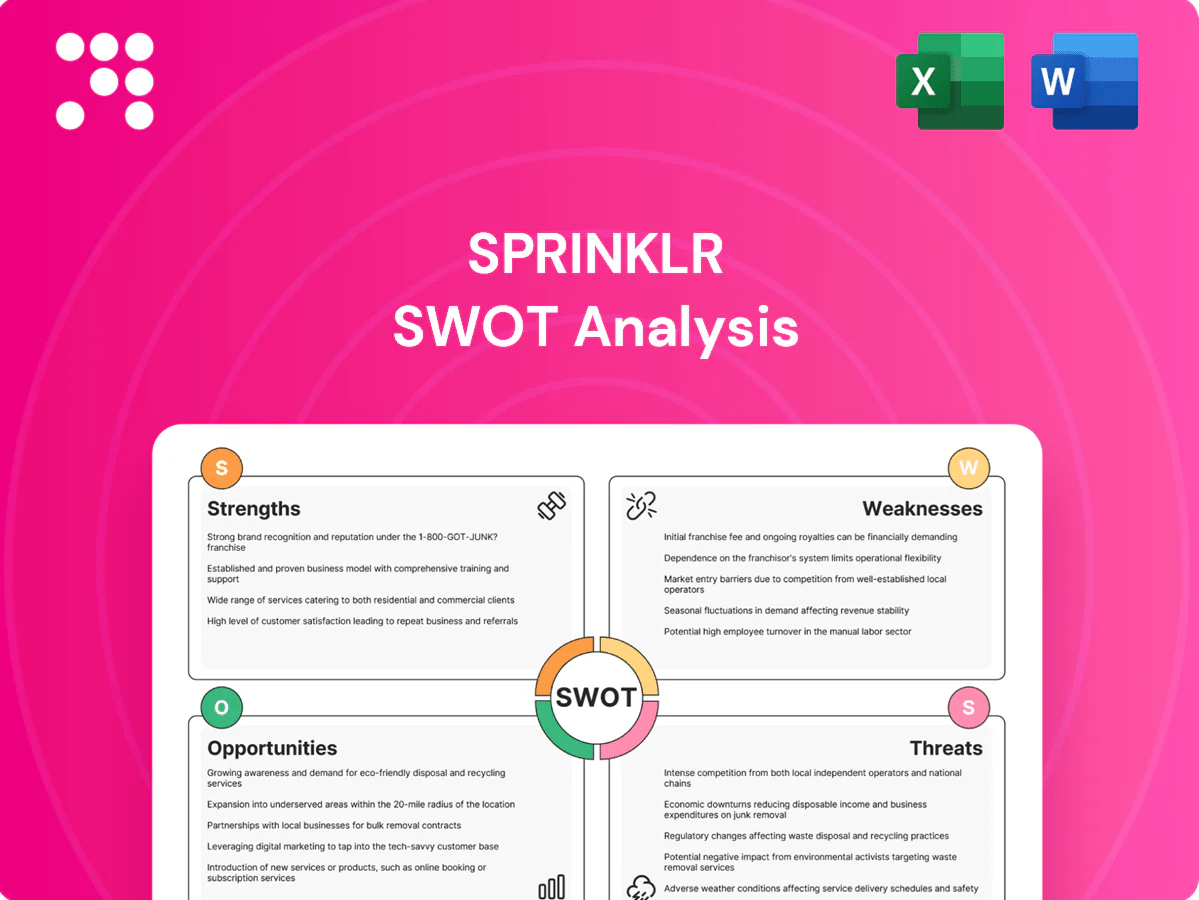
Sprinklr SWOT Analysis

Go Beyond the Preview—Access the Full Strategic Report
Sprinklr's SWOT highlights a strong AI-driven customer experience platform, rapid enterprise adoption, and recurring SaaS revenue, balanced by high competition and integration complexity. Our full SWOT unpacks market threats, growth levers, and actionable strategic moves. Discover detailed, editable insights to support investment or corporate planning—purchase the complete report today.
Strengths

Unified CXM platform
Sprinklr's unified CXM platform covers social, marketing, ads, research and service, reducing tool sprawl and data silos for enterprises that often run over 100 SaaS apps. Unified workflows improve consistency across touchpoints and centralized governance/permissions support compliance and brand safety for its 1,600+ global customers. Consolidation helps lower total cost of ownership for large enterprises.
Omnichannel data and insights
Deep listening across 30+ modern channels fuels real-time analytics and sentiment insights, enabling Sprinklr to process billions of customer interactions annually. Cross-channel data unifies profiles for personalization at scale, supporting enterprise CX programs across hundreds of global brands. AI-driven classification and routing improve response quality and can halve typical handling times, while executives gain holistic visibility into CX performance via unified dashboards.

AI-led automation
Native AI powers content generation, intent detection and case deflection across Sprinklr, while automation streamlines engagement, triage and service workflows. Predictive insights help prioritize high-impact interactions, improving response quality and reducing manual escalations. These efficiency gains support large enterprise volumes, handling millions of interactions monthly and serving thousands of enterprise brands.

Enterprise-grade scale
- Proven: 1,000+ global brands
- Throughput: billions of messages/month
- Compliance: SOC 2/enterprise SLAs
- Integrations: CRM, CDP, ads, service desks
- Global: multi-language, multi-team
End-to-end customer journey
End-to-end coverage from awareness to care enables closed-loop measurement and attribution, with Sprinklr supporting 30+ digital channels and operating as a unified system of record since its 2021 IPO. Teams collaborate on one platform to ensure consistent messaging and reduced departmental fragmentation, while service-layer insights directly inform marketing and product decisions.
- 30+ channels
- Single system of record
- Closed-loop measurement
- Service→marketing/product feedback
Unified CXM centralizes governance for 1,600+ customers and billions of interactions
Sprinklr's unified CXM reduces tool sprawl for 1,600+ enterprise customers, centralizing governance and lowering TCO. Deep listening across 30+ channels processes billions of interactions annually, enabling personalization and AI-driven routing that cuts handling time. Enterprise-grade scale (1,000+ global brands, SOC 2, multi-language) and broad integrations support global CX programs.
| Metric | Value |
|---|---|
| Customers | 1,600+ |
| Channels | 30+ |
| Global brands | 1,000+ |
| Interactions | Billions/year |
| Compliance | SOC 2, enterprise SLAs |
| Integrations | CRM, CDP, ads, service desks |
What is included in the product
 Detailed Word Document
Delivers a strategic overview of Sprinklr’s internal and external business factors, highlighting strengths, weaknesses, opportunities, and threats that shape its competitive position and growth prospects.

 Customizable Excel Spreadsheet
Provides a concise Sprinklr SWOT matrix to quickly surface and prioritize CX and social commerce pain points, enabling fast stakeholder alignment and actionable next steps.
Weaknesses

Complex implementation
Unified Sprinklr deployments are often multi-month and resource-intensive, straining IT and agency budgets despite the platform serving 1,000+ global brands; coordinating change across marketing, care, and insights teams complicates rollouts, deep configuration can overwhelm less mature organizations, and time-to-value typically lags simpler point solutions.
Premium pricing
Premium enterprise bundles can be costly versus niche tools, driving buyers to cheaper point solutions. Budget scrutiny in IT and marketing can slow deals, a challenge for Sprinklr (CXM, public since 2021). ROI often requires broad adoption across teams to justify the spend. Price sensitivity constrains mid-market penetration.

Learning curve
Sprinklr’s feature-rich modules require substantial training and enablement, meaning power users extract disproportionate value while casual users often underutilize capabilities. Complex governance and role setups add administrative overhead and slow rollouts. Variance in adoption across teams can create uneven outcomes and dilute expected ROI.

Dependence on third-party APIs
Dependence on third-party APIs means Sprinklr’s access and functionality are directly tied to social and messaging platform policies, with API rate limits and contract changes capable of degrading key features and SLAs. Data access restrictions reduce analytics depth and may undermine historical insights. Roadmap execution faces material risk from sudden external ecosystem shifts.
- Platform policy risk
- API rate-limit impact
- Reduced analytics scope
- Roadmap vulnerability
Crowded competitive field
Overlap with CRM, MAP, CCaaS and social suites creates buyer confusion as Sprinklr is compared directly to incumbents like Salesforce, Adobe, Microsoft and niche players such as Zendesk, making RFPs favor vendors with established integration footprints. Incumbents’ platform entrenchment means many procurement decisions hinge on existing integrations rather than best-of-breed capabilities, forcing Sprinklr to sustain rapid product innovation to maintain differentiation.
- Integration-driven RFPs
- Direct comparison with enterprise giants
- Overlap across CRM/MAP/CCaaS/social
- Requires continuous innovation
Enterprise CX platforms: long deployments, high cost, steep training, API integration risks
Sprinklr deployments are multi-month and resource-intensive, straining IT/agency budgets despite serving 1,000+ global brands; high bundle pricing limits mid-market traction. Complex feature sets demand heavy training, creating uneven adoption and reliant power users. Dependence on third-party APIs and incumbent integrations (Salesforce, Adobe, Microsoft) exposes roadmap and SLA risk.
| Metric | Value |
|---|---|
| Customers | 1,000+ |
| IPO | 2021 |
| Deployment | Multi-month |
Preview Before You Purchase
Sprinklr SWOT Analysis
This is the actual SWOT analysis document you’ll receive upon purchase—no surprises, just professional quality. The preview below is taken directly from the full SWOT report you'll get, and the complete, editable version is unlocked after checkout. Purchase to download the full, detailed file instantly.

Go Beyond the Preview—Access the Full Strategic Report
Sprinklr's SWOT highlights a strong AI-driven customer experience platform, rapid enterprise adoption, and recurring SaaS revenue, balanced by high competition and integration complexity. Our full SWOT unpacks market threats, growth levers, and actionable strategic moves. Discover detailed, editable insights to support investment or corporate planning—purchase the complete report today.
Strengths
Unified CXM platform
Sprinklr's unified CXM platform covers social, marketing, ads, research and service, reducing tool sprawl and data silos for enterprises that often run over 100 SaaS apps. Unified workflows improve consistency across touchpoints and centralized governance/permissions support compliance and brand safety for its 1,600+ global customers. Consolidation helps lower total cost of ownership for large enterprises.
Omnichannel data and insights
Deep listening across 30+ modern channels fuels real-time analytics and sentiment insights, enabling Sprinklr to process billions of customer interactions annually. Cross-channel data unifies profiles for personalization at scale, supporting enterprise CX programs across hundreds of global brands. AI-driven classification and routing improve response quality and can halve typical handling times, while executives gain holistic visibility into CX performance via unified dashboards.
AI-led automation
Native AI powers content generation, intent detection and case deflection across Sprinklr, while automation streamlines engagement, triage and service workflows. Predictive insights help prioritize high-impact interactions, improving response quality and reducing manual escalations. These efficiency gains support large enterprise volumes, handling millions of interactions monthly and serving thousands of enterprise brands.
Enterprise-grade scale
- Proven: 1,000+ global brands
- Throughput: billions of messages/month
- Compliance: SOC 2/enterprise SLAs
- Integrations: CRM, CDP, ads, service desks
- Global: multi-language, multi-team
End-to-end customer journey
End-to-end coverage from awareness to care enables closed-loop measurement and attribution, with Sprinklr supporting 30+ digital channels and operating as a unified system of record since its 2021 IPO. Teams collaborate on one platform to ensure consistent messaging and reduced departmental fragmentation, while service-layer insights directly inform marketing and product decisions.
- 30+ channels
- Single system of record
- Closed-loop measurement
- Service→marketing/product feedback
Unified CXM centralizes governance for 1,600+ customers and billions of interactions
Sprinklr's unified CXM reduces tool sprawl for 1,600+ enterprise customers, centralizing governance and lowering TCO. Deep listening across 30+ channels processes billions of interactions annually, enabling personalization and AI-driven routing that cuts handling time. Enterprise-grade scale (1,000+ global brands, SOC 2, multi-language) and broad integrations support global CX programs.
| Metric | Value |
|---|---|
| Customers | 1,600+ |
| Channels | 30+ |
| Global brands | 1,000+ |
| Interactions | Billions/year |
| Compliance | SOC 2, enterprise SLAs |
| Integrations | CRM, CDP, ads, service desks |
What is included in the product
Detailed Word Document
Delivers a strategic overview of Sprinklr’s internal and external business factors, highlighting strengths, weaknesses, opportunities, and threats that shape its competitive position and growth prospects.
Customizable Excel Spreadsheet
Provides a concise Sprinklr SWOT matrix to quickly surface and prioritize CX and social commerce pain points, enabling fast stakeholder alignment and actionable next steps.
Weaknesses
Complex implementation
Unified Sprinklr deployments are often multi-month and resource-intensive, straining IT and agency budgets despite the platform serving 1,000+ global brands; coordinating change across marketing, care, and insights teams complicates rollouts, deep configuration can overwhelm less mature organizations, and time-to-value typically lags simpler point solutions.
Premium pricing
Premium enterprise bundles can be costly versus niche tools, driving buyers to cheaper point solutions. Budget scrutiny in IT and marketing can slow deals, a challenge for Sprinklr (CXM, public since 2021). ROI often requires broad adoption across teams to justify the spend. Price sensitivity constrains mid-market penetration.
Learning curve
Sprinklr’s feature-rich modules require substantial training and enablement, meaning power users extract disproportionate value while casual users often underutilize capabilities. Complex governance and role setups add administrative overhead and slow rollouts. Variance in adoption across teams can create uneven outcomes and dilute expected ROI.
Dependence on third-party APIs
Dependence on third-party APIs means Sprinklr’s access and functionality are directly tied to social and messaging platform policies, with API rate limits and contract changes capable of degrading key features and SLAs. Data access restrictions reduce analytics depth and may undermine historical insights. Roadmap execution faces material risk from sudden external ecosystem shifts.
- Platform policy risk
- API rate-limit impact
- Reduced analytics scope
- Roadmap vulnerability
Crowded competitive field
Overlap with CRM, MAP, CCaaS and social suites creates buyer confusion as Sprinklr is compared directly to incumbents like Salesforce, Adobe, Microsoft and niche players such as Zendesk, making RFPs favor vendors with established integration footprints. Incumbents’ platform entrenchment means many procurement decisions hinge on existing integrations rather than best-of-breed capabilities, forcing Sprinklr to sustain rapid product innovation to maintain differentiation.
- Integration-driven RFPs
- Direct comparison with enterprise giants
- Overlap across CRM/MAP/CCaaS/social
- Requires continuous innovation
Enterprise CX platforms: long deployments, high cost, steep training, API integration risks
Sprinklr deployments are multi-month and resource-intensive, straining IT/agency budgets despite serving 1,000+ global brands; high bundle pricing limits mid-market traction. Complex feature sets demand heavy training, creating uneven adoption and reliant power users. Dependence on third-party APIs and incumbent integrations (Salesforce, Adobe, Microsoft) exposes roadmap and SLA risk.
| Metric | Value |
|---|---|
| Customers | 1,000+ |
| IPO | 2021 |
| Deployment | Multi-month |
Preview Before You Purchase
Sprinklr SWOT Analysis
This is the actual SWOT analysis document you’ll receive upon purchase—no surprises, just professional quality. The preview below is taken directly from the full SWOT report you'll get, and the complete, editable version is unlocked after checkout. Purchase to download the full, detailed file instantly.
Original: $10.00
-65%$10.00
$3.50Description
Go Beyond the Preview—Access the Full Strategic Report
Sprinklr's SWOT highlights a strong AI-driven customer experience platform, rapid enterprise adoption, and recurring SaaS revenue, balanced by high competition and integration complexity. Our full SWOT unpacks market threats, growth levers, and actionable strategic moves. Discover detailed, editable insights to support investment or corporate planning—purchase the complete report today.
Strengths
Unified CXM platform
Sprinklr's unified CXM platform covers social, marketing, ads, research and service, reducing tool sprawl and data silos for enterprises that often run over 100 SaaS apps. Unified workflows improve consistency across touchpoints and centralized governance/permissions support compliance and brand safety for its 1,600+ global customers. Consolidation helps lower total cost of ownership for large enterprises.
Omnichannel data and insights
Deep listening across 30+ modern channels fuels real-time analytics and sentiment insights, enabling Sprinklr to process billions of customer interactions annually. Cross-channel data unifies profiles for personalization at scale, supporting enterprise CX programs across hundreds of global brands. AI-driven classification and routing improve response quality and can halve typical handling times, while executives gain holistic visibility into CX performance via unified dashboards.
AI-led automation
Native AI powers content generation, intent detection and case deflection across Sprinklr, while automation streamlines engagement, triage and service workflows. Predictive insights help prioritize high-impact interactions, improving response quality and reducing manual escalations. These efficiency gains support large enterprise volumes, handling millions of interactions monthly and serving thousands of enterprise brands.
Enterprise-grade scale
- Proven: 1,000+ global brands
- Throughput: billions of messages/month
- Compliance: SOC 2/enterprise SLAs
- Integrations: CRM, CDP, ads, service desks
- Global: multi-language, multi-team
End-to-end customer journey
End-to-end coverage from awareness to care enables closed-loop measurement and attribution, with Sprinklr supporting 30+ digital channels and operating as a unified system of record since its 2021 IPO. Teams collaborate on one platform to ensure consistent messaging and reduced departmental fragmentation, while service-layer insights directly inform marketing and product decisions.
- 30+ channels
- Single system of record
- Closed-loop measurement
- Service→marketing/product feedback
Unified CXM centralizes governance for 1,600+ customers and billions of interactions
Sprinklr's unified CXM reduces tool sprawl for 1,600+ enterprise customers, centralizing governance and lowering TCO. Deep listening across 30+ channels processes billions of interactions annually, enabling personalization and AI-driven routing that cuts handling time. Enterprise-grade scale (1,000+ global brands, SOC 2, multi-language) and broad integrations support global CX programs.
| Metric | Value |
|---|---|
| Customers | 1,600+ |
| Channels | 30+ |
| Global brands | 1,000+ |
| Interactions | Billions/year |
| Compliance | SOC 2, enterprise SLAs |
| Integrations | CRM, CDP, ads, service desks |
What is included in the product
Detailed Word Document
Delivers a strategic overview of Sprinklr’s internal and external business factors, highlighting strengths, weaknesses, opportunities, and threats that shape its competitive position and growth prospects.
Customizable Excel Spreadsheet
Provides a concise Sprinklr SWOT matrix to quickly surface and prioritize CX and social commerce pain points, enabling fast stakeholder alignment and actionable next steps.
Weaknesses
Complex implementation
Unified Sprinklr deployments are often multi-month and resource-intensive, straining IT and agency budgets despite the platform serving 1,000+ global brands; coordinating change across marketing, care, and insights teams complicates rollouts, deep configuration can overwhelm less mature organizations, and time-to-value typically lags simpler point solutions.
Premium pricing
Premium enterprise bundles can be costly versus niche tools, driving buyers to cheaper point solutions. Budget scrutiny in IT and marketing can slow deals, a challenge for Sprinklr (CXM, public since 2021). ROI often requires broad adoption across teams to justify the spend. Price sensitivity constrains mid-market penetration.
Learning curve
Sprinklr’s feature-rich modules require substantial training and enablement, meaning power users extract disproportionate value while casual users often underutilize capabilities. Complex governance and role setups add administrative overhead and slow rollouts. Variance in adoption across teams can create uneven outcomes and dilute expected ROI.
Dependence on third-party APIs
Dependence on third-party APIs means Sprinklr’s access and functionality are directly tied to social and messaging platform policies, with API rate limits and contract changes capable of degrading key features and SLAs. Data access restrictions reduce analytics depth and may undermine historical insights. Roadmap execution faces material risk from sudden external ecosystem shifts.
- Platform policy risk
- API rate-limit impact
- Reduced analytics scope
- Roadmap vulnerability
Crowded competitive field
Overlap with CRM, MAP, CCaaS and social suites creates buyer confusion as Sprinklr is compared directly to incumbents like Salesforce, Adobe, Microsoft and niche players such as Zendesk, making RFPs favor vendors with established integration footprints. Incumbents’ platform entrenchment means many procurement decisions hinge on existing integrations rather than best-of-breed capabilities, forcing Sprinklr to sustain rapid product innovation to maintain differentiation.
- Integration-driven RFPs
- Direct comparison with enterprise giants
- Overlap across CRM/MAP/CCaaS/social
- Requires continuous innovation
Enterprise CX platforms: long deployments, high cost, steep training, API integration risks
Sprinklr deployments are multi-month and resource-intensive, straining IT/agency budgets despite serving 1,000+ global brands; high bundle pricing limits mid-market traction. Complex feature sets demand heavy training, creating uneven adoption and reliant power users. Dependence on third-party APIs and incumbent integrations (Salesforce, Adobe, Microsoft) exposes roadmap and SLA risk.
| Metric | Value |
|---|---|
| Customers | 1,000+ |
| IPO | 2021 |
| Deployment | Multi-month |
Preview Before You Purchase
Sprinklr SWOT Analysis
This is the actual SWOT analysis document you’ll receive upon purchase—no surprises, just professional quality. The preview below is taken directly from the full SWOT report you'll get, and the complete, editable version is unlocked after checkout. Purchase to download the full, detailed file instantly.











