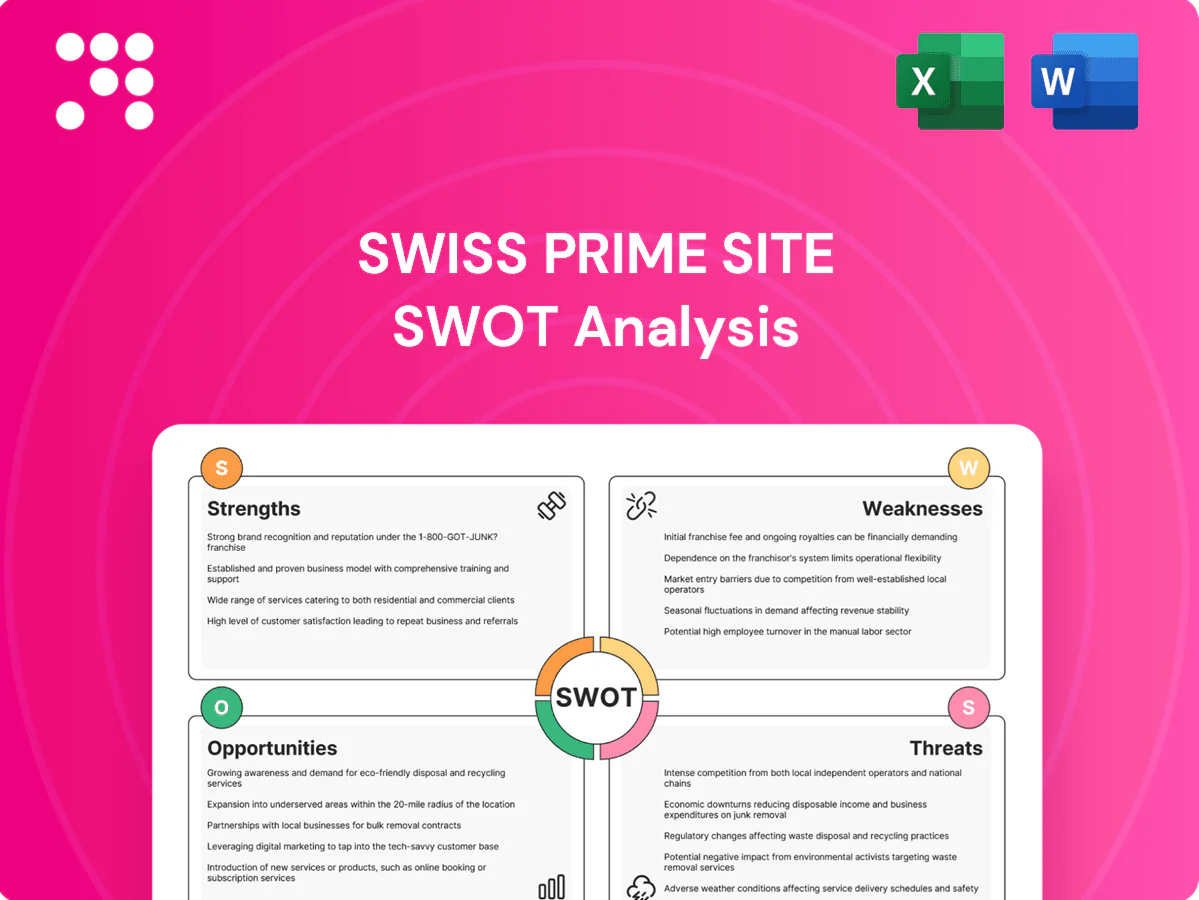
Swiss Prime Site SWOT Analysis

Your Strategic Toolkit Starts Here
Swiss Prime Site’s robust portfolio and steady rental income underpin its market leadership, but exposure to Swiss real estate cycles and interest-rate sensitivity pose tangible risks. Our full SWOT unpacks strategic growth drivers, operational challenges, and investor implications in actionable detail. Purchase the complete Word+Excel report to customize, present, and plan with confidence.
Strengths

Prime Swiss commercial portfolio
Concentrated holdings in Zurich, Geneva and Lausanne sustain resilient occupancy and pricing power, with assets clustered in transit-proximate micro-locations that drive high footfall and stable tenant demand. Low structural vacancy in these core markets preserves cash flows and supports predictable rent reversion. Scarcity of developable land in Switzerland’s prime urban cores further protects asset values and enhances downside protection across cycles.
Integrated real estate value chain
Integrated value chain spans acquisition, development, asset and property management and sales, giving Swiss Prime Site end-to-end control and faster project delivery. Vertical integration drives cost discipline and a more consistent tenant experience. Operational data feedback loops inform development choices and capital allocation, reducing leakage to third parties and improving return on invested capital.

Sustainability and redevelopment expertise
Swiss Prime Site’s track record in sustainable construction and retrofits boosts asset liquidity and tenant appeal; Swiss buildings account for about 30% of national CO2 emissions, so efficiency upgrades meet strong demand. Energy-efficient measures lower operating costs and align with ESG-driven tenants, while green credentials expand access to sustainability-linked financing. This can support valuation premiums and readiness for tightening regulation.

Defensive diversification via Tertianum
Exposure to Tertianum brings needs-based, less cyclical revenue from assisted living and care, shielding Swiss Prime Site from pure office/retail swings.
Swiss Federal Statistical Office: roughly 20% of Swiss residents were 65+ in 2023, projected to near 27% by 2050, underpinning occupancy and pricing power.
Operational care expertise deepens SPS moat versus landlords focused solely on leasing.
- Needs-based revenue
- Demographic tailwinds: 20%→27% (2023→2050, FSO)
- Operational moat
- Risk diversification
Strong tenant relationships and long leases
Institutional-grade tenants on multi-year contracts underpin predictable income for Swiss Prime Site, with reported portfolio occupancy above 90% in 2024 and a weighted average lease term supporting revenue visibility. Built-to-suit spaces and high-spec fit-outs increase switching costs, while active asset management and tenant engagement have kept retention high and reduced vacancy downtime. This stability underpins steady cash flow and supports conservative leverage and financing metrics reported through 2024.
- Institutional tenants: long-term contracts, high visibility (2024)
- High-spec fit-outs: increased switching costs
- Active asset management: high retention, low downtime
- Financial effect: stabilized cash flow, supports conservative leverage (2024)
Swiss prime cities: >90% occupancy, 65+ rising to 27%
Concentrated prime-city portfolio (Zurich, Geneva, Lausanne) sustains >90% occupancy (2024) and pricing power; vertical integration (acquisition→management→sales) accelerates delivery and cost control. Sustainability leadership and retrofits target Swiss building emissions and unlock green financing; Tertianum exposure supplies needs-based revenue amid demographic tailwinds (65+: 20% in 2023 → 27% by 2050, FSO).
| Metric | Value/Source |
|---|---|
| Portfolio occupancy (2024) | >90% (reported) |
| 65+ population | 20% (2023) → 27% (2050), FSO |
| Vertical integration | End-to-end ops |
What is included in the product
 Detailed Word Document
Provides a concise SWOT overview of Swiss Prime Site, outlining internal strengths and weaknesses and external opportunities and threats to assess its competitive position, growth drivers, operational gaps, and strategic risks.

 Customizable Excel Spreadsheet
Provides a concise, visual SWOT matrix for Swiss Prime Site to align strategic priorities quickly and reduce stakeholder friction. Editable format enables fast updates to reflect market shifts and streamline executive decision-making.
Weaknesses

Geographic concentration in Switzerland
Swiss Prime Site derives over 90% of its rental income and property assets from Switzerland, tying revenues and NAV closely to one national economy. Local regulatory shifts, such as tax or zoning changes, or economic shocks can therefore have outsized effects on profit and valuation. Limited exposure to faster-growing international markets caps expansion and portfolio return diversification. Strategic and mandate constraints further restrict offshore allocation options.
Capital-intensive business model
Capital-intensive development and large-scale retrofits demand substantial upfront capital; Swiss Prime Site reported a portfolio value of about CHF 20.2bn in 2024, making rising construction and financing costs (which pushed Swiss building costs up materially in 2023–24) a direct pressure on project IRRs. Limited balance-sheet headroom raises dilution risk and can slow growth when credit tightens.

Exposure to office and retail cycles
Structural shifts to hybrid work and e-commerce are reducing demand in certain office and retail subsegments, increasing vacancy risk. Re-leasing risk and incentive costs tend to rise for non-prime assets, while capex to reposition properties toward mixed-use can be substantial. Recovery trajectories vary significantly across micro-locations, creating uneven returns within the portfolio.

Operational complexity with Tertianum
Operational complexity from Tertianum exposes Swiss Prime Site to regulatory and staffing challenges in healthcare and assisted living, raising margin sensitivity to labor availability and wage inflation; quality or compliance lapses would inflict reputational and financial harm, while integration requires significant management bandwidth across disparate businesses.
- Regulatory & staffing risk
- Margin sensitivity to wages
- Reputational risk from lapses
- High integration demand
Development and permitting risk
Development and permitting risk is material for Swiss Prime Site: entitlements in major Swiss cities often take over 12 months, creating uncertainty that can push holding costs and cause projects to miss favorable market windows. Community and environmental objections frequently force redesigns or added mitigation, increasing capex and delaying stabilisation. Pipeline visibility can swing with cantonal political shifts and planning cycles, affecting timing and valuation.
- permit-duration: >12 months in major cantons
- cost-impact: higher holding costs from delays
- redesign-risk: community/environment objections
- visibility: dependent on political/planning cycles
Concentrated Swiss exposure (>90%) ties CHF 20.2bn NAV to cost, financing and permitting risks
Concentrated Swiss exposure (>90% of rents/assets) ties NAV and cashflows to one economy, limiting geographic diversification. Portfolio value was about CHF 20.2bn in 2024, so rising construction and financing costs compress IRRs and heighten dilution risk. Development/permitting in major cantons often exceeds 12 months, increasing holding costs and timing uncertainty.
| Metric | Value |
|---|---|
| Swiss exposure | >90% |
| Portfolio value (2024) | CHF 20.2bn |
| Permit duration (major cantons) | >12 months |
Same Document Delivered
Swiss Prime Site SWOT Analysis
This is the actual Swiss Prime Site SWOT analysis document you’ll receive upon purchase—no surprises, just professional quality. The preview below is taken directly from the full report and reflects its structure and depth. Buy now to unlock the complete, editable file with full strengths, weaknesses, opportunities and threats.

Your Strategic Toolkit Starts Here
Swiss Prime Site’s robust portfolio and steady rental income underpin its market leadership, but exposure to Swiss real estate cycles and interest-rate sensitivity pose tangible risks. Our full SWOT unpacks strategic growth drivers, operational challenges, and investor implications in actionable detail. Purchase the complete Word+Excel report to customize, present, and plan with confidence.
Strengths
Prime Swiss commercial portfolio
Concentrated holdings in Zurich, Geneva and Lausanne sustain resilient occupancy and pricing power, with assets clustered in transit-proximate micro-locations that drive high footfall and stable tenant demand. Low structural vacancy in these core markets preserves cash flows and supports predictable rent reversion. Scarcity of developable land in Switzerland’s prime urban cores further protects asset values and enhances downside protection across cycles.
Integrated real estate value chain
Integrated value chain spans acquisition, development, asset and property management and sales, giving Swiss Prime Site end-to-end control and faster project delivery. Vertical integration drives cost discipline and a more consistent tenant experience. Operational data feedback loops inform development choices and capital allocation, reducing leakage to third parties and improving return on invested capital.
Sustainability and redevelopment expertise
Swiss Prime Site’s track record in sustainable construction and retrofits boosts asset liquidity and tenant appeal; Swiss buildings account for about 30% of national CO2 emissions, so efficiency upgrades meet strong demand. Energy-efficient measures lower operating costs and align with ESG-driven tenants, while green credentials expand access to sustainability-linked financing. This can support valuation premiums and readiness for tightening regulation.
Defensive diversification via Tertianum
Exposure to Tertianum brings needs-based, less cyclical revenue from assisted living and care, shielding Swiss Prime Site from pure office/retail swings.
Swiss Federal Statistical Office: roughly 20% of Swiss residents were 65+ in 2023, projected to near 27% by 2050, underpinning occupancy and pricing power.
Operational care expertise deepens SPS moat versus landlords focused solely on leasing.
- Needs-based revenue
- Demographic tailwinds: 20%→27% (2023→2050, FSO)
- Operational moat
- Risk diversification
Strong tenant relationships and long leases
Institutional-grade tenants on multi-year contracts underpin predictable income for Swiss Prime Site, with reported portfolio occupancy above 90% in 2024 and a weighted average lease term supporting revenue visibility. Built-to-suit spaces and high-spec fit-outs increase switching costs, while active asset management and tenant engagement have kept retention high and reduced vacancy downtime. This stability underpins steady cash flow and supports conservative leverage and financing metrics reported through 2024.
- Institutional tenants: long-term contracts, high visibility (2024)
- High-spec fit-outs: increased switching costs
- Active asset management: high retention, low downtime
- Financial effect: stabilized cash flow, supports conservative leverage (2024)
Swiss prime cities: >90% occupancy, 65+ rising to 27%
Concentrated prime-city portfolio (Zurich, Geneva, Lausanne) sustains >90% occupancy (2024) and pricing power; vertical integration (acquisition→management→sales) accelerates delivery and cost control. Sustainability leadership and retrofits target Swiss building emissions and unlock green financing; Tertianum exposure supplies needs-based revenue amid demographic tailwinds (65+: 20% in 2023 → 27% by 2050, FSO).
| Metric | Value/Source |
|---|---|
| Portfolio occupancy (2024) | >90% (reported) |
| 65+ population | 20% (2023) → 27% (2050), FSO |
| Vertical integration | End-to-end ops |
What is included in the product
Detailed Word Document
Provides a concise SWOT overview of Swiss Prime Site, outlining internal strengths and weaknesses and external opportunities and threats to assess its competitive position, growth drivers, operational gaps, and strategic risks.
Customizable Excel Spreadsheet
Provides a concise, visual SWOT matrix for Swiss Prime Site to align strategic priorities quickly and reduce stakeholder friction. Editable format enables fast updates to reflect market shifts and streamline executive decision-making.
Weaknesses
Geographic concentration in Switzerland
Swiss Prime Site derives over 90% of its rental income and property assets from Switzerland, tying revenues and NAV closely to one national economy. Local regulatory shifts, such as tax or zoning changes, or economic shocks can therefore have outsized effects on profit and valuation. Limited exposure to faster-growing international markets caps expansion and portfolio return diversification. Strategic and mandate constraints further restrict offshore allocation options.
Capital-intensive business model
Capital-intensive development and large-scale retrofits demand substantial upfront capital; Swiss Prime Site reported a portfolio value of about CHF 20.2bn in 2024, making rising construction and financing costs (which pushed Swiss building costs up materially in 2023–24) a direct pressure on project IRRs. Limited balance-sheet headroom raises dilution risk and can slow growth when credit tightens.
Exposure to office and retail cycles
Structural shifts to hybrid work and e-commerce are reducing demand in certain office and retail subsegments, increasing vacancy risk. Re-leasing risk and incentive costs tend to rise for non-prime assets, while capex to reposition properties toward mixed-use can be substantial. Recovery trajectories vary significantly across micro-locations, creating uneven returns within the portfolio.
Operational complexity with Tertianum
Operational complexity from Tertianum exposes Swiss Prime Site to regulatory and staffing challenges in healthcare and assisted living, raising margin sensitivity to labor availability and wage inflation; quality or compliance lapses would inflict reputational and financial harm, while integration requires significant management bandwidth across disparate businesses.
- Regulatory & staffing risk
- Margin sensitivity to wages
- Reputational risk from lapses
- High integration demand
Development and permitting risk
Development and permitting risk is material for Swiss Prime Site: entitlements in major Swiss cities often take over 12 months, creating uncertainty that can push holding costs and cause projects to miss favorable market windows. Community and environmental objections frequently force redesigns or added mitigation, increasing capex and delaying stabilisation. Pipeline visibility can swing with cantonal political shifts and planning cycles, affecting timing and valuation.
- permit-duration: >12 months in major cantons
- cost-impact: higher holding costs from delays
- redesign-risk: community/environment objections
- visibility: dependent on political/planning cycles
Concentrated Swiss exposure (>90%) ties CHF 20.2bn NAV to cost, financing and permitting risks
Concentrated Swiss exposure (>90% of rents/assets) ties NAV and cashflows to one economy, limiting geographic diversification. Portfolio value was about CHF 20.2bn in 2024, so rising construction and financing costs compress IRRs and heighten dilution risk. Development/permitting in major cantons often exceeds 12 months, increasing holding costs and timing uncertainty.
| Metric | Value |
|---|---|
| Swiss exposure | >90% |
| Portfolio value (2024) | CHF 20.2bn |
| Permit duration (major cantons) | >12 months |
Same Document Delivered
Swiss Prime Site SWOT Analysis
This is the actual Swiss Prime Site SWOT analysis document you’ll receive upon purchase—no surprises, just professional quality. The preview below is taken directly from the full report and reflects its structure and depth. Buy now to unlock the complete, editable file with full strengths, weaknesses, opportunities and threats.
Original: $10.00
-65%$10.00
$3.50Description
Your Strategic Toolkit Starts Here
Swiss Prime Site’s robust portfolio and steady rental income underpin its market leadership, but exposure to Swiss real estate cycles and interest-rate sensitivity pose tangible risks. Our full SWOT unpacks strategic growth drivers, operational challenges, and investor implications in actionable detail. Purchase the complete Word+Excel report to customize, present, and plan with confidence.
Strengths
Prime Swiss commercial portfolio
Concentrated holdings in Zurich, Geneva and Lausanne sustain resilient occupancy and pricing power, with assets clustered in transit-proximate micro-locations that drive high footfall and stable tenant demand. Low structural vacancy in these core markets preserves cash flows and supports predictable rent reversion. Scarcity of developable land in Switzerland’s prime urban cores further protects asset values and enhances downside protection across cycles.
Integrated real estate value chain
Integrated value chain spans acquisition, development, asset and property management and sales, giving Swiss Prime Site end-to-end control and faster project delivery. Vertical integration drives cost discipline and a more consistent tenant experience. Operational data feedback loops inform development choices and capital allocation, reducing leakage to third parties and improving return on invested capital.
Sustainability and redevelopment expertise
Swiss Prime Site’s track record in sustainable construction and retrofits boosts asset liquidity and tenant appeal; Swiss buildings account for about 30% of national CO2 emissions, so efficiency upgrades meet strong demand. Energy-efficient measures lower operating costs and align with ESG-driven tenants, while green credentials expand access to sustainability-linked financing. This can support valuation premiums and readiness for tightening regulation.
Defensive diversification via Tertianum
Exposure to Tertianum brings needs-based, less cyclical revenue from assisted living and care, shielding Swiss Prime Site from pure office/retail swings.
Swiss Federal Statistical Office: roughly 20% of Swiss residents were 65+ in 2023, projected to near 27% by 2050, underpinning occupancy and pricing power.
Operational care expertise deepens SPS moat versus landlords focused solely on leasing.
- Needs-based revenue
- Demographic tailwinds: 20%→27% (2023→2050, FSO)
- Operational moat
- Risk diversification
Strong tenant relationships and long leases
Institutional-grade tenants on multi-year contracts underpin predictable income for Swiss Prime Site, with reported portfolio occupancy above 90% in 2024 and a weighted average lease term supporting revenue visibility. Built-to-suit spaces and high-spec fit-outs increase switching costs, while active asset management and tenant engagement have kept retention high and reduced vacancy downtime. This stability underpins steady cash flow and supports conservative leverage and financing metrics reported through 2024.
- Institutional tenants: long-term contracts, high visibility (2024)
- High-spec fit-outs: increased switching costs
- Active asset management: high retention, low downtime
- Financial effect: stabilized cash flow, supports conservative leverage (2024)
Swiss prime cities: >90% occupancy, 65+ rising to 27%
Concentrated prime-city portfolio (Zurich, Geneva, Lausanne) sustains >90% occupancy (2024) and pricing power; vertical integration (acquisition→management→sales) accelerates delivery and cost control. Sustainability leadership and retrofits target Swiss building emissions and unlock green financing; Tertianum exposure supplies needs-based revenue amid demographic tailwinds (65+: 20% in 2023 → 27% by 2050, FSO).
| Metric | Value/Source |
|---|---|
| Portfolio occupancy (2024) | >90% (reported) |
| 65+ population | 20% (2023) → 27% (2050), FSO |
| Vertical integration | End-to-end ops |
What is included in the product
Detailed Word Document
Provides a concise SWOT overview of Swiss Prime Site, outlining internal strengths and weaknesses and external opportunities and threats to assess its competitive position, growth drivers, operational gaps, and strategic risks.
Customizable Excel Spreadsheet
Provides a concise, visual SWOT matrix for Swiss Prime Site to align strategic priorities quickly and reduce stakeholder friction. Editable format enables fast updates to reflect market shifts and streamline executive decision-making.
Weaknesses
Geographic concentration in Switzerland
Swiss Prime Site derives over 90% of its rental income and property assets from Switzerland, tying revenues and NAV closely to one national economy. Local regulatory shifts, such as tax or zoning changes, or economic shocks can therefore have outsized effects on profit and valuation. Limited exposure to faster-growing international markets caps expansion and portfolio return diversification. Strategic and mandate constraints further restrict offshore allocation options.
Capital-intensive business model
Capital-intensive development and large-scale retrofits demand substantial upfront capital; Swiss Prime Site reported a portfolio value of about CHF 20.2bn in 2024, making rising construction and financing costs (which pushed Swiss building costs up materially in 2023–24) a direct pressure on project IRRs. Limited balance-sheet headroom raises dilution risk and can slow growth when credit tightens.
Exposure to office and retail cycles
Structural shifts to hybrid work and e-commerce are reducing demand in certain office and retail subsegments, increasing vacancy risk. Re-leasing risk and incentive costs tend to rise for non-prime assets, while capex to reposition properties toward mixed-use can be substantial. Recovery trajectories vary significantly across micro-locations, creating uneven returns within the portfolio.
Operational complexity with Tertianum
Operational complexity from Tertianum exposes Swiss Prime Site to regulatory and staffing challenges in healthcare and assisted living, raising margin sensitivity to labor availability and wage inflation; quality or compliance lapses would inflict reputational and financial harm, while integration requires significant management bandwidth across disparate businesses.
- Regulatory & staffing risk
- Margin sensitivity to wages
- Reputational risk from lapses
- High integration demand
Development and permitting risk
Development and permitting risk is material for Swiss Prime Site: entitlements in major Swiss cities often take over 12 months, creating uncertainty that can push holding costs and cause projects to miss favorable market windows. Community and environmental objections frequently force redesigns or added mitigation, increasing capex and delaying stabilisation. Pipeline visibility can swing with cantonal political shifts and planning cycles, affecting timing and valuation.
- permit-duration: >12 months in major cantons
- cost-impact: higher holding costs from delays
- redesign-risk: community/environment objections
- visibility: dependent on political/planning cycles
Concentrated Swiss exposure (>90%) ties CHF 20.2bn NAV to cost, financing and permitting risks
Concentrated Swiss exposure (>90% of rents/assets) ties NAV and cashflows to one economy, limiting geographic diversification. Portfolio value was about CHF 20.2bn in 2024, so rising construction and financing costs compress IRRs and heighten dilution risk. Development/permitting in major cantons often exceeds 12 months, increasing holding costs and timing uncertainty.
| Metric | Value |
|---|---|
| Swiss exposure | >90% |
| Portfolio value (2024) | CHF 20.2bn |
| Permit duration (major cantons) | >12 months |
Same Document Delivered
Swiss Prime Site SWOT Analysis
This is the actual Swiss Prime Site SWOT analysis document you’ll receive upon purchase—no surprises, just professional quality. The preview below is taken directly from the full report and reflects its structure and depth. Buy now to unlock the complete, editable file with full strengths, weaknesses, opportunities and threats.











