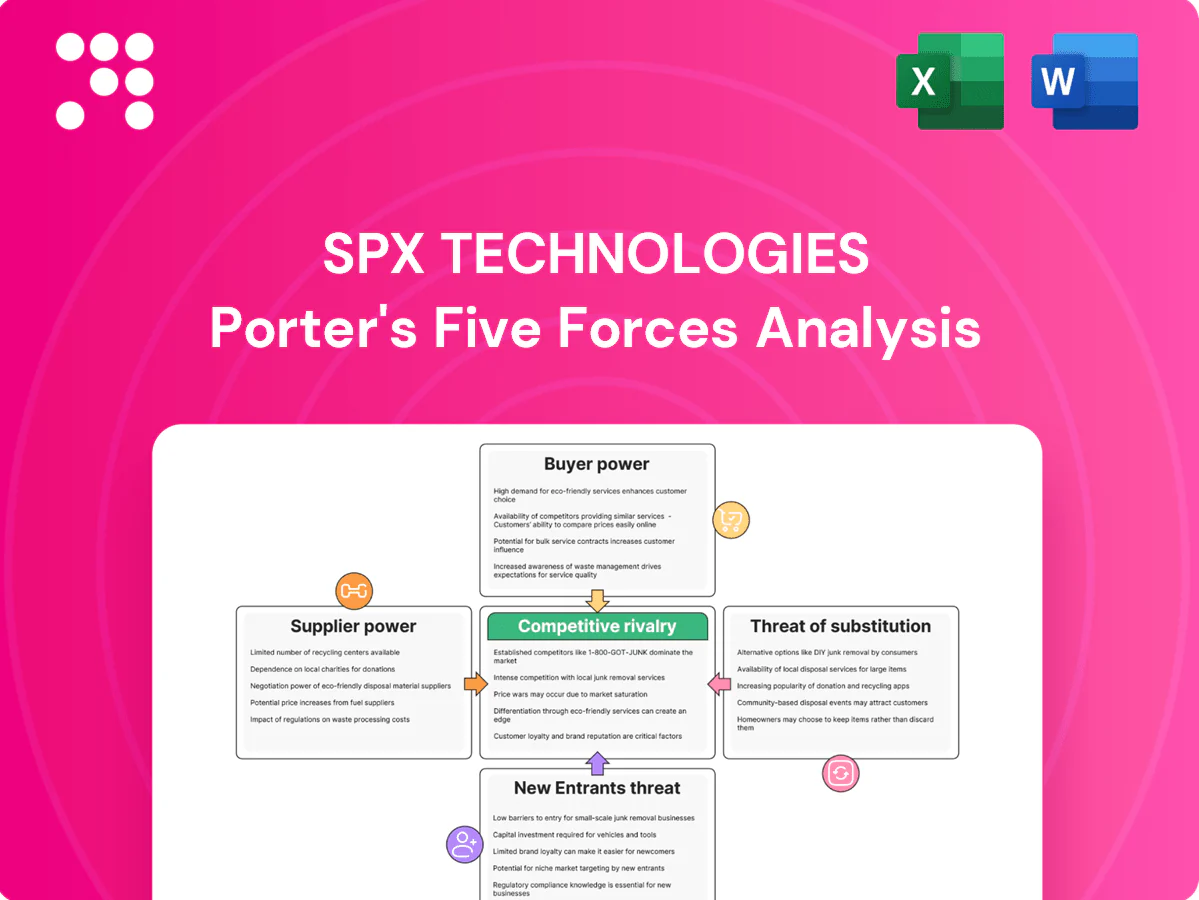
SPX Technologies Porter's Five Forces Analysis

A Must-Have Tool for Decision-Makers
SPX Technologies faces moderate competitive intensity driven by consolidation, specialized suppliers, and evolving substitute technologies that pressure margins and innovation cycles. This brief snapshot only scratches the surface—unlock the full Porter’s Five Forces Analysis to explore force-by-force ratings and market pressures in depth. Get consultant-grade visuals and actionable insights to inform investment or strategy decisions.
Suppliers Bargaining Power

Specialized component concentration
SPX relies on highly engineered components—sensors, compressors, heat exchangers, electronics—sourced from a limited set of qualified suppliers, concentrating supplier power. Supplier concentration raises switching costs through extensive validation, reliability testing, and certification, increasing procurement lead times. Niche suppliers can thus exert pricing and delivery leverage over SPX, and while dual-sourcing can mitigate risk, it is often infeasible for bespoke parts.
Raw material and logistics volatility
Steel, copper, rare earths and semiconductors expose SPX to commodity and supply-chain shocks: 2024 saw elevated copper and rare-earth price volatility and semiconductor supply tightness in specialty nodes, while freight capacity constraints kept lead times elevated and spot ocean rates well above pre‑pandemic norms. Suppliers frequently passed cost rises through to OEMs, compressing margins. Hedging and design value engineering can mitigate but not eliminate this exposure.

Certification and quality lock-in
Inputs for SPX HVAC and safety detection must meet UL, ISO and industry-specific standards, creating high certification barriers. Requalifying an alternative supplier often takes 6–18 months and can cost $50k–$500k, strengthening incumbent power. Rigorous traceability and documentation needs further restrict substitution, especially in safety-critical detection where recalls and failures can exceed $2M in direct costs.

Technological co-development
Technological co-development of co-engineered sensors, firmware, and controls deepens supplier interdependence, linking SPX product roadmaps to partner IP and creating tacit switching barriers that raise integration costs and time-to-replace.
Suppliers contributing IP may demand preferred commercial terms; SPX can mitigate leverage by modular designs and owning core IP to protect margins while aligning roadmaps—industrial automation market ~170B in 2024.
- Co-engineered sensors: increases interdependence
- Roadmap alignment: improves performance, creates switching barriers
- Supplier IP: can demand preferred terms
- SPX defenses: modular design, own core IP
Global footprint and regional dependencies
Localized sourcing for lead-time and tariff reasons increases regional supplier power for SPX, especially where few qualified vendors exist and bargaining leverage tilts to suppliers; currency fluctuations add negotiation complexity and cost volatility. Diversifying suppliers across regions reduces concentration risk and mitigates regional disruptions.
- Regional supplier concentration raises leverage
- Tariffs and lead-times favor local vendors
- Currency swings complicate contracts
- Diversification lowers supplier risk
Requalification barriers: 6–18 months, $50k–$500k
SPX faces concentrated, specialized suppliers that raise switching costs via 6–18 month requalification and $50k–$500k validation expenses, giving suppliers pricing and delivery leverage. 2024 saw sustained semiconductor node tightness and commodity volatility; OEMs bore margin pressure as suppliers passed through costs. SPX offsets risk with modular design, IP ownership and regional diversification.
| Metric | 2024 Value |
|---|---|
| Requalification time | 6–18 months |
| Requalification cost | $50k–$500k |
| Industrial automation market | $170B |
What is included in the product
 Detailed Word Document
Tailored Porter's Five Forces for SPX Technologies revealing competitive intensity, buyer and supplier bargaining power, entry barriers and substitute threats, and highlighting disruptive forces shaping pricing and profitability.

 Customizable Excel Spreadsheet
A concise one-sheet Porter's Five Forces for SPX Technologies—instantly reveals competitive pressures and strategic relief levers, ready to drop into pitch decks or boardroom slides.
Customers Bargaining Power

Large OEMs and contractors
SPX sells into OEMs, EPCs and large contractors that drive scale and negotiate aggressively, often extracting price concessions in the order of 5–15% and extended warranties; consolidated buyers can also demand customization. Performance and reliability of SPX equipment reduce pure price sensitivity, supporting margins despite pressure. Multi-year frame agreements now cover roughly 25–35% of bookings, stabilizing terms and cash flow.
Project-based competitive bidding
Project-based competitive bidding drives high price transparency in HVAC and industrial detection sales, with over 50% of commercial projects in 2024 reportedly procured via competitive bids, strengthening buyer leverage. Buyers routinely pit vendors against each other, compressing margins on commoditized offerings. Strong specification advantages and unique detection features can preserve premium pricing. Pre-specification wins reduce direct comparability and dampen buyer bargaining power.

Switching costs and installed base
Integration with building systems and safety protocols creates high switching friction for SPX Technologies buyers; the global building automation market exceeded $80 billion in 2024 and typical system lifecycles span 10–15 years, locking in installed bases. Training, spares and certification alignments favor incumbents and reduce buyer power in mission-critical applications. Service responsiveness further anchors customer loyalty.

Aftermarket and service leverage
Aftermarket recurring maintenance, calibration, and parts give SPX pricing resilience as buyers prioritize uptime and regulatory compliance, reducing price sensitivity for lifecycle services. Bundled service contracts offset hardware discounting, while predictive service offerings increase customer stickiness and lower buyer power.
- Recurring maintenance
- Uptime/compliance value
- Bundled contracts
- Predictive stickiness
Public sector and standards-driven buyers
Utilities, municipalities and regulated buyers procure under strict specs and public procurement rules, with OECD public procurement ≈12% of GDP in 2024; processes emphasize price but compliance criteria typically cut the eligible vendor pool by >50%, easing long‑term value considerations that moderate upfront price pressure. Proven compliance records (certifications, past performance) materially reduce buyer bargaining strength.
- Spec-driven procurement narrows suppliers
- OECD public procurement ≈12% GDP (2024)
- Lifetime value offsets upfront price focus
- Compliance reduces buyer leverage
Competitive bidding (>50%) raises buyer leverage; frame agreements secure 25–35% bookings
SPX sells to OEMs/EPCs/contractors that extract 5–15% concessions; multi‑year frame agreements cover 25–35% of bookings (2024). Competitive bidding (>50% of commercial projects in 2024) boosts buyer leverage, though spec advantages preserve premiums. Aftermarket services, 10–15 year lifecycles and OECD public procurement ≈12% GDP (2024) reduce long‑term buyer power.
| Metric | 2024 value |
|---|---|
| Price concessions | 5–15% |
| Frame agreements | 25–35% bookings |
| Competitive bids | >50% projects |
| Building automation market | >$80B |
| OECD public procurement | ≈12% GDP |
| System lifecycle | 10–15 yrs |
Preview the Actual Deliverable
SPX Technologies Porter's Five Forces Analysis
This preview shows the exact SPX Technologies Porter’s Five Forces analysis you’ll receive—no placeholders or samples. The document displayed is fully formatted, professionally written, and ready for immediate download after purchase. You’re viewing the final deliverable, identical to the file delivered upon payment.

A Must-Have Tool for Decision-Makers
SPX Technologies faces moderate competitive intensity driven by consolidation, specialized suppliers, and evolving substitute technologies that pressure margins and innovation cycles. This brief snapshot only scratches the surface—unlock the full Porter’s Five Forces Analysis to explore force-by-force ratings and market pressures in depth. Get consultant-grade visuals and actionable insights to inform investment or strategy decisions.
Suppliers Bargaining Power
Specialized component concentration
SPX relies on highly engineered components—sensors, compressors, heat exchangers, electronics—sourced from a limited set of qualified suppliers, concentrating supplier power. Supplier concentration raises switching costs through extensive validation, reliability testing, and certification, increasing procurement lead times. Niche suppliers can thus exert pricing and delivery leverage over SPX, and while dual-sourcing can mitigate risk, it is often infeasible for bespoke parts.
Raw material and logistics volatility
Steel, copper, rare earths and semiconductors expose SPX to commodity and supply-chain shocks: 2024 saw elevated copper and rare-earth price volatility and semiconductor supply tightness in specialty nodes, while freight capacity constraints kept lead times elevated and spot ocean rates well above pre‑pandemic norms. Suppliers frequently passed cost rises through to OEMs, compressing margins. Hedging and design value engineering can mitigate but not eliminate this exposure.
Certification and quality lock-in
Inputs for SPX HVAC and safety detection must meet UL, ISO and industry-specific standards, creating high certification barriers. Requalifying an alternative supplier often takes 6–18 months and can cost $50k–$500k, strengthening incumbent power. Rigorous traceability and documentation needs further restrict substitution, especially in safety-critical detection where recalls and failures can exceed $2M in direct costs.
Technological co-development
Technological co-development of co-engineered sensors, firmware, and controls deepens supplier interdependence, linking SPX product roadmaps to partner IP and creating tacit switching barriers that raise integration costs and time-to-replace.
Suppliers contributing IP may demand preferred commercial terms; SPX can mitigate leverage by modular designs and owning core IP to protect margins while aligning roadmaps—industrial automation market ~170B in 2024.
- Co-engineered sensors: increases interdependence
- Roadmap alignment: improves performance, creates switching barriers
- Supplier IP: can demand preferred terms
- SPX defenses: modular design, own core IP
Global footprint and regional dependencies
Localized sourcing for lead-time and tariff reasons increases regional supplier power for SPX, especially where few qualified vendors exist and bargaining leverage tilts to suppliers; currency fluctuations add negotiation complexity and cost volatility. Diversifying suppliers across regions reduces concentration risk and mitigates regional disruptions.
- Regional supplier concentration raises leverage
- Tariffs and lead-times favor local vendors
- Currency swings complicate contracts
- Diversification lowers supplier risk
Requalification barriers: 6–18 months, $50k–$500k
SPX faces concentrated, specialized suppliers that raise switching costs via 6–18 month requalification and $50k–$500k validation expenses, giving suppliers pricing and delivery leverage. 2024 saw sustained semiconductor node tightness and commodity volatility; OEMs bore margin pressure as suppliers passed through costs. SPX offsets risk with modular design, IP ownership and regional diversification.
| Metric | 2024 Value |
|---|---|
| Requalification time | 6–18 months |
| Requalification cost | $50k–$500k |
| Industrial automation market | $170B |
What is included in the product
Detailed Word Document
Tailored Porter's Five Forces for SPX Technologies revealing competitive intensity, buyer and supplier bargaining power, entry barriers and substitute threats, and highlighting disruptive forces shaping pricing and profitability.
Customizable Excel Spreadsheet
A concise one-sheet Porter's Five Forces for SPX Technologies—instantly reveals competitive pressures and strategic relief levers, ready to drop into pitch decks or boardroom slides.
Customers Bargaining Power
Large OEMs and contractors
SPX sells into OEMs, EPCs and large contractors that drive scale and negotiate aggressively, often extracting price concessions in the order of 5–15% and extended warranties; consolidated buyers can also demand customization. Performance and reliability of SPX equipment reduce pure price sensitivity, supporting margins despite pressure. Multi-year frame agreements now cover roughly 25–35% of bookings, stabilizing terms and cash flow.
Project-based competitive bidding
Project-based competitive bidding drives high price transparency in HVAC and industrial detection sales, with over 50% of commercial projects in 2024 reportedly procured via competitive bids, strengthening buyer leverage. Buyers routinely pit vendors against each other, compressing margins on commoditized offerings. Strong specification advantages and unique detection features can preserve premium pricing. Pre-specification wins reduce direct comparability and dampen buyer bargaining power.
Switching costs and installed base
Integration with building systems and safety protocols creates high switching friction for SPX Technologies buyers; the global building automation market exceeded $80 billion in 2024 and typical system lifecycles span 10–15 years, locking in installed bases. Training, spares and certification alignments favor incumbents and reduce buyer power in mission-critical applications. Service responsiveness further anchors customer loyalty.
Aftermarket and service leverage
Aftermarket recurring maintenance, calibration, and parts give SPX pricing resilience as buyers prioritize uptime and regulatory compliance, reducing price sensitivity for lifecycle services. Bundled service contracts offset hardware discounting, while predictive service offerings increase customer stickiness and lower buyer power.
- Recurring maintenance
- Uptime/compliance value
- Bundled contracts
- Predictive stickiness
Public sector and standards-driven buyers
Utilities, municipalities and regulated buyers procure under strict specs and public procurement rules, with OECD public procurement ≈12% of GDP in 2024; processes emphasize price but compliance criteria typically cut the eligible vendor pool by >50%, easing long‑term value considerations that moderate upfront price pressure. Proven compliance records (certifications, past performance) materially reduce buyer bargaining strength.
- Spec-driven procurement narrows suppliers
- OECD public procurement ≈12% GDP (2024)
- Lifetime value offsets upfront price focus
- Compliance reduces buyer leverage
Competitive bidding (>50%) raises buyer leverage; frame agreements secure 25–35% bookings
SPX sells to OEMs/EPCs/contractors that extract 5–15% concessions; multi‑year frame agreements cover 25–35% of bookings (2024). Competitive bidding (>50% of commercial projects in 2024) boosts buyer leverage, though spec advantages preserve premiums. Aftermarket services, 10–15 year lifecycles and OECD public procurement ≈12% GDP (2024) reduce long‑term buyer power.
| Metric | 2024 value |
|---|---|
| Price concessions | 5–15% |
| Frame agreements | 25–35% bookings |
| Competitive bids | >50% projects |
| Building automation market | >$80B |
| OECD public procurement | ≈12% GDP |
| System lifecycle | 10–15 yrs |
Preview the Actual Deliverable
SPX Technologies Porter's Five Forces Analysis
This preview shows the exact SPX Technologies Porter’s Five Forces analysis you’ll receive—no placeholders or samples. The document displayed is fully formatted, professionally written, and ready for immediate download after purchase. You’re viewing the final deliverable, identical to the file delivered upon payment.
Description
A Must-Have Tool for Decision-Makers
SPX Technologies faces moderate competitive intensity driven by consolidation, specialized suppliers, and evolving substitute technologies that pressure margins and innovation cycles. This brief snapshot only scratches the surface—unlock the full Porter’s Five Forces Analysis to explore force-by-force ratings and market pressures in depth. Get consultant-grade visuals and actionable insights to inform investment or strategy decisions.
Suppliers Bargaining Power
Specialized component concentration
SPX relies on highly engineered components—sensors, compressors, heat exchangers, electronics—sourced from a limited set of qualified suppliers, concentrating supplier power. Supplier concentration raises switching costs through extensive validation, reliability testing, and certification, increasing procurement lead times. Niche suppliers can thus exert pricing and delivery leverage over SPX, and while dual-sourcing can mitigate risk, it is often infeasible for bespoke parts.
Raw material and logistics volatility
Steel, copper, rare earths and semiconductors expose SPX to commodity and supply-chain shocks: 2024 saw elevated copper and rare-earth price volatility and semiconductor supply tightness in specialty nodes, while freight capacity constraints kept lead times elevated and spot ocean rates well above pre‑pandemic norms. Suppliers frequently passed cost rises through to OEMs, compressing margins. Hedging and design value engineering can mitigate but not eliminate this exposure.
Certification and quality lock-in
Inputs for SPX HVAC and safety detection must meet UL, ISO and industry-specific standards, creating high certification barriers. Requalifying an alternative supplier often takes 6–18 months and can cost $50k–$500k, strengthening incumbent power. Rigorous traceability and documentation needs further restrict substitution, especially in safety-critical detection where recalls and failures can exceed $2M in direct costs.
Technological co-development
Technological co-development of co-engineered sensors, firmware, and controls deepens supplier interdependence, linking SPX product roadmaps to partner IP and creating tacit switching barriers that raise integration costs and time-to-replace.
Suppliers contributing IP may demand preferred commercial terms; SPX can mitigate leverage by modular designs and owning core IP to protect margins while aligning roadmaps—industrial automation market ~170B in 2024.
- Co-engineered sensors: increases interdependence
- Roadmap alignment: improves performance, creates switching barriers
- Supplier IP: can demand preferred terms
- SPX defenses: modular design, own core IP
Global footprint and regional dependencies
Localized sourcing for lead-time and tariff reasons increases regional supplier power for SPX, especially where few qualified vendors exist and bargaining leverage tilts to suppliers; currency fluctuations add negotiation complexity and cost volatility. Diversifying suppliers across regions reduces concentration risk and mitigates regional disruptions.
- Regional supplier concentration raises leverage
- Tariffs and lead-times favor local vendors
- Currency swings complicate contracts
- Diversification lowers supplier risk
Requalification barriers: 6–18 months, $50k–$500k
SPX faces concentrated, specialized suppliers that raise switching costs via 6–18 month requalification and $50k–$500k validation expenses, giving suppliers pricing and delivery leverage. 2024 saw sustained semiconductor node tightness and commodity volatility; OEMs bore margin pressure as suppliers passed through costs. SPX offsets risk with modular design, IP ownership and regional diversification.
| Metric | 2024 Value |
|---|---|
| Requalification time | 6–18 months |
| Requalification cost | $50k–$500k |
| Industrial automation market | $170B |
What is included in the product
Detailed Word Document
Tailored Porter's Five Forces for SPX Technologies revealing competitive intensity, buyer and supplier bargaining power, entry barriers and substitute threats, and highlighting disruptive forces shaping pricing and profitability.
Customizable Excel Spreadsheet
A concise one-sheet Porter's Five Forces for SPX Technologies—instantly reveals competitive pressures and strategic relief levers, ready to drop into pitch decks or boardroom slides.
Customers Bargaining Power
Large OEMs and contractors
SPX sells into OEMs, EPCs and large contractors that drive scale and negotiate aggressively, often extracting price concessions in the order of 5–15% and extended warranties; consolidated buyers can also demand customization. Performance and reliability of SPX equipment reduce pure price sensitivity, supporting margins despite pressure. Multi-year frame agreements now cover roughly 25–35% of bookings, stabilizing terms and cash flow.
Project-based competitive bidding
Project-based competitive bidding drives high price transparency in HVAC and industrial detection sales, with over 50% of commercial projects in 2024 reportedly procured via competitive bids, strengthening buyer leverage. Buyers routinely pit vendors against each other, compressing margins on commoditized offerings. Strong specification advantages and unique detection features can preserve premium pricing. Pre-specification wins reduce direct comparability and dampen buyer bargaining power.
Switching costs and installed base
Integration with building systems and safety protocols creates high switching friction for SPX Technologies buyers; the global building automation market exceeded $80 billion in 2024 and typical system lifecycles span 10–15 years, locking in installed bases. Training, spares and certification alignments favor incumbents and reduce buyer power in mission-critical applications. Service responsiveness further anchors customer loyalty.
Aftermarket and service leverage
Aftermarket recurring maintenance, calibration, and parts give SPX pricing resilience as buyers prioritize uptime and regulatory compliance, reducing price sensitivity for lifecycle services. Bundled service contracts offset hardware discounting, while predictive service offerings increase customer stickiness and lower buyer power.
- Recurring maintenance
- Uptime/compliance value
- Bundled contracts
- Predictive stickiness
Public sector and standards-driven buyers
Utilities, municipalities and regulated buyers procure under strict specs and public procurement rules, with OECD public procurement ≈12% of GDP in 2024; processes emphasize price but compliance criteria typically cut the eligible vendor pool by >50%, easing long‑term value considerations that moderate upfront price pressure. Proven compliance records (certifications, past performance) materially reduce buyer bargaining strength.
- Spec-driven procurement narrows suppliers
- OECD public procurement ≈12% GDP (2024)
- Lifetime value offsets upfront price focus
- Compliance reduces buyer leverage
Competitive bidding (>50%) raises buyer leverage; frame agreements secure 25–35% bookings
SPX sells to OEMs/EPCs/contractors that extract 5–15% concessions; multi‑year frame agreements cover 25–35% of bookings (2024). Competitive bidding (>50% of commercial projects in 2024) boosts buyer leverage, though spec advantages preserve premiums. Aftermarket services, 10–15 year lifecycles and OECD public procurement ≈12% GDP (2024) reduce long‑term buyer power.
| Metric | 2024 value |
|---|---|
| Price concessions | 5–15% |
| Frame agreements | 25–35% bookings |
| Competitive bids | >50% projects |
| Building automation market | >$80B |
| OECD public procurement | ≈12% GDP |
| System lifecycle | 10–15 yrs |
Preview the Actual Deliverable
SPX Technologies Porter's Five Forces Analysis
This preview shows the exact SPX Technologies Porter’s Five Forces analysis you’ll receive—no placeholders or samples. The document displayed is fully formatted, professionally written, and ready for immediate download after purchase. You’re viewing the final deliverable, identical to the file delivered upon payment.











