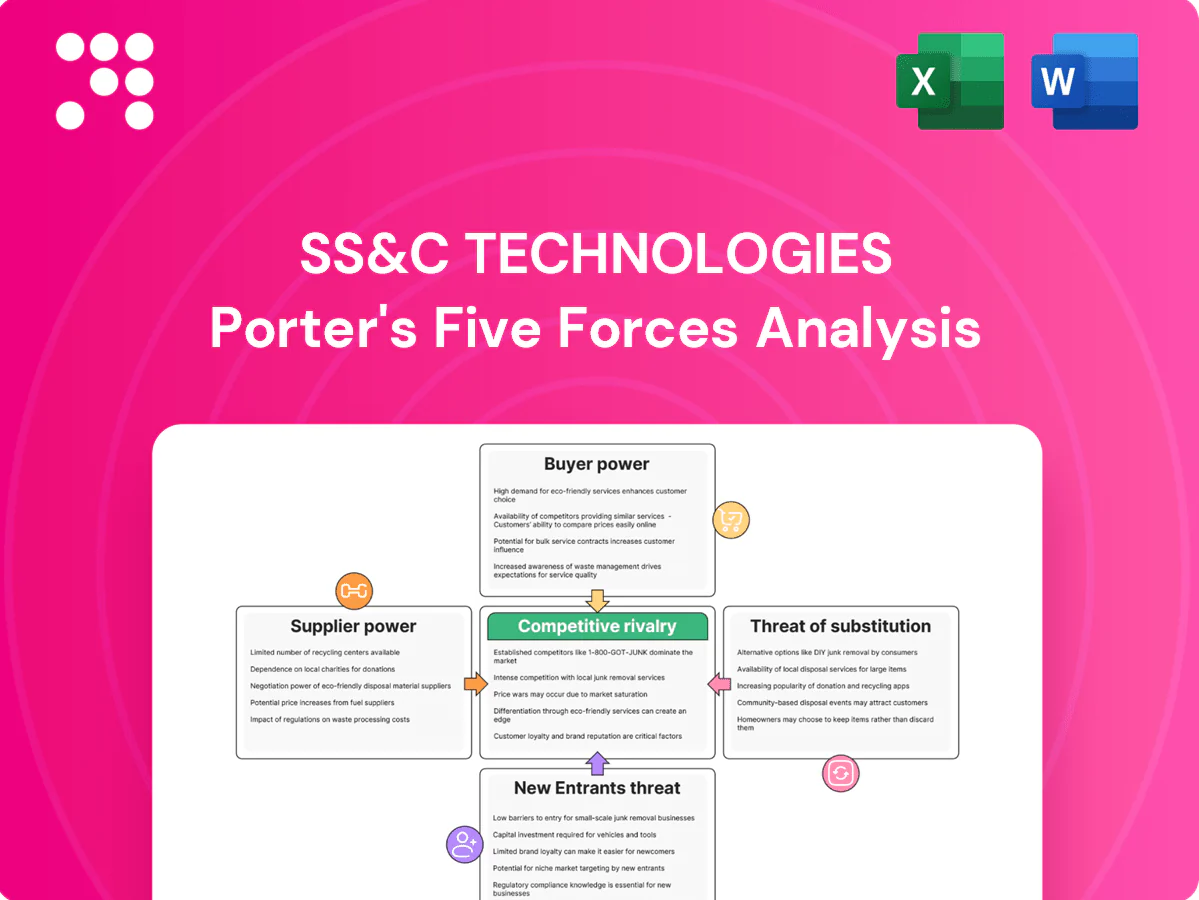
SS&C Technologies Porter's Five Forces Analysis

From Overview to Strategy Blueprint
SS&C Technologies faces moderate supplier power, intense rivalry among asset-servicing platforms, growing buyer sophistication, manageable threat of new entrants, and rising substitution risks from fintech innovations. This snapshot highlights key pressures shaping margins and strategy. Want deeper, force-by-force ratings and visuals? Unlock the full Porter's Five Forces Analysis to inform smarter decisions.
Suppliers Bargaining Power

Specialized tech vendors have moderate leverage
SS&C relies on niche cloud, data and cybersecurity vendors, giving select suppliers leverage over pricing and SLAs, but its 23,000+ employee scale (2024) and multi-vendor strategy dilute that power. Long-term contracts and volume purchasing lower cost volatility and secure capacity. In-house engineering and manageable switching costs for non-core inputs further constrain supplier bargaining.
Talent as a critical supplier pool
Skilled engineers, data scientists and domain experts act as critical supplier pools for SS&C, and tight labor markets (US unemployment ~3.7% in 2024) elevate their bargaining power. Wage inflation and widespread remote work options intensify competition for talent. SS&C mitigates this via global delivery centers and talent-adding acquisitions. Knowledge retention and culture remain essential to lower dependency and turnover risk.

Data providers and market feeds constrain flexibility
Financial data licensors (indices, market and reference data) retain strong contracting power because limited substitutes and regulatory compliance often lock firms into specific feeds; audit rights and fee escalators keep switching costs high. Volume discounts blunt marginal cost but do not negate supplier leverage; SS&C reported roughly $5.3 billion revenue in FY2024 and mitigates supplier power through feed aggregation and proprietary data enrichment.

Public cloud and infrastructure concentration risk
Dependency on a few hyperscalers concentrates SS&C’s supplier power: AWS, Azure and Google Cloud held roughly 66% of global IaaS/PaaS spend in 2024, narrowing pricing leverage; re-architecting for portability typically costs enterprises $1–10m and is often prohibitive; reserved instances and spend commitments can secure discounts up to ~60% and rebalance terms; data residency rules in 130+ countries further constrain host choices.
- Concentration: top‑3 ≈66% (2024)
- Portability cost: $1–10m
- Commitment discounts: up to ~60%
- Regulatory scope: 130+ countries
Third-party software and IP dependencies
Embedded third-party databases and analytics can impose runtime royalties and mandatory upgrades that compress margins; SS&C reported approximately $5.3B revenue in FY2024, making such costs material. Vendor roadmaps can shift SS&C product timelines and R&D scheduling. Increased enterprise open-source adoption (over 60% in 2024) reduces lock-in but raises support risk, while SS&C’s diversified product portfolio diffuses single-vendor exposure.
- Runtime royalties: material to margins
- Vendor roadmaps: timeline risk
- Open-source >60% (2024): lower lock-in, higher support
- Portfolio diversity: reduces single-vendor impact
Cloud and data vendors sustain supplier leverage despite scale and rising open-source defenses
SS&C faces moderate supplier power: niche cloud, data and security vendors exert pricing and SLA leverage, but scale (23,000+ employees) and multi-vendor sourcing dilute this. Critical talent and data licensors raise bargaining through scarcity and regulatory lock‑ins, while open‑source adoption (>60% in 2024) reduces some vendor lock. Hyperscaler concentration (~66% top‑3) and portability costs ($1–10m) keep supplier power meaningful.
| Metric | 2024 |
|---|---|
| Employees | 23,000+ |
| Revenue | $5.3B |
| Hyperscaler top‑3 | ≈66% |
| US unemployment | ≈3.7% |
What is included in the product
 Detailed Word Document
Tailored Porter’s Five Forces analysis for SS&C Technologies that uncovers key competitive drivers, supplier and buyer power, substitution risks, and barriers to entry; highlights disruptive threats and strategic levers influencing pricing, profitability, and market positioning.

 Customizable Excel Spreadsheet
Concise five-force snapshot highlighting SS&C Technologies' competitive pressures and relief levers—ideal for quick strategic decisions and boardroom use. Editable pressure sliders and a radar chart let you model regulatory shocks, client concentration, and fintech threats without complex tools.
Customers Bargaining Power

Large financial institutions demand price and customization
Top asset managers, custodians and insurers wield strong negotiating power, with firms like BlackRock (~$10 trillion AUM) and Vanguard (~$7.5 trillion AUM) in 2024 driving scale-based demands. They require customized features, SLAs and integration support, often via multi-year contracts. Competitive bake-offs intensify price pressure, while demonstrable value and substantial switching and integration costs moderate extremes.
High switching costs, but procurement sophistication
Operational rewiring, data migration, and compliance validation create high switching costs that blunt buyer power despite active procurement processes. Buyers offset this by running rigorous RFPs, pilots, and total-cost analyses and pushing outcome-based pricing and modular contracts. SS&C’s scale — about 23,000 employees and roughly $6.7 billion revenue in 2024 — enables bundling to defend price.

Consolidation among clients increases leverage
Mergers among asset servicers and managers have created fewer, larger buyers, with global AUM surpassing $100 trillion in 2024, increasing buyer leverage. Post-merger standardization lets consolidated clients rationalize vendors and compress pricing through unified RFPs and platform mandates. Cross-portfolio deals amplify discounts as buyers push enterprise-wide contracts. SS&C offsets pressure by cross-selling adjacent modules and offering differentiated service tiers to protect margins and retention.

Healthcare payers/providers price-sensitive and regulated
Healthcare payers/providers face budget ceilings and compliance demands, squeezing prices and driving rigorous proofs-of-value and discounting; interoperability mandates raise integration requirements as 96% of US hospitals used certified EHRs (ONC 2023). Multi-year value-based contracts are common, with about 30% of Medicare payments tied to alternative payment models (CMS 2023), and SS&C’s compliance expertise lowers perceived risk and aids retention.
- Price pressure: budget ceilings, discounts
- Interoperability: 96% hospitals with certified EHRs (ONC 2023)
- Value-based: ~30% Medicare via APMs (CMS 2023)
- Retention: SS&C compliance mitigates risk
Demand for interoperability and open APIs
Demand for interoperability and open APIs is rising; in 2024 clients pushed for vendor-agnostic ecosystems, increasing requirements for integration and data portability and strengthening buyer power as open standards reduce lock-in.
Robust API catalogs and connectors are becoming table stakes, though SS&C’s broad platform and bundled services can still create stickiness despite greater openness.
- 2024 trend: stronger buyer leverage from open standards
- API catalogs considered table stakes by enterprise buyers
- SS&C breadth mitigates but does not eliminate switching pressure
Consolidated asset managers and scaled servicers tighten pricing as open APIs shift buyer leverage
Top asset managers (BlackRock ~$10T, Vanguard ~$7.5T in 2024) and consolidated servicers push strong price and SLA demands, while high switching costs and SS&C scale (revenue ~$6.7B, 23,000 employees) preserve pricing. Open APIs and vendor-agnosticization (96% hospitals EHR 2023; >$100T global AUM 2024) increase buyer leverage. Cross-selling and bundled platforms counterbalance intense RFP-driven pressure.
| Metric | Value |
|---|---|
| BlackRock AUM | ~$10T (2024) |
| Vanguard AUM | ~$7.5T (2024) |
| SS&C revenue | ~$6.7B (2024) |
| SS&C employees | 23,000 (2024) |
| Global AUM | >$100T (2024) |
| Hospitals with certified EHR | 96% (ONC 2023) |
| Medicare via APMs | ~30% (CMS 2023) |
Preview the Actual Deliverable
SS&C Technologies Porter's Five Forces Analysis
This preview shows the exact SS&C Technologies Porter’s Five Forces analysis you’ll receive—fully written, formatted, and ready for use. It covers competitive rivalry, supplier and buyer power, threats of entry and substitutes, and strategic implications. No placeholders or samples—instant access to this identical file after purchase.

From Overview to Strategy Blueprint
SS&C Technologies faces moderate supplier power, intense rivalry among asset-servicing platforms, growing buyer sophistication, manageable threat of new entrants, and rising substitution risks from fintech innovations. This snapshot highlights key pressures shaping margins and strategy. Want deeper, force-by-force ratings and visuals? Unlock the full Porter's Five Forces Analysis to inform smarter decisions.
Suppliers Bargaining Power
Specialized tech vendors have moderate leverage
SS&C relies on niche cloud, data and cybersecurity vendors, giving select suppliers leverage over pricing and SLAs, but its 23,000+ employee scale (2024) and multi-vendor strategy dilute that power. Long-term contracts and volume purchasing lower cost volatility and secure capacity. In-house engineering and manageable switching costs for non-core inputs further constrain supplier bargaining.
Talent as a critical supplier pool
Skilled engineers, data scientists and domain experts act as critical supplier pools for SS&C, and tight labor markets (US unemployment ~3.7% in 2024) elevate their bargaining power. Wage inflation and widespread remote work options intensify competition for talent. SS&C mitigates this via global delivery centers and talent-adding acquisitions. Knowledge retention and culture remain essential to lower dependency and turnover risk.
Data providers and market feeds constrain flexibility
Financial data licensors (indices, market and reference data) retain strong contracting power because limited substitutes and regulatory compliance often lock firms into specific feeds; audit rights and fee escalators keep switching costs high. Volume discounts blunt marginal cost but do not negate supplier leverage; SS&C reported roughly $5.3 billion revenue in FY2024 and mitigates supplier power through feed aggregation and proprietary data enrichment.
Public cloud and infrastructure concentration risk
Dependency on a few hyperscalers concentrates SS&C’s supplier power: AWS, Azure and Google Cloud held roughly 66% of global IaaS/PaaS spend in 2024, narrowing pricing leverage; re-architecting for portability typically costs enterprises $1–10m and is often prohibitive; reserved instances and spend commitments can secure discounts up to ~60% and rebalance terms; data residency rules in 130+ countries further constrain host choices.
- Concentration: top‑3 ≈66% (2024)
- Portability cost: $1–10m
- Commitment discounts: up to ~60%
- Regulatory scope: 130+ countries
Third-party software and IP dependencies
Embedded third-party databases and analytics can impose runtime royalties and mandatory upgrades that compress margins; SS&C reported approximately $5.3B revenue in FY2024, making such costs material. Vendor roadmaps can shift SS&C product timelines and R&D scheduling. Increased enterprise open-source adoption (over 60% in 2024) reduces lock-in but raises support risk, while SS&C’s diversified product portfolio diffuses single-vendor exposure.
- Runtime royalties: material to margins
- Vendor roadmaps: timeline risk
- Open-source >60% (2024): lower lock-in, higher support
- Portfolio diversity: reduces single-vendor impact
Cloud and data vendors sustain supplier leverage despite scale and rising open-source defenses
SS&C faces moderate supplier power: niche cloud, data and security vendors exert pricing and SLA leverage, but scale (23,000+ employees) and multi-vendor sourcing dilute this. Critical talent and data licensors raise bargaining through scarcity and regulatory lock‑ins, while open‑source adoption (>60% in 2024) reduces some vendor lock. Hyperscaler concentration (~66% top‑3) and portability costs ($1–10m) keep supplier power meaningful.
| Metric | 2024 |
|---|---|
| Employees | 23,000+ |
| Revenue | $5.3B |
| Hyperscaler top‑3 | ≈66% |
| US unemployment | ≈3.7% |
What is included in the product
Detailed Word Document
Tailored Porter’s Five Forces analysis for SS&C Technologies that uncovers key competitive drivers, supplier and buyer power, substitution risks, and barriers to entry; highlights disruptive threats and strategic levers influencing pricing, profitability, and market positioning.
Customizable Excel Spreadsheet
Concise five-force snapshot highlighting SS&C Technologies' competitive pressures and relief levers—ideal for quick strategic decisions and boardroom use. Editable pressure sliders and a radar chart let you model regulatory shocks, client concentration, and fintech threats without complex tools.
Customers Bargaining Power
Large financial institutions demand price and customization
Top asset managers, custodians and insurers wield strong negotiating power, with firms like BlackRock (~$10 trillion AUM) and Vanguard (~$7.5 trillion AUM) in 2024 driving scale-based demands. They require customized features, SLAs and integration support, often via multi-year contracts. Competitive bake-offs intensify price pressure, while demonstrable value and substantial switching and integration costs moderate extremes.
High switching costs, but procurement sophistication
Operational rewiring, data migration, and compliance validation create high switching costs that blunt buyer power despite active procurement processes. Buyers offset this by running rigorous RFPs, pilots, and total-cost analyses and pushing outcome-based pricing and modular contracts. SS&C’s scale — about 23,000 employees and roughly $6.7 billion revenue in 2024 — enables bundling to defend price.
Consolidation among clients increases leverage
Mergers among asset servicers and managers have created fewer, larger buyers, with global AUM surpassing $100 trillion in 2024, increasing buyer leverage. Post-merger standardization lets consolidated clients rationalize vendors and compress pricing through unified RFPs and platform mandates. Cross-portfolio deals amplify discounts as buyers push enterprise-wide contracts. SS&C offsets pressure by cross-selling adjacent modules and offering differentiated service tiers to protect margins and retention.
Healthcare payers/providers price-sensitive and regulated
Healthcare payers/providers face budget ceilings and compliance demands, squeezing prices and driving rigorous proofs-of-value and discounting; interoperability mandates raise integration requirements as 96% of US hospitals used certified EHRs (ONC 2023). Multi-year value-based contracts are common, with about 30% of Medicare payments tied to alternative payment models (CMS 2023), and SS&C’s compliance expertise lowers perceived risk and aids retention.
- Price pressure: budget ceilings, discounts
- Interoperability: 96% hospitals with certified EHRs (ONC 2023)
- Value-based: ~30% Medicare via APMs (CMS 2023)
- Retention: SS&C compliance mitigates risk
Demand for interoperability and open APIs
Demand for interoperability and open APIs is rising; in 2024 clients pushed for vendor-agnostic ecosystems, increasing requirements for integration and data portability and strengthening buyer power as open standards reduce lock-in.
Robust API catalogs and connectors are becoming table stakes, though SS&C’s broad platform and bundled services can still create stickiness despite greater openness.
- 2024 trend: stronger buyer leverage from open standards
- API catalogs considered table stakes by enterprise buyers
- SS&C breadth mitigates but does not eliminate switching pressure
Consolidated asset managers and scaled servicers tighten pricing as open APIs shift buyer leverage
Top asset managers (BlackRock ~$10T, Vanguard ~$7.5T in 2024) and consolidated servicers push strong price and SLA demands, while high switching costs and SS&C scale (revenue ~$6.7B, 23,000 employees) preserve pricing. Open APIs and vendor-agnosticization (96% hospitals EHR 2023; >$100T global AUM 2024) increase buyer leverage. Cross-selling and bundled platforms counterbalance intense RFP-driven pressure.
| Metric | Value |
|---|---|
| BlackRock AUM | ~$10T (2024) |
| Vanguard AUM | ~$7.5T (2024) |
| SS&C revenue | ~$6.7B (2024) |
| SS&C employees | 23,000 (2024) |
| Global AUM | >$100T (2024) |
| Hospitals with certified EHR | 96% (ONC 2023) |
| Medicare via APMs | ~30% (CMS 2023) |
Preview the Actual Deliverable
SS&C Technologies Porter's Five Forces Analysis
This preview shows the exact SS&C Technologies Porter’s Five Forces analysis you’ll receive—fully written, formatted, and ready for use. It covers competitive rivalry, supplier and buyer power, threats of entry and substitutes, and strategic implications. No placeholders or samples—instant access to this identical file after purchase.
Description
From Overview to Strategy Blueprint
SS&C Technologies faces moderate supplier power, intense rivalry among asset-servicing platforms, growing buyer sophistication, manageable threat of new entrants, and rising substitution risks from fintech innovations. This snapshot highlights key pressures shaping margins and strategy. Want deeper, force-by-force ratings and visuals? Unlock the full Porter's Five Forces Analysis to inform smarter decisions.
Suppliers Bargaining Power
Specialized tech vendors have moderate leverage
SS&C relies on niche cloud, data and cybersecurity vendors, giving select suppliers leverage over pricing and SLAs, but its 23,000+ employee scale (2024) and multi-vendor strategy dilute that power. Long-term contracts and volume purchasing lower cost volatility and secure capacity. In-house engineering and manageable switching costs for non-core inputs further constrain supplier bargaining.
Talent as a critical supplier pool
Skilled engineers, data scientists and domain experts act as critical supplier pools for SS&C, and tight labor markets (US unemployment ~3.7% in 2024) elevate their bargaining power. Wage inflation and widespread remote work options intensify competition for talent. SS&C mitigates this via global delivery centers and talent-adding acquisitions. Knowledge retention and culture remain essential to lower dependency and turnover risk.
Data providers and market feeds constrain flexibility
Financial data licensors (indices, market and reference data) retain strong contracting power because limited substitutes and regulatory compliance often lock firms into specific feeds; audit rights and fee escalators keep switching costs high. Volume discounts blunt marginal cost but do not negate supplier leverage; SS&C reported roughly $5.3 billion revenue in FY2024 and mitigates supplier power through feed aggregation and proprietary data enrichment.
Public cloud and infrastructure concentration risk
Dependency on a few hyperscalers concentrates SS&C’s supplier power: AWS, Azure and Google Cloud held roughly 66% of global IaaS/PaaS spend in 2024, narrowing pricing leverage; re-architecting for portability typically costs enterprises $1–10m and is often prohibitive; reserved instances and spend commitments can secure discounts up to ~60% and rebalance terms; data residency rules in 130+ countries further constrain host choices.
- Concentration: top‑3 ≈66% (2024)
- Portability cost: $1–10m
- Commitment discounts: up to ~60%
- Regulatory scope: 130+ countries
Third-party software and IP dependencies
Embedded third-party databases and analytics can impose runtime royalties and mandatory upgrades that compress margins; SS&C reported approximately $5.3B revenue in FY2024, making such costs material. Vendor roadmaps can shift SS&C product timelines and R&D scheduling. Increased enterprise open-source adoption (over 60% in 2024) reduces lock-in but raises support risk, while SS&C’s diversified product portfolio diffuses single-vendor exposure.
- Runtime royalties: material to margins
- Vendor roadmaps: timeline risk
- Open-source >60% (2024): lower lock-in, higher support
- Portfolio diversity: reduces single-vendor impact
Cloud and data vendors sustain supplier leverage despite scale and rising open-source defenses
SS&C faces moderate supplier power: niche cloud, data and security vendors exert pricing and SLA leverage, but scale (23,000+ employees) and multi-vendor sourcing dilute this. Critical talent and data licensors raise bargaining through scarcity and regulatory lock‑ins, while open‑source adoption (>60% in 2024) reduces some vendor lock. Hyperscaler concentration (~66% top‑3) and portability costs ($1–10m) keep supplier power meaningful.
| Metric | 2024 |
|---|---|
| Employees | 23,000+ |
| Revenue | $5.3B |
| Hyperscaler top‑3 | ≈66% |
| US unemployment | ≈3.7% |
What is included in the product
Detailed Word Document
Tailored Porter’s Five Forces analysis for SS&C Technologies that uncovers key competitive drivers, supplier and buyer power, substitution risks, and barriers to entry; highlights disruptive threats and strategic levers influencing pricing, profitability, and market positioning.
Customizable Excel Spreadsheet
Concise five-force snapshot highlighting SS&C Technologies' competitive pressures and relief levers—ideal for quick strategic decisions and boardroom use. Editable pressure sliders and a radar chart let you model regulatory shocks, client concentration, and fintech threats without complex tools.
Customers Bargaining Power
Large financial institutions demand price and customization
Top asset managers, custodians and insurers wield strong negotiating power, with firms like BlackRock (~$10 trillion AUM) and Vanguard (~$7.5 trillion AUM) in 2024 driving scale-based demands. They require customized features, SLAs and integration support, often via multi-year contracts. Competitive bake-offs intensify price pressure, while demonstrable value and substantial switching and integration costs moderate extremes.
High switching costs, but procurement sophistication
Operational rewiring, data migration, and compliance validation create high switching costs that blunt buyer power despite active procurement processes. Buyers offset this by running rigorous RFPs, pilots, and total-cost analyses and pushing outcome-based pricing and modular contracts. SS&C’s scale — about 23,000 employees and roughly $6.7 billion revenue in 2024 — enables bundling to defend price.
Consolidation among clients increases leverage
Mergers among asset servicers and managers have created fewer, larger buyers, with global AUM surpassing $100 trillion in 2024, increasing buyer leverage. Post-merger standardization lets consolidated clients rationalize vendors and compress pricing through unified RFPs and platform mandates. Cross-portfolio deals amplify discounts as buyers push enterprise-wide contracts. SS&C offsets pressure by cross-selling adjacent modules and offering differentiated service tiers to protect margins and retention.
Healthcare payers/providers price-sensitive and regulated
Healthcare payers/providers face budget ceilings and compliance demands, squeezing prices and driving rigorous proofs-of-value and discounting; interoperability mandates raise integration requirements as 96% of US hospitals used certified EHRs (ONC 2023). Multi-year value-based contracts are common, with about 30% of Medicare payments tied to alternative payment models (CMS 2023), and SS&C’s compliance expertise lowers perceived risk and aids retention.
- Price pressure: budget ceilings, discounts
- Interoperability: 96% hospitals with certified EHRs (ONC 2023)
- Value-based: ~30% Medicare via APMs (CMS 2023)
- Retention: SS&C compliance mitigates risk
Demand for interoperability and open APIs
Demand for interoperability and open APIs is rising; in 2024 clients pushed for vendor-agnostic ecosystems, increasing requirements for integration and data portability and strengthening buyer power as open standards reduce lock-in.
Robust API catalogs and connectors are becoming table stakes, though SS&C’s broad platform and bundled services can still create stickiness despite greater openness.
- 2024 trend: stronger buyer leverage from open standards
- API catalogs considered table stakes by enterprise buyers
- SS&C breadth mitigates but does not eliminate switching pressure
Consolidated asset managers and scaled servicers tighten pricing as open APIs shift buyer leverage
Top asset managers (BlackRock ~$10T, Vanguard ~$7.5T in 2024) and consolidated servicers push strong price and SLA demands, while high switching costs and SS&C scale (revenue ~$6.7B, 23,000 employees) preserve pricing. Open APIs and vendor-agnosticization (96% hospitals EHR 2023; >$100T global AUM 2024) increase buyer leverage. Cross-selling and bundled platforms counterbalance intense RFP-driven pressure.
| Metric | Value |
|---|---|
| BlackRock AUM | ~$10T (2024) |
| Vanguard AUM | ~$7.5T (2024) |
| SS&C revenue | ~$6.7B (2024) |
| SS&C employees | 23,000 (2024) |
| Global AUM | >$100T (2024) |
| Hospitals with certified EHR | 96% (ONC 2023) |
| Medicare via APMs | ~30% (CMS 2023) |
Preview the Actual Deliverable
SS&C Technologies Porter's Five Forces Analysis
This preview shows the exact SS&C Technologies Porter’s Five Forces analysis you’ll receive—fully written, formatted, and ready for use. It covers competitive rivalry, supplier and buyer power, threats of entry and substitutes, and strategic implications. No placeholders or samples—instant access to this identical file after purchase.











