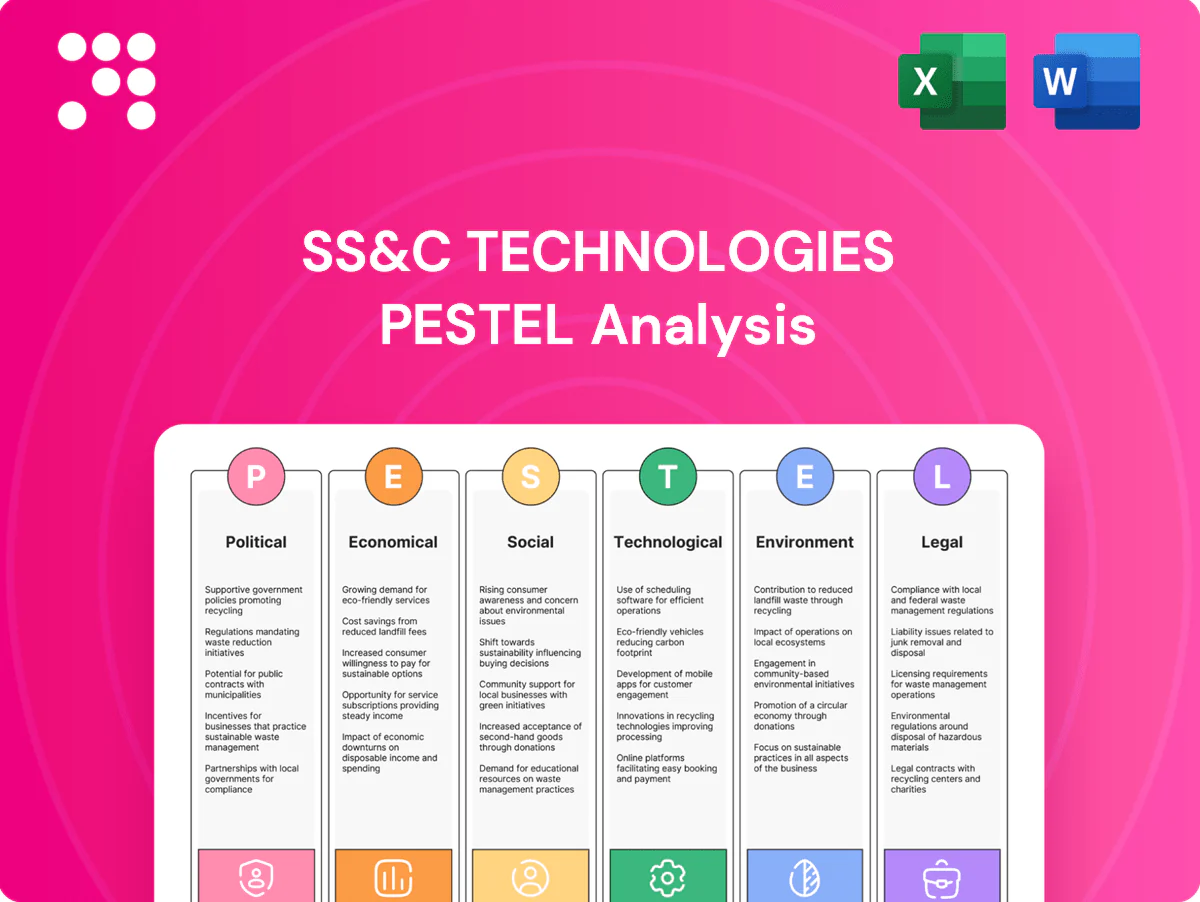
SS&C Technologies PESTLE Analysis

Plan Smarter. Present Sharper. Compete Stronger.
Our PESTLE Analysis for SS&C Technologies pinpoints political, economic, social, technological, legal, and environmental forces shaping its growth and risk profile, offering 3–5 actionable insights per factor. Ideal for investors and strategists, it’s formatted for instant use and decision-making—purchase the full report to access the complete, editable breakdown and strategic recommendations.
Political factors

Cross-border regulatory regimes
Operating across the US, EU, UK and APAC exposes SS&C to shifting rulebooks from the SEC, FCA, ESMA and MAS, forcing product and process updates that protect revenue for a company with roughly $4.6bn FY2024 revenue and ~22,000 employees. Changes in reporting, outsourcing and operational standards can require costly compliance lifts and affect implementation timelines. Political turnover can accelerate or stall mandates, creating timing risk for demand and project pipelines.
Data sovereignty and localization
Governments are tightening data residency and transfer rules, with over 70 countries now enforcing localization or strict cross-border controls, forcing changes to architecture and hosting models.
EU GDPR enforcement (cumulative fines >€3.8bn) and Schrems II, plus emerging APAC localization laws, pressure cloud placement and vendor choices.
SS&C must deploy region-specific data stores and contractual safeguards to preserve market access; non-compliance risks client churn and delayed implementations.

Public sector healthcare priorities
Public sector healthcare IT spend follows national funding cycles and policy reforms, creating lumpy demand for vendors like SS&C. Shifts to value-based reimbursement and interoperability mandates can materially expand or constrain SS&C’s addressable market. The global digital health market is projected to reach about $660 billion by 2025, increasing public-sector opportunity if coupled with favorable policy. Election outcomes and procurement rules often redirect grants toward certified or domestic suppliers, affecting vendor selection.

Sanctions and geopolitical risk
Expanding OFAC, UK HMT and EU regimes since 2022 have increased screening scope and counterparty restrictions, forcing SS&C to embed real-time screening and sanctions controls into its fund-servicing stack to block prohibited transactions.
Geopolitical tensions have disrupted sales pipelines and delivery in Russia, Ukraine and parts of EMEA, while compliance failures can trigger fines and contract terminations; global sanctions enforcement actions exceeded $2bn in 2023.
- Screening: real-time sanctions and PEP checks required
- Risk: disrupted pipelines in Russia/Ukraine/EMEA
- Consequence: enforcement actions > $2bn (2023)
Government cloud and security certifications
Winning public and quasi-public clients often requires FedRAMP, StateRAMP, IRAP or equivalent approvals; FedRAMP reported over 1,100 authorizations as of 2024 and StateRAMP had adoption in 20+ U.S. jurisdictions, raising certification importance amid national cybersecurity priorities.
- Expands TAM: access to 1,100+ federal opportunities (FedRAMP 2024)
- Raises cost-to-serve: continuous compliance and audits
- Policy risk: updates can alter scope and revalidation timelines
Global finance software: compliance, data residency and sanctions drive cost and timing risk
Operating across US, EU, UK and APAC forces SS&C (≈$4.6bn FY2024 revenue, ~22,000 staff) to adapt to SEC/FCA/ESMA/MAS rule changes, driving compliance costs and timing risk. Data residency in 70+ countries, GDPR fines >€3.8bn and Schrems II constrain cloud choices. Sanctions/enforcement (> $2bn in 2023) and FedRAMP (1,100+ auth 2024) raise screening and certification burdens.
| Political Factor | Key Metric |
|---|---|
| Revenue/Scale | $4.6bn; ~22,000 employees |
| Data rules | 70+ countries with localization |
| Privacy enforcement | GDPR fines >€3.8bn |
| Sanctions enforcement | > $2bn (2023) |
| FedRAMP impact | 1,100+ authorizations (2024) |
What is included in the product
 Detailed Word Document
Explores how Political, Economic, Social, Technological, Environmental and Legal factors uniquely affect SS&C Technologies, with data-backed trends and region/industry-specific examples. Designed for executives, investors and consultants, the analysis offers detailed sub-points, forward-looking scenarios and clean formatting ready for business plans, pitch decks and strategy work.

 Customizable Excel Spreadsheet
A concise, visually segmented PESTLE summary of SS&C Technologies that can be dropped into presentations or shared across teams, easily annotated with region- or business-specific notes to streamline external risk discussions and strategic planning.
Economic factors

Market cycles and AUM sensitivity
Revenue from SS&C’s fund administration and investment-operations businesses tracks client AUM and transaction volumes; SS&C reported roughly $5.6 billion in 2024 revenue, highlighting sensitivity to asset levels. Equity drawdowns and risk-off regimes compress transaction fees and fee pools, as seen in 2022 market stress. Bull markets and fund launches expand workloads and upsell opportunities, while SS&C’s diversification across strategies cushions volatility.
Interest rates and capital flows
Rate moves (policy rate ~5.25–5.50% in July 2025 and 10-year Treasury ~4.3%) shift allocations between fixed income, cash and alternatives, altering demand for SS&C modules and services. Higher rates boost demand for cash management and treasury solutions while pressuring leverage-driven funds and margin financing platforms. Lower rates historically revive issuance and securitization workflows, so product mix must adapt quickly to capture flows.

Outsourcing and managed services trend
Cost pressure is driving asset managers and insurers to outsource middle- and back-office functions, boosting SS&C’s recurring service revenues and multi-year contracts; Everest Group estimated the global BFSI outsourcing market at about $55 billion in 2024. Economic slowdowns tend to accelerate outsourcing to cut fixed costs, increasing deal flow into SS&C’s managed services pipeline. Pricing discipline is critical as competitive bids can compress margins despite contract length.

FX and global cost base
SS&C's multi-currency revenues and expenses expose it to FX translation and transaction effects, with FY2024 revenue reported at $5.75 billion, meaning currency swings materially affect reported growth and operating margins; the company cites hedging and contractual pricing clauses to limit near-term volatility. A diversified delivery footprint (offices in 20+ countries) helps hedge wage inflation but increases operational complexity and cross-border cost management.
- FX exposure: multi-currency revenues/expenses
- FY2024 revenue: $5.75 billion
- Delivery footprint: 20+ countries — hedges wages, adds complexity
- Mitigants: hedging policies and pricing clauses
M&A cycle and integration value
SS&C’s growth model has long leaned on acquisitions—most notably the $5.4 billion DST Systems deal in 2018—to add capabilities and scale, but tighter credit and lower valuations can compress deal flow and expected returns. Effective post-merger integration is essential to realize cross-sell and cost synergies through economic cycles; poor timing or execution risks diluting ROIC and stretching capital.
- Acquisition precedent: DST Systems $5.4bn (2018)
- Risk: tight credit reduces deal pipeline and accretion
- Mitigation: rigorous integration to protect cross-sell & cost synergies
- Failure: misexecution can lower ROIC and increase leverage
Global finance software: compliance, data residency and sanctions drive cost and timing risk
SS&C’s FY2024 revenue $5.75B ties fees to client AUM and volumes; macro cycles (policy rate ~5.25–5.50% July 2025, 10y ~4.3%) shift product demand and fee pools. Outsourcing tailwinds (BFSI outsourcing ≈ $55B in 2024) boost managed services but pricing/margin pressure and FX exposure (20+ country footprint) and M&A cadence (DST $5.4B 2018) affect ROIC.
| Metric | Value |
|---|---|
| FY2024 Revenue | $5.75B |
| BFSI Outsourcing 2024 | $55B |
| Policy rate (Jul 2025) | 5.25–5.50% |
| Delivery footprint | 20+ countries |
Same Document Delivered
SS&C Technologies PESTLE Analysis
The SS&C Technologies PESTLE Analysis examines political, economic, social, technological, legal and environmental factors shaping the company’s operating environment and strategic risks. It highlights regulatory pressures, market trends, fintech innovation, and ESG considerations with investor-focused implications. The preview shown here is the exact document you’ll receive after purchase—fully formatted and ready to use.

Plan Smarter. Present Sharper. Compete Stronger.
Our PESTLE Analysis for SS&C Technologies pinpoints political, economic, social, technological, legal, and environmental forces shaping its growth and risk profile, offering 3–5 actionable insights per factor. Ideal for investors and strategists, it’s formatted for instant use and decision-making—purchase the full report to access the complete, editable breakdown and strategic recommendations.
Political factors
Cross-border regulatory regimes
Operating across the US, EU, UK and APAC exposes SS&C to shifting rulebooks from the SEC, FCA, ESMA and MAS, forcing product and process updates that protect revenue for a company with roughly $4.6bn FY2024 revenue and ~22,000 employees. Changes in reporting, outsourcing and operational standards can require costly compliance lifts and affect implementation timelines. Political turnover can accelerate or stall mandates, creating timing risk for demand and project pipelines.
Data sovereignty and localization
Governments are tightening data residency and transfer rules, with over 70 countries now enforcing localization or strict cross-border controls, forcing changes to architecture and hosting models.
EU GDPR enforcement (cumulative fines >€3.8bn) and Schrems II, plus emerging APAC localization laws, pressure cloud placement and vendor choices.
SS&C must deploy region-specific data stores and contractual safeguards to preserve market access; non-compliance risks client churn and delayed implementations.
Public sector healthcare priorities
Public sector healthcare IT spend follows national funding cycles and policy reforms, creating lumpy demand for vendors like SS&C. Shifts to value-based reimbursement and interoperability mandates can materially expand or constrain SS&C’s addressable market. The global digital health market is projected to reach about $660 billion by 2025, increasing public-sector opportunity if coupled with favorable policy. Election outcomes and procurement rules often redirect grants toward certified or domestic suppliers, affecting vendor selection.
Sanctions and geopolitical risk
Expanding OFAC, UK HMT and EU regimes since 2022 have increased screening scope and counterparty restrictions, forcing SS&C to embed real-time screening and sanctions controls into its fund-servicing stack to block prohibited transactions.
Geopolitical tensions have disrupted sales pipelines and delivery in Russia, Ukraine and parts of EMEA, while compliance failures can trigger fines and contract terminations; global sanctions enforcement actions exceeded $2bn in 2023.
- Screening: real-time sanctions and PEP checks required
- Risk: disrupted pipelines in Russia/Ukraine/EMEA
- Consequence: enforcement actions > $2bn (2023)
Government cloud and security certifications
Winning public and quasi-public clients often requires FedRAMP, StateRAMP, IRAP or equivalent approvals; FedRAMP reported over 1,100 authorizations as of 2024 and StateRAMP had adoption in 20+ U.S. jurisdictions, raising certification importance amid national cybersecurity priorities.
- Expands TAM: access to 1,100+ federal opportunities (FedRAMP 2024)
- Raises cost-to-serve: continuous compliance and audits
- Policy risk: updates can alter scope and revalidation timelines
Global finance software: compliance, data residency and sanctions drive cost and timing risk
Operating across US, EU, UK and APAC forces SS&C (≈$4.6bn FY2024 revenue, ~22,000 staff) to adapt to SEC/FCA/ESMA/MAS rule changes, driving compliance costs and timing risk. Data residency in 70+ countries, GDPR fines >€3.8bn and Schrems II constrain cloud choices. Sanctions/enforcement (> $2bn in 2023) and FedRAMP (1,100+ auth 2024) raise screening and certification burdens.
| Political Factor | Key Metric |
|---|---|
| Revenue/Scale | $4.6bn; ~22,000 employees |
| Data rules | 70+ countries with localization |
| Privacy enforcement | GDPR fines >€3.8bn |
| Sanctions enforcement | > $2bn (2023) |
| FedRAMP impact | 1,100+ authorizations (2024) |
What is included in the product
Detailed Word Document
Explores how Political, Economic, Social, Technological, Environmental and Legal factors uniquely affect SS&C Technologies, with data-backed trends and region/industry-specific examples. Designed for executives, investors and consultants, the analysis offers detailed sub-points, forward-looking scenarios and clean formatting ready for business plans, pitch decks and strategy work.
Customizable Excel Spreadsheet
A concise, visually segmented PESTLE summary of SS&C Technologies that can be dropped into presentations or shared across teams, easily annotated with region- or business-specific notes to streamline external risk discussions and strategic planning.
Economic factors
Market cycles and AUM sensitivity
Revenue from SS&C’s fund administration and investment-operations businesses tracks client AUM and transaction volumes; SS&C reported roughly $5.6 billion in 2024 revenue, highlighting sensitivity to asset levels. Equity drawdowns and risk-off regimes compress transaction fees and fee pools, as seen in 2022 market stress. Bull markets and fund launches expand workloads and upsell opportunities, while SS&C’s diversification across strategies cushions volatility.
Interest rates and capital flows
Rate moves (policy rate ~5.25–5.50% in July 2025 and 10-year Treasury ~4.3%) shift allocations between fixed income, cash and alternatives, altering demand for SS&C modules and services. Higher rates boost demand for cash management and treasury solutions while pressuring leverage-driven funds and margin financing platforms. Lower rates historically revive issuance and securitization workflows, so product mix must adapt quickly to capture flows.
Outsourcing and managed services trend
Cost pressure is driving asset managers and insurers to outsource middle- and back-office functions, boosting SS&C’s recurring service revenues and multi-year contracts; Everest Group estimated the global BFSI outsourcing market at about $55 billion in 2024. Economic slowdowns tend to accelerate outsourcing to cut fixed costs, increasing deal flow into SS&C’s managed services pipeline. Pricing discipline is critical as competitive bids can compress margins despite contract length.
FX and global cost base
SS&C's multi-currency revenues and expenses expose it to FX translation and transaction effects, with FY2024 revenue reported at $5.75 billion, meaning currency swings materially affect reported growth and operating margins; the company cites hedging and contractual pricing clauses to limit near-term volatility. A diversified delivery footprint (offices in 20+ countries) helps hedge wage inflation but increases operational complexity and cross-border cost management.
- FX exposure: multi-currency revenues/expenses
- FY2024 revenue: $5.75 billion
- Delivery footprint: 20+ countries — hedges wages, adds complexity
- Mitigants: hedging policies and pricing clauses
M&A cycle and integration value
SS&C’s growth model has long leaned on acquisitions—most notably the $5.4 billion DST Systems deal in 2018—to add capabilities and scale, but tighter credit and lower valuations can compress deal flow and expected returns. Effective post-merger integration is essential to realize cross-sell and cost synergies through economic cycles; poor timing or execution risks diluting ROIC and stretching capital.
- Acquisition precedent: DST Systems $5.4bn (2018)
- Risk: tight credit reduces deal pipeline and accretion
- Mitigation: rigorous integration to protect cross-sell & cost synergies
- Failure: misexecution can lower ROIC and increase leverage
Global finance software: compliance, data residency and sanctions drive cost and timing risk
SS&C’s FY2024 revenue $5.75B ties fees to client AUM and volumes; macro cycles (policy rate ~5.25–5.50% July 2025, 10y ~4.3%) shift product demand and fee pools. Outsourcing tailwinds (BFSI outsourcing ≈ $55B in 2024) boost managed services but pricing/margin pressure and FX exposure (20+ country footprint) and M&A cadence (DST $5.4B 2018) affect ROIC.
| Metric | Value |
|---|---|
| FY2024 Revenue | $5.75B |
| BFSI Outsourcing 2024 | $55B |
| Policy rate (Jul 2025) | 5.25–5.50% |
| Delivery footprint | 20+ countries |
Same Document Delivered
SS&C Technologies PESTLE Analysis
The SS&C Technologies PESTLE Analysis examines political, economic, social, technological, legal and environmental factors shaping the company’s operating environment and strategic risks. It highlights regulatory pressures, market trends, fintech innovation, and ESG considerations with investor-focused implications. The preview shown here is the exact document you’ll receive after purchase—fully formatted and ready to use.
Original: $10.00
-65%$10.00
$3.50Description
Plan Smarter. Present Sharper. Compete Stronger.
Our PESTLE Analysis for SS&C Technologies pinpoints political, economic, social, technological, legal, and environmental forces shaping its growth and risk profile, offering 3–5 actionable insights per factor. Ideal for investors and strategists, it’s formatted for instant use and decision-making—purchase the full report to access the complete, editable breakdown and strategic recommendations.
Political factors
Cross-border regulatory regimes
Operating across the US, EU, UK and APAC exposes SS&C to shifting rulebooks from the SEC, FCA, ESMA and MAS, forcing product and process updates that protect revenue for a company with roughly $4.6bn FY2024 revenue and ~22,000 employees. Changes in reporting, outsourcing and operational standards can require costly compliance lifts and affect implementation timelines. Political turnover can accelerate or stall mandates, creating timing risk for demand and project pipelines.
Data sovereignty and localization
Governments are tightening data residency and transfer rules, with over 70 countries now enforcing localization or strict cross-border controls, forcing changes to architecture and hosting models.
EU GDPR enforcement (cumulative fines >€3.8bn) and Schrems II, plus emerging APAC localization laws, pressure cloud placement and vendor choices.
SS&C must deploy region-specific data stores and contractual safeguards to preserve market access; non-compliance risks client churn and delayed implementations.
Public sector healthcare priorities
Public sector healthcare IT spend follows national funding cycles and policy reforms, creating lumpy demand for vendors like SS&C. Shifts to value-based reimbursement and interoperability mandates can materially expand or constrain SS&C’s addressable market. The global digital health market is projected to reach about $660 billion by 2025, increasing public-sector opportunity if coupled with favorable policy. Election outcomes and procurement rules often redirect grants toward certified or domestic suppliers, affecting vendor selection.
Sanctions and geopolitical risk
Expanding OFAC, UK HMT and EU regimes since 2022 have increased screening scope and counterparty restrictions, forcing SS&C to embed real-time screening and sanctions controls into its fund-servicing stack to block prohibited transactions.
Geopolitical tensions have disrupted sales pipelines and delivery in Russia, Ukraine and parts of EMEA, while compliance failures can trigger fines and contract terminations; global sanctions enforcement actions exceeded $2bn in 2023.
- Screening: real-time sanctions and PEP checks required
- Risk: disrupted pipelines in Russia/Ukraine/EMEA
- Consequence: enforcement actions > $2bn (2023)
Government cloud and security certifications
Winning public and quasi-public clients often requires FedRAMP, StateRAMP, IRAP or equivalent approvals; FedRAMP reported over 1,100 authorizations as of 2024 and StateRAMP had adoption in 20+ U.S. jurisdictions, raising certification importance amid national cybersecurity priorities.
- Expands TAM: access to 1,100+ federal opportunities (FedRAMP 2024)
- Raises cost-to-serve: continuous compliance and audits
- Policy risk: updates can alter scope and revalidation timelines
Global finance software: compliance, data residency and sanctions drive cost and timing risk
Operating across US, EU, UK and APAC forces SS&C (≈$4.6bn FY2024 revenue, ~22,000 staff) to adapt to SEC/FCA/ESMA/MAS rule changes, driving compliance costs and timing risk. Data residency in 70+ countries, GDPR fines >€3.8bn and Schrems II constrain cloud choices. Sanctions/enforcement (> $2bn in 2023) and FedRAMP (1,100+ auth 2024) raise screening and certification burdens.
| Political Factor | Key Metric |
|---|---|
| Revenue/Scale | $4.6bn; ~22,000 employees |
| Data rules | 70+ countries with localization |
| Privacy enforcement | GDPR fines >€3.8bn |
| Sanctions enforcement | > $2bn (2023) |
| FedRAMP impact | 1,100+ authorizations (2024) |
What is included in the product
Detailed Word Document
Explores how Political, Economic, Social, Technological, Environmental and Legal factors uniquely affect SS&C Technologies, with data-backed trends and region/industry-specific examples. Designed for executives, investors and consultants, the analysis offers detailed sub-points, forward-looking scenarios and clean formatting ready for business plans, pitch decks and strategy work.
Customizable Excel Spreadsheet
A concise, visually segmented PESTLE summary of SS&C Technologies that can be dropped into presentations or shared across teams, easily annotated with region- or business-specific notes to streamline external risk discussions and strategic planning.
Economic factors
Market cycles and AUM sensitivity
Revenue from SS&C’s fund administration and investment-operations businesses tracks client AUM and transaction volumes; SS&C reported roughly $5.6 billion in 2024 revenue, highlighting sensitivity to asset levels. Equity drawdowns and risk-off regimes compress transaction fees and fee pools, as seen in 2022 market stress. Bull markets and fund launches expand workloads and upsell opportunities, while SS&C’s diversification across strategies cushions volatility.
Interest rates and capital flows
Rate moves (policy rate ~5.25–5.50% in July 2025 and 10-year Treasury ~4.3%) shift allocations between fixed income, cash and alternatives, altering demand for SS&C modules and services. Higher rates boost demand for cash management and treasury solutions while pressuring leverage-driven funds and margin financing platforms. Lower rates historically revive issuance and securitization workflows, so product mix must adapt quickly to capture flows.
Outsourcing and managed services trend
Cost pressure is driving asset managers and insurers to outsource middle- and back-office functions, boosting SS&C’s recurring service revenues and multi-year contracts; Everest Group estimated the global BFSI outsourcing market at about $55 billion in 2024. Economic slowdowns tend to accelerate outsourcing to cut fixed costs, increasing deal flow into SS&C’s managed services pipeline. Pricing discipline is critical as competitive bids can compress margins despite contract length.
FX and global cost base
SS&C's multi-currency revenues and expenses expose it to FX translation and transaction effects, with FY2024 revenue reported at $5.75 billion, meaning currency swings materially affect reported growth and operating margins; the company cites hedging and contractual pricing clauses to limit near-term volatility. A diversified delivery footprint (offices in 20+ countries) helps hedge wage inflation but increases operational complexity and cross-border cost management.
- FX exposure: multi-currency revenues/expenses
- FY2024 revenue: $5.75 billion
- Delivery footprint: 20+ countries — hedges wages, adds complexity
- Mitigants: hedging policies and pricing clauses
M&A cycle and integration value
SS&C’s growth model has long leaned on acquisitions—most notably the $5.4 billion DST Systems deal in 2018—to add capabilities and scale, but tighter credit and lower valuations can compress deal flow and expected returns. Effective post-merger integration is essential to realize cross-sell and cost synergies through economic cycles; poor timing or execution risks diluting ROIC and stretching capital.
- Acquisition precedent: DST Systems $5.4bn (2018)
- Risk: tight credit reduces deal pipeline and accretion
- Mitigation: rigorous integration to protect cross-sell & cost synergies
- Failure: misexecution can lower ROIC and increase leverage
Global finance software: compliance, data residency and sanctions drive cost and timing risk
SS&C’s FY2024 revenue $5.75B ties fees to client AUM and volumes; macro cycles (policy rate ~5.25–5.50% July 2025, 10y ~4.3%) shift product demand and fee pools. Outsourcing tailwinds (BFSI outsourcing ≈ $55B in 2024) boost managed services but pricing/margin pressure and FX exposure (20+ country footprint) and M&A cadence (DST $5.4B 2018) affect ROIC.
| Metric | Value |
|---|---|
| FY2024 Revenue | $5.75B |
| BFSI Outsourcing 2024 | $55B |
| Policy rate (Jul 2025) | 5.25–5.50% |
| Delivery footprint | 20+ countries |
Same Document Delivered
SS&C Technologies PESTLE Analysis
The SS&C Technologies PESTLE Analysis examines political, economic, social, technological, legal and environmental factors shaping the company’s operating environment and strategic risks. It highlights regulatory pressures, market trends, fintech innovation, and ESG considerations with investor-focused implications. The preview shown here is the exact document you’ll receive after purchase—fully formatted and ready to use.











