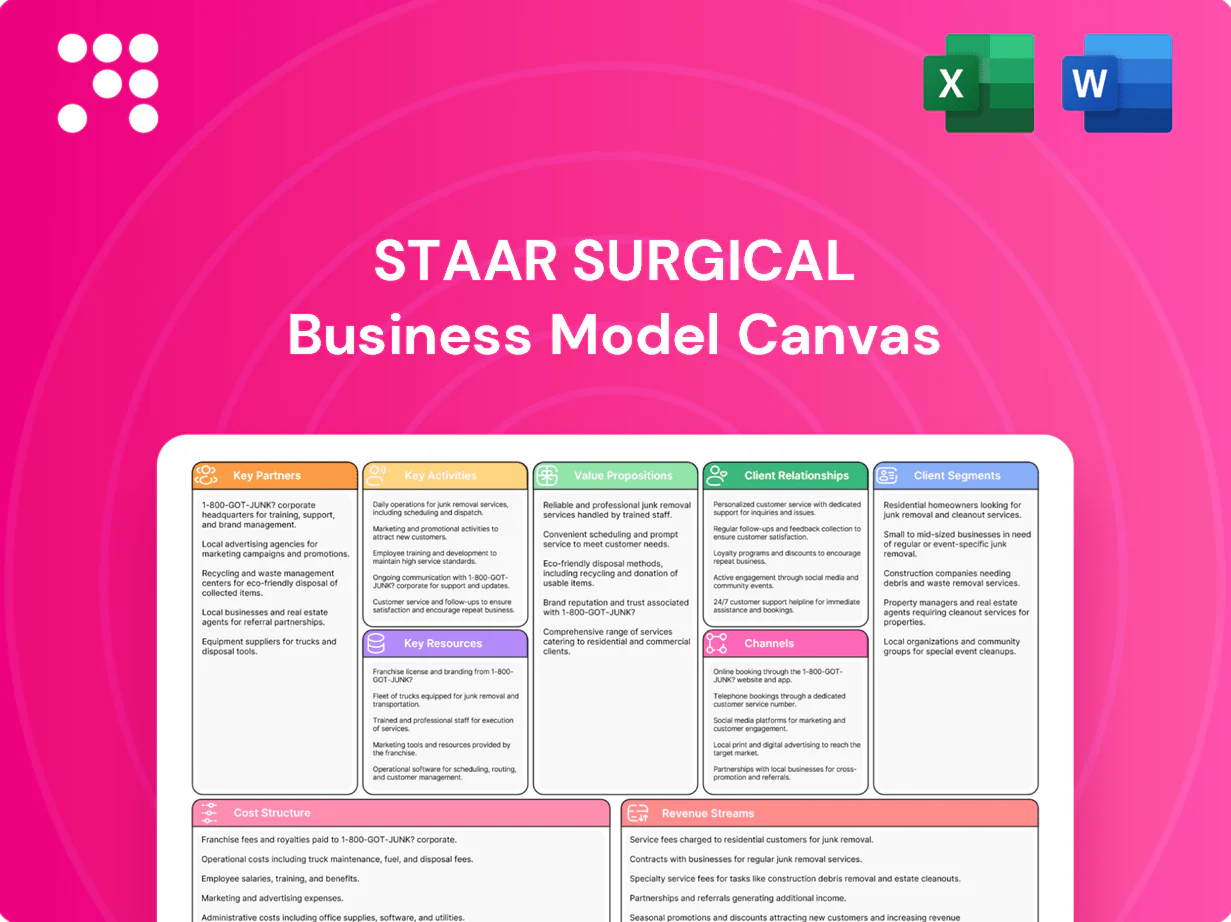
STAAR Surgical Business Model Canvas

Unlock a surgical implant company's business model canvas: value, partners, growth, revenue
Unlock STAAR Surgical’s strategic blueprint with a concise Business Model Canvas that maps value propositions, customer segments, key partners, and revenue streams. This 4-section snapshot reveals how STAAR scales, mitigates risk, and captures market share. Ideal for investors, consultants, and founders seeking actionable insight. Download the full Word & Excel canvas to benchmark or adapt these proven strategies today.
Partnerships

Ophthalmic surgeons and refractive clinics
Ophthalmic surgeons and refractive clinics are the primary adopters and influencers for ICL procedures, shaping patient selection and demand. Close partnerships create rapid feedback loops for product improvements and real‑time case support. Co‑development of best practices elevates outcomes and drives procedure growth, while these relationships anchor training and advocacy, supporting over 200,000 EVO ICL implants globally by 2024.
Hospitals and ambulatory surgery centers
Hospitals and ambulatory surgery centers provide the setting, equipment and scheduling for implant procedures, supporting roughly 4 million cataract surgeries annually in the US. Contracting secures access, pricing and standardized processes for implants and reimbursement. Aligning with OR managers streamlines lens availability and sterilization workflows, helping scale procedure throughput and improve case turnover.

Regulators, CROs, and academic institutions
Regulators, CROs, and academic centers drive STAAR Surgical uptake: CRO-led trials and 20+ post-market studies support safety and label expansions, regulatory collaboration has enabled approvals in 75+ countries, and over 200 peer-reviewed publications from academic centers validate EVO ICL outcomes, reinforcing efficacy and adoption.

Material suppliers and precision equipment vendors
Reliable collamer and optics-grade inputs are critical to STAAR Surgical implant quality; precision molding, polishing, and sterilization equipment from specialized vendors enable tight tolerances and biocompatibility. Collaborative process development with suppliers reduces defects and stabilizes yields, while multi-sourcing plus rigorous QA audits mitigate supplier and regulatory risk.
- Supplier reliability: critical for material purity and optical clarity
- Equipment partners: enable sub-micron tolerances and sterile processing
- Joint R&D: lowers defect rates, improves yield consistency
- Multi-sourcing + QA audits: reduce single-source and compliance risks
Distributors and regional strategic partners
~200,000 implants and 75+ country approvals drive global refractive lens adoption
Surgeons, clinics and distributors drive adoption and feedback loops, supporting ~200,000 EVO ICL implants by 2024 and a 70+ country distribution network. CROs, regulators and academic centers enable approvals in 75+ countries via 20+ post‑market studies and 200+ publications. Precision suppliers and equipment partners ensure optical quality and yield consistency, while performance‑based distributor contracts align growth incentives.
| Partner | 2024 Metric |
|---|---|
| EVO ICL implants | ~200,000 |
| Distribution reach | 70+ countries |
| Regulatory approvals | 75+ countries |
| Post‑market studies | 20+ |
| Publications | 200+ |
What is included in the product
 Detailed Word Document
A concise, pre-built Business Model Canvas for STAAR Surgical detailing customer segments, channels, value propositions, revenue streams and key activities aligned with real-world operations and growth plans. Designed for presentations and investor discussions, it includes SWOT-linked insights, competitive advantages per BMC block, and practical guidance for analysts and entrepreneurs.

 Customizable Excel Spreadsheet
High-level view of STAAR Surgical’s business model with editable cells to eliminate lengthy formatting and clarify strategic priorities. Perfect for fast comparisons, team collaboration, and turning complex ophthalmic-market insights into board-ready decisions.
Activities

Lens R&D and design optimization
Continuous lens R&D targets improved optics, biocompatibility and ease of implantation, with pipeline parameter ranges spanning myopia -1 to -20 D, hyperopia +1 to +10 D and astigmatism up to 6 D. Design-of-experiments and simulation de-risk iterations reduce prototype cycles and time-to-market. Regular IP filings secure differentiation and protect margin upside.
Manufacturing and quality assurance
STAAR Surgical operates ISO 7 cleanroom production with optical metrology to ensure lens surface and refractive precision; automated in‑process testing controls curvature, thickness and clarity to medical‑device tolerances. Sterilization is validated to a sterility assurance level of 10^-6 (ISO 11137) with shelf‑life protocols per ISO 11607 (commonly 2–5 years). Continuous improvement programs tie SPC and CAPA metrics to regulatory compliance and yield optimization.

Clinical trials and regulatory submissions
Prospective and post-market studies underpin claims and label extensions, with STAAR citing over 1 million ICL implants worldwide to support safety and efficacy data.
Dossiers prepared for FDA, CE and other agencies drive approvals across 75+ countries, enabling commercial rollouts and reimbursement discussions.
Vigilance systems monitor real-world safety/performance and timely submissions keep global market access aligned with regulatory windows.

Surgeon training and certification
Surgeon training and certification combine hands-on labs, proctorships, and digital modules to build competence and lower complication rates; Visian ICL (STAAR Surgical) has been FDA-approved since 2005, underscoring long-term clinical adoption. Standardized protocols reduce variability, KOL mentoring speeds community uptake, and formal credentialing protects patient outcomes and brand reputation.
- Hands-on labs, proctorships, digital modules
- Standardized protocols to reduce variability
- KOL mentoring to accelerate adoption
- Credentialing to safeguard outcomes and reputation
Marketing, education, and KOL engagement
- Clinical-to-value messaging
- Patient education → higher conversion
- KOL amplification at conferences/online
- Co-marketing drives leads & volume
R&D, ISO7 production and surgeon training fast‑track global ICL rollout; >1,000,000 implants, $253M
R&D advances lenses (myopia −1 to −20 D, hyperopia +1 to +10 D, astigmatism ≤6 D), IP filings and DOE/simulation shorten time‑to‑market. ISO 7 production, validated sterilization (SAL 10^-6) and SPC/CAPA drive quality and yield. Clinical/regulatory dossiers and surgeon training support global rollout and uptake.
| Metric | Value |
|---|---|
| ICL implants | >1,000,000 |
| FY2023 revenue | $253M |
| Markets | 75+ |
Preview Before You Purchase
Business Model Canvas
The document you’re previewing is the exact STAAR Surgical Business Model Canvas you’ll receive—this is not a mockup or sample. After purchase you’ll get the complete, editable file formatted exactly as shown, ready for presentation, editing, or sharing. No surprises—what you see here is what you’ll download and own.

Unlock a surgical implant company's business model canvas: value, partners, growth, revenue
Unlock STAAR Surgical’s strategic blueprint with a concise Business Model Canvas that maps value propositions, customer segments, key partners, and revenue streams. This 4-section snapshot reveals how STAAR scales, mitigates risk, and captures market share. Ideal for investors, consultants, and founders seeking actionable insight. Download the full Word & Excel canvas to benchmark or adapt these proven strategies today.
Partnerships
Ophthalmic surgeons and refractive clinics
Ophthalmic surgeons and refractive clinics are the primary adopters and influencers for ICL procedures, shaping patient selection and demand. Close partnerships create rapid feedback loops for product improvements and real‑time case support. Co‑development of best practices elevates outcomes and drives procedure growth, while these relationships anchor training and advocacy, supporting over 200,000 EVO ICL implants globally by 2024.
Hospitals and ambulatory surgery centers
Hospitals and ambulatory surgery centers provide the setting, equipment and scheduling for implant procedures, supporting roughly 4 million cataract surgeries annually in the US. Contracting secures access, pricing and standardized processes for implants and reimbursement. Aligning with OR managers streamlines lens availability and sterilization workflows, helping scale procedure throughput and improve case turnover.
Regulators, CROs, and academic institutions
Regulators, CROs, and academic centers drive STAAR Surgical uptake: CRO-led trials and 20+ post-market studies support safety and label expansions, regulatory collaboration has enabled approvals in 75+ countries, and over 200 peer-reviewed publications from academic centers validate EVO ICL outcomes, reinforcing efficacy and adoption.
Material suppliers and precision equipment vendors
Reliable collamer and optics-grade inputs are critical to STAAR Surgical implant quality; precision molding, polishing, and sterilization equipment from specialized vendors enable tight tolerances and biocompatibility. Collaborative process development with suppliers reduces defects and stabilizes yields, while multi-sourcing plus rigorous QA audits mitigate supplier and regulatory risk.
- Supplier reliability: critical for material purity and optical clarity
- Equipment partners: enable sub-micron tolerances and sterile processing
- Joint R&D: lowers defect rates, improves yield consistency
- Multi-sourcing + QA audits: reduce single-source and compliance risks
Distributors and regional strategic partners
~200,000 implants and 75+ country approvals drive global refractive lens adoption
Surgeons, clinics and distributors drive adoption and feedback loops, supporting ~200,000 EVO ICL implants by 2024 and a 70+ country distribution network. CROs, regulators and academic centers enable approvals in 75+ countries via 20+ post‑market studies and 200+ publications. Precision suppliers and equipment partners ensure optical quality and yield consistency, while performance‑based distributor contracts align growth incentives.
| Partner | 2024 Metric |
|---|---|
| EVO ICL implants | ~200,000 |
| Distribution reach | 70+ countries |
| Regulatory approvals | 75+ countries |
| Post‑market studies | 20+ |
| Publications | 200+ |
What is included in the product
Detailed Word Document
A concise, pre-built Business Model Canvas for STAAR Surgical detailing customer segments, channels, value propositions, revenue streams and key activities aligned with real-world operations and growth plans. Designed for presentations and investor discussions, it includes SWOT-linked insights, competitive advantages per BMC block, and practical guidance for analysts and entrepreneurs.
Customizable Excel Spreadsheet
High-level view of STAAR Surgical’s business model with editable cells to eliminate lengthy formatting and clarify strategic priorities. Perfect for fast comparisons, team collaboration, and turning complex ophthalmic-market insights into board-ready decisions.
Activities
Lens R&D and design optimization
Continuous lens R&D targets improved optics, biocompatibility and ease of implantation, with pipeline parameter ranges spanning myopia -1 to -20 D, hyperopia +1 to +10 D and astigmatism up to 6 D. Design-of-experiments and simulation de-risk iterations reduce prototype cycles and time-to-market. Regular IP filings secure differentiation and protect margin upside.
Manufacturing and quality assurance
STAAR Surgical operates ISO 7 cleanroom production with optical metrology to ensure lens surface and refractive precision; automated in‑process testing controls curvature, thickness and clarity to medical‑device tolerances. Sterilization is validated to a sterility assurance level of 10^-6 (ISO 11137) with shelf‑life protocols per ISO 11607 (commonly 2–5 years). Continuous improvement programs tie SPC and CAPA metrics to regulatory compliance and yield optimization.
Clinical trials and regulatory submissions
Prospective and post-market studies underpin claims and label extensions, with STAAR citing over 1 million ICL implants worldwide to support safety and efficacy data.
Dossiers prepared for FDA, CE and other agencies drive approvals across 75+ countries, enabling commercial rollouts and reimbursement discussions.
Vigilance systems monitor real-world safety/performance and timely submissions keep global market access aligned with regulatory windows.
Surgeon training and certification
Surgeon training and certification combine hands-on labs, proctorships, and digital modules to build competence and lower complication rates; Visian ICL (STAAR Surgical) has been FDA-approved since 2005, underscoring long-term clinical adoption. Standardized protocols reduce variability, KOL mentoring speeds community uptake, and formal credentialing protects patient outcomes and brand reputation.
- Hands-on labs, proctorships, digital modules
- Standardized protocols to reduce variability
- KOL mentoring to accelerate adoption
- Credentialing to safeguard outcomes and reputation
Marketing, education, and KOL engagement
- Clinical-to-value messaging
- Patient education → higher conversion
- KOL amplification at conferences/online
- Co-marketing drives leads & volume
R&D, ISO7 production and surgeon training fast‑track global ICL rollout; >1,000,000 implants, $253M
R&D advances lenses (myopia −1 to −20 D, hyperopia +1 to +10 D, astigmatism ≤6 D), IP filings and DOE/simulation shorten time‑to‑market. ISO 7 production, validated sterilization (SAL 10^-6) and SPC/CAPA drive quality and yield. Clinical/regulatory dossiers and surgeon training support global rollout and uptake.
| Metric | Value |
|---|---|
| ICL implants | >1,000,000 |
| FY2023 revenue | $253M |
| Markets | 75+ |
Preview Before You Purchase
Business Model Canvas
The document you’re previewing is the exact STAAR Surgical Business Model Canvas you’ll receive—this is not a mockup or sample. After purchase you’ll get the complete, editable file formatted exactly as shown, ready for presentation, editing, or sharing. No surprises—what you see here is what you’ll download and own.
Original: $10.00
-65%$10.00
$3.50Description
Unlock a surgical implant company's business model canvas: value, partners, growth, revenue
Unlock STAAR Surgical’s strategic blueprint with a concise Business Model Canvas that maps value propositions, customer segments, key partners, and revenue streams. This 4-section snapshot reveals how STAAR scales, mitigates risk, and captures market share. Ideal for investors, consultants, and founders seeking actionable insight. Download the full Word & Excel canvas to benchmark or adapt these proven strategies today.
Partnerships
Ophthalmic surgeons and refractive clinics
Ophthalmic surgeons and refractive clinics are the primary adopters and influencers for ICL procedures, shaping patient selection and demand. Close partnerships create rapid feedback loops for product improvements and real‑time case support. Co‑development of best practices elevates outcomes and drives procedure growth, while these relationships anchor training and advocacy, supporting over 200,000 EVO ICL implants globally by 2024.
Hospitals and ambulatory surgery centers
Hospitals and ambulatory surgery centers provide the setting, equipment and scheduling for implant procedures, supporting roughly 4 million cataract surgeries annually in the US. Contracting secures access, pricing and standardized processes for implants and reimbursement. Aligning with OR managers streamlines lens availability and sterilization workflows, helping scale procedure throughput and improve case turnover.
Regulators, CROs, and academic institutions
Regulators, CROs, and academic centers drive STAAR Surgical uptake: CRO-led trials and 20+ post-market studies support safety and label expansions, regulatory collaboration has enabled approvals in 75+ countries, and over 200 peer-reviewed publications from academic centers validate EVO ICL outcomes, reinforcing efficacy and adoption.
Material suppliers and precision equipment vendors
Reliable collamer and optics-grade inputs are critical to STAAR Surgical implant quality; precision molding, polishing, and sterilization equipment from specialized vendors enable tight tolerances and biocompatibility. Collaborative process development with suppliers reduces defects and stabilizes yields, while multi-sourcing plus rigorous QA audits mitigate supplier and regulatory risk.
- Supplier reliability: critical for material purity and optical clarity
- Equipment partners: enable sub-micron tolerances and sterile processing
- Joint R&D: lowers defect rates, improves yield consistency
- Multi-sourcing + QA audits: reduce single-source and compliance risks
Distributors and regional strategic partners
~200,000 implants and 75+ country approvals drive global refractive lens adoption
Surgeons, clinics and distributors drive adoption and feedback loops, supporting ~200,000 EVO ICL implants by 2024 and a 70+ country distribution network. CROs, regulators and academic centers enable approvals in 75+ countries via 20+ post‑market studies and 200+ publications. Precision suppliers and equipment partners ensure optical quality and yield consistency, while performance‑based distributor contracts align growth incentives.
| Partner | 2024 Metric |
|---|---|
| EVO ICL implants | ~200,000 |
| Distribution reach | 70+ countries |
| Regulatory approvals | 75+ countries |
| Post‑market studies | 20+ |
| Publications | 200+ |
What is included in the product
Detailed Word Document
A concise, pre-built Business Model Canvas for STAAR Surgical detailing customer segments, channels, value propositions, revenue streams and key activities aligned with real-world operations and growth plans. Designed for presentations and investor discussions, it includes SWOT-linked insights, competitive advantages per BMC block, and practical guidance for analysts and entrepreneurs.
Customizable Excel Spreadsheet
High-level view of STAAR Surgical’s business model with editable cells to eliminate lengthy formatting and clarify strategic priorities. Perfect for fast comparisons, team collaboration, and turning complex ophthalmic-market insights into board-ready decisions.
Activities
Lens R&D and design optimization
Continuous lens R&D targets improved optics, biocompatibility and ease of implantation, with pipeline parameter ranges spanning myopia -1 to -20 D, hyperopia +1 to +10 D and astigmatism up to 6 D. Design-of-experiments and simulation de-risk iterations reduce prototype cycles and time-to-market. Regular IP filings secure differentiation and protect margin upside.
Manufacturing and quality assurance
STAAR Surgical operates ISO 7 cleanroom production with optical metrology to ensure lens surface and refractive precision; automated in‑process testing controls curvature, thickness and clarity to medical‑device tolerances. Sterilization is validated to a sterility assurance level of 10^-6 (ISO 11137) with shelf‑life protocols per ISO 11607 (commonly 2–5 years). Continuous improvement programs tie SPC and CAPA metrics to regulatory compliance and yield optimization.
Clinical trials and regulatory submissions
Prospective and post-market studies underpin claims and label extensions, with STAAR citing over 1 million ICL implants worldwide to support safety and efficacy data.
Dossiers prepared for FDA, CE and other agencies drive approvals across 75+ countries, enabling commercial rollouts and reimbursement discussions.
Vigilance systems monitor real-world safety/performance and timely submissions keep global market access aligned with regulatory windows.
Surgeon training and certification
Surgeon training and certification combine hands-on labs, proctorships, and digital modules to build competence and lower complication rates; Visian ICL (STAAR Surgical) has been FDA-approved since 2005, underscoring long-term clinical adoption. Standardized protocols reduce variability, KOL mentoring speeds community uptake, and formal credentialing protects patient outcomes and brand reputation.
- Hands-on labs, proctorships, digital modules
- Standardized protocols to reduce variability
- KOL mentoring to accelerate adoption
- Credentialing to safeguard outcomes and reputation
Marketing, education, and KOL engagement
- Clinical-to-value messaging
- Patient education → higher conversion
- KOL amplification at conferences/online
- Co-marketing drives leads & volume
R&D, ISO7 production and surgeon training fast‑track global ICL rollout; >1,000,000 implants, $253M
R&D advances lenses (myopia −1 to −20 D, hyperopia +1 to +10 D, astigmatism ≤6 D), IP filings and DOE/simulation shorten time‑to‑market. ISO 7 production, validated sterilization (SAL 10^-6) and SPC/CAPA drive quality and yield. Clinical/regulatory dossiers and surgeon training support global rollout and uptake.
| Metric | Value |
|---|---|
| ICL implants | >1,000,000 |
| FY2023 revenue | $253M |
| Markets | 75+ |
Preview Before You Purchase
Business Model Canvas
The document you’re previewing is the exact STAAR Surgical Business Model Canvas you’ll receive—this is not a mockup or sample. After purchase you’ll get the complete, editable file formatted exactly as shown, ready for presentation, editing, or sharing. No surprises—what you see here is what you’ll download and own.











