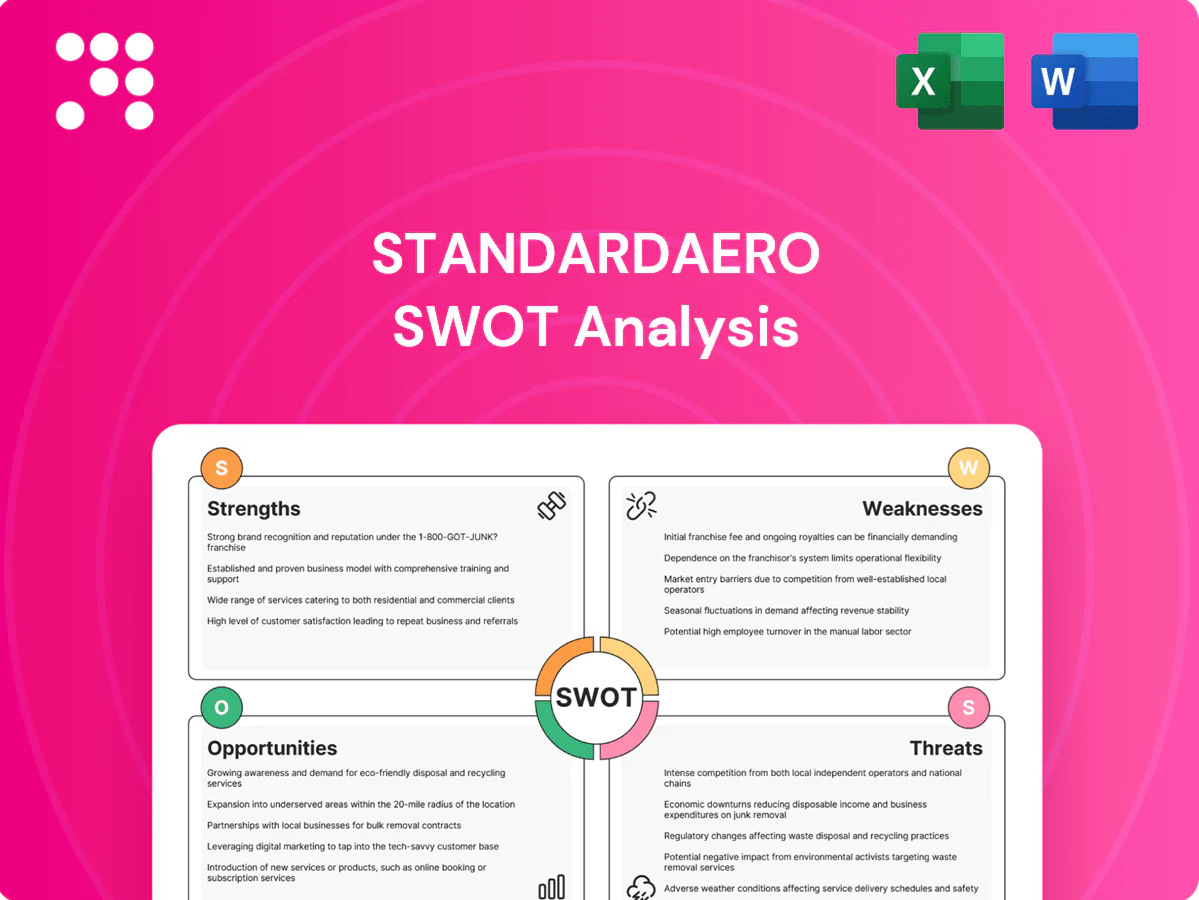
StandardAero SWOT Analysis

Go Beyond the Preview—Access the Full Strategic Report
StandardAero SWOT Analysis reveals strengths in MRO scale and global service network, weaknesses tied to cyclic aerospace demand, opportunities from aftermarket growth and defense contracts, and threats from OEM competition and supply-chain pressures. Discover the full, research-backed SWOT with editable Word and Excel deliverables to support investment and strategy decisions. Purchase the complete report to unlock detailed insights and actionable recommendations.
Strengths

Broad, independent MRO portfolio
StandardAero services engines, components and airframes across commercial, business and defense fleets, creating diversified revenue streams. Its independence from OEMs enables flexible turnarounds, competitive pricing and tailored workscopes. A comprehensive suite allows bundled solutions that reduce aircraft downtime, boosting customer stickiness and cross-selling across its global MRO footprint.
Deep turbine engine expertise
StandardAero supports a wide range of turbine engine families with specialized tooling, certified processes, and multi-regulatory approvals, enabling consistent maintenance across legacy and current platforms.
Deep experience across engine types improves first-time fix rates and in-service reliability through targeted diagnostics and repair protocols.
Advanced engineering capabilities deliver complex repairs and life-extension solutions, underpinning premium service levels and strong repeat business.

Global customer mix and end-market balance
StandardAero’s customer mix across airlines, business aviation, military, and governments reduces demand volatility by diversifying end-markets and revenue streams. Geographic spread mitigates regional economic cycles and regulatory differences, supporting fleet access and parts flow. Stable defense and government contracts cushion commercial downturns, aiding capacity utilization and delivering more predictable cash flows.

OEM authorizations and quality certifications
StandardAero holds OEM authorizations from GE Aerospace, Pratt & Whitney, Rolls‑Royce, Honeywell and airframe makers, granting access to IP, parts and factory repair specifications essential for modern turbofan and helicopter engines. Meeting FAA, EASA and OEM quality standards strengthens trust with Tier‑1 airlines and defense customers and enables entry into high‑value, regulated programs such as engine LLP repairs and OEM-managed sustainment. This verified credibility acts as a durable competitive moat in the global MRO market.
- OEM approvals: GE, P&W, Rolls‑Royce, Honeywell, Boeing/Airbus
- Regulatory: FAA and EASA certifications
- Enables: LLP, shop visits and OEM sustainment contracts
Integrated turnaround and reliability performance
Integrated process maturity and program management give StandardAero consistent turnaround times and on-wing reliability across engines, components and airframes, minimizing logistics handoffs and downtime. Strong TAT and proven reliability reduce customers’ total cost of ownership and support the economics of long-term service agreements. Operational performance metrics are used to reinforce multi-year contracts and service guarantees.
- Integrated engine/component/airframe capabilities
- Reduced logistics handoffs, faster TAT
- Lower customer total cost of ownership
- Performance metrics underpin LTSA
Diversified MRO: OEM-authorized, FAA/EASA certified, 50+ global sites reducing TAT
StandardAero provides diversified MRO across engines, components and airframes, enabling bundled solutions and high customer retention. OEM authorizations (GE, Pratt & Whitney, Rolls‑Royce, Honeywell, Boeing, Airbus) and FAA/EASA certifications secure access to IP, parts and LLP workscopes. Integrated global operations cut TAT and lower customer total cost of ownership, supporting long‑term contracts and stable defense revenue.
| Metric | Fact |
|---|---|
| OEM approvals | GE, P&W, RR, Honeywell, Boeing, Airbus |
| Regulatory | FAA, EASA |
| Global footprint | 50+ sites |
What is included in the product
 Detailed Word Document
Provides a concise SWOT analysis of StandardAero, highlighting internal strengths and weaknesses and external opportunities and threats that shape its competitive and strategic position in aerospace maintenance, repair and overhaul (MRO) services.

 Customizable Excel Spreadsheet
Provides a concise SWOT matrix tailored to StandardAero for rapid alignment of MRO and aerospace strategy teams, easing cross‑functional decision-making. Editable, presentation‑ready format lets users update competitive, regulatory, and operational insights quickly for stakeholder briefings.
Weaknesses

Dependence on OEM IP and licenses
Dependence on OEM IP and authorizations constrains StandardAero’s scope of work and squeezes margins by limiting access to cheaper aftermarket parts and repairs; unfavorable license renewals or tighter terms can increase costs over time. Restrictions on DER/PMA usage reduce key cost levers and spare-part alternatives, weakening StandardAero’s negotiating power with OEMs and exposing revenue to contract term shifts.
Capital- and labor-intensive operations
Engine shops demand heavy capex for tooling, test cells and spare inventory, raising fixed costs and breakeven risk during demand dips; global MRO margins tightened post‑2020. Skilled technicians are scarce and costly—U.S. Bureau of Labor Statistics reports median annual wage for aircraft mechanics and service technicians $69,450 (May 2023)—and continuous training is required for new platforms like LEAP and GE9X.

Program and platform concentration
StandardAero’s exposure to a few engine families concentrates revenue risk: major programs can account for a substantial share of MRO hours, so if a platform phases out or reliability improvements cut shop visits, revenue can fall sharply. Certification lead times for new engine work commonly range 12–36 months, slowing diversification. Shifting capacity between programs is operationally complex and can incur retooling and training costs in the low-to-mid tens of millions.

Pricing pressure and competitive tenders
Airlines and defense buyers run aggressive RFPs that compress MRO margins, while OEM-affiliated MROs bundle services and parts to undercut independents; extended warranties and power-by-the-hour constructs further shift price and availability risk onto MROs, making margin recovery difficult and differentiation beyond price challenging.
- Aggressive RFPs compress margins
- OEM bundles undercut independents
- PaaH/warranties shift risk to MROs
- Non-price differentiation remains hard
Supply chain complexity and parts availability
Supply chain complexity and limited availability of life‑limited parts and rotable components can extend StandardAero turn‑around times, with scarcity often forcing costly cannibalization or premium USM purchases. Reliance on a small set of specialized suppliers creates single‑source vulnerability and exposure to tier disruptions. Elevated inventory carrying costs strain working capital and compress margins.
- Extended TATs due to part lead times
- Costly cannibalization and USM procurement
- Single‑supplier vulnerability
- High inventory carrying costs
OEM IP reliance, high capex & scarce techs (median $69,450) risk breakeven
Dependence on OEM IP/authorizations limits repair scope and margins; DER/PMA restrictions reduce cost levers. High capex and technician scarcity (median wage $69,450, BLS May 2023) raise breakeven risk; certification lead times 12–36 months slow diversification. Revenue concentration on few engine families and supplier single‑source risks amplify demand and supply shocks.
| Metric | Value |
|---|---|
| Technician median wage | $69,450 (May 2023, BLS) |
| Certification lead time | 12–36 months |
| Retooling cost | Low–mid $10sM |
Preview Before You Purchase
StandardAero SWOT Analysis
This is the actual StandardAero SWOT analysis document you’ll receive upon purchase—no surprises, just professional quality. The preview below is taken directly from the full SWOT report you'll get, and the complete, editable version is unlocked after payment. Purchase to download the entire, ready-to-use analysis immediately.

Go Beyond the Preview—Access the Full Strategic Report
StandardAero SWOT Analysis reveals strengths in MRO scale and global service network, weaknesses tied to cyclic aerospace demand, opportunities from aftermarket growth and defense contracts, and threats from OEM competition and supply-chain pressures. Discover the full, research-backed SWOT with editable Word and Excel deliverables to support investment and strategy decisions. Purchase the complete report to unlock detailed insights and actionable recommendations.
Strengths
Broad, independent MRO portfolio
StandardAero services engines, components and airframes across commercial, business and defense fleets, creating diversified revenue streams. Its independence from OEMs enables flexible turnarounds, competitive pricing and tailored workscopes. A comprehensive suite allows bundled solutions that reduce aircraft downtime, boosting customer stickiness and cross-selling across its global MRO footprint.
Deep turbine engine expertise
StandardAero supports a wide range of turbine engine families with specialized tooling, certified processes, and multi-regulatory approvals, enabling consistent maintenance across legacy and current platforms.
Deep experience across engine types improves first-time fix rates and in-service reliability through targeted diagnostics and repair protocols.
Advanced engineering capabilities deliver complex repairs and life-extension solutions, underpinning premium service levels and strong repeat business.
Global customer mix and end-market balance
StandardAero’s customer mix across airlines, business aviation, military, and governments reduces demand volatility by diversifying end-markets and revenue streams. Geographic spread mitigates regional economic cycles and regulatory differences, supporting fleet access and parts flow. Stable defense and government contracts cushion commercial downturns, aiding capacity utilization and delivering more predictable cash flows.
OEM authorizations and quality certifications
StandardAero holds OEM authorizations from GE Aerospace, Pratt & Whitney, Rolls‑Royce, Honeywell and airframe makers, granting access to IP, parts and factory repair specifications essential for modern turbofan and helicopter engines. Meeting FAA, EASA and OEM quality standards strengthens trust with Tier‑1 airlines and defense customers and enables entry into high‑value, regulated programs such as engine LLP repairs and OEM-managed sustainment. This verified credibility acts as a durable competitive moat in the global MRO market.
- OEM approvals: GE, P&W, Rolls‑Royce, Honeywell, Boeing/Airbus
- Regulatory: FAA and EASA certifications
- Enables: LLP, shop visits and OEM sustainment contracts
Integrated turnaround and reliability performance
Integrated process maturity and program management give StandardAero consistent turnaround times and on-wing reliability across engines, components and airframes, minimizing logistics handoffs and downtime. Strong TAT and proven reliability reduce customers’ total cost of ownership and support the economics of long-term service agreements. Operational performance metrics are used to reinforce multi-year contracts and service guarantees.
- Integrated engine/component/airframe capabilities
- Reduced logistics handoffs, faster TAT
- Lower customer total cost of ownership
- Performance metrics underpin LTSA
Diversified MRO: OEM-authorized, FAA/EASA certified, 50+ global sites reducing TAT
StandardAero provides diversified MRO across engines, components and airframes, enabling bundled solutions and high customer retention. OEM authorizations (GE, Pratt & Whitney, Rolls‑Royce, Honeywell, Boeing, Airbus) and FAA/EASA certifications secure access to IP, parts and LLP workscopes. Integrated global operations cut TAT and lower customer total cost of ownership, supporting long‑term contracts and stable defense revenue.
| Metric | Fact |
|---|---|
| OEM approvals | GE, P&W, RR, Honeywell, Boeing, Airbus |
| Regulatory | FAA, EASA |
| Global footprint | 50+ sites |
What is included in the product
Detailed Word Document
Provides a concise SWOT analysis of StandardAero, highlighting internal strengths and weaknesses and external opportunities and threats that shape its competitive and strategic position in aerospace maintenance, repair and overhaul (MRO) services.
Customizable Excel Spreadsheet
Provides a concise SWOT matrix tailored to StandardAero for rapid alignment of MRO and aerospace strategy teams, easing cross‑functional decision-making. Editable, presentation‑ready format lets users update competitive, regulatory, and operational insights quickly for stakeholder briefings.
Weaknesses
Dependence on OEM IP and licenses
Dependence on OEM IP and authorizations constrains StandardAero’s scope of work and squeezes margins by limiting access to cheaper aftermarket parts and repairs; unfavorable license renewals or tighter terms can increase costs over time. Restrictions on DER/PMA usage reduce key cost levers and spare-part alternatives, weakening StandardAero’s negotiating power with OEMs and exposing revenue to contract term shifts.
Capital- and labor-intensive operations
Engine shops demand heavy capex for tooling, test cells and spare inventory, raising fixed costs and breakeven risk during demand dips; global MRO margins tightened post‑2020. Skilled technicians are scarce and costly—U.S. Bureau of Labor Statistics reports median annual wage for aircraft mechanics and service technicians $69,450 (May 2023)—and continuous training is required for new platforms like LEAP and GE9X.
Program and platform concentration
StandardAero’s exposure to a few engine families concentrates revenue risk: major programs can account for a substantial share of MRO hours, so if a platform phases out or reliability improvements cut shop visits, revenue can fall sharply. Certification lead times for new engine work commonly range 12–36 months, slowing diversification. Shifting capacity between programs is operationally complex and can incur retooling and training costs in the low-to-mid tens of millions.
Pricing pressure and competitive tenders
Airlines and defense buyers run aggressive RFPs that compress MRO margins, while OEM-affiliated MROs bundle services and parts to undercut independents; extended warranties and power-by-the-hour constructs further shift price and availability risk onto MROs, making margin recovery difficult and differentiation beyond price challenging.
- Aggressive RFPs compress margins
- OEM bundles undercut independents
- PaaH/warranties shift risk to MROs
- Non-price differentiation remains hard
Supply chain complexity and parts availability
Supply chain complexity and limited availability of life‑limited parts and rotable components can extend StandardAero turn‑around times, with scarcity often forcing costly cannibalization or premium USM purchases. Reliance on a small set of specialized suppliers creates single‑source vulnerability and exposure to tier disruptions. Elevated inventory carrying costs strain working capital and compress margins.
- Extended TATs due to part lead times
- Costly cannibalization and USM procurement
- Single‑supplier vulnerability
- High inventory carrying costs
OEM IP reliance, high capex & scarce techs (median $69,450) risk breakeven
Dependence on OEM IP/authorizations limits repair scope and margins; DER/PMA restrictions reduce cost levers. High capex and technician scarcity (median wage $69,450, BLS May 2023) raise breakeven risk; certification lead times 12–36 months slow diversification. Revenue concentration on few engine families and supplier single‑source risks amplify demand and supply shocks.
| Metric | Value |
|---|---|
| Technician median wage | $69,450 (May 2023, BLS) |
| Certification lead time | 12–36 months |
| Retooling cost | Low–mid $10sM |
Preview Before You Purchase
StandardAero SWOT Analysis
This is the actual StandardAero SWOT analysis document you’ll receive upon purchase—no surprises, just professional quality. The preview below is taken directly from the full SWOT report you'll get, and the complete, editable version is unlocked after payment. Purchase to download the entire, ready-to-use analysis immediately.
Original: $10.00
-65%$10.00
$3.50Description
Go Beyond the Preview—Access the Full Strategic Report
StandardAero SWOT Analysis reveals strengths in MRO scale and global service network, weaknesses tied to cyclic aerospace demand, opportunities from aftermarket growth and defense contracts, and threats from OEM competition and supply-chain pressures. Discover the full, research-backed SWOT with editable Word and Excel deliverables to support investment and strategy decisions. Purchase the complete report to unlock detailed insights and actionable recommendations.
Strengths
Broad, independent MRO portfolio
StandardAero services engines, components and airframes across commercial, business and defense fleets, creating diversified revenue streams. Its independence from OEMs enables flexible turnarounds, competitive pricing and tailored workscopes. A comprehensive suite allows bundled solutions that reduce aircraft downtime, boosting customer stickiness and cross-selling across its global MRO footprint.
Deep turbine engine expertise
StandardAero supports a wide range of turbine engine families with specialized tooling, certified processes, and multi-regulatory approvals, enabling consistent maintenance across legacy and current platforms.
Deep experience across engine types improves first-time fix rates and in-service reliability through targeted diagnostics and repair protocols.
Advanced engineering capabilities deliver complex repairs and life-extension solutions, underpinning premium service levels and strong repeat business.
Global customer mix and end-market balance
StandardAero’s customer mix across airlines, business aviation, military, and governments reduces demand volatility by diversifying end-markets and revenue streams. Geographic spread mitigates regional economic cycles and regulatory differences, supporting fleet access and parts flow. Stable defense and government contracts cushion commercial downturns, aiding capacity utilization and delivering more predictable cash flows.
OEM authorizations and quality certifications
StandardAero holds OEM authorizations from GE Aerospace, Pratt & Whitney, Rolls‑Royce, Honeywell and airframe makers, granting access to IP, parts and factory repair specifications essential for modern turbofan and helicopter engines. Meeting FAA, EASA and OEM quality standards strengthens trust with Tier‑1 airlines and defense customers and enables entry into high‑value, regulated programs such as engine LLP repairs and OEM-managed sustainment. This verified credibility acts as a durable competitive moat in the global MRO market.
- OEM approvals: GE, P&W, Rolls‑Royce, Honeywell, Boeing/Airbus
- Regulatory: FAA and EASA certifications
- Enables: LLP, shop visits and OEM sustainment contracts
Integrated turnaround and reliability performance
Integrated process maturity and program management give StandardAero consistent turnaround times and on-wing reliability across engines, components and airframes, minimizing logistics handoffs and downtime. Strong TAT and proven reliability reduce customers’ total cost of ownership and support the economics of long-term service agreements. Operational performance metrics are used to reinforce multi-year contracts and service guarantees.
- Integrated engine/component/airframe capabilities
- Reduced logistics handoffs, faster TAT
- Lower customer total cost of ownership
- Performance metrics underpin LTSA
Diversified MRO: OEM-authorized, FAA/EASA certified, 50+ global sites reducing TAT
StandardAero provides diversified MRO across engines, components and airframes, enabling bundled solutions and high customer retention. OEM authorizations (GE, Pratt & Whitney, Rolls‑Royce, Honeywell, Boeing, Airbus) and FAA/EASA certifications secure access to IP, parts and LLP workscopes. Integrated global operations cut TAT and lower customer total cost of ownership, supporting long‑term contracts and stable defense revenue.
| Metric | Fact |
|---|---|
| OEM approvals | GE, P&W, RR, Honeywell, Boeing, Airbus |
| Regulatory | FAA, EASA |
| Global footprint | 50+ sites |
What is included in the product
Detailed Word Document
Provides a concise SWOT analysis of StandardAero, highlighting internal strengths and weaknesses and external opportunities and threats that shape its competitive and strategic position in aerospace maintenance, repair and overhaul (MRO) services.
Customizable Excel Spreadsheet
Provides a concise SWOT matrix tailored to StandardAero for rapid alignment of MRO and aerospace strategy teams, easing cross‑functional decision-making. Editable, presentation‑ready format lets users update competitive, regulatory, and operational insights quickly for stakeholder briefings.
Weaknesses
Dependence on OEM IP and licenses
Dependence on OEM IP and authorizations constrains StandardAero’s scope of work and squeezes margins by limiting access to cheaper aftermarket parts and repairs; unfavorable license renewals or tighter terms can increase costs over time. Restrictions on DER/PMA usage reduce key cost levers and spare-part alternatives, weakening StandardAero’s negotiating power with OEMs and exposing revenue to contract term shifts.
Capital- and labor-intensive operations
Engine shops demand heavy capex for tooling, test cells and spare inventory, raising fixed costs and breakeven risk during demand dips; global MRO margins tightened post‑2020. Skilled technicians are scarce and costly—U.S. Bureau of Labor Statistics reports median annual wage for aircraft mechanics and service technicians $69,450 (May 2023)—and continuous training is required for new platforms like LEAP and GE9X.
Program and platform concentration
StandardAero’s exposure to a few engine families concentrates revenue risk: major programs can account for a substantial share of MRO hours, so if a platform phases out or reliability improvements cut shop visits, revenue can fall sharply. Certification lead times for new engine work commonly range 12–36 months, slowing diversification. Shifting capacity between programs is operationally complex and can incur retooling and training costs in the low-to-mid tens of millions.
Pricing pressure and competitive tenders
Airlines and defense buyers run aggressive RFPs that compress MRO margins, while OEM-affiliated MROs bundle services and parts to undercut independents; extended warranties and power-by-the-hour constructs further shift price and availability risk onto MROs, making margin recovery difficult and differentiation beyond price challenging.
- Aggressive RFPs compress margins
- OEM bundles undercut independents
- PaaH/warranties shift risk to MROs
- Non-price differentiation remains hard
Supply chain complexity and parts availability
Supply chain complexity and limited availability of life‑limited parts and rotable components can extend StandardAero turn‑around times, with scarcity often forcing costly cannibalization or premium USM purchases. Reliance on a small set of specialized suppliers creates single‑source vulnerability and exposure to tier disruptions. Elevated inventory carrying costs strain working capital and compress margins.
- Extended TATs due to part lead times
- Costly cannibalization and USM procurement
- Single‑supplier vulnerability
- High inventory carrying costs
OEM IP reliance, high capex & scarce techs (median $69,450) risk breakeven
Dependence on OEM IP/authorizations limits repair scope and margins; DER/PMA restrictions reduce cost levers. High capex and technician scarcity (median wage $69,450, BLS May 2023) raise breakeven risk; certification lead times 12–36 months slow diversification. Revenue concentration on few engine families and supplier single‑source risks amplify demand and supply shocks.
| Metric | Value |
|---|---|
| Technician median wage | $69,450 (May 2023, BLS) |
| Certification lead time | 12–36 months |
| Retooling cost | Low–mid $10sM |
Preview Before You Purchase
StandardAero SWOT Analysis
This is the actual StandardAero SWOT analysis document you’ll receive upon purchase—no surprises, just professional quality. The preview below is taken directly from the full SWOT report you'll get, and the complete, editable version is unlocked after payment. Purchase to download the entire, ready-to-use analysis immediately.











