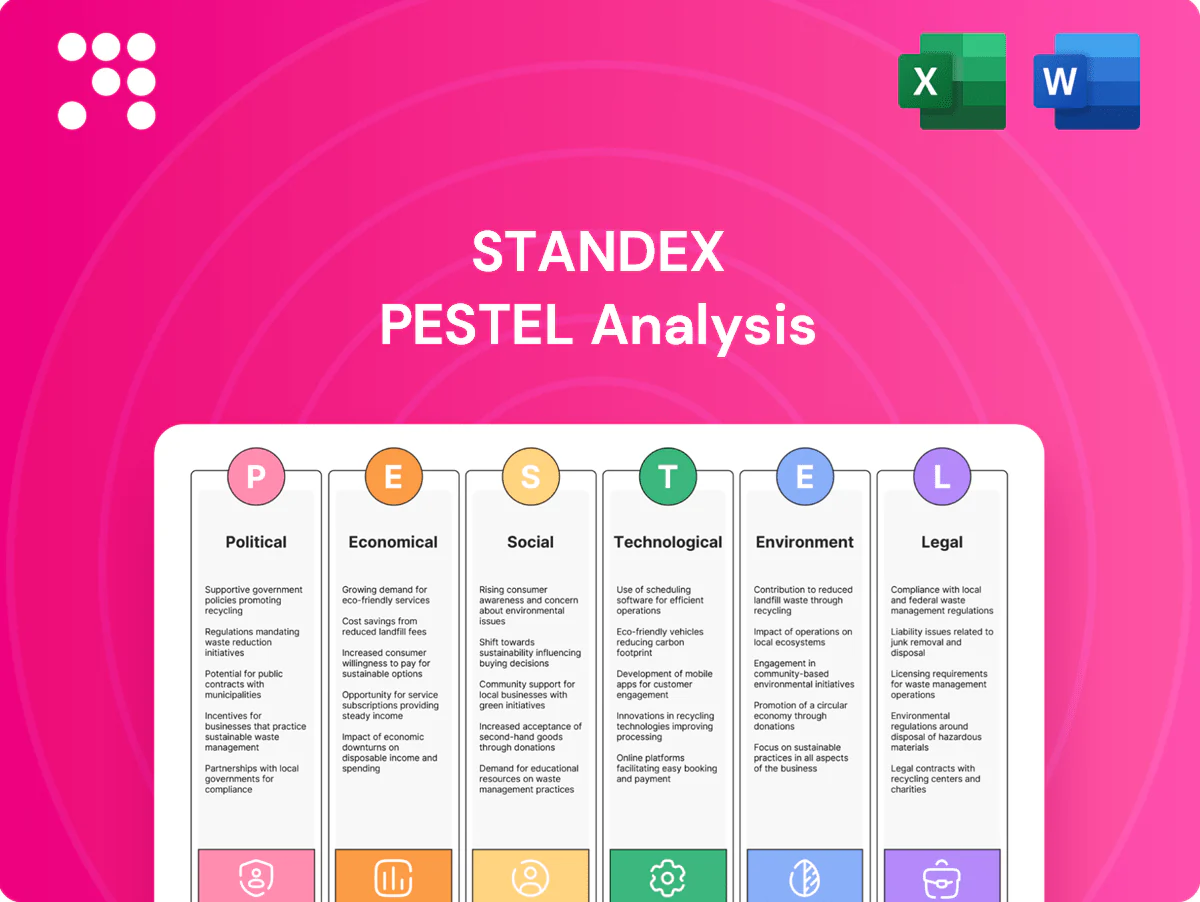
Standex PESTLE Analysis

Your Shortcut to Market Insight Starts Here
Gain a competitive edge with our targeted PESTLE Analysis of Standex—three to five expert-level insights reveal how political, economic, social, technological, legal, and environmental forces shape its outlook. Ideal for investors and strategists, this ready-to-use report helps you spot risks and opportunities fast. Buy the full version to access the complete, editable analysis immediately.
Political factors

Trade policy shifts
Standex’s global supply chains and customer base are exposed to tariffs, export controls and local-content rules that can raise costs and delay deliveries; U.S. Section 301 tariffs still cover roughly $370 billion of Chinese imports at rates up to 25%. Changes in U.S.–China and EU trade relations, plus semiconductor export controls, can alter sourcing costs and lead times for electronics and engineered components. Proactive tariff engineering and supplier diversification reduce disruption and cost volatility. Government incentives such as the U.S. CHIPS Act ($52 billion) can reshape plant-location economics and sourcing decisions.
Geopolitical instability
Geopolitical instability — e.g., the Russia–Ukraine war and expanded sanctions since 2022 — can impede cross-border shipments and payments, triggering export controls and banking de-risking that raise logistics costs. Aerospace and automotive customers often delay programs when geopolitical risk rises; supply-chain surveys in 2024 showed increased program delays and order deferrals. Scenario planning and inventory buffers preserve service levels and mitigate downtime. Regional manufacturing footprints reduce single-country concentration risk and improve resilience amid 3.2% IMF global growth headwinds.

Industrial policy incentives
US industrial incentives such as the CHIPS Act's $52 billion for semiconductors and the Inflation Reduction Act's roughly $369 billion in clean energy investments, plus EV consumer tax credits up to $7,500, can boost demand for Standex’s electronics and engineering segments. Securing grants or tax credits reduces effective capex and R&D costs. Monitoring eligibility windows and partnering with local agencies speeds bid timing and approvals.

Public procurement dynamics
Defense and aerospace programs for Standex track government budgets and election cycles, with the US FY2025 DoD budget request at about 842 billion USD shaping contract timing and volume; multi-year funding profiles enable investment in long-lead tooling and engineering technologies and reduce program risk, while strict compliance with procurement standards is essential to retain vendor status and win renewals; visibility into appropriations supports capacity and workforce planning.
- FY2025 DoD request ~842B USD
- Multi-year awards enable long-lead tooling
- Procurement compliance = vendor retention
- Appropriations visibility aids capacity planning
Localization and reshoring
Policies like the US CHIPS Act (roughly $52B) and the Inflation Reduction Act (about $369B) push North American and European customers toward domestic production, forcing Standex to align manufacturing and service capabilities nearer customer plants; this can boost responsiveness but raises transitional capex and supply-chain setup costs. Strategic site choice must weigh incentives versus local labor and logistics.
- Impact: incentive-driven demand shift
- Consequence: closer plants, higher capex
- Trade-off: faster response vs transitional cost
- Decision factors: incentives, labor, logistics
Tariffs, export controls and CHIPS/IRA onshoring raise costs and delay defense programs
Standex faces tariffs and export controls (US Section 301 covers ~370B USD of Chinese imports), semiconductor curbs and geopolitics that raise costs and lead times. US CHIPS (52B USD) and IRA (~369B USD) drive onshoring and higher capex. FY2025 DoD request ~842B USD shapes aerospace program timing and compliance.
| Factor | Metric | Impact |
|---|---|---|
| Tariffs/export controls | ~370B USD | Higher costs, delays |
| Incentives | CHIPS 52B / IRA ~369B USD | Onshoring, capex |
| Defense budgets | DoD ~842B USD (FY2025) | Program timing, compliance |
What is included in the product
 Detailed Word Document
Explores how macro-environmental factors affect Standex across Political, Economic, Social, Technological, Environmental and Legal dimensions, with data-backed trends and forward-looking insights to support scenario planning; designed for executives, consultants and investors, formatted for easy inclusion in plans, decks and reports.

 Customizable Excel Spreadsheet
A concise, visually segmented PESTLE summary for Standex that’s easily shareable and editable for region or business-line notes, drop‑in ready for presentations and group planning, helping teams quickly align on external risks and strategic positioning.
Economic factors

Industrial demand cycles
Standex serves cyclical markets—automotive, aerospace and food‑service equipment—where FY2024 revenue was roughly $800m and adjusted operating margin about 12%. Macro slowdowns cut capex and tooling orders, while recoveries expand backlog; a diversified segment mix smooths volatility and flexible cost structures plus pricing discipline help protect margins.
Interest rates and capex
Higher rates (Fed funds 5.25–5.50% in 2024–25) raise borrowing costs for Standex and customers, dampening equipment purchases and elevating inventory carrying costs; durable goods orders fell in 2024, constraining engraving and specialty demand. Lower rates can unlock deferred projects in engraving and specialty solutions. Hedging and prudent leverage preserve liquidity and covenant headroom. ROI hurdles and project cut‑offs must be reset to reflect a higher market WACC and corporate yield environment near 5%.

FX and currency exposure
Standex's global sales and sourcing expose it to translation and transaction risk; with 2024 net sales roughly $877 million and about 36% generated outside the US, FX swings materially affect reported results. A strong US dollar (DXY ~105 in 2024–mid‑2025) can compress reported revenue and weaken price competitiveness abroad. Local production and currency-matched costs provide natural hedges, while selective financial hedges cover residual exposures.

Commodity and input prices
Metals (LME copper ~9,000 USD/ton mid-2024–25), resins (PE ~0.80 USD/lb 2024 US average), electronics components and energy (Brent ~80 USD/bbl, Henry Hub ~3–4 USD/MMBtu) materially raise Standex COGS; supply tightness extends lead times and forces redesigns, while index-based pricing and multi-sourcing preserve margins and inventory optimization balances price risk with service levels.
- Metals: LME copper ~9,000 USD/ton
- Resins: PE ~0.80 USD/lb (2024 US avg)
- Energy: Brent ~80 USD/bbl; Henry Hub ~3–4 USD/MMBtu
- Mitigation: index-pricing, multi-sourcing, inventory optimization
Labor availability and costs
Tight skilled-labor markets are pressuring wages and constraining throughput in precision manufacturing; BLS data showed manufacturing job openings stayed elevated through 2024, sustaining upward wage pressure with average hourly earnings in manufacturing rising roughly 4.5% YoY in 2024.
Standex can mitigate risk via targeted training, automation and richer benefits to boost retention; geographic dispersion lets firms arbitrage labor pools and lower costs.
Productivity programs and lean initiatives have offset part of inflationary labor cost increases, preserving margins.
- job openings >600,000 (2024)
- wage growth ~4.5% YoY (2024)
- automation & training reduce churn
- geographic dispersion enables labor arbitrage
Tariffs, export controls and CHIPS/IRA onshoring raise costs and delay defense programs
Standex FY2024 sales ~$877m with adjusted operating margin ~12%; cyclicality in auto/aero/food drives backlog swings. Fed funds 5.25–5.50% (2024–25) and DXY ~105 pressure capex, borrowing and FX translation. Key input costs: LME copper ~9,000 USD/ton, PE ~0.80 USD/lb, Brent ~80 USD/bbl; manufacturing wages +4.5% YoY (2024), job openings >600,000.
| Metric | 2024–25 Value |
|---|---|
| Revenue (FY2024) | ~877m USD |
| Adj. Op Margin | ~12% |
| Fed funds | 5.25–5.50% |
| DXY | ~105 |
| Copper | ~9,000 USD/ton |
| PE | ~0.80 USD/lb |
| Brent | ~80 USD/bbl |
| Wage growth | ~4.5% YoY |
What You See Is What You Get
Standex PESTLE Analysis
This Standex PESTLE Analysis preview is the exact, fully formatted document you’ll receive after purchase. The layout, content, and structure shown here are final and ready to download. No placeholders or teasers—what you see is what you’ll get.

Your Shortcut to Market Insight Starts Here
Gain a competitive edge with our targeted PESTLE Analysis of Standex—three to five expert-level insights reveal how political, economic, social, technological, legal, and environmental forces shape its outlook. Ideal for investors and strategists, this ready-to-use report helps you spot risks and opportunities fast. Buy the full version to access the complete, editable analysis immediately.
Political factors
Trade policy shifts
Standex’s global supply chains and customer base are exposed to tariffs, export controls and local-content rules that can raise costs and delay deliveries; U.S. Section 301 tariffs still cover roughly $370 billion of Chinese imports at rates up to 25%. Changes in U.S.–China and EU trade relations, plus semiconductor export controls, can alter sourcing costs and lead times for electronics and engineered components. Proactive tariff engineering and supplier diversification reduce disruption and cost volatility. Government incentives such as the U.S. CHIPS Act ($52 billion) can reshape plant-location economics and sourcing decisions.
Geopolitical instability
Geopolitical instability — e.g., the Russia–Ukraine war and expanded sanctions since 2022 — can impede cross-border shipments and payments, triggering export controls and banking de-risking that raise logistics costs. Aerospace and automotive customers often delay programs when geopolitical risk rises; supply-chain surveys in 2024 showed increased program delays and order deferrals. Scenario planning and inventory buffers preserve service levels and mitigate downtime. Regional manufacturing footprints reduce single-country concentration risk and improve resilience amid 3.2% IMF global growth headwinds.
Industrial policy incentives
US industrial incentives such as the CHIPS Act's $52 billion for semiconductors and the Inflation Reduction Act's roughly $369 billion in clean energy investments, plus EV consumer tax credits up to $7,500, can boost demand for Standex’s electronics and engineering segments. Securing grants or tax credits reduces effective capex and R&D costs. Monitoring eligibility windows and partnering with local agencies speeds bid timing and approvals.
Public procurement dynamics
Defense and aerospace programs for Standex track government budgets and election cycles, with the US FY2025 DoD budget request at about 842 billion USD shaping contract timing and volume; multi-year funding profiles enable investment in long-lead tooling and engineering technologies and reduce program risk, while strict compliance with procurement standards is essential to retain vendor status and win renewals; visibility into appropriations supports capacity and workforce planning.
- FY2025 DoD request ~842B USD
- Multi-year awards enable long-lead tooling
- Procurement compliance = vendor retention
- Appropriations visibility aids capacity planning
Localization and reshoring
Policies like the US CHIPS Act (roughly $52B) and the Inflation Reduction Act (about $369B) push North American and European customers toward domestic production, forcing Standex to align manufacturing and service capabilities nearer customer plants; this can boost responsiveness but raises transitional capex and supply-chain setup costs. Strategic site choice must weigh incentives versus local labor and logistics.
- Impact: incentive-driven demand shift
- Consequence: closer plants, higher capex
- Trade-off: faster response vs transitional cost
- Decision factors: incentives, labor, logistics
Tariffs, export controls and CHIPS/IRA onshoring raise costs and delay defense programs
Standex faces tariffs and export controls (US Section 301 covers ~370B USD of Chinese imports), semiconductor curbs and geopolitics that raise costs and lead times. US CHIPS (52B USD) and IRA (~369B USD) drive onshoring and higher capex. FY2025 DoD request ~842B USD shapes aerospace program timing and compliance.
| Factor | Metric | Impact |
|---|---|---|
| Tariffs/export controls | ~370B USD | Higher costs, delays |
| Incentives | CHIPS 52B / IRA ~369B USD | Onshoring, capex |
| Defense budgets | DoD ~842B USD (FY2025) | Program timing, compliance |
What is included in the product
Detailed Word Document
Explores how macro-environmental factors affect Standex across Political, Economic, Social, Technological, Environmental and Legal dimensions, with data-backed trends and forward-looking insights to support scenario planning; designed for executives, consultants and investors, formatted for easy inclusion in plans, decks and reports.
Customizable Excel Spreadsheet
A concise, visually segmented PESTLE summary for Standex that’s easily shareable and editable for region or business-line notes, drop‑in ready for presentations and group planning, helping teams quickly align on external risks and strategic positioning.
Economic factors
Industrial demand cycles
Standex serves cyclical markets—automotive, aerospace and food‑service equipment—where FY2024 revenue was roughly $800m and adjusted operating margin about 12%. Macro slowdowns cut capex and tooling orders, while recoveries expand backlog; a diversified segment mix smooths volatility and flexible cost structures plus pricing discipline help protect margins.
Interest rates and capex
Higher rates (Fed funds 5.25–5.50% in 2024–25) raise borrowing costs for Standex and customers, dampening equipment purchases and elevating inventory carrying costs; durable goods orders fell in 2024, constraining engraving and specialty demand. Lower rates can unlock deferred projects in engraving and specialty solutions. Hedging and prudent leverage preserve liquidity and covenant headroom. ROI hurdles and project cut‑offs must be reset to reflect a higher market WACC and corporate yield environment near 5%.
FX and currency exposure
Standex's global sales and sourcing expose it to translation and transaction risk; with 2024 net sales roughly $877 million and about 36% generated outside the US, FX swings materially affect reported results. A strong US dollar (DXY ~105 in 2024–mid‑2025) can compress reported revenue and weaken price competitiveness abroad. Local production and currency-matched costs provide natural hedges, while selective financial hedges cover residual exposures.
Commodity and input prices
Metals (LME copper ~9,000 USD/ton mid-2024–25), resins (PE ~0.80 USD/lb 2024 US average), electronics components and energy (Brent ~80 USD/bbl, Henry Hub ~3–4 USD/MMBtu) materially raise Standex COGS; supply tightness extends lead times and forces redesigns, while index-based pricing and multi-sourcing preserve margins and inventory optimization balances price risk with service levels.
- Metals: LME copper ~9,000 USD/ton
- Resins: PE ~0.80 USD/lb (2024 US avg)
- Energy: Brent ~80 USD/bbl; Henry Hub ~3–4 USD/MMBtu
- Mitigation: index-pricing, multi-sourcing, inventory optimization
Labor availability and costs
Tight skilled-labor markets are pressuring wages and constraining throughput in precision manufacturing; BLS data showed manufacturing job openings stayed elevated through 2024, sustaining upward wage pressure with average hourly earnings in manufacturing rising roughly 4.5% YoY in 2024.
Standex can mitigate risk via targeted training, automation and richer benefits to boost retention; geographic dispersion lets firms arbitrage labor pools and lower costs.
Productivity programs and lean initiatives have offset part of inflationary labor cost increases, preserving margins.
- job openings >600,000 (2024)
- wage growth ~4.5% YoY (2024)
- automation & training reduce churn
- geographic dispersion enables labor arbitrage
Tariffs, export controls and CHIPS/IRA onshoring raise costs and delay defense programs
Standex FY2024 sales ~$877m with adjusted operating margin ~12%; cyclicality in auto/aero/food drives backlog swings. Fed funds 5.25–5.50% (2024–25) and DXY ~105 pressure capex, borrowing and FX translation. Key input costs: LME copper ~9,000 USD/ton, PE ~0.80 USD/lb, Brent ~80 USD/bbl; manufacturing wages +4.5% YoY (2024), job openings >600,000.
| Metric | 2024–25 Value |
|---|---|
| Revenue (FY2024) | ~877m USD |
| Adj. Op Margin | ~12% |
| Fed funds | 5.25–5.50% |
| DXY | ~105 |
| Copper | ~9,000 USD/ton |
| PE | ~0.80 USD/lb |
| Brent | ~80 USD/bbl |
| Wage growth | ~4.5% YoY |
What You See Is What You Get
Standex PESTLE Analysis
This Standex PESTLE Analysis preview is the exact, fully formatted document you’ll receive after purchase. The layout, content, and structure shown here are final and ready to download. No placeholders or teasers—what you see is what you’ll get.
Original: $10.00
-65%$10.00
$3.50Description
Your Shortcut to Market Insight Starts Here
Gain a competitive edge with our targeted PESTLE Analysis of Standex—three to five expert-level insights reveal how political, economic, social, technological, legal, and environmental forces shape its outlook. Ideal for investors and strategists, this ready-to-use report helps you spot risks and opportunities fast. Buy the full version to access the complete, editable analysis immediately.
Political factors
Trade policy shifts
Standex’s global supply chains and customer base are exposed to tariffs, export controls and local-content rules that can raise costs and delay deliveries; U.S. Section 301 tariffs still cover roughly $370 billion of Chinese imports at rates up to 25%. Changes in U.S.–China and EU trade relations, plus semiconductor export controls, can alter sourcing costs and lead times for electronics and engineered components. Proactive tariff engineering and supplier diversification reduce disruption and cost volatility. Government incentives such as the U.S. CHIPS Act ($52 billion) can reshape plant-location economics and sourcing decisions.
Geopolitical instability
Geopolitical instability — e.g., the Russia–Ukraine war and expanded sanctions since 2022 — can impede cross-border shipments and payments, triggering export controls and banking de-risking that raise logistics costs. Aerospace and automotive customers often delay programs when geopolitical risk rises; supply-chain surveys in 2024 showed increased program delays and order deferrals. Scenario planning and inventory buffers preserve service levels and mitigate downtime. Regional manufacturing footprints reduce single-country concentration risk and improve resilience amid 3.2% IMF global growth headwinds.
Industrial policy incentives
US industrial incentives such as the CHIPS Act's $52 billion for semiconductors and the Inflation Reduction Act's roughly $369 billion in clean energy investments, plus EV consumer tax credits up to $7,500, can boost demand for Standex’s electronics and engineering segments. Securing grants or tax credits reduces effective capex and R&D costs. Monitoring eligibility windows and partnering with local agencies speeds bid timing and approvals.
Public procurement dynamics
Defense and aerospace programs for Standex track government budgets and election cycles, with the US FY2025 DoD budget request at about 842 billion USD shaping contract timing and volume; multi-year funding profiles enable investment in long-lead tooling and engineering technologies and reduce program risk, while strict compliance with procurement standards is essential to retain vendor status and win renewals; visibility into appropriations supports capacity and workforce planning.
- FY2025 DoD request ~842B USD
- Multi-year awards enable long-lead tooling
- Procurement compliance = vendor retention
- Appropriations visibility aids capacity planning
Localization and reshoring
Policies like the US CHIPS Act (roughly $52B) and the Inflation Reduction Act (about $369B) push North American and European customers toward domestic production, forcing Standex to align manufacturing and service capabilities nearer customer plants; this can boost responsiveness but raises transitional capex and supply-chain setup costs. Strategic site choice must weigh incentives versus local labor and logistics.
- Impact: incentive-driven demand shift
- Consequence: closer plants, higher capex
- Trade-off: faster response vs transitional cost
- Decision factors: incentives, labor, logistics
Tariffs, export controls and CHIPS/IRA onshoring raise costs and delay defense programs
Standex faces tariffs and export controls (US Section 301 covers ~370B USD of Chinese imports), semiconductor curbs and geopolitics that raise costs and lead times. US CHIPS (52B USD) and IRA (~369B USD) drive onshoring and higher capex. FY2025 DoD request ~842B USD shapes aerospace program timing and compliance.
| Factor | Metric | Impact |
|---|---|---|
| Tariffs/export controls | ~370B USD | Higher costs, delays |
| Incentives | CHIPS 52B / IRA ~369B USD | Onshoring, capex |
| Defense budgets | DoD ~842B USD (FY2025) | Program timing, compliance |
What is included in the product
Detailed Word Document
Explores how macro-environmental factors affect Standex across Political, Economic, Social, Technological, Environmental and Legal dimensions, with data-backed trends and forward-looking insights to support scenario planning; designed for executives, consultants and investors, formatted for easy inclusion in plans, decks and reports.
Customizable Excel Spreadsheet
A concise, visually segmented PESTLE summary for Standex that’s easily shareable and editable for region or business-line notes, drop‑in ready for presentations and group planning, helping teams quickly align on external risks and strategic positioning.
Economic factors
Industrial demand cycles
Standex serves cyclical markets—automotive, aerospace and food‑service equipment—where FY2024 revenue was roughly $800m and adjusted operating margin about 12%. Macro slowdowns cut capex and tooling orders, while recoveries expand backlog; a diversified segment mix smooths volatility and flexible cost structures plus pricing discipline help protect margins.
Interest rates and capex
Higher rates (Fed funds 5.25–5.50% in 2024–25) raise borrowing costs for Standex and customers, dampening equipment purchases and elevating inventory carrying costs; durable goods orders fell in 2024, constraining engraving and specialty demand. Lower rates can unlock deferred projects in engraving and specialty solutions. Hedging and prudent leverage preserve liquidity and covenant headroom. ROI hurdles and project cut‑offs must be reset to reflect a higher market WACC and corporate yield environment near 5%.
FX and currency exposure
Standex's global sales and sourcing expose it to translation and transaction risk; with 2024 net sales roughly $877 million and about 36% generated outside the US, FX swings materially affect reported results. A strong US dollar (DXY ~105 in 2024–mid‑2025) can compress reported revenue and weaken price competitiveness abroad. Local production and currency-matched costs provide natural hedges, while selective financial hedges cover residual exposures.
Commodity and input prices
Metals (LME copper ~9,000 USD/ton mid-2024–25), resins (PE ~0.80 USD/lb 2024 US average), electronics components and energy (Brent ~80 USD/bbl, Henry Hub ~3–4 USD/MMBtu) materially raise Standex COGS; supply tightness extends lead times and forces redesigns, while index-based pricing and multi-sourcing preserve margins and inventory optimization balances price risk with service levels.
- Metals: LME copper ~9,000 USD/ton
- Resins: PE ~0.80 USD/lb (2024 US avg)
- Energy: Brent ~80 USD/bbl; Henry Hub ~3–4 USD/MMBtu
- Mitigation: index-pricing, multi-sourcing, inventory optimization
Labor availability and costs
Tight skilled-labor markets are pressuring wages and constraining throughput in precision manufacturing; BLS data showed manufacturing job openings stayed elevated through 2024, sustaining upward wage pressure with average hourly earnings in manufacturing rising roughly 4.5% YoY in 2024.
Standex can mitigate risk via targeted training, automation and richer benefits to boost retention; geographic dispersion lets firms arbitrage labor pools and lower costs.
Productivity programs and lean initiatives have offset part of inflationary labor cost increases, preserving margins.
- job openings >600,000 (2024)
- wage growth ~4.5% YoY (2024)
- automation & training reduce churn
- geographic dispersion enables labor arbitrage
Tariffs, export controls and CHIPS/IRA onshoring raise costs and delay defense programs
Standex FY2024 sales ~$877m with adjusted operating margin ~12%; cyclicality in auto/aero/food drives backlog swings. Fed funds 5.25–5.50% (2024–25) and DXY ~105 pressure capex, borrowing and FX translation. Key input costs: LME copper ~9,000 USD/ton, PE ~0.80 USD/lb, Brent ~80 USD/bbl; manufacturing wages +4.5% YoY (2024), job openings >600,000.
| Metric | 2024–25 Value |
|---|---|
| Revenue (FY2024) | ~877m USD |
| Adj. Op Margin | ~12% |
| Fed funds | 5.25–5.50% |
| DXY | ~105 |
| Copper | ~9,000 USD/ton |
| PE | ~0.80 USD/lb |
| Brent | ~80 USD/bbl |
| Wage growth | ~4.5% YoY |
What You See Is What You Get
Standex PESTLE Analysis
This Standex PESTLE Analysis preview is the exact, fully formatted document you’ll receive after purchase. The layout, content, and structure shown here are final and ready to download. No placeholders or teasers—what you see is what you’ll get.











