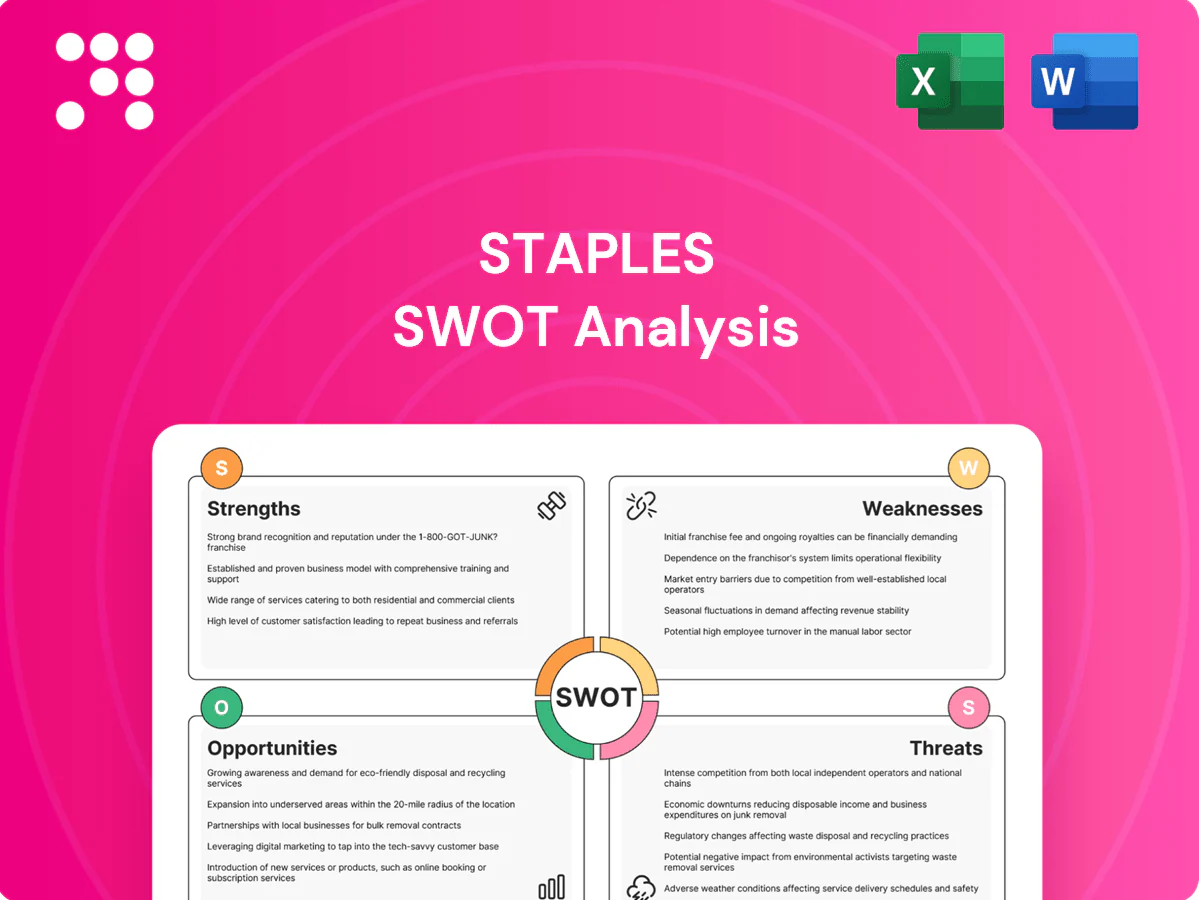
Staples SWOT Analysis

Go Beyond the Preview—Access the Full Strategic Report
Staples’ SWOT analysis highlights resilient omnichannel strength, cost pressures from retail rivals, and opportunities in B2B services and sustainability-driven demand. Understand risks from supply chains and digital disruption. Purchase the full SWOT analysis for an editable, research-backed report to inform strategy or investment.
Strengths

Omnichannel reach
Staples leverages an omnichannel footprint with over 1,000 retail locations plus a robust e-commerce platform and dedicated B2B sales force, meeting customers wherever they buy.
This breadth delivers convenience, regional coverage and rapid fulfillment, enabling buy-online-pickup-in-store (BOPIS) and same-day delivery in hundreds of markets.
The integrated network smooths demand volatility by shifting volumes across stores, web and B2B channels.
B2B contracts scale
B2B contracts with over 1.5 million business customers drive recurring revenue and larger basket sizes, stabilizing Staples' cash flows. Contract pricing, dedicated account reps and delivery programs raise switching costs and retention. Scale boosts purchasing leverage with vendors, lowering unit costs, and improves demand visibility for inventory planning and fulfillment.

Service portfolio breadth
Staples bundles copy/print, tech support and repair services alongside product sales to deepen customer relationships and capture higher-margin revenue streams. These services boost store traffic and cross-sell potential, leveraging Staples' network of about 1,000 North American stores to drive repeat visits. They help differentiate Staples from pure e-commerce rivals by offering in-person, same-day solutions that online-only competitors cannot match.

Private label and sourcing power
Staples-branded products deliver higher gross margins and tighter price control, letting the company protect profitability while offering everyday value. Scale procurement lowers unit costs across core categories, enabling competitive pricing that preserves margin. Exclusive SKUs reduce direct price comparisons and strengthen customer retention through differentiated assortments.
- Higher gross margins
- Scale-driven lower unit costs
- Exclusive SKUs
- Defends everyday pricing
Brand recognition in workplace needs
Staples, founded in 1986, is a well-known North American name for office and workplace supplies and services, with nearly four decades of brand presence that underpins trust for essentials and business services. This familiarity lowers acquisition friction for SMBs and home offices, improves marketing efficiency through recognized branding, and contributes to repeat purchase loyalty across retail and B2B channels.
- Founded 1986 — ~39 years brand history
- North American retail and B2B presence
- Drives SMB and home-office customer acquisition
- Enhances marketing efficiency and loyalty
Omnichannel office network: 1,000 stores 1.5M B2B clients
Staples operates an omnichannel network of about 1,000 North American stores plus a robust e-commerce and B2B sales force, enabling BOPIS and same-day fulfillment.
B2B contracts with ~1.5 million business customers drive recurring revenue and higher average order sizes, stabilizing cash flows.
Scale enables lower unit costs and exclusive SKUs that protect margins and deter direct price comparison.
Founded 1986, brand recognition supports SMB and home-office loyalty.
| Metric | Value |
|---|---|
| Retail locations | ~1,000 |
| B2B customers | ~1.5M |
| Founded | 1986 (~39 yrs) |
What is included in the product
 Detailed Word Document
Provides a concise SWOT analysis of Staples, highlighting internal strengths and weaknesses and external opportunities and threats shaping its retail and B2B office-supply strategy.

 Customizable Excel Spreadsheet
Delivers a focused Staples SWOT matrix that pinpoints operational pain points and clear mitigation opportunities for rapid strategic alignment and decision-making.
Weaknesses

Legacy store footprint
Staples' legacy footprint of roughly 1,000 retail locations imposes high fixed costs as in-store foot traffic remains below pre‑pandemic levels, pressuring profitability. Underutilized square footage erodes store‑level margins and increases inventory/operational inefficiencies. Long‑term lease obligations restrict flexibility during downturns, while store rationalization would require significant cash outlays and months of execution.
Commoditized categories
Paper, ink and basic peripherals face intense price competition, driving down average selling prices and compressing gross margins. Low differentiation in these commoditized categories limits Staples' ability to charge premiums. Online price transparency—Amazon held roughly 38% of US e-commerce in 2024—erodes pricing power. Heavy promotional dependence trains customers to wait for deals, reducing margin stability.

Exposure to office demand cycles
Staples remains exposed as work-from-home and hybrid trends shift purchasing from office to home — U.S. office occupancy averaged about 54% in 2024 (Kastle), reducing in-office demand. Corporate procurement freezes have led to rapid, often double-digit volume declines in office categories, amplifying seasonality from back-to-school (roughly 20% of annual school/office product demand). Forecasting errors during these swings drive markdowns or stockouts, pressuring margins and working capital.

Perception as “office-only”
Perception as office-only limits Staples: consumer mindshare often does not extend to broader workplace and tech services, narrowing top-of-funnel traffic versus big-box peers that bundle groceries, home goods and services. Brand repositioning will require sustained marketing and capex to shift purchase intent, while cross-category attachment rates (office supplies to tech/services) remain below potential.
- Office-focused image
- Lower discovery vs big-box
- Needs sustained investment
- Attachment rates underperform
Limited international diversification
Limited international diversification leaves Staples heavily dependent on North American revenue, increasing sensitivity to US/Canada economic cycles and domestic competitive shocks. Reduced exposure to faster-growing APAC and Latin American markets limits offsetting growth and scale benefits. Currency and geopolitical hedges are modest, constraining resilience against regional disruptions.
- Regional revenue concentration
- Missed growth markets
- Limited currency/geopolitical hedge
- Domestic shocks amplified
Large store network, 54% office occupancy and 38% e‑commerce share squeeze margins
Staples' ~1,000 stores create high fixed costs and underused space as US office occupancy was ~54% in 2024, pressuring margins. Commoditized SKUs and Amazon's ~38% share of US e‑commerce in 2024 erode pricing power. Heavy domestic concentration limits growth diversification.
| Metric | 2024 |
|---|---|
| Stores | ~1,000 |
| US office occupancy | 54% |
| Amazon e‑commerce share | 38% |
What You See Is What You Get
Staples SWOT Analysis
This is the actual SWOT analysis document you’ll receive upon purchase—no surprises, just professional quality. The preview below is taken directly from the full SWOT report you'll get. Purchase unlocks the entire in-depth, editable version.

Go Beyond the Preview—Access the Full Strategic Report
Staples’ SWOT analysis highlights resilient omnichannel strength, cost pressures from retail rivals, and opportunities in B2B services and sustainability-driven demand. Understand risks from supply chains and digital disruption. Purchase the full SWOT analysis for an editable, research-backed report to inform strategy or investment.
Strengths
Omnichannel reach
Staples leverages an omnichannel footprint with over 1,000 retail locations plus a robust e-commerce platform and dedicated B2B sales force, meeting customers wherever they buy.
This breadth delivers convenience, regional coverage and rapid fulfillment, enabling buy-online-pickup-in-store (BOPIS) and same-day delivery in hundreds of markets.
The integrated network smooths demand volatility by shifting volumes across stores, web and B2B channels.
B2B contracts scale
B2B contracts with over 1.5 million business customers drive recurring revenue and larger basket sizes, stabilizing Staples' cash flows. Contract pricing, dedicated account reps and delivery programs raise switching costs and retention. Scale boosts purchasing leverage with vendors, lowering unit costs, and improves demand visibility for inventory planning and fulfillment.
Service portfolio breadth
Staples bundles copy/print, tech support and repair services alongside product sales to deepen customer relationships and capture higher-margin revenue streams. These services boost store traffic and cross-sell potential, leveraging Staples' network of about 1,000 North American stores to drive repeat visits. They help differentiate Staples from pure e-commerce rivals by offering in-person, same-day solutions that online-only competitors cannot match.
Private label and sourcing power
Staples-branded products deliver higher gross margins and tighter price control, letting the company protect profitability while offering everyday value. Scale procurement lowers unit costs across core categories, enabling competitive pricing that preserves margin. Exclusive SKUs reduce direct price comparisons and strengthen customer retention through differentiated assortments.
- Higher gross margins
- Scale-driven lower unit costs
- Exclusive SKUs
- Defends everyday pricing
Brand recognition in workplace needs
Staples, founded in 1986, is a well-known North American name for office and workplace supplies and services, with nearly four decades of brand presence that underpins trust for essentials and business services. This familiarity lowers acquisition friction for SMBs and home offices, improves marketing efficiency through recognized branding, and contributes to repeat purchase loyalty across retail and B2B channels.
- Founded 1986 — ~39 years brand history
- North American retail and B2B presence
- Drives SMB and home-office customer acquisition
- Enhances marketing efficiency and loyalty
Omnichannel office network: 1,000 stores 1.5M B2B clients
Staples operates an omnichannel network of about 1,000 North American stores plus a robust e-commerce and B2B sales force, enabling BOPIS and same-day fulfillment.
B2B contracts with ~1.5 million business customers drive recurring revenue and higher average order sizes, stabilizing cash flows.
Scale enables lower unit costs and exclusive SKUs that protect margins and deter direct price comparison.
Founded 1986, brand recognition supports SMB and home-office loyalty.
| Metric | Value |
|---|---|
| Retail locations | ~1,000 |
| B2B customers | ~1.5M |
| Founded | 1986 (~39 yrs) |
What is included in the product
Detailed Word Document
Provides a concise SWOT analysis of Staples, highlighting internal strengths and weaknesses and external opportunities and threats shaping its retail and B2B office-supply strategy.
Customizable Excel Spreadsheet
Delivers a focused Staples SWOT matrix that pinpoints operational pain points and clear mitigation opportunities for rapid strategic alignment and decision-making.
Weaknesses
Legacy store footprint
Staples' legacy footprint of roughly 1,000 retail locations imposes high fixed costs as in-store foot traffic remains below pre‑pandemic levels, pressuring profitability. Underutilized square footage erodes store‑level margins and increases inventory/operational inefficiencies. Long‑term lease obligations restrict flexibility during downturns, while store rationalization would require significant cash outlays and months of execution.
Commoditized categories
Paper, ink and basic peripherals face intense price competition, driving down average selling prices and compressing gross margins. Low differentiation in these commoditized categories limits Staples' ability to charge premiums. Online price transparency—Amazon held roughly 38% of US e-commerce in 2024—erodes pricing power. Heavy promotional dependence trains customers to wait for deals, reducing margin stability.
Exposure to office demand cycles
Staples remains exposed as work-from-home and hybrid trends shift purchasing from office to home — U.S. office occupancy averaged about 54% in 2024 (Kastle), reducing in-office demand. Corporate procurement freezes have led to rapid, often double-digit volume declines in office categories, amplifying seasonality from back-to-school (roughly 20% of annual school/office product demand). Forecasting errors during these swings drive markdowns or stockouts, pressuring margins and working capital.
Perception as “office-only”
Perception as office-only limits Staples: consumer mindshare often does not extend to broader workplace and tech services, narrowing top-of-funnel traffic versus big-box peers that bundle groceries, home goods and services. Brand repositioning will require sustained marketing and capex to shift purchase intent, while cross-category attachment rates (office supplies to tech/services) remain below potential.
- Office-focused image
- Lower discovery vs big-box
- Needs sustained investment
- Attachment rates underperform
Limited international diversification
Limited international diversification leaves Staples heavily dependent on North American revenue, increasing sensitivity to US/Canada economic cycles and domestic competitive shocks. Reduced exposure to faster-growing APAC and Latin American markets limits offsetting growth and scale benefits. Currency and geopolitical hedges are modest, constraining resilience against regional disruptions.
- Regional revenue concentration
- Missed growth markets
- Limited currency/geopolitical hedge
- Domestic shocks amplified
Large store network, 54% office occupancy and 38% e‑commerce share squeeze margins
Staples' ~1,000 stores create high fixed costs and underused space as US office occupancy was ~54% in 2024, pressuring margins. Commoditized SKUs and Amazon's ~38% share of US e‑commerce in 2024 erode pricing power. Heavy domestic concentration limits growth diversification.
| Metric | 2024 |
|---|---|
| Stores | ~1,000 |
| US office occupancy | 54% |
| Amazon e‑commerce share | 38% |
What You See Is What You Get
Staples SWOT Analysis
This is the actual SWOT analysis document you’ll receive upon purchase—no surprises, just professional quality. The preview below is taken directly from the full SWOT report you'll get. Purchase unlocks the entire in-depth, editable version.
Original: $10.00
-65%$10.00
$3.50Description
Go Beyond the Preview—Access the Full Strategic Report
Staples’ SWOT analysis highlights resilient omnichannel strength, cost pressures from retail rivals, and opportunities in B2B services and sustainability-driven demand. Understand risks from supply chains and digital disruption. Purchase the full SWOT analysis for an editable, research-backed report to inform strategy or investment.
Strengths
Omnichannel reach
Staples leverages an omnichannel footprint with over 1,000 retail locations plus a robust e-commerce platform and dedicated B2B sales force, meeting customers wherever they buy.
This breadth delivers convenience, regional coverage and rapid fulfillment, enabling buy-online-pickup-in-store (BOPIS) and same-day delivery in hundreds of markets.
The integrated network smooths demand volatility by shifting volumes across stores, web and B2B channels.
B2B contracts scale
B2B contracts with over 1.5 million business customers drive recurring revenue and larger basket sizes, stabilizing Staples' cash flows. Contract pricing, dedicated account reps and delivery programs raise switching costs and retention. Scale boosts purchasing leverage with vendors, lowering unit costs, and improves demand visibility for inventory planning and fulfillment.
Service portfolio breadth
Staples bundles copy/print, tech support and repair services alongside product sales to deepen customer relationships and capture higher-margin revenue streams. These services boost store traffic and cross-sell potential, leveraging Staples' network of about 1,000 North American stores to drive repeat visits. They help differentiate Staples from pure e-commerce rivals by offering in-person, same-day solutions that online-only competitors cannot match.
Private label and sourcing power
Staples-branded products deliver higher gross margins and tighter price control, letting the company protect profitability while offering everyday value. Scale procurement lowers unit costs across core categories, enabling competitive pricing that preserves margin. Exclusive SKUs reduce direct price comparisons and strengthen customer retention through differentiated assortments.
- Higher gross margins
- Scale-driven lower unit costs
- Exclusive SKUs
- Defends everyday pricing
Brand recognition in workplace needs
Staples, founded in 1986, is a well-known North American name for office and workplace supplies and services, with nearly four decades of brand presence that underpins trust for essentials and business services. This familiarity lowers acquisition friction for SMBs and home offices, improves marketing efficiency through recognized branding, and contributes to repeat purchase loyalty across retail and B2B channels.
- Founded 1986 — ~39 years brand history
- North American retail and B2B presence
- Drives SMB and home-office customer acquisition
- Enhances marketing efficiency and loyalty
Omnichannel office network: 1,000 stores 1.5M B2B clients
Staples operates an omnichannel network of about 1,000 North American stores plus a robust e-commerce and B2B sales force, enabling BOPIS and same-day fulfillment.
B2B contracts with ~1.5 million business customers drive recurring revenue and higher average order sizes, stabilizing cash flows.
Scale enables lower unit costs and exclusive SKUs that protect margins and deter direct price comparison.
Founded 1986, brand recognition supports SMB and home-office loyalty.
| Metric | Value |
|---|---|
| Retail locations | ~1,000 |
| B2B customers | ~1.5M |
| Founded | 1986 (~39 yrs) |
What is included in the product
Detailed Word Document
Provides a concise SWOT analysis of Staples, highlighting internal strengths and weaknesses and external opportunities and threats shaping its retail and B2B office-supply strategy.
Customizable Excel Spreadsheet
Delivers a focused Staples SWOT matrix that pinpoints operational pain points and clear mitigation opportunities for rapid strategic alignment and decision-making.
Weaknesses
Legacy store footprint
Staples' legacy footprint of roughly 1,000 retail locations imposes high fixed costs as in-store foot traffic remains below pre‑pandemic levels, pressuring profitability. Underutilized square footage erodes store‑level margins and increases inventory/operational inefficiencies. Long‑term lease obligations restrict flexibility during downturns, while store rationalization would require significant cash outlays and months of execution.
Commoditized categories
Paper, ink and basic peripherals face intense price competition, driving down average selling prices and compressing gross margins. Low differentiation in these commoditized categories limits Staples' ability to charge premiums. Online price transparency—Amazon held roughly 38% of US e-commerce in 2024—erodes pricing power. Heavy promotional dependence trains customers to wait for deals, reducing margin stability.
Exposure to office demand cycles
Staples remains exposed as work-from-home and hybrid trends shift purchasing from office to home — U.S. office occupancy averaged about 54% in 2024 (Kastle), reducing in-office demand. Corporate procurement freezes have led to rapid, often double-digit volume declines in office categories, amplifying seasonality from back-to-school (roughly 20% of annual school/office product demand). Forecasting errors during these swings drive markdowns or stockouts, pressuring margins and working capital.
Perception as “office-only”
Perception as office-only limits Staples: consumer mindshare often does not extend to broader workplace and tech services, narrowing top-of-funnel traffic versus big-box peers that bundle groceries, home goods and services. Brand repositioning will require sustained marketing and capex to shift purchase intent, while cross-category attachment rates (office supplies to tech/services) remain below potential.
- Office-focused image
- Lower discovery vs big-box
- Needs sustained investment
- Attachment rates underperform
Limited international diversification
Limited international diversification leaves Staples heavily dependent on North American revenue, increasing sensitivity to US/Canada economic cycles and domestic competitive shocks. Reduced exposure to faster-growing APAC and Latin American markets limits offsetting growth and scale benefits. Currency and geopolitical hedges are modest, constraining resilience against regional disruptions.
- Regional revenue concentration
- Missed growth markets
- Limited currency/geopolitical hedge
- Domestic shocks amplified
Large store network, 54% office occupancy and 38% e‑commerce share squeeze margins
Staples' ~1,000 stores create high fixed costs and underused space as US office occupancy was ~54% in 2024, pressuring margins. Commoditized SKUs and Amazon's ~38% share of US e‑commerce in 2024 erode pricing power. Heavy domestic concentration limits growth diversification.
| Metric | 2024 |
|---|---|
| Stores | ~1,000 |
| US office occupancy | 54% |
| Amazon e‑commerce share | 38% |
What You See Is What You Get
Staples SWOT Analysis
This is the actual SWOT analysis document you’ll receive upon purchase—no surprises, just professional quality. The preview below is taken directly from the full SWOT report you'll get. Purchase unlocks the entire in-depth, editable version.











