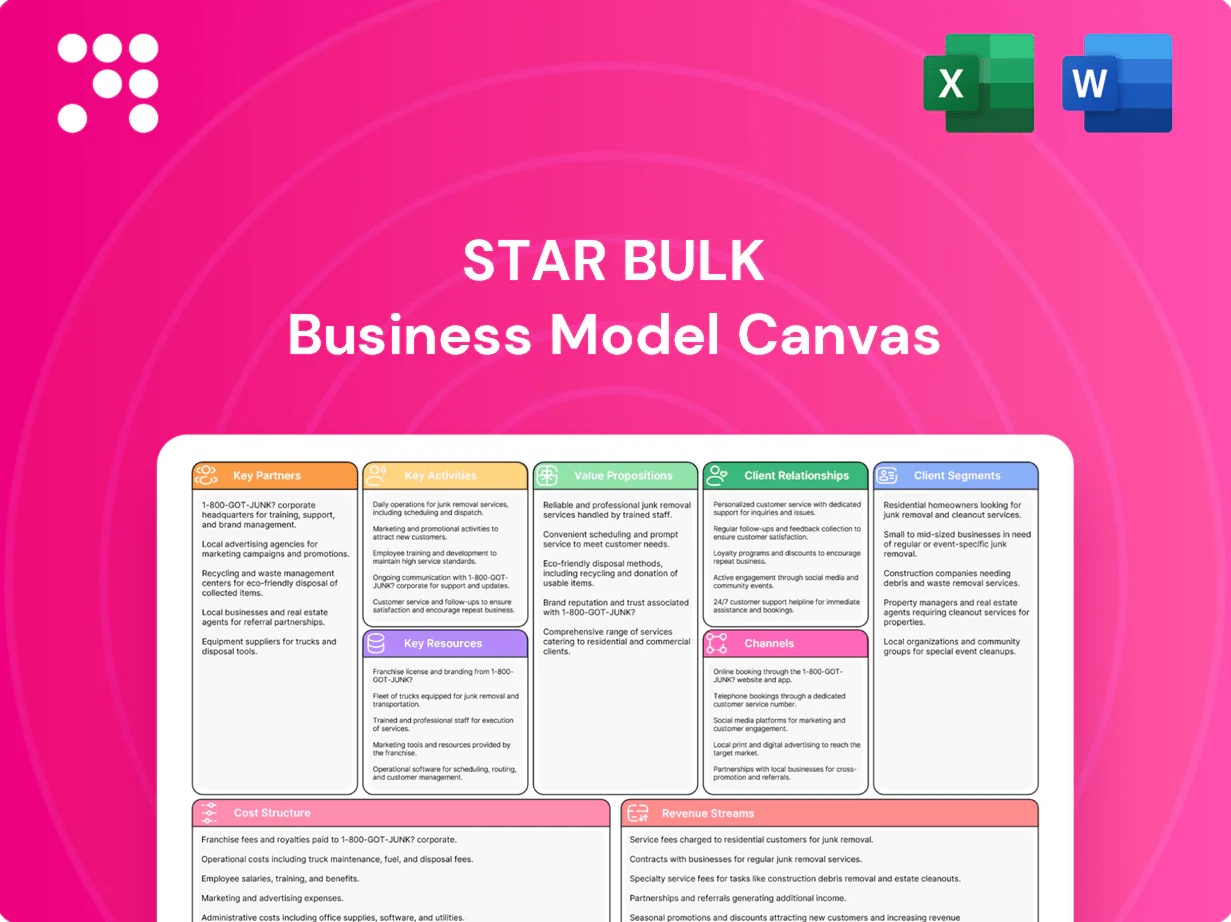
Star Bulk Business Model Canvas

Unlock the strategic Business Model Canvas for maritime shipping investments
Unlock the full strategic blueprint behind Star Bulk’s business model with our detailed Business Model Canvas. This concise, section-by-section analysis reveals value propositions, revenue drivers, key partnerships, and cost structure to inform investment or strategy decisions. Download the editable Word and Excel file to apply insights directly to your analysis.
Partnerships

Global charterers & traders
Relationships with major miners, utilities and commodity traders secure steady cargo flows—Star Bulk leverages multi-year COAs and term contracts that in 2024 helped lock in volumes despite a Baltic Dry Index averaging ~1,200; partners provide visibility on routes and volumes. Co-planning and COAs reduce volatility and optimize vessel deployment, improving utilization and TCE stability across cycles.
Shipyards & technical service firms
OEMs and shipyards support retrofits, dry-dockings and fuel-efficiency upgrades that industry studies show can reduce fuel burn by 5–15% and CO2 intensity per voyage. Reliable yards minimize off-hire and cost overruns, often keeping dry-dock durations near industry medians of 10–20 days. Technical advisors ensure class compliance and performance during modifications. Close collaboration accelerates uptake of new technologies across the fleet.

Fuel suppliers & bunkering networks
Global bunker partners enable cost-effective, timely refueling across Star Bulk’s fleet of over 120 vessels, supporting port coverage in major hubs worldwide. Access to VLSFO, MGO and emerging alternative fuels (biodiesel blends, LNG bunkering corridors) enhances voyage flexibility. Structured pricing frameworks and hedging programs mitigate fuel-cost volatility, while strict quality-assurance checks protect engine health and operational performance.

Port agents, terminals & logistics
Local port agents and terminal partners accelerate port calls, documentation and cargo operations for Star Bulk, reducing berth-to-sail times and exposure to demurrage. Slot coordination with terminals shortens waiting times and aligns arrival windows with cargo windows. Integrated planning of laycans with berth availability and reliable ground networks improves schedule integrity and voyage predictability.
Classification societies & insurers
Classification societies certify vessel safety and environmental standards for Star Bulk, with annual and 5-year special surveys forming the backbone of compliance; in 2024 these certifications remained mandatory for chartering and financing. P&I and H&M insurers manage operational and liability risks, while risk-sharing structures help stabilize premiums and protect the balance sheet.
- Class surveys: annual/5‑yr mandatory
- P&I/H&M: operational + liability cover
- Risk-sharing: stabilizes costs, shields equity
COAs secure cargo flows as BDI 1,200; retrofits cut fuel 5-15% across 120+ vessels
Long-term COAs with miners/traders secured steady cargo flows in 2024 amid a Baltic Dry Index ~1,200, improving utilization and TCE stability. Shipyards/OEMs enabled 5–15% fuel burn and CO2 intensity reductions via retrofits; dry-dock medians remained 10–20 days. Bunker partners, class societies and insurers ensured fuel access, compliance and risk transfer across Star Bulk’s 120+ vessel fleet.
| Partner | Role | 2024 metric |
|---|---|---|
| Miners/Traders | COAs/term cargos | BDI ~1,200 |
| Shipyards/OEMs | Retrofits/dry‑dock | Fuel reduction 5–15% |
| Class/Insurers | Compliance/risk | 120+ vessels certified |
What is included in the product
 Detailed Word Document
A comprehensive Business Model Canvas tailored to Star Bulk’s dry bulk shipping strategy, covering all nine BMC blocks with value propositions, customer segments, channels, revenue streams and cost structure, plus linked SWOT and competitive-advantage analysis to support investor presentations and strategic decisions.

 Customizable Excel Spreadsheet
High-level view of Star Bulk's business model with editable cells, condensing fleet strategy, revenue streams and cost drivers into a one-page snapshot for rapid analysis, team collaboration, and faster executive decision-making.
Activities

Voyage planning & scheduling
In 2024 Star Bulk's voyage planning & scheduling focuses on routing, weather optimization and ballast management to cut fuel burn and voyage time—industry studies show routing/weather optimization can reduce fuel use by roughly 5–10%. Berth coordination aligns arrivals to laycans to avoid waiting and off-hire days while digital tools boost ETA accuracy and regulatory compliance. Continuous replanning and AIS-driven updates mitigate disruptions and lower operational variability.
Commercial chartering & pricing
Commercial chartering and pricing at Star Bulk balances spot, time charters and COAs to align risk and returns, using a portfolio mix that smooths earnings volatility across cycles. Market analysis—driven by freight indicators such as the 2024 average Baltic Dry Index near 1,200—informs rate negotiation and vessel positioning. Proactive broker engagement expands cargo access and fills gaps between long and short-term cover. This approach aims to optimize TCE and downside protection.

Fleet operations & crewing
Daily vessel management at Star Bulk oversees safe, compliant voyages across a fleet of 121 vessels (approx. 11.6 million dwt as of mid‑2024), driving on‑time operations and regulatory adherence. Crewing emphasizes training, retention and competency, supporting average crew retention improvements and STCW compliance. Rigorous onboard maintenance maximizes uptime and TCE generation. Standard operating procedures ensure operational consistency and auditable performance.

Maintenance, repairs & dry-docking
Planned dry-docks for Star Bulk align with regulatory surveys and upgrades, scheduled across a fleet of over 120 vessels in 2024 with typical dry-dock cycles of 36–60 months. Condition-based maintenance and predictive analytics aim to minimize unexpected off-hire—industry studies show up to 30% fewer failures. Tight supplier coordination accelerates parts availability and reduces downtime; hull and propeller care yields 1–3% fuel-efficiency gains.
- Fleet: over 120 vessels (2024)
- Dry-dock cycle: 36–60 months
- Predictive maintenance: up to 30% fewer failures
- Hull/propeller care: 1–3% fuel savings
Compliance, ESG & risk management
Compliance follows IMO EEXI and CII requirements (in force since 2023) and ongoing flag and port state controls; ESG programs focus on emissions reduction, crew safety, and corporate governance; financial hedging covers bunker, FX and voyage freight exposures; transparent, audited reporting supports stakeholder trust.
- Regulation: IMO EEXI/CII enforced since 2023
- ESG focus: emissions, safety, governance
- Risk tools: bunker, FX, freight hedges
- Trust: robust, audited reporting
121-vessel fleet maximizes TCE via 5–10% voyage fuel savings, maintenance and hedges
Star Bulk operates 121 vessels (~11.6m dwt mid‑2024), optimizing voyages (routing/weather ~5–10% fuel save) and balancing spot/time/COA exposure (2024 BDI avg ~1,200) to maximize TCE. Fleet upkeep uses 36–60 month dry‑dock cycles, predictive maintenance (up to 30% fewer failures) and hull care (1–3% fuel gain). Risk controls include bunker, FX and freight hedges and IMO EEXI/CII compliance.
| Metric | 2024 |
|---|---|
| Fleet | 121 vessels / 11.6m dwt |
| BDI avg | ~1,200 |
| Fuel savings | Routing 5–10%; hull 1–3% |
| Maintenance | Dry‑dock 36–60m; −30% failures |
Full Version Awaits
Business Model Canvas
The Star Bulk Business Model Canvas shown here is the actual deliverable, not a mockup, and contains the same content and layout you’ll receive after purchase. Upon completing your order you’ll download this exact, fully editable file ready for presentation and analysis in Word and Excel. Trust that what you preview is what you’ll own—no surprises.

Unlock the strategic Business Model Canvas for maritime shipping investments
Unlock the full strategic blueprint behind Star Bulk’s business model with our detailed Business Model Canvas. This concise, section-by-section analysis reveals value propositions, revenue drivers, key partnerships, and cost structure to inform investment or strategy decisions. Download the editable Word and Excel file to apply insights directly to your analysis.
Partnerships
Global charterers & traders
Relationships with major miners, utilities and commodity traders secure steady cargo flows—Star Bulk leverages multi-year COAs and term contracts that in 2024 helped lock in volumes despite a Baltic Dry Index averaging ~1,200; partners provide visibility on routes and volumes. Co-planning and COAs reduce volatility and optimize vessel deployment, improving utilization and TCE stability across cycles.
Shipyards & technical service firms
OEMs and shipyards support retrofits, dry-dockings and fuel-efficiency upgrades that industry studies show can reduce fuel burn by 5–15% and CO2 intensity per voyage. Reliable yards minimize off-hire and cost overruns, often keeping dry-dock durations near industry medians of 10–20 days. Technical advisors ensure class compliance and performance during modifications. Close collaboration accelerates uptake of new technologies across the fleet.
Fuel suppliers & bunkering networks
Global bunker partners enable cost-effective, timely refueling across Star Bulk’s fleet of over 120 vessels, supporting port coverage in major hubs worldwide. Access to VLSFO, MGO and emerging alternative fuels (biodiesel blends, LNG bunkering corridors) enhances voyage flexibility. Structured pricing frameworks and hedging programs mitigate fuel-cost volatility, while strict quality-assurance checks protect engine health and operational performance.
Port agents, terminals & logistics
Local port agents and terminal partners accelerate port calls, documentation and cargo operations for Star Bulk, reducing berth-to-sail times and exposure to demurrage. Slot coordination with terminals shortens waiting times and aligns arrival windows with cargo windows. Integrated planning of laycans with berth availability and reliable ground networks improves schedule integrity and voyage predictability.
Classification societies & insurers
Classification societies certify vessel safety and environmental standards for Star Bulk, with annual and 5-year special surveys forming the backbone of compliance; in 2024 these certifications remained mandatory for chartering and financing. P&I and H&M insurers manage operational and liability risks, while risk-sharing structures help stabilize premiums and protect the balance sheet.
- Class surveys: annual/5‑yr mandatory
- P&I/H&M: operational + liability cover
- Risk-sharing: stabilizes costs, shields equity
COAs secure cargo flows as BDI 1,200; retrofits cut fuel 5-15% across 120+ vessels
Long-term COAs with miners/traders secured steady cargo flows in 2024 amid a Baltic Dry Index ~1,200, improving utilization and TCE stability. Shipyards/OEMs enabled 5–15% fuel burn and CO2 intensity reductions via retrofits; dry-dock medians remained 10–20 days. Bunker partners, class societies and insurers ensured fuel access, compliance and risk transfer across Star Bulk’s 120+ vessel fleet.
| Partner | Role | 2024 metric |
|---|---|---|
| Miners/Traders | COAs/term cargos | BDI ~1,200 |
| Shipyards/OEMs | Retrofits/dry‑dock | Fuel reduction 5–15% |
| Class/Insurers | Compliance/risk | 120+ vessels certified |
What is included in the product
Detailed Word Document
A comprehensive Business Model Canvas tailored to Star Bulk’s dry bulk shipping strategy, covering all nine BMC blocks with value propositions, customer segments, channels, revenue streams and cost structure, plus linked SWOT and competitive-advantage analysis to support investor presentations and strategic decisions.
Customizable Excel Spreadsheet
High-level view of Star Bulk's business model with editable cells, condensing fleet strategy, revenue streams and cost drivers into a one-page snapshot for rapid analysis, team collaboration, and faster executive decision-making.
Activities
Voyage planning & scheduling
In 2024 Star Bulk's voyage planning & scheduling focuses on routing, weather optimization and ballast management to cut fuel burn and voyage time—industry studies show routing/weather optimization can reduce fuel use by roughly 5–10%. Berth coordination aligns arrivals to laycans to avoid waiting and off-hire days while digital tools boost ETA accuracy and regulatory compliance. Continuous replanning and AIS-driven updates mitigate disruptions and lower operational variability.
Commercial chartering & pricing
Commercial chartering and pricing at Star Bulk balances spot, time charters and COAs to align risk and returns, using a portfolio mix that smooths earnings volatility across cycles. Market analysis—driven by freight indicators such as the 2024 average Baltic Dry Index near 1,200—informs rate negotiation and vessel positioning. Proactive broker engagement expands cargo access and fills gaps between long and short-term cover. This approach aims to optimize TCE and downside protection.
Fleet operations & crewing
Daily vessel management at Star Bulk oversees safe, compliant voyages across a fleet of 121 vessels (approx. 11.6 million dwt as of mid‑2024), driving on‑time operations and regulatory adherence. Crewing emphasizes training, retention and competency, supporting average crew retention improvements and STCW compliance. Rigorous onboard maintenance maximizes uptime and TCE generation. Standard operating procedures ensure operational consistency and auditable performance.
Maintenance, repairs & dry-docking
Planned dry-docks for Star Bulk align with regulatory surveys and upgrades, scheduled across a fleet of over 120 vessels in 2024 with typical dry-dock cycles of 36–60 months. Condition-based maintenance and predictive analytics aim to minimize unexpected off-hire—industry studies show up to 30% fewer failures. Tight supplier coordination accelerates parts availability and reduces downtime; hull and propeller care yields 1–3% fuel-efficiency gains.
- Fleet: over 120 vessels (2024)
- Dry-dock cycle: 36–60 months
- Predictive maintenance: up to 30% fewer failures
- Hull/propeller care: 1–3% fuel savings
Compliance, ESG & risk management
Compliance follows IMO EEXI and CII requirements (in force since 2023) and ongoing flag and port state controls; ESG programs focus on emissions reduction, crew safety, and corporate governance; financial hedging covers bunker, FX and voyage freight exposures; transparent, audited reporting supports stakeholder trust.
- Regulation: IMO EEXI/CII enforced since 2023
- ESG focus: emissions, safety, governance
- Risk tools: bunker, FX, freight hedges
- Trust: robust, audited reporting
121-vessel fleet maximizes TCE via 5–10% voyage fuel savings, maintenance and hedges
Star Bulk operates 121 vessels (~11.6m dwt mid‑2024), optimizing voyages (routing/weather ~5–10% fuel save) and balancing spot/time/COA exposure (2024 BDI avg ~1,200) to maximize TCE. Fleet upkeep uses 36–60 month dry‑dock cycles, predictive maintenance (up to 30% fewer failures) and hull care (1–3% fuel gain). Risk controls include bunker, FX and freight hedges and IMO EEXI/CII compliance.
| Metric | 2024 |
|---|---|
| Fleet | 121 vessels / 11.6m dwt |
| BDI avg | ~1,200 |
| Fuel savings | Routing 5–10%; hull 1–3% |
| Maintenance | Dry‑dock 36–60m; −30% failures |
Full Version Awaits
Business Model Canvas
The Star Bulk Business Model Canvas shown here is the actual deliverable, not a mockup, and contains the same content and layout you’ll receive after purchase. Upon completing your order you’ll download this exact, fully editable file ready for presentation and analysis in Word and Excel. Trust that what you preview is what you’ll own—no surprises.
Original: $10.00
-65%$10.00
$3.50Description
Unlock the strategic Business Model Canvas for maritime shipping investments
Unlock the full strategic blueprint behind Star Bulk’s business model with our detailed Business Model Canvas. This concise, section-by-section analysis reveals value propositions, revenue drivers, key partnerships, and cost structure to inform investment or strategy decisions. Download the editable Word and Excel file to apply insights directly to your analysis.
Partnerships
Global charterers & traders
Relationships with major miners, utilities and commodity traders secure steady cargo flows—Star Bulk leverages multi-year COAs and term contracts that in 2024 helped lock in volumes despite a Baltic Dry Index averaging ~1,200; partners provide visibility on routes and volumes. Co-planning and COAs reduce volatility and optimize vessel deployment, improving utilization and TCE stability across cycles.
Shipyards & technical service firms
OEMs and shipyards support retrofits, dry-dockings and fuel-efficiency upgrades that industry studies show can reduce fuel burn by 5–15% and CO2 intensity per voyage. Reliable yards minimize off-hire and cost overruns, often keeping dry-dock durations near industry medians of 10–20 days. Technical advisors ensure class compliance and performance during modifications. Close collaboration accelerates uptake of new technologies across the fleet.
Fuel suppliers & bunkering networks
Global bunker partners enable cost-effective, timely refueling across Star Bulk’s fleet of over 120 vessels, supporting port coverage in major hubs worldwide. Access to VLSFO, MGO and emerging alternative fuels (biodiesel blends, LNG bunkering corridors) enhances voyage flexibility. Structured pricing frameworks and hedging programs mitigate fuel-cost volatility, while strict quality-assurance checks protect engine health and operational performance.
Port agents, terminals & logistics
Local port agents and terminal partners accelerate port calls, documentation and cargo operations for Star Bulk, reducing berth-to-sail times and exposure to demurrage. Slot coordination with terminals shortens waiting times and aligns arrival windows with cargo windows. Integrated planning of laycans with berth availability and reliable ground networks improves schedule integrity and voyage predictability.
Classification societies & insurers
Classification societies certify vessel safety and environmental standards for Star Bulk, with annual and 5-year special surveys forming the backbone of compliance; in 2024 these certifications remained mandatory for chartering and financing. P&I and H&M insurers manage operational and liability risks, while risk-sharing structures help stabilize premiums and protect the balance sheet.
- Class surveys: annual/5‑yr mandatory
- P&I/H&M: operational + liability cover
- Risk-sharing: stabilizes costs, shields equity
COAs secure cargo flows as BDI 1,200; retrofits cut fuel 5-15% across 120+ vessels
Long-term COAs with miners/traders secured steady cargo flows in 2024 amid a Baltic Dry Index ~1,200, improving utilization and TCE stability. Shipyards/OEMs enabled 5–15% fuel burn and CO2 intensity reductions via retrofits; dry-dock medians remained 10–20 days. Bunker partners, class societies and insurers ensured fuel access, compliance and risk transfer across Star Bulk’s 120+ vessel fleet.
| Partner | Role | 2024 metric |
|---|---|---|
| Miners/Traders | COAs/term cargos | BDI ~1,200 |
| Shipyards/OEMs | Retrofits/dry‑dock | Fuel reduction 5–15% |
| Class/Insurers | Compliance/risk | 120+ vessels certified |
What is included in the product
Detailed Word Document
A comprehensive Business Model Canvas tailored to Star Bulk’s dry bulk shipping strategy, covering all nine BMC blocks with value propositions, customer segments, channels, revenue streams and cost structure, plus linked SWOT and competitive-advantage analysis to support investor presentations and strategic decisions.
Customizable Excel Spreadsheet
High-level view of Star Bulk's business model with editable cells, condensing fleet strategy, revenue streams and cost drivers into a one-page snapshot for rapid analysis, team collaboration, and faster executive decision-making.
Activities
Voyage planning & scheduling
In 2024 Star Bulk's voyage planning & scheduling focuses on routing, weather optimization and ballast management to cut fuel burn and voyage time—industry studies show routing/weather optimization can reduce fuel use by roughly 5–10%. Berth coordination aligns arrivals to laycans to avoid waiting and off-hire days while digital tools boost ETA accuracy and regulatory compliance. Continuous replanning and AIS-driven updates mitigate disruptions and lower operational variability.
Commercial chartering & pricing
Commercial chartering and pricing at Star Bulk balances spot, time charters and COAs to align risk and returns, using a portfolio mix that smooths earnings volatility across cycles. Market analysis—driven by freight indicators such as the 2024 average Baltic Dry Index near 1,200—informs rate negotiation and vessel positioning. Proactive broker engagement expands cargo access and fills gaps between long and short-term cover. This approach aims to optimize TCE and downside protection.
Fleet operations & crewing
Daily vessel management at Star Bulk oversees safe, compliant voyages across a fleet of 121 vessels (approx. 11.6 million dwt as of mid‑2024), driving on‑time operations and regulatory adherence. Crewing emphasizes training, retention and competency, supporting average crew retention improvements and STCW compliance. Rigorous onboard maintenance maximizes uptime and TCE generation. Standard operating procedures ensure operational consistency and auditable performance.
Maintenance, repairs & dry-docking
Planned dry-docks for Star Bulk align with regulatory surveys and upgrades, scheduled across a fleet of over 120 vessels in 2024 with typical dry-dock cycles of 36–60 months. Condition-based maintenance and predictive analytics aim to minimize unexpected off-hire—industry studies show up to 30% fewer failures. Tight supplier coordination accelerates parts availability and reduces downtime; hull and propeller care yields 1–3% fuel-efficiency gains.
- Fleet: over 120 vessels (2024)
- Dry-dock cycle: 36–60 months
- Predictive maintenance: up to 30% fewer failures
- Hull/propeller care: 1–3% fuel savings
Compliance, ESG & risk management
Compliance follows IMO EEXI and CII requirements (in force since 2023) and ongoing flag and port state controls; ESG programs focus on emissions reduction, crew safety, and corporate governance; financial hedging covers bunker, FX and voyage freight exposures; transparent, audited reporting supports stakeholder trust.
- Regulation: IMO EEXI/CII enforced since 2023
- ESG focus: emissions, safety, governance
- Risk tools: bunker, FX, freight hedges
- Trust: robust, audited reporting
121-vessel fleet maximizes TCE via 5–10% voyage fuel savings, maintenance and hedges
Star Bulk operates 121 vessels (~11.6m dwt mid‑2024), optimizing voyages (routing/weather ~5–10% fuel save) and balancing spot/time/COA exposure (2024 BDI avg ~1,200) to maximize TCE. Fleet upkeep uses 36–60 month dry‑dock cycles, predictive maintenance (up to 30% fewer failures) and hull care (1–3% fuel gain). Risk controls include bunker, FX and freight hedges and IMO EEXI/CII compliance.
| Metric | 2024 |
|---|---|
| Fleet | 121 vessels / 11.6m dwt |
| BDI avg | ~1,200 |
| Fuel savings | Routing 5–10%; hull 1–3% |
| Maintenance | Dry‑dock 36–60m; −30% failures |
Full Version Awaits
Business Model Canvas
The Star Bulk Business Model Canvas shown here is the actual deliverable, not a mockup, and contains the same content and layout you’ll receive after purchase. Upon completing your order you’ll download this exact, fully editable file ready for presentation and analysis in Word and Excel. Trust that what you preview is what you’ll own—no surprises.











