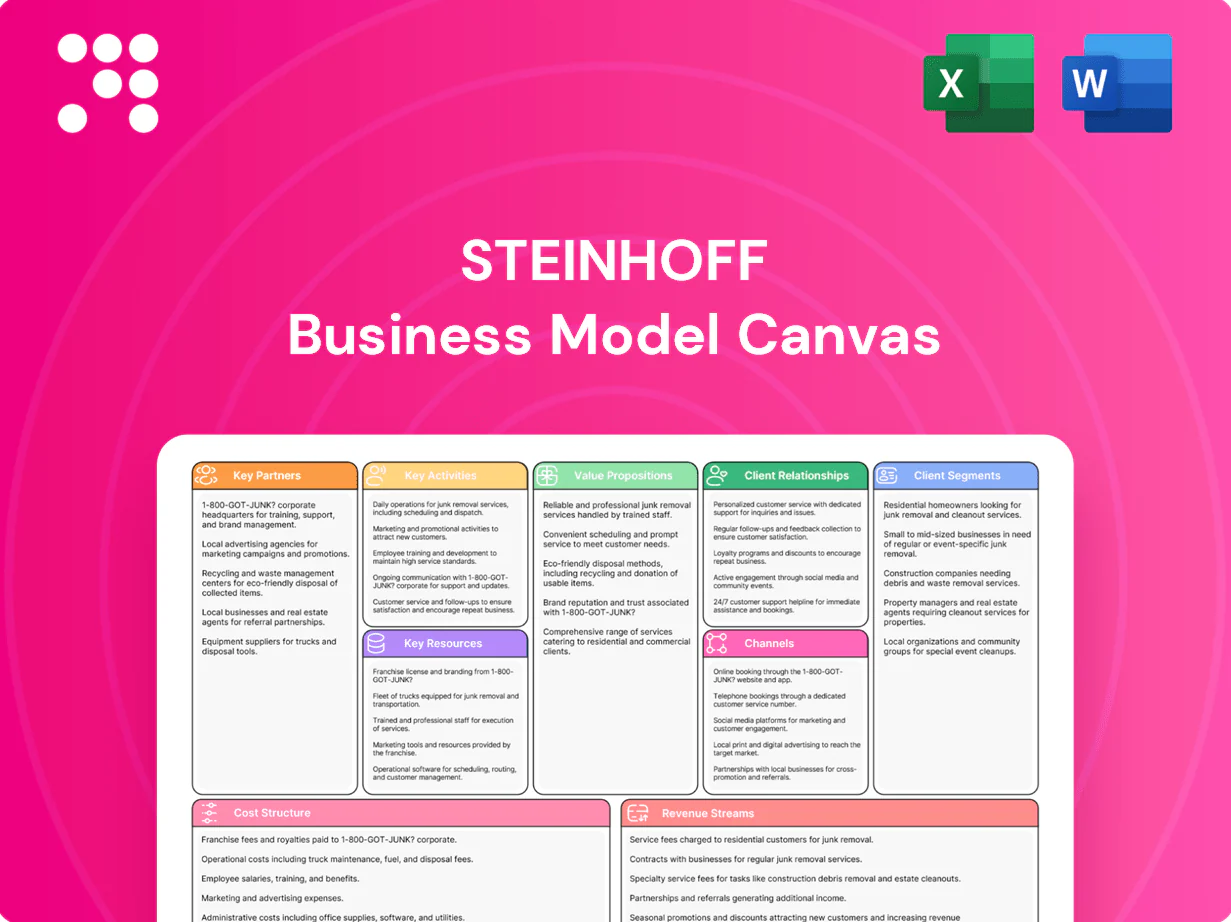
Steinhoff Business Model Canvas

Unlock the full strategic blueprint behind a retail conglomerate's business model
Unlock the full strategic blueprint behind Steinhoff’s business model with our in-depth Business Model Canvas. This concise, sector-tailored analysis reveals value propositions, revenue streams, key partners and cost drivers to inform investment or strategic decisions. Ideal for investors, consultants and founders, the downloadable Word and Excel files are ready for benchmarking and fast adaptation—purchase the full canvas to accelerate your analysis.
Partnerships

Strategic suppliers and manufacturers
Partner with global and regional factories for furniture, textiles, appliances and apparel at scale, locking key suppliers into 3–5 year contracts to stabilize pricing and supply continuity. Enforce quarterly quality and compliance audits with supplier scorecards to protect brand standards, and diversify sourcing across at least three regions to mitigate geopolitical and currency risks.
Logistics and distribution providers
Steinhoff leverages ocean freight, port handlers and 3PLs for inbound and last-mile efficiency; container rates returned near pre-COVID levels in 2024, down ~70% from 2022 peaks. Optimized warehousing and cross-docking reduced lead times and costs, enabling 20–30% faster throughput in pilot DCs. Carrier partnerships balance cost, service and peak capacity while volume-based rates and performance SLAs cut peak surcharges ~15–25%.

Financial institutions and credit partners
Work with banks and fintechs to underwrite in‑store credit and consumer finance, ensuring point‑of‑sale lending integrates with Steinhoff retail operations. Arrange trade finance, hedging, and liquidity lines to smooth seasonal inventory cycles and FX exposure. Maintain trustee and bondholder relations to preserve capital market access and transparency. In wind‑down scenarios coordinate closely with creditors on recoveries and distributions.

Brand, license, and private-label partners
Leverage licensed brands to broaden assortment and price tiers, driving traffic and conversion; in 2024 Steinhoff prioritized brand licensing to fill mid‑ and premium SKUs. Build private‑label programs with OEMs to enhance gross margins and control supply; private‑label initiatives targeted double‑digit SKU growth in 2024. Co‑develop exclusive products to increase store visits while ensuring IP, labeling, and safety compliance across all markets.
- 2024 focus: licensed brands, private label, exclusives
- Margin uplift via OEM private labels
- Compliance: IP, labeling, safety across markets
Advisors, administrators, and regulators
Retain specialist legal, audit, restructuring and insolvency advisors to steer remediation and potential wind‑down, ensuring forensic clarity and compliance with ongoing investigations. Engage market regulators and listing authorities to maintain regulatory dialogue and meet disclosure and reporting obligations. Coordinate administrators to prioritize asset sales, creditor reconciliation and value-preserving dispositions while managing stakeholder communications to limit reputational and value erosion.
- Advisors: legal, forensic audit, restructuring, insolvency
- Regulators: listing authorities, market supervisors
- Administrators: asset sale & creditor coordination
- Communications: creditors, investors, employees
Lock 3–5 yr contracts; lead times down 20–30%
Lock 3–5 year supplier contracts and diversify sourcing across ≥3 regions to stabilize supply and pricing. Logistics partnerships cut lead times 20–30% in pilot DCs and container rates fell ~70% from 2022 peaks to near pre‑COVID levels in 2024. 2024 focus on licensed brands and private‑label programs targeting double‑digit SKU growth; trade finance and POS lending secured.
| Metric | 2024 |
|---|---|
| Container rates vs 2022 | -70% |
| Lead time reduction (pilot DCs) | 20–30% |
| Supplier contract length | 3–5 yrs |
| Private‑label SKU growth | Double‑digit |
What is included in the product
 Detailed Word Document
A comprehensive Business Model Canvas tailored to Steinhoff’s retail and furniture ecosystem, detailing customer segments, channels, value propositions, revenue streams and cost structure across the nine BMC blocks. Designed for presentations and investor discussions, it includes competitive-advantage analysis, linked SWOT insights and actionable strategic recommendations reflecting real-world operations.

 Customizable Excel Spreadsheet
High-level, shareable Business Model Canvas tailored to Steinhoff that condenses strategy into an editable one-page snapshot—ideal for quickly identifying pain points, aligning teams, and saving hours on formatting for boardrooms or rapid comparisons.
Activities

Global sourcing and procurement
Global sourcing and procurement identify, qualify and negotiate with suppliers across categories and geographies to secure scale and flexibility; demand forecasts drive orders to meet seasonal peaks and reduce stockouts. Cost, quality and ESG controls are embedded in supplier contracts and audits to limit risk and uphold compliance. Currency hedges manage import exposures to stabilize margins.
Retail operations and merchandising
Plan assortments by store format and customer segment to drive category-specific sales; retail teams target 4–6 inventory turns and <2% shrink. Execute pricing, promotions and inventory-turn targets to hit weekly sell-through benchmarks (often 50–70%) and maintain >95% in-stock rates. Manage store labor, visual merchandising and shrink through KPIs and training, while monitoring sell-through and replenishing dynamically via RFID/POS-driven triggers.

Omnichannel and e-commerce enablement
Maintain webstores, marketplaces and click‑and‑collect to capture share of the $6.3 trillion global e‑commerce market in 2024, integrating POS, ERP and CRM to create a single customer view that lifts omnichannel retention. Optimize digital marketing, SEO/SEM and conversion funnels (average e‑commerce conversion ~2.3% in 2024) and coordinate fulfillment from DCs and stores to lower last‑mile costs and boost order‑cycle speed.

Risk, governance, and compliance
Steinhoff in 2024 tightened internal controls and accelerated financial reporting cycles to meet IFRS deadlines, commissioning audits and forensic reviews with documented remediation timelines and quarterly investor updates. Compliance programs cover product safety, data privacy, and consumer lending rules while prioritizing transparent reporting to investors, creditors, and regulators.
- 2024: quarterly forensic audits
- Remediation plans with defined timelines
- Ongoing product, data, lending compliance
- Regular transparent reporting to stakeholders
Restructuring, asset sales, and liquidation
Prepare comprehensive data rooms, valuation packs and transaction pipelines to market assets efficiently; since 2018 Steinhoff has pursued disposals that generated over €1.5bn in proceeds to reduce leverage (company disclosures through 2024).
Run competitive auctions for businesses, brands and property portfolios, negotiate settlements and creditor arrangements with appointed advisors and trustee committees, and execute orderly wind‑downs while preserving going‑concern value where possible.
- Data rooms: standardized valuation packs
- Auctions: businesses, brands, property portfolios
- Negotiations: creditor settlements, trustee engagement
- Wind‑down: orderly execution preserving going‑concern value
Global sourcing + omnichannel deliver margins: 4-6 turns, under 2% shrink, €1.5bn+ disposals
Global sourcing, procurement and currency hedging secure margins; inventory planning targets 4–6 turns, <2% shrink and >95% in‑stock. Omnichannel ops capture share of the $6.3T e‑commerce market (conversion ~2.3% in 2024) via POS/ERP/CRM integration. 2024 saw quarterly forensic audits, €1.5bn+ disposals since 2018 and tightened compliance.
| KPI | 2024 |
|---|---|
| Inventory turns | 4–6 |
| Shrink | <2% |
| E‑com conv. | ~2.3% |
| Disposals since 2018 | €1.5bn+ |
What You See Is What You Get
Business Model Canvas
The Steinhoff Business Model Canvas you’re previewing is the actual deliverable, not a mockup. It’s a direct snapshot from the final file you’ll receive after purchase. When you complete your order, you’ll get this same editable document ready for use. No placeholders, no surprises—what you see is what you’ll download.

Unlock the full strategic blueprint behind a retail conglomerate's business model
Unlock the full strategic blueprint behind Steinhoff’s business model with our in-depth Business Model Canvas. This concise, sector-tailored analysis reveals value propositions, revenue streams, key partners and cost drivers to inform investment or strategic decisions. Ideal for investors, consultants and founders, the downloadable Word and Excel files are ready for benchmarking and fast adaptation—purchase the full canvas to accelerate your analysis.
Partnerships
Strategic suppliers and manufacturers
Partner with global and regional factories for furniture, textiles, appliances and apparel at scale, locking key suppliers into 3–5 year contracts to stabilize pricing and supply continuity. Enforce quarterly quality and compliance audits with supplier scorecards to protect brand standards, and diversify sourcing across at least three regions to mitigate geopolitical and currency risks.
Logistics and distribution providers
Steinhoff leverages ocean freight, port handlers and 3PLs for inbound and last-mile efficiency; container rates returned near pre-COVID levels in 2024, down ~70% from 2022 peaks. Optimized warehousing and cross-docking reduced lead times and costs, enabling 20–30% faster throughput in pilot DCs. Carrier partnerships balance cost, service and peak capacity while volume-based rates and performance SLAs cut peak surcharges ~15–25%.
Financial institutions and credit partners
Work with banks and fintechs to underwrite in‑store credit and consumer finance, ensuring point‑of‑sale lending integrates with Steinhoff retail operations. Arrange trade finance, hedging, and liquidity lines to smooth seasonal inventory cycles and FX exposure. Maintain trustee and bondholder relations to preserve capital market access and transparency. In wind‑down scenarios coordinate closely with creditors on recoveries and distributions.
Brand, license, and private-label partners
Leverage licensed brands to broaden assortment and price tiers, driving traffic and conversion; in 2024 Steinhoff prioritized brand licensing to fill mid‑ and premium SKUs. Build private‑label programs with OEMs to enhance gross margins and control supply; private‑label initiatives targeted double‑digit SKU growth in 2024. Co‑develop exclusive products to increase store visits while ensuring IP, labeling, and safety compliance across all markets.
- 2024 focus: licensed brands, private label, exclusives
- Margin uplift via OEM private labels
- Compliance: IP, labeling, safety across markets
Advisors, administrators, and regulators
Retain specialist legal, audit, restructuring and insolvency advisors to steer remediation and potential wind‑down, ensuring forensic clarity and compliance with ongoing investigations. Engage market regulators and listing authorities to maintain regulatory dialogue and meet disclosure and reporting obligations. Coordinate administrators to prioritize asset sales, creditor reconciliation and value-preserving dispositions while managing stakeholder communications to limit reputational and value erosion.
- Advisors: legal, forensic audit, restructuring, insolvency
- Regulators: listing authorities, market supervisors
- Administrators: asset sale & creditor coordination
- Communications: creditors, investors, employees
Lock 3–5 yr contracts; lead times down 20–30%
Lock 3–5 year supplier contracts and diversify sourcing across ≥3 regions to stabilize supply and pricing. Logistics partnerships cut lead times 20–30% in pilot DCs and container rates fell ~70% from 2022 peaks to near pre‑COVID levels in 2024. 2024 focus on licensed brands and private‑label programs targeting double‑digit SKU growth; trade finance and POS lending secured.
| Metric | 2024 |
|---|---|
| Container rates vs 2022 | -70% |
| Lead time reduction (pilot DCs) | 20–30% |
| Supplier contract length | 3–5 yrs |
| Private‑label SKU growth | Double‑digit |
What is included in the product
Detailed Word Document
A comprehensive Business Model Canvas tailored to Steinhoff’s retail and furniture ecosystem, detailing customer segments, channels, value propositions, revenue streams and cost structure across the nine BMC blocks. Designed for presentations and investor discussions, it includes competitive-advantage analysis, linked SWOT insights and actionable strategic recommendations reflecting real-world operations.
Customizable Excel Spreadsheet
High-level, shareable Business Model Canvas tailored to Steinhoff that condenses strategy into an editable one-page snapshot—ideal for quickly identifying pain points, aligning teams, and saving hours on formatting for boardrooms or rapid comparisons.
Activities
Global sourcing and procurement
Global sourcing and procurement identify, qualify and negotiate with suppliers across categories and geographies to secure scale and flexibility; demand forecasts drive orders to meet seasonal peaks and reduce stockouts. Cost, quality and ESG controls are embedded in supplier contracts and audits to limit risk and uphold compliance. Currency hedges manage import exposures to stabilize margins.
Retail operations and merchandising
Plan assortments by store format and customer segment to drive category-specific sales; retail teams target 4–6 inventory turns and <2% shrink. Execute pricing, promotions and inventory-turn targets to hit weekly sell-through benchmarks (often 50–70%) and maintain >95% in-stock rates. Manage store labor, visual merchandising and shrink through KPIs and training, while monitoring sell-through and replenishing dynamically via RFID/POS-driven triggers.
Omnichannel and e-commerce enablement
Maintain webstores, marketplaces and click‑and‑collect to capture share of the $6.3 trillion global e‑commerce market in 2024, integrating POS, ERP and CRM to create a single customer view that lifts omnichannel retention. Optimize digital marketing, SEO/SEM and conversion funnels (average e‑commerce conversion ~2.3% in 2024) and coordinate fulfillment from DCs and stores to lower last‑mile costs and boost order‑cycle speed.
Risk, governance, and compliance
Steinhoff in 2024 tightened internal controls and accelerated financial reporting cycles to meet IFRS deadlines, commissioning audits and forensic reviews with documented remediation timelines and quarterly investor updates. Compliance programs cover product safety, data privacy, and consumer lending rules while prioritizing transparent reporting to investors, creditors, and regulators.
- 2024: quarterly forensic audits
- Remediation plans with defined timelines
- Ongoing product, data, lending compliance
- Regular transparent reporting to stakeholders
Restructuring, asset sales, and liquidation
Prepare comprehensive data rooms, valuation packs and transaction pipelines to market assets efficiently; since 2018 Steinhoff has pursued disposals that generated over €1.5bn in proceeds to reduce leverage (company disclosures through 2024).
Run competitive auctions for businesses, brands and property portfolios, negotiate settlements and creditor arrangements with appointed advisors and trustee committees, and execute orderly wind‑downs while preserving going‑concern value where possible.
- Data rooms: standardized valuation packs
- Auctions: businesses, brands, property portfolios
- Negotiations: creditor settlements, trustee engagement
- Wind‑down: orderly execution preserving going‑concern value
Global sourcing + omnichannel deliver margins: 4-6 turns, under 2% shrink, €1.5bn+ disposals
Global sourcing, procurement and currency hedging secure margins; inventory planning targets 4–6 turns, <2% shrink and >95% in‑stock. Omnichannel ops capture share of the $6.3T e‑commerce market (conversion ~2.3% in 2024) via POS/ERP/CRM integration. 2024 saw quarterly forensic audits, €1.5bn+ disposals since 2018 and tightened compliance.
| KPI | 2024 |
|---|---|
| Inventory turns | 4–6 |
| Shrink | <2% |
| E‑com conv. | ~2.3% |
| Disposals since 2018 | €1.5bn+ |
What You See Is What You Get
Business Model Canvas
The Steinhoff Business Model Canvas you’re previewing is the actual deliverable, not a mockup. It’s a direct snapshot from the final file you’ll receive after purchase. When you complete your order, you’ll get this same editable document ready for use. No placeholders, no surprises—what you see is what you’ll download.
Original: $10.00
-65%$10.00
$3.50Description
Unlock the full strategic blueprint behind a retail conglomerate's business model
Unlock the full strategic blueprint behind Steinhoff’s business model with our in-depth Business Model Canvas. This concise, sector-tailored analysis reveals value propositions, revenue streams, key partners and cost drivers to inform investment or strategic decisions. Ideal for investors, consultants and founders, the downloadable Word and Excel files are ready for benchmarking and fast adaptation—purchase the full canvas to accelerate your analysis.
Partnerships
Strategic suppliers and manufacturers
Partner with global and regional factories for furniture, textiles, appliances and apparel at scale, locking key suppliers into 3–5 year contracts to stabilize pricing and supply continuity. Enforce quarterly quality and compliance audits with supplier scorecards to protect brand standards, and diversify sourcing across at least three regions to mitigate geopolitical and currency risks.
Logistics and distribution providers
Steinhoff leverages ocean freight, port handlers and 3PLs for inbound and last-mile efficiency; container rates returned near pre-COVID levels in 2024, down ~70% from 2022 peaks. Optimized warehousing and cross-docking reduced lead times and costs, enabling 20–30% faster throughput in pilot DCs. Carrier partnerships balance cost, service and peak capacity while volume-based rates and performance SLAs cut peak surcharges ~15–25%.
Financial institutions and credit partners
Work with banks and fintechs to underwrite in‑store credit and consumer finance, ensuring point‑of‑sale lending integrates with Steinhoff retail operations. Arrange trade finance, hedging, and liquidity lines to smooth seasonal inventory cycles and FX exposure. Maintain trustee and bondholder relations to preserve capital market access and transparency. In wind‑down scenarios coordinate closely with creditors on recoveries and distributions.
Brand, license, and private-label partners
Leverage licensed brands to broaden assortment and price tiers, driving traffic and conversion; in 2024 Steinhoff prioritized brand licensing to fill mid‑ and premium SKUs. Build private‑label programs with OEMs to enhance gross margins and control supply; private‑label initiatives targeted double‑digit SKU growth in 2024. Co‑develop exclusive products to increase store visits while ensuring IP, labeling, and safety compliance across all markets.
- 2024 focus: licensed brands, private label, exclusives
- Margin uplift via OEM private labels
- Compliance: IP, labeling, safety across markets
Advisors, administrators, and regulators
Retain specialist legal, audit, restructuring and insolvency advisors to steer remediation and potential wind‑down, ensuring forensic clarity and compliance with ongoing investigations. Engage market regulators and listing authorities to maintain regulatory dialogue and meet disclosure and reporting obligations. Coordinate administrators to prioritize asset sales, creditor reconciliation and value-preserving dispositions while managing stakeholder communications to limit reputational and value erosion.
- Advisors: legal, forensic audit, restructuring, insolvency
- Regulators: listing authorities, market supervisors
- Administrators: asset sale & creditor coordination
- Communications: creditors, investors, employees
Lock 3–5 yr contracts; lead times down 20–30%
Lock 3–5 year supplier contracts and diversify sourcing across ≥3 regions to stabilize supply and pricing. Logistics partnerships cut lead times 20–30% in pilot DCs and container rates fell ~70% from 2022 peaks to near pre‑COVID levels in 2024. 2024 focus on licensed brands and private‑label programs targeting double‑digit SKU growth; trade finance and POS lending secured.
| Metric | 2024 |
|---|---|
| Container rates vs 2022 | -70% |
| Lead time reduction (pilot DCs) | 20–30% |
| Supplier contract length | 3–5 yrs |
| Private‑label SKU growth | Double‑digit |
What is included in the product
Detailed Word Document
A comprehensive Business Model Canvas tailored to Steinhoff’s retail and furniture ecosystem, detailing customer segments, channels, value propositions, revenue streams and cost structure across the nine BMC blocks. Designed for presentations and investor discussions, it includes competitive-advantage analysis, linked SWOT insights and actionable strategic recommendations reflecting real-world operations.
Customizable Excel Spreadsheet
High-level, shareable Business Model Canvas tailored to Steinhoff that condenses strategy into an editable one-page snapshot—ideal for quickly identifying pain points, aligning teams, and saving hours on formatting for boardrooms or rapid comparisons.
Activities
Global sourcing and procurement
Global sourcing and procurement identify, qualify and negotiate with suppliers across categories and geographies to secure scale and flexibility; demand forecasts drive orders to meet seasonal peaks and reduce stockouts. Cost, quality and ESG controls are embedded in supplier contracts and audits to limit risk and uphold compliance. Currency hedges manage import exposures to stabilize margins.
Retail operations and merchandising
Plan assortments by store format and customer segment to drive category-specific sales; retail teams target 4–6 inventory turns and <2% shrink. Execute pricing, promotions and inventory-turn targets to hit weekly sell-through benchmarks (often 50–70%) and maintain >95% in-stock rates. Manage store labor, visual merchandising and shrink through KPIs and training, while monitoring sell-through and replenishing dynamically via RFID/POS-driven triggers.
Omnichannel and e-commerce enablement
Maintain webstores, marketplaces and click‑and‑collect to capture share of the $6.3 trillion global e‑commerce market in 2024, integrating POS, ERP and CRM to create a single customer view that lifts omnichannel retention. Optimize digital marketing, SEO/SEM and conversion funnels (average e‑commerce conversion ~2.3% in 2024) and coordinate fulfillment from DCs and stores to lower last‑mile costs and boost order‑cycle speed.
Risk, governance, and compliance
Steinhoff in 2024 tightened internal controls and accelerated financial reporting cycles to meet IFRS deadlines, commissioning audits and forensic reviews with documented remediation timelines and quarterly investor updates. Compliance programs cover product safety, data privacy, and consumer lending rules while prioritizing transparent reporting to investors, creditors, and regulators.
- 2024: quarterly forensic audits
- Remediation plans with defined timelines
- Ongoing product, data, lending compliance
- Regular transparent reporting to stakeholders
Restructuring, asset sales, and liquidation
Prepare comprehensive data rooms, valuation packs and transaction pipelines to market assets efficiently; since 2018 Steinhoff has pursued disposals that generated over €1.5bn in proceeds to reduce leverage (company disclosures through 2024).
Run competitive auctions for businesses, brands and property portfolios, negotiate settlements and creditor arrangements with appointed advisors and trustee committees, and execute orderly wind‑downs while preserving going‑concern value where possible.
- Data rooms: standardized valuation packs
- Auctions: businesses, brands, property portfolios
- Negotiations: creditor settlements, trustee engagement
- Wind‑down: orderly execution preserving going‑concern value
Global sourcing + omnichannel deliver margins: 4-6 turns, under 2% shrink, €1.5bn+ disposals
Global sourcing, procurement and currency hedging secure margins; inventory planning targets 4–6 turns, <2% shrink and >95% in‑stock. Omnichannel ops capture share of the $6.3T e‑commerce market (conversion ~2.3% in 2024) via POS/ERP/CRM integration. 2024 saw quarterly forensic audits, €1.5bn+ disposals since 2018 and tightened compliance.
| KPI | 2024 |
|---|---|
| Inventory turns | 4–6 |
| Shrink | <2% |
| E‑com conv. | ~2.3% |
| Disposals since 2018 | €1.5bn+ |
What You See Is What You Get
Business Model Canvas
The Steinhoff Business Model Canvas you’re previewing is the actual deliverable, not a mockup. It’s a direct snapshot from the final file you’ll receive after purchase. When you complete your order, you’ll get this same editable document ready for use. No placeholders, no surprises—what you see is what you’ll download.











