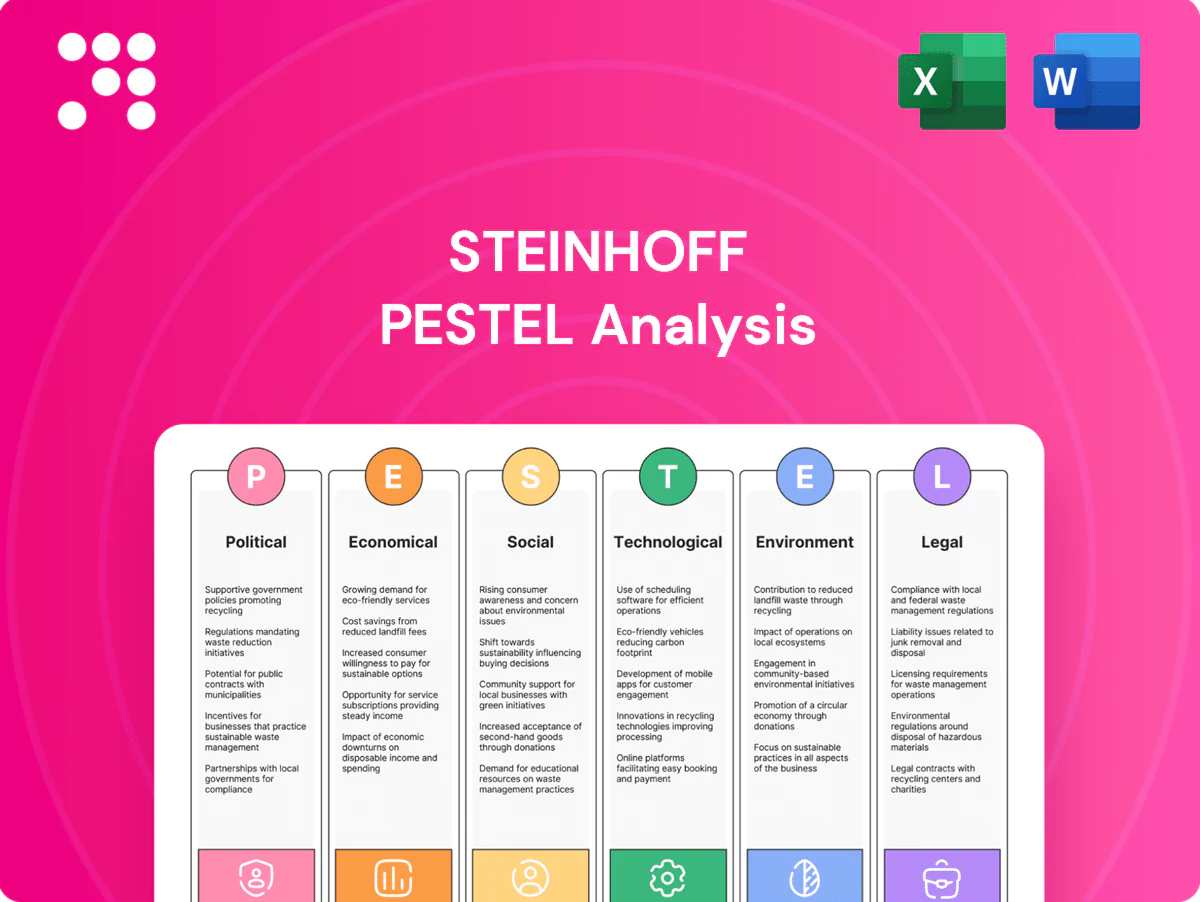
Steinhoff PESTLE Analysis

Your Shortcut to Market Insight Starts Here
Gain a strategic edge with our PESTLE analysis of Steinhoff, revealing how political, economic, social, technological, legal and environmental forces shape its prospects. Ideal for investors and strategists seeking actionable intelligence. Purchase the full report to access the complete, editable breakdown and make decisions with confidence.
Political factors

Policy stability in core markets
Steinhoff's operations across South Africa, Europe and Australasia mean that policy volatility directly affects retail sentiment and the timing of asset sales; South Africa's national election on 29 May 2024 increased short-term disposal and creditor-settlement risk. Political stability in these jurisdictions can accelerate regulatory approvals for disposals and creditor agreements. Conversely, election cycles and sudden policy shifts have delayed liquidation timelines in past restructurings. Predictable government processes are essential for coordinated stakeholder outcomes.
Trade and customs impacts on asset disposals
Divesting inventory and fixtures across borders requires full customs compliance and import/export documentation; post-Brexit checks have been linked to an estimated ≈12% increase in trade frictions, raising administrative delays often by 24–72 hours per consignment. Tariff shifts can compress achievable prices and extend timing, while efficient clearance — and average extra paperwork costs of roughly £50–£120 per shipment — helps preserve value during wind‑down.

Public sector scrutiny of corporate conduct
Following Steinhoff’s 2017 accounting scandal, political actors pushed for accountability and restitution, intensified by a >90% share-price collapse that wiped roughly €10 billion of market value in December 2017. Parliamentary inquiries and ministry oversight have shaped settlement optics and public expectations. That scrutiny has accelerated legal restructuring milestones and influenced timing of asset disposals. It also constrains reputational legacy for brands sold to new owners.

Government support or constraints in retail sectors
Policy measures such as consumer subsidies or price controls shift demand toward value retail and can alter valuations in Steinhoff-related transactions—during wind‑downs these measures affect how buyers underwrite acquired chains; employment‑retention incentives often attach to asset transfers; conversely fiscal austerity reduces bidder appetite. South Africa unemployment 32.9% (Q1 2024, Stats SA) heightens political sensitivity.
- subsidies → higher value‑retail demand
- price controls → margin compression
- retention incentives → conditional transfers
- austerity → fewer bidders
Sanctions and geopolitical risk exposure
Global portfolios face heightened risk from expanding sanctions regimes and regional conflicts, which can chill interest in assets like Steinhoff’s disposed operations; prospective buyers routinely flag geopolitical exposure during due diligence. Sanctions screening often prolongs timelines and can add compliance costs, meaning geopolitics materially influences final recovery values.
- Sanctions sensitivity flagged in buyer due diligence
- Screening increases transaction time and costs
- Geopolitics lowers expected recovery values
SA election 29 May 2024 and 32.9% unemployment amplify trade-driven disposal risk
Political volatility (SA election 29 May 2024) and policy shifts materially affect timing/value of disposals; SA unemployment 32.9% (Q1 2024) raises political risk. Trade frictions (post‑Brexit ≈12%) and customs costs (£50–£120/shipment) compress recoveries. Post‑2017 scandal scrutiny (≈€10bn market wipe) continues to shape settlements and buyer appetite.
| Factor | Metric | Impact |
|---|---|---|
| Election risk | 29 May 2024 | delay/disposal risk |
| Unemployment SA | 32.9% Q1 2024 | political sensitivity |
| Trade frictions | ≈12% post‑Brexit | delay/costs £50–£120 |
| Reputational | ≈€10bn wipe 2017 | regulatory scrutiny |
What is included in the product
 Detailed Word Document
Explores how external macro-environmental factors uniquely affect Steinhoff across Political, Economic, Social, Technological, Environmental and Legal dimensions; each section is data-backed, region-specific and forward-looking to help executives, investors and advisers identify threats, opportunities and scenario-driven strategies.

 Customizable Excel Spreadsheet
Concise, visually segmented Steinhoff PESTLE summary that highlights key external risks and opportunities for quick reference in meetings or presentations, easily editable for regional or business‑line notes and shareable across teams.
Economic factors

Consumer spending cycles
Value retail is highly sensitive to disposable income and inflation; South Africa inflation averaged about 5.4% in 2024, pushing shoppers toward lower-priced Steinhoff formats while compressing gross margins by an estimated 200–400 basis points and lowering valuation multiples. During liquidation, macro conditions materially affect inventory clearance proceeds; timing disposals as inflation stabilizes (or falls) can materially improve recovery rates.
Interest rates and discount rates
Elevated rates—South Africa repo at ~8.25% and US Fed funds ~5.25–5.50% as of mid‑2025—raise buyers’ cost of capital, reducing bids for Steinhoff assets. Higher rates increase restructuring financing costs and often extend time to close. Lower rates can improve auction outcomes for viable units. Movements in discount rates materially change creditor recovery expectations by altering NPV of claims.

Currency volatility across jurisdictions
Multi-currency exposures at Steinhoff mean translated earnings, asset values and debt repayments swing with FX; the South African rand traded around 19 ZAR/USD in 2024, magnifying translation effects. Weakness in local currencies can erode sale proceeds when reported in hard currency, shrinking recoveries for creditors. Hedging becomes costly during a wind‑down as liquidity and forward premia widen, and FX mismatches complicate pro‑rata creditor distributions.

Labor market tightness and wage pressures
Tight labor markets have pushed operating costs higher for Steinhoff's retained entities pre-sale, with retail wage inflation averaging about 6% in 2024–2025 in key markets, compressing EBITDA margins by an estimated 100–150 basis points.
Buyers now bake sustained wage inflation into bids, lowering enterprise values; severance obligations from closures and restructures raised near-term cash needs by millions in recent carve-outs.
Active union negotiations in South Africa and parts of Europe have extended closure timelines and increased settlement costs, materially affecting transaction timing and cash forecasts.
- Labor tightness: retail wage inflation ~6% (2024–25)
- Margin impact: ~100–150 bps EBITDA compression
- Cash strain: severance payouts raised short-term cash needs by multi‑million amounts
- Union risk: delays and higher closure costs in SA and EU
Asset market liquidity
Asset market liquidity determines Steinhoff exit outcomes: shallow buyer pools for furniture and apparel mean break‑ups or store‑by‑store disposals can outperform single‑asset sales in weak M&A windows. Secondary markets for fixtures and logistics typically establish floor values that creditors rely on. Liquidity cycles in 2024–25 have closely tracked creditor recovery rates across retail restructurings.
- Buyer depth drives exit pricing
- Store‑level disposals can exceed single‑sale proceeds
- Fixtures/logistics set floor values
- Liquidity cycles map to creditor recoveries
SA election 29 May 2024 and 32.9% unemployment amplify trade-driven disposal risk
Value retail sensitivity to disposable income (SA inflation ~5.4% in 2024) compressed margins ~200–400 bps; repo ~8.25% (mid‑2025) raised buyer cost of capital; rand ~19 ZAR/USD magnified FX translation; wage inflation ~6% cut EBITDA ~100–150 bps and added multi‑million severance cash needs; shallow buyer pools reduced exit pricing.
| Metric | 2024–25 | Impact |
|---|---|---|
| Inflation (SA) | 5.4% | Lower demand, −200–400bps margins |
| Repo rate | 8.25% | Higher cost of capital |
| FX | 19 ZAR/USD | Translation losses |
| Wage inflation | ~6% | −100–150bps EBITDA |
Preview Before You Purchase
Steinhoff PESTLE Analysis
This Steinhoff PESTLE Analysis examines political, economic, social, technological, legal, and environmental factors affecting the company and its global operations. The preview shown here is the exact document you’ll receive after purchase—fully formatted and ready to use. It includes concise insights, risk implications, and strategic considerations to support investment or corporate decision-making.

Your Shortcut to Market Insight Starts Here
Gain a strategic edge with our PESTLE analysis of Steinhoff, revealing how political, economic, social, technological, legal and environmental forces shape its prospects. Ideal for investors and strategists seeking actionable intelligence. Purchase the full report to access the complete, editable breakdown and make decisions with confidence.
Political factors
Policy stability in core markets
Steinhoff's operations across South Africa, Europe and Australasia mean that policy volatility directly affects retail sentiment and the timing of asset sales; South Africa's national election on 29 May 2024 increased short-term disposal and creditor-settlement risk. Political stability in these jurisdictions can accelerate regulatory approvals for disposals and creditor agreements. Conversely, election cycles and sudden policy shifts have delayed liquidation timelines in past restructurings. Predictable government processes are essential for coordinated stakeholder outcomes.
Trade and customs impacts on asset disposals
Divesting inventory and fixtures across borders requires full customs compliance and import/export documentation; post-Brexit checks have been linked to an estimated ≈12% increase in trade frictions, raising administrative delays often by 24–72 hours per consignment. Tariff shifts can compress achievable prices and extend timing, while efficient clearance — and average extra paperwork costs of roughly £50–£120 per shipment — helps preserve value during wind‑down.
Public sector scrutiny of corporate conduct
Following Steinhoff’s 2017 accounting scandal, political actors pushed for accountability and restitution, intensified by a >90% share-price collapse that wiped roughly €10 billion of market value in December 2017. Parliamentary inquiries and ministry oversight have shaped settlement optics and public expectations. That scrutiny has accelerated legal restructuring milestones and influenced timing of asset disposals. It also constrains reputational legacy for brands sold to new owners.
Government support or constraints in retail sectors
Policy measures such as consumer subsidies or price controls shift demand toward value retail and can alter valuations in Steinhoff-related transactions—during wind‑downs these measures affect how buyers underwrite acquired chains; employment‑retention incentives often attach to asset transfers; conversely fiscal austerity reduces bidder appetite. South Africa unemployment 32.9% (Q1 2024, Stats SA) heightens political sensitivity.
- subsidies → higher value‑retail demand
- price controls → margin compression
- retention incentives → conditional transfers
- austerity → fewer bidders
Sanctions and geopolitical risk exposure
Global portfolios face heightened risk from expanding sanctions regimes and regional conflicts, which can chill interest in assets like Steinhoff’s disposed operations; prospective buyers routinely flag geopolitical exposure during due diligence. Sanctions screening often prolongs timelines and can add compliance costs, meaning geopolitics materially influences final recovery values.
- Sanctions sensitivity flagged in buyer due diligence
- Screening increases transaction time and costs
- Geopolitics lowers expected recovery values
SA election 29 May 2024 and 32.9% unemployment amplify trade-driven disposal risk
Political volatility (SA election 29 May 2024) and policy shifts materially affect timing/value of disposals; SA unemployment 32.9% (Q1 2024) raises political risk. Trade frictions (post‑Brexit ≈12%) and customs costs (£50–£120/shipment) compress recoveries. Post‑2017 scandal scrutiny (≈€10bn market wipe) continues to shape settlements and buyer appetite.
| Factor | Metric | Impact |
|---|---|---|
| Election risk | 29 May 2024 | delay/disposal risk |
| Unemployment SA | 32.9% Q1 2024 | political sensitivity |
| Trade frictions | ≈12% post‑Brexit | delay/costs £50–£120 |
| Reputational | ≈€10bn wipe 2017 | regulatory scrutiny |
What is included in the product
Detailed Word Document
Explores how external macro-environmental factors uniquely affect Steinhoff across Political, Economic, Social, Technological, Environmental and Legal dimensions; each section is data-backed, region-specific and forward-looking to help executives, investors and advisers identify threats, opportunities and scenario-driven strategies.
Customizable Excel Spreadsheet
Concise, visually segmented Steinhoff PESTLE summary that highlights key external risks and opportunities for quick reference in meetings or presentations, easily editable for regional or business‑line notes and shareable across teams.
Economic factors
Consumer spending cycles
Value retail is highly sensitive to disposable income and inflation; South Africa inflation averaged about 5.4% in 2024, pushing shoppers toward lower-priced Steinhoff formats while compressing gross margins by an estimated 200–400 basis points and lowering valuation multiples. During liquidation, macro conditions materially affect inventory clearance proceeds; timing disposals as inflation stabilizes (or falls) can materially improve recovery rates.
Interest rates and discount rates
Elevated rates—South Africa repo at ~8.25% and US Fed funds ~5.25–5.50% as of mid‑2025—raise buyers’ cost of capital, reducing bids for Steinhoff assets. Higher rates increase restructuring financing costs and often extend time to close. Lower rates can improve auction outcomes for viable units. Movements in discount rates materially change creditor recovery expectations by altering NPV of claims.
Currency volatility across jurisdictions
Multi-currency exposures at Steinhoff mean translated earnings, asset values and debt repayments swing with FX; the South African rand traded around 19 ZAR/USD in 2024, magnifying translation effects. Weakness in local currencies can erode sale proceeds when reported in hard currency, shrinking recoveries for creditors. Hedging becomes costly during a wind‑down as liquidity and forward premia widen, and FX mismatches complicate pro‑rata creditor distributions.
Labor market tightness and wage pressures
Tight labor markets have pushed operating costs higher for Steinhoff's retained entities pre-sale, with retail wage inflation averaging about 6% in 2024–2025 in key markets, compressing EBITDA margins by an estimated 100–150 basis points.
Buyers now bake sustained wage inflation into bids, lowering enterprise values; severance obligations from closures and restructures raised near-term cash needs by millions in recent carve-outs.
Active union negotiations in South Africa and parts of Europe have extended closure timelines and increased settlement costs, materially affecting transaction timing and cash forecasts.
- Labor tightness: retail wage inflation ~6% (2024–25)
- Margin impact: ~100–150 bps EBITDA compression
- Cash strain: severance payouts raised short-term cash needs by multi‑million amounts
- Union risk: delays and higher closure costs in SA and EU
Asset market liquidity
Asset market liquidity determines Steinhoff exit outcomes: shallow buyer pools for furniture and apparel mean break‑ups or store‑by‑store disposals can outperform single‑asset sales in weak M&A windows. Secondary markets for fixtures and logistics typically establish floor values that creditors rely on. Liquidity cycles in 2024–25 have closely tracked creditor recovery rates across retail restructurings.
- Buyer depth drives exit pricing
- Store‑level disposals can exceed single‑sale proceeds
- Fixtures/logistics set floor values
- Liquidity cycles map to creditor recoveries
SA election 29 May 2024 and 32.9% unemployment amplify trade-driven disposal risk
Value retail sensitivity to disposable income (SA inflation ~5.4% in 2024) compressed margins ~200–400 bps; repo ~8.25% (mid‑2025) raised buyer cost of capital; rand ~19 ZAR/USD magnified FX translation; wage inflation ~6% cut EBITDA ~100–150 bps and added multi‑million severance cash needs; shallow buyer pools reduced exit pricing.
| Metric | 2024–25 | Impact |
|---|---|---|
| Inflation (SA) | 5.4% | Lower demand, −200–400bps margins |
| Repo rate | 8.25% | Higher cost of capital |
| FX | 19 ZAR/USD | Translation losses |
| Wage inflation | ~6% | −100–150bps EBITDA |
Preview Before You Purchase
Steinhoff PESTLE Analysis
This Steinhoff PESTLE Analysis examines political, economic, social, technological, legal, and environmental factors affecting the company and its global operations. The preview shown here is the exact document you’ll receive after purchase—fully formatted and ready to use. It includes concise insights, risk implications, and strategic considerations to support investment or corporate decision-making.
Original: $10.00
-65%$10.00
$3.50Description
Your Shortcut to Market Insight Starts Here
Gain a strategic edge with our PESTLE analysis of Steinhoff, revealing how political, economic, social, technological, legal and environmental forces shape its prospects. Ideal for investors and strategists seeking actionable intelligence. Purchase the full report to access the complete, editable breakdown and make decisions with confidence.
Political factors
Policy stability in core markets
Steinhoff's operations across South Africa, Europe and Australasia mean that policy volatility directly affects retail sentiment and the timing of asset sales; South Africa's national election on 29 May 2024 increased short-term disposal and creditor-settlement risk. Political stability in these jurisdictions can accelerate regulatory approvals for disposals and creditor agreements. Conversely, election cycles and sudden policy shifts have delayed liquidation timelines in past restructurings. Predictable government processes are essential for coordinated stakeholder outcomes.
Trade and customs impacts on asset disposals
Divesting inventory and fixtures across borders requires full customs compliance and import/export documentation; post-Brexit checks have been linked to an estimated ≈12% increase in trade frictions, raising administrative delays often by 24–72 hours per consignment. Tariff shifts can compress achievable prices and extend timing, while efficient clearance — and average extra paperwork costs of roughly £50–£120 per shipment — helps preserve value during wind‑down.
Public sector scrutiny of corporate conduct
Following Steinhoff’s 2017 accounting scandal, political actors pushed for accountability and restitution, intensified by a >90% share-price collapse that wiped roughly €10 billion of market value in December 2017. Parliamentary inquiries and ministry oversight have shaped settlement optics and public expectations. That scrutiny has accelerated legal restructuring milestones and influenced timing of asset disposals. It also constrains reputational legacy for brands sold to new owners.
Government support or constraints in retail sectors
Policy measures such as consumer subsidies or price controls shift demand toward value retail and can alter valuations in Steinhoff-related transactions—during wind‑downs these measures affect how buyers underwrite acquired chains; employment‑retention incentives often attach to asset transfers; conversely fiscal austerity reduces bidder appetite. South Africa unemployment 32.9% (Q1 2024, Stats SA) heightens political sensitivity.
- subsidies → higher value‑retail demand
- price controls → margin compression
- retention incentives → conditional transfers
- austerity → fewer bidders
Sanctions and geopolitical risk exposure
Global portfolios face heightened risk from expanding sanctions regimes and regional conflicts, which can chill interest in assets like Steinhoff’s disposed operations; prospective buyers routinely flag geopolitical exposure during due diligence. Sanctions screening often prolongs timelines and can add compliance costs, meaning geopolitics materially influences final recovery values.
- Sanctions sensitivity flagged in buyer due diligence
- Screening increases transaction time and costs
- Geopolitics lowers expected recovery values
SA election 29 May 2024 and 32.9% unemployment amplify trade-driven disposal risk
Political volatility (SA election 29 May 2024) and policy shifts materially affect timing/value of disposals; SA unemployment 32.9% (Q1 2024) raises political risk. Trade frictions (post‑Brexit ≈12%) and customs costs (£50–£120/shipment) compress recoveries. Post‑2017 scandal scrutiny (≈€10bn market wipe) continues to shape settlements and buyer appetite.
| Factor | Metric | Impact |
|---|---|---|
| Election risk | 29 May 2024 | delay/disposal risk |
| Unemployment SA | 32.9% Q1 2024 | political sensitivity |
| Trade frictions | ≈12% post‑Brexit | delay/costs £50–£120 |
| Reputational | ≈€10bn wipe 2017 | regulatory scrutiny |
What is included in the product
Detailed Word Document
Explores how external macro-environmental factors uniquely affect Steinhoff across Political, Economic, Social, Technological, Environmental and Legal dimensions; each section is data-backed, region-specific and forward-looking to help executives, investors and advisers identify threats, opportunities and scenario-driven strategies.
Customizable Excel Spreadsheet
Concise, visually segmented Steinhoff PESTLE summary that highlights key external risks and opportunities for quick reference in meetings or presentations, easily editable for regional or business‑line notes and shareable across teams.
Economic factors
Consumer spending cycles
Value retail is highly sensitive to disposable income and inflation; South Africa inflation averaged about 5.4% in 2024, pushing shoppers toward lower-priced Steinhoff formats while compressing gross margins by an estimated 200–400 basis points and lowering valuation multiples. During liquidation, macro conditions materially affect inventory clearance proceeds; timing disposals as inflation stabilizes (or falls) can materially improve recovery rates.
Interest rates and discount rates
Elevated rates—South Africa repo at ~8.25% and US Fed funds ~5.25–5.50% as of mid‑2025—raise buyers’ cost of capital, reducing bids for Steinhoff assets. Higher rates increase restructuring financing costs and often extend time to close. Lower rates can improve auction outcomes for viable units. Movements in discount rates materially change creditor recovery expectations by altering NPV of claims.
Currency volatility across jurisdictions
Multi-currency exposures at Steinhoff mean translated earnings, asset values and debt repayments swing with FX; the South African rand traded around 19 ZAR/USD in 2024, magnifying translation effects. Weakness in local currencies can erode sale proceeds when reported in hard currency, shrinking recoveries for creditors. Hedging becomes costly during a wind‑down as liquidity and forward premia widen, and FX mismatches complicate pro‑rata creditor distributions.
Labor market tightness and wage pressures
Tight labor markets have pushed operating costs higher for Steinhoff's retained entities pre-sale, with retail wage inflation averaging about 6% in 2024–2025 in key markets, compressing EBITDA margins by an estimated 100–150 basis points.
Buyers now bake sustained wage inflation into bids, lowering enterprise values; severance obligations from closures and restructures raised near-term cash needs by millions in recent carve-outs.
Active union negotiations in South Africa and parts of Europe have extended closure timelines and increased settlement costs, materially affecting transaction timing and cash forecasts.
- Labor tightness: retail wage inflation ~6% (2024–25)
- Margin impact: ~100–150 bps EBITDA compression
- Cash strain: severance payouts raised short-term cash needs by multi‑million amounts
- Union risk: delays and higher closure costs in SA and EU
Asset market liquidity
Asset market liquidity determines Steinhoff exit outcomes: shallow buyer pools for furniture and apparel mean break‑ups or store‑by‑store disposals can outperform single‑asset sales in weak M&A windows. Secondary markets for fixtures and logistics typically establish floor values that creditors rely on. Liquidity cycles in 2024–25 have closely tracked creditor recovery rates across retail restructurings.
- Buyer depth drives exit pricing
- Store‑level disposals can exceed single‑sale proceeds
- Fixtures/logistics set floor values
- Liquidity cycles map to creditor recoveries
SA election 29 May 2024 and 32.9% unemployment amplify trade-driven disposal risk
Value retail sensitivity to disposable income (SA inflation ~5.4% in 2024) compressed margins ~200–400 bps; repo ~8.25% (mid‑2025) raised buyer cost of capital; rand ~19 ZAR/USD magnified FX translation; wage inflation ~6% cut EBITDA ~100–150 bps and added multi‑million severance cash needs; shallow buyer pools reduced exit pricing.
| Metric | 2024–25 | Impact |
|---|---|---|
| Inflation (SA) | 5.4% | Lower demand, −200–400bps margins |
| Repo rate | 8.25% | Higher cost of capital |
| FX | 19 ZAR/USD | Translation losses |
| Wage inflation | ~6% | −100–150bps EBITDA |
Preview Before You Purchase
Steinhoff PESTLE Analysis
This Steinhoff PESTLE Analysis examines political, economic, social, technological, legal, and environmental factors affecting the company and its global operations. The preview shown here is the exact document you’ll receive after purchase—fully formatted and ready to use. It includes concise insights, risk implications, and strategic considerations to support investment or corporate decision-making.











