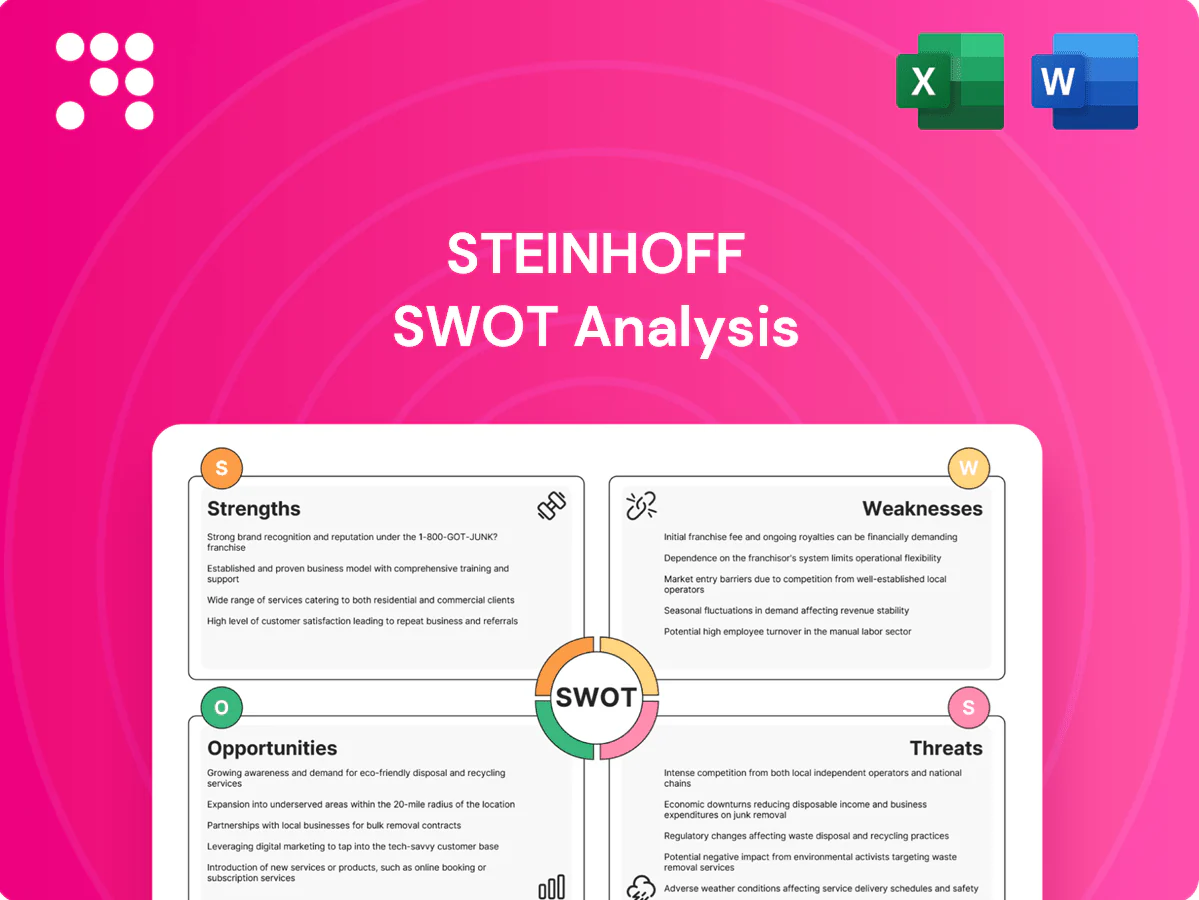
Steinhoff SWOT Analysis

Dive Deeper Into the Company’s Strategic Blueprint
Steinhoff's SWOT reveals residual strengths like global retail scale and asset base, but also deep weaknesses from accounting scandals, legal liabilities, and reputation damage. Opportunities include restructuring, asset disposals and growth in African and online markets, while threats span regulatory action, creditor pressure and intense discount competition. Purchase the full SWOT to get a research-backed, editable Word + Excel package with detailed financial context and strategic recommendations.
Strengths

Deep value-retail know‑how
The group built scale in affordable furniture, household goods and apparel for price‑sensitive consumers, operating across 30+ countries and roughly 5,000 stores at its peak; peak group revenue was about €10–11bn. Decades of merchandising, sourcing and strict cost control created repeatable playbooks that, even during wind‑down, enable orderly disposals and buyer continuity, preserving residual brand and operating procedure value.
Diversified brand and format legacy
Diversified brand and format legacy across retail banners once spread demand risk, allowing Steinhoff to offer buyer optionality in asset sales; targeted divestments can match specific acquirers seeking niches, and legacy portfolio segments—sold separately—have historically attracted premia, supporting recovery of value after the 2017 accounting crisis.

Vertical sourcing and manufacturing capabilities
In-house manufacturing and global procurement historically enabled Steinhoff to deliver low prices and operate on thin retail margins, a dynamic that collapsed after the 2017 accounting scandal and subsequent restructuring. These integrated capabilities remain attractive to acquirers seeking supply-chain efficiencies and can materially enhance valuation of remaining units or contracts. Embedded manufacturing know-how and established procurement channels reduce integration risk for buyers.

Footprint across Europe and Africa
Steinhoff’s footprint across Europe and Africa has historically smoothed revenue cycles and expanded customer reach, with regional positions that remain monetizable on a market-by-market basis. Local scale and entrenched distribution relationships carry standalone value, enabling buyers to extract margin through assortment optimization. Established store networks and logistics nodes offer immediate physical infrastructure for roll-out or consolidation.
- Regional diversification
- Standalone distribution value
- Monetizable market positions
- Established store + logistics nodes
Restructuring experience and process momentum
Management, advisors and creditors have advanced a structured wind-down since the 2017 accounting scandal, with established creditor agreements and timelines that reduce uncertainty. Process discipline aims to maximize recoveries from remaining assets, supported by governance enhancements implemented after the crisis that improved control during exit.
- Creditor-approved frameworks and milestones
- Focused asset realization to boost recoveries
- Strengthened governance and oversight post-2017
Scale-ready discount furniture and apparel: €10–11bn peak, 30+ countries, ~5,000 stores
Scale in affordable furniture and apparel across 30+ countries and ~5,000 stores at peak; peak group revenue ~€10–11bn.
Repeatable sourcing, in‑house manufacturing and procurement deliver low‑cost playbooks attractive to buyers.
Regional footprints in Europe and Africa provide monetizable store and logistics nodes market‑by‑market.
Creditor‑approved wind‑down frameworks and strengthened governance since 2017 support orderly asset realization.
| Metric | Value |
|---|---|
| Peak revenue | €10–11bn |
| Geographic reach | 30+ countries |
| Peak stores | ~5,000 |
What is included in the product
 Detailed Word Document
Delivers a strategic overview of Steinhoff’s internal and external business factors, outlining strengths, weaknesses, opportunities and threats that shape its recovery, operational resilience, and market positioning.

 Customizable Excel Spreadsheet
Provides a concise Steinhoff SWOT matrix for fast, visual assessment of post-crisis risks and recovery opportunities, ideal for executives needing a snapshot of strategic positioning.
Weaknesses

Severe trust deficit from accounting scandal
Historic accounting irregularities erased credibility after Steinhoff shares plunged c.95% in late 2017, shattering investor, lender and partner trust. Counterparties now demand higher risk premia and tighter covenants, raising financing costs and slowing deal execution. That dynamic depresses transaction values in disposals and forces fire-sale pricing. Reputation damage constrains strategic options, limiting M&A, refinancing and partnership routes.
High leverage and contingent liabilities
Steinhoff remains highly leveraged, with creditor and investor claims exceeding €10 billion after the 2017 accounting scandal, constraining strategic flexibility and refinancing options. Cash flows from operations have proven insufficient to service outstanding obligations without recurring asset disposals and restructurings. Large contingent claims and ongoing litigation complicate valuation and timing of distributions, leaving recoveries highly sensitive to legal outcomes and settlement timing.

Complex, opaque corporate structure
Multiple jurisdictions, numerous legal entities and opaque intercompany flows within Steinhoff hinder visibility across operations and financials. This complexity raises due‑diligence costs for buyers and advisers and routinely prolongs negotiations and closing timelines. Structural opacity historically masked risks, exemplified by the 2017 accounting scandal with impairments around €6.7bn, eroding investor confidence.

Loss of scale and synergies through disposals
Asset sales have unwound purchasing power and shared-services benefits, stripping scale from core operations and raising unit costs.
Dis-synergies reduce the standalone appeal of residual units, making them harder to value or sell at premium multiples.
Fragmentation increases overhead per asset and overall earnings power collapses during break-up, pressuring margins and liquidity.
Delisting and exit from public markets
Delisting curtails Steinhoff's access to equity capital and market signalling, forcing reliance on creditor-driven restructuring since the 2017 accounting crisis. The investor base narrows to distressed and private buyers, limiting competitive bids and valuation visibility. Liquidity for shareholders is largely confined to negotiated settlements, while reduced public scrutiny weakens governance perceptions.
- Delisted since 2017: public equity access lost
- Investor base: distressed/private buyers
- Liquidity: tied to restructuring outcomes
- Governance: reduced market scrutiny
Fraud wiped ~95%, >€10bn claims; delisted
Historic accounting fraud wiped out credibility after Steinhoff shares fell c.95% in late 2017, raising counterparty risk and financing costs. High leverage persists with creditor and investor claims >€10bn and 2017 impairments of €6.7bn, forcing repeated asset sales and restructurings. Delisting since 2017 limits equity access and narrows the buyer base to distressed/private parties.
| Metric | Value |
|---|---|
| Share drop (2017) | c.95% |
| Creditor/investor claims | >€10bn |
| 2017 impairments | €6.7bn |
| Delisted | 2017 |
Same Document Delivered
Steinhoff SWOT Analysis
This is the actual SWOT analysis document you’ll receive upon purchase—no surprises, just professional quality. The preview below is taken directly from the full report and reflects the complete structure and findings on Steinhoff. Purchase unlocks the editable, full version.

Dive Deeper Into the Company’s Strategic Blueprint
Steinhoff's SWOT reveals residual strengths like global retail scale and asset base, but also deep weaknesses from accounting scandals, legal liabilities, and reputation damage. Opportunities include restructuring, asset disposals and growth in African and online markets, while threats span regulatory action, creditor pressure and intense discount competition. Purchase the full SWOT to get a research-backed, editable Word + Excel package with detailed financial context and strategic recommendations.
Strengths
Deep value-retail know‑how
The group built scale in affordable furniture, household goods and apparel for price‑sensitive consumers, operating across 30+ countries and roughly 5,000 stores at its peak; peak group revenue was about €10–11bn. Decades of merchandising, sourcing and strict cost control created repeatable playbooks that, even during wind‑down, enable orderly disposals and buyer continuity, preserving residual brand and operating procedure value.
Diversified brand and format legacy
Diversified brand and format legacy across retail banners once spread demand risk, allowing Steinhoff to offer buyer optionality in asset sales; targeted divestments can match specific acquirers seeking niches, and legacy portfolio segments—sold separately—have historically attracted premia, supporting recovery of value after the 2017 accounting crisis.
Vertical sourcing and manufacturing capabilities
In-house manufacturing and global procurement historically enabled Steinhoff to deliver low prices and operate on thin retail margins, a dynamic that collapsed after the 2017 accounting scandal and subsequent restructuring. These integrated capabilities remain attractive to acquirers seeking supply-chain efficiencies and can materially enhance valuation of remaining units or contracts. Embedded manufacturing know-how and established procurement channels reduce integration risk for buyers.
Footprint across Europe and Africa
Steinhoff’s footprint across Europe and Africa has historically smoothed revenue cycles and expanded customer reach, with regional positions that remain monetizable on a market-by-market basis. Local scale and entrenched distribution relationships carry standalone value, enabling buyers to extract margin through assortment optimization. Established store networks and logistics nodes offer immediate physical infrastructure for roll-out or consolidation.
- Regional diversification
- Standalone distribution value
- Monetizable market positions
- Established store + logistics nodes
Restructuring experience and process momentum
Management, advisors and creditors have advanced a structured wind-down since the 2017 accounting scandal, with established creditor agreements and timelines that reduce uncertainty. Process discipline aims to maximize recoveries from remaining assets, supported by governance enhancements implemented after the crisis that improved control during exit.
- Creditor-approved frameworks and milestones
- Focused asset realization to boost recoveries
- Strengthened governance and oversight post-2017
Scale-ready discount furniture and apparel: €10–11bn peak, 30+ countries, ~5,000 stores
Scale in affordable furniture and apparel across 30+ countries and ~5,000 stores at peak; peak group revenue ~€10–11bn.
Repeatable sourcing, in‑house manufacturing and procurement deliver low‑cost playbooks attractive to buyers.
Regional footprints in Europe and Africa provide monetizable store and logistics nodes market‑by‑market.
Creditor‑approved wind‑down frameworks and strengthened governance since 2017 support orderly asset realization.
| Metric | Value |
|---|---|
| Peak revenue | €10–11bn |
| Geographic reach | 30+ countries |
| Peak stores | ~5,000 |
What is included in the product
Detailed Word Document
Delivers a strategic overview of Steinhoff’s internal and external business factors, outlining strengths, weaknesses, opportunities and threats that shape its recovery, operational resilience, and market positioning.
Customizable Excel Spreadsheet
Provides a concise Steinhoff SWOT matrix for fast, visual assessment of post-crisis risks and recovery opportunities, ideal for executives needing a snapshot of strategic positioning.
Weaknesses
Severe trust deficit from accounting scandal
Historic accounting irregularities erased credibility after Steinhoff shares plunged c.95% in late 2017, shattering investor, lender and partner trust. Counterparties now demand higher risk premia and tighter covenants, raising financing costs and slowing deal execution. That dynamic depresses transaction values in disposals and forces fire-sale pricing. Reputation damage constrains strategic options, limiting M&A, refinancing and partnership routes.
High leverage and contingent liabilities
Steinhoff remains highly leveraged, with creditor and investor claims exceeding €10 billion after the 2017 accounting scandal, constraining strategic flexibility and refinancing options. Cash flows from operations have proven insufficient to service outstanding obligations without recurring asset disposals and restructurings. Large contingent claims and ongoing litigation complicate valuation and timing of distributions, leaving recoveries highly sensitive to legal outcomes and settlement timing.
Complex, opaque corporate structure
Multiple jurisdictions, numerous legal entities and opaque intercompany flows within Steinhoff hinder visibility across operations and financials. This complexity raises due‑diligence costs for buyers and advisers and routinely prolongs negotiations and closing timelines. Structural opacity historically masked risks, exemplified by the 2017 accounting scandal with impairments around €6.7bn, eroding investor confidence.
Loss of scale and synergies through disposals
Asset sales have unwound purchasing power and shared-services benefits, stripping scale from core operations and raising unit costs.
Dis-synergies reduce the standalone appeal of residual units, making them harder to value or sell at premium multiples.
Fragmentation increases overhead per asset and overall earnings power collapses during break-up, pressuring margins and liquidity.
Delisting and exit from public markets
Delisting curtails Steinhoff's access to equity capital and market signalling, forcing reliance on creditor-driven restructuring since the 2017 accounting crisis. The investor base narrows to distressed and private buyers, limiting competitive bids and valuation visibility. Liquidity for shareholders is largely confined to negotiated settlements, while reduced public scrutiny weakens governance perceptions.
- Delisted since 2017: public equity access lost
- Investor base: distressed/private buyers
- Liquidity: tied to restructuring outcomes
- Governance: reduced market scrutiny
Fraud wiped ~95%, >€10bn claims; delisted
Historic accounting fraud wiped out credibility after Steinhoff shares fell c.95% in late 2017, raising counterparty risk and financing costs. High leverage persists with creditor and investor claims >€10bn and 2017 impairments of €6.7bn, forcing repeated asset sales and restructurings. Delisting since 2017 limits equity access and narrows the buyer base to distressed/private parties.
| Metric | Value |
|---|---|
| Share drop (2017) | c.95% |
| Creditor/investor claims | >€10bn |
| 2017 impairments | €6.7bn |
| Delisted | 2017 |
Same Document Delivered
Steinhoff SWOT Analysis
This is the actual SWOT analysis document you’ll receive upon purchase—no surprises, just professional quality. The preview below is taken directly from the full report and reflects the complete structure and findings on Steinhoff. Purchase unlocks the editable, full version.
Description
Dive Deeper Into the Company’s Strategic Blueprint
Steinhoff's SWOT reveals residual strengths like global retail scale and asset base, but also deep weaknesses from accounting scandals, legal liabilities, and reputation damage. Opportunities include restructuring, asset disposals and growth in African and online markets, while threats span regulatory action, creditor pressure and intense discount competition. Purchase the full SWOT to get a research-backed, editable Word + Excel package with detailed financial context and strategic recommendations.
Strengths
Deep value-retail know‑how
The group built scale in affordable furniture, household goods and apparel for price‑sensitive consumers, operating across 30+ countries and roughly 5,000 stores at its peak; peak group revenue was about €10–11bn. Decades of merchandising, sourcing and strict cost control created repeatable playbooks that, even during wind‑down, enable orderly disposals and buyer continuity, preserving residual brand and operating procedure value.
Diversified brand and format legacy
Diversified brand and format legacy across retail banners once spread demand risk, allowing Steinhoff to offer buyer optionality in asset sales; targeted divestments can match specific acquirers seeking niches, and legacy portfolio segments—sold separately—have historically attracted premia, supporting recovery of value after the 2017 accounting crisis.
Vertical sourcing and manufacturing capabilities
In-house manufacturing and global procurement historically enabled Steinhoff to deliver low prices and operate on thin retail margins, a dynamic that collapsed after the 2017 accounting scandal and subsequent restructuring. These integrated capabilities remain attractive to acquirers seeking supply-chain efficiencies and can materially enhance valuation of remaining units or contracts. Embedded manufacturing know-how and established procurement channels reduce integration risk for buyers.
Footprint across Europe and Africa
Steinhoff’s footprint across Europe and Africa has historically smoothed revenue cycles and expanded customer reach, with regional positions that remain monetizable on a market-by-market basis. Local scale and entrenched distribution relationships carry standalone value, enabling buyers to extract margin through assortment optimization. Established store networks and logistics nodes offer immediate physical infrastructure for roll-out or consolidation.
- Regional diversification
- Standalone distribution value
- Monetizable market positions
- Established store + logistics nodes
Restructuring experience and process momentum
Management, advisors and creditors have advanced a structured wind-down since the 2017 accounting scandal, with established creditor agreements and timelines that reduce uncertainty. Process discipline aims to maximize recoveries from remaining assets, supported by governance enhancements implemented after the crisis that improved control during exit.
- Creditor-approved frameworks and milestones
- Focused asset realization to boost recoveries
- Strengthened governance and oversight post-2017
Scale-ready discount furniture and apparel: €10–11bn peak, 30+ countries, ~5,000 stores
Scale in affordable furniture and apparel across 30+ countries and ~5,000 stores at peak; peak group revenue ~€10–11bn.
Repeatable sourcing, in‑house manufacturing and procurement deliver low‑cost playbooks attractive to buyers.
Regional footprints in Europe and Africa provide monetizable store and logistics nodes market‑by‑market.
Creditor‑approved wind‑down frameworks and strengthened governance since 2017 support orderly asset realization.
| Metric | Value |
|---|---|
| Peak revenue | €10–11bn |
| Geographic reach | 30+ countries |
| Peak stores | ~5,000 |
What is included in the product
Detailed Word Document
Delivers a strategic overview of Steinhoff’s internal and external business factors, outlining strengths, weaknesses, opportunities and threats that shape its recovery, operational resilience, and market positioning.
Customizable Excel Spreadsheet
Provides a concise Steinhoff SWOT matrix for fast, visual assessment of post-crisis risks and recovery opportunities, ideal for executives needing a snapshot of strategic positioning.
Weaknesses
Severe trust deficit from accounting scandal
Historic accounting irregularities erased credibility after Steinhoff shares plunged c.95% in late 2017, shattering investor, lender and partner trust. Counterparties now demand higher risk premia and tighter covenants, raising financing costs and slowing deal execution. That dynamic depresses transaction values in disposals and forces fire-sale pricing. Reputation damage constrains strategic options, limiting M&A, refinancing and partnership routes.
High leverage and contingent liabilities
Steinhoff remains highly leveraged, with creditor and investor claims exceeding €10 billion after the 2017 accounting scandal, constraining strategic flexibility and refinancing options. Cash flows from operations have proven insufficient to service outstanding obligations without recurring asset disposals and restructurings. Large contingent claims and ongoing litigation complicate valuation and timing of distributions, leaving recoveries highly sensitive to legal outcomes and settlement timing.
Complex, opaque corporate structure
Multiple jurisdictions, numerous legal entities and opaque intercompany flows within Steinhoff hinder visibility across operations and financials. This complexity raises due‑diligence costs for buyers and advisers and routinely prolongs negotiations and closing timelines. Structural opacity historically masked risks, exemplified by the 2017 accounting scandal with impairments around €6.7bn, eroding investor confidence.
Loss of scale and synergies through disposals
Asset sales have unwound purchasing power and shared-services benefits, stripping scale from core operations and raising unit costs.
Dis-synergies reduce the standalone appeal of residual units, making them harder to value or sell at premium multiples.
Fragmentation increases overhead per asset and overall earnings power collapses during break-up, pressuring margins and liquidity.
Delisting and exit from public markets
Delisting curtails Steinhoff's access to equity capital and market signalling, forcing reliance on creditor-driven restructuring since the 2017 accounting crisis. The investor base narrows to distressed and private buyers, limiting competitive bids and valuation visibility. Liquidity for shareholders is largely confined to negotiated settlements, while reduced public scrutiny weakens governance perceptions.
- Delisted since 2017: public equity access lost
- Investor base: distressed/private buyers
- Liquidity: tied to restructuring outcomes
- Governance: reduced market scrutiny
Fraud wiped ~95%, >€10bn claims; delisted
Historic accounting fraud wiped out credibility after Steinhoff shares fell c.95% in late 2017, raising counterparty risk and financing costs. High leverage persists with creditor and investor claims >€10bn and 2017 impairments of €6.7bn, forcing repeated asset sales and restructurings. Delisting since 2017 limits equity access and narrows the buyer base to distressed/private parties.
| Metric | Value |
|---|---|
| Share drop (2017) | c.95% |
| Creditor/investor claims | >€10bn |
| 2017 impairments | €6.7bn |
| Delisted | 2017 |
Same Document Delivered
Steinhoff SWOT Analysis
This is the actual SWOT analysis document you’ll receive upon purchase—no surprises, just professional quality. The preview below is taken directly from the full report and reflects the complete structure and findings on Steinhoff. Purchase unlocks the editable, full version.











