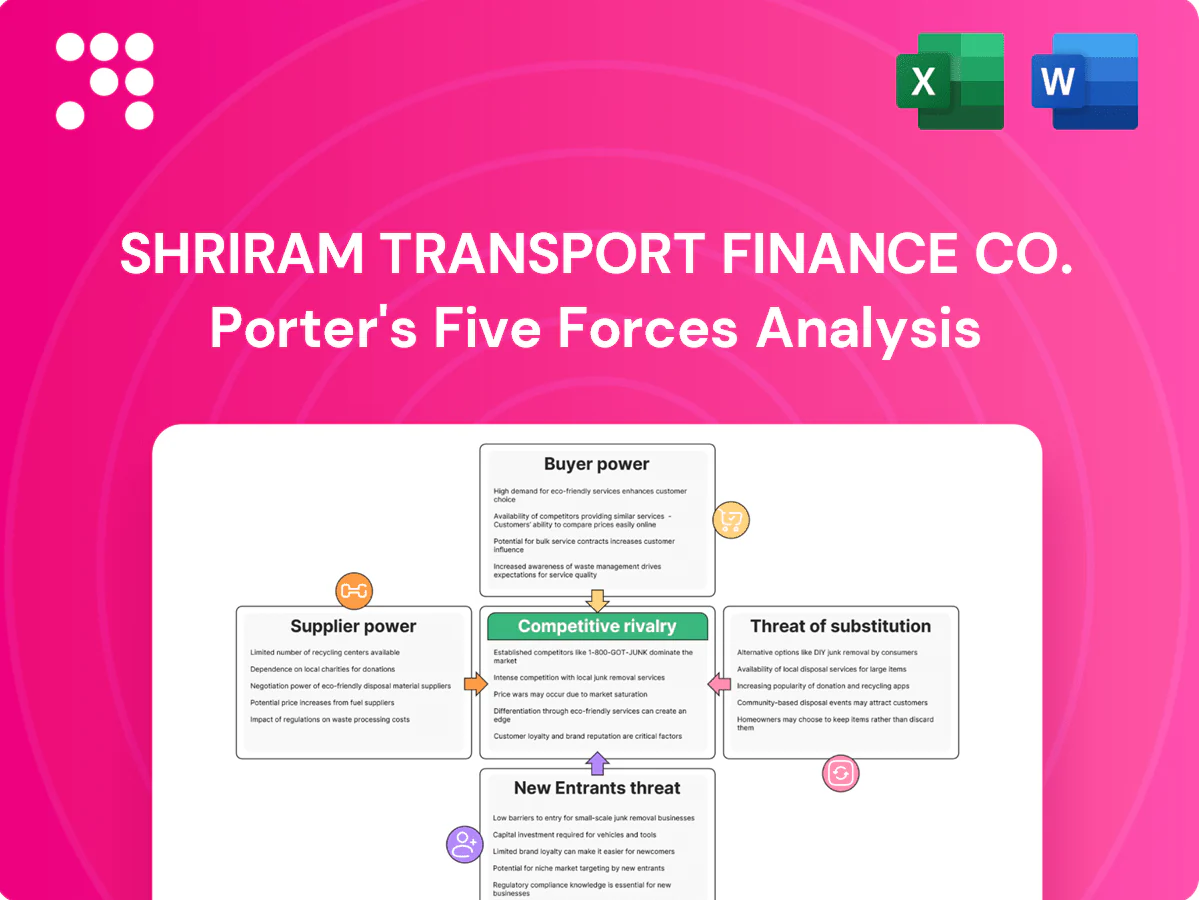
Shriram Transport Finance Co. Porter's Five Forces Analysis

A Must-Have Tool for Decision-Makers
Shriram Transport Finance Co. faces intense competitive rivalry and moderate buyer power amid a capital-heavy, regulated vehicle-finance market, while substitutes and new entrants pose limited but growing threats. This snapshot highlights key pressures on margins and growth. Unlock the full Porter's Five Forces Analysis for force-by-force ratings, visuals, and strategic implications.
Suppliers Bargaining Power

Dependence on wholesale funding
As an NBFC, Shriram Finance depends heavily on bank lines, term loans, securitisation and bond markets for wholesale funding, creating supplier leverage. Concentration among large banks and institutional investors raises funding costs during tight liquidity cycles. When risk appetite falls, spreads widen and covenants tighten, increasing supplier power in downcycles and pressuring margins and growth flexibility.
Interest rate pass-through
Funding providers reprice quickly when the RBI policy repo stood at about 6.50% in 2024, increasing funding costs for Shriram Transport Finance Co.; lenders can reprice assets, but competitive pressure and a sizable fixed-rate legacy book delay full pass-through. This timing gap strengthens supplier leverage, forcing STFC to absorb higher short-term costs. The delay compresses net interest margins until asset repricing catches up.

Securitization market depth
Shriram Transport uses securitization to diversify funding, but investor sentiment drives terms: in stressed windows credit enhancement costs and yields have widened roughly 100–300 bps, raising effective supplier power; deep securitization markets with steady primary issuance compress spreads and limit this risk, while stressed 2023–24 episodes amplified supplier leverage and funding cost volatility.

Technology and data vendors
Shriram Transport Finance relies on numerous core-banking, collections and analytics vendors, which moderates supplier power, but mission-critical switches are costly and risky, creating pockets of vendor lock-in; negotiating leverage rises when STFC pursues multi-vendor strategies. STFC reported AUM of Rs 1.08 lakh crore as of March 2024, increasing the stakes of system continuity.
- Many vendors: reduces overall supplier power
- High switching cost: 12–24 months typical implementation risk
- Vendor lock-in: mission-critical modules create pockets of dependence
- Leverage: multi-vendor setups improve negotiation
DSAs and dealership channels
Loan sourcing via DSAs and dealerships exposes Shriram Transport Finance to commission pressure, especially in competitive pockets where DSAs push for higher payouts; however, STFCL reported consolidated AUM of about INR 1.2 trillion as of March 2024 and relies heavily on its field network. The company’s deep field force and strong direct sourcing mix reduce dependence on third-party channels, keeping supplier power contained and commission escalation limited.
- DSA commission pressure in hot markets
- Direct sourcing via field force reduces dependency
- Reported AUM ~INR 1.2 trillion (Mar 2024)
- Channel supplier power contained
Funding squeeze: RBI 6.50%, spreads widen 100-300bps
Shriram Transport faces moderate supplier power from concentrated bank and institutional wholesale funding, with RBI repo near 6.50% in 2024 raising repricing risk. Securitisation spreads widened ~100–300 bps in stressed 2023–24, increasing funding cost volatility. Vendor and DSA dependencies are limited by a large field force and multi-vendor setups; AUM stood at Rs 1.08 lakh crore (Mar 2024).
| Metric | Value |
|---|---|
| AUM (Mar 2024) | Rs 1.08 lakh crore |
| RBI repo (2024) | ~6.50% |
| Securitisation spread move | 100–300 bps |
| Vendor switching | 12–24 months |
What is included in the product
 Detailed Word Document
Tailored Porter's Five Forces analysis of Shriram Transport Finance Co. uncovering competitive intensity, buyer/supplier power, entry barriers and substitutes, plus disruptive threats and strategic levers affecting pricing, market share and profitability.

 Customizable Excel Spreadsheet
A clear one-sheet Porter’s Five Forces for Shriram Transport Finance Co.—quickly reveals competitive pressures (buyer/supplier power, new entrants, substitutes, rivalry) to relieve strategic blind spots; customizable pressure levels and an instant radar chart make it deck-ready and easy to integrate into reports.
Customers Bargaining Power

Price sensitivity of CV borrowers
Owner-drivers and small fleet operators are highly rate- and EMI-sensitive; even modest interest moves of 25–50 basis points or small tenure shifts materially change monthly EMIs and project IRR. This sensitivity gives buyers tangible bargaining leverage on loan pricing and fees. During economic slowdowns CV demand and repayment capacity compress, further amplifying price pressure on lenders.
Switching costs and relationships
Relationship lending, deep asset knowledge and doorstep service raise switching costs for Shriram Transport Finance customers; its loan book exceeded Rs 1 lakh crore in FY2024, reinforcing scale advantages. Fast disbursals and flexible collections (field-based EMI pick-ups) make borrowers stickier, tempering buyer power despite rate sensitivity. High repeat-loan incidence and cross-sell of insurance and small-TL products further improve retention.

Access to alternatives
Banks, NBFC peers, captives and informal lenders all provide alternatives, increasing buyer bargaining where bank penetration is high; Shriram Transport Finance Ltd (STFCL) reported consolidated AUM of about INR 1.2 lakh crore in FY2024, reflecting scale against rivals. In well-banked regions customers can demand pricing leverage, but in underbanked districts and the used-CV segment options narrow. STFCL’s niche underwriting and branch reach reduce buyer power in those segments.

Product customization
- Structured EMIs: improves affordability
- Seasonal moratoriums: match harvest/income cycles
- LTV flexibility: lowers renegotiation pressure on rates
Information transparency
Information transparency from digital marketplaces and rate aggregators has improved price discovery, strengthening buyer power for new commercial vehicle loans, but underwriting for informal‑income borrowers still depends on field assessment and cash‑flow verification, limiting comparability. In that niche, few comparable offers cap customer leverage.
- Digital marketplaces: better price discovery
- Stronger buyer power on new CV loans
- Field underwriting persists for informal incomes
- Limited comparable offers reduce bargaining
EMI sensitivity gives owner-drivers price leverage; Rs 1.28 lakh crore aids scale
Owner‑drivers and small fleets remain highly EMI‑sensitive, giving customers price leverage especially in well‑banked areas; STFCL reported consolidated AUM of Rs 1.28 lakh crore (Mar 2024), supporting scale but not nullifying rate pressure. Relationship lending, doorstep collections and product customization (seasonal moratoria, LTV flexibility) raise switching costs and reduce buyer power in underbanked/used‑CV niches. Digital marketplaces boost price discovery for new CV loans, increasing bargaining on those products.
| Metric | Value (FY/Mar 2024) |
|---|---|
| Consolidated AUM | Rs 1.28 lakh crore |
| High buyer power segments | New CV loans, well‑banked regions |
| Low buyer power segments | Used CVs, informal‑income borrowers |
Same Document Delivered
Shriram Transport Finance Co. Porter's Five Forces Analysis
This Porter's Five Forces analysis of Shriram Transport Finance Co. assesses competitive rivalry, supplier and buyer bargaining power, threats of new entrants and substitutes, and industry-specific regulatory pressures. The preview you see is the exact, fully formatted document you'll receive immediately after purchase. No placeholders, no samples—this file is ready for use.

A Must-Have Tool for Decision-Makers
Shriram Transport Finance Co. faces intense competitive rivalry and moderate buyer power amid a capital-heavy, regulated vehicle-finance market, while substitutes and new entrants pose limited but growing threats. This snapshot highlights key pressures on margins and growth. Unlock the full Porter's Five Forces Analysis for force-by-force ratings, visuals, and strategic implications.
Suppliers Bargaining Power
Dependence on wholesale funding
As an NBFC, Shriram Finance depends heavily on bank lines, term loans, securitisation and bond markets for wholesale funding, creating supplier leverage. Concentration among large banks and institutional investors raises funding costs during tight liquidity cycles. When risk appetite falls, spreads widen and covenants tighten, increasing supplier power in downcycles and pressuring margins and growth flexibility.
Interest rate pass-through
Funding providers reprice quickly when the RBI policy repo stood at about 6.50% in 2024, increasing funding costs for Shriram Transport Finance Co.; lenders can reprice assets, but competitive pressure and a sizable fixed-rate legacy book delay full pass-through. This timing gap strengthens supplier leverage, forcing STFC to absorb higher short-term costs. The delay compresses net interest margins until asset repricing catches up.
Securitization market depth
Shriram Transport uses securitization to diversify funding, but investor sentiment drives terms: in stressed windows credit enhancement costs and yields have widened roughly 100–300 bps, raising effective supplier power; deep securitization markets with steady primary issuance compress spreads and limit this risk, while stressed 2023–24 episodes amplified supplier leverage and funding cost volatility.
Technology and data vendors
Shriram Transport Finance relies on numerous core-banking, collections and analytics vendors, which moderates supplier power, but mission-critical switches are costly and risky, creating pockets of vendor lock-in; negotiating leverage rises when STFC pursues multi-vendor strategies. STFC reported AUM of Rs 1.08 lakh crore as of March 2024, increasing the stakes of system continuity.
- Many vendors: reduces overall supplier power
- High switching cost: 12–24 months typical implementation risk
- Vendor lock-in: mission-critical modules create pockets of dependence
- Leverage: multi-vendor setups improve negotiation
DSAs and dealership channels
Loan sourcing via DSAs and dealerships exposes Shriram Transport Finance to commission pressure, especially in competitive pockets where DSAs push for higher payouts; however, STFCL reported consolidated AUM of about INR 1.2 trillion as of March 2024 and relies heavily on its field network. The company’s deep field force and strong direct sourcing mix reduce dependence on third-party channels, keeping supplier power contained and commission escalation limited.
- DSA commission pressure in hot markets
- Direct sourcing via field force reduces dependency
- Reported AUM ~INR 1.2 trillion (Mar 2024)
- Channel supplier power contained
Funding squeeze: RBI 6.50%, spreads widen 100-300bps
Shriram Transport faces moderate supplier power from concentrated bank and institutional wholesale funding, with RBI repo near 6.50% in 2024 raising repricing risk. Securitisation spreads widened ~100–300 bps in stressed 2023–24, increasing funding cost volatility. Vendor and DSA dependencies are limited by a large field force and multi-vendor setups; AUM stood at Rs 1.08 lakh crore (Mar 2024).
| Metric | Value |
|---|---|
| AUM (Mar 2024) | Rs 1.08 lakh crore |
| RBI repo (2024) | ~6.50% |
| Securitisation spread move | 100–300 bps |
| Vendor switching | 12–24 months |
What is included in the product
Detailed Word Document
Tailored Porter's Five Forces analysis of Shriram Transport Finance Co. uncovering competitive intensity, buyer/supplier power, entry barriers and substitutes, plus disruptive threats and strategic levers affecting pricing, market share and profitability.
Customizable Excel Spreadsheet
A clear one-sheet Porter’s Five Forces for Shriram Transport Finance Co.—quickly reveals competitive pressures (buyer/supplier power, new entrants, substitutes, rivalry) to relieve strategic blind spots; customizable pressure levels and an instant radar chart make it deck-ready and easy to integrate into reports.
Customers Bargaining Power
Price sensitivity of CV borrowers
Owner-drivers and small fleet operators are highly rate- and EMI-sensitive; even modest interest moves of 25–50 basis points or small tenure shifts materially change monthly EMIs and project IRR. This sensitivity gives buyers tangible bargaining leverage on loan pricing and fees. During economic slowdowns CV demand and repayment capacity compress, further amplifying price pressure on lenders.
Switching costs and relationships
Relationship lending, deep asset knowledge and doorstep service raise switching costs for Shriram Transport Finance customers; its loan book exceeded Rs 1 lakh crore in FY2024, reinforcing scale advantages. Fast disbursals and flexible collections (field-based EMI pick-ups) make borrowers stickier, tempering buyer power despite rate sensitivity. High repeat-loan incidence and cross-sell of insurance and small-TL products further improve retention.
Access to alternatives
Banks, NBFC peers, captives and informal lenders all provide alternatives, increasing buyer bargaining where bank penetration is high; Shriram Transport Finance Ltd (STFCL) reported consolidated AUM of about INR 1.2 lakh crore in FY2024, reflecting scale against rivals. In well-banked regions customers can demand pricing leverage, but in underbanked districts and the used-CV segment options narrow. STFCL’s niche underwriting and branch reach reduce buyer power in those segments.
Product customization
- Structured EMIs: improves affordability
- Seasonal moratoriums: match harvest/income cycles
- LTV flexibility: lowers renegotiation pressure on rates
Information transparency
Information transparency from digital marketplaces and rate aggregators has improved price discovery, strengthening buyer power for new commercial vehicle loans, but underwriting for informal‑income borrowers still depends on field assessment and cash‑flow verification, limiting comparability. In that niche, few comparable offers cap customer leverage.
- Digital marketplaces: better price discovery
- Stronger buyer power on new CV loans
- Field underwriting persists for informal incomes
- Limited comparable offers reduce bargaining
EMI sensitivity gives owner-drivers price leverage; Rs 1.28 lakh crore aids scale
Owner‑drivers and small fleets remain highly EMI‑sensitive, giving customers price leverage especially in well‑banked areas; STFCL reported consolidated AUM of Rs 1.28 lakh crore (Mar 2024), supporting scale but not nullifying rate pressure. Relationship lending, doorstep collections and product customization (seasonal moratoria, LTV flexibility) raise switching costs and reduce buyer power in underbanked/used‑CV niches. Digital marketplaces boost price discovery for new CV loans, increasing bargaining on those products.
| Metric | Value (FY/Mar 2024) |
|---|---|
| Consolidated AUM | Rs 1.28 lakh crore |
| High buyer power segments | New CV loans, well‑banked regions |
| Low buyer power segments | Used CVs, informal‑income borrowers |
Same Document Delivered
Shriram Transport Finance Co. Porter's Five Forces Analysis
This Porter's Five Forces analysis of Shriram Transport Finance Co. assesses competitive rivalry, supplier and buyer bargaining power, threats of new entrants and substitutes, and industry-specific regulatory pressures. The preview you see is the exact, fully formatted document you'll receive immediately after purchase. No placeholders, no samples—this file is ready for use.
Description
A Must-Have Tool for Decision-Makers
Shriram Transport Finance Co. faces intense competitive rivalry and moderate buyer power amid a capital-heavy, regulated vehicle-finance market, while substitutes and new entrants pose limited but growing threats. This snapshot highlights key pressures on margins and growth. Unlock the full Porter's Five Forces Analysis for force-by-force ratings, visuals, and strategic implications.
Suppliers Bargaining Power
Dependence on wholesale funding
As an NBFC, Shriram Finance depends heavily on bank lines, term loans, securitisation and bond markets for wholesale funding, creating supplier leverage. Concentration among large banks and institutional investors raises funding costs during tight liquidity cycles. When risk appetite falls, spreads widen and covenants tighten, increasing supplier power in downcycles and pressuring margins and growth flexibility.
Interest rate pass-through
Funding providers reprice quickly when the RBI policy repo stood at about 6.50% in 2024, increasing funding costs for Shriram Transport Finance Co.; lenders can reprice assets, but competitive pressure and a sizable fixed-rate legacy book delay full pass-through. This timing gap strengthens supplier leverage, forcing STFC to absorb higher short-term costs. The delay compresses net interest margins until asset repricing catches up.
Securitization market depth
Shriram Transport uses securitization to diversify funding, but investor sentiment drives terms: in stressed windows credit enhancement costs and yields have widened roughly 100–300 bps, raising effective supplier power; deep securitization markets with steady primary issuance compress spreads and limit this risk, while stressed 2023–24 episodes amplified supplier leverage and funding cost volatility.
Technology and data vendors
Shriram Transport Finance relies on numerous core-banking, collections and analytics vendors, which moderates supplier power, but mission-critical switches are costly and risky, creating pockets of vendor lock-in; negotiating leverage rises when STFC pursues multi-vendor strategies. STFC reported AUM of Rs 1.08 lakh crore as of March 2024, increasing the stakes of system continuity.
- Many vendors: reduces overall supplier power
- High switching cost: 12–24 months typical implementation risk
- Vendor lock-in: mission-critical modules create pockets of dependence
- Leverage: multi-vendor setups improve negotiation
DSAs and dealership channels
Loan sourcing via DSAs and dealerships exposes Shriram Transport Finance to commission pressure, especially in competitive pockets where DSAs push for higher payouts; however, STFCL reported consolidated AUM of about INR 1.2 trillion as of March 2024 and relies heavily on its field network. The company’s deep field force and strong direct sourcing mix reduce dependence on third-party channels, keeping supplier power contained and commission escalation limited.
- DSA commission pressure in hot markets
- Direct sourcing via field force reduces dependency
- Reported AUM ~INR 1.2 trillion (Mar 2024)
- Channel supplier power contained
Funding squeeze: RBI 6.50%, spreads widen 100-300bps
Shriram Transport faces moderate supplier power from concentrated bank and institutional wholesale funding, with RBI repo near 6.50% in 2024 raising repricing risk. Securitisation spreads widened ~100–300 bps in stressed 2023–24, increasing funding cost volatility. Vendor and DSA dependencies are limited by a large field force and multi-vendor setups; AUM stood at Rs 1.08 lakh crore (Mar 2024).
| Metric | Value |
|---|---|
| AUM (Mar 2024) | Rs 1.08 lakh crore |
| RBI repo (2024) | ~6.50% |
| Securitisation spread move | 100–300 bps |
| Vendor switching | 12–24 months |
What is included in the product
Detailed Word Document
Tailored Porter's Five Forces analysis of Shriram Transport Finance Co. uncovering competitive intensity, buyer/supplier power, entry barriers and substitutes, plus disruptive threats and strategic levers affecting pricing, market share and profitability.
Customizable Excel Spreadsheet
A clear one-sheet Porter’s Five Forces for Shriram Transport Finance Co.—quickly reveals competitive pressures (buyer/supplier power, new entrants, substitutes, rivalry) to relieve strategic blind spots; customizable pressure levels and an instant radar chart make it deck-ready and easy to integrate into reports.
Customers Bargaining Power
Price sensitivity of CV borrowers
Owner-drivers and small fleet operators are highly rate- and EMI-sensitive; even modest interest moves of 25–50 basis points or small tenure shifts materially change monthly EMIs and project IRR. This sensitivity gives buyers tangible bargaining leverage on loan pricing and fees. During economic slowdowns CV demand and repayment capacity compress, further amplifying price pressure on lenders.
Switching costs and relationships
Relationship lending, deep asset knowledge and doorstep service raise switching costs for Shriram Transport Finance customers; its loan book exceeded Rs 1 lakh crore in FY2024, reinforcing scale advantages. Fast disbursals and flexible collections (field-based EMI pick-ups) make borrowers stickier, tempering buyer power despite rate sensitivity. High repeat-loan incidence and cross-sell of insurance and small-TL products further improve retention.
Access to alternatives
Banks, NBFC peers, captives and informal lenders all provide alternatives, increasing buyer bargaining where bank penetration is high; Shriram Transport Finance Ltd (STFCL) reported consolidated AUM of about INR 1.2 lakh crore in FY2024, reflecting scale against rivals. In well-banked regions customers can demand pricing leverage, but in underbanked districts and the used-CV segment options narrow. STFCL’s niche underwriting and branch reach reduce buyer power in those segments.
Product customization
- Structured EMIs: improves affordability
- Seasonal moratoriums: match harvest/income cycles
- LTV flexibility: lowers renegotiation pressure on rates
Information transparency
Information transparency from digital marketplaces and rate aggregators has improved price discovery, strengthening buyer power for new commercial vehicle loans, but underwriting for informal‑income borrowers still depends on field assessment and cash‑flow verification, limiting comparability. In that niche, few comparable offers cap customer leverage.
- Digital marketplaces: better price discovery
- Stronger buyer power on new CV loans
- Field underwriting persists for informal incomes
- Limited comparable offers reduce bargaining
EMI sensitivity gives owner-drivers price leverage; Rs 1.28 lakh crore aids scale
Owner‑drivers and small fleets remain highly EMI‑sensitive, giving customers price leverage especially in well‑banked areas; STFCL reported consolidated AUM of Rs 1.28 lakh crore (Mar 2024), supporting scale but not nullifying rate pressure. Relationship lending, doorstep collections and product customization (seasonal moratoria, LTV flexibility) raise switching costs and reduce buyer power in underbanked/used‑CV niches. Digital marketplaces boost price discovery for new CV loans, increasing bargaining on those products.
| Metric | Value (FY/Mar 2024) |
|---|---|
| Consolidated AUM | Rs 1.28 lakh crore |
| High buyer power segments | New CV loans, well‑banked regions |
| Low buyer power segments | Used CVs, informal‑income borrowers |
Same Document Delivered
Shriram Transport Finance Co. Porter's Five Forces Analysis
This Porter's Five Forces analysis of Shriram Transport Finance Co. assesses competitive rivalry, supplier and buyer bargaining power, threats of new entrants and substitutes, and industry-specific regulatory pressures. The preview you see is the exact, fully formatted document you'll receive immediately after purchase. No placeholders, no samples—this file is ready for use.











