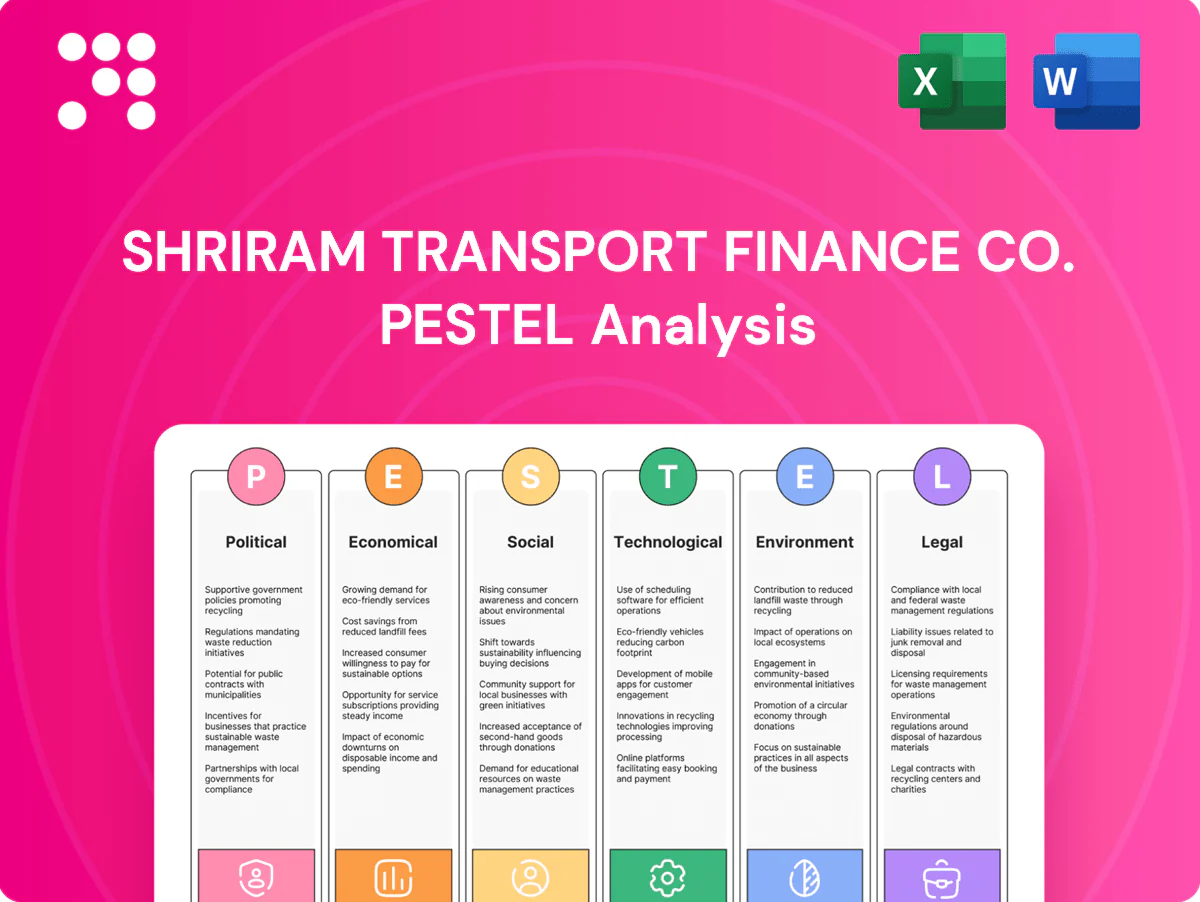
Shriram Transport Finance Co. PESTLE Analysis

Your Shortcut to Market Insight Starts Here
Our PESTLE analysis of Shriram Transport Finance Co. reveals how political regulations, macroeconomic cycles, social mobility, technological disruption, legal norms and environmental trends shape its lending risk and growth opportunities. Leverage these insights to anticipate challenges and spot market gaps. Buy the full, downloadable PESTLE for actionable, board-ready intelligence.
Political factors

Infra push and logistics policy
Government capital expenditure of ₹10 lakh crore in FY25 and PM Gati Shakti's integrated corridor planning boost freight throughput and commercial vehicle demand, supporting Shriram Transport's loan book via higher replacement and new-sales financing. Strong public project pipelines underpin stable utilisation and replacement cycles, reducing demand volatility. Execution slowdowns or project delays can soften disbursements and collections, raising credit risk.
Priority for MSMEs and inclusion
Priority for MSMEs and financial inclusion expands Shriram Transport Finance's addressable base given MSMEs contribute roughly 30% of India’s GDP and employ about 110 million people (Ministry of MSME). Credit guarantees and interest subventions under schemes like CGTMSE lower effective risk costs and support lending spreads. Targeted support during downturns preserves asset quality; withdrawal of support can tighten liquidity for small operators and raise delinquencies.

Election-cycle volatility
India’s April–May 2024 general election shifted public investment timing and delayed some state-level contracts, constraining road freight flows and contributing to a short-term moderation in commercial-vehicle loan disbursals across NBFCs in Q1 FY2025. Short-term uncertainty typically dampens STFCL’s loan growth given its focus on cyclical freight financing, while post-election clarity in H2 2024 helped normalize demand. Regional outcomes matter sharply for STFCL because its client base is concentrated in semi-urban and rural markets and the company’s assets under management exceed Rs 1 lakh crore.

Fuel and transport policies
Excise and state VAT shifts on diesel directly compress trucker margins and Shriram Transport Finance loan repayment capacity, with diesel historically constituting a large share of operating cost; sudden tax hikes have raised default risk. Toll policy and mandatory FASTag rollout since February 2021 raised electronic tolling adoption, affecting intraday cash flows and cost predictability. Permit, overloading and road-safety enforcement influence fleet utilization and asset life, altering residual-value assumptions. Predictable fuel and transport regulation supports tighter underwriting and lower PDs.
- Diesel tax volatility: increases raise default risk
- FASTag mandatory Feb 2021: improves toll collection predictability
- Permit/overload enforcement: affects utilization and asset life
- Stable policy: enables stricter underwriting, lower PDs
Public–private regulatory stance on NBFCs
Policy alignment between MoF and RBI shapes Shriram Transport Finance growth latitude; coordinated oversight since IL&FS has tightened norms and liquidity access. Supportive frameworks (post-2020 liquidity windows) enabled calibrated expansion, while stress-driven tightening historically pushed NBFC borrowing spreads up 200–300 bps. Consistent policy sustains lender and investor confidence.
- NBFC sector assets ≈ ₹60 trillion (circa 2024)
- Post-stress spread rise: 200–300 bps
- Consistent MoF–RBI stance reduces funding and compliance volatility
Govt capex ₹10 lakh crore + Gati Shakti boost CVs, ease NBFC stress
Government capex ₹10 lakh crore FY25 and PM Gati Shakti raise CV demand, supporting Shriram Transport’s loan book; election timing in Apr–May 2024 caused short-term disbursal moderation. Diesel tax volatility and toll policy alter repayment capacity and residual-value risk. Coordinated MoF–RBI support narrows funding stress for NBFCs.
| Metric | Value |
|---|---|
| Gov capex FY25 | ₹10 lakh crore |
| NBFC assets (2024) | ≈₹60 trillion |
| STFCL AUM | >₹1 lakh crore |
What is included in the product
 Detailed Word Document
Explores how macro-environmental factors uniquely affect Shriram Transport Finance Co. across Political, Economic, Social, Technological, Environmental and Legal dimensions, with data-driven trends and sector-specific examples. Designed for executives and investors to identify risks, opportunities and actionable strategies aligned to regional market dynamics.

 Customizable Excel Spreadsheet
A clean, summarized PESTLE of Shriram Transport Finance highlighting regulatory, economic, and technological risks for quick meeting reference; editable notes let teams localize insights and drop concise slides into presentations for fast cross‑team alignment.
Economic factors

GDP and freight elasticity
CV finance demand is highly pro-cyclical: India’s GDP stayed near 7% in 2024 (IMF) and IIP expanded roughly 3.5% YoY, driving higher fleet utilization and stronger loan offtake for Shriram Transport; economic slowdowns quickly strain collections and asset turnover; regional performance varies with sectoral mix—construction, agriculture and booming e-commerce create divergent demand pockets.
Interest rates and liquidity
RBI policy stance and system liquidity—policy repo at about 6.5% and average systemic surplus near ₹3 lakh crore (2024–25)—directly drive STFC borrowing costs and spreads. Higher rates can compress demand and NIMs; STFC reported NIM around 6.1% in FY24, so rate upcycles erode margins. Lower rates spur refinancing and asset churn. A diversified funding mix (bank loans, NCDs, securitisations) and strict ALM are critical in tightening cycles.

Fuel and inflation dynamics
Rising diesel (retail ~INR 95–110/l across metros in 2024–25) and headline CPI near 5% in 2024 squeeze trucker margins as freight-rate pass-through is often lagged by 2–6 months, stressing early-cycle EMIs for Shriram Transport borrowers. Persistent inflation elevates credit and NPA risk; conversely disinflation improves affordability and loan appetite, boosting demand for new CV financing.

Used CV market cycles
Shriram Transport’s used commercial vehicle franchise depends heavily on resilient resale values, since lower secondary prices directly raise loss-given-default on repossessions and stress recovery rates. Strong demand in key transport segments has recently supported collateral coverage even as price volatility increases. Market depth and liquidity remain uneven across vehicle classes and older-age cohorts, affecting recovery timelines.
Rural incomes and monsoon
Agricultural output and rural cash flows remain primary drivers of earnings for small transport operators financed by Shriram Transport Finance, with near‑normal monsoons in 2024 and steady MSP support boosting freight volumes and utilisation. Poor seasons historically raise delinquencies on agri‑linked routes; STFC’s pan‑India regional diversification and mix of commercial‑vehicle segments reduce localized shocks.
- Rural cash flows drive operator earnings
- Near‑normal 2024 monsoon + MSP support lifted demand
- Weak seasons -> higher delinquencies
- Regional diversification mitigates risk
Govt capex ₹10 lakh crore + Gati Shakti boost CVs, ease NBFC stress
CV finance is pro‑cyclical: India GDP ~7% (IMF 2024) and IIP +3.5% YoY lifted fleet utilisation and loan offtake; rate cycles and liquidity (repo ~6.5%, systemic surplus ~₹3 lakh crore 2024–25) set funding costs; STFC NIM ~6.1% FY24. Diesel ₹95–110/l and CPI ~5% (2024) squeeze operator margins; near‑normal 2024 monsoon supported rural cash flows.
| Metric | Value (2024/25) |
|---|---|
| GDP (IMF) | ~7% |
| Repo | ~6.5% |
| Systemic surplus | ~₹3 lakh crore |
| STFC NIM | 6.1% FY24 |
| Diesel | ₹95–110/l |
Full Version Awaits
Shriram Transport Finance Co. PESTLE Analysis
This PESTLE analysis of Shriram Transport Finance Company examines political, economic, social, technological, legal and environmental factors affecting its commercial vehicle lending business and highlights key risks and strategic opportunities. The report includes actionable implications for stakeholders and strategic recommendations. The preview shown here is the exact document you’ll receive after purchase—fully formatted and ready to use.

Your Shortcut to Market Insight Starts Here
Our PESTLE analysis of Shriram Transport Finance Co. reveals how political regulations, macroeconomic cycles, social mobility, technological disruption, legal norms and environmental trends shape its lending risk and growth opportunities. Leverage these insights to anticipate challenges and spot market gaps. Buy the full, downloadable PESTLE for actionable, board-ready intelligence.
Political factors
Infra push and logistics policy
Government capital expenditure of ₹10 lakh crore in FY25 and PM Gati Shakti's integrated corridor planning boost freight throughput and commercial vehicle demand, supporting Shriram Transport's loan book via higher replacement and new-sales financing. Strong public project pipelines underpin stable utilisation and replacement cycles, reducing demand volatility. Execution slowdowns or project delays can soften disbursements and collections, raising credit risk.
Priority for MSMEs and inclusion
Priority for MSMEs and financial inclusion expands Shriram Transport Finance's addressable base given MSMEs contribute roughly 30% of India’s GDP and employ about 110 million people (Ministry of MSME). Credit guarantees and interest subventions under schemes like CGTMSE lower effective risk costs and support lending spreads. Targeted support during downturns preserves asset quality; withdrawal of support can tighten liquidity for small operators and raise delinquencies.
Election-cycle volatility
India’s April–May 2024 general election shifted public investment timing and delayed some state-level contracts, constraining road freight flows and contributing to a short-term moderation in commercial-vehicle loan disbursals across NBFCs in Q1 FY2025. Short-term uncertainty typically dampens STFCL’s loan growth given its focus on cyclical freight financing, while post-election clarity in H2 2024 helped normalize demand. Regional outcomes matter sharply for STFCL because its client base is concentrated in semi-urban and rural markets and the company’s assets under management exceed Rs 1 lakh crore.
Fuel and transport policies
Excise and state VAT shifts on diesel directly compress trucker margins and Shriram Transport Finance loan repayment capacity, with diesel historically constituting a large share of operating cost; sudden tax hikes have raised default risk. Toll policy and mandatory FASTag rollout since February 2021 raised electronic tolling adoption, affecting intraday cash flows and cost predictability. Permit, overloading and road-safety enforcement influence fleet utilization and asset life, altering residual-value assumptions. Predictable fuel and transport regulation supports tighter underwriting and lower PDs.
- Diesel tax volatility: increases raise default risk
- FASTag mandatory Feb 2021: improves toll collection predictability
- Permit/overload enforcement: affects utilization and asset life
- Stable policy: enables stricter underwriting, lower PDs
Public–private regulatory stance on NBFCs
Policy alignment between MoF and RBI shapes Shriram Transport Finance growth latitude; coordinated oversight since IL&FS has tightened norms and liquidity access. Supportive frameworks (post-2020 liquidity windows) enabled calibrated expansion, while stress-driven tightening historically pushed NBFC borrowing spreads up 200–300 bps. Consistent policy sustains lender and investor confidence.
- NBFC sector assets ≈ ₹60 trillion (circa 2024)
- Post-stress spread rise: 200–300 bps
- Consistent MoF–RBI stance reduces funding and compliance volatility
Govt capex ₹10 lakh crore + Gati Shakti boost CVs, ease NBFC stress
Government capex ₹10 lakh crore FY25 and PM Gati Shakti raise CV demand, supporting Shriram Transport’s loan book; election timing in Apr–May 2024 caused short-term disbursal moderation. Diesel tax volatility and toll policy alter repayment capacity and residual-value risk. Coordinated MoF–RBI support narrows funding stress for NBFCs.
| Metric | Value |
|---|---|
| Gov capex FY25 | ₹10 lakh crore |
| NBFC assets (2024) | ≈₹60 trillion |
| STFCL AUM | >₹1 lakh crore |
What is included in the product
Detailed Word Document
Explores how macro-environmental factors uniquely affect Shriram Transport Finance Co. across Political, Economic, Social, Technological, Environmental and Legal dimensions, with data-driven trends and sector-specific examples. Designed for executives and investors to identify risks, opportunities and actionable strategies aligned to regional market dynamics.
Customizable Excel Spreadsheet
A clean, summarized PESTLE of Shriram Transport Finance highlighting regulatory, economic, and technological risks for quick meeting reference; editable notes let teams localize insights and drop concise slides into presentations for fast cross‑team alignment.
Economic factors
GDP and freight elasticity
CV finance demand is highly pro-cyclical: India’s GDP stayed near 7% in 2024 (IMF) and IIP expanded roughly 3.5% YoY, driving higher fleet utilization and stronger loan offtake for Shriram Transport; economic slowdowns quickly strain collections and asset turnover; regional performance varies with sectoral mix—construction, agriculture and booming e-commerce create divergent demand pockets.
Interest rates and liquidity
RBI policy stance and system liquidity—policy repo at about 6.5% and average systemic surplus near ₹3 lakh crore (2024–25)—directly drive STFC borrowing costs and spreads. Higher rates can compress demand and NIMs; STFC reported NIM around 6.1% in FY24, so rate upcycles erode margins. Lower rates spur refinancing and asset churn. A diversified funding mix (bank loans, NCDs, securitisations) and strict ALM are critical in tightening cycles.
Fuel and inflation dynamics
Rising diesel (retail ~INR 95–110/l across metros in 2024–25) and headline CPI near 5% in 2024 squeeze trucker margins as freight-rate pass-through is often lagged by 2–6 months, stressing early-cycle EMIs for Shriram Transport borrowers. Persistent inflation elevates credit and NPA risk; conversely disinflation improves affordability and loan appetite, boosting demand for new CV financing.
Used CV market cycles
Shriram Transport’s used commercial vehicle franchise depends heavily on resilient resale values, since lower secondary prices directly raise loss-given-default on repossessions and stress recovery rates. Strong demand in key transport segments has recently supported collateral coverage even as price volatility increases. Market depth and liquidity remain uneven across vehicle classes and older-age cohorts, affecting recovery timelines.
Rural incomes and monsoon
Agricultural output and rural cash flows remain primary drivers of earnings for small transport operators financed by Shriram Transport Finance, with near‑normal monsoons in 2024 and steady MSP support boosting freight volumes and utilisation. Poor seasons historically raise delinquencies on agri‑linked routes; STFC’s pan‑India regional diversification and mix of commercial‑vehicle segments reduce localized shocks.
- Rural cash flows drive operator earnings
- Near‑normal 2024 monsoon + MSP support lifted demand
- Weak seasons -> higher delinquencies
- Regional diversification mitigates risk
Govt capex ₹10 lakh crore + Gati Shakti boost CVs, ease NBFC stress
CV finance is pro‑cyclical: India GDP ~7% (IMF 2024) and IIP +3.5% YoY lifted fleet utilisation and loan offtake; rate cycles and liquidity (repo ~6.5%, systemic surplus ~₹3 lakh crore 2024–25) set funding costs; STFC NIM ~6.1% FY24. Diesel ₹95–110/l and CPI ~5% (2024) squeeze operator margins; near‑normal 2024 monsoon supported rural cash flows.
| Metric | Value (2024/25) |
|---|---|
| GDP (IMF) | ~7% |
| Repo | ~6.5% |
| Systemic surplus | ~₹3 lakh crore |
| STFC NIM | 6.1% FY24 |
| Diesel | ₹95–110/l |
Full Version Awaits
Shriram Transport Finance Co. PESTLE Analysis
This PESTLE analysis of Shriram Transport Finance Company examines political, economic, social, technological, legal and environmental factors affecting its commercial vehicle lending business and highlights key risks and strategic opportunities. The report includes actionable implications for stakeholders and strategic recommendations. The preview shown here is the exact document you’ll receive after purchase—fully formatted and ready to use.
Original: $10.00
-65%$10.00
$3.50Description
Your Shortcut to Market Insight Starts Here
Our PESTLE analysis of Shriram Transport Finance Co. reveals how political regulations, macroeconomic cycles, social mobility, technological disruption, legal norms and environmental trends shape its lending risk and growth opportunities. Leverage these insights to anticipate challenges and spot market gaps. Buy the full, downloadable PESTLE for actionable, board-ready intelligence.
Political factors
Infra push and logistics policy
Government capital expenditure of ₹10 lakh crore in FY25 and PM Gati Shakti's integrated corridor planning boost freight throughput and commercial vehicle demand, supporting Shriram Transport's loan book via higher replacement and new-sales financing. Strong public project pipelines underpin stable utilisation and replacement cycles, reducing demand volatility. Execution slowdowns or project delays can soften disbursements and collections, raising credit risk.
Priority for MSMEs and inclusion
Priority for MSMEs and financial inclusion expands Shriram Transport Finance's addressable base given MSMEs contribute roughly 30% of India’s GDP and employ about 110 million people (Ministry of MSME). Credit guarantees and interest subventions under schemes like CGTMSE lower effective risk costs and support lending spreads. Targeted support during downturns preserves asset quality; withdrawal of support can tighten liquidity for small operators and raise delinquencies.
Election-cycle volatility
India’s April–May 2024 general election shifted public investment timing and delayed some state-level contracts, constraining road freight flows and contributing to a short-term moderation in commercial-vehicle loan disbursals across NBFCs in Q1 FY2025. Short-term uncertainty typically dampens STFCL’s loan growth given its focus on cyclical freight financing, while post-election clarity in H2 2024 helped normalize demand. Regional outcomes matter sharply for STFCL because its client base is concentrated in semi-urban and rural markets and the company’s assets under management exceed Rs 1 lakh crore.
Fuel and transport policies
Excise and state VAT shifts on diesel directly compress trucker margins and Shriram Transport Finance loan repayment capacity, with diesel historically constituting a large share of operating cost; sudden tax hikes have raised default risk. Toll policy and mandatory FASTag rollout since February 2021 raised electronic tolling adoption, affecting intraday cash flows and cost predictability. Permit, overloading and road-safety enforcement influence fleet utilization and asset life, altering residual-value assumptions. Predictable fuel and transport regulation supports tighter underwriting and lower PDs.
- Diesel tax volatility: increases raise default risk
- FASTag mandatory Feb 2021: improves toll collection predictability
- Permit/overload enforcement: affects utilization and asset life
- Stable policy: enables stricter underwriting, lower PDs
Public–private regulatory stance on NBFCs
Policy alignment between MoF and RBI shapes Shriram Transport Finance growth latitude; coordinated oversight since IL&FS has tightened norms and liquidity access. Supportive frameworks (post-2020 liquidity windows) enabled calibrated expansion, while stress-driven tightening historically pushed NBFC borrowing spreads up 200–300 bps. Consistent policy sustains lender and investor confidence.
- NBFC sector assets ≈ ₹60 trillion (circa 2024)
- Post-stress spread rise: 200–300 bps
- Consistent MoF–RBI stance reduces funding and compliance volatility
Govt capex ₹10 lakh crore + Gati Shakti boost CVs, ease NBFC stress
Government capex ₹10 lakh crore FY25 and PM Gati Shakti raise CV demand, supporting Shriram Transport’s loan book; election timing in Apr–May 2024 caused short-term disbursal moderation. Diesel tax volatility and toll policy alter repayment capacity and residual-value risk. Coordinated MoF–RBI support narrows funding stress for NBFCs.
| Metric | Value |
|---|---|
| Gov capex FY25 | ₹10 lakh crore |
| NBFC assets (2024) | ≈₹60 trillion |
| STFCL AUM | >₹1 lakh crore |
What is included in the product
Detailed Word Document
Explores how macro-environmental factors uniquely affect Shriram Transport Finance Co. across Political, Economic, Social, Technological, Environmental and Legal dimensions, with data-driven trends and sector-specific examples. Designed for executives and investors to identify risks, opportunities and actionable strategies aligned to regional market dynamics.
Customizable Excel Spreadsheet
A clean, summarized PESTLE of Shriram Transport Finance highlighting regulatory, economic, and technological risks for quick meeting reference; editable notes let teams localize insights and drop concise slides into presentations for fast cross‑team alignment.
Economic factors
GDP and freight elasticity
CV finance demand is highly pro-cyclical: India’s GDP stayed near 7% in 2024 (IMF) and IIP expanded roughly 3.5% YoY, driving higher fleet utilization and stronger loan offtake for Shriram Transport; economic slowdowns quickly strain collections and asset turnover; regional performance varies with sectoral mix—construction, agriculture and booming e-commerce create divergent demand pockets.
Interest rates and liquidity
RBI policy stance and system liquidity—policy repo at about 6.5% and average systemic surplus near ₹3 lakh crore (2024–25)—directly drive STFC borrowing costs and spreads. Higher rates can compress demand and NIMs; STFC reported NIM around 6.1% in FY24, so rate upcycles erode margins. Lower rates spur refinancing and asset churn. A diversified funding mix (bank loans, NCDs, securitisations) and strict ALM are critical in tightening cycles.
Fuel and inflation dynamics
Rising diesel (retail ~INR 95–110/l across metros in 2024–25) and headline CPI near 5% in 2024 squeeze trucker margins as freight-rate pass-through is often lagged by 2–6 months, stressing early-cycle EMIs for Shriram Transport borrowers. Persistent inflation elevates credit and NPA risk; conversely disinflation improves affordability and loan appetite, boosting demand for new CV financing.
Used CV market cycles
Shriram Transport’s used commercial vehicle franchise depends heavily on resilient resale values, since lower secondary prices directly raise loss-given-default on repossessions and stress recovery rates. Strong demand in key transport segments has recently supported collateral coverage even as price volatility increases. Market depth and liquidity remain uneven across vehicle classes and older-age cohorts, affecting recovery timelines.
Rural incomes and monsoon
Agricultural output and rural cash flows remain primary drivers of earnings for small transport operators financed by Shriram Transport Finance, with near‑normal monsoons in 2024 and steady MSP support boosting freight volumes and utilisation. Poor seasons historically raise delinquencies on agri‑linked routes; STFC’s pan‑India regional diversification and mix of commercial‑vehicle segments reduce localized shocks.
- Rural cash flows drive operator earnings
- Near‑normal 2024 monsoon + MSP support lifted demand
- Weak seasons -> higher delinquencies
- Regional diversification mitigates risk
Govt capex ₹10 lakh crore + Gati Shakti boost CVs, ease NBFC stress
CV finance is pro‑cyclical: India GDP ~7% (IMF 2024) and IIP +3.5% YoY lifted fleet utilisation and loan offtake; rate cycles and liquidity (repo ~6.5%, systemic surplus ~₹3 lakh crore 2024–25) set funding costs; STFC NIM ~6.1% FY24. Diesel ₹95–110/l and CPI ~5% (2024) squeeze operator margins; near‑normal 2024 monsoon supported rural cash flows.
| Metric | Value (2024/25) |
|---|---|
| GDP (IMF) | ~7% |
| Repo | ~6.5% |
| Systemic surplus | ~₹3 lakh crore |
| STFC NIM | 6.1% FY24 |
| Diesel | ₹95–110/l |
Full Version Awaits
Shriram Transport Finance Co. PESTLE Analysis
This PESTLE analysis of Shriram Transport Finance Company examines political, economic, social, technological, legal and environmental factors affecting its commercial vehicle lending business and highlights key risks and strategic opportunities. The report includes actionable implications for stakeholders and strategic recommendations. The preview shown here is the exact document you’ll receive after purchase—fully formatted and ready to use.











