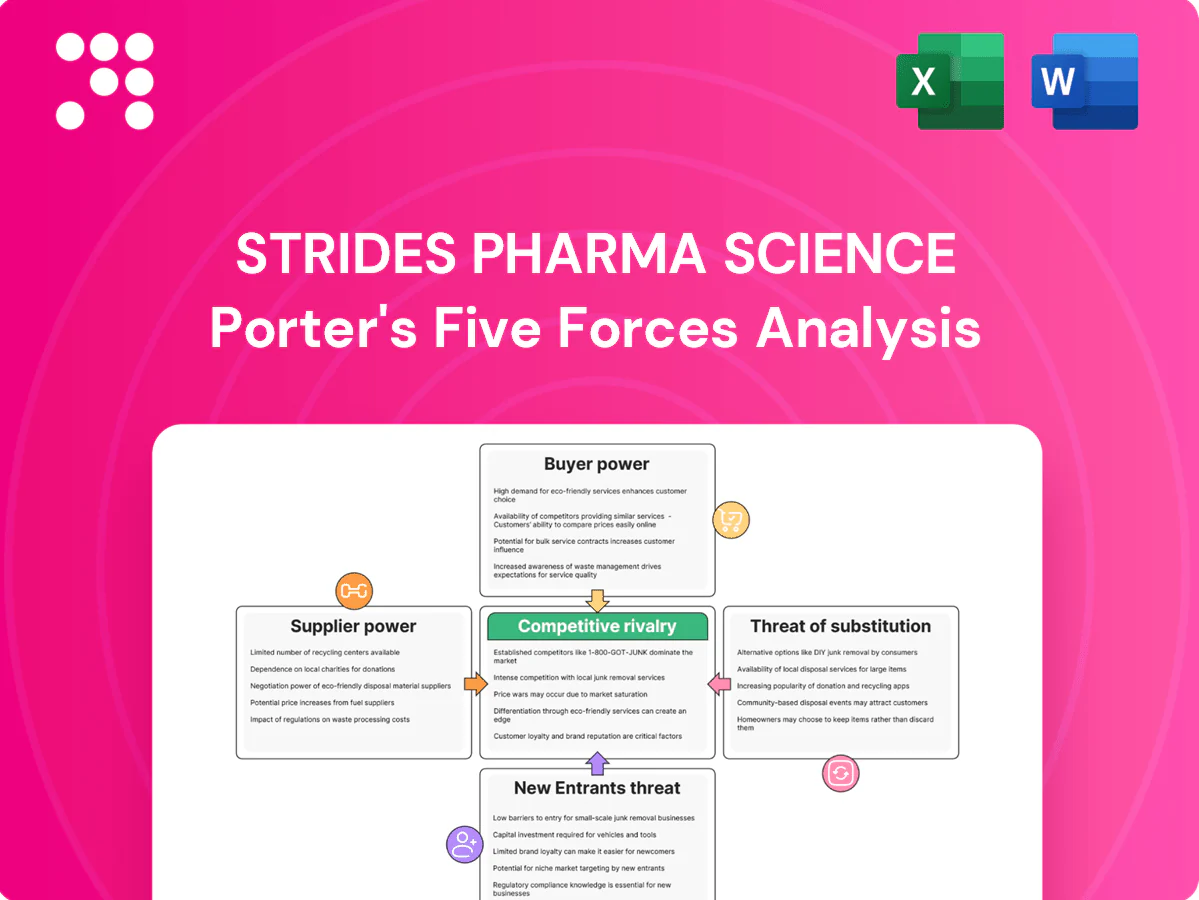
Strides Pharma Science Porter's Five Forces Analysis

Go Beyond the Preview—Access the Full Strategic Report
Strides Pharma Science faces moderate supplier power, rising buyer scrutiny, and intense rivalry from generics and CDMOs, while regulatory barriers temper threat of new entrants and substitute biologics loom. This snapshot highlights key pressures shaping margins and growth. Unlock the full Porter's Five Forces Analysis for force-by-force ratings, visuals, and actionable strategy tailored to Strides.
Suppliers Bargaining Power

Concentrated API sources
APIs for many generics are sourced from a limited pool concentrated in India and China, which accounted for roughly 70% of global generic API volume in 2024. This supplier concentration raises switching costs and lead times, while any compliance lapse or export disruption can sharply tighten availability and lift prices. Strides mitigates risks via multi-sourcing and in‑house qualifications but cannot fully eliminate exposure.
Sterile and softgel inputs
Sterile injectables and softgels need specialized materials, components and equipment, and approved suppliers for vials, stoppers, gelatin and aseptic consumables remain limited and tightly audited. This concentration narrows alternatives and raises supplier leverage for contract manufacturers like Strides. Long supplier qualification cycles—commonly 12–24 months—and heightened 2024 regulatory scrutiny further reinforce supplier power and switching costs.

Regulatory qualification lock-in
Vendors are embedded in regulatory filings for CMC and device components, so supplier changes trigger post-approval supplements with FDA/EMA review timelines commonly in the 6–12 month range, making swaps costly and time-consuming. Validation batches and stability programs often exceed $100,000 per change, adding delay and commercial risk. Suppliers exploit this friction to strengthen pricing and lead-time leverage, while dual-qualification of vendors reduces lock-in but raises procurement and overhead costs and operational complexity.

Capacity and energy constraints
Global capacity tightness for sterile lines and higher costs for energy-intensive inputs tightened supply in 2024, with industry reports indicating sterile injectable line utilization above 80%, pushing suppliers to pass through surcharges that increased COGS. Spikes in utilities, solvents and logistics created cascading cost pressure; Strides’ scale improves bargaining leverage but cannot neutralize systemic market constraints.
- Capacity: sterile line utilization >80% (2024)
- Cost pass-through: supplier surcharges common in 2024
- Impact: utilities/solvents/logistics directly raise COGS
- Mitigation: Strides’ scale helps negotiation but not market-wide shortages
FX and commodity volatility
Currency swings and raw-material volatility directly raise Strides Pharma input costs; INR weakened about 3% versus USD in 2024 and Brent averaged near $86/bbl, increasing API and logistics expenses. Hedging programs reduce but do not eliminate exposure, leaving residual P&L sensitivity. Suppliers can reprice faster than buyers absorb increases, creating short-term margin compression.
Supply squeeze: ~70% API and >80% sterile lines
Supplier concentration (India/China ~70% of generic API volume in 2024) and scarce sterile-material vendors give suppliers strong leverage, raising switching costs and lead times. Long qualification cycles (12–24 months) and validation costs (> $100,000) lock in suppliers; sterile line utilization >80% in 2024 tightened capacity and enabled price surcharges. INR ~3% weakness vs USD and Brent ≈ $86/bbl in 2024 added cost pass-through risk.
| Metric | 2024 Value |
|---|---|
| API supply concentration | ~70% India/China |
| Sterile line utilization | >80% |
| Qualification lead time | 12–24 months |
| Validation cost per change | >$100,000 |
| INR vs USD | ~3% weaker |
| Brent | ≈ $86/bbl |
What is included in the product
 Detailed Word Document
Tailored exclusively for Strides Pharma Science, this Porter's Five Forces analysis uncovers key drivers of competition, customer influence, and market entry risks within its pharmaceutical supply chain. It evaluates supplier and buyer power, identifies disruptive substitutes and emerging threats, and highlights dynamics that deter entrants and protect incumbents.

 Customizable Excel Spreadsheet
A clear, one-sheet Porter's Five Forces summary for Strides Pharma Science—instantly highlights supplier, buyer, rivalry, entrant and substitute pressures to simplify strategic decisions and relieve analysis bottlenecks.
Customers Bargaining Power

US channel consolidation
US channel consolidation concentrates buying power in three wholesalers (AmerisourceBergen, Cardinal, McKesson) that handle roughly 85–90% of distribution, alongside top GPOs and PBMs that manage about 75–80% of prescriptions. Their scale forces aggressive price negotiations and rebates often in the 30–45% range, squeezing list-to-net margins. Portfolio awards tend to be winner-take-most, intensifying margin pressure, while strict service-level agreements and fill-rate penalties add further leverage.
Tender-driven markets
In tender-driven markets such as Europe, Australia and many emerging economies, public tenders dominate procurement—public procurement equals about 14% of EU GDP and tenders can represent 20–60% of hospital drug volumes. Short award cycles and reference pricing compress margins and amplify buyer power; losing a tender can cut volumes by 30–100% per product. Strides' multi-market footprint reduces but does not eliminate this pressure.

Low switching costs
Generic drugs are highly substitutable at pharmacy and hospital levels, with generics accounting for roughly 90% of US prescriptions by volume, enabling buyers to switch on price and supply reliability with minimal friction. This dynamic anchors ongoing price erosion for manufacturers like Strides. Differentiated dosage forms—extended‑release, injectables—can modestly reduce substitutability and support price premiums.

Quality and service expectations
Buyers demand impeccable compliance, supply assurance, and competitive net pricing; in FY24 Strides reported consolidated revenue of INR 3,352 crore, making large buyers especially sensitive to service lapses.
Stockouts or warning letters rapidly shift share to rivals, while consistent OTIF performance provides limited pricing latitude—buyers retain leverage due to consolidation.
- Buyers: consolidated, high leverage
- Risk: stockouts/warning letters → market share loss
- Leverage: OTIF compliance can earn modest premium
Portfolio breadth as offset
Strides’ presence across oral solids, injectables and softgels creates bundled-value propositions that smooth procurement cycles and raise switching costs; as of 2024 Strides supplies into 100+ markets, helping negotiate portfolio-level agreements. Cross-therapeutic offerings can secure preferred supplier status, allowing margin concession on select SKUs in exchange for higher basket volume; this tempers but does not eliminate buyer power.
- Portfolio breadth: oral solids, injectables, softgels
- Commercial leverage: preferred-supplier wins via bundled contracts
- Trade-off: margin concessions on SKUs for volume across basket
- Net effect: reduces but does not overturn buyer bargaining power
Distributor/PBM dominance forces 30-45% rebates, squeezing margins
Buyers wield high leverage via US distributor concentration (AmerisourceBergen, Cardinal, McKesson ~85–90% channel share) and PBM/GPO control (~75–80% of scripts), forcing rebates of 30–45% and compressing margins. Tender markets (EU, Australia) and 90% generic substitution in US prescriptions deepen price pressure; Strides FY24 revenue INR 3,352 crore, presence in 100+ markets slightly offsets but does not negate buyer power.
| Metric | Value |
|---|---|
| US distributor share | 85–90% |
| PBM/GPO script share | 75–80% |
| Generic Rx (US) | ~90% by volume |
| Strides FY24 revenue | INR 3,352 crore |
| Markets | 100+ |
Same Document Delivered
Strides Pharma Science Porter's Five Forces Analysis
This preview shows the exact document you'll receive immediately after purchase—no surprises. The Porter’s Five Forces analysis of Strides Pharma Science assesses competitive rivalry, supplier and buyer power, and threats from new entrants and substitutes. It evaluates regulatory impact and market dynamics on profitability. The file includes actionable strategic recommendations ready for immediate use.

Go Beyond the Preview—Access the Full Strategic Report
Strides Pharma Science faces moderate supplier power, rising buyer scrutiny, and intense rivalry from generics and CDMOs, while regulatory barriers temper threat of new entrants and substitute biologics loom. This snapshot highlights key pressures shaping margins and growth. Unlock the full Porter's Five Forces Analysis for force-by-force ratings, visuals, and actionable strategy tailored to Strides.
Suppliers Bargaining Power
Concentrated API sources
APIs for many generics are sourced from a limited pool concentrated in India and China, which accounted for roughly 70% of global generic API volume in 2024. This supplier concentration raises switching costs and lead times, while any compliance lapse or export disruption can sharply tighten availability and lift prices. Strides mitigates risks via multi-sourcing and in‑house qualifications but cannot fully eliminate exposure.
Sterile and softgel inputs
Sterile injectables and softgels need specialized materials, components and equipment, and approved suppliers for vials, stoppers, gelatin and aseptic consumables remain limited and tightly audited. This concentration narrows alternatives and raises supplier leverage for contract manufacturers like Strides. Long supplier qualification cycles—commonly 12–24 months—and heightened 2024 regulatory scrutiny further reinforce supplier power and switching costs.
Regulatory qualification lock-in
Vendors are embedded in regulatory filings for CMC and device components, so supplier changes trigger post-approval supplements with FDA/EMA review timelines commonly in the 6–12 month range, making swaps costly and time-consuming. Validation batches and stability programs often exceed $100,000 per change, adding delay and commercial risk. Suppliers exploit this friction to strengthen pricing and lead-time leverage, while dual-qualification of vendors reduces lock-in but raises procurement and overhead costs and operational complexity.
Capacity and energy constraints
Global capacity tightness for sterile lines and higher costs for energy-intensive inputs tightened supply in 2024, with industry reports indicating sterile injectable line utilization above 80%, pushing suppliers to pass through surcharges that increased COGS. Spikes in utilities, solvents and logistics created cascading cost pressure; Strides’ scale improves bargaining leverage but cannot neutralize systemic market constraints.
- Capacity: sterile line utilization >80% (2024)
- Cost pass-through: supplier surcharges common in 2024
- Impact: utilities/solvents/logistics directly raise COGS
- Mitigation: Strides’ scale helps negotiation but not market-wide shortages
FX and commodity volatility
Currency swings and raw-material volatility directly raise Strides Pharma input costs; INR weakened about 3% versus USD in 2024 and Brent averaged near $86/bbl, increasing API and logistics expenses. Hedging programs reduce but do not eliminate exposure, leaving residual P&L sensitivity. Suppliers can reprice faster than buyers absorb increases, creating short-term margin compression.
Supply squeeze: ~70% API and >80% sterile lines
Supplier concentration (India/China ~70% of generic API volume in 2024) and scarce sterile-material vendors give suppliers strong leverage, raising switching costs and lead times. Long qualification cycles (12–24 months) and validation costs (> $100,000) lock in suppliers; sterile line utilization >80% in 2024 tightened capacity and enabled price surcharges. INR ~3% weakness vs USD and Brent ≈ $86/bbl in 2024 added cost pass-through risk.
| Metric | 2024 Value |
|---|---|
| API supply concentration | ~70% India/China |
| Sterile line utilization | >80% |
| Qualification lead time | 12–24 months |
| Validation cost per change | >$100,000 |
| INR vs USD | ~3% weaker |
| Brent | ≈ $86/bbl |
What is included in the product
Detailed Word Document
Tailored exclusively for Strides Pharma Science, this Porter's Five Forces analysis uncovers key drivers of competition, customer influence, and market entry risks within its pharmaceutical supply chain. It evaluates supplier and buyer power, identifies disruptive substitutes and emerging threats, and highlights dynamics that deter entrants and protect incumbents.
Customizable Excel Spreadsheet
A clear, one-sheet Porter's Five Forces summary for Strides Pharma Science—instantly highlights supplier, buyer, rivalry, entrant and substitute pressures to simplify strategic decisions and relieve analysis bottlenecks.
Customers Bargaining Power
US channel consolidation
US channel consolidation concentrates buying power in three wholesalers (AmerisourceBergen, Cardinal, McKesson) that handle roughly 85–90% of distribution, alongside top GPOs and PBMs that manage about 75–80% of prescriptions. Their scale forces aggressive price negotiations and rebates often in the 30–45% range, squeezing list-to-net margins. Portfolio awards tend to be winner-take-most, intensifying margin pressure, while strict service-level agreements and fill-rate penalties add further leverage.
Tender-driven markets
In tender-driven markets such as Europe, Australia and many emerging economies, public tenders dominate procurement—public procurement equals about 14% of EU GDP and tenders can represent 20–60% of hospital drug volumes. Short award cycles and reference pricing compress margins and amplify buyer power; losing a tender can cut volumes by 30–100% per product. Strides' multi-market footprint reduces but does not eliminate this pressure.
Low switching costs
Generic drugs are highly substitutable at pharmacy and hospital levels, with generics accounting for roughly 90% of US prescriptions by volume, enabling buyers to switch on price and supply reliability with minimal friction. This dynamic anchors ongoing price erosion for manufacturers like Strides. Differentiated dosage forms—extended‑release, injectables—can modestly reduce substitutability and support price premiums.
Quality and service expectations
Buyers demand impeccable compliance, supply assurance, and competitive net pricing; in FY24 Strides reported consolidated revenue of INR 3,352 crore, making large buyers especially sensitive to service lapses.
Stockouts or warning letters rapidly shift share to rivals, while consistent OTIF performance provides limited pricing latitude—buyers retain leverage due to consolidation.
- Buyers: consolidated, high leverage
- Risk: stockouts/warning letters → market share loss
- Leverage: OTIF compliance can earn modest premium
Portfolio breadth as offset
Strides’ presence across oral solids, injectables and softgels creates bundled-value propositions that smooth procurement cycles and raise switching costs; as of 2024 Strides supplies into 100+ markets, helping negotiate portfolio-level agreements. Cross-therapeutic offerings can secure preferred supplier status, allowing margin concession on select SKUs in exchange for higher basket volume; this tempers but does not eliminate buyer power.
- Portfolio breadth: oral solids, injectables, softgels
- Commercial leverage: preferred-supplier wins via bundled contracts
- Trade-off: margin concessions on SKUs for volume across basket
- Net effect: reduces but does not overturn buyer bargaining power
Distributor/PBM dominance forces 30-45% rebates, squeezing margins
Buyers wield high leverage via US distributor concentration (AmerisourceBergen, Cardinal, McKesson ~85–90% channel share) and PBM/GPO control (~75–80% of scripts), forcing rebates of 30–45% and compressing margins. Tender markets (EU, Australia) and 90% generic substitution in US prescriptions deepen price pressure; Strides FY24 revenue INR 3,352 crore, presence in 100+ markets slightly offsets but does not negate buyer power.
| Metric | Value |
|---|---|
| US distributor share | 85–90% |
| PBM/GPO script share | 75–80% |
| Generic Rx (US) | ~90% by volume |
| Strides FY24 revenue | INR 3,352 crore |
| Markets | 100+ |
Same Document Delivered
Strides Pharma Science Porter's Five Forces Analysis
This preview shows the exact document you'll receive immediately after purchase—no surprises. The Porter’s Five Forces analysis of Strides Pharma Science assesses competitive rivalry, supplier and buyer power, and threats from new entrants and substitutes. It evaluates regulatory impact and market dynamics on profitability. The file includes actionable strategic recommendations ready for immediate use.
Description
Go Beyond the Preview—Access the Full Strategic Report
Strides Pharma Science faces moderate supplier power, rising buyer scrutiny, and intense rivalry from generics and CDMOs, while regulatory barriers temper threat of new entrants and substitute biologics loom. This snapshot highlights key pressures shaping margins and growth. Unlock the full Porter's Five Forces Analysis for force-by-force ratings, visuals, and actionable strategy tailored to Strides.
Suppliers Bargaining Power
Concentrated API sources
APIs for many generics are sourced from a limited pool concentrated in India and China, which accounted for roughly 70% of global generic API volume in 2024. This supplier concentration raises switching costs and lead times, while any compliance lapse or export disruption can sharply tighten availability and lift prices. Strides mitigates risks via multi-sourcing and in‑house qualifications but cannot fully eliminate exposure.
Sterile and softgel inputs
Sterile injectables and softgels need specialized materials, components and equipment, and approved suppliers for vials, stoppers, gelatin and aseptic consumables remain limited and tightly audited. This concentration narrows alternatives and raises supplier leverage for contract manufacturers like Strides. Long supplier qualification cycles—commonly 12–24 months—and heightened 2024 regulatory scrutiny further reinforce supplier power and switching costs.
Regulatory qualification lock-in
Vendors are embedded in regulatory filings for CMC and device components, so supplier changes trigger post-approval supplements with FDA/EMA review timelines commonly in the 6–12 month range, making swaps costly and time-consuming. Validation batches and stability programs often exceed $100,000 per change, adding delay and commercial risk. Suppliers exploit this friction to strengthen pricing and lead-time leverage, while dual-qualification of vendors reduces lock-in but raises procurement and overhead costs and operational complexity.
Capacity and energy constraints
Global capacity tightness for sterile lines and higher costs for energy-intensive inputs tightened supply in 2024, with industry reports indicating sterile injectable line utilization above 80%, pushing suppliers to pass through surcharges that increased COGS. Spikes in utilities, solvents and logistics created cascading cost pressure; Strides’ scale improves bargaining leverage but cannot neutralize systemic market constraints.
- Capacity: sterile line utilization >80% (2024)
- Cost pass-through: supplier surcharges common in 2024
- Impact: utilities/solvents/logistics directly raise COGS
- Mitigation: Strides’ scale helps negotiation but not market-wide shortages
FX and commodity volatility
Currency swings and raw-material volatility directly raise Strides Pharma input costs; INR weakened about 3% versus USD in 2024 and Brent averaged near $86/bbl, increasing API and logistics expenses. Hedging programs reduce but do not eliminate exposure, leaving residual P&L sensitivity. Suppliers can reprice faster than buyers absorb increases, creating short-term margin compression.
Supply squeeze: ~70% API and >80% sterile lines
Supplier concentration (India/China ~70% of generic API volume in 2024) and scarce sterile-material vendors give suppliers strong leverage, raising switching costs and lead times. Long qualification cycles (12–24 months) and validation costs (> $100,000) lock in suppliers; sterile line utilization >80% in 2024 tightened capacity and enabled price surcharges. INR ~3% weakness vs USD and Brent ≈ $86/bbl in 2024 added cost pass-through risk.
| Metric | 2024 Value |
|---|---|
| API supply concentration | ~70% India/China |
| Sterile line utilization | >80% |
| Qualification lead time | 12–24 months |
| Validation cost per change | >$100,000 |
| INR vs USD | ~3% weaker |
| Brent | ≈ $86/bbl |
What is included in the product
Detailed Word Document
Tailored exclusively for Strides Pharma Science, this Porter's Five Forces analysis uncovers key drivers of competition, customer influence, and market entry risks within its pharmaceutical supply chain. It evaluates supplier and buyer power, identifies disruptive substitutes and emerging threats, and highlights dynamics that deter entrants and protect incumbents.
Customizable Excel Spreadsheet
A clear, one-sheet Porter's Five Forces summary for Strides Pharma Science—instantly highlights supplier, buyer, rivalry, entrant and substitute pressures to simplify strategic decisions and relieve analysis bottlenecks.
Customers Bargaining Power
US channel consolidation
US channel consolidation concentrates buying power in three wholesalers (AmerisourceBergen, Cardinal, McKesson) that handle roughly 85–90% of distribution, alongside top GPOs and PBMs that manage about 75–80% of prescriptions. Their scale forces aggressive price negotiations and rebates often in the 30–45% range, squeezing list-to-net margins. Portfolio awards tend to be winner-take-most, intensifying margin pressure, while strict service-level agreements and fill-rate penalties add further leverage.
Tender-driven markets
In tender-driven markets such as Europe, Australia and many emerging economies, public tenders dominate procurement—public procurement equals about 14% of EU GDP and tenders can represent 20–60% of hospital drug volumes. Short award cycles and reference pricing compress margins and amplify buyer power; losing a tender can cut volumes by 30–100% per product. Strides' multi-market footprint reduces but does not eliminate this pressure.
Low switching costs
Generic drugs are highly substitutable at pharmacy and hospital levels, with generics accounting for roughly 90% of US prescriptions by volume, enabling buyers to switch on price and supply reliability with minimal friction. This dynamic anchors ongoing price erosion for manufacturers like Strides. Differentiated dosage forms—extended‑release, injectables—can modestly reduce substitutability and support price premiums.
Quality and service expectations
Buyers demand impeccable compliance, supply assurance, and competitive net pricing; in FY24 Strides reported consolidated revenue of INR 3,352 crore, making large buyers especially sensitive to service lapses.
Stockouts or warning letters rapidly shift share to rivals, while consistent OTIF performance provides limited pricing latitude—buyers retain leverage due to consolidation.
- Buyers: consolidated, high leverage
- Risk: stockouts/warning letters → market share loss
- Leverage: OTIF compliance can earn modest premium
Portfolio breadth as offset
Strides’ presence across oral solids, injectables and softgels creates bundled-value propositions that smooth procurement cycles and raise switching costs; as of 2024 Strides supplies into 100+ markets, helping negotiate portfolio-level agreements. Cross-therapeutic offerings can secure preferred supplier status, allowing margin concession on select SKUs in exchange for higher basket volume; this tempers but does not eliminate buyer power.
- Portfolio breadth: oral solids, injectables, softgels
- Commercial leverage: preferred-supplier wins via bundled contracts
- Trade-off: margin concessions on SKUs for volume across basket
- Net effect: reduces but does not overturn buyer bargaining power
Distributor/PBM dominance forces 30-45% rebates, squeezing margins
Buyers wield high leverage via US distributor concentration (AmerisourceBergen, Cardinal, McKesson ~85–90% channel share) and PBM/GPO control (~75–80% of scripts), forcing rebates of 30–45% and compressing margins. Tender markets (EU, Australia) and 90% generic substitution in US prescriptions deepen price pressure; Strides FY24 revenue INR 3,352 crore, presence in 100+ markets slightly offsets but does not negate buyer power.
| Metric | Value |
|---|---|
| US distributor share | 85–90% |
| PBM/GPO script share | 75–80% |
| Generic Rx (US) | ~90% by volume |
| Strides FY24 revenue | INR 3,352 crore |
| Markets | 100+ |
Same Document Delivered
Strides Pharma Science Porter's Five Forces Analysis
This preview shows the exact document you'll receive immediately after purchase—no surprises. The Porter’s Five Forces analysis of Strides Pharma Science assesses competitive rivalry, supplier and buyer power, and threats from new entrants and substitutes. It evaluates regulatory impact and market dynamics on profitability. The file includes actionable strategic recommendations ready for immediate use.











