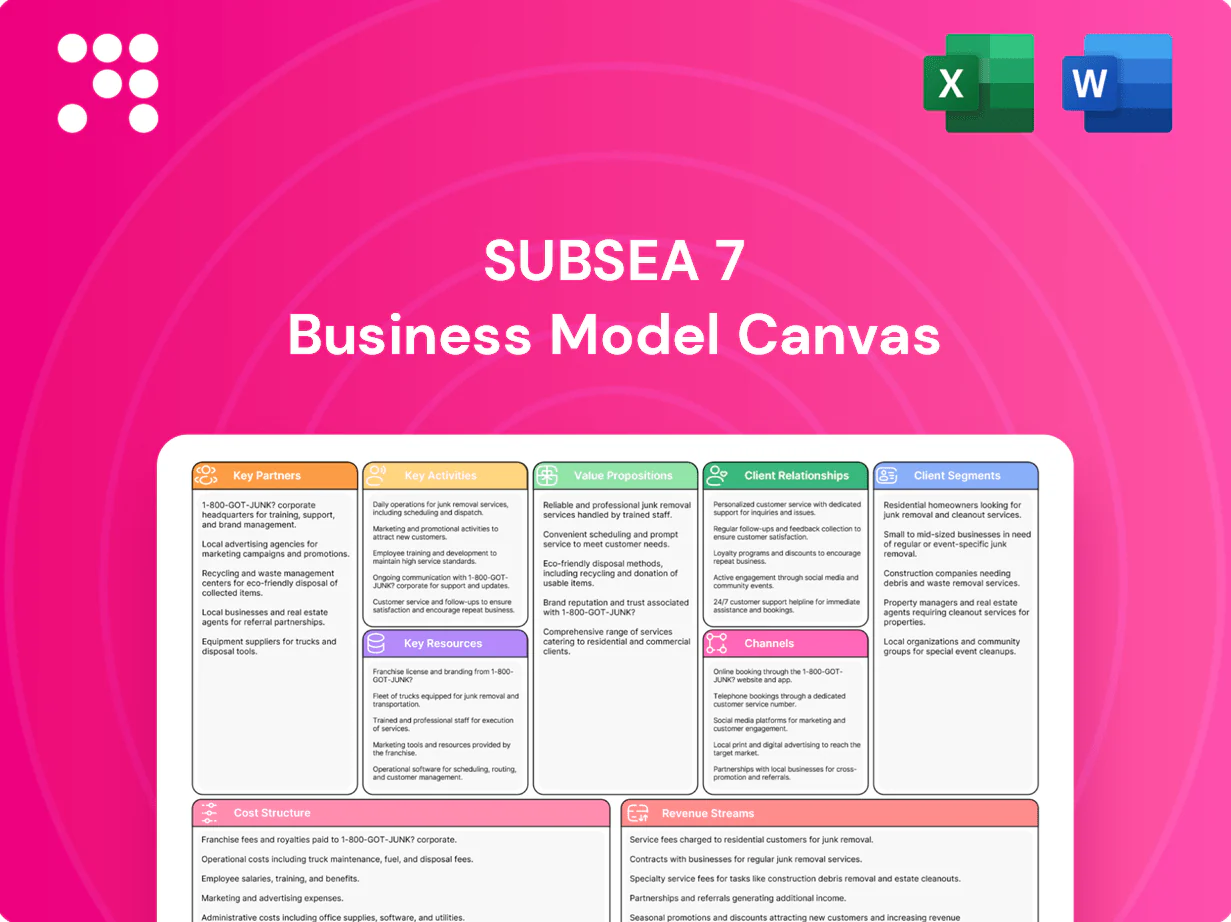
Subsea 7 Business Model Canvas

Offshore engineering Business Model Canvas: fleet, partners, recurring revenue drivers
Explore Subsea 7’s Business Model Canvas to see how its engineering excellence, fleet capabilities, and partner network deliver offshore energy solutions and recurring contracts. This concise snapshot highlights customer segments, revenue streams, and cost drivers—download the full, editable canvas for a complete, investor-ready strategic toolkit.
Partnerships

Subsea equipment OEMs and technology providers
Partnerships with umbilical, riser, flowline, and subsea processing OEMs secure qualified equipment and technical support, evidenced in 2024 joint supply agreements across major North Sea and Gulf of Mexico projects. Joint development programs in 2024 accelerated standardization and helped lower total installed cost through repeatable designs. These partners enable interface assurance across complex systems and co-innovation de-risks first-of-a-kind deployments.
Shipyards, fabrication yards, and spoolbases
Global shipyards, fabrication yards, and 50+ spoolbases in 2024 provide welding, coating and assembly capacity close to project sites, lowering transit and handover delays. Secure access to quays, heavy-lift cranes and dedicated storage reduces cycle times and mobilization costs for heavy subsea modules. Spoolbases enable rapid pipelay readiness and inline quality control, shortening offshore duration. Local yards ensure compliance with local content rules and ease logistics constraints.

Renewables technology and turbine OEM partners
Alliances with foundation, cable and turbine suppliers streamline delivery for large offshore wind arrays of 100+ turbines, typically using 8–15 MW nacelles in 2024. Tight interface management between partners preserves schedule integrity across multi-month campaigns. Joint planning optimizes installation windows and mitigates weather risk. Co-engineering aligns turbine and foundation design for faster installation and lower lifecycle cost.

Strategic alliances and joint ventures with operators and peers
Strategic alliances and joint ventures with operators and peers drive repeatable workstreams, shared efficiencies and predictable margins; collaborative models align incentives on cost, schedule and HSE, improving on-time delivery. JVs extend capability, footprint and peak-cycle capacity, while integrated delivery across seabed-to-surface scopes boosts outcomes in complex basins.
- Repeatability: long-term alliances reduce unit costs
- Alignment: incentive-linked contracts improve schedule/HSE
- Capacity: JVs scale fleet/skills in peaks
- Outcomes: integrated delivery lowers rework in complex basins
Governments, regulators, and local content partners
Regulatory alignment with governments and regulators accelerates permitting and compliance, reducing project lead times and de-risking offshore developments; in 2024 many permitting windows shortened by months due to streamlined offshore licensing reforms. Local content partners unlock workforce, supply chain capability and social license, with common local content targets of 30–50% in frontier markets. Engagement supports ESG commitments and community value through structured programs that meet local content and training targets and track outcomes year-on-year.
- Permitting: shortened licensing windows in 2024
- Local content: typical targets 30–50%
- Workforce: local hiring and training programs
- ESG: programs tied to community value and compliance
OEM supply, 50+ spoolbases and JVs cut permitting; enable 100+ turbines and 30–50% local content
Key partnerships in 2024 secured OEM supply and co‑innovation for umbilicals, risers and subsea processing, supporting repeatable designs and lower TIC. Network of 50+ spoolbases and global yards reduced mobilization and offshore days. Alliances with wind suppliers enabled 100+ turbine array delivery (8–15 MW). JVs and regulators cut permitting by months and met 30–50% local content targets.
| Metric | 2024 |
|---|---|
| Spoolbases | 50+ |
| Turbine arrays | 100+ (8–15 MW) |
| Local content | 30–50% |
| Permitting | Shortened by months |
What is included in the product
 Detailed Word Document
A concise Business Model Canvas for Subsea7 outlining its nine blocks—customer segments (O&G, offshore wind), value propositions (complex subsea engineering, integrated project delivery), channels (vessel fleet, EPC partners), revenue streams, cost structure, key resources, partners, activities, governance—plus competitive advantages and linked SWOT insights for investors and strategists.

 Customizable Excel Spreadsheet
High-level view of Subsea 7’s business model with editable cells, distilling offshore engineering, project delivery, and asset strategies into a one-page snapshot that saves hours of formatting and speeds boardroom decision-making.
Activities

Front-end engineering and project management
Concept selection, FEED and detailed design optimize lifecycle value by aligning scope to field economics and reducing through-life costs. Integrated planning links engineering with installation constraints to cut rework and mobilization delays. Subsea7’s robust PMO enforces cost, schedule and quality control across projects; the company employed about 12,000 staff in 2024. Rigorous risk and interface management drive predictable outcomes.
Offshore installation and construction
Pipelay, heavy lift and subsea construction are the core execution activities, delivering trunk and tie‑back installs. Advanced pipelay and heavy‑lift vessels plus workclass and inspection‑class ROVs operate in harsh seas and deepwater, with ROVs routinely rated beyond 3,000 m. Campaign planning maximizes weather windows and can improve vessel uptime by up to 15%, targeting utilization >70% in 2024. Offshore commissioning completes ready‑for‑startup targets.

Fabrication, welding, and logistics
Spool, manifold and umbilical terminations demand precision fabrication with tolerances down to 0.1 mm and typical yard throughput of several thousand spools annually; Subsea7 (SSW.L) leverages dedicated fabrication yards to meet this volume. Welding procedures and NDT (radiography, UT) maintain integrity with industry acceptance targets above 98%. Global logistics synchronize materials to 60+ yards and vessels, coordinating customs, ports and heavy transport for loads often exceeding 200 tonnes.

Asset management and marine operations
Asset management and marine operations sustain 90%+ fleet availability through proactive scheduling and maintenance in 2024, keeping project timelines on track. Class, certification and DP assurance drive safety compliance and lower incident risk across global operations. Data-driven uptime management reduced operating costs by about 12% in industry benchmarks, while vessel upgrades in 2024 improved capability and fuel efficiency up to 10%.
- Fleet availability: 90%+
- Opex reduction via uptime data: ~12%
- Fuel efficiency gains from upgrades: up to 10%
HSE, digitalization, and continuous improvement
Safety leadership underpins operations and culture at Subsea7, supporting a workforce of over 10,000 and the company commitment to net zero GHG by 2050. Digital twins, simulation and analytics accelerate engineering and execution, reducing uncertainty and enabling data-driven delivery. Lessons-learned cycles standardize best practices while innovation targets measurable cost, carbon and schedule gains.
- Safety-first culture; net zero by 2050
- Digital twins and analytics for engineering accuracy
- Lessons-learned to codify best practices
- Innovation focused on cost, carbon and schedule improvements
Integrated FEED cuts mobilization; fleet utilization >70%, staff ~12,000
Concept, FEED and integrated planning align scope to field economics and cut mobilization; Subsea7 employed ~12,000 staff in 2024. Core execution: pipelay, heavy lift, ROV work (>3,000 m) and offshore commissioning with vessel utilization >70% in 2024. Fabrication tolerances 0.1 mm, NDT acceptance >98%. Fleet availability ~90%, Opex down ~12% and fuel efficiency gains up to 10%.
| Metric | 2024 |
|---|---|
| Staff | ~12,000 |
| Fleet availability | ~90%+ |
| Vessel utilization | >70% |
| Opex reduction (bench) | ~12% |
| Fuel efficiency gains | up to 10% |
Full Document Unlocks After Purchase
Business Model Canvas
The Subsea 7 Business Model Canvas you’re previewing is the actual deliverable, not a mockup. After purchase you’ll receive this exact file with the full content, formatted and ready-to-edit in Word and Excel. No placeholders or surprises—what you see is what you’ll download and use.

Offshore engineering Business Model Canvas: fleet, partners, recurring revenue drivers
Explore Subsea 7’s Business Model Canvas to see how its engineering excellence, fleet capabilities, and partner network deliver offshore energy solutions and recurring contracts. This concise snapshot highlights customer segments, revenue streams, and cost drivers—download the full, editable canvas for a complete, investor-ready strategic toolkit.
Partnerships
Subsea equipment OEMs and technology providers
Partnerships with umbilical, riser, flowline, and subsea processing OEMs secure qualified equipment and technical support, evidenced in 2024 joint supply agreements across major North Sea and Gulf of Mexico projects. Joint development programs in 2024 accelerated standardization and helped lower total installed cost through repeatable designs. These partners enable interface assurance across complex systems and co-innovation de-risks first-of-a-kind deployments.
Shipyards, fabrication yards, and spoolbases
Global shipyards, fabrication yards, and 50+ spoolbases in 2024 provide welding, coating and assembly capacity close to project sites, lowering transit and handover delays. Secure access to quays, heavy-lift cranes and dedicated storage reduces cycle times and mobilization costs for heavy subsea modules. Spoolbases enable rapid pipelay readiness and inline quality control, shortening offshore duration. Local yards ensure compliance with local content rules and ease logistics constraints.
Renewables technology and turbine OEM partners
Alliances with foundation, cable and turbine suppliers streamline delivery for large offshore wind arrays of 100+ turbines, typically using 8–15 MW nacelles in 2024. Tight interface management between partners preserves schedule integrity across multi-month campaigns. Joint planning optimizes installation windows and mitigates weather risk. Co-engineering aligns turbine and foundation design for faster installation and lower lifecycle cost.
Strategic alliances and joint ventures with operators and peers
Strategic alliances and joint ventures with operators and peers drive repeatable workstreams, shared efficiencies and predictable margins; collaborative models align incentives on cost, schedule and HSE, improving on-time delivery. JVs extend capability, footprint and peak-cycle capacity, while integrated delivery across seabed-to-surface scopes boosts outcomes in complex basins.
- Repeatability: long-term alliances reduce unit costs
- Alignment: incentive-linked contracts improve schedule/HSE
- Capacity: JVs scale fleet/skills in peaks
- Outcomes: integrated delivery lowers rework in complex basins
Governments, regulators, and local content partners
Regulatory alignment with governments and regulators accelerates permitting and compliance, reducing project lead times and de-risking offshore developments; in 2024 many permitting windows shortened by months due to streamlined offshore licensing reforms. Local content partners unlock workforce, supply chain capability and social license, with common local content targets of 30–50% in frontier markets. Engagement supports ESG commitments and community value through structured programs that meet local content and training targets and track outcomes year-on-year.
- Permitting: shortened licensing windows in 2024
- Local content: typical targets 30–50%
- Workforce: local hiring and training programs
- ESG: programs tied to community value and compliance
OEM supply, 50+ spoolbases and JVs cut permitting; enable 100+ turbines and 30–50% local content
Key partnerships in 2024 secured OEM supply and co‑innovation for umbilicals, risers and subsea processing, supporting repeatable designs and lower TIC. Network of 50+ spoolbases and global yards reduced mobilization and offshore days. Alliances with wind suppliers enabled 100+ turbine array delivery (8–15 MW). JVs and regulators cut permitting by months and met 30–50% local content targets.
| Metric | 2024 |
|---|---|
| Spoolbases | 50+ |
| Turbine arrays | 100+ (8–15 MW) |
| Local content | 30–50% |
| Permitting | Shortened by months |
What is included in the product
Detailed Word Document
A concise Business Model Canvas for Subsea7 outlining its nine blocks—customer segments (O&G, offshore wind), value propositions (complex subsea engineering, integrated project delivery), channels (vessel fleet, EPC partners), revenue streams, cost structure, key resources, partners, activities, governance—plus competitive advantages and linked SWOT insights for investors and strategists.
Customizable Excel Spreadsheet
High-level view of Subsea 7’s business model with editable cells, distilling offshore engineering, project delivery, and asset strategies into a one-page snapshot that saves hours of formatting and speeds boardroom decision-making.
Activities
Front-end engineering and project management
Concept selection, FEED and detailed design optimize lifecycle value by aligning scope to field economics and reducing through-life costs. Integrated planning links engineering with installation constraints to cut rework and mobilization delays. Subsea7’s robust PMO enforces cost, schedule and quality control across projects; the company employed about 12,000 staff in 2024. Rigorous risk and interface management drive predictable outcomes.
Offshore installation and construction
Pipelay, heavy lift and subsea construction are the core execution activities, delivering trunk and tie‑back installs. Advanced pipelay and heavy‑lift vessels plus workclass and inspection‑class ROVs operate in harsh seas and deepwater, with ROVs routinely rated beyond 3,000 m. Campaign planning maximizes weather windows and can improve vessel uptime by up to 15%, targeting utilization >70% in 2024. Offshore commissioning completes ready‑for‑startup targets.
Fabrication, welding, and logistics
Spool, manifold and umbilical terminations demand precision fabrication with tolerances down to 0.1 mm and typical yard throughput of several thousand spools annually; Subsea7 (SSW.L) leverages dedicated fabrication yards to meet this volume. Welding procedures and NDT (radiography, UT) maintain integrity with industry acceptance targets above 98%. Global logistics synchronize materials to 60+ yards and vessels, coordinating customs, ports and heavy transport for loads often exceeding 200 tonnes.
Asset management and marine operations
Asset management and marine operations sustain 90%+ fleet availability through proactive scheduling and maintenance in 2024, keeping project timelines on track. Class, certification and DP assurance drive safety compliance and lower incident risk across global operations. Data-driven uptime management reduced operating costs by about 12% in industry benchmarks, while vessel upgrades in 2024 improved capability and fuel efficiency up to 10%.
- Fleet availability: 90%+
- Opex reduction via uptime data: ~12%
- Fuel efficiency gains from upgrades: up to 10%
HSE, digitalization, and continuous improvement
Safety leadership underpins operations and culture at Subsea7, supporting a workforce of over 10,000 and the company commitment to net zero GHG by 2050. Digital twins, simulation and analytics accelerate engineering and execution, reducing uncertainty and enabling data-driven delivery. Lessons-learned cycles standardize best practices while innovation targets measurable cost, carbon and schedule gains.
- Safety-first culture; net zero by 2050
- Digital twins and analytics for engineering accuracy
- Lessons-learned to codify best practices
- Innovation focused on cost, carbon and schedule improvements
Integrated FEED cuts mobilization; fleet utilization >70%, staff ~12,000
Concept, FEED and integrated planning align scope to field economics and cut mobilization; Subsea7 employed ~12,000 staff in 2024. Core execution: pipelay, heavy lift, ROV work (>3,000 m) and offshore commissioning with vessel utilization >70% in 2024. Fabrication tolerances 0.1 mm, NDT acceptance >98%. Fleet availability ~90%, Opex down ~12% and fuel efficiency gains up to 10%.
| Metric | 2024 |
|---|---|
| Staff | ~12,000 |
| Fleet availability | ~90%+ |
| Vessel utilization | >70% |
| Opex reduction (bench) | ~12% |
| Fuel efficiency gains | up to 10% |
Full Document Unlocks After Purchase
Business Model Canvas
The Subsea 7 Business Model Canvas you’re previewing is the actual deliverable, not a mockup. After purchase you’ll receive this exact file with the full content, formatted and ready-to-edit in Word and Excel. No placeholders or surprises—what you see is what you’ll download and use.
Original: $10.00
-65%$10.00
$3.50Description
Offshore engineering Business Model Canvas: fleet, partners, recurring revenue drivers
Explore Subsea 7’s Business Model Canvas to see how its engineering excellence, fleet capabilities, and partner network deliver offshore energy solutions and recurring contracts. This concise snapshot highlights customer segments, revenue streams, and cost drivers—download the full, editable canvas for a complete, investor-ready strategic toolkit.
Partnerships
Subsea equipment OEMs and technology providers
Partnerships with umbilical, riser, flowline, and subsea processing OEMs secure qualified equipment and technical support, evidenced in 2024 joint supply agreements across major North Sea and Gulf of Mexico projects. Joint development programs in 2024 accelerated standardization and helped lower total installed cost through repeatable designs. These partners enable interface assurance across complex systems and co-innovation de-risks first-of-a-kind deployments.
Shipyards, fabrication yards, and spoolbases
Global shipyards, fabrication yards, and 50+ spoolbases in 2024 provide welding, coating and assembly capacity close to project sites, lowering transit and handover delays. Secure access to quays, heavy-lift cranes and dedicated storage reduces cycle times and mobilization costs for heavy subsea modules. Spoolbases enable rapid pipelay readiness and inline quality control, shortening offshore duration. Local yards ensure compliance with local content rules and ease logistics constraints.
Renewables technology and turbine OEM partners
Alliances with foundation, cable and turbine suppliers streamline delivery for large offshore wind arrays of 100+ turbines, typically using 8–15 MW nacelles in 2024. Tight interface management between partners preserves schedule integrity across multi-month campaigns. Joint planning optimizes installation windows and mitigates weather risk. Co-engineering aligns turbine and foundation design for faster installation and lower lifecycle cost.
Strategic alliances and joint ventures with operators and peers
Strategic alliances and joint ventures with operators and peers drive repeatable workstreams, shared efficiencies and predictable margins; collaborative models align incentives on cost, schedule and HSE, improving on-time delivery. JVs extend capability, footprint and peak-cycle capacity, while integrated delivery across seabed-to-surface scopes boosts outcomes in complex basins.
- Repeatability: long-term alliances reduce unit costs
- Alignment: incentive-linked contracts improve schedule/HSE
- Capacity: JVs scale fleet/skills in peaks
- Outcomes: integrated delivery lowers rework in complex basins
Governments, regulators, and local content partners
Regulatory alignment with governments and regulators accelerates permitting and compliance, reducing project lead times and de-risking offshore developments; in 2024 many permitting windows shortened by months due to streamlined offshore licensing reforms. Local content partners unlock workforce, supply chain capability and social license, with common local content targets of 30–50% in frontier markets. Engagement supports ESG commitments and community value through structured programs that meet local content and training targets and track outcomes year-on-year.
- Permitting: shortened licensing windows in 2024
- Local content: typical targets 30–50%
- Workforce: local hiring and training programs
- ESG: programs tied to community value and compliance
OEM supply, 50+ spoolbases and JVs cut permitting; enable 100+ turbines and 30–50% local content
Key partnerships in 2024 secured OEM supply and co‑innovation for umbilicals, risers and subsea processing, supporting repeatable designs and lower TIC. Network of 50+ spoolbases and global yards reduced mobilization and offshore days. Alliances with wind suppliers enabled 100+ turbine array delivery (8–15 MW). JVs and regulators cut permitting by months and met 30–50% local content targets.
| Metric | 2024 |
|---|---|
| Spoolbases | 50+ |
| Turbine arrays | 100+ (8–15 MW) |
| Local content | 30–50% |
| Permitting | Shortened by months |
What is included in the product
Detailed Word Document
A concise Business Model Canvas for Subsea7 outlining its nine blocks—customer segments (O&G, offshore wind), value propositions (complex subsea engineering, integrated project delivery), channels (vessel fleet, EPC partners), revenue streams, cost structure, key resources, partners, activities, governance—plus competitive advantages and linked SWOT insights for investors and strategists.
Customizable Excel Spreadsheet
High-level view of Subsea 7’s business model with editable cells, distilling offshore engineering, project delivery, and asset strategies into a one-page snapshot that saves hours of formatting and speeds boardroom decision-making.
Activities
Front-end engineering and project management
Concept selection, FEED and detailed design optimize lifecycle value by aligning scope to field economics and reducing through-life costs. Integrated planning links engineering with installation constraints to cut rework and mobilization delays. Subsea7’s robust PMO enforces cost, schedule and quality control across projects; the company employed about 12,000 staff in 2024. Rigorous risk and interface management drive predictable outcomes.
Offshore installation and construction
Pipelay, heavy lift and subsea construction are the core execution activities, delivering trunk and tie‑back installs. Advanced pipelay and heavy‑lift vessels plus workclass and inspection‑class ROVs operate in harsh seas and deepwater, with ROVs routinely rated beyond 3,000 m. Campaign planning maximizes weather windows and can improve vessel uptime by up to 15%, targeting utilization >70% in 2024. Offshore commissioning completes ready‑for‑startup targets.
Fabrication, welding, and logistics
Spool, manifold and umbilical terminations demand precision fabrication with tolerances down to 0.1 mm and typical yard throughput of several thousand spools annually; Subsea7 (SSW.L) leverages dedicated fabrication yards to meet this volume. Welding procedures and NDT (radiography, UT) maintain integrity with industry acceptance targets above 98%. Global logistics synchronize materials to 60+ yards and vessels, coordinating customs, ports and heavy transport for loads often exceeding 200 tonnes.
Asset management and marine operations
Asset management and marine operations sustain 90%+ fleet availability through proactive scheduling and maintenance in 2024, keeping project timelines on track. Class, certification and DP assurance drive safety compliance and lower incident risk across global operations. Data-driven uptime management reduced operating costs by about 12% in industry benchmarks, while vessel upgrades in 2024 improved capability and fuel efficiency up to 10%.
- Fleet availability: 90%+
- Opex reduction via uptime data: ~12%
- Fuel efficiency gains from upgrades: up to 10%
HSE, digitalization, and continuous improvement
Safety leadership underpins operations and culture at Subsea7, supporting a workforce of over 10,000 and the company commitment to net zero GHG by 2050. Digital twins, simulation and analytics accelerate engineering and execution, reducing uncertainty and enabling data-driven delivery. Lessons-learned cycles standardize best practices while innovation targets measurable cost, carbon and schedule gains.
- Safety-first culture; net zero by 2050
- Digital twins and analytics for engineering accuracy
- Lessons-learned to codify best practices
- Innovation focused on cost, carbon and schedule improvements
Integrated FEED cuts mobilization; fleet utilization >70%, staff ~12,000
Concept, FEED and integrated planning align scope to field economics and cut mobilization; Subsea7 employed ~12,000 staff in 2024. Core execution: pipelay, heavy lift, ROV work (>3,000 m) and offshore commissioning with vessel utilization >70% in 2024. Fabrication tolerances 0.1 mm, NDT acceptance >98%. Fleet availability ~90%, Opex down ~12% and fuel efficiency gains up to 10%.
| Metric | 2024 |
|---|---|
| Staff | ~12,000 |
| Fleet availability | ~90%+ |
| Vessel utilization | >70% |
| Opex reduction (bench) | ~12% |
| Fuel efficiency gains | up to 10% |
Full Document Unlocks After Purchase
Business Model Canvas
The Subsea 7 Business Model Canvas you’re previewing is the actual deliverable, not a mockup. After purchase you’ll receive this exact file with the full content, formatted and ready-to-edit in Word and Excel. No placeholders or surprises—what you see is what you’ll download and use.











