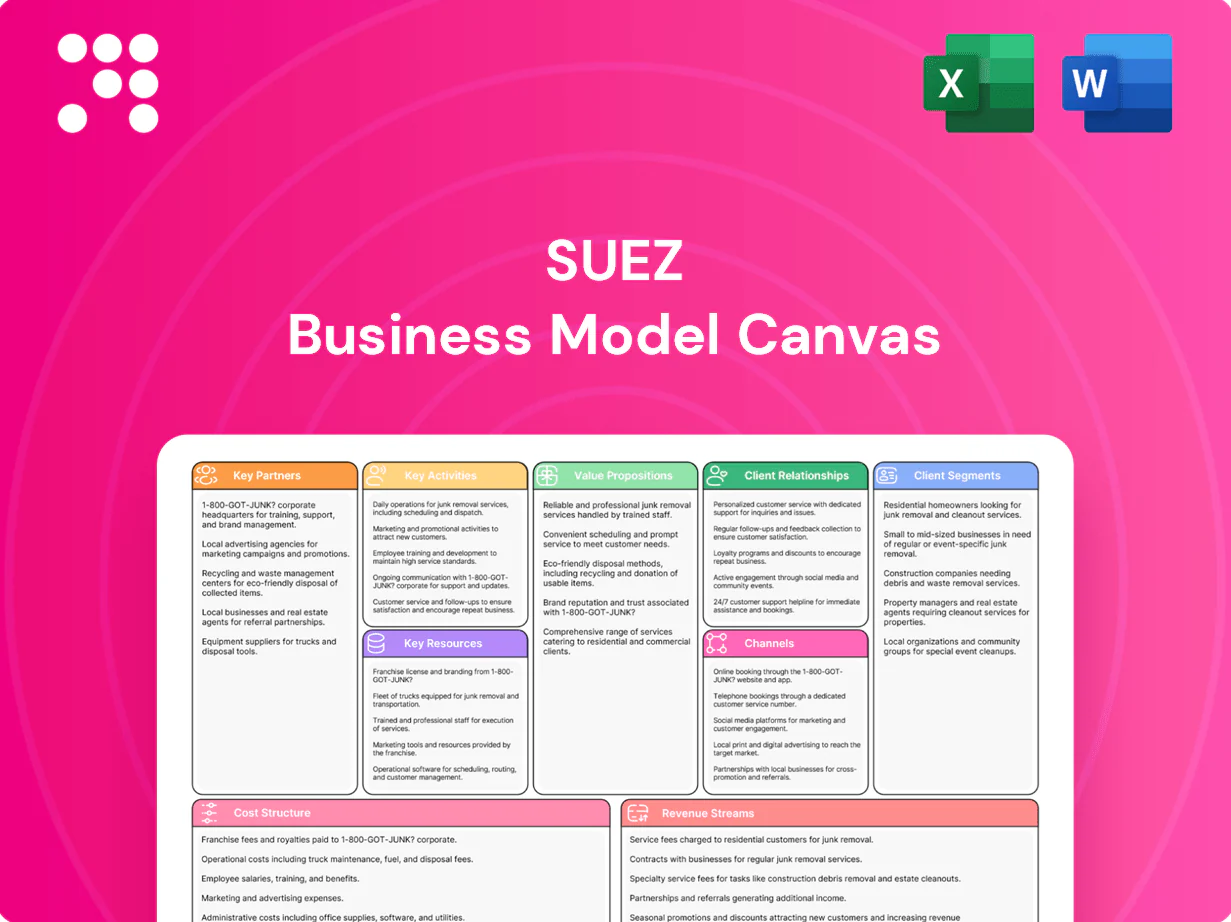
Suez Business Model Canvas

Explore the complete Business Model Canvas for a global water and waste services leader
Unlock the full strategic blueprint behind Suez's business model. This in-depth Business Model Canvas reveals how Suez creates value, scales operations, and maintains competitive advantage across water and waste services. Buy the complete, editable Word and Excel files to get nine-block insights, financial implications, and practical takeaways for investors, consultants, and leaders.
Partnerships

Municipal and public sector alliances
Collaborations with cities, utilities and public agencies underpin Suez’s over 2,000 municipal concessions and multi-year contracts, often running 15–30 years, securing long-term water and waste service rights. These alliances align service levels with regulatory and community goals through jointly defined KPIs and compliance targets. Co-investment models fund major infrastructure upgrades alongside public partners, de-risking CAPEX and ensuring stable volumes and predictable demand.
Technology and equipment providers
SUEZ partners with OEMs and tech firms supplying membranes, sensors, robotics and modular treatment units to scale projects; by 2024 membrane lifetimes of 5–7 years and sensor detection to sub-ppm are industry norms. Joint R&D accelerates digital monitoring, leak detection and advanced recycling, supporting SLAs near 99.9% uptime. Strong vendor relationships drive cost-efficiency and enable rapid deployment across diverse geographies.

Industrial and commercial partners
Industrial and commercial partners co-design on-site water and waste solutions, integrating SUEZ expertise to meet productivity, compliance and circularity KPIs. Performance contracts tie fees to outcomes, aligning payments with measured productivity and regulatory compliance. Partnerships enable by-product recovery and energy-from-waste, stabilizing feedstock streams and recurring service revenues in 2024.

Financial and infrastructure investors
- Co-financing: banks + DFIs + infra funds
- Maturities: 15–30 years
- Cost of capital: ≈100–300 bps reduction
- Benefit: risk sharing, scalable market expansion
Research and academic institutions
Universities and labs co-develop R&D with Suez in water reuse, sludge valorization and AI optimization, supporting over 30 pilot sites worldwide to validate processes before commercial rollout. Knowledge exchange with academia accelerates regulatory readiness and shortens time-to-market, tapping a global water reuse market estimated at about $3.1bn in 2024. This collaboration reinforces Suez’s technical leadership and expands its IP portfolio.
- R&D focus: water reuse, sludge valorization, AI optimization
- Pilots: >30 global validation sites
- Market context: water reuse ~ $3.1bn (2024)
- Outcomes: faster regulatory approval, stronger IP
Cities lock >2,000 deals; OEMs, finance cut WACC 100-300bps
Collaborations with cities/utilities secure >2,000 municipal concessions (15–30 yr), aligning KPIs and co-investment. OEMs/tech deliver membranes (5–7 yr), sensors and ~99.9% SLA; >30 R&D pilots speed rollout. Banks, DFIs and infra funds co-finance, lowering WACC ~100–300 bps; water reuse market ≈ $3.1bn (2024).
| Tag | Metric | Value |
|---|---|---|
| Concessions | Count | >2,000 |
| Contract length | Years | 15–30 |
| WACC impact | bps | 100–300 |
| R&D pilots | Sites | >30 |
| Market | Water reuse (2024) | $3.1bn |
What is included in the product
 Detailed Word Document
A comprehensive Business Model Canvas for Suez detailing customer segments, value propositions, channels, revenue streams and operations across the 9 BMC blocks, with linked SWOT, competitive advantages and investor-ready narratives for strategic planning and funding discussions.

 Customizable Excel Spreadsheet
Condenses Suez’s complex waste and water services into a clean, editable one-page canvas to quickly identify operational bottlenecks and strategic opportunities, saving teams hours of modeling and aligning stakeholders for faster decision-making.
Activities

Water production and distribution
Design, operate and maintain drinking-water plants and distribution networks, deploying SCADA and asset-management systems to secure continuous supply. Continuous monitoring of quality, pressure and flow ensures compliance with WHO/UNICEF safely managed water targets and reduces service interruptions. Leak detection and pressure management target non-revenue water; global average NRW is about 35%, a key KPI to minimize. Compliance follows stringent public-health standards and local regulations.
Wastewater treatment and reuse
Suez treats municipal and industrial effluents to discharge or reuse standards, addressing a global shortfall where UN-Water estimates 80% of wastewater is discharged untreated.
It deploys advanced processes including MBR, tertiary filtration and UV/chlorine disinfection to meet reuse criteria and achieve pathogen removal often exceeding 99%.
Suez captures biosolids for energy and materials recovery via anaerobic digestion and manages permits and environmental compliance across jurisdictions.

Waste collection, sorting, and recycling
Suez provides curbside collection, material recovery facility operations and specialty streams (WEEE, organics, industrial) across ~70 countries and ~40,000 employees, processing millions of tonnes annually to meet EU municipal waste recycling targets of 55% by 2025. Automation and data analytics can lift recycling yields by up to 20%, improving sort precision and revenue capture. Suez develops closed-loop programs with clients to return recycled feedstock into supply chains, reducing virgin use. All operations emphasize certified safe handling and digital traceability (batch-level tracking, RFID/Blockchain pilots) to ensure compliance and chain-of-custody.

Resource recovery and energy generation
Convert waste streams into energy, heat and secondary raw materials via optimized WtE and anaerobic digestion, extracting metals, plastics, paper fibers and organics for industrial reuse; Suez operates across ~70 countries (2024) to scale recovery and decarbonize clients.
Monetize by-products and environmental attributes through biogas sales, heat networks, recyclates and tradable credits while improving AD and WtE efficiencies.
- Recover: metals, plastics, fibers, organics
- Outputs: energy, heat, recyclates, biogas
- Optimize: AD and WtE yields
- Monetize: recyclates, heat, credits
Digital monitoring and asset management
Deploy IoT, SCADA and AI for predictive maintenance and process control, cutting downtime by up to 50% and maintenance costs 20–40% in 2024 deployments; use digital twins to optimize networks and plants, lowering OPEX 10–20%; provide client dashboards and reporting to boost transparency, compliance and uptime while meeting regulatory requirements.
- IoT/SCADA/AI: predictive maintenance
- Digital twins: network & plant optimization
- Dashboards: client reporting & compliance
- Outcomes: efficiency, uptime, regulatory adherence
Global water operator cuts downtime 50%, slashes OPEX 20%
Suez designs, operates and maintains water and waste networks across ~70 countries with ~40,000 staff (2024), targeting NRW ~35% and meeting WHO/UNICEF and local regs. It treats wastewater (addressing UN-Water’s 80% untreated gap), recovers energy/raw materials and monetizes biogas, recyclates and credits. Digital IoT/SCADA/AI and digital twins cut downtime up to 50%, maintenance 20–40% and OPEX 10–20%.
| KPI | Value |
|---|---|
| Countries | ~70 (2024) |
| Employees | ~40,000 |
| NRW | ~35% |
| Untreated WW | 80% (UN-Water) |
| EU recycling target | 55% by 2025 |
| Digital savings | Downtime -50%, Maint 20–40%, OPEX 10–20% |
Delivered as Displayed
Business Model Canvas
The Suez Business Model Canvas you’re previewing is the actual deliverable, not a mockup, and reflects the full structure and content you’ll receive after purchase. When you complete your order you’ll get this same document ready to use and edit, formatted for professional presentation. No placeholders or altered layouts—what you see is exactly what you’ll download.

Explore the complete Business Model Canvas for a global water and waste services leader
Unlock the full strategic blueprint behind Suez's business model. This in-depth Business Model Canvas reveals how Suez creates value, scales operations, and maintains competitive advantage across water and waste services. Buy the complete, editable Word and Excel files to get nine-block insights, financial implications, and practical takeaways for investors, consultants, and leaders.
Partnerships
Municipal and public sector alliances
Collaborations with cities, utilities and public agencies underpin Suez’s over 2,000 municipal concessions and multi-year contracts, often running 15–30 years, securing long-term water and waste service rights. These alliances align service levels with regulatory and community goals through jointly defined KPIs and compliance targets. Co-investment models fund major infrastructure upgrades alongside public partners, de-risking CAPEX and ensuring stable volumes and predictable demand.
Technology and equipment providers
SUEZ partners with OEMs and tech firms supplying membranes, sensors, robotics and modular treatment units to scale projects; by 2024 membrane lifetimes of 5–7 years and sensor detection to sub-ppm are industry norms. Joint R&D accelerates digital monitoring, leak detection and advanced recycling, supporting SLAs near 99.9% uptime. Strong vendor relationships drive cost-efficiency and enable rapid deployment across diverse geographies.
Industrial and commercial partners
Industrial and commercial partners co-design on-site water and waste solutions, integrating SUEZ expertise to meet productivity, compliance and circularity KPIs. Performance contracts tie fees to outcomes, aligning payments with measured productivity and regulatory compliance. Partnerships enable by-product recovery and energy-from-waste, stabilizing feedstock streams and recurring service revenues in 2024.
Financial and infrastructure investors
- Co-financing: banks + DFIs + infra funds
- Maturities: 15–30 years
- Cost of capital: ≈100–300 bps reduction
- Benefit: risk sharing, scalable market expansion
Research and academic institutions
Universities and labs co-develop R&D with Suez in water reuse, sludge valorization and AI optimization, supporting over 30 pilot sites worldwide to validate processes before commercial rollout. Knowledge exchange with academia accelerates regulatory readiness and shortens time-to-market, tapping a global water reuse market estimated at about $3.1bn in 2024. This collaboration reinforces Suez’s technical leadership and expands its IP portfolio.
- R&D focus: water reuse, sludge valorization, AI optimization
- Pilots: >30 global validation sites
- Market context: water reuse ~ $3.1bn (2024)
- Outcomes: faster regulatory approval, stronger IP
Cities lock >2,000 deals; OEMs, finance cut WACC 100-300bps
Collaborations with cities/utilities secure >2,000 municipal concessions (15–30 yr), aligning KPIs and co-investment. OEMs/tech deliver membranes (5–7 yr), sensors and ~99.9% SLA; >30 R&D pilots speed rollout. Banks, DFIs and infra funds co-finance, lowering WACC ~100–300 bps; water reuse market ≈ $3.1bn (2024).
| Tag | Metric | Value |
|---|---|---|
| Concessions | Count | >2,000 |
| Contract length | Years | 15–30 |
| WACC impact | bps | 100–300 |
| R&D pilots | Sites | >30 |
| Market | Water reuse (2024) | $3.1bn |
What is included in the product
Detailed Word Document
A comprehensive Business Model Canvas for Suez detailing customer segments, value propositions, channels, revenue streams and operations across the 9 BMC blocks, with linked SWOT, competitive advantages and investor-ready narratives for strategic planning and funding discussions.
Customizable Excel Spreadsheet
Condenses Suez’s complex waste and water services into a clean, editable one-page canvas to quickly identify operational bottlenecks and strategic opportunities, saving teams hours of modeling and aligning stakeholders for faster decision-making.
Activities
Water production and distribution
Design, operate and maintain drinking-water plants and distribution networks, deploying SCADA and asset-management systems to secure continuous supply. Continuous monitoring of quality, pressure and flow ensures compliance with WHO/UNICEF safely managed water targets and reduces service interruptions. Leak detection and pressure management target non-revenue water; global average NRW is about 35%, a key KPI to minimize. Compliance follows stringent public-health standards and local regulations.
Wastewater treatment and reuse
Suez treats municipal and industrial effluents to discharge or reuse standards, addressing a global shortfall where UN-Water estimates 80% of wastewater is discharged untreated.
It deploys advanced processes including MBR, tertiary filtration and UV/chlorine disinfection to meet reuse criteria and achieve pathogen removal often exceeding 99%.
Suez captures biosolids for energy and materials recovery via anaerobic digestion and manages permits and environmental compliance across jurisdictions.
Waste collection, sorting, and recycling
Suez provides curbside collection, material recovery facility operations and specialty streams (WEEE, organics, industrial) across ~70 countries and ~40,000 employees, processing millions of tonnes annually to meet EU municipal waste recycling targets of 55% by 2025. Automation and data analytics can lift recycling yields by up to 20%, improving sort precision and revenue capture. Suez develops closed-loop programs with clients to return recycled feedstock into supply chains, reducing virgin use. All operations emphasize certified safe handling and digital traceability (batch-level tracking, RFID/Blockchain pilots) to ensure compliance and chain-of-custody.
Resource recovery and energy generation
Convert waste streams into energy, heat and secondary raw materials via optimized WtE and anaerobic digestion, extracting metals, plastics, paper fibers and organics for industrial reuse; Suez operates across ~70 countries (2024) to scale recovery and decarbonize clients.
Monetize by-products and environmental attributes through biogas sales, heat networks, recyclates and tradable credits while improving AD and WtE efficiencies.
- Recover: metals, plastics, fibers, organics
- Outputs: energy, heat, recyclates, biogas
- Optimize: AD and WtE yields
- Monetize: recyclates, heat, credits
Digital monitoring and asset management
Deploy IoT, SCADA and AI for predictive maintenance and process control, cutting downtime by up to 50% and maintenance costs 20–40% in 2024 deployments; use digital twins to optimize networks and plants, lowering OPEX 10–20%; provide client dashboards and reporting to boost transparency, compliance and uptime while meeting regulatory requirements.
- IoT/SCADA/AI: predictive maintenance
- Digital twins: network & plant optimization
- Dashboards: client reporting & compliance
- Outcomes: efficiency, uptime, regulatory adherence
Global water operator cuts downtime 50%, slashes OPEX 20%
Suez designs, operates and maintains water and waste networks across ~70 countries with ~40,000 staff (2024), targeting NRW ~35% and meeting WHO/UNICEF and local regs. It treats wastewater (addressing UN-Water’s 80% untreated gap), recovers energy/raw materials and monetizes biogas, recyclates and credits. Digital IoT/SCADA/AI and digital twins cut downtime up to 50%, maintenance 20–40% and OPEX 10–20%.
| KPI | Value |
|---|---|
| Countries | ~70 (2024) |
| Employees | ~40,000 |
| NRW | ~35% |
| Untreated WW | 80% (UN-Water) |
| EU recycling target | 55% by 2025 |
| Digital savings | Downtime -50%, Maint 20–40%, OPEX 10–20% |
Delivered as Displayed
Business Model Canvas
The Suez Business Model Canvas you’re previewing is the actual deliverable, not a mockup, and reflects the full structure and content you’ll receive after purchase. When you complete your order you’ll get this same document ready to use and edit, formatted for professional presentation. No placeholders or altered layouts—what you see is exactly what you’ll download.
Original: $10.00
-65%$10.00
$3.50Description
Explore the complete Business Model Canvas for a global water and waste services leader
Unlock the full strategic blueprint behind Suez's business model. This in-depth Business Model Canvas reveals how Suez creates value, scales operations, and maintains competitive advantage across water and waste services. Buy the complete, editable Word and Excel files to get nine-block insights, financial implications, and practical takeaways for investors, consultants, and leaders.
Partnerships
Municipal and public sector alliances
Collaborations with cities, utilities and public agencies underpin Suez’s over 2,000 municipal concessions and multi-year contracts, often running 15–30 years, securing long-term water and waste service rights. These alliances align service levels with regulatory and community goals through jointly defined KPIs and compliance targets. Co-investment models fund major infrastructure upgrades alongside public partners, de-risking CAPEX and ensuring stable volumes and predictable demand.
Technology and equipment providers
SUEZ partners with OEMs and tech firms supplying membranes, sensors, robotics and modular treatment units to scale projects; by 2024 membrane lifetimes of 5–7 years and sensor detection to sub-ppm are industry norms. Joint R&D accelerates digital monitoring, leak detection and advanced recycling, supporting SLAs near 99.9% uptime. Strong vendor relationships drive cost-efficiency and enable rapid deployment across diverse geographies.
Industrial and commercial partners
Industrial and commercial partners co-design on-site water and waste solutions, integrating SUEZ expertise to meet productivity, compliance and circularity KPIs. Performance contracts tie fees to outcomes, aligning payments with measured productivity and regulatory compliance. Partnerships enable by-product recovery and energy-from-waste, stabilizing feedstock streams and recurring service revenues in 2024.
Financial and infrastructure investors
- Co-financing: banks + DFIs + infra funds
- Maturities: 15–30 years
- Cost of capital: ≈100–300 bps reduction
- Benefit: risk sharing, scalable market expansion
Research and academic institutions
Universities and labs co-develop R&D with Suez in water reuse, sludge valorization and AI optimization, supporting over 30 pilot sites worldwide to validate processes before commercial rollout. Knowledge exchange with academia accelerates regulatory readiness and shortens time-to-market, tapping a global water reuse market estimated at about $3.1bn in 2024. This collaboration reinforces Suez’s technical leadership and expands its IP portfolio.
- R&D focus: water reuse, sludge valorization, AI optimization
- Pilots: >30 global validation sites
- Market context: water reuse ~ $3.1bn (2024)
- Outcomes: faster regulatory approval, stronger IP
Cities lock >2,000 deals; OEMs, finance cut WACC 100-300bps
Collaborations with cities/utilities secure >2,000 municipal concessions (15–30 yr), aligning KPIs and co-investment. OEMs/tech deliver membranes (5–7 yr), sensors and ~99.9% SLA; >30 R&D pilots speed rollout. Banks, DFIs and infra funds co-finance, lowering WACC ~100–300 bps; water reuse market ≈ $3.1bn (2024).
| Tag | Metric | Value |
|---|---|---|
| Concessions | Count | >2,000 |
| Contract length | Years | 15–30 |
| WACC impact | bps | 100–300 |
| R&D pilots | Sites | >30 |
| Market | Water reuse (2024) | $3.1bn |
What is included in the product
Detailed Word Document
A comprehensive Business Model Canvas for Suez detailing customer segments, value propositions, channels, revenue streams and operations across the 9 BMC blocks, with linked SWOT, competitive advantages and investor-ready narratives for strategic planning and funding discussions.
Customizable Excel Spreadsheet
Condenses Suez’s complex waste and water services into a clean, editable one-page canvas to quickly identify operational bottlenecks and strategic opportunities, saving teams hours of modeling and aligning stakeholders for faster decision-making.
Activities
Water production and distribution
Design, operate and maintain drinking-water plants and distribution networks, deploying SCADA and asset-management systems to secure continuous supply. Continuous monitoring of quality, pressure and flow ensures compliance with WHO/UNICEF safely managed water targets and reduces service interruptions. Leak detection and pressure management target non-revenue water; global average NRW is about 35%, a key KPI to minimize. Compliance follows stringent public-health standards and local regulations.
Wastewater treatment and reuse
Suez treats municipal and industrial effluents to discharge or reuse standards, addressing a global shortfall where UN-Water estimates 80% of wastewater is discharged untreated.
It deploys advanced processes including MBR, tertiary filtration and UV/chlorine disinfection to meet reuse criteria and achieve pathogen removal often exceeding 99%.
Suez captures biosolids for energy and materials recovery via anaerobic digestion and manages permits and environmental compliance across jurisdictions.
Waste collection, sorting, and recycling
Suez provides curbside collection, material recovery facility operations and specialty streams (WEEE, organics, industrial) across ~70 countries and ~40,000 employees, processing millions of tonnes annually to meet EU municipal waste recycling targets of 55% by 2025. Automation and data analytics can lift recycling yields by up to 20%, improving sort precision and revenue capture. Suez develops closed-loop programs with clients to return recycled feedstock into supply chains, reducing virgin use. All operations emphasize certified safe handling and digital traceability (batch-level tracking, RFID/Blockchain pilots) to ensure compliance and chain-of-custody.
Resource recovery and energy generation
Convert waste streams into energy, heat and secondary raw materials via optimized WtE and anaerobic digestion, extracting metals, plastics, paper fibers and organics for industrial reuse; Suez operates across ~70 countries (2024) to scale recovery and decarbonize clients.
Monetize by-products and environmental attributes through biogas sales, heat networks, recyclates and tradable credits while improving AD and WtE efficiencies.
- Recover: metals, plastics, fibers, organics
- Outputs: energy, heat, recyclates, biogas
- Optimize: AD and WtE yields
- Monetize: recyclates, heat, credits
Digital monitoring and asset management
Deploy IoT, SCADA and AI for predictive maintenance and process control, cutting downtime by up to 50% and maintenance costs 20–40% in 2024 deployments; use digital twins to optimize networks and plants, lowering OPEX 10–20%; provide client dashboards and reporting to boost transparency, compliance and uptime while meeting regulatory requirements.
- IoT/SCADA/AI: predictive maintenance
- Digital twins: network & plant optimization
- Dashboards: client reporting & compliance
- Outcomes: efficiency, uptime, regulatory adherence
Global water operator cuts downtime 50%, slashes OPEX 20%
Suez designs, operates and maintains water and waste networks across ~70 countries with ~40,000 staff (2024), targeting NRW ~35% and meeting WHO/UNICEF and local regs. It treats wastewater (addressing UN-Water’s 80% untreated gap), recovers energy/raw materials and monetizes biogas, recyclates and credits. Digital IoT/SCADA/AI and digital twins cut downtime up to 50%, maintenance 20–40% and OPEX 10–20%.
| KPI | Value |
|---|---|
| Countries | ~70 (2024) |
| Employees | ~40,000 |
| NRW | ~35% |
| Untreated WW | 80% (UN-Water) |
| EU recycling target | 55% by 2025 |
| Digital savings | Downtime -50%, Maint 20–40%, OPEX 10–20% |
Delivered as Displayed
Business Model Canvas
The Suez Business Model Canvas you’re previewing is the actual deliverable, not a mockup, and reflects the full structure and content you’ll receive after purchase. When you complete your order you’ll get this same document ready to use and edit, formatted for professional presentation. No placeholders or altered layouts—what you see is exactly what you’ll download.











