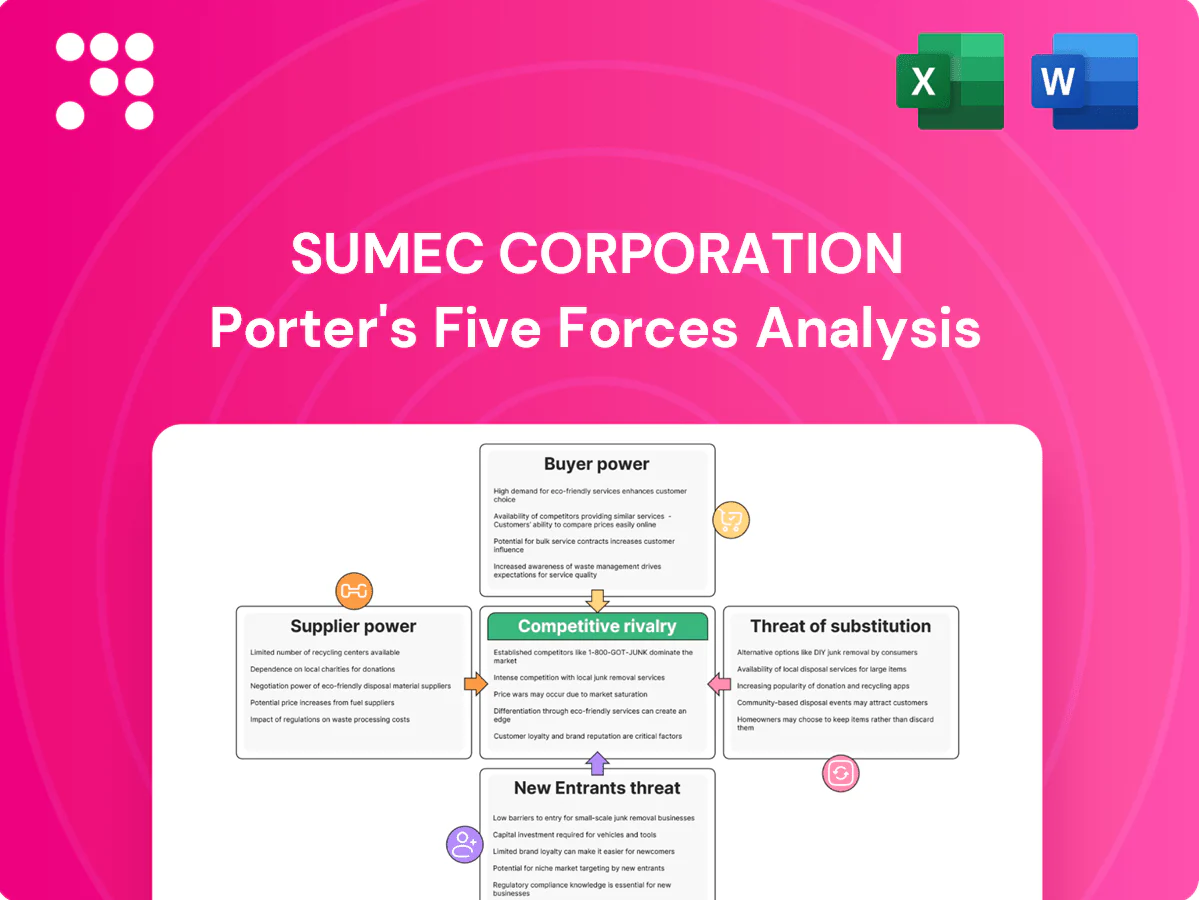
Sumec Corporation Porter's Five Forces Analysis

Go Beyond the Preview—Access the Full Strategic Report
Sumec Corporation faces moderate supplier power, fragmented buyers, and growing rivalry as it navigates industrial and renewable markets. Regulatory and technological shifts increase substitute and entrant risks. This brief snapshot only scratches the surface. Unlock the full Porter's Five Forces Analysis to explore Sumec’s competitive dynamics, market pressures, and strategic advantages in detail.
Suppliers Bargaining Power

Diverse upstream base tempers leverage
Sumec sources across machinery, ship components, energy equipment and environmental tech, diluting dependence on any single supplier and supporting multisourcing and global procurement strategies. Multisourcing and international purchasing reduce switching costs and exposure to local disruptions. However, highly specialized items such as marine engines and grid‑grade inverters remain concentrated among a few OEMs, and long lead times plus stringent quality certifications in 2024 strengthen these critical suppliers.
Commodity volatility passes through
Steel, copper and energy inputs expose Sumec projects to sharp price swings — copper and rebar experienced intra-year volatility exceeding 15% in 2024 while Brent crude averaged about 85 USD/barrel that year, enabling suppliers to pass costs through. Contract escalation clauses protect margins but reduce Sumec’s bargaining latitude on fixed bids. Hedging and inventory planning partially mitigate exposure but raise working capital needs. Tighter markets or logistics bottlenecks amplify supplier clout.

Standards and certifications lock-in
Compliance with IMO, IEC and ISO standards narrows Sumec’s approved vendor lists, making certified suppliers effectively gatekeepers; qualification cycles commonly take 6–18 months, raising mid-project switching costs. Suppliers owning proprietary technologies can command 10–25% pricing premiums, while framework agreements historically secure 5–15% unit-cost reductions in exchange for volume commitments.

Geopolitics and logistics constraints
Export controls, tariffs and shipping disruptions materially elevate supplier bargaining power in 2024; with 80% of global trade by volume moved by sea (UNCTAD 2024), route disruptions raise costs and lead times. Concentration of key component processing—China accounts for about 85% of rare earth refining in 2024—pushes risk premia higher. Sumec’s vertical supply-chain integration and alternative lanes mitigate some pressure, yet time‑critical EPC schedules magnify supplier leverage during shocks.
- Export controls: higher lead times
- Tariff risk: cost volatility
- Shipping: 80% trade by sea (UNCTAD 2024)
- Concentration: ~85% rare earth refining in China (2024)
- Sumec: integration + alternative lanes
- EPC timetables: increased supplier leverage
Financial strength and prepayment terms
Upstream OEMs commonly require deposits or letters of credit, shifting up to 20-30% of project working capital onto Sumec in some 2024 contracts; larger, cash-rich suppliers can push stricter payment terms and shorter receivable cycles. Sumec’s scale secures better supplier credit on high-volume lines, and alignment with project financing has rebalanced terms in long-cycle EPC contracts.
- Deposits/LCs: 20-30% reported in 2024 deals
- Large suppliers: tighter terms, faster collections
- Sumec scale: preferential credit on high volumes
- Project financing: offsets working-capital shifts
Suppliers exert moderate-high leverage; copper ±15% and Brent ≈85 USD/bbl
Suppliers hold moderate–high power: diversified sourcing lowers dependence but specialized OEMs (marine engines, inverters) and certification lead times (6–18 months) concentrate leverage. Commodity swings (copper/rebar ±15% in 2024; Brent ~85 USD/bbl) and logistics (80% trade by sea) enable cost pass-through. Contracts often demand 20–30% deposits, though Sumec scale and project finance soften terms.
| Metric | 2024 figure |
|---|---|
| Copper/rebar volatility | ≈15% |
| Brent | ≈85 USD/bbl |
| Sea trade | 80% |
| Rare earth refining (China) | ≈85% |
| Deposits/LCs | 20–30% |
What is included in the product
 Detailed Word Document
Tailored Porter’s Five Forces analysis for Sumec Corporation revealing competitive intensity, supplier and buyer power, threat of substitutes and entrants, and strategic levers to protect margins and market share.

 Customizable Excel Spreadsheet
One-sheet Porter's Five Forces for Sumec Corporation—condenses supplier, buyer, entrant, substitute and rivalry pressures into a clean chart so executives can instantly assess competitive pain points and copy-ready insights for pitches or strategic plans.
Customers Bargaining Power

Large institutional buyers negotiate hard
State utilities, shipowners and industrial conglomerates wield scale and procurement expertise, forcing competitive tenders that compress margins and lengthen payment terms; Sumec (SHA:601126) faces these pressures in 2024. Buyers increasingly demand performance guarantees and liquidated damages, shifting risk onto suppliers. To preserve pricing Sumec must differentiate on total cost of ownership and proven reliability.
Information transparency intensifies price focus
Global benchmarks and open specs enable easy cross-bidding, letting buyers rapidly pit suppliers against each other; by 2024 roughly two-thirds of industrial buyers use digital procurement tools to compare multi-vendor quotes. This accelerates price sensitivity in commoditized packages and pressures margins. Bundled services and lifecycle support help Sumec shift negotiations from upfront price to total-cost-of-ownership, reducing pure price competition.

Switching costs vary by project phase
Pre-award switching is easy, letting buyers leverage early-phase competition for price and scope concessions. Post-award switching becomes costly as interface and design lock-in increase exposure to change orders, which industry surveys show typically add about 10–15% to final project costs. After engineering freeze, Sumec can regain pricing power as changes become materially more expensive. Contract structures that stage value delivery (milestones, design freezes) shift bargaining leverage back toward the supplier.

Performance and ESG requirements
Buyers now impose stringent quality, safety and ESG criteria, widening negotiations beyond price; in 2024 about 72% of procurement leaders ranked supplier ESG performance as critical to contracts. Non-price demands such as certifications and extended warranties are leveraged to secure 5–10% effective price concessions. Meeting these standards raises delivery complexity, but verified compliance can justify premium pricing.
- ESG demands expand bargaining scope
- Non-price terms used to extract discounts/warranties
- Compliance raises complexity but supports premiums
After-sales and financing as levers
Buyers demand O&M, spares, and vendor financing to cut lifecycle costs, and bundled O&M-plus-financing offers raise switching costs while provoking tougher upfront commercial terms; Sumec’s integrated services can lock in multi-year revenue streams and influence procurement. In 2024 financing availability continued to tip award decisions in capital-intensive projects, benefiting suppliers who offer on-balance-sheet or partner-backed credit solutions.
- Buyers: O&M, spares, vendor finance
- Bundling: higher dependence, tougher terms
- Sumec: locks long-term revenue via services
- 2024: financing often decisive in awards
Digital tenders and ESG squeeze margins — ~66% digital, 72% ESG
Large buyers drive competitive tenders, compressing margins; ~66% of industrial buyers used digital procurement in 2024. Buyers demand ESG, warranties and performance guarantees (72% of procurement leaders in 2024), shifting risk and extracting 5–10% concessions. Post-award changes add ~10–15% to project costs, letting Sumec recover pricing after design freeze.
| Metric | 2024 Value |
|---|---|
| Digital procurement use | ~66% |
| Procurement leaders citing ESG critical | 72% |
| Change-order cost uplift | 10–15% |
| Typical ESG-driven price concession | 5–10% |
What You See Is What You Get
Sumec Corporation Porter's Five Forces Analysis
Sumec Corporation Porter’s Five Forces analysis assesses supplier and buyer power, industry rivalry, threat of new entrants, and substitutes to evaluate competitive intensity and profitability. It highlights high rivalry and moderate supplier power due to component sourcing, plus barriers to entry from scale and customer relationships. You're looking at the actual document. Once you complete your purchase, you’ll get instant access to this exact file.

Go Beyond the Preview—Access the Full Strategic Report
Sumec Corporation faces moderate supplier power, fragmented buyers, and growing rivalry as it navigates industrial and renewable markets. Regulatory and technological shifts increase substitute and entrant risks. This brief snapshot only scratches the surface. Unlock the full Porter's Five Forces Analysis to explore Sumec’s competitive dynamics, market pressures, and strategic advantages in detail.
Suppliers Bargaining Power
Diverse upstream base tempers leverage
Sumec sources across machinery, ship components, energy equipment and environmental tech, diluting dependence on any single supplier and supporting multisourcing and global procurement strategies. Multisourcing and international purchasing reduce switching costs and exposure to local disruptions. However, highly specialized items such as marine engines and grid‑grade inverters remain concentrated among a few OEMs, and long lead times plus stringent quality certifications in 2024 strengthen these critical suppliers.
Commodity volatility passes through
Steel, copper and energy inputs expose Sumec projects to sharp price swings — copper and rebar experienced intra-year volatility exceeding 15% in 2024 while Brent crude averaged about 85 USD/barrel that year, enabling suppliers to pass costs through. Contract escalation clauses protect margins but reduce Sumec’s bargaining latitude on fixed bids. Hedging and inventory planning partially mitigate exposure but raise working capital needs. Tighter markets or logistics bottlenecks amplify supplier clout.
Standards and certifications lock-in
Compliance with IMO, IEC and ISO standards narrows Sumec’s approved vendor lists, making certified suppliers effectively gatekeepers; qualification cycles commonly take 6–18 months, raising mid-project switching costs. Suppliers owning proprietary technologies can command 10–25% pricing premiums, while framework agreements historically secure 5–15% unit-cost reductions in exchange for volume commitments.
Geopolitics and logistics constraints
Export controls, tariffs and shipping disruptions materially elevate supplier bargaining power in 2024; with 80% of global trade by volume moved by sea (UNCTAD 2024), route disruptions raise costs and lead times. Concentration of key component processing—China accounts for about 85% of rare earth refining in 2024—pushes risk premia higher. Sumec’s vertical supply-chain integration and alternative lanes mitigate some pressure, yet time‑critical EPC schedules magnify supplier leverage during shocks.
- Export controls: higher lead times
- Tariff risk: cost volatility
- Shipping: 80% trade by sea (UNCTAD 2024)
- Concentration: ~85% rare earth refining in China (2024)
- Sumec: integration + alternative lanes
- EPC timetables: increased supplier leverage
Financial strength and prepayment terms
Upstream OEMs commonly require deposits or letters of credit, shifting up to 20-30% of project working capital onto Sumec in some 2024 contracts; larger, cash-rich suppliers can push stricter payment terms and shorter receivable cycles. Sumec’s scale secures better supplier credit on high-volume lines, and alignment with project financing has rebalanced terms in long-cycle EPC contracts.
- Deposits/LCs: 20-30% reported in 2024 deals
- Large suppliers: tighter terms, faster collections
- Sumec scale: preferential credit on high volumes
- Project financing: offsets working-capital shifts
Suppliers exert moderate-high leverage; copper ±15% and Brent ≈85 USD/bbl
Suppliers hold moderate–high power: diversified sourcing lowers dependence but specialized OEMs (marine engines, inverters) and certification lead times (6–18 months) concentrate leverage. Commodity swings (copper/rebar ±15% in 2024; Brent ~85 USD/bbl) and logistics (80% trade by sea) enable cost pass-through. Contracts often demand 20–30% deposits, though Sumec scale and project finance soften terms.
| Metric | 2024 figure |
|---|---|
| Copper/rebar volatility | ≈15% |
| Brent | ≈85 USD/bbl |
| Sea trade | 80% |
| Rare earth refining (China) | ≈85% |
| Deposits/LCs | 20–30% |
What is included in the product
Detailed Word Document
Tailored Porter’s Five Forces analysis for Sumec Corporation revealing competitive intensity, supplier and buyer power, threat of substitutes and entrants, and strategic levers to protect margins and market share.
Customizable Excel Spreadsheet
One-sheet Porter's Five Forces for Sumec Corporation—condenses supplier, buyer, entrant, substitute and rivalry pressures into a clean chart so executives can instantly assess competitive pain points and copy-ready insights for pitches or strategic plans.
Customers Bargaining Power
Large institutional buyers negotiate hard
State utilities, shipowners and industrial conglomerates wield scale and procurement expertise, forcing competitive tenders that compress margins and lengthen payment terms; Sumec (SHA:601126) faces these pressures in 2024. Buyers increasingly demand performance guarantees and liquidated damages, shifting risk onto suppliers. To preserve pricing Sumec must differentiate on total cost of ownership and proven reliability.
Information transparency intensifies price focus
Global benchmarks and open specs enable easy cross-bidding, letting buyers rapidly pit suppliers against each other; by 2024 roughly two-thirds of industrial buyers use digital procurement tools to compare multi-vendor quotes. This accelerates price sensitivity in commoditized packages and pressures margins. Bundled services and lifecycle support help Sumec shift negotiations from upfront price to total-cost-of-ownership, reducing pure price competition.
Switching costs vary by project phase
Pre-award switching is easy, letting buyers leverage early-phase competition for price and scope concessions. Post-award switching becomes costly as interface and design lock-in increase exposure to change orders, which industry surveys show typically add about 10–15% to final project costs. After engineering freeze, Sumec can regain pricing power as changes become materially more expensive. Contract structures that stage value delivery (milestones, design freezes) shift bargaining leverage back toward the supplier.
Performance and ESG requirements
Buyers now impose stringent quality, safety and ESG criteria, widening negotiations beyond price; in 2024 about 72% of procurement leaders ranked supplier ESG performance as critical to contracts. Non-price demands such as certifications and extended warranties are leveraged to secure 5–10% effective price concessions. Meeting these standards raises delivery complexity, but verified compliance can justify premium pricing.
- ESG demands expand bargaining scope
- Non-price terms used to extract discounts/warranties
- Compliance raises complexity but supports premiums
After-sales and financing as levers
Buyers demand O&M, spares, and vendor financing to cut lifecycle costs, and bundled O&M-plus-financing offers raise switching costs while provoking tougher upfront commercial terms; Sumec’s integrated services can lock in multi-year revenue streams and influence procurement. In 2024 financing availability continued to tip award decisions in capital-intensive projects, benefiting suppliers who offer on-balance-sheet or partner-backed credit solutions.
- Buyers: O&M, spares, vendor finance
- Bundling: higher dependence, tougher terms
- Sumec: locks long-term revenue via services
- 2024: financing often decisive in awards
Digital tenders and ESG squeeze margins — ~66% digital, 72% ESG
Large buyers drive competitive tenders, compressing margins; ~66% of industrial buyers used digital procurement in 2024. Buyers demand ESG, warranties and performance guarantees (72% of procurement leaders in 2024), shifting risk and extracting 5–10% concessions. Post-award changes add ~10–15% to project costs, letting Sumec recover pricing after design freeze.
| Metric | 2024 Value |
|---|---|
| Digital procurement use | ~66% |
| Procurement leaders citing ESG critical | 72% |
| Change-order cost uplift | 10–15% |
| Typical ESG-driven price concession | 5–10% |
What You See Is What You Get
Sumec Corporation Porter's Five Forces Analysis
Sumec Corporation Porter’s Five Forces analysis assesses supplier and buyer power, industry rivalry, threat of new entrants, and substitutes to evaluate competitive intensity and profitability. It highlights high rivalry and moderate supplier power due to component sourcing, plus barriers to entry from scale and customer relationships. You're looking at the actual document. Once you complete your purchase, you’ll get instant access to this exact file.
Original: $10.00
-65%$10.00
$3.50Description
Go Beyond the Preview—Access the Full Strategic Report
Sumec Corporation faces moderate supplier power, fragmented buyers, and growing rivalry as it navigates industrial and renewable markets. Regulatory and technological shifts increase substitute and entrant risks. This brief snapshot only scratches the surface. Unlock the full Porter's Five Forces Analysis to explore Sumec’s competitive dynamics, market pressures, and strategic advantages in detail.
Suppliers Bargaining Power
Diverse upstream base tempers leverage
Sumec sources across machinery, ship components, energy equipment and environmental tech, diluting dependence on any single supplier and supporting multisourcing and global procurement strategies. Multisourcing and international purchasing reduce switching costs and exposure to local disruptions. However, highly specialized items such as marine engines and grid‑grade inverters remain concentrated among a few OEMs, and long lead times plus stringent quality certifications in 2024 strengthen these critical suppliers.
Commodity volatility passes through
Steel, copper and energy inputs expose Sumec projects to sharp price swings — copper and rebar experienced intra-year volatility exceeding 15% in 2024 while Brent crude averaged about 85 USD/barrel that year, enabling suppliers to pass costs through. Contract escalation clauses protect margins but reduce Sumec’s bargaining latitude on fixed bids. Hedging and inventory planning partially mitigate exposure but raise working capital needs. Tighter markets or logistics bottlenecks amplify supplier clout.
Standards and certifications lock-in
Compliance with IMO, IEC and ISO standards narrows Sumec’s approved vendor lists, making certified suppliers effectively gatekeepers; qualification cycles commonly take 6–18 months, raising mid-project switching costs. Suppliers owning proprietary technologies can command 10–25% pricing premiums, while framework agreements historically secure 5–15% unit-cost reductions in exchange for volume commitments.
Geopolitics and logistics constraints
Export controls, tariffs and shipping disruptions materially elevate supplier bargaining power in 2024; with 80% of global trade by volume moved by sea (UNCTAD 2024), route disruptions raise costs and lead times. Concentration of key component processing—China accounts for about 85% of rare earth refining in 2024—pushes risk premia higher. Sumec’s vertical supply-chain integration and alternative lanes mitigate some pressure, yet time‑critical EPC schedules magnify supplier leverage during shocks.
- Export controls: higher lead times
- Tariff risk: cost volatility
- Shipping: 80% trade by sea (UNCTAD 2024)
- Concentration: ~85% rare earth refining in China (2024)
- Sumec: integration + alternative lanes
- EPC timetables: increased supplier leverage
Financial strength and prepayment terms
Upstream OEMs commonly require deposits or letters of credit, shifting up to 20-30% of project working capital onto Sumec in some 2024 contracts; larger, cash-rich suppliers can push stricter payment terms and shorter receivable cycles. Sumec’s scale secures better supplier credit on high-volume lines, and alignment with project financing has rebalanced terms in long-cycle EPC contracts.
- Deposits/LCs: 20-30% reported in 2024 deals
- Large suppliers: tighter terms, faster collections
- Sumec scale: preferential credit on high volumes
- Project financing: offsets working-capital shifts
Suppliers exert moderate-high leverage; copper ±15% and Brent ≈85 USD/bbl
Suppliers hold moderate–high power: diversified sourcing lowers dependence but specialized OEMs (marine engines, inverters) and certification lead times (6–18 months) concentrate leverage. Commodity swings (copper/rebar ±15% in 2024; Brent ~85 USD/bbl) and logistics (80% trade by sea) enable cost pass-through. Contracts often demand 20–30% deposits, though Sumec scale and project finance soften terms.
| Metric | 2024 figure |
|---|---|
| Copper/rebar volatility | ≈15% |
| Brent | ≈85 USD/bbl |
| Sea trade | 80% |
| Rare earth refining (China) | ≈85% |
| Deposits/LCs | 20–30% |
What is included in the product
Detailed Word Document
Tailored Porter’s Five Forces analysis for Sumec Corporation revealing competitive intensity, supplier and buyer power, threat of substitutes and entrants, and strategic levers to protect margins and market share.
Customizable Excel Spreadsheet
One-sheet Porter's Five Forces for Sumec Corporation—condenses supplier, buyer, entrant, substitute and rivalry pressures into a clean chart so executives can instantly assess competitive pain points and copy-ready insights for pitches or strategic plans.
Customers Bargaining Power
Large institutional buyers negotiate hard
State utilities, shipowners and industrial conglomerates wield scale and procurement expertise, forcing competitive tenders that compress margins and lengthen payment terms; Sumec (SHA:601126) faces these pressures in 2024. Buyers increasingly demand performance guarantees and liquidated damages, shifting risk onto suppliers. To preserve pricing Sumec must differentiate on total cost of ownership and proven reliability.
Information transparency intensifies price focus
Global benchmarks and open specs enable easy cross-bidding, letting buyers rapidly pit suppliers against each other; by 2024 roughly two-thirds of industrial buyers use digital procurement tools to compare multi-vendor quotes. This accelerates price sensitivity in commoditized packages and pressures margins. Bundled services and lifecycle support help Sumec shift negotiations from upfront price to total-cost-of-ownership, reducing pure price competition.
Switching costs vary by project phase
Pre-award switching is easy, letting buyers leverage early-phase competition for price and scope concessions. Post-award switching becomes costly as interface and design lock-in increase exposure to change orders, which industry surveys show typically add about 10–15% to final project costs. After engineering freeze, Sumec can regain pricing power as changes become materially more expensive. Contract structures that stage value delivery (milestones, design freezes) shift bargaining leverage back toward the supplier.
Performance and ESG requirements
Buyers now impose stringent quality, safety and ESG criteria, widening negotiations beyond price; in 2024 about 72% of procurement leaders ranked supplier ESG performance as critical to contracts. Non-price demands such as certifications and extended warranties are leveraged to secure 5–10% effective price concessions. Meeting these standards raises delivery complexity, but verified compliance can justify premium pricing.
- ESG demands expand bargaining scope
- Non-price terms used to extract discounts/warranties
- Compliance raises complexity but supports premiums
After-sales and financing as levers
Buyers demand O&M, spares, and vendor financing to cut lifecycle costs, and bundled O&M-plus-financing offers raise switching costs while provoking tougher upfront commercial terms; Sumec’s integrated services can lock in multi-year revenue streams and influence procurement. In 2024 financing availability continued to tip award decisions in capital-intensive projects, benefiting suppliers who offer on-balance-sheet or partner-backed credit solutions.
- Buyers: O&M, spares, vendor finance
- Bundling: higher dependence, tougher terms
- Sumec: locks long-term revenue via services
- 2024: financing often decisive in awards
Digital tenders and ESG squeeze margins — ~66% digital, 72% ESG
Large buyers drive competitive tenders, compressing margins; ~66% of industrial buyers used digital procurement in 2024. Buyers demand ESG, warranties and performance guarantees (72% of procurement leaders in 2024), shifting risk and extracting 5–10% concessions. Post-award changes add ~10–15% to project costs, letting Sumec recover pricing after design freeze.
| Metric | 2024 Value |
|---|---|
| Digital procurement use | ~66% |
| Procurement leaders citing ESG critical | 72% |
| Change-order cost uplift | 10–15% |
| Typical ESG-driven price concession | 5–10% |
What You See Is What You Get
Sumec Corporation Porter's Five Forces Analysis
Sumec Corporation Porter’s Five Forces analysis assesses supplier and buyer power, industry rivalry, threat of new entrants, and substitutes to evaluate competitive intensity and profitability. It highlights high rivalry and moderate supplier power due to component sourcing, plus barriers to entry from scale and customer relationships. You're looking at the actual document. Once you complete your purchase, you’ll get instant access to this exact file.











