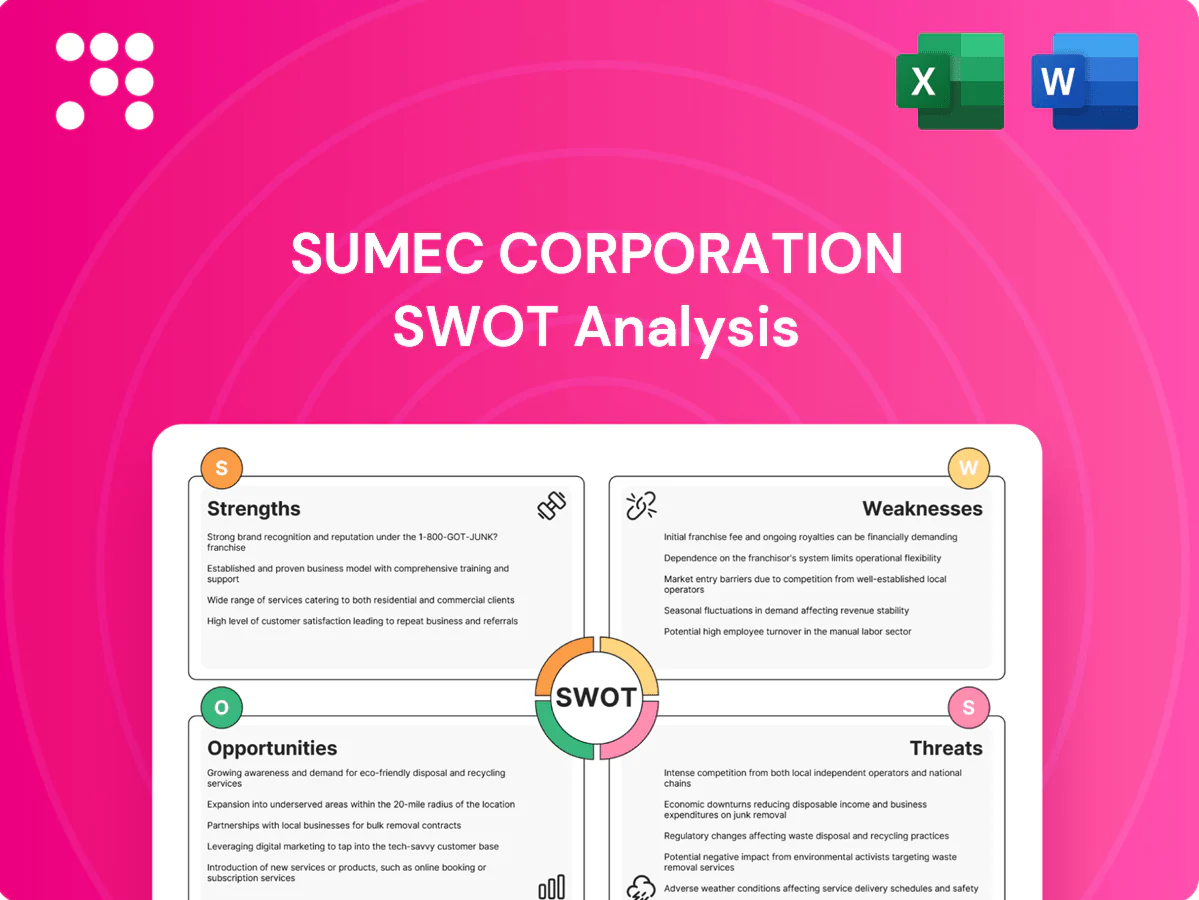
Sumec Corporation SWOT Analysis

Elevate Your Analysis with the Complete SWOT Report
Sumec Corporation shows strong manufacturing capabilities and diversified electrical equipment lines but faces margin pressure from supply chains and intense competition; growth hinges on tech upgrade and overseas expansion. Want the full strategic picture? Purchase the complete SWOT for a research-backed, editable Word and Excel package to plan, pitch, or invest with confidence.
Strengths

Diversified business portfolio
Sumec Corporation operates across trade and services, engineering contracting, and investment, reducing reliance on any single revenue source. Its exposure to machinery, shipbuilding, energy, and environmental protection helps smooth cyclical volatility. Diversification enables cross-selling and risk balancing across segments and supports resilience during sector-specific downturns.
Integrated global supply chain capabilities
Sumec’s integrated global supply-chain links sourcing, logistics, financing and after-sales to deepen client stickiness and enable scale purchasing, delivering measurable cost and delivery advantages. Cross-chain visibility strengthens risk control and quality assurance, and captures higher margins versus pure traders. Industry studies (McKinsey 2023) cite 10–20% procurement cost reduction from end-to-end integration.

Strong EPC and international contracting expertise
Experience in turnkey project delivery boosts Sumec’s credibility in overseas markets, enabling smoother entry and client trust. Capability to manage complex engineering, procurement, and construction reduces execution risk and attracts risk-averse buyers. Strong references in energy and environmental projects enhance bidding competitiveness. These project capabilities support higher-value, multi-year revenue streams and repeat business.

Access to industrial ecosystems and partnerships
Ties with equipment makers, shipyards and energy-technology providers let Sumec offer bundled solutions and systems integration across supply chains, accelerating uptake in sectors like shipbuilding and power. Partnerships expand technical breadth without full asset ownership, enabling flexible M&A-lite growth. Ecosystem access shortens time-to-market for new offerings and opens co-development and co-financing lanes for large projects often exceeding $50m.
- Bundled solutions via equipment + shipyard ties
- Asset-light technical expansion through partnerships
- Faster time-to-market from ecosystem access
- Co-development/co-financing for >$50m projects
Exposure to energy transition and environmental sectors
Participation in renewable, efficiency, and environmental protection projects aligns Sumec with global and Chinese policy tailwinds, strengthening order visibility and risk mitigation. Growing demand for pollution control and clean power equipment driven by regulatory mandates creates recurring upgrade and maintenance needs that support stable aftermarket revenue. This positioning enables premium pricing and long-term project pipelines, improving margin resilience and cash flow predictability.
- Policy alignment
- Recurring upgrade demand
- Aftermarket revenue support
- Premium pricing potential
Diversified operations and integrated supply chain drive 10-20% procurement gains
Sumec’s diversified operations across trade, engineering contracting and investments reduce single-market exposure and enable cross-selling; integrated supply-chain and after-sales deliver procurement and delivery advantages (McKinsey 2023 notes 10–20% gains from end-to-end integration). Turnkey project experience and partner ecosystem support higher-value, repeatable contracts in renewables and environmental projects.
| Strength | Evidence |
|---|---|
| Diversification | Trade, EPC, Investment |
| Integration | End-to-end supply chain (procurement, logistics, financing) |
| Project capability | Turnkey EPC in energy/environment |
What is included in the product
 Detailed Word Document
Provides a concise SWOT analysis identifying Sumec Corporation’s internal strengths and weaknesses and external opportunities and threats to assess its competitive position and future growth risks.

 Customizable Excel Spreadsheet
Provides a concise, tailored SWOT matrix for Sumec Corporation to rapidly align strategy and resolve key pain points; editable format enables quick updates and easy integration into presentations and reports.
Weaknesses

Execution complexity across segments
Managing diverse businesses raises coordination costs and governance demands, stretching Sumec’s corporate controls across trading, EPC and equipment segments. Differing risk profiles between trade and EPC can dilute managerial focus and resource allocation. Complex oversight slows decision-making and heightens the chance of project overruns where controls are uneven.
High working capital intensity
Trading and EPC operations force Sumec to carry substantial inventories, large receivables and project guarantees, driving high working capital intensity. Extended cash conversion cycles strain liquidity and increase reliance on bank facilities during project ramp-ups. Customer credit deterioration in downcycles can accumulate receivables and amplify losses, compressing returns versus asset-light peers.

Exposure to commodity and freight volatility
Equipment and ship-related activities expose Sumec to input-price swings and logistics costs, with freight benchmarks like the Baltic Dry Index and SCFI showing large 2024–25 swings that can move costs by tens of percent. Hedging can be imperfect during rapid market moves, leaving residual exposure when rates spike. Fixed-price contracts risk margin compression and forecasting inaccuracies have led to documented cost overruns in project work.

Dependence on policy and sovereign clients
Dependence on policy and sovereign clients ties Sumec's international contracting to government budgets and approvals, so funding delays or political decisions can stall backlog conversion and extend project timelines. Payment collection risk rises in higher-risk jurisdictions, increasing working capital pressure and necessitating stronger credit controls. Political shifts or renegotiations can change project terms midstream, squeezing margins and cash flow.
- Government-dependent backlog exposure
- Higher cross-border payment risk
- Vulnerability to policy or term changes
Potential brand dilution across geographies
Operating across diverse geographies can create uneven service quality for Sumec, with inconsistent local partnerships affecting delivery standards and project timelines. Brand recognition often trails incumbents in new markets, forcing higher bid expenses and lowering early win rates. This fragmentation risks reputational dilution and margin compression during expansion.
- Uneven service quality
- Inconsistent partner standards
- Lower recognition vs incumbents
- Higher initial bid costs, reduced win rates
Complex EPC and trading mix raises project overruns, tight liquidity and margin pressure
Sumec’s diversified trading, EPC and equipment mix increases coordination and governance burdens, slowing decisions and raising overrun risk. High working-capital intensity from inventories, receivables and guarantees stresses liquidity versus asset-light peers. Commodity and freight volatility (2024–25) plus fixed-price contracts compress margins. Heavy reliance on sovereign clients and uneven local execution heighten payment and reputational risks.
| Metric | Status | 2024–25 Trend |
|---|---|---|
| Working-capital intensity | High | Rising |
| Backlog: government exposure | Concentrated | Volatile |
| Freight/input-price exposure | Significant | Fluctuating |
Preview Before You Purchase
Sumec Corporation SWOT Analysis
This is the actual SWOT analysis document you’ll receive upon purchase—no surprises, just professional quality. The preview below is taken directly from the full SWOT report you'll get. Buy now to unlock the complete, editable version.

Elevate Your Analysis with the Complete SWOT Report
Sumec Corporation shows strong manufacturing capabilities and diversified electrical equipment lines but faces margin pressure from supply chains and intense competition; growth hinges on tech upgrade and overseas expansion. Want the full strategic picture? Purchase the complete SWOT for a research-backed, editable Word and Excel package to plan, pitch, or invest with confidence.
Strengths
Diversified business portfolio
Sumec Corporation operates across trade and services, engineering contracting, and investment, reducing reliance on any single revenue source. Its exposure to machinery, shipbuilding, energy, and environmental protection helps smooth cyclical volatility. Diversification enables cross-selling and risk balancing across segments and supports resilience during sector-specific downturns.
Integrated global supply chain capabilities
Sumec’s integrated global supply-chain links sourcing, logistics, financing and after-sales to deepen client stickiness and enable scale purchasing, delivering measurable cost and delivery advantages. Cross-chain visibility strengthens risk control and quality assurance, and captures higher margins versus pure traders. Industry studies (McKinsey 2023) cite 10–20% procurement cost reduction from end-to-end integration.
Strong EPC and international contracting expertise
Experience in turnkey project delivery boosts Sumec’s credibility in overseas markets, enabling smoother entry and client trust. Capability to manage complex engineering, procurement, and construction reduces execution risk and attracts risk-averse buyers. Strong references in energy and environmental projects enhance bidding competitiveness. These project capabilities support higher-value, multi-year revenue streams and repeat business.
Access to industrial ecosystems and partnerships
Ties with equipment makers, shipyards and energy-technology providers let Sumec offer bundled solutions and systems integration across supply chains, accelerating uptake in sectors like shipbuilding and power. Partnerships expand technical breadth without full asset ownership, enabling flexible M&A-lite growth. Ecosystem access shortens time-to-market for new offerings and opens co-development and co-financing lanes for large projects often exceeding $50m.
- Bundled solutions via equipment + shipyard ties
- Asset-light technical expansion through partnerships
- Faster time-to-market from ecosystem access
- Co-development/co-financing for >$50m projects
Exposure to energy transition and environmental sectors
Participation in renewable, efficiency, and environmental protection projects aligns Sumec with global and Chinese policy tailwinds, strengthening order visibility and risk mitigation. Growing demand for pollution control and clean power equipment driven by regulatory mandates creates recurring upgrade and maintenance needs that support stable aftermarket revenue. This positioning enables premium pricing and long-term project pipelines, improving margin resilience and cash flow predictability.
- Policy alignment
- Recurring upgrade demand
- Aftermarket revenue support
- Premium pricing potential
Diversified operations and integrated supply chain drive 10-20% procurement gains
Sumec’s diversified operations across trade, engineering contracting and investments reduce single-market exposure and enable cross-selling; integrated supply-chain and after-sales deliver procurement and delivery advantages (McKinsey 2023 notes 10–20% gains from end-to-end integration). Turnkey project experience and partner ecosystem support higher-value, repeatable contracts in renewables and environmental projects.
| Strength | Evidence |
|---|---|
| Diversification | Trade, EPC, Investment |
| Integration | End-to-end supply chain (procurement, logistics, financing) |
| Project capability | Turnkey EPC in energy/environment |
What is included in the product
Detailed Word Document
Provides a concise SWOT analysis identifying Sumec Corporation’s internal strengths and weaknesses and external opportunities and threats to assess its competitive position and future growth risks.
Customizable Excel Spreadsheet
Provides a concise, tailored SWOT matrix for Sumec Corporation to rapidly align strategy and resolve key pain points; editable format enables quick updates and easy integration into presentations and reports.
Weaknesses
Execution complexity across segments
Managing diverse businesses raises coordination costs and governance demands, stretching Sumec’s corporate controls across trading, EPC and equipment segments. Differing risk profiles between trade and EPC can dilute managerial focus and resource allocation. Complex oversight slows decision-making and heightens the chance of project overruns where controls are uneven.
High working capital intensity
Trading and EPC operations force Sumec to carry substantial inventories, large receivables and project guarantees, driving high working capital intensity. Extended cash conversion cycles strain liquidity and increase reliance on bank facilities during project ramp-ups. Customer credit deterioration in downcycles can accumulate receivables and amplify losses, compressing returns versus asset-light peers.
Exposure to commodity and freight volatility
Equipment and ship-related activities expose Sumec to input-price swings and logistics costs, with freight benchmarks like the Baltic Dry Index and SCFI showing large 2024–25 swings that can move costs by tens of percent. Hedging can be imperfect during rapid market moves, leaving residual exposure when rates spike. Fixed-price contracts risk margin compression and forecasting inaccuracies have led to documented cost overruns in project work.
Dependence on policy and sovereign clients
Dependence on policy and sovereign clients ties Sumec's international contracting to government budgets and approvals, so funding delays or political decisions can stall backlog conversion and extend project timelines. Payment collection risk rises in higher-risk jurisdictions, increasing working capital pressure and necessitating stronger credit controls. Political shifts or renegotiations can change project terms midstream, squeezing margins and cash flow.
- Government-dependent backlog exposure
- Higher cross-border payment risk
- Vulnerability to policy or term changes
Potential brand dilution across geographies
Operating across diverse geographies can create uneven service quality for Sumec, with inconsistent local partnerships affecting delivery standards and project timelines. Brand recognition often trails incumbents in new markets, forcing higher bid expenses and lowering early win rates. This fragmentation risks reputational dilution and margin compression during expansion.
- Uneven service quality
- Inconsistent partner standards
- Lower recognition vs incumbents
- Higher initial bid costs, reduced win rates
Complex EPC and trading mix raises project overruns, tight liquidity and margin pressure
Sumec’s diversified trading, EPC and equipment mix increases coordination and governance burdens, slowing decisions and raising overrun risk. High working-capital intensity from inventories, receivables and guarantees stresses liquidity versus asset-light peers. Commodity and freight volatility (2024–25) plus fixed-price contracts compress margins. Heavy reliance on sovereign clients and uneven local execution heighten payment and reputational risks.
| Metric | Status | 2024–25 Trend |
|---|---|---|
| Working-capital intensity | High | Rising |
| Backlog: government exposure | Concentrated | Volatile |
| Freight/input-price exposure | Significant | Fluctuating |
Preview Before You Purchase
Sumec Corporation SWOT Analysis
This is the actual SWOT analysis document you’ll receive upon purchase—no surprises, just professional quality. The preview below is taken directly from the full SWOT report you'll get. Buy now to unlock the complete, editable version.
Description
Elevate Your Analysis with the Complete SWOT Report
Sumec Corporation shows strong manufacturing capabilities and diversified electrical equipment lines but faces margin pressure from supply chains and intense competition; growth hinges on tech upgrade and overseas expansion. Want the full strategic picture? Purchase the complete SWOT for a research-backed, editable Word and Excel package to plan, pitch, or invest with confidence.
Strengths
Diversified business portfolio
Sumec Corporation operates across trade and services, engineering contracting, and investment, reducing reliance on any single revenue source. Its exposure to machinery, shipbuilding, energy, and environmental protection helps smooth cyclical volatility. Diversification enables cross-selling and risk balancing across segments and supports resilience during sector-specific downturns.
Integrated global supply chain capabilities
Sumec’s integrated global supply-chain links sourcing, logistics, financing and after-sales to deepen client stickiness and enable scale purchasing, delivering measurable cost and delivery advantages. Cross-chain visibility strengthens risk control and quality assurance, and captures higher margins versus pure traders. Industry studies (McKinsey 2023) cite 10–20% procurement cost reduction from end-to-end integration.
Strong EPC and international contracting expertise
Experience in turnkey project delivery boosts Sumec’s credibility in overseas markets, enabling smoother entry and client trust. Capability to manage complex engineering, procurement, and construction reduces execution risk and attracts risk-averse buyers. Strong references in energy and environmental projects enhance bidding competitiveness. These project capabilities support higher-value, multi-year revenue streams and repeat business.
Access to industrial ecosystems and partnerships
Ties with equipment makers, shipyards and energy-technology providers let Sumec offer bundled solutions and systems integration across supply chains, accelerating uptake in sectors like shipbuilding and power. Partnerships expand technical breadth without full asset ownership, enabling flexible M&A-lite growth. Ecosystem access shortens time-to-market for new offerings and opens co-development and co-financing lanes for large projects often exceeding $50m.
- Bundled solutions via equipment + shipyard ties
- Asset-light technical expansion through partnerships
- Faster time-to-market from ecosystem access
- Co-development/co-financing for >$50m projects
Exposure to energy transition and environmental sectors
Participation in renewable, efficiency, and environmental protection projects aligns Sumec with global and Chinese policy tailwinds, strengthening order visibility and risk mitigation. Growing demand for pollution control and clean power equipment driven by regulatory mandates creates recurring upgrade and maintenance needs that support stable aftermarket revenue. This positioning enables premium pricing and long-term project pipelines, improving margin resilience and cash flow predictability.
- Policy alignment
- Recurring upgrade demand
- Aftermarket revenue support
- Premium pricing potential
Diversified operations and integrated supply chain drive 10-20% procurement gains
Sumec’s diversified operations across trade, engineering contracting and investments reduce single-market exposure and enable cross-selling; integrated supply-chain and after-sales deliver procurement and delivery advantages (McKinsey 2023 notes 10–20% gains from end-to-end integration). Turnkey project experience and partner ecosystem support higher-value, repeatable contracts in renewables and environmental projects.
| Strength | Evidence |
|---|---|
| Diversification | Trade, EPC, Investment |
| Integration | End-to-end supply chain (procurement, logistics, financing) |
| Project capability | Turnkey EPC in energy/environment |
What is included in the product
Detailed Word Document
Provides a concise SWOT analysis identifying Sumec Corporation’s internal strengths and weaknesses and external opportunities and threats to assess its competitive position and future growth risks.
Customizable Excel Spreadsheet
Provides a concise, tailored SWOT matrix for Sumec Corporation to rapidly align strategy and resolve key pain points; editable format enables quick updates and easy integration into presentations and reports.
Weaknesses
Execution complexity across segments
Managing diverse businesses raises coordination costs and governance demands, stretching Sumec’s corporate controls across trading, EPC and equipment segments. Differing risk profiles between trade and EPC can dilute managerial focus and resource allocation. Complex oversight slows decision-making and heightens the chance of project overruns where controls are uneven.
High working capital intensity
Trading and EPC operations force Sumec to carry substantial inventories, large receivables and project guarantees, driving high working capital intensity. Extended cash conversion cycles strain liquidity and increase reliance on bank facilities during project ramp-ups. Customer credit deterioration in downcycles can accumulate receivables and amplify losses, compressing returns versus asset-light peers.
Exposure to commodity and freight volatility
Equipment and ship-related activities expose Sumec to input-price swings and logistics costs, with freight benchmarks like the Baltic Dry Index and SCFI showing large 2024–25 swings that can move costs by tens of percent. Hedging can be imperfect during rapid market moves, leaving residual exposure when rates spike. Fixed-price contracts risk margin compression and forecasting inaccuracies have led to documented cost overruns in project work.
Dependence on policy and sovereign clients
Dependence on policy and sovereign clients ties Sumec's international contracting to government budgets and approvals, so funding delays or political decisions can stall backlog conversion and extend project timelines. Payment collection risk rises in higher-risk jurisdictions, increasing working capital pressure and necessitating stronger credit controls. Political shifts or renegotiations can change project terms midstream, squeezing margins and cash flow.
- Government-dependent backlog exposure
- Higher cross-border payment risk
- Vulnerability to policy or term changes
Potential brand dilution across geographies
Operating across diverse geographies can create uneven service quality for Sumec, with inconsistent local partnerships affecting delivery standards and project timelines. Brand recognition often trails incumbents in new markets, forcing higher bid expenses and lowering early win rates. This fragmentation risks reputational dilution and margin compression during expansion.
- Uneven service quality
- Inconsistent partner standards
- Lower recognition vs incumbents
- Higher initial bid costs, reduced win rates
Complex EPC and trading mix raises project overruns, tight liquidity and margin pressure
Sumec’s diversified trading, EPC and equipment mix increases coordination and governance burdens, slowing decisions and raising overrun risk. High working-capital intensity from inventories, receivables and guarantees stresses liquidity versus asset-light peers. Commodity and freight volatility (2024–25) plus fixed-price contracts compress margins. Heavy reliance on sovereign clients and uneven local execution heighten payment and reputational risks.
| Metric | Status | 2024–25 Trend |
|---|---|---|
| Working-capital intensity | High | Rising |
| Backlog: government exposure | Concentrated | Volatile |
| Freight/input-price exposure | Significant | Fluctuating |
Preview Before You Purchase
Sumec Corporation SWOT Analysis
This is the actual SWOT analysis document you’ll receive upon purchase—no surprises, just professional quality. The preview below is taken directly from the full SWOT report you'll get. Buy now to unlock the complete, editable version.











