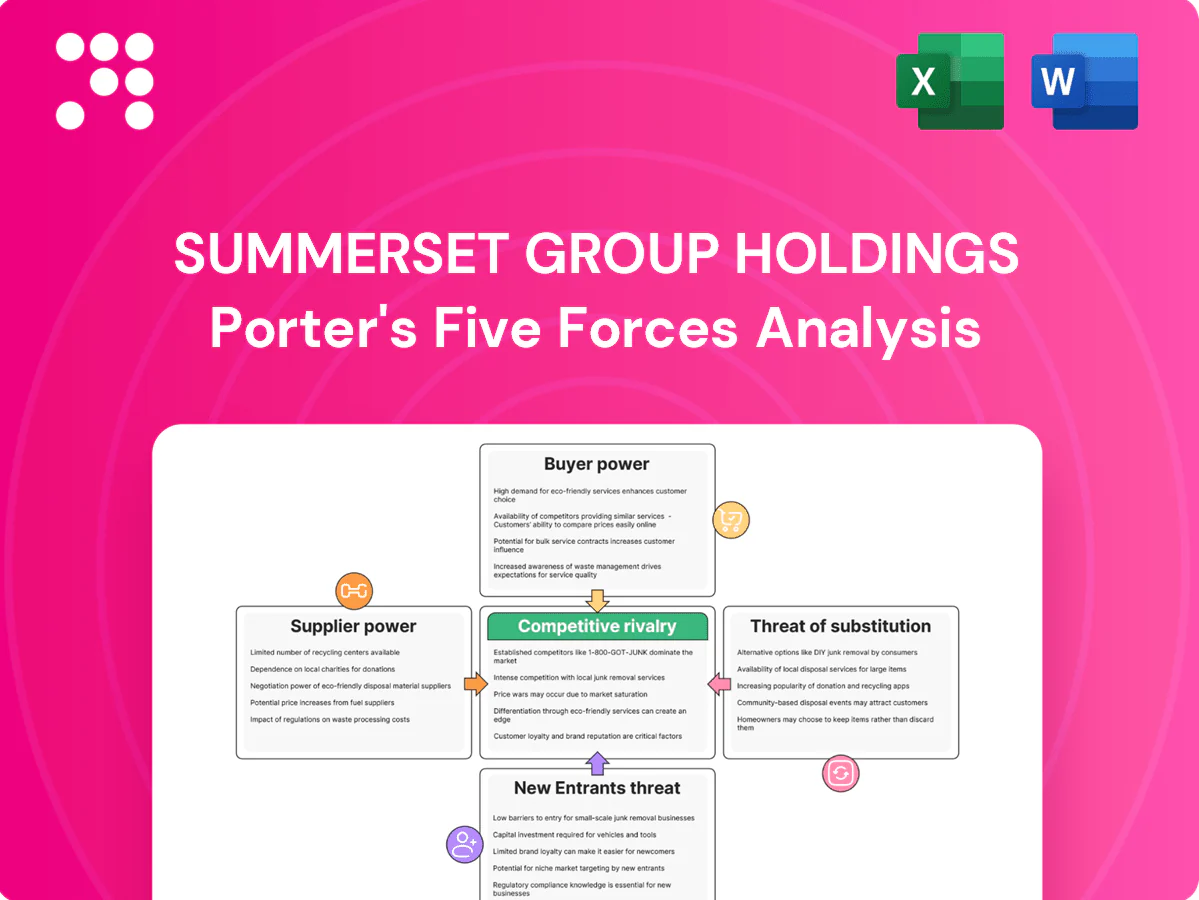
Summerset Group Holdings Porter's Five Forces Analysis

Go Beyond the Preview—Access the Full Strategic Report
Summerset Group Holdings faces moderate buyer power, steady supplier relationships, and rising competitive pressure from alternative aged-care models, shaping margins and growth prospects. Threat of new entrants is limited by capital and regulation, while substitutes and rivalry drive strategic differentiation needs. This brief snapshot only scratches the surface. Unlock the full Porter's Five Forces Analysis to explore Summerset Group Holdings’s competitive dynamics in detail.
Suppliers Bargaining Power

Scarce development land
Zoning, consenting and serviced sites near ageing populations are limited, concentrating bargaining power with land vendors; prime urban infill parcels in NZ and Australia commonly attract multiple bidders (typically 4–8), driving up prices. Greenfield projects carry holding risk with development timelines of roughly 18–36 months, giving sellers leverage, while long option pipelines (often 2–5 years) mitigate but do not eliminate scarcity.
Construction and materials volatility
Builders, subcontractors and inputs like steel, concrete and HVAC faced cyclical shortages and price swings through 2023–24, forcing capacity constraints that pushed up tender prices and led to schedule compromises for Summerset projects. Tier-1 contractors increasingly prioritise larger builds, raising Summerset’s dependency on smaller contractors. Long-term partnering and component standardisation reduce but do not eliminate supply-risk.

Clinical workforce dependence
Nurses, caregivers and specialists remain tight labor pools, with immigration policy and stronger wage-setting in 2024 increasing recruitment pressure. Staff shortages push higher overtime and agency reliance, amplifying wage bargaining power across Summerset’s sites. Quality-of-care and regulatory standards limit substitution, keeping supplier leverage high. Investment in training pipelines and employer branding eases but does not eliminate supplier strength.

Healthcare and care consumables
Medical equipment, pharmaceuticals, PPE and diagnostics for Summerset are sourced from regulated suppliers, so compliance and spec requirements narrow vendor choice and raise switching costs; the global PPE market reached about US$70bn in 2024, allowing bulk buys to cut unit costs but stock-outs quickly shift bargaining power back to suppliers.
- Regulation-driven vendor concentration
- Bulk procurement reduces prices
- Stock-outs increase supplier power
- Traceability entrenches preferred vendors
Utilities and digital systems
Utilities (power, water, broadband) are essential for Summerset with limited local alternatives; NZ’s retail energy market is concentrated (top five retailers ~75% share in 2024), strengthening supplier leverage. Integrated clinical/village software, alarms and security are sticky once deployed, raising switching costs and operational risk; global healthcare IT vendor consolidation continued in 2024. SLAs and multi-sourcing mitigate but do not eliminate dependence.
- High supplier power: concentrated utilities (~75% by top five, 2024)
- Sticky systems: clinical/management software causes vendor lock-in
- Switching costs: elevated transition and operational risk
- Mitigation: SLAs and multi-sourcing reduce but not remove dependence
Site scarcity, supplier concentration raise vendor power; construction, labor costs climb
Zoning/site scarcity concentrates land vendor power (prime parcels attract 4–8 bidders; greenfield holds 18–36 months; option pipelines 2–5 years). Construction inputs and contractors tightened through 2023–24, lifting tender prices and prioritising large projects. Health workforce shortages and stronger 2024 wage settings raise labor bargaining power; PPE market ~US$70bn (2024). Utilities top‑5 retailers ~75% share (NZ, 2024), increasing supplier leverage.
| Metric | 2024 figure |
|---|---|
| Prime parcel bidders | 4–8 |
| Greenfield timeline | 18–36 months |
| PPE market | US$70bn |
| Top‑5 energy share (NZ) | ~75% |
What is included in the product
 Detailed Word Document
Tailored Porter's Five Forces analysis for Summerset Group Holdings uncovering key competitive drivers, buyer and supplier power, substitute risks, and barriers deterring new entrants. Identifies disruptive threats and strategic levers to protect market share and inform investor or board-level decisions.

 Customizable Excel Spreadsheet
Clear, one-sheet Porter's Five Forces for Summerset Group Holdings that distills competitive pressures into an executive-ready spider chart for fast strategic decisions. Customize force levels, swap in your own data, and drop the chart into decks or Excel dashboards—no macros or finance expertise required.
Customers Bargaining Power

Resident and family choice
Prospective residents and families compare villages on price, DMF structures, care levels and amenities, increasing price sensitivity; in 2024 New Zealand's 65+ cohort was about 16.6% of the population, heightening demand for choice. Online reviews and word-of-mouth boost transparency and bargaining power, but proximity to family and existing waitlists constrain options. After move-in, high switching costs and disruption temper ongoing buyer leverage.
Government funding influence
Government sets aged-care subsidies and clinical funding frameworks such as AN-ACC (introduced Oct 2022), effectively capping reimbursement and contributing roughly A$25 billion annually to residential aged care in 2023–24; policy shifts or acuity reassessments can rapidly compress provider margins. Providers have limited bargaining power on rates, giving the state high buyer power, so Summerset must optimize care mix and higher-acuity placements to preserve margins.

Price sensitivity to DMF and fees
Buyers scrutinise deferred management fees (commonly 20–33%), weekly charges (typically NZ$500–800) and capital gains policies, negotiating incentives, refurb credits and settlement timing to reduce effective costs. Transparent, competitively structured offers lower buyer pushback but compress pricing latitude, while investment in amenity upgrades shifts bargaining from price toward experience and occupancy premium.

Local market alternatives
In urban NZ markets where multiple operators exist customers often switch at the search stage, with rival promotions and digital listings expanding options; urban residents account for about 86% of the population (Stats NZ). Rural areas show lower buyer power due to scarcity of alternatives, and reputation for care quality remains the decisive tiebreaker.
- Urban switching high
- Promotions amplify choices
- Rural scarcity lowers power
- Care reputation decisive
Aging-in-place preferences
Many seniors prefer to age in place, with an AARP 2024 survey showing about 77% favoring home-based care, which strengthens customer negotiating leverage against Summerset village entry prices. Rising resident acuity and clear social supports in villages, plus NZ 65+ population ~17% in 2024, counterbalance that leverage by increasing demand for integrated care. Tailored continuum-of-care packages can convert hesitancy by matching home-care preferences with on-site escalation pathways.
- 77% AARP 2024: prefer aging in place
- NZ 65+ ~17% (2024)
- Higher acuity raises willingness to pay for on-site care
- Continuum-of-care offerings reduce entry-price resistance
Moderate resident leverage: DMFs 20–33%, NZ 65+ ~17%
Prospective residents wield moderate bargaining power: price sensitivity (DMFs 20–33%, weekly fees NZ$500–800) and online transparency increase leverage, but high post-entry switching costs limit it. NZ 65+ ~17% (2024) raises demand; govt funding/AN-ACC (A$25bn 2023–24) caps reimbursements, constraining providers' rate flexibility.
| Metric | 2024 |
|---|---|
| NZ 65+ | ~17% |
| Govt aged-care spend | A$25bn (2023–24) |
What You See Is What You Get
Summerset Group Holdings Porter's Five Forces Analysis
This Porter’s Five Forces analysis of Summerset Group Holdings assesses competitive rivalry, supplier and buyer power, threat of substitutes, and barriers to entry to evaluate industry attractiveness and strategic risk. You’re previewing the final version—precisely the same document that will be available to you instantly after buying. It is fully formatted and ready for use in investment or strategic planning.

Go Beyond the Preview—Access the Full Strategic Report
Summerset Group Holdings faces moderate buyer power, steady supplier relationships, and rising competitive pressure from alternative aged-care models, shaping margins and growth prospects. Threat of new entrants is limited by capital and regulation, while substitutes and rivalry drive strategic differentiation needs. This brief snapshot only scratches the surface. Unlock the full Porter's Five Forces Analysis to explore Summerset Group Holdings’s competitive dynamics in detail.
Suppliers Bargaining Power
Scarce development land
Zoning, consenting and serviced sites near ageing populations are limited, concentrating bargaining power with land vendors; prime urban infill parcels in NZ and Australia commonly attract multiple bidders (typically 4–8), driving up prices. Greenfield projects carry holding risk with development timelines of roughly 18–36 months, giving sellers leverage, while long option pipelines (often 2–5 years) mitigate but do not eliminate scarcity.
Construction and materials volatility
Builders, subcontractors and inputs like steel, concrete and HVAC faced cyclical shortages and price swings through 2023–24, forcing capacity constraints that pushed up tender prices and led to schedule compromises for Summerset projects. Tier-1 contractors increasingly prioritise larger builds, raising Summerset’s dependency on smaller contractors. Long-term partnering and component standardisation reduce but do not eliminate supply-risk.
Clinical workforce dependence
Nurses, caregivers and specialists remain tight labor pools, with immigration policy and stronger wage-setting in 2024 increasing recruitment pressure. Staff shortages push higher overtime and agency reliance, amplifying wage bargaining power across Summerset’s sites. Quality-of-care and regulatory standards limit substitution, keeping supplier leverage high. Investment in training pipelines and employer branding eases but does not eliminate supplier strength.
Healthcare and care consumables
Medical equipment, pharmaceuticals, PPE and diagnostics for Summerset are sourced from regulated suppliers, so compliance and spec requirements narrow vendor choice and raise switching costs; the global PPE market reached about US$70bn in 2024, allowing bulk buys to cut unit costs but stock-outs quickly shift bargaining power back to suppliers.
- Regulation-driven vendor concentration
- Bulk procurement reduces prices
- Stock-outs increase supplier power
- Traceability entrenches preferred vendors
Utilities and digital systems
Utilities (power, water, broadband) are essential for Summerset with limited local alternatives; NZ’s retail energy market is concentrated (top five retailers ~75% share in 2024), strengthening supplier leverage. Integrated clinical/village software, alarms and security are sticky once deployed, raising switching costs and operational risk; global healthcare IT vendor consolidation continued in 2024. SLAs and multi-sourcing mitigate but do not eliminate dependence.
- High supplier power: concentrated utilities (~75% by top five, 2024)
- Sticky systems: clinical/management software causes vendor lock-in
- Switching costs: elevated transition and operational risk
- Mitigation: SLAs and multi-sourcing reduce but not remove dependence
Site scarcity, supplier concentration raise vendor power; construction, labor costs climb
Zoning/site scarcity concentrates land vendor power (prime parcels attract 4–8 bidders; greenfield holds 18–36 months; option pipelines 2–5 years). Construction inputs and contractors tightened through 2023–24, lifting tender prices and prioritising large projects. Health workforce shortages and stronger 2024 wage settings raise labor bargaining power; PPE market ~US$70bn (2024). Utilities top‑5 retailers ~75% share (NZ, 2024), increasing supplier leverage.
| Metric | 2024 figure |
|---|---|
| Prime parcel bidders | 4–8 |
| Greenfield timeline | 18–36 months |
| PPE market | US$70bn |
| Top‑5 energy share (NZ) | ~75% |
What is included in the product
Detailed Word Document
Tailored Porter's Five Forces analysis for Summerset Group Holdings uncovering key competitive drivers, buyer and supplier power, substitute risks, and barriers deterring new entrants. Identifies disruptive threats and strategic levers to protect market share and inform investor or board-level decisions.
Customizable Excel Spreadsheet
Clear, one-sheet Porter's Five Forces for Summerset Group Holdings that distills competitive pressures into an executive-ready spider chart for fast strategic decisions. Customize force levels, swap in your own data, and drop the chart into decks or Excel dashboards—no macros or finance expertise required.
Customers Bargaining Power
Resident and family choice
Prospective residents and families compare villages on price, DMF structures, care levels and amenities, increasing price sensitivity; in 2024 New Zealand's 65+ cohort was about 16.6% of the population, heightening demand for choice. Online reviews and word-of-mouth boost transparency and bargaining power, but proximity to family and existing waitlists constrain options. After move-in, high switching costs and disruption temper ongoing buyer leverage.
Government funding influence
Government sets aged-care subsidies and clinical funding frameworks such as AN-ACC (introduced Oct 2022), effectively capping reimbursement and contributing roughly A$25 billion annually to residential aged care in 2023–24; policy shifts or acuity reassessments can rapidly compress provider margins. Providers have limited bargaining power on rates, giving the state high buyer power, so Summerset must optimize care mix and higher-acuity placements to preserve margins.
Price sensitivity to DMF and fees
Buyers scrutinise deferred management fees (commonly 20–33%), weekly charges (typically NZ$500–800) and capital gains policies, negotiating incentives, refurb credits and settlement timing to reduce effective costs. Transparent, competitively structured offers lower buyer pushback but compress pricing latitude, while investment in amenity upgrades shifts bargaining from price toward experience and occupancy premium.
Local market alternatives
In urban NZ markets where multiple operators exist customers often switch at the search stage, with rival promotions and digital listings expanding options; urban residents account for about 86% of the population (Stats NZ). Rural areas show lower buyer power due to scarcity of alternatives, and reputation for care quality remains the decisive tiebreaker.
- Urban switching high
- Promotions amplify choices
- Rural scarcity lowers power
- Care reputation decisive
Aging-in-place preferences
Many seniors prefer to age in place, with an AARP 2024 survey showing about 77% favoring home-based care, which strengthens customer negotiating leverage against Summerset village entry prices. Rising resident acuity and clear social supports in villages, plus NZ 65+ population ~17% in 2024, counterbalance that leverage by increasing demand for integrated care. Tailored continuum-of-care packages can convert hesitancy by matching home-care preferences with on-site escalation pathways.
- 77% AARP 2024: prefer aging in place
- NZ 65+ ~17% (2024)
- Higher acuity raises willingness to pay for on-site care
- Continuum-of-care offerings reduce entry-price resistance
Moderate resident leverage: DMFs 20–33%, NZ 65+ ~17%
Prospective residents wield moderate bargaining power: price sensitivity (DMFs 20–33%, weekly fees NZ$500–800) and online transparency increase leverage, but high post-entry switching costs limit it. NZ 65+ ~17% (2024) raises demand; govt funding/AN-ACC (A$25bn 2023–24) caps reimbursements, constraining providers' rate flexibility.
| Metric | 2024 |
|---|---|
| NZ 65+ | ~17% |
| Govt aged-care spend | A$25bn (2023–24) |
What You See Is What You Get
Summerset Group Holdings Porter's Five Forces Analysis
This Porter’s Five Forces analysis of Summerset Group Holdings assesses competitive rivalry, supplier and buyer power, threat of substitutes, and barriers to entry to evaluate industry attractiveness and strategic risk. You’re previewing the final version—precisely the same document that will be available to you instantly after buying. It is fully formatted and ready for use in investment or strategic planning.
Description
Go Beyond the Preview—Access the Full Strategic Report
Summerset Group Holdings faces moderate buyer power, steady supplier relationships, and rising competitive pressure from alternative aged-care models, shaping margins and growth prospects. Threat of new entrants is limited by capital and regulation, while substitutes and rivalry drive strategic differentiation needs. This brief snapshot only scratches the surface. Unlock the full Porter's Five Forces Analysis to explore Summerset Group Holdings’s competitive dynamics in detail.
Suppliers Bargaining Power
Scarce development land
Zoning, consenting and serviced sites near ageing populations are limited, concentrating bargaining power with land vendors; prime urban infill parcels in NZ and Australia commonly attract multiple bidders (typically 4–8), driving up prices. Greenfield projects carry holding risk with development timelines of roughly 18–36 months, giving sellers leverage, while long option pipelines (often 2–5 years) mitigate but do not eliminate scarcity.
Construction and materials volatility
Builders, subcontractors and inputs like steel, concrete and HVAC faced cyclical shortages and price swings through 2023–24, forcing capacity constraints that pushed up tender prices and led to schedule compromises for Summerset projects. Tier-1 contractors increasingly prioritise larger builds, raising Summerset’s dependency on smaller contractors. Long-term partnering and component standardisation reduce but do not eliminate supply-risk.
Clinical workforce dependence
Nurses, caregivers and specialists remain tight labor pools, with immigration policy and stronger wage-setting in 2024 increasing recruitment pressure. Staff shortages push higher overtime and agency reliance, amplifying wage bargaining power across Summerset’s sites. Quality-of-care and regulatory standards limit substitution, keeping supplier leverage high. Investment in training pipelines and employer branding eases but does not eliminate supplier strength.
Healthcare and care consumables
Medical equipment, pharmaceuticals, PPE and diagnostics for Summerset are sourced from regulated suppliers, so compliance and spec requirements narrow vendor choice and raise switching costs; the global PPE market reached about US$70bn in 2024, allowing bulk buys to cut unit costs but stock-outs quickly shift bargaining power back to suppliers.
- Regulation-driven vendor concentration
- Bulk procurement reduces prices
- Stock-outs increase supplier power
- Traceability entrenches preferred vendors
Utilities and digital systems
Utilities (power, water, broadband) are essential for Summerset with limited local alternatives; NZ’s retail energy market is concentrated (top five retailers ~75% share in 2024), strengthening supplier leverage. Integrated clinical/village software, alarms and security are sticky once deployed, raising switching costs and operational risk; global healthcare IT vendor consolidation continued in 2024. SLAs and multi-sourcing mitigate but do not eliminate dependence.
- High supplier power: concentrated utilities (~75% by top five, 2024)
- Sticky systems: clinical/management software causes vendor lock-in
- Switching costs: elevated transition and operational risk
- Mitigation: SLAs and multi-sourcing reduce but not remove dependence
Site scarcity, supplier concentration raise vendor power; construction, labor costs climb
Zoning/site scarcity concentrates land vendor power (prime parcels attract 4–8 bidders; greenfield holds 18–36 months; option pipelines 2–5 years). Construction inputs and contractors tightened through 2023–24, lifting tender prices and prioritising large projects. Health workforce shortages and stronger 2024 wage settings raise labor bargaining power; PPE market ~US$70bn (2024). Utilities top‑5 retailers ~75% share (NZ, 2024), increasing supplier leverage.
| Metric | 2024 figure |
|---|---|
| Prime parcel bidders | 4–8 |
| Greenfield timeline | 18–36 months |
| PPE market | US$70bn |
| Top‑5 energy share (NZ) | ~75% |
What is included in the product
Detailed Word Document
Tailored Porter's Five Forces analysis for Summerset Group Holdings uncovering key competitive drivers, buyer and supplier power, substitute risks, and barriers deterring new entrants. Identifies disruptive threats and strategic levers to protect market share and inform investor or board-level decisions.
Customizable Excel Spreadsheet
Clear, one-sheet Porter's Five Forces for Summerset Group Holdings that distills competitive pressures into an executive-ready spider chart for fast strategic decisions. Customize force levels, swap in your own data, and drop the chart into decks or Excel dashboards—no macros or finance expertise required.
Customers Bargaining Power
Resident and family choice
Prospective residents and families compare villages on price, DMF structures, care levels and amenities, increasing price sensitivity; in 2024 New Zealand's 65+ cohort was about 16.6% of the population, heightening demand for choice. Online reviews and word-of-mouth boost transparency and bargaining power, but proximity to family and existing waitlists constrain options. After move-in, high switching costs and disruption temper ongoing buyer leverage.
Government funding influence
Government sets aged-care subsidies and clinical funding frameworks such as AN-ACC (introduced Oct 2022), effectively capping reimbursement and contributing roughly A$25 billion annually to residential aged care in 2023–24; policy shifts or acuity reassessments can rapidly compress provider margins. Providers have limited bargaining power on rates, giving the state high buyer power, so Summerset must optimize care mix and higher-acuity placements to preserve margins.
Price sensitivity to DMF and fees
Buyers scrutinise deferred management fees (commonly 20–33%), weekly charges (typically NZ$500–800) and capital gains policies, negotiating incentives, refurb credits and settlement timing to reduce effective costs. Transparent, competitively structured offers lower buyer pushback but compress pricing latitude, while investment in amenity upgrades shifts bargaining from price toward experience and occupancy premium.
Local market alternatives
In urban NZ markets where multiple operators exist customers often switch at the search stage, with rival promotions and digital listings expanding options; urban residents account for about 86% of the population (Stats NZ). Rural areas show lower buyer power due to scarcity of alternatives, and reputation for care quality remains the decisive tiebreaker.
- Urban switching high
- Promotions amplify choices
- Rural scarcity lowers power
- Care reputation decisive
Aging-in-place preferences
Many seniors prefer to age in place, with an AARP 2024 survey showing about 77% favoring home-based care, which strengthens customer negotiating leverage against Summerset village entry prices. Rising resident acuity and clear social supports in villages, plus NZ 65+ population ~17% in 2024, counterbalance that leverage by increasing demand for integrated care. Tailored continuum-of-care packages can convert hesitancy by matching home-care preferences with on-site escalation pathways.
- 77% AARP 2024: prefer aging in place
- NZ 65+ ~17% (2024)
- Higher acuity raises willingness to pay for on-site care
- Continuum-of-care offerings reduce entry-price resistance
Moderate resident leverage: DMFs 20–33%, NZ 65+ ~17%
Prospective residents wield moderate bargaining power: price sensitivity (DMFs 20–33%, weekly fees NZ$500–800) and online transparency increase leverage, but high post-entry switching costs limit it. NZ 65+ ~17% (2024) raises demand; govt funding/AN-ACC (A$25bn 2023–24) caps reimbursements, constraining providers' rate flexibility.
| Metric | 2024 |
|---|---|
| NZ 65+ | ~17% |
| Govt aged-care spend | A$25bn (2023–24) |
What You See Is What You Get
Summerset Group Holdings Porter's Five Forces Analysis
This Porter’s Five Forces analysis of Summerset Group Holdings assesses competitive rivalry, supplier and buyer power, threat of substitutes, and barriers to entry to evaluate industry attractiveness and strategic risk. You’re previewing the final version—precisely the same document that will be available to you instantly after buying. It is fully formatted and ready for use in investment or strategic planning.











