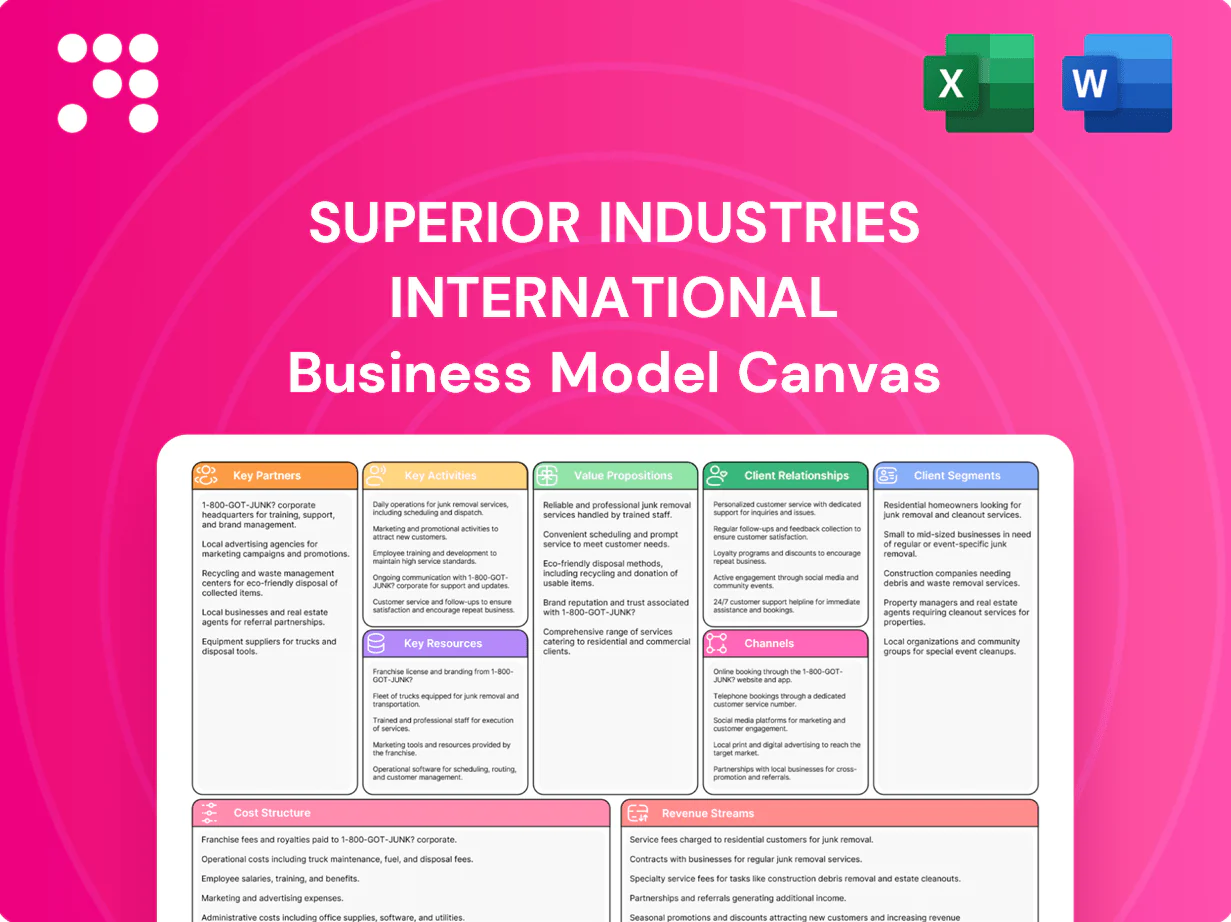
Superior Industries International Business Model Canvas

Business Model Canvas: Actionable Strategic Blueprint for Investors and Executives
Unlock the full strategic blueprint behind Superior Industries International with our Business Model Canvas — a concise, actionable map of value propositions, customer segments, and revenue drivers. Ideal for investors, consultants, and founders seeking competitive edge. Download the complete Word and Excel files to benchmark, adapt, and execute with confidence.
Partnerships

OEM co-development alliances
Deep co-development with global light-vehicle and commercial-truck OEMs drives design inputs, volumes and launch timing; industry OEM programs in 2024 commonly span 5–7 year lifecycles. Joint engineering ensures wheel fitment, NVH performance and cost targets, while long-term agreements stabilize demand and enable capacity planning. Early nomination secures tooling amortization and predictable program revenue.
Aluminum and alloy suppliers
Primary aluminum, billet and specialty-alloy partners ensure consistent metallurgical quality for Superior Industries, supporting tight tolerances and yield targets. Index-linked contracts are used to balance price volatility with supply security. Co-innovation on alloy chemistries raises strength-to-weight and corrosion resistance for lighter, durable parts. Sustainability partners supply recycled content—recycling aluminum saves up to 95% of the energy vs primary metal production.

Tooling, dies, and equipment makers
Partnerships with mold, die, forging press, and machining OEMs cut cycle times and improve yields, with lean tooling programs typically reducing takt time by ~20–30% and scrap rates measurably declining. Rapid tool iterations accelerate PPAP, shortening approval timelines by as much as 30% in 2024 program rollouts. Preventive maintenance with suppliers boosts uptime ~25–40% while joint CapEx planning aligns spend with program ramps and volume forecasts.

Testing labs and certification bodies
External fatigue, impact, and corrosion testing augment in-house validation and shorten time-to-market; accredited partners support IATF 16949, ISO 14001 and OEM-specific audits to ensure traceable results.
- Compliance services accelerate homologation across regions
- Data-sharing fortifies continuous improvement
- Third-party certification reduces audit burden on manufacturing
Logistics and just-in-time providers
Inbound metal and outbound wheels require tightly synchronized logistics to meet OEM takt times; 2024 supply-chain analyses show JIT and sequenced delivery partners can cut on-hand OEM inventory by up to 30% and materially reduce line-side stoppages. Cross-border specialists streamline NA–EU flows, lowering average border delay impact by around 40% in 2024, while packaging vendors protect finish quality and curb transit scrap.
- JIT/sequenced partners: inventory -30% (2024)
- Cross-border specialists: delay impact -40% (2024)
- Packaging vendors: reduced transit scrap, improved finish protection
OEM co-dev secures launch; JIT -30%, recycling 95%
Deep OEM co-development (5–7 year programs) secures launch timing, volumes and tooling amortization; JIT/sequenced logistics cut OEM on-hand inventory ~30% (2024) and cross-border specialists reduced border delay impact ~40% (2024). Alloy and recycling partners deliver up to 95% energy savings vs primary aluminum production and stabilize input cost via index-linked contracts. Tooling and maintenance partnerships raised uptime ~25–40% in 2024.
| Metric | Value (2024) |
|---|---|
| OEM program life | 5–7 years |
| Inventory reduction (JIT) | -30% |
| Border delay impact | -40% |
| Recycling energy savings | ~95% |
| Uptime improvement | 25–40% |
What is included in the product
 Detailed Word Document
A comprehensive, pre-written Business Model Canvas for Superior Industries International detailing customer segments, channels, value propositions, key activities and partners, cost/revenue structure, and competitive advantages to support investor presentations and strategic decision-making.

 Customizable Excel Spreadsheet
High-level, editable one-page Business Model Canvas for Superior Industries International that condenses strategy into a clean, shareable layout—saving hours of formatting while enabling quick comparison, team collaboration, and fast executive summaries.
Activities

Design and engineering
Concept-to-production wheel design balances aesthetics, weight, and structural integrity via iterative CAD and validation, targeting typical mass reductions of 10–15% versus legacy cast designs.
CAE, topology optimization and DFM/DFA shorten development cycles—industry benchmarks show cycle compression of ~30%—enabling faster iterations and cost control.
OEM co-design sessions align interfaces and brake/package constraints, while PPAP Level 3 documentation underpins launch readiness and supplier qualification.
Casting and forging operations
High-pressure and low-pressure casting plus closed-die forging deliver targeted performance and, in 2024, supported a global die-casting/forging supply chain estimated near $33 billion. Tight process control reduces porosity and ensures consistent grain structure, while heat treatment, precision machining and shot blasting refine tolerances and strength. Automation—robots and PLCs—has boosted throughput and repeatability, improving yield and cycle-time by double-digit percentages in modern plants.

Surface finishing and coatings
Painting, powder coating and specialized finishes improve durability and brand appeal while cutting lifecycle costs, with powder coatings delivering higher film build and corrosion resistance versus liquid paints. Clearcoats and anti-corrosion systems are formulated to meet OEM salt-spray requirements (ASTM B117 commonly specified at 240+ hours). Tight cosmetic standards lower rework and warranty claims, and continuous color-matching across plants maintains visual consistency for multi-site OEM programs.

Quality assurance and testing
Quality assurance uses in-process metrology, x-ray and leak checks to prevent defects escaping to assembly; fatigue, cornering and radial load tests validate designs under real-world stresses. SPC and traceability systems enable audit readiness and efficient recalls, while systematic root-cause analysis drives scrap reduction and continuous improvement.
- In-process metrology
- X-ray & leak checks
- Fatigue/cornering/radial tests
- SPC & traceability
- Root-cause scrap reduction
Supply chain and program management
SIOP aligns demand, capacity and inventory to meet OEM schedules, integrating forecasts with production to hit line-side sequencing and delivery windows. EDI-driven scheduling supports JIT and sequenced delivery, linking ASN and sequencing data directly to OEM TMS. Tooling, CapEx and launch gates follow APQP five-phase gates for launch control. Commodity hedging uses LME-linked contracts and index mechanisms to manage metal-price risk.
- APQP: 5 phases
- EDI: ASN + sequencing
- SIOP: demand-capacity-inventory alignment
- Hedging: LME/index-linked contracts
CAE wheels:10–15% mass,~30% dev,33B
Concept-to-production wheel design achieves ~10–15% mass reduction vs legacy cast wheels and uses CAE/topology to cut development time ~30% (2024 benchmarks).
Casting/forging, heat treat and machining support a global die-casting/forging market near $33B in 2024; automation lifts yield and throughput by double-digit percentages.
QA (x-ray, SPC), APQP/PPAP and SIOP/EDI ensure OEM launch readiness, with ASTM B117 salt-spray targets commonly 240+ hours.
| Metric | 2024 Value |
|---|---|
| Market | $33B |
| Mass reduction | 10–15% |
| Dev time cut | ~30% |
Full Document Unlocks After Purchase
Business Model Canvas
The preview you see is the exact Superior Industries International Business Model Canvas—not a mockup—and it reflects the final deliverable you’ll receive after purchase. Upon completing your order you’ll get this same professional, ready-to-edit document in Word and Excel formats. The full content and formatting are included as shown, with no hidden pages or surprises.

Business Model Canvas: Actionable Strategic Blueprint for Investors and Executives
Unlock the full strategic blueprint behind Superior Industries International with our Business Model Canvas — a concise, actionable map of value propositions, customer segments, and revenue drivers. Ideal for investors, consultants, and founders seeking competitive edge. Download the complete Word and Excel files to benchmark, adapt, and execute with confidence.
Partnerships
OEM co-development alliances
Deep co-development with global light-vehicle and commercial-truck OEMs drives design inputs, volumes and launch timing; industry OEM programs in 2024 commonly span 5–7 year lifecycles. Joint engineering ensures wheel fitment, NVH performance and cost targets, while long-term agreements stabilize demand and enable capacity planning. Early nomination secures tooling amortization and predictable program revenue.
Aluminum and alloy suppliers
Primary aluminum, billet and specialty-alloy partners ensure consistent metallurgical quality for Superior Industries, supporting tight tolerances and yield targets. Index-linked contracts are used to balance price volatility with supply security. Co-innovation on alloy chemistries raises strength-to-weight and corrosion resistance for lighter, durable parts. Sustainability partners supply recycled content—recycling aluminum saves up to 95% of the energy vs primary metal production.
Tooling, dies, and equipment makers
Partnerships with mold, die, forging press, and machining OEMs cut cycle times and improve yields, with lean tooling programs typically reducing takt time by ~20–30% and scrap rates measurably declining. Rapid tool iterations accelerate PPAP, shortening approval timelines by as much as 30% in 2024 program rollouts. Preventive maintenance with suppliers boosts uptime ~25–40% while joint CapEx planning aligns spend with program ramps and volume forecasts.
Testing labs and certification bodies
External fatigue, impact, and corrosion testing augment in-house validation and shorten time-to-market; accredited partners support IATF 16949, ISO 14001 and OEM-specific audits to ensure traceable results.
- Compliance services accelerate homologation across regions
- Data-sharing fortifies continuous improvement
- Third-party certification reduces audit burden on manufacturing
Logistics and just-in-time providers
Inbound metal and outbound wheels require tightly synchronized logistics to meet OEM takt times; 2024 supply-chain analyses show JIT and sequenced delivery partners can cut on-hand OEM inventory by up to 30% and materially reduce line-side stoppages. Cross-border specialists streamline NA–EU flows, lowering average border delay impact by around 40% in 2024, while packaging vendors protect finish quality and curb transit scrap.
- JIT/sequenced partners: inventory -30% (2024)
- Cross-border specialists: delay impact -40% (2024)
- Packaging vendors: reduced transit scrap, improved finish protection
OEM co-dev secures launch; JIT -30%, recycling 95%
Deep OEM co-development (5–7 year programs) secures launch timing, volumes and tooling amortization; JIT/sequenced logistics cut OEM on-hand inventory ~30% (2024) and cross-border specialists reduced border delay impact ~40% (2024). Alloy and recycling partners deliver up to 95% energy savings vs primary aluminum production and stabilize input cost via index-linked contracts. Tooling and maintenance partnerships raised uptime ~25–40% in 2024.
| Metric | Value (2024) |
|---|---|
| OEM program life | 5–7 years |
| Inventory reduction (JIT) | -30% |
| Border delay impact | -40% |
| Recycling energy savings | ~95% |
| Uptime improvement | 25–40% |
What is included in the product
Detailed Word Document
A comprehensive, pre-written Business Model Canvas for Superior Industries International detailing customer segments, channels, value propositions, key activities and partners, cost/revenue structure, and competitive advantages to support investor presentations and strategic decision-making.
Customizable Excel Spreadsheet
High-level, editable one-page Business Model Canvas for Superior Industries International that condenses strategy into a clean, shareable layout—saving hours of formatting while enabling quick comparison, team collaboration, and fast executive summaries.
Activities
Design and engineering
Concept-to-production wheel design balances aesthetics, weight, and structural integrity via iterative CAD and validation, targeting typical mass reductions of 10–15% versus legacy cast designs.
CAE, topology optimization and DFM/DFA shorten development cycles—industry benchmarks show cycle compression of ~30%—enabling faster iterations and cost control.
OEM co-design sessions align interfaces and brake/package constraints, while PPAP Level 3 documentation underpins launch readiness and supplier qualification.
Casting and forging operations
High-pressure and low-pressure casting plus closed-die forging deliver targeted performance and, in 2024, supported a global die-casting/forging supply chain estimated near $33 billion. Tight process control reduces porosity and ensures consistent grain structure, while heat treatment, precision machining and shot blasting refine tolerances and strength. Automation—robots and PLCs—has boosted throughput and repeatability, improving yield and cycle-time by double-digit percentages in modern plants.
Surface finishing and coatings
Painting, powder coating and specialized finishes improve durability and brand appeal while cutting lifecycle costs, with powder coatings delivering higher film build and corrosion resistance versus liquid paints. Clearcoats and anti-corrosion systems are formulated to meet OEM salt-spray requirements (ASTM B117 commonly specified at 240+ hours). Tight cosmetic standards lower rework and warranty claims, and continuous color-matching across plants maintains visual consistency for multi-site OEM programs.
Quality assurance and testing
Quality assurance uses in-process metrology, x-ray and leak checks to prevent defects escaping to assembly; fatigue, cornering and radial load tests validate designs under real-world stresses. SPC and traceability systems enable audit readiness and efficient recalls, while systematic root-cause analysis drives scrap reduction and continuous improvement.
- In-process metrology
- X-ray & leak checks
- Fatigue/cornering/radial tests
- SPC & traceability
- Root-cause scrap reduction
Supply chain and program management
SIOP aligns demand, capacity and inventory to meet OEM schedules, integrating forecasts with production to hit line-side sequencing and delivery windows. EDI-driven scheduling supports JIT and sequenced delivery, linking ASN and sequencing data directly to OEM TMS. Tooling, CapEx and launch gates follow APQP five-phase gates for launch control. Commodity hedging uses LME-linked contracts and index mechanisms to manage metal-price risk.
- APQP: 5 phases
- EDI: ASN + sequencing
- SIOP: demand-capacity-inventory alignment
- Hedging: LME/index-linked contracts
CAE wheels:10–15% mass,~30% dev,33B
Concept-to-production wheel design achieves ~10–15% mass reduction vs legacy cast wheels and uses CAE/topology to cut development time ~30% (2024 benchmarks).
Casting/forging, heat treat and machining support a global die-casting/forging market near $33B in 2024; automation lifts yield and throughput by double-digit percentages.
QA (x-ray, SPC), APQP/PPAP and SIOP/EDI ensure OEM launch readiness, with ASTM B117 salt-spray targets commonly 240+ hours.
| Metric | 2024 Value |
|---|---|
| Market | $33B |
| Mass reduction | 10–15% |
| Dev time cut | ~30% |
Full Document Unlocks After Purchase
Business Model Canvas
The preview you see is the exact Superior Industries International Business Model Canvas—not a mockup—and it reflects the final deliverable you’ll receive after purchase. Upon completing your order you’ll get this same professional, ready-to-edit document in Word and Excel formats. The full content and formatting are included as shown, with no hidden pages or surprises.
Description
Business Model Canvas: Actionable Strategic Blueprint for Investors and Executives
Unlock the full strategic blueprint behind Superior Industries International with our Business Model Canvas — a concise, actionable map of value propositions, customer segments, and revenue drivers. Ideal for investors, consultants, and founders seeking competitive edge. Download the complete Word and Excel files to benchmark, adapt, and execute with confidence.
Partnerships
OEM co-development alliances
Deep co-development with global light-vehicle and commercial-truck OEMs drives design inputs, volumes and launch timing; industry OEM programs in 2024 commonly span 5–7 year lifecycles. Joint engineering ensures wheel fitment, NVH performance and cost targets, while long-term agreements stabilize demand and enable capacity planning. Early nomination secures tooling amortization and predictable program revenue.
Aluminum and alloy suppliers
Primary aluminum, billet and specialty-alloy partners ensure consistent metallurgical quality for Superior Industries, supporting tight tolerances and yield targets. Index-linked contracts are used to balance price volatility with supply security. Co-innovation on alloy chemistries raises strength-to-weight and corrosion resistance for lighter, durable parts. Sustainability partners supply recycled content—recycling aluminum saves up to 95% of the energy vs primary metal production.
Tooling, dies, and equipment makers
Partnerships with mold, die, forging press, and machining OEMs cut cycle times and improve yields, with lean tooling programs typically reducing takt time by ~20–30% and scrap rates measurably declining. Rapid tool iterations accelerate PPAP, shortening approval timelines by as much as 30% in 2024 program rollouts. Preventive maintenance with suppliers boosts uptime ~25–40% while joint CapEx planning aligns spend with program ramps and volume forecasts.
Testing labs and certification bodies
External fatigue, impact, and corrosion testing augment in-house validation and shorten time-to-market; accredited partners support IATF 16949, ISO 14001 and OEM-specific audits to ensure traceable results.
- Compliance services accelerate homologation across regions
- Data-sharing fortifies continuous improvement
- Third-party certification reduces audit burden on manufacturing
Logistics and just-in-time providers
Inbound metal and outbound wheels require tightly synchronized logistics to meet OEM takt times; 2024 supply-chain analyses show JIT and sequenced delivery partners can cut on-hand OEM inventory by up to 30% and materially reduce line-side stoppages. Cross-border specialists streamline NA–EU flows, lowering average border delay impact by around 40% in 2024, while packaging vendors protect finish quality and curb transit scrap.
- JIT/sequenced partners: inventory -30% (2024)
- Cross-border specialists: delay impact -40% (2024)
- Packaging vendors: reduced transit scrap, improved finish protection
OEM co-dev secures launch; JIT -30%, recycling 95%
Deep OEM co-development (5–7 year programs) secures launch timing, volumes and tooling amortization; JIT/sequenced logistics cut OEM on-hand inventory ~30% (2024) and cross-border specialists reduced border delay impact ~40% (2024). Alloy and recycling partners deliver up to 95% energy savings vs primary aluminum production and stabilize input cost via index-linked contracts. Tooling and maintenance partnerships raised uptime ~25–40% in 2024.
| Metric | Value (2024) |
|---|---|
| OEM program life | 5–7 years |
| Inventory reduction (JIT) | -30% |
| Border delay impact | -40% |
| Recycling energy savings | ~95% |
| Uptime improvement | 25–40% |
What is included in the product
Detailed Word Document
A comprehensive, pre-written Business Model Canvas for Superior Industries International detailing customer segments, channels, value propositions, key activities and partners, cost/revenue structure, and competitive advantages to support investor presentations and strategic decision-making.
Customizable Excel Spreadsheet
High-level, editable one-page Business Model Canvas for Superior Industries International that condenses strategy into a clean, shareable layout—saving hours of formatting while enabling quick comparison, team collaboration, and fast executive summaries.
Activities
Design and engineering
Concept-to-production wheel design balances aesthetics, weight, and structural integrity via iterative CAD and validation, targeting typical mass reductions of 10–15% versus legacy cast designs.
CAE, topology optimization and DFM/DFA shorten development cycles—industry benchmarks show cycle compression of ~30%—enabling faster iterations and cost control.
OEM co-design sessions align interfaces and brake/package constraints, while PPAP Level 3 documentation underpins launch readiness and supplier qualification.
Casting and forging operations
High-pressure and low-pressure casting plus closed-die forging deliver targeted performance and, in 2024, supported a global die-casting/forging supply chain estimated near $33 billion. Tight process control reduces porosity and ensures consistent grain structure, while heat treatment, precision machining and shot blasting refine tolerances and strength. Automation—robots and PLCs—has boosted throughput and repeatability, improving yield and cycle-time by double-digit percentages in modern plants.
Surface finishing and coatings
Painting, powder coating and specialized finishes improve durability and brand appeal while cutting lifecycle costs, with powder coatings delivering higher film build and corrosion resistance versus liquid paints. Clearcoats and anti-corrosion systems are formulated to meet OEM salt-spray requirements (ASTM B117 commonly specified at 240+ hours). Tight cosmetic standards lower rework and warranty claims, and continuous color-matching across plants maintains visual consistency for multi-site OEM programs.
Quality assurance and testing
Quality assurance uses in-process metrology, x-ray and leak checks to prevent defects escaping to assembly; fatigue, cornering and radial load tests validate designs under real-world stresses. SPC and traceability systems enable audit readiness and efficient recalls, while systematic root-cause analysis drives scrap reduction and continuous improvement.
- In-process metrology
- X-ray & leak checks
- Fatigue/cornering/radial tests
- SPC & traceability
- Root-cause scrap reduction
Supply chain and program management
SIOP aligns demand, capacity and inventory to meet OEM schedules, integrating forecasts with production to hit line-side sequencing and delivery windows. EDI-driven scheduling supports JIT and sequenced delivery, linking ASN and sequencing data directly to OEM TMS. Tooling, CapEx and launch gates follow APQP five-phase gates for launch control. Commodity hedging uses LME-linked contracts and index mechanisms to manage metal-price risk.
- APQP: 5 phases
- EDI: ASN + sequencing
- SIOP: demand-capacity-inventory alignment
- Hedging: LME/index-linked contracts
CAE wheels:10–15% mass,~30% dev,33B
Concept-to-production wheel design achieves ~10–15% mass reduction vs legacy cast wheels and uses CAE/topology to cut development time ~30% (2024 benchmarks).
Casting/forging, heat treat and machining support a global die-casting/forging market near $33B in 2024; automation lifts yield and throughput by double-digit percentages.
QA (x-ray, SPC), APQP/PPAP and SIOP/EDI ensure OEM launch readiness, with ASTM B117 salt-spray targets commonly 240+ hours.
| Metric | 2024 Value |
|---|---|
| Market | $33B |
| Mass reduction | 10–15% |
| Dev time cut | ~30% |
Full Document Unlocks After Purchase
Business Model Canvas
The preview you see is the exact Superior Industries International Business Model Canvas—not a mockup—and it reflects the final deliverable you’ll receive after purchase. Upon completing your order you’ll get this same professional, ready-to-edit document in Word and Excel formats. The full content and formatting are included as shown, with no hidden pages or surprises.











