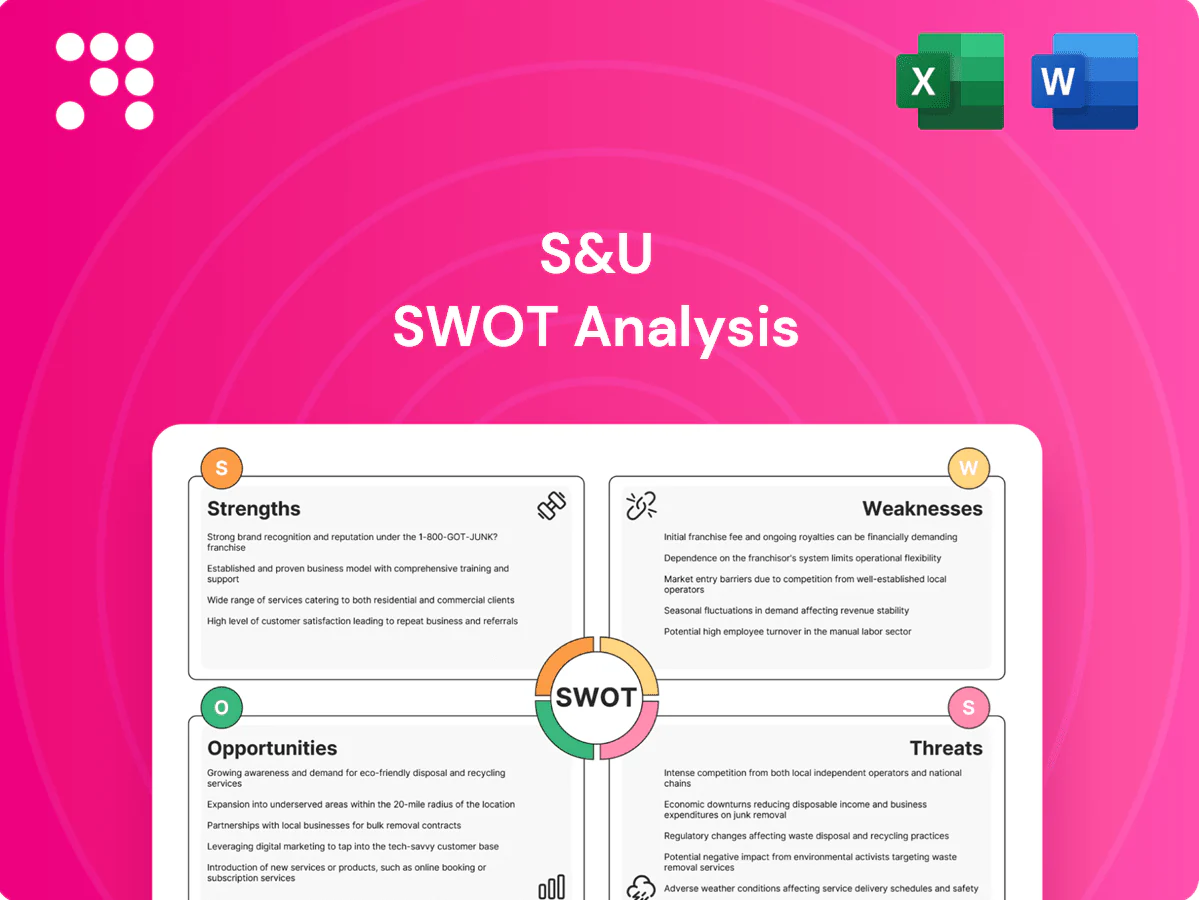
S&U SWOT Analysis

Make Insightful Decisions Backed by Expert Research
Unlock the full S&U SWOT analysis to reveal the lender’s competitive strengths, credit risks, and growth levers—complete with research-backed insights, expert commentary and editable Word + Excel deliverables. Purchase the full report to inform investment decisions, strategic planning, or client pitches with confidence.
Strengths

Diversified motor and bridging portfolio
Operating both non-prime used-car HP and property bridging smooths earnings across cycles; S&U’s dual focus reduced reliance on any single market in 2024. Each book exhibits distinct risk/return dynamics, lowering single-segment exposure, while cross-division insights have tightened pricing and underwriting. Diversification supports flexible capital deployment and portfolio rebalancing through 2024–25.
Specialist underwriting and risk controls
With 30+ years in non-prime auto and short-term property lending, S&U’s specialist underwriting drives disciplined credit selection. Data-driven scorecards and a collateral-first approach constrain losses and improve cure rates. Tight, process-led collections boost recoveries and lower net write-offs. Consistent execution has sustained attractive risk-adjusted yields for investors.

Established UK distribution relationships
Deep ties with c.1,200 UK used-car dealers and brokers drive steady origination flow, supporting S&U’s motor finance loan book of around £1.2bn and consistent new business volumes. Strong brand recognition in niche segments sustains referral momentum and repeat business, while partner networks lower acquisition costs and CAO per originator, preserving margins. Broad relationships help maintain pricing power across cycles.

Attractive yields and short asset duration
S&U’s specialist books typically deliver gross yields markedly above mainstream lenders, roughly 20–25% on instalment portfolios in recent reporting periods, while average asset lives are short—around 12–24 months—allowing rapid repricing as Bank Rate moved above 5% in 2024. Fast capital turn amplifies ROCE (reported mid-20s % range in strong years) when arrears and losses are contained, and the short duration profile supports liquidity management via quicker asset-to-cash conversion.
- Gross yield: c.20–25%
- Average life: c.12–24 months
- ROCE: mid-20s% in strong years
- Bank Rate (2024): >5%, aids repricing
Prudent capital and conservative culture
Prudent capital and a conservative culture have driven historically cautious growth and provisioning, tempering downside risk and supporting consistent credit performance. The firm maintains a balanced mix of own capital and diversified funding channels that underpins resilience through cycles. Governance is tightly aligned to niche risk appetites, and a long track record fosters stakeholder confidence.
- Conservative provisioning
- Balanced capital-funding mix
- Governance aligned to niche risk
- Proven stakeholder trust
Dual non-prime motor + short-term property, 1.2k dealers, mid-20s% ROCE
S&U’s dual non‑prime motor and short‑term property books smooth earnings and reduce single‑market exposure; c.1,200 dealer relationships sustain origination and lower acquisition costs. Specialist underwriting, conservative provisioning and balanced funding support low net write‑offs and mid‑20s% ROCE in strong years. Short asset lives (c.12–24m) and gross yields c.20–25% enable rapid repricing as Bank Rate exceeded 5% in 2024.
| Metric | Value |
|---|---|
| Motor loan book | c.£1.2bn |
| Dealer partners | c.1,200 |
| Gross yield | c.20–25% |
| Avg asset life | c.12–24 months |
| ROCE (strong yrs) | mid‑20s% |
What is included in the product
 Detailed Word Document
Provides a concise SWOT analysis of S&U, outlining its core strengths, operational weaknesses, market opportunities and external threats to clarify strategic priorities and risks.

 Customizable Excel Spreadsheet
Provides a concise S&U SWOT matrix to quickly pinpoint customer credit and operational pain points for faster remediation. Editable, high-level format lets teams align strategy and communicate fixes to stakeholders efficiently.
Weaknesses

Concentration in UK economy
S&U’s operations are effectively concentrated in the UK, leaving performance tied to UK macro and policy shifts and a domestic consumer base of around 67 million people. Regional slowdowns can hit both car finance and property divisions simultaneously, amplifying credit and asset-price risks. Limited geographic hedging increases earnings volatility and caps growth potential to the size and cycles of the UK market.
Exposure to non-prime credit
Customer base has higher default probability, especially in downturns: UK unemployment ~4.1% (2024) and household unsecured credit near £250bn amplify risk. Loss rates can swing quickly with employment and inflation — CPI averaged ~3.9% in 2024. Higher collections intensity raises operating costs, and elevated provisions to cover credit losses can materially pressure S&U earnings.

Interest rate and funding sensitivity
Reliance on external facilities exposes S&U to margin compression as funding costs rose with Bank Rate at 5.25% in mid‑2024, increasing wholesale borrowing costs across the sector. Bridging profitability hinges on tight spread management—small spread erosion can turn double‑digit gross yields into low single‑digit net returns. Repricing lags and covenant limits in tighter markets can erode NIM and constrain growth.

Smaller scale versus banks and fintechs
Smaller scale versus banks and fintechs raises unit costs and makes large tech investments harder; major UK banks hold >£1tn in assets (Barclays £1.05tn 2023), giving them funding cost advantages that squeeze pricing power and margins. Narrower marketing reach and limited operational leverage slow growth versus larger rivals.
- Higher unit costs
- Weaker pricing power
- Smaller marketing reach
- Harder operational leverage
Regulatory complexity and oversight
FCA Consumer Duty (effective 31 July 2023), stricter affordability tests and heightened FCA oversight have materially increased S&U’s compliance burden; manual underwriting and legacy processes raise the risk of conduct breaches while diluting operational efficiency. Bridging lending faces evolving valuation and AML expectations, eroding spreads as compliance costs compress margins.
- Consumer Duty: effective 31 July 2023
- Affordability tests: increased documentation & review
- Manual processes: higher conduct breach risk
- Bridging loans: rising valuation/AML scrutiny
- Impact: compliance costs dilute margins
UK specialist consumer lenders: 5.25% Bank Rate squeezes margins, default risk rises
S&U is UK‑centric, tying earnings to a 67m market and 4.1% unemployment (2024), increasing cyclicality. Funding relies on external facilities amid Bank Rate 5.25% (mid‑2024), compressing margins. Higher default risk with UK unsecured credit ~£250bn (2024) forces elevated provisions; smaller scale vs banks (Barclays £1.05tn assets 2023) limits pricing power.
| Metric | Value |
|---|---|
| UK population | 67m |
| Unemployment | 4.1% (2024) |
| Bank Rate | 5.25% (mid‑2024) |
| Household unsecured credit | £250bn (2024) |
| Top bank assets | Barclays £1.05tn (2023) |
Same Document Delivered
S&U SWOT Analysis
This is the actual SWOT analysis document you’ll receive upon purchase—no surprises, just professional quality. The preview below is taken directly from the full SWOT report you'll get; purchase unlocks the complete, editable version. You’re viewing a live preview of the real file, structured and ready to use immediately after checkout.

Make Insightful Decisions Backed by Expert Research
Unlock the full S&U SWOT analysis to reveal the lender’s competitive strengths, credit risks, and growth levers—complete with research-backed insights, expert commentary and editable Word + Excel deliverables. Purchase the full report to inform investment decisions, strategic planning, or client pitches with confidence.
Strengths
Diversified motor and bridging portfolio
Operating both non-prime used-car HP and property bridging smooths earnings across cycles; S&U’s dual focus reduced reliance on any single market in 2024. Each book exhibits distinct risk/return dynamics, lowering single-segment exposure, while cross-division insights have tightened pricing and underwriting. Diversification supports flexible capital deployment and portfolio rebalancing through 2024–25.
Specialist underwriting and risk controls
With 30+ years in non-prime auto and short-term property lending, S&U’s specialist underwriting drives disciplined credit selection. Data-driven scorecards and a collateral-first approach constrain losses and improve cure rates. Tight, process-led collections boost recoveries and lower net write-offs. Consistent execution has sustained attractive risk-adjusted yields for investors.
Established UK distribution relationships
Deep ties with c.1,200 UK used-car dealers and brokers drive steady origination flow, supporting S&U’s motor finance loan book of around £1.2bn and consistent new business volumes. Strong brand recognition in niche segments sustains referral momentum and repeat business, while partner networks lower acquisition costs and CAO per originator, preserving margins. Broad relationships help maintain pricing power across cycles.
Attractive yields and short asset duration
S&U’s specialist books typically deliver gross yields markedly above mainstream lenders, roughly 20–25% on instalment portfolios in recent reporting periods, while average asset lives are short—around 12–24 months—allowing rapid repricing as Bank Rate moved above 5% in 2024. Fast capital turn amplifies ROCE (reported mid-20s % range in strong years) when arrears and losses are contained, and the short duration profile supports liquidity management via quicker asset-to-cash conversion.
- Gross yield: c.20–25%
- Average life: c.12–24 months
- ROCE: mid-20s% in strong years
- Bank Rate (2024): >5%, aids repricing
Prudent capital and conservative culture
Prudent capital and a conservative culture have driven historically cautious growth and provisioning, tempering downside risk and supporting consistent credit performance. The firm maintains a balanced mix of own capital and diversified funding channels that underpins resilience through cycles. Governance is tightly aligned to niche risk appetites, and a long track record fosters stakeholder confidence.
- Conservative provisioning
- Balanced capital-funding mix
- Governance aligned to niche risk
- Proven stakeholder trust
Dual non-prime motor + short-term property, 1.2k dealers, mid-20s% ROCE
S&U’s dual non‑prime motor and short‑term property books smooth earnings and reduce single‑market exposure; c.1,200 dealer relationships sustain origination and lower acquisition costs. Specialist underwriting, conservative provisioning and balanced funding support low net write‑offs and mid‑20s% ROCE in strong years. Short asset lives (c.12–24m) and gross yields c.20–25% enable rapid repricing as Bank Rate exceeded 5% in 2024.
| Metric | Value |
|---|---|
| Motor loan book | c.£1.2bn |
| Dealer partners | c.1,200 |
| Gross yield | c.20–25% |
| Avg asset life | c.12–24 months |
| ROCE (strong yrs) | mid‑20s% |
What is included in the product
Detailed Word Document
Provides a concise SWOT analysis of S&U, outlining its core strengths, operational weaknesses, market opportunities and external threats to clarify strategic priorities and risks.
Customizable Excel Spreadsheet
Provides a concise S&U SWOT matrix to quickly pinpoint customer credit and operational pain points for faster remediation. Editable, high-level format lets teams align strategy and communicate fixes to stakeholders efficiently.
Weaknesses
Concentration in UK economy
S&U’s operations are effectively concentrated in the UK, leaving performance tied to UK macro and policy shifts and a domestic consumer base of around 67 million people. Regional slowdowns can hit both car finance and property divisions simultaneously, amplifying credit and asset-price risks. Limited geographic hedging increases earnings volatility and caps growth potential to the size and cycles of the UK market.
Exposure to non-prime credit
Customer base has higher default probability, especially in downturns: UK unemployment ~4.1% (2024) and household unsecured credit near £250bn amplify risk. Loss rates can swing quickly with employment and inflation — CPI averaged ~3.9% in 2024. Higher collections intensity raises operating costs, and elevated provisions to cover credit losses can materially pressure S&U earnings.
Interest rate and funding sensitivity
Reliance on external facilities exposes S&U to margin compression as funding costs rose with Bank Rate at 5.25% in mid‑2024, increasing wholesale borrowing costs across the sector. Bridging profitability hinges on tight spread management—small spread erosion can turn double‑digit gross yields into low single‑digit net returns. Repricing lags and covenant limits in tighter markets can erode NIM and constrain growth.
Smaller scale versus banks and fintechs
Smaller scale versus banks and fintechs raises unit costs and makes large tech investments harder; major UK banks hold >£1tn in assets (Barclays £1.05tn 2023), giving them funding cost advantages that squeeze pricing power and margins. Narrower marketing reach and limited operational leverage slow growth versus larger rivals.
- Higher unit costs
- Weaker pricing power
- Smaller marketing reach
- Harder operational leverage
Regulatory complexity and oversight
FCA Consumer Duty (effective 31 July 2023), stricter affordability tests and heightened FCA oversight have materially increased S&U’s compliance burden; manual underwriting and legacy processes raise the risk of conduct breaches while diluting operational efficiency. Bridging lending faces evolving valuation and AML expectations, eroding spreads as compliance costs compress margins.
- Consumer Duty: effective 31 July 2023
- Affordability tests: increased documentation & review
- Manual processes: higher conduct breach risk
- Bridging loans: rising valuation/AML scrutiny
- Impact: compliance costs dilute margins
UK specialist consumer lenders: 5.25% Bank Rate squeezes margins, default risk rises
S&U is UK‑centric, tying earnings to a 67m market and 4.1% unemployment (2024), increasing cyclicality. Funding relies on external facilities amid Bank Rate 5.25% (mid‑2024), compressing margins. Higher default risk with UK unsecured credit ~£250bn (2024) forces elevated provisions; smaller scale vs banks (Barclays £1.05tn assets 2023) limits pricing power.
| Metric | Value |
|---|---|
| UK population | 67m |
| Unemployment | 4.1% (2024) |
| Bank Rate | 5.25% (mid‑2024) |
| Household unsecured credit | £250bn (2024) |
| Top bank assets | Barclays £1.05tn (2023) |
Same Document Delivered
S&U SWOT Analysis
This is the actual SWOT analysis document you’ll receive upon purchase—no surprises, just professional quality. The preview below is taken directly from the full SWOT report you'll get; purchase unlocks the complete, editable version. You’re viewing a live preview of the real file, structured and ready to use immediately after checkout.
Original: $10.00
-65%$10.00
$3.50Description
Make Insightful Decisions Backed by Expert Research
Unlock the full S&U SWOT analysis to reveal the lender’s competitive strengths, credit risks, and growth levers—complete with research-backed insights, expert commentary and editable Word + Excel deliverables. Purchase the full report to inform investment decisions, strategic planning, or client pitches with confidence.
Strengths
Diversified motor and bridging portfolio
Operating both non-prime used-car HP and property bridging smooths earnings across cycles; S&U’s dual focus reduced reliance on any single market in 2024. Each book exhibits distinct risk/return dynamics, lowering single-segment exposure, while cross-division insights have tightened pricing and underwriting. Diversification supports flexible capital deployment and portfolio rebalancing through 2024–25.
Specialist underwriting and risk controls
With 30+ years in non-prime auto and short-term property lending, S&U’s specialist underwriting drives disciplined credit selection. Data-driven scorecards and a collateral-first approach constrain losses and improve cure rates. Tight, process-led collections boost recoveries and lower net write-offs. Consistent execution has sustained attractive risk-adjusted yields for investors.
Established UK distribution relationships
Deep ties with c.1,200 UK used-car dealers and brokers drive steady origination flow, supporting S&U’s motor finance loan book of around £1.2bn and consistent new business volumes. Strong brand recognition in niche segments sustains referral momentum and repeat business, while partner networks lower acquisition costs and CAO per originator, preserving margins. Broad relationships help maintain pricing power across cycles.
Attractive yields and short asset duration
S&U’s specialist books typically deliver gross yields markedly above mainstream lenders, roughly 20–25% on instalment portfolios in recent reporting periods, while average asset lives are short—around 12–24 months—allowing rapid repricing as Bank Rate moved above 5% in 2024. Fast capital turn amplifies ROCE (reported mid-20s % range in strong years) when arrears and losses are contained, and the short duration profile supports liquidity management via quicker asset-to-cash conversion.
- Gross yield: c.20–25%
- Average life: c.12–24 months
- ROCE: mid-20s% in strong years
- Bank Rate (2024): >5%, aids repricing
Prudent capital and conservative culture
Prudent capital and a conservative culture have driven historically cautious growth and provisioning, tempering downside risk and supporting consistent credit performance. The firm maintains a balanced mix of own capital and diversified funding channels that underpins resilience through cycles. Governance is tightly aligned to niche risk appetites, and a long track record fosters stakeholder confidence.
- Conservative provisioning
- Balanced capital-funding mix
- Governance aligned to niche risk
- Proven stakeholder trust
Dual non-prime motor + short-term property, 1.2k dealers, mid-20s% ROCE
S&U’s dual non‑prime motor and short‑term property books smooth earnings and reduce single‑market exposure; c.1,200 dealer relationships sustain origination and lower acquisition costs. Specialist underwriting, conservative provisioning and balanced funding support low net write‑offs and mid‑20s% ROCE in strong years. Short asset lives (c.12–24m) and gross yields c.20–25% enable rapid repricing as Bank Rate exceeded 5% in 2024.
| Metric | Value |
|---|---|
| Motor loan book | c.£1.2bn |
| Dealer partners | c.1,200 |
| Gross yield | c.20–25% |
| Avg asset life | c.12–24 months |
| ROCE (strong yrs) | mid‑20s% |
What is included in the product
Detailed Word Document
Provides a concise SWOT analysis of S&U, outlining its core strengths, operational weaknesses, market opportunities and external threats to clarify strategic priorities and risks.
Customizable Excel Spreadsheet
Provides a concise S&U SWOT matrix to quickly pinpoint customer credit and operational pain points for faster remediation. Editable, high-level format lets teams align strategy and communicate fixes to stakeholders efficiently.
Weaknesses
Concentration in UK economy
S&U’s operations are effectively concentrated in the UK, leaving performance tied to UK macro and policy shifts and a domestic consumer base of around 67 million people. Regional slowdowns can hit both car finance and property divisions simultaneously, amplifying credit and asset-price risks. Limited geographic hedging increases earnings volatility and caps growth potential to the size and cycles of the UK market.
Exposure to non-prime credit
Customer base has higher default probability, especially in downturns: UK unemployment ~4.1% (2024) and household unsecured credit near £250bn amplify risk. Loss rates can swing quickly with employment and inflation — CPI averaged ~3.9% in 2024. Higher collections intensity raises operating costs, and elevated provisions to cover credit losses can materially pressure S&U earnings.
Interest rate and funding sensitivity
Reliance on external facilities exposes S&U to margin compression as funding costs rose with Bank Rate at 5.25% in mid‑2024, increasing wholesale borrowing costs across the sector. Bridging profitability hinges on tight spread management—small spread erosion can turn double‑digit gross yields into low single‑digit net returns. Repricing lags and covenant limits in tighter markets can erode NIM and constrain growth.
Smaller scale versus banks and fintechs
Smaller scale versus banks and fintechs raises unit costs and makes large tech investments harder; major UK banks hold >£1tn in assets (Barclays £1.05tn 2023), giving them funding cost advantages that squeeze pricing power and margins. Narrower marketing reach and limited operational leverage slow growth versus larger rivals.
- Higher unit costs
- Weaker pricing power
- Smaller marketing reach
- Harder operational leverage
Regulatory complexity and oversight
FCA Consumer Duty (effective 31 July 2023), stricter affordability tests and heightened FCA oversight have materially increased S&U’s compliance burden; manual underwriting and legacy processes raise the risk of conduct breaches while diluting operational efficiency. Bridging lending faces evolving valuation and AML expectations, eroding spreads as compliance costs compress margins.
- Consumer Duty: effective 31 July 2023
- Affordability tests: increased documentation & review
- Manual processes: higher conduct breach risk
- Bridging loans: rising valuation/AML scrutiny
- Impact: compliance costs dilute margins
UK specialist consumer lenders: 5.25% Bank Rate squeezes margins, default risk rises
S&U is UK‑centric, tying earnings to a 67m market and 4.1% unemployment (2024), increasing cyclicality. Funding relies on external facilities amid Bank Rate 5.25% (mid‑2024), compressing margins. Higher default risk with UK unsecured credit ~£250bn (2024) forces elevated provisions; smaller scale vs banks (Barclays £1.05tn assets 2023) limits pricing power.
| Metric | Value |
|---|---|
| UK population | 67m |
| Unemployment | 4.1% (2024) |
| Bank Rate | 5.25% (mid‑2024) |
| Household unsecured credit | £250bn (2024) |
| Top bank assets | Barclays £1.05tn (2023) |
Same Document Delivered
S&U SWOT Analysis
This is the actual SWOT analysis document you’ll receive upon purchase—no surprises, just professional quality. The preview below is taken directly from the full SWOT report you'll get; purchase unlocks the complete, editable version. You’re viewing a live preview of the real file, structured and ready to use immediately after checkout.











