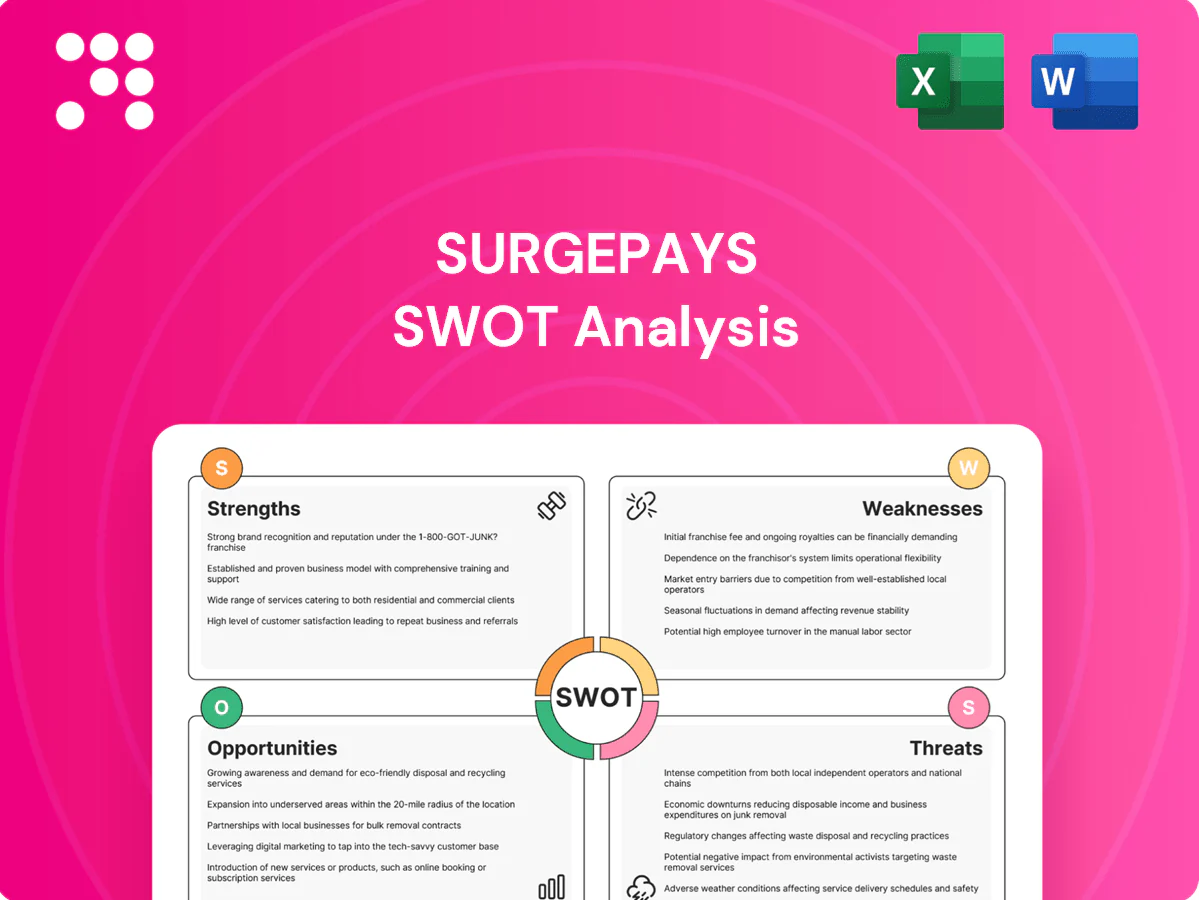
SurgePays SWOT Analysis

Your Strategic Toolkit Starts Here
SurgePays SWOT highlights strong embedded payroll tech, scalable partner channels, and growing SMB adoption, balanced against regulatory complexity and competitive fintech pressure. Our full SWOT unpacks risks, monetization levers, and growth scenarios. Purchase the complete report for editable Word and Excel deliverables to plan, pitch, and invest with confidence.
Strengths

Deep underbanked focus
SurgePays targets the sizable underbanked segment—globally 1.4 billion adults remain unbanked (World Bank Findex 2021), and 13.7% of U.S. households were underbanked (FDIC 2021)—allowing focused market knowledge and tailored products. This specialization drives strong retailer adoption by meeting clear cash-flow and payment needs. The niche supports pricing power and higher customer loyalty through bespoke services and reduced churn.
Extensive retail network
SurgePays leverages convenience stores and small retailers as its primary distribution channel, delivering local presence and high-frequency touchpoints that boost transaction velocity. Retail partners realize incremental foot traffic and revenue from payments and ancillary services, increasing stickiness. As coverage expands, network effects lower customer acquisition costs and improve unit economics across the footprint.

Versatile transaction platform
SurgePays supports three core services: mobile top-ups, bill pay, and prepaid services, enabling cross-sell at checkout. Multi-service rails increase basket size per visit and reduce churn by concentrating transactions. Unified technology lowers integration costs for new offerings, and scalability enables rapid rollout across geographies and partners.

Point-of-sale ad and data
SurgePays monetizes point-of-sale through targeted advertising and analytics, enabling brands to achieve closed-loop attribution at the moment of purchase and directly measure ROI. Retailers use SurgePays data to refine targeting and optimize product mix, increasing basket size and margin. This model creates recurring ad and insights revenue streams beyond transaction fees.
- POS ad monetization
- Closed-loop purchase attribution
- Targeting & product-mix insights
- Additional revenue beyond fees
Low-cost customer acquisition
Retail partners serve as on-the-ground distribution that minimizes customer acquisition cost by leveraging existing store infrastructure and staff. In-store promotion converts foot traffic efficiently, turning walk-ins into users with lower spend than digital campaigns. Cross-selling multiple SurgePays services raises lifetime value, improving unit economics and supporting sustainable growth and margins.
- Retail distribution lowers CAC
- In-store promotion boosts conversion
- Cross-sell increases LTV
1.4B unbanked, 13.7% US, 150k c-stores
SurgePays targets 1.4 billion unbanked adults (World Bank 2021) and 13.7% underbanked U.S. households (FDIC 2021), enabling tailored offerings and higher loyalty. Retail distribution via ~150,000 U.S. convenience stores (NACS 2024) boosts velocity and lowers CAC. Three rails (top-up, bill pay, prepaid) drive cross-sell. POS ad/analytics create recurring revenue beyond fees.
| Metric | Value |
|---|---|
| Unbanked | 1.4B |
| US underbanked | 13.7% |
| US convenience stores | ~150k |
What is included in the product
 Detailed Word Document
Delivers a strategic overview of SurgePays’s internal and external business factors, outlining strengths, weaknesses, opportunities, and threats to assess competitive positioning and growth prospects.

 Customizable Excel Spreadsheet
Delivers a concise SWOT snapshot of SurgePays that pinpoints key risks and opportunities, enabling rapid resolution of strategic pain points and faster alignment across teams.
Weaknesses

Retailer dependency
SurgePays relies on third-party stores for last-mile access, so partner churn—industry studies report annual agent churn often above 20%—or underperformance directly reduces transaction volume and revenue. Limited control over in-store execution harms customer experience and compliance, while aligning incentives requires ongoing investments in training, marketing and subsidies that compress margins.
Thin transaction margins
Prepaid and bill-pay offerings typically carry modest fees, with industry take rates often in the 0.5–2% range and per-transaction fees commonly under $1. Profitability therefore hinges on scale and revenue mix; many processors need millions of monthly transactions to reach break-even. Pricing pressure from competitors can compress take rates over time, so SurgePays must enforce strict cost discipline and prioritize upsell to protect margins.

Technology integration limits
Legacy POS systems at small retailers vary widely, creating complex, time-consuming integrations that slow onboarding and feature uptake. Heterogeneous environments raise support burdens and downtime risk, driving higher service costs. McKinsey estimates up to 70% of digital transformations fail, highlighting resistance and standardization hurdles.

Brand awareness constraints
Consumer-facing brand recognition for SurgePays often trails larger fintech incumbents, limiting organic acquisition and premium pricing power. Reliance on retailer co-branding dilutes direct customer affinity and reduces visibility in digital channels. Limited marketing budgets constrain national campaigns and performance advertising. Trust-building hinges on consistently positive in-store experiences and staff training.
- Lower direct brand recall vs major fintechs
- Retailer-branded presence reduces customer loyalty
- Restricted marketing spend limits reach
- In-store consistency required to build trust
Concentration risk
Revenue remains concentrated in select regions and partner channels, so regulatory or competitive shocks in those areas can produce outsized negative effects; diversification across geographies and customer segments is still evolving, leaving dependency that increases quarter-to-quarter volatility in results.
- Concentrated revenue exposure
- High sensitivity to regional shocks
- Ongoing geographic/segment diversification
- Elevated earnings volatility from partner dependency
Agent churn over 20% and 0.5–2% take-rates, plus 70% digital-failure risk, squeeze margins
SurgePays depends on third-party stores for last-mile access, with agent churn often above 20% that directly cuts transaction volume and revenue. Low take-rates (0.5–2%) and sub-$1 fees mean profitability requires scale; many processors need millions of monthly transactions to breakeven. Heterogeneous legacy POS and a 70% digital transformation failure rate (McKinsey) raise onboarding costs and service risk.
| Metric | Value | Source |
|---|---|---|
| Agent churn | >20% | Industry studies |
| Typical take-rate | 0.5–2% | Payments industry |
| Per-transaction fee | <$1 | Market benchmarks |
| Digital transformation failure | ~70% | McKinsey |
Same Document Delivered
SurgePays SWOT Analysis
This is the actual SWOT analysis document you’ll receive upon purchase—no surprises, just professional quality. The preview below is taken directly from the full SWOT report you'll get; buying unlocks the complete, editable version. You’re viewing a live excerpt of the real file, structured and ready to use immediately after checkout.

Your Strategic Toolkit Starts Here
SurgePays SWOT highlights strong embedded payroll tech, scalable partner channels, and growing SMB adoption, balanced against regulatory complexity and competitive fintech pressure. Our full SWOT unpacks risks, monetization levers, and growth scenarios. Purchase the complete report for editable Word and Excel deliverables to plan, pitch, and invest with confidence.
Strengths
Deep underbanked focus
SurgePays targets the sizable underbanked segment—globally 1.4 billion adults remain unbanked (World Bank Findex 2021), and 13.7% of U.S. households were underbanked (FDIC 2021)—allowing focused market knowledge and tailored products. This specialization drives strong retailer adoption by meeting clear cash-flow and payment needs. The niche supports pricing power and higher customer loyalty through bespoke services and reduced churn.
Extensive retail network
SurgePays leverages convenience stores and small retailers as its primary distribution channel, delivering local presence and high-frequency touchpoints that boost transaction velocity. Retail partners realize incremental foot traffic and revenue from payments and ancillary services, increasing stickiness. As coverage expands, network effects lower customer acquisition costs and improve unit economics across the footprint.
Versatile transaction platform
SurgePays supports three core services: mobile top-ups, bill pay, and prepaid services, enabling cross-sell at checkout. Multi-service rails increase basket size per visit and reduce churn by concentrating transactions. Unified technology lowers integration costs for new offerings, and scalability enables rapid rollout across geographies and partners.
Point-of-sale ad and data
SurgePays monetizes point-of-sale through targeted advertising and analytics, enabling brands to achieve closed-loop attribution at the moment of purchase and directly measure ROI. Retailers use SurgePays data to refine targeting and optimize product mix, increasing basket size and margin. This model creates recurring ad and insights revenue streams beyond transaction fees.
- POS ad monetization
- Closed-loop purchase attribution
- Targeting & product-mix insights
- Additional revenue beyond fees
Low-cost customer acquisition
Retail partners serve as on-the-ground distribution that minimizes customer acquisition cost by leveraging existing store infrastructure and staff. In-store promotion converts foot traffic efficiently, turning walk-ins into users with lower spend than digital campaigns. Cross-selling multiple SurgePays services raises lifetime value, improving unit economics and supporting sustainable growth and margins.
- Retail distribution lowers CAC
- In-store promotion boosts conversion
- Cross-sell increases LTV
1.4B unbanked, 13.7% US, 150k c-stores
SurgePays targets 1.4 billion unbanked adults (World Bank 2021) and 13.7% underbanked U.S. households (FDIC 2021), enabling tailored offerings and higher loyalty. Retail distribution via ~150,000 U.S. convenience stores (NACS 2024) boosts velocity and lowers CAC. Three rails (top-up, bill pay, prepaid) drive cross-sell. POS ad/analytics create recurring revenue beyond fees.
| Metric | Value |
|---|---|
| Unbanked | 1.4B |
| US underbanked | 13.7% |
| US convenience stores | ~150k |
What is included in the product
Detailed Word Document
Delivers a strategic overview of SurgePays’s internal and external business factors, outlining strengths, weaknesses, opportunities, and threats to assess competitive positioning and growth prospects.
Customizable Excel Spreadsheet
Delivers a concise SWOT snapshot of SurgePays that pinpoints key risks and opportunities, enabling rapid resolution of strategic pain points and faster alignment across teams.
Weaknesses
Retailer dependency
SurgePays relies on third-party stores for last-mile access, so partner churn—industry studies report annual agent churn often above 20%—or underperformance directly reduces transaction volume and revenue. Limited control over in-store execution harms customer experience and compliance, while aligning incentives requires ongoing investments in training, marketing and subsidies that compress margins.
Thin transaction margins
Prepaid and bill-pay offerings typically carry modest fees, with industry take rates often in the 0.5–2% range and per-transaction fees commonly under $1. Profitability therefore hinges on scale and revenue mix; many processors need millions of monthly transactions to reach break-even. Pricing pressure from competitors can compress take rates over time, so SurgePays must enforce strict cost discipline and prioritize upsell to protect margins.
Technology integration limits
Legacy POS systems at small retailers vary widely, creating complex, time-consuming integrations that slow onboarding and feature uptake. Heterogeneous environments raise support burdens and downtime risk, driving higher service costs. McKinsey estimates up to 70% of digital transformations fail, highlighting resistance and standardization hurdles.
Brand awareness constraints
Consumer-facing brand recognition for SurgePays often trails larger fintech incumbents, limiting organic acquisition and premium pricing power. Reliance on retailer co-branding dilutes direct customer affinity and reduces visibility in digital channels. Limited marketing budgets constrain national campaigns and performance advertising. Trust-building hinges on consistently positive in-store experiences and staff training.
- Lower direct brand recall vs major fintechs
- Retailer-branded presence reduces customer loyalty
- Restricted marketing spend limits reach
- In-store consistency required to build trust
Concentration risk
Revenue remains concentrated in select regions and partner channels, so regulatory or competitive shocks in those areas can produce outsized negative effects; diversification across geographies and customer segments is still evolving, leaving dependency that increases quarter-to-quarter volatility in results.
- Concentrated revenue exposure
- High sensitivity to regional shocks
- Ongoing geographic/segment diversification
- Elevated earnings volatility from partner dependency
Agent churn over 20% and 0.5–2% take-rates, plus 70% digital-failure risk, squeeze margins
SurgePays depends on third-party stores for last-mile access, with agent churn often above 20% that directly cuts transaction volume and revenue. Low take-rates (0.5–2%) and sub-$1 fees mean profitability requires scale; many processors need millions of monthly transactions to breakeven. Heterogeneous legacy POS and a 70% digital transformation failure rate (McKinsey) raise onboarding costs and service risk.
| Metric | Value | Source |
|---|---|---|
| Agent churn | >20% | Industry studies |
| Typical take-rate | 0.5–2% | Payments industry |
| Per-transaction fee | <$1 | Market benchmarks |
| Digital transformation failure | ~70% | McKinsey |
Same Document Delivered
SurgePays SWOT Analysis
This is the actual SWOT analysis document you’ll receive upon purchase—no surprises, just professional quality. The preview below is taken directly from the full SWOT report you'll get; buying unlocks the complete, editable version. You’re viewing a live excerpt of the real file, structured and ready to use immediately after checkout.
Description
Your Strategic Toolkit Starts Here
SurgePays SWOT highlights strong embedded payroll tech, scalable partner channels, and growing SMB adoption, balanced against regulatory complexity and competitive fintech pressure. Our full SWOT unpacks risks, monetization levers, and growth scenarios. Purchase the complete report for editable Word and Excel deliverables to plan, pitch, and invest with confidence.
Strengths
Deep underbanked focus
SurgePays targets the sizable underbanked segment—globally 1.4 billion adults remain unbanked (World Bank Findex 2021), and 13.7% of U.S. households were underbanked (FDIC 2021)—allowing focused market knowledge and tailored products. This specialization drives strong retailer adoption by meeting clear cash-flow and payment needs. The niche supports pricing power and higher customer loyalty through bespoke services and reduced churn.
Extensive retail network
SurgePays leverages convenience stores and small retailers as its primary distribution channel, delivering local presence and high-frequency touchpoints that boost transaction velocity. Retail partners realize incremental foot traffic and revenue from payments and ancillary services, increasing stickiness. As coverage expands, network effects lower customer acquisition costs and improve unit economics across the footprint.
Versatile transaction platform
SurgePays supports three core services: mobile top-ups, bill pay, and prepaid services, enabling cross-sell at checkout. Multi-service rails increase basket size per visit and reduce churn by concentrating transactions. Unified technology lowers integration costs for new offerings, and scalability enables rapid rollout across geographies and partners.
Point-of-sale ad and data
SurgePays monetizes point-of-sale through targeted advertising and analytics, enabling brands to achieve closed-loop attribution at the moment of purchase and directly measure ROI. Retailers use SurgePays data to refine targeting and optimize product mix, increasing basket size and margin. This model creates recurring ad and insights revenue streams beyond transaction fees.
- POS ad monetization
- Closed-loop purchase attribution
- Targeting & product-mix insights
- Additional revenue beyond fees
Low-cost customer acquisition
Retail partners serve as on-the-ground distribution that minimizes customer acquisition cost by leveraging existing store infrastructure and staff. In-store promotion converts foot traffic efficiently, turning walk-ins into users with lower spend than digital campaigns. Cross-selling multiple SurgePays services raises lifetime value, improving unit economics and supporting sustainable growth and margins.
- Retail distribution lowers CAC
- In-store promotion boosts conversion
- Cross-sell increases LTV
1.4B unbanked, 13.7% US, 150k c-stores
SurgePays targets 1.4 billion unbanked adults (World Bank 2021) and 13.7% underbanked U.S. households (FDIC 2021), enabling tailored offerings and higher loyalty. Retail distribution via ~150,000 U.S. convenience stores (NACS 2024) boosts velocity and lowers CAC. Three rails (top-up, bill pay, prepaid) drive cross-sell. POS ad/analytics create recurring revenue beyond fees.
| Metric | Value |
|---|---|
| Unbanked | 1.4B |
| US underbanked | 13.7% |
| US convenience stores | ~150k |
What is included in the product
Detailed Word Document
Delivers a strategic overview of SurgePays’s internal and external business factors, outlining strengths, weaknesses, opportunities, and threats to assess competitive positioning and growth prospects.
Customizable Excel Spreadsheet
Delivers a concise SWOT snapshot of SurgePays that pinpoints key risks and opportunities, enabling rapid resolution of strategic pain points and faster alignment across teams.
Weaknesses
Retailer dependency
SurgePays relies on third-party stores for last-mile access, so partner churn—industry studies report annual agent churn often above 20%—or underperformance directly reduces transaction volume and revenue. Limited control over in-store execution harms customer experience and compliance, while aligning incentives requires ongoing investments in training, marketing and subsidies that compress margins.
Thin transaction margins
Prepaid and bill-pay offerings typically carry modest fees, with industry take rates often in the 0.5–2% range and per-transaction fees commonly under $1. Profitability therefore hinges on scale and revenue mix; many processors need millions of monthly transactions to reach break-even. Pricing pressure from competitors can compress take rates over time, so SurgePays must enforce strict cost discipline and prioritize upsell to protect margins.
Technology integration limits
Legacy POS systems at small retailers vary widely, creating complex, time-consuming integrations that slow onboarding and feature uptake. Heterogeneous environments raise support burdens and downtime risk, driving higher service costs. McKinsey estimates up to 70% of digital transformations fail, highlighting resistance and standardization hurdles.
Brand awareness constraints
Consumer-facing brand recognition for SurgePays often trails larger fintech incumbents, limiting organic acquisition and premium pricing power. Reliance on retailer co-branding dilutes direct customer affinity and reduces visibility in digital channels. Limited marketing budgets constrain national campaigns and performance advertising. Trust-building hinges on consistently positive in-store experiences and staff training.
- Lower direct brand recall vs major fintechs
- Retailer-branded presence reduces customer loyalty
- Restricted marketing spend limits reach
- In-store consistency required to build trust
Concentration risk
Revenue remains concentrated in select regions and partner channels, so regulatory or competitive shocks in those areas can produce outsized negative effects; diversification across geographies and customer segments is still evolving, leaving dependency that increases quarter-to-quarter volatility in results.
- Concentrated revenue exposure
- High sensitivity to regional shocks
- Ongoing geographic/segment diversification
- Elevated earnings volatility from partner dependency
Agent churn over 20% and 0.5–2% take-rates, plus 70% digital-failure risk, squeeze margins
SurgePays depends on third-party stores for last-mile access, with agent churn often above 20% that directly cuts transaction volume and revenue. Low take-rates (0.5–2%) and sub-$1 fees mean profitability requires scale; many processors need millions of monthly transactions to breakeven. Heterogeneous legacy POS and a 70% digital transformation failure rate (McKinsey) raise onboarding costs and service risk.
| Metric | Value | Source |
|---|---|---|
| Agent churn | >20% | Industry studies |
| Typical take-rate | 0.5–2% | Payments industry |
| Per-transaction fee | <$1 | Market benchmarks |
| Digital transformation failure | ~70% | McKinsey |
Same Document Delivered
SurgePays SWOT Analysis
This is the actual SWOT analysis document you’ll receive upon purchase—no surprises, just professional quality. The preview below is taken directly from the full SWOT report you'll get; buying unlocks the complete, editable version. You’re viewing a live excerpt of the real file, structured and ready to use immediately after checkout.











