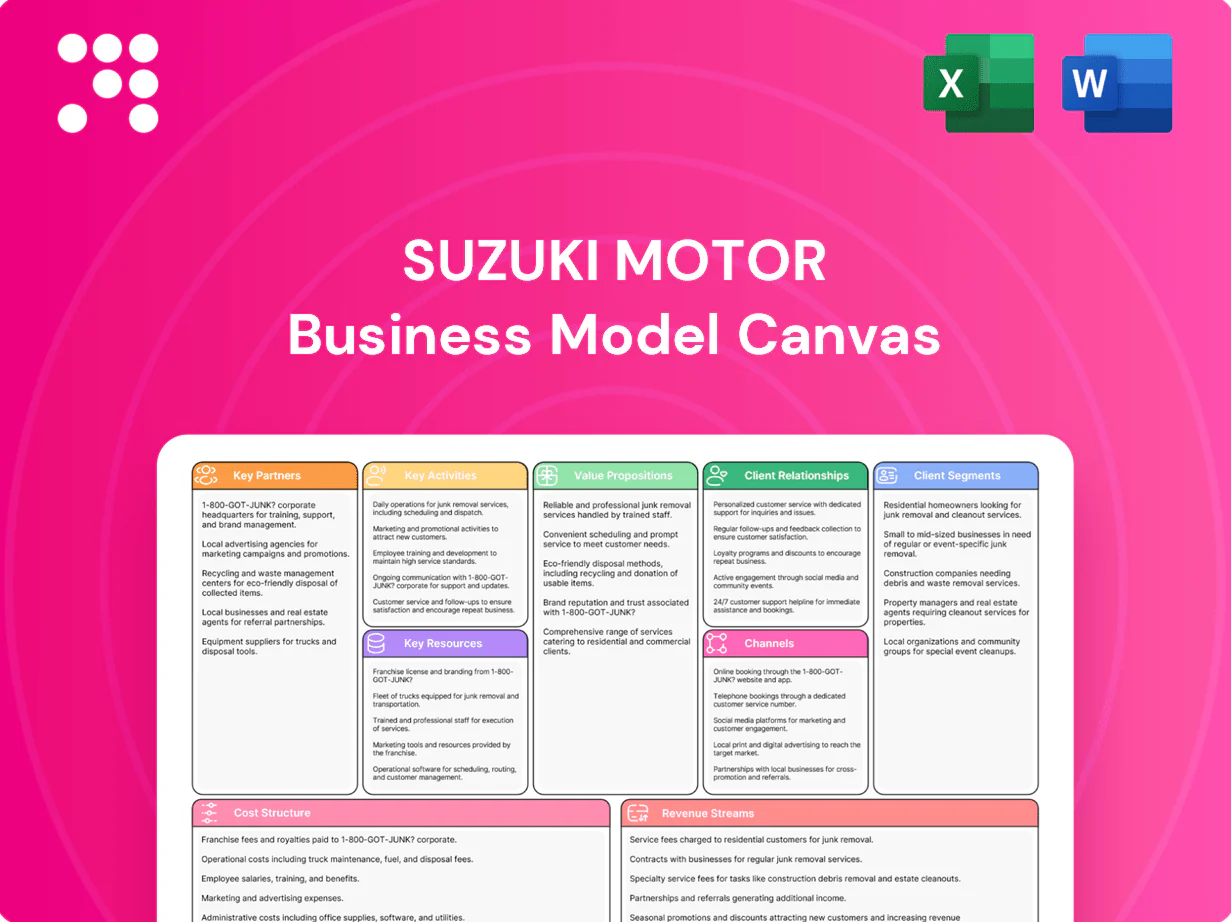
Suzuki Motor Business Model Canvas

Unlock the automotive strategic blueprint with our concise Business Model Canvas — download full pack
Unlock Suzuki Motor’s strategic blueprint with our concise Business Model Canvas—discover its core value propositions, customer segments, and revenue levers. Purchase the full downloadable Canvas (Word & Excel) for a section-by-section analysis, key partnerships, and financial implications. Ideal for investors, consultants, and founders seeking actionable automotive insights.
Partnerships

Toyota & tech alliances
Suzuki and Toyota (Toyota holds 4.9% of Suzuki; Suzuki holds 0.2% of Toyota) collaborate on shared platforms, hybrid systems and EV development to shorten time-to-market. Joint procurement and localized sourcing improve cost efficiency across supply chains. Badge engineering and co-developed models such as the Toyota Glanza and Urban Cruiser expand market reach. R&D and program risks are shared to lower individual capital burden.
Tier-1 suppliers
Suzuki relies on global and local Tier-1 suppliers for powertrains, electronics, safety systems and materials, securing quality and volume through multi-year contracts that lock in cost targets and supply continuity. Co-engineering with key suppliers accelerates compact, efficient component innovation, while local supplier development — over 80% local sourcing in India in 2024 — underpins cost leadership in emerging markets.

Dealers & service networks
Authorized Suzuki dealers and service partners deliver sales coverage and lifecycle support through over 3,000 dealerships and 5,000 service points worldwide as of 2024, enabling test drives, financing facilitation, and reliable maintenance.
Dealer feedback feeds product improvements and timely recalls, while robust aftersales networks underpin residual values and sustain brand trust among customers and financiers.

Logistics & manufacturing partners
Third-party logistics and contract manufacturers streamline inbound parts flow and outbound vehicle distribution, delivering 2024 cost cuts—about 10%—and lead-time improvements near 12% on average. Regional assemblers enable CKD/SKD strategies to avoid tariffs (savings up to 15% in key markets in 2024). Flexible capacity smooths demand cycles and boosts responsiveness.
- Third-party logistics: cost −10%, lead-time −12% (2024)
- CKD/SKD: tariff savings ≈15% (2024)
- Flexible capacity: demand smoothing, faster ramp-up
Financial & mobility partners
- Finance: captive banks — ~30% penetration
- Sales: ~3.0M units 2024
- Fleet/Rides: B2B volume + telematics
- Cross-promos: outdoor/marine
Toyota alliance and local sourcing drive ≈3.0M sales, ≈30% captive finance
Suzuki leverages strategic partnerships—notably Toyota (Toyota 4.9% stake) and >3,000 dealers/5,000 service points—to co-develop platforms, share R&D risk and speed EV/hybrid rollout. Local suppliers (≈80% sourcing in India 2024) and 3PLs cut costs ~10% and lead-times ~12%, while CKD/SKD and regional assemblers deliver ≈15% tariff savings. Captive finance penetration ~30% supports ~3.0M unit sales in 2024.
| Metric | 2024 / Note |
|---|---|
| Global sales | ≈3.0M units |
| Captive finance | ≈30% penetration |
| India local sourcing | ≈80% |
| 3PL cost cuts | −10% |
| 3PL lead-time | −12% |
| CKD/SKD tariff savings | ≈15% |
| Toyota stake | 4.9% |
What is included in the product
 Detailed Word Document
A comprehensive Suzuki Motor Business Model Canvas detailing customer segments, channels, value propositions, key activities, partners, resources, cost structure and revenue streams aligned to Suzuki’s real-world operations and strategic goals. Ideal for presentations or investor discussions, it includes competitive advantage analysis, SWOT linkages and actionable insights for entrepreneurs and analysts.

 Customizable Excel Spreadsheet
High-level view of Suzuki's business model with editable cells, relieving the pain of scattered strategy notes by consolidating vehicle segments, supply chain, partner networks, and revenue streams into a single, actionable snapshot.
Activities

Compact vehicle R&D
Suzuki designs efficient small cars, motorcycles and sub-1.2L engines tailored to urban and emerging markets. R&D prioritizes fuel economy, lightweighting and durability while embedding safety and emissions compliance (Japan, EU, India standards) early. Incremental innovation balances cost and performance to keep vehicles affordable and reliable.
Lean manufacturing
Suzuki runs high-utilization plants employing just-in-time logistics across 28 production bases in 23 countries, minimizing inventory and lead times. Extensive localization—notably in India—reduces currency and tariff exposures. Continuous improvement (Kaizen) focuses on yield, takt time and defect-rate reductions. Flexible lines enable multi-model production on shared platforms.

Supply chain orchestration
Suzuki orchestrates global sourcing, vendor quality and logistics coordination across a 2.86 million‑vehicle footprint (2023), buffering critical components while minimizing inventory through just‑in‑time and safety stock strategies. Dual‑sourcing and regional localization in India and ASEAN reduce disruption risk. Digital platforms provide real‑time tracking of parts, cost flows and CO2 emissions for procurement decisions.

Marketing & channel enablement
Brand campaigns stress value, reliability and low total cost of ownership while dealer training, incentives and digital selling tools lift conversion; pricing and promotions are tailored by market income tiers and community engagement programs strengthen loyalty—Maruti Suzuki reported a 47.3% domestic PV market share in FY2024.
- Value-focused brand messaging
- Dealer training + digital tools
- Income-segmented pricing
- Community engagement for retention
Aftersales & lifecycle services
Aftersales parts distribution, maintenance and warranty management sustain recurring revenue for Suzuki, supporting its post-sale margin stability; Suzuki sold about 2.7 million vehicles in FY2023 (ending March 2024), creating a large serviceable base. Service packages and accessories lift margins through higher per-vehicle spend, while field data drives targeted recalls and software/product updates. Recommerce and certified pre-owned programs extend customer lifecycle and brand retention.
- Parts & service revenue: recurring stream
- 2.7M vehicles (FY2023)
- Service packages raise margins
- Field data → recalls/updates
- Certified pre-owned extends ecosystem
Efficient small cars: 28 plants, 2.7M sold, 47.3% share
Suzuki designs efficient small cars, motorcycles and sub‑1.2L engines for urban/emerging markets, prioritizing fuel economy, lightweighting and regulatory compliance.
Operates 28 production bases in 23 countries with JIT, localization (India), Kaizen and flexible multi‑model lines; 2.86M vehicle footprint (2023).
Global sourcing with dual‑sourcing, digital parts tracking and 2.7M sold (FY2023); Maruti domestic PV share 47.3% (FY2024).
| Metric | Value |
|---|---|
| Production bases | 28 |
| Vehicles sold | 2.7M (FY2023) |
| Footprint | 2.86M (2023) |
| Maruti PV share | 47.3% (FY2024) |
Preview Before You Purchase
Business Model Canvas
The document you're previewing is the actual Suzuki Motor Business Model Canvas you will receive—no mockup or sample. After purchase you’ll get this exact, fully editable file, formatted and structured the same way, ready for presentation or analysis. Instant download includes the complete document with all sections included, editable and shareable—no surprises.

Unlock the automotive strategic blueprint with our concise Business Model Canvas — download full pack
Unlock Suzuki Motor’s strategic blueprint with our concise Business Model Canvas—discover its core value propositions, customer segments, and revenue levers. Purchase the full downloadable Canvas (Word & Excel) for a section-by-section analysis, key partnerships, and financial implications. Ideal for investors, consultants, and founders seeking actionable automotive insights.
Partnerships
Toyota & tech alliances
Suzuki and Toyota (Toyota holds 4.9% of Suzuki; Suzuki holds 0.2% of Toyota) collaborate on shared platforms, hybrid systems and EV development to shorten time-to-market. Joint procurement and localized sourcing improve cost efficiency across supply chains. Badge engineering and co-developed models such as the Toyota Glanza and Urban Cruiser expand market reach. R&D and program risks are shared to lower individual capital burden.
Tier-1 suppliers
Suzuki relies on global and local Tier-1 suppliers for powertrains, electronics, safety systems and materials, securing quality and volume through multi-year contracts that lock in cost targets and supply continuity. Co-engineering with key suppliers accelerates compact, efficient component innovation, while local supplier development — over 80% local sourcing in India in 2024 — underpins cost leadership in emerging markets.
Dealers & service networks
Authorized Suzuki dealers and service partners deliver sales coverage and lifecycle support through over 3,000 dealerships and 5,000 service points worldwide as of 2024, enabling test drives, financing facilitation, and reliable maintenance.
Dealer feedback feeds product improvements and timely recalls, while robust aftersales networks underpin residual values and sustain brand trust among customers and financiers.
Logistics & manufacturing partners
Third-party logistics and contract manufacturers streamline inbound parts flow and outbound vehicle distribution, delivering 2024 cost cuts—about 10%—and lead-time improvements near 12% on average. Regional assemblers enable CKD/SKD strategies to avoid tariffs (savings up to 15% in key markets in 2024). Flexible capacity smooths demand cycles and boosts responsiveness.
- Third-party logistics: cost −10%, lead-time −12% (2024)
- CKD/SKD: tariff savings ≈15% (2024)
- Flexible capacity: demand smoothing, faster ramp-up
Financial & mobility partners
- Finance: captive banks — ~30% penetration
- Sales: ~3.0M units 2024
- Fleet/Rides: B2B volume + telematics
- Cross-promos: outdoor/marine
Toyota alliance and local sourcing drive ≈3.0M sales, ≈30% captive finance
Suzuki leverages strategic partnerships—notably Toyota (Toyota 4.9% stake) and >3,000 dealers/5,000 service points—to co-develop platforms, share R&D risk and speed EV/hybrid rollout. Local suppliers (≈80% sourcing in India 2024) and 3PLs cut costs ~10% and lead-times ~12%, while CKD/SKD and regional assemblers deliver ≈15% tariff savings. Captive finance penetration ~30% supports ~3.0M unit sales in 2024.
| Metric | 2024 / Note |
|---|---|
| Global sales | ≈3.0M units |
| Captive finance | ≈30% penetration |
| India local sourcing | ≈80% |
| 3PL cost cuts | −10% |
| 3PL lead-time | −12% |
| CKD/SKD tariff savings | ≈15% |
| Toyota stake | 4.9% |
What is included in the product
Detailed Word Document
A comprehensive Suzuki Motor Business Model Canvas detailing customer segments, channels, value propositions, key activities, partners, resources, cost structure and revenue streams aligned to Suzuki’s real-world operations and strategic goals. Ideal for presentations or investor discussions, it includes competitive advantage analysis, SWOT linkages and actionable insights for entrepreneurs and analysts.
Customizable Excel Spreadsheet
High-level view of Suzuki's business model with editable cells, relieving the pain of scattered strategy notes by consolidating vehicle segments, supply chain, partner networks, and revenue streams into a single, actionable snapshot.
Activities
Compact vehicle R&D
Suzuki designs efficient small cars, motorcycles and sub-1.2L engines tailored to urban and emerging markets. R&D prioritizes fuel economy, lightweighting and durability while embedding safety and emissions compliance (Japan, EU, India standards) early. Incremental innovation balances cost and performance to keep vehicles affordable and reliable.
Lean manufacturing
Suzuki runs high-utilization plants employing just-in-time logistics across 28 production bases in 23 countries, minimizing inventory and lead times. Extensive localization—notably in India—reduces currency and tariff exposures. Continuous improvement (Kaizen) focuses on yield, takt time and defect-rate reductions. Flexible lines enable multi-model production on shared platforms.
Supply chain orchestration
Suzuki orchestrates global sourcing, vendor quality and logistics coordination across a 2.86 million‑vehicle footprint (2023), buffering critical components while minimizing inventory through just‑in‑time and safety stock strategies. Dual‑sourcing and regional localization in India and ASEAN reduce disruption risk. Digital platforms provide real‑time tracking of parts, cost flows and CO2 emissions for procurement decisions.
Marketing & channel enablement
Brand campaigns stress value, reliability and low total cost of ownership while dealer training, incentives and digital selling tools lift conversion; pricing and promotions are tailored by market income tiers and community engagement programs strengthen loyalty—Maruti Suzuki reported a 47.3% domestic PV market share in FY2024.
- Value-focused brand messaging
- Dealer training + digital tools
- Income-segmented pricing
- Community engagement for retention
Aftersales & lifecycle services
Aftersales parts distribution, maintenance and warranty management sustain recurring revenue for Suzuki, supporting its post-sale margin stability; Suzuki sold about 2.7 million vehicles in FY2023 (ending March 2024), creating a large serviceable base. Service packages and accessories lift margins through higher per-vehicle spend, while field data drives targeted recalls and software/product updates. Recommerce and certified pre-owned programs extend customer lifecycle and brand retention.
- Parts & service revenue: recurring stream
- 2.7M vehicles (FY2023)
- Service packages raise margins
- Field data → recalls/updates
- Certified pre-owned extends ecosystem
Efficient small cars: 28 plants, 2.7M sold, 47.3% share
Suzuki designs efficient small cars, motorcycles and sub‑1.2L engines for urban/emerging markets, prioritizing fuel economy, lightweighting and regulatory compliance.
Operates 28 production bases in 23 countries with JIT, localization (India), Kaizen and flexible multi‑model lines; 2.86M vehicle footprint (2023).
Global sourcing with dual‑sourcing, digital parts tracking and 2.7M sold (FY2023); Maruti domestic PV share 47.3% (FY2024).
| Metric | Value |
|---|---|
| Production bases | 28 |
| Vehicles sold | 2.7M (FY2023) |
| Footprint | 2.86M (2023) |
| Maruti PV share | 47.3% (FY2024) |
Preview Before You Purchase
Business Model Canvas
The document you're previewing is the actual Suzuki Motor Business Model Canvas you will receive—no mockup or sample. After purchase you’ll get this exact, fully editable file, formatted and structured the same way, ready for presentation or analysis. Instant download includes the complete document with all sections included, editable and shareable—no surprises.
Description
Unlock the automotive strategic blueprint with our concise Business Model Canvas — download full pack
Unlock Suzuki Motor’s strategic blueprint with our concise Business Model Canvas—discover its core value propositions, customer segments, and revenue levers. Purchase the full downloadable Canvas (Word & Excel) for a section-by-section analysis, key partnerships, and financial implications. Ideal for investors, consultants, and founders seeking actionable automotive insights.
Partnerships
Toyota & tech alliances
Suzuki and Toyota (Toyota holds 4.9% of Suzuki; Suzuki holds 0.2% of Toyota) collaborate on shared platforms, hybrid systems and EV development to shorten time-to-market. Joint procurement and localized sourcing improve cost efficiency across supply chains. Badge engineering and co-developed models such as the Toyota Glanza and Urban Cruiser expand market reach. R&D and program risks are shared to lower individual capital burden.
Tier-1 suppliers
Suzuki relies on global and local Tier-1 suppliers for powertrains, electronics, safety systems and materials, securing quality and volume through multi-year contracts that lock in cost targets and supply continuity. Co-engineering with key suppliers accelerates compact, efficient component innovation, while local supplier development — over 80% local sourcing in India in 2024 — underpins cost leadership in emerging markets.
Dealers & service networks
Authorized Suzuki dealers and service partners deliver sales coverage and lifecycle support through over 3,000 dealerships and 5,000 service points worldwide as of 2024, enabling test drives, financing facilitation, and reliable maintenance.
Dealer feedback feeds product improvements and timely recalls, while robust aftersales networks underpin residual values and sustain brand trust among customers and financiers.
Logistics & manufacturing partners
Third-party logistics and contract manufacturers streamline inbound parts flow and outbound vehicle distribution, delivering 2024 cost cuts—about 10%—and lead-time improvements near 12% on average. Regional assemblers enable CKD/SKD strategies to avoid tariffs (savings up to 15% in key markets in 2024). Flexible capacity smooths demand cycles and boosts responsiveness.
- Third-party logistics: cost −10%, lead-time −12% (2024)
- CKD/SKD: tariff savings ≈15% (2024)
- Flexible capacity: demand smoothing, faster ramp-up
Financial & mobility partners
- Finance: captive banks — ~30% penetration
- Sales: ~3.0M units 2024
- Fleet/Rides: B2B volume + telematics
- Cross-promos: outdoor/marine
Toyota alliance and local sourcing drive ≈3.0M sales, ≈30% captive finance
Suzuki leverages strategic partnerships—notably Toyota (Toyota 4.9% stake) and >3,000 dealers/5,000 service points—to co-develop platforms, share R&D risk and speed EV/hybrid rollout. Local suppliers (≈80% sourcing in India 2024) and 3PLs cut costs ~10% and lead-times ~12%, while CKD/SKD and regional assemblers deliver ≈15% tariff savings. Captive finance penetration ~30% supports ~3.0M unit sales in 2024.
| Metric | 2024 / Note |
|---|---|
| Global sales | ≈3.0M units |
| Captive finance | ≈30% penetration |
| India local sourcing | ≈80% |
| 3PL cost cuts | −10% |
| 3PL lead-time | −12% |
| CKD/SKD tariff savings | ≈15% |
| Toyota stake | 4.9% |
What is included in the product
Detailed Word Document
A comprehensive Suzuki Motor Business Model Canvas detailing customer segments, channels, value propositions, key activities, partners, resources, cost structure and revenue streams aligned to Suzuki’s real-world operations and strategic goals. Ideal for presentations or investor discussions, it includes competitive advantage analysis, SWOT linkages and actionable insights for entrepreneurs and analysts.
Customizable Excel Spreadsheet
High-level view of Suzuki's business model with editable cells, relieving the pain of scattered strategy notes by consolidating vehicle segments, supply chain, partner networks, and revenue streams into a single, actionable snapshot.
Activities
Compact vehicle R&D
Suzuki designs efficient small cars, motorcycles and sub-1.2L engines tailored to urban and emerging markets. R&D prioritizes fuel economy, lightweighting and durability while embedding safety and emissions compliance (Japan, EU, India standards) early. Incremental innovation balances cost and performance to keep vehicles affordable and reliable.
Lean manufacturing
Suzuki runs high-utilization plants employing just-in-time logistics across 28 production bases in 23 countries, minimizing inventory and lead times. Extensive localization—notably in India—reduces currency and tariff exposures. Continuous improvement (Kaizen) focuses on yield, takt time and defect-rate reductions. Flexible lines enable multi-model production on shared platforms.
Supply chain orchestration
Suzuki orchestrates global sourcing, vendor quality and logistics coordination across a 2.86 million‑vehicle footprint (2023), buffering critical components while minimizing inventory through just‑in‑time and safety stock strategies. Dual‑sourcing and regional localization in India and ASEAN reduce disruption risk. Digital platforms provide real‑time tracking of parts, cost flows and CO2 emissions for procurement decisions.
Marketing & channel enablement
Brand campaigns stress value, reliability and low total cost of ownership while dealer training, incentives and digital selling tools lift conversion; pricing and promotions are tailored by market income tiers and community engagement programs strengthen loyalty—Maruti Suzuki reported a 47.3% domestic PV market share in FY2024.
- Value-focused brand messaging
- Dealer training + digital tools
- Income-segmented pricing
- Community engagement for retention
Aftersales & lifecycle services
Aftersales parts distribution, maintenance and warranty management sustain recurring revenue for Suzuki, supporting its post-sale margin stability; Suzuki sold about 2.7 million vehicles in FY2023 (ending March 2024), creating a large serviceable base. Service packages and accessories lift margins through higher per-vehicle spend, while field data drives targeted recalls and software/product updates. Recommerce and certified pre-owned programs extend customer lifecycle and brand retention.
- Parts & service revenue: recurring stream
- 2.7M vehicles (FY2023)
- Service packages raise margins
- Field data → recalls/updates
- Certified pre-owned extends ecosystem
Efficient small cars: 28 plants, 2.7M sold, 47.3% share
Suzuki designs efficient small cars, motorcycles and sub‑1.2L engines for urban/emerging markets, prioritizing fuel economy, lightweighting and regulatory compliance.
Operates 28 production bases in 23 countries with JIT, localization (India), Kaizen and flexible multi‑model lines; 2.86M vehicle footprint (2023).
Global sourcing with dual‑sourcing, digital parts tracking and 2.7M sold (FY2023); Maruti domestic PV share 47.3% (FY2024).
| Metric | Value |
|---|---|
| Production bases | 28 |
| Vehicles sold | 2.7M (FY2023) |
| Footprint | 2.86M (2023) |
| Maruti PV share | 47.3% (FY2024) |
Preview Before You Purchase
Business Model Canvas
The document you're previewing is the actual Suzuki Motor Business Model Canvas you will receive—no mockup or sample. After purchase you’ll get this exact, fully editable file, formatted and structured the same way, ready for presentation or analysis. Instant download includes the complete document with all sections included, editable and shareable—no surprises.











