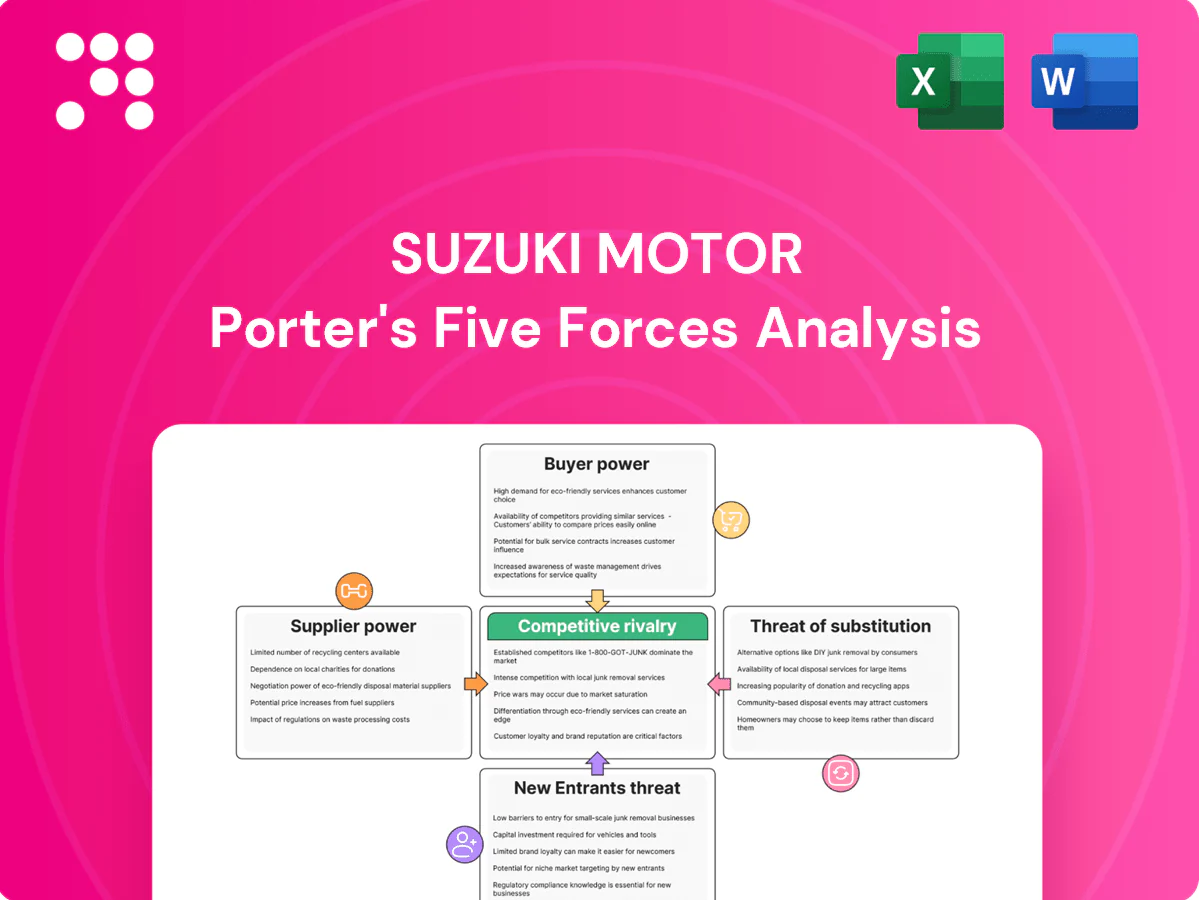
Suzuki Motor Porter's Five Forces Analysis

From Overview to Strategy Blueprint
Suzuki Motor faces varied competitive pressures—from tight supplier relations and strong buyer expectations to emerging EV entrants and substitute mobility options—shaping margins and strategic choices. This snapshot teases the insights; unlock the full Porter's Five Forces Analysis for force-by-force ratings, visuals, and actionable recommendations to guide investment or strategy.
Suppliers Bargaining Power

Localized vendor base vs. critical imported components
Suzuki sources many parts locally across India and ASEAN, diffusing supplier leverage, yet critical inputs—semiconductors and EV batteries—are concentrated among a few global players; by 2024 CATL remained the largest EV battery maker while Infineon, NXP and Renesas dominated automotive semiconductors. This duality keeps average supplier power moderate but causes sharp spikes during shortages. Diversification and vendor-development programs are used to mitigate these risks.
Commodity inputs and price volatility
Steel, aluminum, plastics and rubber remain key cost drivers for Suzuki, making margins sensitive to commodity cycles; in 2024 suppliers continued to pass through higher input costs during upswings, compressing margins on value-focused models. Hedging programs mitigate but do not fully offset price swings, and long-term supply contracts provide partial cost stability while limiting Suzuki’s flexibility.

Technology dependence in electrification
Shift to hybrids/EVs raises Suzuki’s reliance on cell chemistry, battery packs and power electronics; top five cell makers held about 80% of global capacity in 2024, boosting supplier leverage. Global average battery pack cost was near 130 USD/kWh in 2024, keeping component value high. Joint ventures and in‑house tech roadmaps can rebalance power. Early volume commitments secure capacity and pricing.

Quality, compliance, and recall exposure
Stringent 2024 safety and emissions rules force Suzuki to source high-spec components, raising switching costs and supplier dependence; global vehicle recalls topped 50 million in 2023–24, underscoring recall exposure and amplifying supplier importance. Robust tier-2 visibility and audits reduce surprise risk, while collaboration on PPAP/APQP keeps Suzuki’s leverage contained and defect rates lower.
- High-spec parts => higher switching costs
- 50M+ global recalls (2023–24) => amplified supplier risk
- Tier-2 visibility + audits => fewer surprises
- PPAP/APQP collaboration => contained leverage
Scale and platform commonality
Suzuki’s 2024 scale in small cars and motorcycles lets it bundle volumes across shared platforms, lowering unit costs and weakening supplier leverage; predictable, higher volumes enable tougher pricing and longer contracts. Niche SKUs and low-volume exports still grant suppliers pockets of negotiation power. Global sourcing councils formed in 2024 aggregate demand to secure better terms.
- 2024: platform bundling reduces unit cost, lowers supplier power
- Niche SKUs = higher supplier leverage
- Global sourcing councils = improved terms via aggregated demand
Concentrated suppliers raise leverage - top5 batteries ~80%, cost 130 USD/kWh
Supplier power is moderate: localized sourcing lowers leverage but critical inputs concentrate risk—top five battery makers held ~80% capacity in 2024 and global battery pack cost ~130 USD/kWh. Semiconductors remain concentrated with Infineon, NXP, Renesas dominant; 50M+ global recalls (2023–24) amplify supplier impact. Suzuki mitigates via volume bundling, JV battery deals and long-term contracts.
| Factor | 2024 Metric | Impact |
|---|---|---|
| Battery concentration | Top5 ~80% capacity | High leverage |
| Battery cost | ~130 USD/kWh | Component value high |
| Recalls | 50M+ (2023–24) | Raises dependency |
What is included in the product
 Detailed Word Document
Tailored Porter’s Five Forces analysis for Suzuki Motor, uncovering competitive drivers, buyer and supplier bargaining power, entry barriers, substitute threats, and industry rivalry with actionable insights and strategic implications. Ideal for investor reports, strategy decks, and academic work—fully editable and focused on protecting Suzuki’s market position amid emerging mobility trends.

 Customizable Excel Spreadsheet
A concise, one-sheet Porter’s Five Forces for Suzuki Motor—instantly shows competitive pressure, supplier/buyer leverage and threat of substitutes in a clean radar chart for quick strategic decisions and slide-ready reports.
Customers Bargaining Power

Price-sensitive emerging market customers
Core markets like India are highly value-driven — Maruti Suzuki held roughly 45% of India’s passenger vehicle market in 2024, amplifying buyer price sensitivity. Low switching costs and abundant comparable models encourage cross-shopping, while promotions and financing (about 50% of new-car purchases financed) materially sway decisions. Strong resale values—many Suzuki models retain around 50% of value after three years—help offset some price pressure.
Abundant alternatives across segments
Buyers can choose from domestic, Japanese, Korean and increasingly Chinese brands, driving abundant alternatives across segments; in India Maruti Suzuki maintained roughly 40% passenger-vehicle market share in 2024. Feature parity in compact segments intensifies side-by-side comparisons on specs and price. Online research and influencer reviews have raised transparency, shortening consideration cycles. Differentiation via proven reliability and lower total cost of ownership is critical to retain price-sensitive buyers.

Dealer network and after-sales influence
Suzuki's dense dealer network—over 3,500 sales outlets and ~4,000 service centers in India as of 2024—lowers perceived service costs and improves parts availability, boosting value perception and limiting bargaining on price. Buyers still extract concessions on accessories, extended warranties and maintenance packs, especially in segmented urban markets. Strong after-sales (sub-5% defection in well-served regions) moderates buyer power, while weak rural service amplifies leverage by roughly 15%.

Fleet and institutional buyers
Fleet and institutional buyers such as ride-hailing, government, and corporate fleets negotiate bulk discounts with Suzuki, using standardized specs and high volumes to amplify bargaining power.
They often require long-term service and warranty commitments, raising Suzuki's lifecycle costs; winning tenders can dilute margins but adds scale and predictable revenue.
- Bulk orders drive price concessions
- Standard specs increase buyer leverage
- Long-term service boosts total cost
- Tenders trade margin for volume
Motorcycle customers’ flexibility
Two-wheeler buyers can switch brands easily because offerings are comparable; 2024 surveys show price, mileage and service footprint rank as top three purchase drivers for about 70% of buyers. Promotions, financing (finance penetration ~45% in key markets in 2024) and spare-parts pricing frequently tip decisions. Brand loyalty exists but is fragile in entry-level segments where switching rates exceed 30% annually.
- Price-led purchases
- Mileage & service footprint
- Promotions & 45% financing
- Spare-parts pricing
- Entry-level loyalty fragile (30%+ churn)
Buyers gain leverage as top PV firm holds ~45%; financing and resale key
Buyers have moderate-to-high power: Maruti Suzuki held ~45% of India PV market in 2024, with strong price sensitivity, ~50% new-car financing and ~50% 3-year resale values easing price pressure. Dense network (≈3,500 outlets, ≈4,000 service centers) reduces bargaining, while fleets and entry-level two-wheeler buyers (45% financing, >30% churn) extract discounts.
| Metric | 2024 value |
|---|---|
| PV market share | ~45% |
| New-car financing | ~50% |
| 3yr resale | ~50% |
| Dealers / service | ≈3,500 / ≈4,000 |
| 2W financing | ~45% |
| 2W churn | >30% |
Preview the Actual Deliverable
Suzuki Motor Porter's Five Forces Analysis
This preview shows the Suzuki Motor Porter’s Five Forces Analysis and is the exact document you’ll receive immediately after purchase—no surprises or placeholders. The file is fully formatted, professionally written and ready for download and use the moment you buy. You’re viewing the final deliverable, identical to the instant-access file provided post-purchase.

From Overview to Strategy Blueprint
Suzuki Motor faces varied competitive pressures—from tight supplier relations and strong buyer expectations to emerging EV entrants and substitute mobility options—shaping margins and strategic choices. This snapshot teases the insights; unlock the full Porter's Five Forces Analysis for force-by-force ratings, visuals, and actionable recommendations to guide investment or strategy.
Suppliers Bargaining Power
Localized vendor base vs. critical imported components
Suzuki sources many parts locally across India and ASEAN, diffusing supplier leverage, yet critical inputs—semiconductors and EV batteries—are concentrated among a few global players; by 2024 CATL remained the largest EV battery maker while Infineon, NXP and Renesas dominated automotive semiconductors. This duality keeps average supplier power moderate but causes sharp spikes during shortages. Diversification and vendor-development programs are used to mitigate these risks.
Commodity inputs and price volatility
Steel, aluminum, plastics and rubber remain key cost drivers for Suzuki, making margins sensitive to commodity cycles; in 2024 suppliers continued to pass through higher input costs during upswings, compressing margins on value-focused models. Hedging programs mitigate but do not fully offset price swings, and long-term supply contracts provide partial cost stability while limiting Suzuki’s flexibility.
Technology dependence in electrification
Shift to hybrids/EVs raises Suzuki’s reliance on cell chemistry, battery packs and power electronics; top five cell makers held about 80% of global capacity in 2024, boosting supplier leverage. Global average battery pack cost was near 130 USD/kWh in 2024, keeping component value high. Joint ventures and in‑house tech roadmaps can rebalance power. Early volume commitments secure capacity and pricing.
Quality, compliance, and recall exposure
Stringent 2024 safety and emissions rules force Suzuki to source high-spec components, raising switching costs and supplier dependence; global vehicle recalls topped 50 million in 2023–24, underscoring recall exposure and amplifying supplier importance. Robust tier-2 visibility and audits reduce surprise risk, while collaboration on PPAP/APQP keeps Suzuki’s leverage contained and defect rates lower.
- High-spec parts => higher switching costs
- 50M+ global recalls (2023–24) => amplified supplier risk
- Tier-2 visibility + audits => fewer surprises
- PPAP/APQP collaboration => contained leverage
Scale and platform commonality
Suzuki’s 2024 scale in small cars and motorcycles lets it bundle volumes across shared platforms, lowering unit costs and weakening supplier leverage; predictable, higher volumes enable tougher pricing and longer contracts. Niche SKUs and low-volume exports still grant suppliers pockets of negotiation power. Global sourcing councils formed in 2024 aggregate demand to secure better terms.
- 2024: platform bundling reduces unit cost, lowers supplier power
- Niche SKUs = higher supplier leverage
- Global sourcing councils = improved terms via aggregated demand
Concentrated suppliers raise leverage - top5 batteries ~80%, cost 130 USD/kWh
Supplier power is moderate: localized sourcing lowers leverage but critical inputs concentrate risk—top five battery makers held ~80% capacity in 2024 and global battery pack cost ~130 USD/kWh. Semiconductors remain concentrated with Infineon, NXP, Renesas dominant; 50M+ global recalls (2023–24) amplify supplier impact. Suzuki mitigates via volume bundling, JV battery deals and long-term contracts.
| Factor | 2024 Metric | Impact |
|---|---|---|
| Battery concentration | Top5 ~80% capacity | High leverage |
| Battery cost | ~130 USD/kWh | Component value high |
| Recalls | 50M+ (2023–24) | Raises dependency |
What is included in the product
Detailed Word Document
Tailored Porter’s Five Forces analysis for Suzuki Motor, uncovering competitive drivers, buyer and supplier bargaining power, entry barriers, substitute threats, and industry rivalry with actionable insights and strategic implications. Ideal for investor reports, strategy decks, and academic work—fully editable and focused on protecting Suzuki’s market position amid emerging mobility trends.
Customizable Excel Spreadsheet
A concise, one-sheet Porter’s Five Forces for Suzuki Motor—instantly shows competitive pressure, supplier/buyer leverage and threat of substitutes in a clean radar chart for quick strategic decisions and slide-ready reports.
Customers Bargaining Power
Price-sensitive emerging market customers
Core markets like India are highly value-driven — Maruti Suzuki held roughly 45% of India’s passenger vehicle market in 2024, amplifying buyer price sensitivity. Low switching costs and abundant comparable models encourage cross-shopping, while promotions and financing (about 50% of new-car purchases financed) materially sway decisions. Strong resale values—many Suzuki models retain around 50% of value after three years—help offset some price pressure.
Abundant alternatives across segments
Buyers can choose from domestic, Japanese, Korean and increasingly Chinese brands, driving abundant alternatives across segments; in India Maruti Suzuki maintained roughly 40% passenger-vehicle market share in 2024. Feature parity in compact segments intensifies side-by-side comparisons on specs and price. Online research and influencer reviews have raised transparency, shortening consideration cycles. Differentiation via proven reliability and lower total cost of ownership is critical to retain price-sensitive buyers.
Dealer network and after-sales influence
Suzuki's dense dealer network—over 3,500 sales outlets and ~4,000 service centers in India as of 2024—lowers perceived service costs and improves parts availability, boosting value perception and limiting bargaining on price. Buyers still extract concessions on accessories, extended warranties and maintenance packs, especially in segmented urban markets. Strong after-sales (sub-5% defection in well-served regions) moderates buyer power, while weak rural service amplifies leverage by roughly 15%.
Fleet and institutional buyers
Fleet and institutional buyers such as ride-hailing, government, and corporate fleets negotiate bulk discounts with Suzuki, using standardized specs and high volumes to amplify bargaining power.
They often require long-term service and warranty commitments, raising Suzuki's lifecycle costs; winning tenders can dilute margins but adds scale and predictable revenue.
- Bulk orders drive price concessions
- Standard specs increase buyer leverage
- Long-term service boosts total cost
- Tenders trade margin for volume
Motorcycle customers’ flexibility
Two-wheeler buyers can switch brands easily because offerings are comparable; 2024 surveys show price, mileage and service footprint rank as top three purchase drivers for about 70% of buyers. Promotions, financing (finance penetration ~45% in key markets in 2024) and spare-parts pricing frequently tip decisions. Brand loyalty exists but is fragile in entry-level segments where switching rates exceed 30% annually.
- Price-led purchases
- Mileage & service footprint
- Promotions & 45% financing
- Spare-parts pricing
- Entry-level loyalty fragile (30%+ churn)
Buyers gain leverage as top PV firm holds ~45%; financing and resale key
Buyers have moderate-to-high power: Maruti Suzuki held ~45% of India PV market in 2024, with strong price sensitivity, ~50% new-car financing and ~50% 3-year resale values easing price pressure. Dense network (≈3,500 outlets, ≈4,000 service centers) reduces bargaining, while fleets and entry-level two-wheeler buyers (45% financing, >30% churn) extract discounts.
| Metric | 2024 value |
|---|---|
| PV market share | ~45% |
| New-car financing | ~50% |
| 3yr resale | ~50% |
| Dealers / service | ≈3,500 / ≈4,000 |
| 2W financing | ~45% |
| 2W churn | >30% |
Preview the Actual Deliverable
Suzuki Motor Porter's Five Forces Analysis
This preview shows the Suzuki Motor Porter’s Five Forces Analysis and is the exact document you’ll receive immediately after purchase—no surprises or placeholders. The file is fully formatted, professionally written and ready for download and use the moment you buy. You’re viewing the final deliverable, identical to the instant-access file provided post-purchase.
Description
From Overview to Strategy Blueprint
Suzuki Motor faces varied competitive pressures—from tight supplier relations and strong buyer expectations to emerging EV entrants and substitute mobility options—shaping margins and strategic choices. This snapshot teases the insights; unlock the full Porter's Five Forces Analysis for force-by-force ratings, visuals, and actionable recommendations to guide investment or strategy.
Suppliers Bargaining Power
Localized vendor base vs. critical imported components
Suzuki sources many parts locally across India and ASEAN, diffusing supplier leverage, yet critical inputs—semiconductors and EV batteries—are concentrated among a few global players; by 2024 CATL remained the largest EV battery maker while Infineon, NXP and Renesas dominated automotive semiconductors. This duality keeps average supplier power moderate but causes sharp spikes during shortages. Diversification and vendor-development programs are used to mitigate these risks.
Commodity inputs and price volatility
Steel, aluminum, plastics and rubber remain key cost drivers for Suzuki, making margins sensitive to commodity cycles; in 2024 suppliers continued to pass through higher input costs during upswings, compressing margins on value-focused models. Hedging programs mitigate but do not fully offset price swings, and long-term supply contracts provide partial cost stability while limiting Suzuki’s flexibility.
Technology dependence in electrification
Shift to hybrids/EVs raises Suzuki’s reliance on cell chemistry, battery packs and power electronics; top five cell makers held about 80% of global capacity in 2024, boosting supplier leverage. Global average battery pack cost was near 130 USD/kWh in 2024, keeping component value high. Joint ventures and in‑house tech roadmaps can rebalance power. Early volume commitments secure capacity and pricing.
Quality, compliance, and recall exposure
Stringent 2024 safety and emissions rules force Suzuki to source high-spec components, raising switching costs and supplier dependence; global vehicle recalls topped 50 million in 2023–24, underscoring recall exposure and amplifying supplier importance. Robust tier-2 visibility and audits reduce surprise risk, while collaboration on PPAP/APQP keeps Suzuki’s leverage contained and defect rates lower.
- High-spec parts => higher switching costs
- 50M+ global recalls (2023–24) => amplified supplier risk
- Tier-2 visibility + audits => fewer surprises
- PPAP/APQP collaboration => contained leverage
Scale and platform commonality
Suzuki’s 2024 scale in small cars and motorcycles lets it bundle volumes across shared platforms, lowering unit costs and weakening supplier leverage; predictable, higher volumes enable tougher pricing and longer contracts. Niche SKUs and low-volume exports still grant suppliers pockets of negotiation power. Global sourcing councils formed in 2024 aggregate demand to secure better terms.
- 2024: platform bundling reduces unit cost, lowers supplier power
- Niche SKUs = higher supplier leverage
- Global sourcing councils = improved terms via aggregated demand
Concentrated suppliers raise leverage - top5 batteries ~80%, cost 130 USD/kWh
Supplier power is moderate: localized sourcing lowers leverage but critical inputs concentrate risk—top five battery makers held ~80% capacity in 2024 and global battery pack cost ~130 USD/kWh. Semiconductors remain concentrated with Infineon, NXP, Renesas dominant; 50M+ global recalls (2023–24) amplify supplier impact. Suzuki mitigates via volume bundling, JV battery deals and long-term contracts.
| Factor | 2024 Metric | Impact |
|---|---|---|
| Battery concentration | Top5 ~80% capacity | High leverage |
| Battery cost | ~130 USD/kWh | Component value high |
| Recalls | 50M+ (2023–24) | Raises dependency |
What is included in the product
Detailed Word Document
Tailored Porter’s Five Forces analysis for Suzuki Motor, uncovering competitive drivers, buyer and supplier bargaining power, entry barriers, substitute threats, and industry rivalry with actionable insights and strategic implications. Ideal for investor reports, strategy decks, and academic work—fully editable and focused on protecting Suzuki’s market position amid emerging mobility trends.
Customizable Excel Spreadsheet
A concise, one-sheet Porter’s Five Forces for Suzuki Motor—instantly shows competitive pressure, supplier/buyer leverage and threat of substitutes in a clean radar chart for quick strategic decisions and slide-ready reports.
Customers Bargaining Power
Price-sensitive emerging market customers
Core markets like India are highly value-driven — Maruti Suzuki held roughly 45% of India’s passenger vehicle market in 2024, amplifying buyer price sensitivity. Low switching costs and abundant comparable models encourage cross-shopping, while promotions and financing (about 50% of new-car purchases financed) materially sway decisions. Strong resale values—many Suzuki models retain around 50% of value after three years—help offset some price pressure.
Abundant alternatives across segments
Buyers can choose from domestic, Japanese, Korean and increasingly Chinese brands, driving abundant alternatives across segments; in India Maruti Suzuki maintained roughly 40% passenger-vehicle market share in 2024. Feature parity in compact segments intensifies side-by-side comparisons on specs and price. Online research and influencer reviews have raised transparency, shortening consideration cycles. Differentiation via proven reliability and lower total cost of ownership is critical to retain price-sensitive buyers.
Dealer network and after-sales influence
Suzuki's dense dealer network—over 3,500 sales outlets and ~4,000 service centers in India as of 2024—lowers perceived service costs and improves parts availability, boosting value perception and limiting bargaining on price. Buyers still extract concessions on accessories, extended warranties and maintenance packs, especially in segmented urban markets. Strong after-sales (sub-5% defection in well-served regions) moderates buyer power, while weak rural service amplifies leverage by roughly 15%.
Fleet and institutional buyers
Fleet and institutional buyers such as ride-hailing, government, and corporate fleets negotiate bulk discounts with Suzuki, using standardized specs and high volumes to amplify bargaining power.
They often require long-term service and warranty commitments, raising Suzuki's lifecycle costs; winning tenders can dilute margins but adds scale and predictable revenue.
- Bulk orders drive price concessions
- Standard specs increase buyer leverage
- Long-term service boosts total cost
- Tenders trade margin for volume
Motorcycle customers’ flexibility
Two-wheeler buyers can switch brands easily because offerings are comparable; 2024 surveys show price, mileage and service footprint rank as top three purchase drivers for about 70% of buyers. Promotions, financing (finance penetration ~45% in key markets in 2024) and spare-parts pricing frequently tip decisions. Brand loyalty exists but is fragile in entry-level segments where switching rates exceed 30% annually.
- Price-led purchases
- Mileage & service footprint
- Promotions & 45% financing
- Spare-parts pricing
- Entry-level loyalty fragile (30%+ churn)
Buyers gain leverage as top PV firm holds ~45%; financing and resale key
Buyers have moderate-to-high power: Maruti Suzuki held ~45% of India PV market in 2024, with strong price sensitivity, ~50% new-car financing and ~50% 3-year resale values easing price pressure. Dense network (≈3,500 outlets, ≈4,000 service centers) reduces bargaining, while fleets and entry-level two-wheeler buyers (45% financing, >30% churn) extract discounts.
| Metric | 2024 value |
|---|---|
| PV market share | ~45% |
| New-car financing | ~50% |
| 3yr resale | ~50% |
| Dealers / service | ≈3,500 / ≈4,000 |
| 2W financing | ~45% |
| 2W churn | >30% |
Preview the Actual Deliverable
Suzuki Motor Porter's Five Forces Analysis
This preview shows the Suzuki Motor Porter’s Five Forces Analysis and is the exact document you’ll receive immediately after purchase—no surprises or placeholders. The file is fully formatted, professionally written and ready for download and use the moment you buy. You’re viewing the final deliverable, identical to the instant-access file provided post-purchase.











