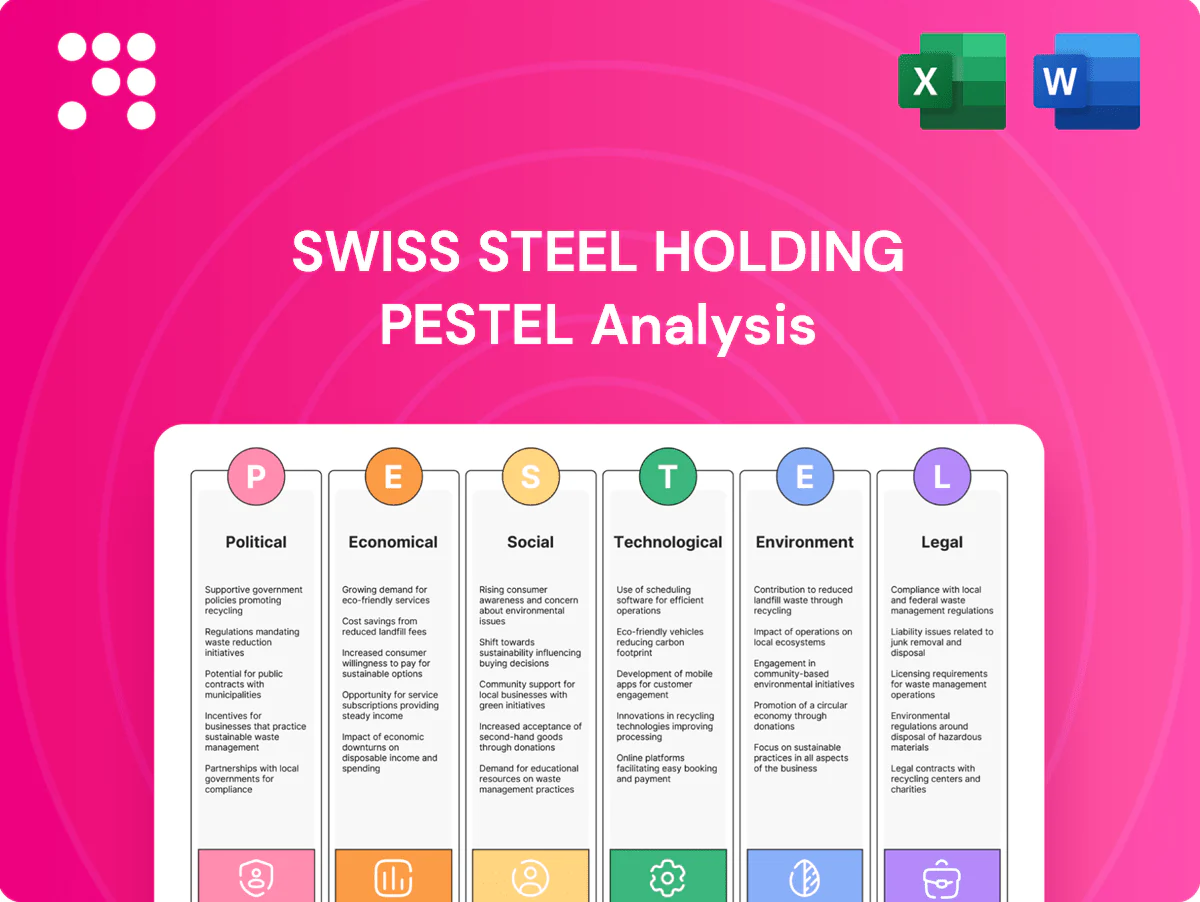
Swiss Steel Holding PESTLE Analysis

Your Shortcut to Market Insight Starts Here
Gain strategic clarity with our PESTLE Analysis of Swiss Steel Holding, revealing how political, economic and environmental forces shape its market position. Use these insights to anticipate risks and spot growth opportunities. Download the full report now for actionable, ready-to-use intelligence.
Political factors

Swiss/EU industrial policy alignment
Switzerland’s alignment with EU industrial and decarbonization rules — notably the CBAM operational since October 2023 and an EU ETS carbon price around €90/t in 2024 — shapes standards, subsidies and market access for specialty steel. Convergence can unlock Horizon Europe R&D funds (EU budget €95.5bn 2021–2027) but raises compliance complexity and costs. Divergence risks non‑tariff barriers and certification hurdles for exports. Strategic lobbying and leading standards adoption mitigate fragmentation.
Trade tariffs, sanctions, and CBAM
Shifts in tariffs, anti-dumping duties and sanctions change input costs and export competitiveness for Swiss Steel, especially given the EU’s ongoing trade defence measures on steel. The EU’s Carbon Border Adjustment Mechanism entered a reporting phase in October 2023 and moves to full application in 2026, covering steel among other sectors and demanding emissions transparency. Misalignment of carbon intensity versus EU benchmarks can erode margins. Proactive carbon accounting and low-carbon sourcing are therefore critical.

Energy security and pricing policy
Government direction on electricity and gas markets drives EAF steel cost volatility, with energy prices normalizing from 2022 peaks by 2024 but remaining sensitive to policy shifts and cross‑border flows.
Stronger Swiss support for renewables and grid stability programs in 2024 increases availability of policy-backed PPAs, shaping long-term power contract pricing.
Policy-driven price spikes compress product spreads; active hedging and PPAs tied to renewables materially reduce Swiss Steel Holding’s exposure.

Infrastructure and logistics governance
Customs efficiency, rail freight priorities and cross-border rules materially shape delivery reliability for Swiss Steel; Swiss rail carried about 37% of land freight tonne-km in 2023, supporting heavy-product flow but sensitive to border procedures and regulatory shifts. Political investment in corridors and ports (Swiss federal rail budgets ~CHF 3.5bn/year) shortens lead times, while strikes or sudden rule changes can stall shipments, so diversified routing and inventory buffers are used.
- customs: clearance delays raise variability
- rail-priority: 37% rail freight share (2023)
- investment: CHF 3.5bn/yr rail budget
- mitigation: alternative routes + inventory buffers
Geopolitical supply chain risk
Geopolitical conflicts and diplomatic rifts tighten access to alloying elements such as nickel, molybdenum and chromium, forcing Swiss Steel to reprice inputs and absorb political risk premiums that elevate working capital needs. Export controls on metals and dual‑use technologies since 2022 have reshaped sourcing maps and increased supplier on‑boarding costs. Multi‑region supplier qualification and inventory buffers improve resilience and reduce single‑source exposure.
- Supply constraint: tighter access to nickel/molybdenum/chromium
- Regulation: export controls reshape sourcing
- Finance: political risk premiums raise working capital
- Mitigation: multi‑region supplier qualification
Swiss CBAM alignment and €90/t EU ETS lift costs; Horizon funding and rail support mitigate risks
Switzerland’s CBAM alignment and an EU ETS price ~€90/t in 2024 raise compliance costs but preserve EU market access; Horizon Europe funds (EU budget €95.5bn 2021–2027) offer R&D upside. Energy policy and renewables PPAs (stronger 2024 support) affect EAF costs; rail freight 37% share (2023) and CHF 3.5bn/yr rail budget shape logistics. Export controls and metal supply constraints increase input premiums and working capital needs.
| Factor | 2023–24 data |
|---|---|
| EU ETS price | ~€90/t (2024) |
| CBAM | reporting Oct 2023, phased 2026 |
| Rail freight | 37% land tonne‑km (2023) |
| Swiss rail budget | ~CHF 3.5bn/yr |
What is included in the product
 Detailed Word Document
Explores how Political, Economic, Social, Technological, Environmental and Legal forces uniquely affect Swiss Steel Holding, with data-backed trends, sector-specific examples and forward-looking insights to aid executives and investors.

 Customizable Excel Spreadsheet
A concise PESTLE summary for Swiss Steel Holding that highlights key political, economic, social, technological, legal and environmental risks and opportunities, enabling quick alignment in meetings and strategic planning.
Economic factors

Cyclical demand in end-markets
Automotive, machinery and oil & gas cycles drive Swiss Steel Holding order books for special long steel, with downturns cutting volumes and price discipline and upswings straining capacity. Mix shifts to EVs—global EV sales reached about 14 million in 2023 (IEA)—and higher-spec machinery support demand for premium grades. Flexible production planning is used to capture cyclical upside while protecting margins.
Raw material and energy cost swings
Scrap, ferroalloys and electricity drive EAF variable costs—scrap can represent up to 60% of input value while energy accounts for roughly 15–25% of conversion costs; European industrial power spikes in 2022 pushed margins under pressure. Volatility narrows or widens metal spreads depending on contract pass-throughs; index-linked pricing and surcharges cover a significant portion of sales, stabilizing gross margins. Supplier diversification and hedging programs reduce cost shocks.

FX exposure CHF/EUR/USD
Revenue and costs across Switzerland, the EU and global markets create currency mismatches for Swiss Steel; in 2024 a large share of sales was EUR/USD‑linked while significant costs remained in CHF. A strong CHF (EUR/CHF ~1.00, USD/CHF ~0.92 mid‑2024) pressures export competitiveness and reported profits. Eurozone operations provide partial natural hedges. Treasury policies and pricing clauses mitigate translation and transaction risk.

Interest rates and refinancing
- SNB policy rate: 1.75% (mid-2024)
- Focus: liquidity headroom, undrawn facilities
- Actions: sequenced capex, covenant monitoring
Customer consolidation and pricing power
Large OEMs exert strong negotiating leverage on price and specifications, pushing Swiss Steel toward higher service levels and tailored alloys; vendor rationalization increasingly favors reliable, high-quality suppliers able to meet just-in-time and certification demands. Economic slowdowns intensify price pressure, while specialization and robust QA enable capture of premium margins beyond commodity steel pricing.
- OEM leverage: favors spec compliance and scale
- Vendor cuts: benefits trusted, certified suppliers
- Downturns: increase price pressure
- Specialization & QA: support premium pricing
Swiss CBAM alignment and €90/t EU ETS lift costs; Horizon funding and rail support mitigate risks
Cyclical demand from automotive, machinery and oil & gas drives volumes; EVs (≈14m global sales 2023) lift premium-grade demand. EAF costs: scrap up to 60% of input value, energy 15–25% of conversion; price pass-throughs and surcharges stabilize margins. FX: EUR/CHF ~1.00, USD/CHF ~0.92 (mid‑2024) and SNB rate 1.75% raise funding costs; liquidity headroom and hedging reduce risk.
| Metric | Value (mid‑2024) |
|---|---|
| SNB policy rate | 1.75% |
| EV sales (2023) | ≈14m |
| Scrap share | up to 60% |
| Energy share | 15–25% |
| EUR/CHF | ~1.00 |
Preview the Actual Deliverable
Swiss Steel Holding PESTLE Analysis
The Swiss Steel Holding PESTLE Analysis examines political, economic, social, technological, legal and environmental factors affecting the company and offers concise strategic implications and risk considerations. It highlights regulatory, market and sustainability trends that shape competitive positioning. The preview shown here is the exact document you’ll receive after purchase—fully formatted and ready to use.

Your Shortcut to Market Insight Starts Here
Gain strategic clarity with our PESTLE Analysis of Swiss Steel Holding, revealing how political, economic and environmental forces shape its market position. Use these insights to anticipate risks and spot growth opportunities. Download the full report now for actionable, ready-to-use intelligence.
Political factors
Swiss/EU industrial policy alignment
Switzerland’s alignment with EU industrial and decarbonization rules — notably the CBAM operational since October 2023 and an EU ETS carbon price around €90/t in 2024 — shapes standards, subsidies and market access for specialty steel. Convergence can unlock Horizon Europe R&D funds (EU budget €95.5bn 2021–2027) but raises compliance complexity and costs. Divergence risks non‑tariff barriers and certification hurdles for exports. Strategic lobbying and leading standards adoption mitigate fragmentation.
Trade tariffs, sanctions, and CBAM
Shifts in tariffs, anti-dumping duties and sanctions change input costs and export competitiveness for Swiss Steel, especially given the EU’s ongoing trade defence measures on steel. The EU’s Carbon Border Adjustment Mechanism entered a reporting phase in October 2023 and moves to full application in 2026, covering steel among other sectors and demanding emissions transparency. Misalignment of carbon intensity versus EU benchmarks can erode margins. Proactive carbon accounting and low-carbon sourcing are therefore critical.
Energy security and pricing policy
Government direction on electricity and gas markets drives EAF steel cost volatility, with energy prices normalizing from 2022 peaks by 2024 but remaining sensitive to policy shifts and cross‑border flows.
Stronger Swiss support for renewables and grid stability programs in 2024 increases availability of policy-backed PPAs, shaping long-term power contract pricing.
Policy-driven price spikes compress product spreads; active hedging and PPAs tied to renewables materially reduce Swiss Steel Holding’s exposure.
Infrastructure and logistics governance
Customs efficiency, rail freight priorities and cross-border rules materially shape delivery reliability for Swiss Steel; Swiss rail carried about 37% of land freight tonne-km in 2023, supporting heavy-product flow but sensitive to border procedures and regulatory shifts. Political investment in corridors and ports (Swiss federal rail budgets ~CHF 3.5bn/year) shortens lead times, while strikes or sudden rule changes can stall shipments, so diversified routing and inventory buffers are used.
- customs: clearance delays raise variability
- rail-priority: 37% rail freight share (2023)
- investment: CHF 3.5bn/yr rail budget
- mitigation: alternative routes + inventory buffers
Geopolitical supply chain risk
Geopolitical conflicts and diplomatic rifts tighten access to alloying elements such as nickel, molybdenum and chromium, forcing Swiss Steel to reprice inputs and absorb political risk premiums that elevate working capital needs. Export controls on metals and dual‑use technologies since 2022 have reshaped sourcing maps and increased supplier on‑boarding costs. Multi‑region supplier qualification and inventory buffers improve resilience and reduce single‑source exposure.
- Supply constraint: tighter access to nickel/molybdenum/chromium
- Regulation: export controls reshape sourcing
- Finance: political risk premiums raise working capital
- Mitigation: multi‑region supplier qualification
Swiss CBAM alignment and €90/t EU ETS lift costs; Horizon funding and rail support mitigate risks
Switzerland’s CBAM alignment and an EU ETS price ~€90/t in 2024 raise compliance costs but preserve EU market access; Horizon Europe funds (EU budget €95.5bn 2021–2027) offer R&D upside. Energy policy and renewables PPAs (stronger 2024 support) affect EAF costs; rail freight 37% share (2023) and CHF 3.5bn/yr rail budget shape logistics. Export controls and metal supply constraints increase input premiums and working capital needs.
| Factor | 2023–24 data |
|---|---|
| EU ETS price | ~€90/t (2024) |
| CBAM | reporting Oct 2023, phased 2026 |
| Rail freight | 37% land tonne‑km (2023) |
| Swiss rail budget | ~CHF 3.5bn/yr |
What is included in the product
Detailed Word Document
Explores how Political, Economic, Social, Technological, Environmental and Legal forces uniquely affect Swiss Steel Holding, with data-backed trends, sector-specific examples and forward-looking insights to aid executives and investors.
Customizable Excel Spreadsheet
A concise PESTLE summary for Swiss Steel Holding that highlights key political, economic, social, technological, legal and environmental risks and opportunities, enabling quick alignment in meetings and strategic planning.
Economic factors
Cyclical demand in end-markets
Automotive, machinery and oil & gas cycles drive Swiss Steel Holding order books for special long steel, with downturns cutting volumes and price discipline and upswings straining capacity. Mix shifts to EVs—global EV sales reached about 14 million in 2023 (IEA)—and higher-spec machinery support demand for premium grades. Flexible production planning is used to capture cyclical upside while protecting margins.
Raw material and energy cost swings
Scrap, ferroalloys and electricity drive EAF variable costs—scrap can represent up to 60% of input value while energy accounts for roughly 15–25% of conversion costs; European industrial power spikes in 2022 pushed margins under pressure. Volatility narrows or widens metal spreads depending on contract pass-throughs; index-linked pricing and surcharges cover a significant portion of sales, stabilizing gross margins. Supplier diversification and hedging programs reduce cost shocks.
FX exposure CHF/EUR/USD
Revenue and costs across Switzerland, the EU and global markets create currency mismatches for Swiss Steel; in 2024 a large share of sales was EUR/USD‑linked while significant costs remained in CHF. A strong CHF (EUR/CHF ~1.00, USD/CHF ~0.92 mid‑2024) pressures export competitiveness and reported profits. Eurozone operations provide partial natural hedges. Treasury policies and pricing clauses mitigate translation and transaction risk.
Interest rates and refinancing
- SNB policy rate: 1.75% (mid-2024)
- Focus: liquidity headroom, undrawn facilities
- Actions: sequenced capex, covenant monitoring
Customer consolidation and pricing power
Large OEMs exert strong negotiating leverage on price and specifications, pushing Swiss Steel toward higher service levels and tailored alloys; vendor rationalization increasingly favors reliable, high-quality suppliers able to meet just-in-time and certification demands. Economic slowdowns intensify price pressure, while specialization and robust QA enable capture of premium margins beyond commodity steel pricing.
- OEM leverage: favors spec compliance and scale
- Vendor cuts: benefits trusted, certified suppliers
- Downturns: increase price pressure
- Specialization & QA: support premium pricing
Swiss CBAM alignment and €90/t EU ETS lift costs; Horizon funding and rail support mitigate risks
Cyclical demand from automotive, machinery and oil & gas drives volumes; EVs (≈14m global sales 2023) lift premium-grade demand. EAF costs: scrap up to 60% of input value, energy 15–25% of conversion; price pass-throughs and surcharges stabilize margins. FX: EUR/CHF ~1.00, USD/CHF ~0.92 (mid‑2024) and SNB rate 1.75% raise funding costs; liquidity headroom and hedging reduce risk.
| Metric | Value (mid‑2024) |
|---|---|
| SNB policy rate | 1.75% |
| EV sales (2023) | ≈14m |
| Scrap share | up to 60% |
| Energy share | 15–25% |
| EUR/CHF | ~1.00 |
Preview the Actual Deliverable
Swiss Steel Holding PESTLE Analysis
The Swiss Steel Holding PESTLE Analysis examines political, economic, social, technological, legal and environmental factors affecting the company and offers concise strategic implications and risk considerations. It highlights regulatory, market and sustainability trends that shape competitive positioning. The preview shown here is the exact document you’ll receive after purchase—fully formatted and ready to use.
Original: $10.00
-65%$10.00
$3.50Description
Your Shortcut to Market Insight Starts Here
Gain strategic clarity with our PESTLE Analysis of Swiss Steel Holding, revealing how political, economic and environmental forces shape its market position. Use these insights to anticipate risks and spot growth opportunities. Download the full report now for actionable, ready-to-use intelligence.
Political factors
Swiss/EU industrial policy alignment
Switzerland’s alignment with EU industrial and decarbonization rules — notably the CBAM operational since October 2023 and an EU ETS carbon price around €90/t in 2024 — shapes standards, subsidies and market access for specialty steel. Convergence can unlock Horizon Europe R&D funds (EU budget €95.5bn 2021–2027) but raises compliance complexity and costs. Divergence risks non‑tariff barriers and certification hurdles for exports. Strategic lobbying and leading standards adoption mitigate fragmentation.
Trade tariffs, sanctions, and CBAM
Shifts in tariffs, anti-dumping duties and sanctions change input costs and export competitiveness for Swiss Steel, especially given the EU’s ongoing trade defence measures on steel. The EU’s Carbon Border Adjustment Mechanism entered a reporting phase in October 2023 and moves to full application in 2026, covering steel among other sectors and demanding emissions transparency. Misalignment of carbon intensity versus EU benchmarks can erode margins. Proactive carbon accounting and low-carbon sourcing are therefore critical.
Energy security and pricing policy
Government direction on electricity and gas markets drives EAF steel cost volatility, with energy prices normalizing from 2022 peaks by 2024 but remaining sensitive to policy shifts and cross‑border flows.
Stronger Swiss support for renewables and grid stability programs in 2024 increases availability of policy-backed PPAs, shaping long-term power contract pricing.
Policy-driven price spikes compress product spreads; active hedging and PPAs tied to renewables materially reduce Swiss Steel Holding’s exposure.
Infrastructure and logistics governance
Customs efficiency, rail freight priorities and cross-border rules materially shape delivery reliability for Swiss Steel; Swiss rail carried about 37% of land freight tonne-km in 2023, supporting heavy-product flow but sensitive to border procedures and regulatory shifts. Political investment in corridors and ports (Swiss federal rail budgets ~CHF 3.5bn/year) shortens lead times, while strikes or sudden rule changes can stall shipments, so diversified routing and inventory buffers are used.
- customs: clearance delays raise variability
- rail-priority: 37% rail freight share (2023)
- investment: CHF 3.5bn/yr rail budget
- mitigation: alternative routes + inventory buffers
Geopolitical supply chain risk
Geopolitical conflicts and diplomatic rifts tighten access to alloying elements such as nickel, molybdenum and chromium, forcing Swiss Steel to reprice inputs and absorb political risk premiums that elevate working capital needs. Export controls on metals and dual‑use technologies since 2022 have reshaped sourcing maps and increased supplier on‑boarding costs. Multi‑region supplier qualification and inventory buffers improve resilience and reduce single‑source exposure.
- Supply constraint: tighter access to nickel/molybdenum/chromium
- Regulation: export controls reshape sourcing
- Finance: political risk premiums raise working capital
- Mitigation: multi‑region supplier qualification
Swiss CBAM alignment and €90/t EU ETS lift costs; Horizon funding and rail support mitigate risks
Switzerland’s CBAM alignment and an EU ETS price ~€90/t in 2024 raise compliance costs but preserve EU market access; Horizon Europe funds (EU budget €95.5bn 2021–2027) offer R&D upside. Energy policy and renewables PPAs (stronger 2024 support) affect EAF costs; rail freight 37% share (2023) and CHF 3.5bn/yr rail budget shape logistics. Export controls and metal supply constraints increase input premiums and working capital needs.
| Factor | 2023–24 data |
|---|---|
| EU ETS price | ~€90/t (2024) |
| CBAM | reporting Oct 2023, phased 2026 |
| Rail freight | 37% land tonne‑km (2023) |
| Swiss rail budget | ~CHF 3.5bn/yr |
What is included in the product
Detailed Word Document
Explores how Political, Economic, Social, Technological, Environmental and Legal forces uniquely affect Swiss Steel Holding, with data-backed trends, sector-specific examples and forward-looking insights to aid executives and investors.
Customizable Excel Spreadsheet
A concise PESTLE summary for Swiss Steel Holding that highlights key political, economic, social, technological, legal and environmental risks and opportunities, enabling quick alignment in meetings and strategic planning.
Economic factors
Cyclical demand in end-markets
Automotive, machinery and oil & gas cycles drive Swiss Steel Holding order books for special long steel, with downturns cutting volumes and price discipline and upswings straining capacity. Mix shifts to EVs—global EV sales reached about 14 million in 2023 (IEA)—and higher-spec machinery support demand for premium grades. Flexible production planning is used to capture cyclical upside while protecting margins.
Raw material and energy cost swings
Scrap, ferroalloys and electricity drive EAF variable costs—scrap can represent up to 60% of input value while energy accounts for roughly 15–25% of conversion costs; European industrial power spikes in 2022 pushed margins under pressure. Volatility narrows or widens metal spreads depending on contract pass-throughs; index-linked pricing and surcharges cover a significant portion of sales, stabilizing gross margins. Supplier diversification and hedging programs reduce cost shocks.
FX exposure CHF/EUR/USD
Revenue and costs across Switzerland, the EU and global markets create currency mismatches for Swiss Steel; in 2024 a large share of sales was EUR/USD‑linked while significant costs remained in CHF. A strong CHF (EUR/CHF ~1.00, USD/CHF ~0.92 mid‑2024) pressures export competitiveness and reported profits. Eurozone operations provide partial natural hedges. Treasury policies and pricing clauses mitigate translation and transaction risk.
Interest rates and refinancing
- SNB policy rate: 1.75% (mid-2024)
- Focus: liquidity headroom, undrawn facilities
- Actions: sequenced capex, covenant monitoring
Customer consolidation and pricing power
Large OEMs exert strong negotiating leverage on price and specifications, pushing Swiss Steel toward higher service levels and tailored alloys; vendor rationalization increasingly favors reliable, high-quality suppliers able to meet just-in-time and certification demands. Economic slowdowns intensify price pressure, while specialization and robust QA enable capture of premium margins beyond commodity steel pricing.
- OEM leverage: favors spec compliance and scale
- Vendor cuts: benefits trusted, certified suppliers
- Downturns: increase price pressure
- Specialization & QA: support premium pricing
Swiss CBAM alignment and €90/t EU ETS lift costs; Horizon funding and rail support mitigate risks
Cyclical demand from automotive, machinery and oil & gas drives volumes; EVs (≈14m global sales 2023) lift premium-grade demand. EAF costs: scrap up to 60% of input value, energy 15–25% of conversion; price pass-throughs and surcharges stabilize margins. FX: EUR/CHF ~1.00, USD/CHF ~0.92 (mid‑2024) and SNB rate 1.75% raise funding costs; liquidity headroom and hedging reduce risk.
| Metric | Value (mid‑2024) |
|---|---|
| SNB policy rate | 1.75% |
| EV sales (2023) | ≈14m |
| Scrap share | up to 60% |
| Energy share | 15–25% |
| EUR/CHF | ~1.00 |
Preview the Actual Deliverable
Swiss Steel Holding PESTLE Analysis
The Swiss Steel Holding PESTLE Analysis examines political, economic, social, technological, legal and environmental factors affecting the company and offers concise strategic implications and risk considerations. It highlights regulatory, market and sustainability trends that shape competitive positioning. The preview shown here is the exact document you’ll receive after purchase—fully formatted and ready to use.











