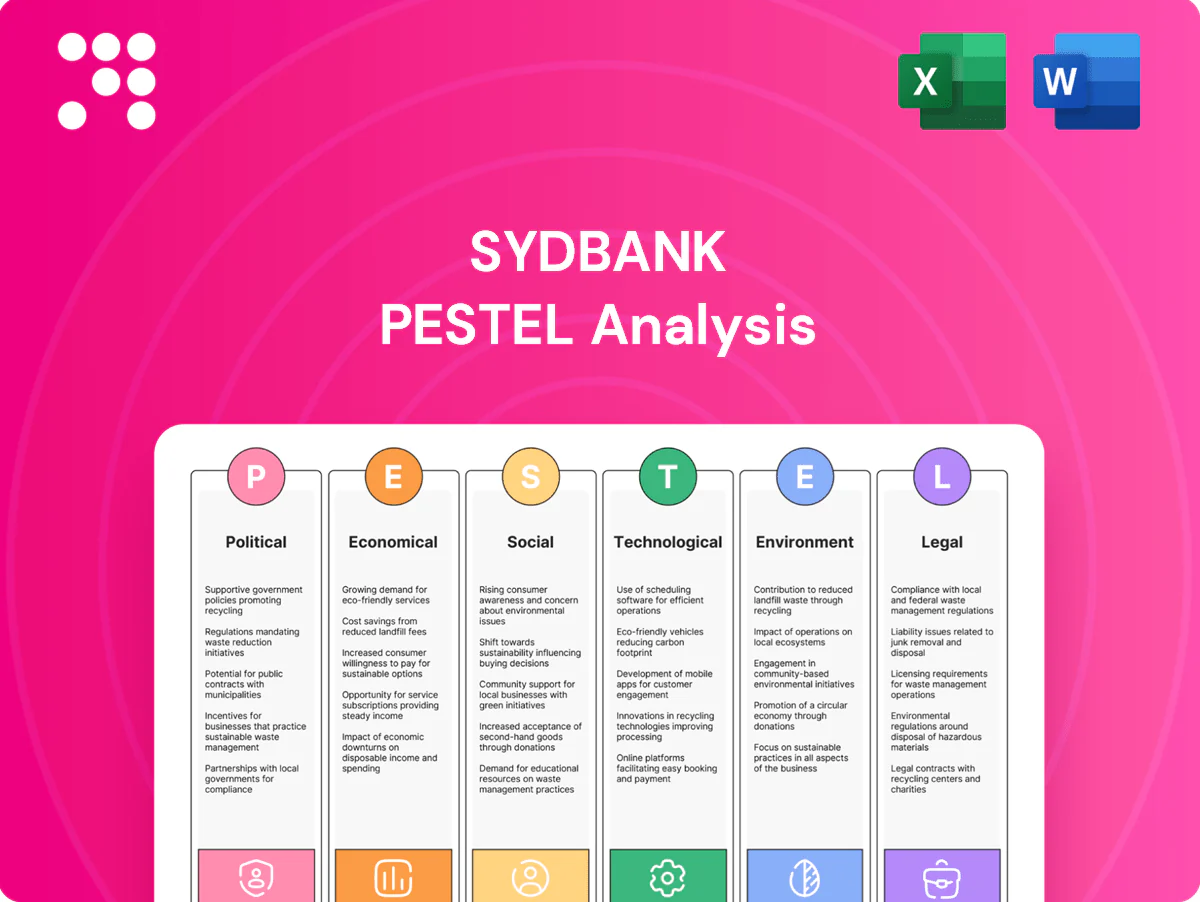
Sydbank PESTLE Analysis

Your Competitive Advantage Starts with This Report
Uncover how political shifts, economic cycles, and regulatory change are shaping Sydbank’s strategic position and risk profile. This concise PESTLE summary highlights the external forces investors and managers must track. Purchase the full analysis for a detailed, actionable breakdown ready for use in reports and strategy sessions.
Political factors

EU and Danish regulatory governance
EU-level rulemaking via the European Commission and European Parliament (CRR/CRD, PSD2/AML) together with national supervisors — Danish FSA and Germany’s BaFin — directly determine Sydbank’s capital, conduct and consumer rules and require cross-border coordination for its Danish‑German footprint. ECB/SSM reporting shows euro‑area CET1 at about 15.2% at end‑2023, setting supervisory expectations that influence Sydbank’s buffers. Policy stability helps planning, but episodes of sudden supervisory tightening can force rapid capital or provisioning moves, raising compliance costs. Higher regulatory compliance increases operating expenses and constrains strategic flexibility for M&A or product shifts.
Monetary policy coordination (ECB/Danmarks Nationalbank)
ECB deposit rate at 4.00% (July 2025) anchors German market rates while Danmarks Nationalbank, with a policy rate near 4.65% to defend the krone peg, forces Danish rates to track EUR moves; this compresses Sydbank net interest margin via higher deposit betas and muted loan demand sensitivity. Policy divergence risk raises funding-cost volatility and requires active liquidity buffers, duration positioning and FX interest-rate hedges to protect balance-sheet NII and capital ratios.

Public support for SMEs and green finance
Danish schemes (Vækstfonden, EKF) and German KfW/Hermes programs channel large state-backed SME and export finance—KfW’s balance sheet exceeds EUR 550bn (2024), while EKF/Vækstfonden materially expand guarantees and co‑lending for SMEs—subsidies and guarantees raise credit volumes and lower RWA through official risk-sharing, boosting lending capacity; energy-transition loans (wind, heat pumps, green capex) are growth opportunities, but access requires detailed applications, environmental reporting and collateral and compliance with state-aid rules.

Geopolitical and security dynamics
EU-Russia tensions and sanctions since 2022 cut EU goods imports from Russia by ~60% in 2022, forcing clients into reshoring and compliance-heavy supply chains; the 2023 EU Critical Raw Materials Act targets 10% extraction and 40% processing by 2030. NATO spending and posture lift defense-sector demand while cybercrime costs, rising from $8.4T (2022) toward a projected $10.5T by 2025, heighten resilience and screening obligations, increasing credit risk for energy, shipping and defense suppliers.
- sanctions: tight banking/transaction screening
- reshoring: CRM Act targets 10%/40%
- security: higher NATO defense demand
- cyber: rising global losses ≈$10.5T by 2025
- credit risk: elevated in energy/shipping/defense
Local political priorities and taxation
Denmark’s corporate tax is 22% while Germany’s combined rate (corporate + solidarity + trade tax) typically runs ~30–33% (trade tax 14–17%), and 2024–25 debates included one‑off windfall levies on banks that could squeeze profits and capital planning. Municipal politics influence branch footprints, property taxes and real-estate exposure, affecting ABR and reputation management with stakeholders.
- Tax rates: DK 22%; DE ~30–33%
- Trade tax (DE) 14–17%
- 2024–25: windfall levy debates risk profit pressure
- Local politics drive branch presence, property tax and reputational risk
Regulation and rate divergence squeeze margins, raise compliance and credit risk
EU/DK/DE regulation (CRR/CRD, PSD2, AML) and supervisors (Danish FSA, BaFin, ECB/SSM) set capital, conduct and cross‑border rules that raise compliance costs and constrain strategic moves. Divergent rates (ECB 4.00% Jul 2025; Danmarks Nationalbank ~4.65%) increase funding volatility and compress NIM. State programs (KfW >EUR550bn, EKF/Vækstfonden) boost SME lending but add conditionality; sanctions, cyber losses (~USD10.5T by 2025) elevate screening and credit risk.
| Factor | Metric | Impact |
|---|---|---|
| Tax | DK 22% / DE ~30–33% | Profitability, capital planning |
| Rates | ECB 4.00% (Jul 2025) | Funding cost, NIM |
| State finance | KfW >EUR550bn (2024) | SME lending support |
| Geopolitics | Russia imports −60% (2022) | Supply‑chain risk |
| Cyber | Losses ≈USD10.5T (2025) | Operational & credit risk |
What is included in the product
 Detailed Word Document
Explores how Political, Economic, Social, Technological, Environmental and Legal forces uniquely impact Sydbank, with data-backed insights and region-specific regulatory context. Designed for executives and advisors, it delivers forward-looking implications and ready-to-use findings for strategy, funding and risk planning.

 Customizable Excel Spreadsheet
Condensed Sydbank PESTLE summary that’s visually segmented for quick interpretation, easily dropped into presentations or shared across teams to streamline external risk discussions and planning sessions.
Economic factors

Interest rate cycle and margin dynamics
Policy rate moves (ECB deposit rate 4.0% and Danmarks Nationalbank policy rate ~4.2% mid‑2025) transmit into Sydbank’s asset yields quickly via floating loans and covered mortgage repricing, while deposit repricing lags; Denmark shows faster mortgage/wholesale pass‑through than Germany’s sticky retail deposits. NII is highly sensitive—±100bp alters annual NII materially—so fee income substitution (advisory, payments) becomes crucial under cuts; a rate‑cut scenario erodes margins, a higher‑for‑longer path supports NII but pressures deposit pricing.
Macro growth in Denmark and Northern Germany
Denmark GDP grew about 1.6% in 2024 while Northern Germany (Schleswig-Holstein) saw muted growth near 1.0%, with Denmark and Schleswig-Holstein highly export‑oriented (Danish exports ≈45% of GDP), linking regional industrial health to global demand. For Sydbank this supports steady loan demand from exporters and asset management inflows, though rising cost pressures could nudge impairments from current low NPLs (~1%); strong Danish household saving (~10–11%) cushions consumer credit risk. Regional diversification helps but is limited by concentrated cross‑border trade exposure.

Housing market and collateral values
Danish mortgage system relies on covered-bond funding with common maximum LTVs around 80% for owner-occupied loans and widespread amortising structures, driving sensitivity to cyclical house-price swings (prices fell in 2023 then partially recovered in 2024). German residential saw slower growth and rising vacancy in some cities, while commercial yields widened, reducing collateral values and increasing provisioning needs. Higher refinancing volumes and elevated prepayment in low-rate vintages amplify Sydbank’s capital-buffer and liquidity planning requirements.

Inflation and cost pressures
Inflation cooled to 2.4% in 2024 (Eurostat) but Danish wage growth ~4.0% and lower wholesale energy (-≈70% vs 2022) keep upward operating-cost pressure for Sydbank, raising vendor and salary expenses while offsetting credit losses have been limited so far.
Higher rates improved net interest margins, enabling selective product repricing and fee increases, though fee elasticity may curb uptake; productivity gains and automation investments (ongoing) partly offset cost inflation.
FX and cross-border operations
DKK–EUR peg stable at central rate 7.46038 DKK/EUR under ERM II, keeping translation risk minimal, though Sydbank still handles significant operational FX in client flows and rising demand for FX hedging products in 2024–25.
- Minimal translation risk: peg 7.46038 DKK/EUR
- Hedging demand: client-driven FX products
- Lower SEPA costs; higher settlement risk in USD/GBP corridors (CLS mitigant)
- Treasury: intra-group pooling, Danmarks Nationalbank facilities
Regulation and rate divergence squeeze margins, raise compliance and credit risk
Policy rates (ECB 4.0%, DNB ~4.2% mid‑2025) drive NII sensitivity; ±100bp materially moves margins. Denmark GDP ~1.6% (2024), inflation 2.4%, wage growth ~4.0% sustain costs; NPLs low (~1%) but export exposure (~45% of GDP) links credit risk to global demand.
| Metric | Value |
|---|---|
| ECB deposit | 4.0% |
| Danmarks NB | ~4.2% |
| Denmark GDP (2024) | 1.6% |
| Inflation (2024) | 2.4% |
| Wage growth | ~4.0% |
| NPLs | ~1% |
| DKK–EUR | 7.46038 |
Preview Before You Purchase
Sydbank PESTLE Analysis
This Sydbank PESTLE Analysis preview is the exact, fully formatted document you’ll receive after purchase. It includes complete political, economic, social, technological, legal and environmental sections ready to use. No placeholders or teasers—what you see is the final file.

Your Competitive Advantage Starts with This Report
Uncover how political shifts, economic cycles, and regulatory change are shaping Sydbank’s strategic position and risk profile. This concise PESTLE summary highlights the external forces investors and managers must track. Purchase the full analysis for a detailed, actionable breakdown ready for use in reports and strategy sessions.
Political factors
EU and Danish regulatory governance
EU-level rulemaking via the European Commission and European Parliament (CRR/CRD, PSD2/AML) together with national supervisors — Danish FSA and Germany’s BaFin — directly determine Sydbank’s capital, conduct and consumer rules and require cross-border coordination for its Danish‑German footprint. ECB/SSM reporting shows euro‑area CET1 at about 15.2% at end‑2023, setting supervisory expectations that influence Sydbank’s buffers. Policy stability helps planning, but episodes of sudden supervisory tightening can force rapid capital or provisioning moves, raising compliance costs. Higher regulatory compliance increases operating expenses and constrains strategic flexibility for M&A or product shifts.
Monetary policy coordination (ECB/Danmarks Nationalbank)
ECB deposit rate at 4.00% (July 2025) anchors German market rates while Danmarks Nationalbank, with a policy rate near 4.65% to defend the krone peg, forces Danish rates to track EUR moves; this compresses Sydbank net interest margin via higher deposit betas and muted loan demand sensitivity. Policy divergence risk raises funding-cost volatility and requires active liquidity buffers, duration positioning and FX interest-rate hedges to protect balance-sheet NII and capital ratios.
Public support for SMEs and green finance
Danish schemes (Vækstfonden, EKF) and German KfW/Hermes programs channel large state-backed SME and export finance—KfW’s balance sheet exceeds EUR 550bn (2024), while EKF/Vækstfonden materially expand guarantees and co‑lending for SMEs—subsidies and guarantees raise credit volumes and lower RWA through official risk-sharing, boosting lending capacity; energy-transition loans (wind, heat pumps, green capex) are growth opportunities, but access requires detailed applications, environmental reporting and collateral and compliance with state-aid rules.
Geopolitical and security dynamics
EU-Russia tensions and sanctions since 2022 cut EU goods imports from Russia by ~60% in 2022, forcing clients into reshoring and compliance-heavy supply chains; the 2023 EU Critical Raw Materials Act targets 10% extraction and 40% processing by 2030. NATO spending and posture lift defense-sector demand while cybercrime costs, rising from $8.4T (2022) toward a projected $10.5T by 2025, heighten resilience and screening obligations, increasing credit risk for energy, shipping and defense suppliers.
- sanctions: tight banking/transaction screening
- reshoring: CRM Act targets 10%/40%
- security: higher NATO defense demand
- cyber: rising global losses ≈$10.5T by 2025
- credit risk: elevated in energy/shipping/defense
Local political priorities and taxation
Denmark’s corporate tax is 22% while Germany’s combined rate (corporate + solidarity + trade tax) typically runs ~30–33% (trade tax 14–17%), and 2024–25 debates included one‑off windfall levies on banks that could squeeze profits and capital planning. Municipal politics influence branch footprints, property taxes and real-estate exposure, affecting ABR and reputation management with stakeholders.
- Tax rates: DK 22%; DE ~30–33%
- Trade tax (DE) 14–17%
- 2024–25: windfall levy debates risk profit pressure
- Local politics drive branch presence, property tax and reputational risk
Regulation and rate divergence squeeze margins, raise compliance and credit risk
EU/DK/DE regulation (CRR/CRD, PSD2, AML) and supervisors (Danish FSA, BaFin, ECB/SSM) set capital, conduct and cross‑border rules that raise compliance costs and constrain strategic moves. Divergent rates (ECB 4.00% Jul 2025; Danmarks Nationalbank ~4.65%) increase funding volatility and compress NIM. State programs (KfW >EUR550bn, EKF/Vækstfonden) boost SME lending but add conditionality; sanctions, cyber losses (~USD10.5T by 2025) elevate screening and credit risk.
| Factor | Metric | Impact |
|---|---|---|
| Tax | DK 22% / DE ~30–33% | Profitability, capital planning |
| Rates | ECB 4.00% (Jul 2025) | Funding cost, NIM |
| State finance | KfW >EUR550bn (2024) | SME lending support |
| Geopolitics | Russia imports −60% (2022) | Supply‑chain risk |
| Cyber | Losses ≈USD10.5T (2025) | Operational & credit risk |
What is included in the product
Detailed Word Document
Explores how Political, Economic, Social, Technological, Environmental and Legal forces uniquely impact Sydbank, with data-backed insights and region-specific regulatory context. Designed for executives and advisors, it delivers forward-looking implications and ready-to-use findings for strategy, funding and risk planning.
Customizable Excel Spreadsheet
Condensed Sydbank PESTLE summary that’s visually segmented for quick interpretation, easily dropped into presentations or shared across teams to streamline external risk discussions and planning sessions.
Economic factors
Interest rate cycle and margin dynamics
Policy rate moves (ECB deposit rate 4.0% and Danmarks Nationalbank policy rate ~4.2% mid‑2025) transmit into Sydbank’s asset yields quickly via floating loans and covered mortgage repricing, while deposit repricing lags; Denmark shows faster mortgage/wholesale pass‑through than Germany’s sticky retail deposits. NII is highly sensitive—±100bp alters annual NII materially—so fee income substitution (advisory, payments) becomes crucial under cuts; a rate‑cut scenario erodes margins, a higher‑for‑longer path supports NII but pressures deposit pricing.
Macro growth in Denmark and Northern Germany
Denmark GDP grew about 1.6% in 2024 while Northern Germany (Schleswig-Holstein) saw muted growth near 1.0%, with Denmark and Schleswig-Holstein highly export‑oriented (Danish exports ≈45% of GDP), linking regional industrial health to global demand. For Sydbank this supports steady loan demand from exporters and asset management inflows, though rising cost pressures could nudge impairments from current low NPLs (~1%); strong Danish household saving (~10–11%) cushions consumer credit risk. Regional diversification helps but is limited by concentrated cross‑border trade exposure.
Housing market and collateral values
Danish mortgage system relies on covered-bond funding with common maximum LTVs around 80% for owner-occupied loans and widespread amortising structures, driving sensitivity to cyclical house-price swings (prices fell in 2023 then partially recovered in 2024). German residential saw slower growth and rising vacancy in some cities, while commercial yields widened, reducing collateral values and increasing provisioning needs. Higher refinancing volumes and elevated prepayment in low-rate vintages amplify Sydbank’s capital-buffer and liquidity planning requirements.
Inflation and cost pressures
Inflation cooled to 2.4% in 2024 (Eurostat) but Danish wage growth ~4.0% and lower wholesale energy (-≈70% vs 2022) keep upward operating-cost pressure for Sydbank, raising vendor and salary expenses while offsetting credit losses have been limited so far.
Higher rates improved net interest margins, enabling selective product repricing and fee increases, though fee elasticity may curb uptake; productivity gains and automation investments (ongoing) partly offset cost inflation.
FX and cross-border operations
DKK–EUR peg stable at central rate 7.46038 DKK/EUR under ERM II, keeping translation risk minimal, though Sydbank still handles significant operational FX in client flows and rising demand for FX hedging products in 2024–25.
- Minimal translation risk: peg 7.46038 DKK/EUR
- Hedging demand: client-driven FX products
- Lower SEPA costs; higher settlement risk in USD/GBP corridors (CLS mitigant)
- Treasury: intra-group pooling, Danmarks Nationalbank facilities
Regulation and rate divergence squeeze margins, raise compliance and credit risk
Policy rates (ECB 4.0%, DNB ~4.2% mid‑2025) drive NII sensitivity; ±100bp materially moves margins. Denmark GDP ~1.6% (2024), inflation 2.4%, wage growth ~4.0% sustain costs; NPLs low (~1%) but export exposure (~45% of GDP) links credit risk to global demand.
| Metric | Value |
|---|---|
| ECB deposit | 4.0% |
| Danmarks NB | ~4.2% |
| Denmark GDP (2024) | 1.6% |
| Inflation (2024) | 2.4% |
| Wage growth | ~4.0% |
| NPLs | ~1% |
| DKK–EUR | 7.46038 |
Preview Before You Purchase
Sydbank PESTLE Analysis
This Sydbank PESTLE Analysis preview is the exact, fully formatted document you’ll receive after purchase. It includes complete political, economic, social, technological, legal and environmental sections ready to use. No placeholders or teasers—what you see is the final file.
Description
Your Competitive Advantage Starts with This Report
Uncover how political shifts, economic cycles, and regulatory change are shaping Sydbank’s strategic position and risk profile. This concise PESTLE summary highlights the external forces investors and managers must track. Purchase the full analysis for a detailed, actionable breakdown ready for use in reports and strategy sessions.
Political factors
EU and Danish regulatory governance
EU-level rulemaking via the European Commission and European Parliament (CRR/CRD, PSD2/AML) together with national supervisors — Danish FSA and Germany’s BaFin — directly determine Sydbank’s capital, conduct and consumer rules and require cross-border coordination for its Danish‑German footprint. ECB/SSM reporting shows euro‑area CET1 at about 15.2% at end‑2023, setting supervisory expectations that influence Sydbank’s buffers. Policy stability helps planning, but episodes of sudden supervisory tightening can force rapid capital or provisioning moves, raising compliance costs. Higher regulatory compliance increases operating expenses and constrains strategic flexibility for M&A or product shifts.
Monetary policy coordination (ECB/Danmarks Nationalbank)
ECB deposit rate at 4.00% (July 2025) anchors German market rates while Danmarks Nationalbank, with a policy rate near 4.65% to defend the krone peg, forces Danish rates to track EUR moves; this compresses Sydbank net interest margin via higher deposit betas and muted loan demand sensitivity. Policy divergence risk raises funding-cost volatility and requires active liquidity buffers, duration positioning and FX interest-rate hedges to protect balance-sheet NII and capital ratios.
Public support for SMEs and green finance
Danish schemes (Vækstfonden, EKF) and German KfW/Hermes programs channel large state-backed SME and export finance—KfW’s balance sheet exceeds EUR 550bn (2024), while EKF/Vækstfonden materially expand guarantees and co‑lending for SMEs—subsidies and guarantees raise credit volumes and lower RWA through official risk-sharing, boosting lending capacity; energy-transition loans (wind, heat pumps, green capex) are growth opportunities, but access requires detailed applications, environmental reporting and collateral and compliance with state-aid rules.
Geopolitical and security dynamics
EU-Russia tensions and sanctions since 2022 cut EU goods imports from Russia by ~60% in 2022, forcing clients into reshoring and compliance-heavy supply chains; the 2023 EU Critical Raw Materials Act targets 10% extraction and 40% processing by 2030. NATO spending and posture lift defense-sector demand while cybercrime costs, rising from $8.4T (2022) toward a projected $10.5T by 2025, heighten resilience and screening obligations, increasing credit risk for energy, shipping and defense suppliers.
- sanctions: tight banking/transaction screening
- reshoring: CRM Act targets 10%/40%
- security: higher NATO defense demand
- cyber: rising global losses ≈$10.5T by 2025
- credit risk: elevated in energy/shipping/defense
Local political priorities and taxation
Denmark’s corporate tax is 22% while Germany’s combined rate (corporate + solidarity + trade tax) typically runs ~30–33% (trade tax 14–17%), and 2024–25 debates included one‑off windfall levies on banks that could squeeze profits and capital planning. Municipal politics influence branch footprints, property taxes and real-estate exposure, affecting ABR and reputation management with stakeholders.
- Tax rates: DK 22%; DE ~30–33%
- Trade tax (DE) 14–17%
- 2024–25: windfall levy debates risk profit pressure
- Local politics drive branch presence, property tax and reputational risk
Regulation and rate divergence squeeze margins, raise compliance and credit risk
EU/DK/DE regulation (CRR/CRD, PSD2, AML) and supervisors (Danish FSA, BaFin, ECB/SSM) set capital, conduct and cross‑border rules that raise compliance costs and constrain strategic moves. Divergent rates (ECB 4.00% Jul 2025; Danmarks Nationalbank ~4.65%) increase funding volatility and compress NIM. State programs (KfW >EUR550bn, EKF/Vækstfonden) boost SME lending but add conditionality; sanctions, cyber losses (~USD10.5T by 2025) elevate screening and credit risk.
| Factor | Metric | Impact |
|---|---|---|
| Tax | DK 22% / DE ~30–33% | Profitability, capital planning |
| Rates | ECB 4.00% (Jul 2025) | Funding cost, NIM |
| State finance | KfW >EUR550bn (2024) | SME lending support |
| Geopolitics | Russia imports −60% (2022) | Supply‑chain risk |
| Cyber | Losses ≈USD10.5T (2025) | Operational & credit risk |
What is included in the product
Detailed Word Document
Explores how Political, Economic, Social, Technological, Environmental and Legal forces uniquely impact Sydbank, with data-backed insights and region-specific regulatory context. Designed for executives and advisors, it delivers forward-looking implications and ready-to-use findings for strategy, funding and risk planning.
Customizable Excel Spreadsheet
Condensed Sydbank PESTLE summary that’s visually segmented for quick interpretation, easily dropped into presentations or shared across teams to streamline external risk discussions and planning sessions.
Economic factors
Interest rate cycle and margin dynamics
Policy rate moves (ECB deposit rate 4.0% and Danmarks Nationalbank policy rate ~4.2% mid‑2025) transmit into Sydbank’s asset yields quickly via floating loans and covered mortgage repricing, while deposit repricing lags; Denmark shows faster mortgage/wholesale pass‑through than Germany’s sticky retail deposits. NII is highly sensitive—±100bp alters annual NII materially—so fee income substitution (advisory, payments) becomes crucial under cuts; a rate‑cut scenario erodes margins, a higher‑for‑longer path supports NII but pressures deposit pricing.
Macro growth in Denmark and Northern Germany
Denmark GDP grew about 1.6% in 2024 while Northern Germany (Schleswig-Holstein) saw muted growth near 1.0%, with Denmark and Schleswig-Holstein highly export‑oriented (Danish exports ≈45% of GDP), linking regional industrial health to global demand. For Sydbank this supports steady loan demand from exporters and asset management inflows, though rising cost pressures could nudge impairments from current low NPLs (~1%); strong Danish household saving (~10–11%) cushions consumer credit risk. Regional diversification helps but is limited by concentrated cross‑border trade exposure.
Housing market and collateral values
Danish mortgage system relies on covered-bond funding with common maximum LTVs around 80% for owner-occupied loans and widespread amortising structures, driving sensitivity to cyclical house-price swings (prices fell in 2023 then partially recovered in 2024). German residential saw slower growth and rising vacancy in some cities, while commercial yields widened, reducing collateral values and increasing provisioning needs. Higher refinancing volumes and elevated prepayment in low-rate vintages amplify Sydbank’s capital-buffer and liquidity planning requirements.
Inflation and cost pressures
Inflation cooled to 2.4% in 2024 (Eurostat) but Danish wage growth ~4.0% and lower wholesale energy (-≈70% vs 2022) keep upward operating-cost pressure for Sydbank, raising vendor and salary expenses while offsetting credit losses have been limited so far.
Higher rates improved net interest margins, enabling selective product repricing and fee increases, though fee elasticity may curb uptake; productivity gains and automation investments (ongoing) partly offset cost inflation.
FX and cross-border operations
DKK–EUR peg stable at central rate 7.46038 DKK/EUR under ERM II, keeping translation risk minimal, though Sydbank still handles significant operational FX in client flows and rising demand for FX hedging products in 2024–25.
- Minimal translation risk: peg 7.46038 DKK/EUR
- Hedging demand: client-driven FX products
- Lower SEPA costs; higher settlement risk in USD/GBP corridors (CLS mitigant)
- Treasury: intra-group pooling, Danmarks Nationalbank facilities
Regulation and rate divergence squeeze margins, raise compliance and credit risk
Policy rates (ECB 4.0%, DNB ~4.2% mid‑2025) drive NII sensitivity; ±100bp materially moves margins. Denmark GDP ~1.6% (2024), inflation 2.4%, wage growth ~4.0% sustain costs; NPLs low (~1%) but export exposure (~45% of GDP) links credit risk to global demand.
| Metric | Value |
|---|---|
| ECB deposit | 4.0% |
| Danmarks NB | ~4.2% |
| Denmark GDP (2024) | 1.6% |
| Inflation (2024) | 2.4% |
| Wage growth | ~4.0% |
| NPLs | ~1% |
| DKK–EUR | 7.46038 |
Preview Before You Purchase
Sydbank PESTLE Analysis
This Sydbank PESTLE Analysis preview is the exact, fully formatted document you’ll receive after purchase. It includes complete political, economic, social, technological, legal and environmental sections ready to use. No placeholders or teasers—what you see is the final file.











