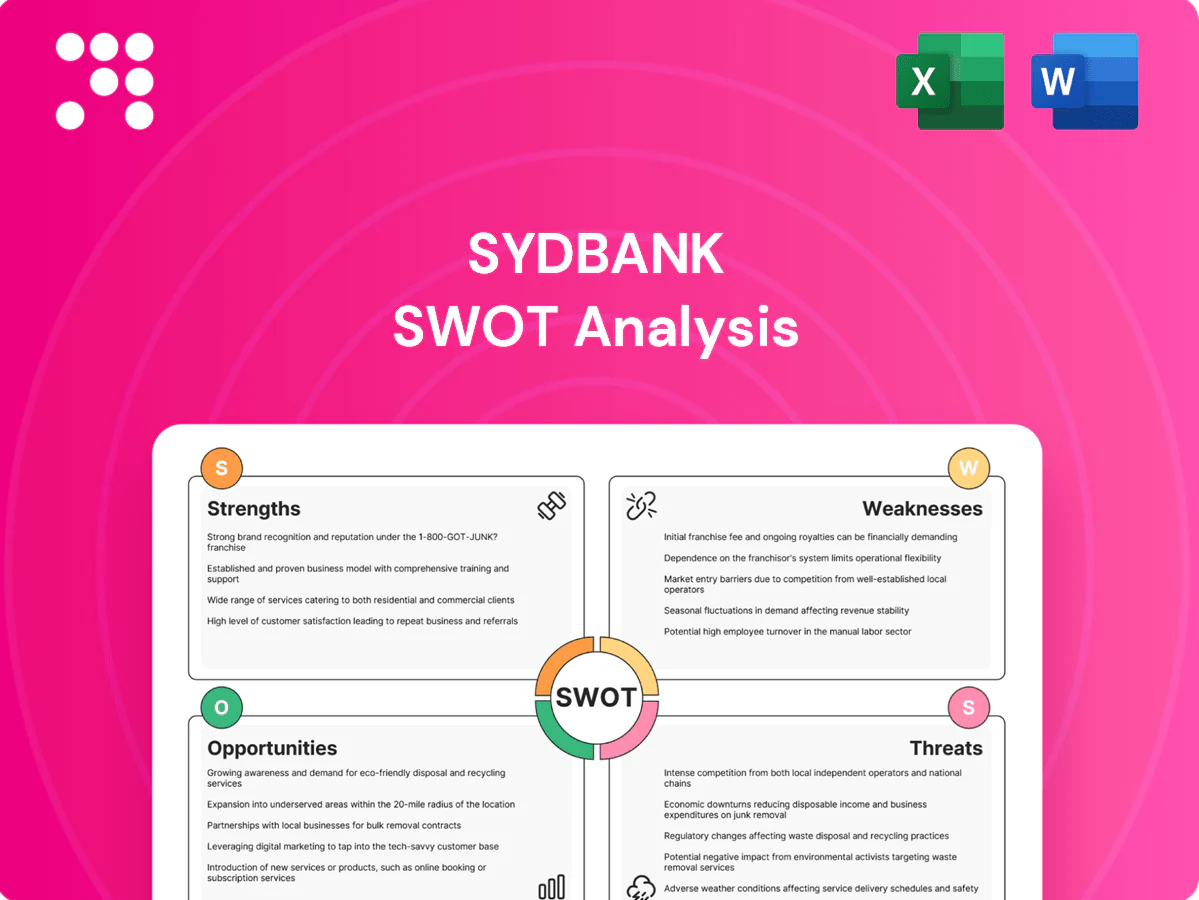
Sydbank SWOT Analysis

Your Strategic Toolkit Starts Here
Sydbank shows solid regional market strengths, strong customer deposits, and digital momentum, but faces margin pressure, regulatory headwinds, and competitive banking dynamics. Want the full story behind its risks and growth drivers? Purchase the complete SWOT analysis to get a professionally written, editable report with actionable insights. Unlock the full report now to plan, pitch, or invest with confidence.
Strengths

Diversified universal banking model
Sydbank’s diversified universal banking model spans six business areas — retail, SME, corporate, asset management, insurance and real estate — creating multiple revenue streams. This breadth helps smooth earnings across cycles and lowers reliance on any single product line. It also supports cross-selling to deepen wallet share and boost customer lifetime value.
Strong regional franchise in Denmark and Northern Germany
Focused footprint across Southern Denmark and Northern Germany strengthens Sydbank’s brand recognition and relationship banking, with local decision-making enabling faster credit approvals and higher customer satisfaction. Proximity to clients supports tailored lending to SMEs and mid-corporates and helps anchor stable retail and corporate deposit bases in core markets.

Relationship-driven SME and corporate expertise
Sydbank’s advisory-led model aligns with Denmark’s SME-dominated economy, where SMEs represent about 99.8% of enterprises and employ roughly 70% of the workforce (Statistics Denmark/Eurostat). Longstanding client ties enhance credit insight and retention. Tailored cash-management and trade services add commercial stickiness. This positioning helps defend margins against commoditized retail banking.

Growing fee income via wealth and insurance
Growing fee income from asset management and bancassurance provides Sydbank with capital-light revenue that can offset interest margin volatility, diversifying income beyond lending and lowering earnings cyclicality; effective cross-selling raises lifetime value per client and strengthens customer stickiness.
Omnichannel capabilities and digital adoption
Sydbank's omnichannel platform increases convenience and reduces branch costs by shifting routine flows to digital channels while preserving high-touch hybrid advisory for complex needs, enabling scale without proportional expense. Data-driven personalization—via transaction analytics and CRM—boosts engagement and retention, strengthening defenses against neobank challengers.
- Digital convenience lowers operational cost
- Hybrid advisory scales advice cost-efficiently
- Data personalization increases customer engagement
- Omnichannel defends market share vs neobanks
Regional universal bank model: SME focus, omnichannel digitalisation, diversified revenue streams
Sydbank’s diversified universal-banking model and regional focus generate multiple revenue streams and strong SME relationships. Omnichannel digitalisation lowers branch costs while preserving high-touch advisory. Denmark’s SMEs represent 99.8% of firms and ~70% of employment, supporting Sydbank’s SME-centric strategy.
| Metric | Value |
|---|---|
| SME share of enterprises (Denmark) | 99.8% |
| SME share of employment | ~70% |
What is included in the product
 Detailed Word Document
Provides a strategic overview of Sydbank’s internal strengths and weaknesses and external opportunities and threats, mapping its competitive position, growth drivers, operational gaps, and market risks to inform strategic decision-making.

 Customizable Excel Spreadsheet
Provides a concise, Sydbank-specific SWOT matrix for fast strategic alignment and stakeholder-ready summaries, easing decision-making under changing market conditions.
Weaknesses

Geographic concentration risk
Revenue and lending remain concentrated in Denmark and adjacent Northern Germany, so local GDP, housing and SME downturns can materially affect Sydbank’s results; limited exposure to other regions reduces geographic diversification and increases sensitivity to domestic housing market swings and SME credit cycles.
Smaller scale versus Nordic majors
Smaller scale raises unit costs and limits pricing power; Sydbank, with about 3,700 employees and roughly DKK 300–350bn in assets in 2024, cannot match Nordic majors' buying power. Larger peers like Nordea (tens of thousands of staff) and DNB outspend on tech and marketing, investing hundreds of millions annually in digital transformation. Over time this spending gap can erode Sydbank's market share and margin pressure.

Interest-income dependence
Lending and deposits still drive Sydbank, with net interest income accounting for roughly 65% of operating income in 2024, so margin compression can quickly hit profits; fee income rose modestly in 2024 but covered only part of potential NIM declines, while balance-sheet repricing delays (weeks–quarters) add earnings volatility.

Legacy systems and complexity
Integrating older core systems with new digital layers pushes IT spend and prolongs vendor dependency, increasing total cost of ownership. The resulting architectural complexity elevates operational risk and incident surface. Large-scale modernization programs can disrupt delivery timelines and customer-facing operations, and delays impede rollout of new features.
- IT spend pressure
- Higher operational risk
- Program disruption
- Slower feature rollout
Sectoral exposure to cyclical clients
Concentration in SMEs and real-estate-linked lending leaves Sydbank vulnerable: about DKK 260bn loan book with roughly 60% exposure to SMEs/property (2024), so downturns can sharply amplify losses. Credit losses and NPLs have risen in stressed cycles, eroding net interest returns and forcing higher provisioning. Correlated collateral values tied to local property markets increase volatility; higher provisions dilute ROE.
- DKK 260bn loan book (2024)
- ~60% SME/real-estate exposure
- Rising provisioning pressure
- Collateral values linked to local markets
DKK 260bn loan book; ~60% SME/real-estate; NII ≈65% exposure
High domestic concentration: ~DKK 260bn loan book with ~60% SME/real-estate exposure (2024) raises sensitivity to Danish housing and SME cycles. Scale disadvantage (≈3,700 staff; DKK 300–350bn assets) limits tech and marketing investment vs Nordic peers. NII ≈65% of operating income (2024) makes profits vulnerable to NIM compression. Legacy core integration increases IT spend, operational risk and rollout delays.
| Metric | 2024 |
|---|---|
| Loan book | DKK 260bn |
| SME/real-estate | ~60% |
| Assets | DKK 300–350bn |
| Employees | ≈3,700 |
| NII share | ≈65% |
Full Version Awaits
Sydbank SWOT Analysis
This is the actual Sydbank SWOT analysis document you’ll receive upon purchase—no surprises, just professional quality. The preview below is taken directly from the full report you'll get; buy to unlock the complete, editable version. You’ll receive the full file immediately after payment, structured and ready to use.

Your Strategic Toolkit Starts Here
Sydbank shows solid regional market strengths, strong customer deposits, and digital momentum, but faces margin pressure, regulatory headwinds, and competitive banking dynamics. Want the full story behind its risks and growth drivers? Purchase the complete SWOT analysis to get a professionally written, editable report with actionable insights. Unlock the full report now to plan, pitch, or invest with confidence.
Strengths
Diversified universal banking model
Sydbank’s diversified universal banking model spans six business areas — retail, SME, corporate, asset management, insurance and real estate — creating multiple revenue streams. This breadth helps smooth earnings across cycles and lowers reliance on any single product line. It also supports cross-selling to deepen wallet share and boost customer lifetime value.
Strong regional franchise in Denmark and Northern Germany
Focused footprint across Southern Denmark and Northern Germany strengthens Sydbank’s brand recognition and relationship banking, with local decision-making enabling faster credit approvals and higher customer satisfaction. Proximity to clients supports tailored lending to SMEs and mid-corporates and helps anchor stable retail and corporate deposit bases in core markets.
Relationship-driven SME and corporate expertise
Sydbank’s advisory-led model aligns with Denmark’s SME-dominated economy, where SMEs represent about 99.8% of enterprises and employ roughly 70% of the workforce (Statistics Denmark/Eurostat). Longstanding client ties enhance credit insight and retention. Tailored cash-management and trade services add commercial stickiness. This positioning helps defend margins against commoditized retail banking.
Growing fee income via wealth and insurance
Growing fee income from asset management and bancassurance provides Sydbank with capital-light revenue that can offset interest margin volatility, diversifying income beyond lending and lowering earnings cyclicality; effective cross-selling raises lifetime value per client and strengthens customer stickiness.
Omnichannel capabilities and digital adoption
Sydbank's omnichannel platform increases convenience and reduces branch costs by shifting routine flows to digital channels while preserving high-touch hybrid advisory for complex needs, enabling scale without proportional expense. Data-driven personalization—via transaction analytics and CRM—boosts engagement and retention, strengthening defenses against neobank challengers.
- Digital convenience lowers operational cost
- Hybrid advisory scales advice cost-efficiently
- Data personalization increases customer engagement
- Omnichannel defends market share vs neobanks
Regional universal bank model: SME focus, omnichannel digitalisation, diversified revenue streams
Sydbank’s diversified universal-banking model and regional focus generate multiple revenue streams and strong SME relationships. Omnichannel digitalisation lowers branch costs while preserving high-touch advisory. Denmark’s SMEs represent 99.8% of firms and ~70% of employment, supporting Sydbank’s SME-centric strategy.
| Metric | Value |
|---|---|
| SME share of enterprises (Denmark) | 99.8% |
| SME share of employment | ~70% |
What is included in the product
Detailed Word Document
Provides a strategic overview of Sydbank’s internal strengths and weaknesses and external opportunities and threats, mapping its competitive position, growth drivers, operational gaps, and market risks to inform strategic decision-making.
Customizable Excel Spreadsheet
Provides a concise, Sydbank-specific SWOT matrix for fast strategic alignment and stakeholder-ready summaries, easing decision-making under changing market conditions.
Weaknesses
Geographic concentration risk
Revenue and lending remain concentrated in Denmark and adjacent Northern Germany, so local GDP, housing and SME downturns can materially affect Sydbank’s results; limited exposure to other regions reduces geographic diversification and increases sensitivity to domestic housing market swings and SME credit cycles.
Smaller scale versus Nordic majors
Smaller scale raises unit costs and limits pricing power; Sydbank, with about 3,700 employees and roughly DKK 300–350bn in assets in 2024, cannot match Nordic majors' buying power. Larger peers like Nordea (tens of thousands of staff) and DNB outspend on tech and marketing, investing hundreds of millions annually in digital transformation. Over time this spending gap can erode Sydbank's market share and margin pressure.
Interest-income dependence
Lending and deposits still drive Sydbank, with net interest income accounting for roughly 65% of operating income in 2024, so margin compression can quickly hit profits; fee income rose modestly in 2024 but covered only part of potential NIM declines, while balance-sheet repricing delays (weeks–quarters) add earnings volatility.
Legacy systems and complexity
Integrating older core systems with new digital layers pushes IT spend and prolongs vendor dependency, increasing total cost of ownership. The resulting architectural complexity elevates operational risk and incident surface. Large-scale modernization programs can disrupt delivery timelines and customer-facing operations, and delays impede rollout of new features.
- IT spend pressure
- Higher operational risk
- Program disruption
- Slower feature rollout
Sectoral exposure to cyclical clients
Concentration in SMEs and real-estate-linked lending leaves Sydbank vulnerable: about DKK 260bn loan book with roughly 60% exposure to SMEs/property (2024), so downturns can sharply amplify losses. Credit losses and NPLs have risen in stressed cycles, eroding net interest returns and forcing higher provisioning. Correlated collateral values tied to local property markets increase volatility; higher provisions dilute ROE.
- DKK 260bn loan book (2024)
- ~60% SME/real-estate exposure
- Rising provisioning pressure
- Collateral values linked to local markets
DKK 260bn loan book; ~60% SME/real-estate; NII ≈65% exposure
High domestic concentration: ~DKK 260bn loan book with ~60% SME/real-estate exposure (2024) raises sensitivity to Danish housing and SME cycles. Scale disadvantage (≈3,700 staff; DKK 300–350bn assets) limits tech and marketing investment vs Nordic peers. NII ≈65% of operating income (2024) makes profits vulnerable to NIM compression. Legacy core integration increases IT spend, operational risk and rollout delays.
| Metric | 2024 |
|---|---|
| Loan book | DKK 260bn |
| SME/real-estate | ~60% |
| Assets | DKK 300–350bn |
| Employees | ≈3,700 |
| NII share | ≈65% |
Full Version Awaits
Sydbank SWOT Analysis
This is the actual Sydbank SWOT analysis document you’ll receive upon purchase—no surprises, just professional quality. The preview below is taken directly from the full report you'll get; buy to unlock the complete, editable version. You’ll receive the full file immediately after payment, structured and ready to use.
Original: $10.00
-65%$10.00
$3.50Description
Your Strategic Toolkit Starts Here
Sydbank shows solid regional market strengths, strong customer deposits, and digital momentum, but faces margin pressure, regulatory headwinds, and competitive banking dynamics. Want the full story behind its risks and growth drivers? Purchase the complete SWOT analysis to get a professionally written, editable report with actionable insights. Unlock the full report now to plan, pitch, or invest with confidence.
Strengths
Diversified universal banking model
Sydbank’s diversified universal banking model spans six business areas — retail, SME, corporate, asset management, insurance and real estate — creating multiple revenue streams. This breadth helps smooth earnings across cycles and lowers reliance on any single product line. It also supports cross-selling to deepen wallet share and boost customer lifetime value.
Strong regional franchise in Denmark and Northern Germany
Focused footprint across Southern Denmark and Northern Germany strengthens Sydbank’s brand recognition and relationship banking, with local decision-making enabling faster credit approvals and higher customer satisfaction. Proximity to clients supports tailored lending to SMEs and mid-corporates and helps anchor stable retail and corporate deposit bases in core markets.
Relationship-driven SME and corporate expertise
Sydbank’s advisory-led model aligns with Denmark’s SME-dominated economy, where SMEs represent about 99.8% of enterprises and employ roughly 70% of the workforce (Statistics Denmark/Eurostat). Longstanding client ties enhance credit insight and retention. Tailored cash-management and trade services add commercial stickiness. This positioning helps defend margins against commoditized retail banking.
Growing fee income via wealth and insurance
Growing fee income from asset management and bancassurance provides Sydbank with capital-light revenue that can offset interest margin volatility, diversifying income beyond lending and lowering earnings cyclicality; effective cross-selling raises lifetime value per client and strengthens customer stickiness.
Omnichannel capabilities and digital adoption
Sydbank's omnichannel platform increases convenience and reduces branch costs by shifting routine flows to digital channels while preserving high-touch hybrid advisory for complex needs, enabling scale without proportional expense. Data-driven personalization—via transaction analytics and CRM—boosts engagement and retention, strengthening defenses against neobank challengers.
- Digital convenience lowers operational cost
- Hybrid advisory scales advice cost-efficiently
- Data personalization increases customer engagement
- Omnichannel defends market share vs neobanks
Regional universal bank model: SME focus, omnichannel digitalisation, diversified revenue streams
Sydbank’s diversified universal-banking model and regional focus generate multiple revenue streams and strong SME relationships. Omnichannel digitalisation lowers branch costs while preserving high-touch advisory. Denmark’s SMEs represent 99.8% of firms and ~70% of employment, supporting Sydbank’s SME-centric strategy.
| Metric | Value |
|---|---|
| SME share of enterprises (Denmark) | 99.8% |
| SME share of employment | ~70% |
What is included in the product
Detailed Word Document
Provides a strategic overview of Sydbank’s internal strengths and weaknesses and external opportunities and threats, mapping its competitive position, growth drivers, operational gaps, and market risks to inform strategic decision-making.
Customizable Excel Spreadsheet
Provides a concise, Sydbank-specific SWOT matrix for fast strategic alignment and stakeholder-ready summaries, easing decision-making under changing market conditions.
Weaknesses
Geographic concentration risk
Revenue and lending remain concentrated in Denmark and adjacent Northern Germany, so local GDP, housing and SME downturns can materially affect Sydbank’s results; limited exposure to other regions reduces geographic diversification and increases sensitivity to domestic housing market swings and SME credit cycles.
Smaller scale versus Nordic majors
Smaller scale raises unit costs and limits pricing power; Sydbank, with about 3,700 employees and roughly DKK 300–350bn in assets in 2024, cannot match Nordic majors' buying power. Larger peers like Nordea (tens of thousands of staff) and DNB outspend on tech and marketing, investing hundreds of millions annually in digital transformation. Over time this spending gap can erode Sydbank's market share and margin pressure.
Interest-income dependence
Lending and deposits still drive Sydbank, with net interest income accounting for roughly 65% of operating income in 2024, so margin compression can quickly hit profits; fee income rose modestly in 2024 but covered only part of potential NIM declines, while balance-sheet repricing delays (weeks–quarters) add earnings volatility.
Legacy systems and complexity
Integrating older core systems with new digital layers pushes IT spend and prolongs vendor dependency, increasing total cost of ownership. The resulting architectural complexity elevates operational risk and incident surface. Large-scale modernization programs can disrupt delivery timelines and customer-facing operations, and delays impede rollout of new features.
- IT spend pressure
- Higher operational risk
- Program disruption
- Slower feature rollout
Sectoral exposure to cyclical clients
Concentration in SMEs and real-estate-linked lending leaves Sydbank vulnerable: about DKK 260bn loan book with roughly 60% exposure to SMEs/property (2024), so downturns can sharply amplify losses. Credit losses and NPLs have risen in stressed cycles, eroding net interest returns and forcing higher provisioning. Correlated collateral values tied to local property markets increase volatility; higher provisions dilute ROE.
- DKK 260bn loan book (2024)
- ~60% SME/real-estate exposure
- Rising provisioning pressure
- Collateral values linked to local markets
DKK 260bn loan book; ~60% SME/real-estate; NII ≈65% exposure
High domestic concentration: ~DKK 260bn loan book with ~60% SME/real-estate exposure (2024) raises sensitivity to Danish housing and SME cycles. Scale disadvantage (≈3,700 staff; DKK 300–350bn assets) limits tech and marketing investment vs Nordic peers. NII ≈65% of operating income (2024) makes profits vulnerable to NIM compression. Legacy core integration increases IT spend, operational risk and rollout delays.
| Metric | 2024 |
|---|---|
| Loan book | DKK 260bn |
| SME/real-estate | ~60% |
| Assets | DKK 300–350bn |
| Employees | ≈3,700 |
| NII share | ≈65% |
Full Version Awaits
Sydbank SWOT Analysis
This is the actual Sydbank SWOT analysis document you’ll receive upon purchase—no surprises, just professional quality. The preview below is taken directly from the full report you'll get; buy to unlock the complete, editable version. You’ll receive the full file immediately after payment, structured and ready to use.











