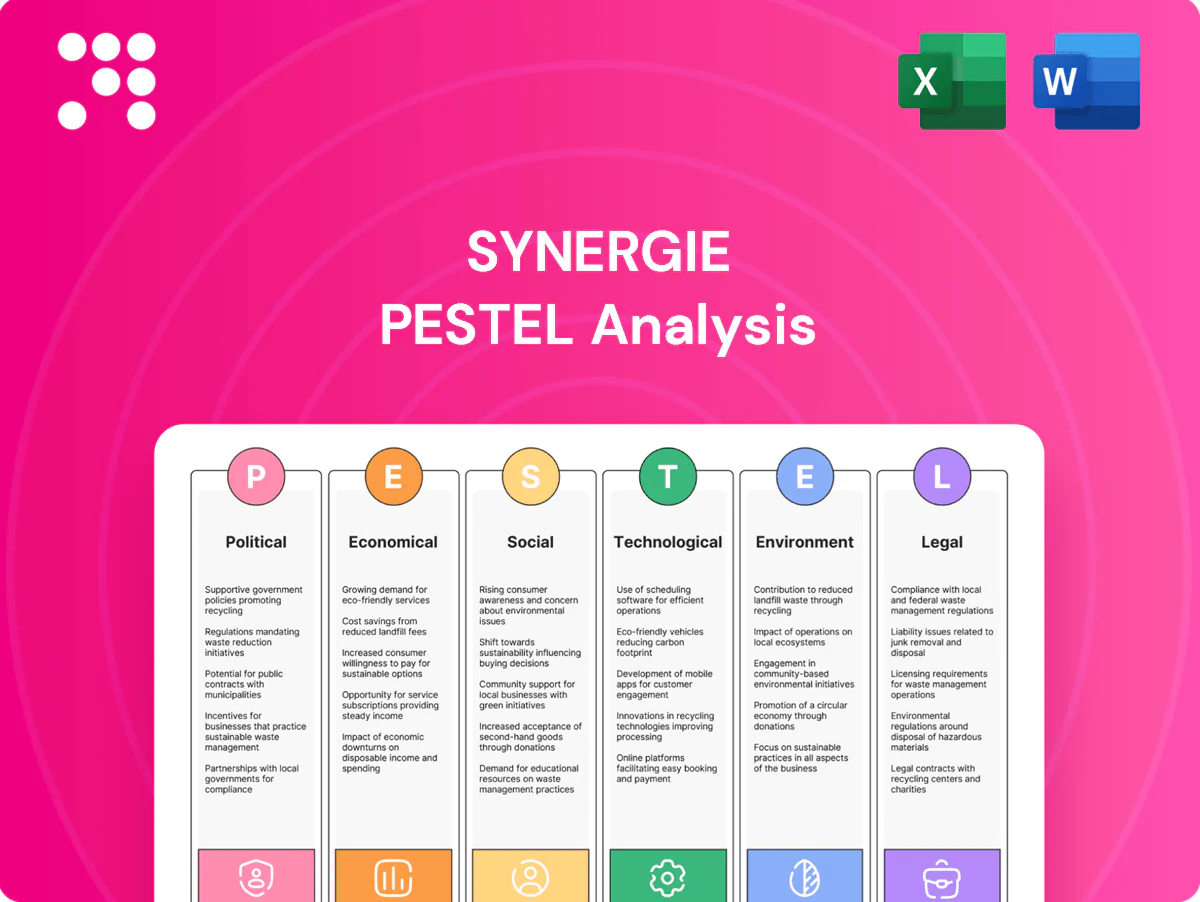
Synergie PESTLE Analysis

Plan Smarter. Present Sharper. Compete Stronger.
Unlock how political shifts, economic trends, social dynamics, and technological changes are shaping Synergie’s prospects with our concise PESTLE snapshot—perfect for investors and strategists. For a full, actionable breakdown with regulatory risk, market drivers, and scenario-ready insights, purchase the complete PESTLE now and make smarter decisions faster.
Political factors

Public employment and labor policies
Government initiatives on employment, apprenticeships and active labor market policies directly shape demand for staffing services. EU NextGenerationEU recovery funds (~€800bn) and national incentives can boost placement volumes; Eurostat recorded a 6.4% unemployment rate in 2024. Public-sector hiring freezes or budget cuts reduce opportunities. Synergie should align bids and training offerings with national and regional programs.
Immigration and work permit regimes
Migration regimes shape Synergie’s talent supply: US H-1B caps remain at 85,000 annual visas, Schengen rules target 15-day visa processing, and Canada sets 6-month service standards for many work permits, all affecting candidate flow. Stricter border controls shrink available pools and intensify wage pressure for scarce skills. Streamlined sector-specific permits speed placements in healthcare and tech. Proactive compliance and mobility services create a competitive differentiator.

Geopolitical stability and cross-border operations
Political instability, sanctions, or conflict can interrupt multinational clients and cross-border staffing; over 70 countries maintain active sanctions regimes as of 2025, increasing compliance burden. Currency and policy volatility raise operational risk in exposed markets. Diversified geography mitigates concentration risk, while scenario planning preserves service continuity.

EU directives and national transposition
EU directives on platform work, temporary agency work and worker protections drive structural change across 27 member states; directives typically allow up to 24 months for national transposition. Variation in timing and measures creates compliance complexity and local legal risk. Harmonized frameworks aid scalability but require country-specific HR, legal and payroll expertise. Early monitoring of transposition lets Synergie adjust pricing and contracts.
- 27 member states
- Transposition window commonly up to 24 months
- High local compliance complexity
- Harmonization aids scalability but needs local expertise
- Early monitoring enables pricing/contract adjustments
Public procurement dynamics
Staffing contracts with public bodies follow cyclical tenders driven by political priorities; public procurement represents roughly 14% of EU GDP and remains a major revenue stream for providers. Recent shifts toward insourcing and local-preference rules (eg, strengthened Buy America/Buy Local measures through 2024) have reduced win rates in some markets. By 2024 EU procurement rules formally embed environmental and social criteria, raising the bar for suppliers. Robust bidding teams plus certifications (ISO 9001/14001) measurably improve shortlisting and award chances.
- tender cycles: high volatility
- market size: ~14% EU GDP
- policy risk: insourcing/local-preference up
- ESG: embedded in 2024 tenders
- advantage: ISO certifications & strong bid teams
EU €800bn recovery fuels demand; procurement ~14% GDP, unemployment 6.4%
Government hiring cycles, EU NextGeneration (~€800bn) and 2024 unemployment 6.4% drive demand; public procurement ~14% EU GDP with ESG now mandatory. Migration controls (US H‑1B 85,000 cap) and Schengen visa targets shape supply; sanctions (>70 countries by 2025) and geopolitical risk raise compliance costs.
| Metric | Value |
|---|---|
| EU recovery | ~€800bn |
| Unemployment (2024) | 6.4% |
| Public procurement | ~14% GDP |
| Sanctions (2025) | >70 countries |
What is included in the product
 Detailed Word Document
Explores how macro-environmental factors uniquely affect Synergie across Political, Economic, Social, Technological, Environmental and Legal dimensions, with data-backed trends, detailed subpoints and forward-looking insights—designed by experienced strategists to inform executives, boost investor confidence and support scenario planning.

 Customizable Excel Spreadsheet
A condensed, visually segmented PESTLE summary that’s editable for region- or business-specific notes, easily dropped into presentations or shared across teams, using clear language to support rapid risk discussions, alignment and client-ready reports.
Economic factors

Business cycle sensitivity
Temporary staffing is cyclical—expanding in growth phases and contracting in recessions—while permanent placement is highly pro-cyclical; Synergie mitigates volatility by maintaining a diversified mix. SIA reported global staffing revenue of about 574 billion USD in 2023, underscoring market scale. Training and reskilling can be counter-cyclical, smoothing demand, and dynamic cost management preserves margins across cycles.
Labor shortages and wage inflation
Talent scarcity in healthcare, logistics, IT and green roles — with AAMC projecting up to 121,900 physician shortfall by 2034, IRENA reporting 12.7M renewables jobs in 2023 and Korn Ferry forecasting a global 85M gap by 2030 — is pushing bill rates higher while BLS showed ~4% wage growth in 2024, compressing spreads if client pricing lags; rapid repricing, value-added services, proprietary talent pools and training pipelines cut acquisition costs and ease bottlenecks.

SME vs large-enterprise demand
Large accounts often generate 60–80% of revenue and provide stability but compress margins through aggressive pricing. SMEs deliver 15–30% higher gross margins yet show churn of 20–35% versus 5–8% for large clients. A segmented go-to-market raises risk-adjusted portfolio yield. Payment terms/DSO range 30–90 days; credit-loss rates ≈0.2–0.5% (large) vs 2–5% (SME).

Interest rates and funding costs
Working capital is heavy due to payroll pre-financing, and elevated policy rates (US federal funds 5.25–5.50% and ECB deposit 4.00% in 2024) raise factoring and debt costs, compressing margins. Tightening increases cost of receivables financing and bank credit spreads, so efficient DSO management and dynamic discounting materially cut funding needs. Strong cash forecasting improves liquidity resilience and reduces expensive short-term borrowing.
- Payroll pre-finance: high cash draw
- Policy rates: US 5.25–5.50%, ECB 4.00% (2024)
- Higher rates → higher factoring/debt costs
- DSO + dynamic discounting = lower funding need
- Cash forecasting = resilience
Sectoral shifts and green growth
Energy transition and infrastructure spending (US Inflation Reduction Act ~369bn in incentives) are creating strong demand for technical and project staffing, while global e-commerce growth slowed to about 8% in 2024, moderating logistics hiring even as manufacturing reshoring lifts industrial roles and capital investment.
- Tag: energy_staffing
- Tag: infra_projects
- Tag: ecom_moderation
- Tag: reshoring_industrial
- Tag: training_alignment
- Tag: data_workforce
EU €800bn recovery fuels demand; procurement ~14% GDP, unemployment 6.4%
Temporary staffing cushions cycles while permanent placement amplifies them; Synergie offsets volatility via channel diversification. Talent shortages (physician gap 121,900 by 2034; 12.7M renewables jobs 2023) push bill rates even as 2024 wage growth ~4% compresses spreads. Heavy payroll pre-finance and 2024 policy rates (US 5.25–5.50%, ECB 4.00%) elevate funding costs; DSO, dynamic discounting and training pipelines preserve margins.
| Metric | Value |
|---|---|
| Global staffing rev (SIA 2023) | 574bn USD |
| Physician shortfall | 121,900 by 2034 |
| Renewables jobs (2023) | 12.7M |
| Policy rates (2024) | US 5.25–5.50%, ECB 4.00% |
Full Version Awaits
Synergie PESTLE Analysis
The Synergie PESTLE Analysis preview shown here is the exact document you’ll receive after purchase—fully formatted, professionally structured, and ready to use. What you see is the finished file with complete content and layout, not a teaser or placeholder. After checkout you’ll be able to download this same comprehensive analysis immediately.

Plan Smarter. Present Sharper. Compete Stronger.
Unlock how political shifts, economic trends, social dynamics, and technological changes are shaping Synergie’s prospects with our concise PESTLE snapshot—perfect for investors and strategists. For a full, actionable breakdown with regulatory risk, market drivers, and scenario-ready insights, purchase the complete PESTLE now and make smarter decisions faster.
Political factors
Public employment and labor policies
Government initiatives on employment, apprenticeships and active labor market policies directly shape demand for staffing services. EU NextGenerationEU recovery funds (~€800bn) and national incentives can boost placement volumes; Eurostat recorded a 6.4% unemployment rate in 2024. Public-sector hiring freezes or budget cuts reduce opportunities. Synergie should align bids and training offerings with national and regional programs.
Immigration and work permit regimes
Migration regimes shape Synergie’s talent supply: US H-1B caps remain at 85,000 annual visas, Schengen rules target 15-day visa processing, and Canada sets 6-month service standards for many work permits, all affecting candidate flow. Stricter border controls shrink available pools and intensify wage pressure for scarce skills. Streamlined sector-specific permits speed placements in healthcare and tech. Proactive compliance and mobility services create a competitive differentiator.
Geopolitical stability and cross-border operations
Political instability, sanctions, or conflict can interrupt multinational clients and cross-border staffing; over 70 countries maintain active sanctions regimes as of 2025, increasing compliance burden. Currency and policy volatility raise operational risk in exposed markets. Diversified geography mitigates concentration risk, while scenario planning preserves service continuity.
EU directives and national transposition
EU directives on platform work, temporary agency work and worker protections drive structural change across 27 member states; directives typically allow up to 24 months for national transposition. Variation in timing and measures creates compliance complexity and local legal risk. Harmonized frameworks aid scalability but require country-specific HR, legal and payroll expertise. Early monitoring of transposition lets Synergie adjust pricing and contracts.
- 27 member states
- Transposition window commonly up to 24 months
- High local compliance complexity
- Harmonization aids scalability but needs local expertise
- Early monitoring enables pricing/contract adjustments
Public procurement dynamics
Staffing contracts with public bodies follow cyclical tenders driven by political priorities; public procurement represents roughly 14% of EU GDP and remains a major revenue stream for providers. Recent shifts toward insourcing and local-preference rules (eg, strengthened Buy America/Buy Local measures through 2024) have reduced win rates in some markets. By 2024 EU procurement rules formally embed environmental and social criteria, raising the bar for suppliers. Robust bidding teams plus certifications (ISO 9001/14001) measurably improve shortlisting and award chances.
- tender cycles: high volatility
- market size: ~14% EU GDP
- policy risk: insourcing/local-preference up
- ESG: embedded in 2024 tenders
- advantage: ISO certifications & strong bid teams
EU €800bn recovery fuels demand; procurement ~14% GDP, unemployment 6.4%
Government hiring cycles, EU NextGeneration (~€800bn) and 2024 unemployment 6.4% drive demand; public procurement ~14% EU GDP with ESG now mandatory. Migration controls (US H‑1B 85,000 cap) and Schengen visa targets shape supply; sanctions (>70 countries by 2025) and geopolitical risk raise compliance costs.
| Metric | Value |
|---|---|
| EU recovery | ~€800bn |
| Unemployment (2024) | 6.4% |
| Public procurement | ~14% GDP |
| Sanctions (2025) | >70 countries |
What is included in the product
Detailed Word Document
Explores how macro-environmental factors uniquely affect Synergie across Political, Economic, Social, Technological, Environmental and Legal dimensions, with data-backed trends, detailed subpoints and forward-looking insights—designed by experienced strategists to inform executives, boost investor confidence and support scenario planning.
Customizable Excel Spreadsheet
A condensed, visually segmented PESTLE summary that’s editable for region- or business-specific notes, easily dropped into presentations or shared across teams, using clear language to support rapid risk discussions, alignment and client-ready reports.
Economic factors
Business cycle sensitivity
Temporary staffing is cyclical—expanding in growth phases and contracting in recessions—while permanent placement is highly pro-cyclical; Synergie mitigates volatility by maintaining a diversified mix. SIA reported global staffing revenue of about 574 billion USD in 2023, underscoring market scale. Training and reskilling can be counter-cyclical, smoothing demand, and dynamic cost management preserves margins across cycles.
Labor shortages and wage inflation
Talent scarcity in healthcare, logistics, IT and green roles — with AAMC projecting up to 121,900 physician shortfall by 2034, IRENA reporting 12.7M renewables jobs in 2023 and Korn Ferry forecasting a global 85M gap by 2030 — is pushing bill rates higher while BLS showed ~4% wage growth in 2024, compressing spreads if client pricing lags; rapid repricing, value-added services, proprietary talent pools and training pipelines cut acquisition costs and ease bottlenecks.
SME vs large-enterprise demand
Large accounts often generate 60–80% of revenue and provide stability but compress margins through aggressive pricing. SMEs deliver 15–30% higher gross margins yet show churn of 20–35% versus 5–8% for large clients. A segmented go-to-market raises risk-adjusted portfolio yield. Payment terms/DSO range 30–90 days; credit-loss rates ≈0.2–0.5% (large) vs 2–5% (SME).
Interest rates and funding costs
Working capital is heavy due to payroll pre-financing, and elevated policy rates (US federal funds 5.25–5.50% and ECB deposit 4.00% in 2024) raise factoring and debt costs, compressing margins. Tightening increases cost of receivables financing and bank credit spreads, so efficient DSO management and dynamic discounting materially cut funding needs. Strong cash forecasting improves liquidity resilience and reduces expensive short-term borrowing.
- Payroll pre-finance: high cash draw
- Policy rates: US 5.25–5.50%, ECB 4.00% (2024)
- Higher rates → higher factoring/debt costs
- DSO + dynamic discounting = lower funding need
- Cash forecasting = resilience
Sectoral shifts and green growth
Energy transition and infrastructure spending (US Inflation Reduction Act ~369bn in incentives) are creating strong demand for technical and project staffing, while global e-commerce growth slowed to about 8% in 2024, moderating logistics hiring even as manufacturing reshoring lifts industrial roles and capital investment.
- Tag: energy_staffing
- Tag: infra_projects
- Tag: ecom_moderation
- Tag: reshoring_industrial
- Tag: training_alignment
- Tag: data_workforce
EU €800bn recovery fuels demand; procurement ~14% GDP, unemployment 6.4%
Temporary staffing cushions cycles while permanent placement amplifies them; Synergie offsets volatility via channel diversification. Talent shortages (physician gap 121,900 by 2034; 12.7M renewables jobs 2023) push bill rates even as 2024 wage growth ~4% compresses spreads. Heavy payroll pre-finance and 2024 policy rates (US 5.25–5.50%, ECB 4.00%) elevate funding costs; DSO, dynamic discounting and training pipelines preserve margins.
| Metric | Value |
|---|---|
| Global staffing rev (SIA 2023) | 574bn USD |
| Physician shortfall | 121,900 by 2034 |
| Renewables jobs (2023) | 12.7M |
| Policy rates (2024) | US 5.25–5.50%, ECB 4.00% |
Full Version Awaits
Synergie PESTLE Analysis
The Synergie PESTLE Analysis preview shown here is the exact document you’ll receive after purchase—fully formatted, professionally structured, and ready to use. What you see is the finished file with complete content and layout, not a teaser or placeholder. After checkout you’ll be able to download this same comprehensive analysis immediately.
Original: $10.00
-65%$10.00
$3.50Description
Plan Smarter. Present Sharper. Compete Stronger.
Unlock how political shifts, economic trends, social dynamics, and technological changes are shaping Synergie’s prospects with our concise PESTLE snapshot—perfect for investors and strategists. For a full, actionable breakdown with regulatory risk, market drivers, and scenario-ready insights, purchase the complete PESTLE now and make smarter decisions faster.
Political factors
Public employment and labor policies
Government initiatives on employment, apprenticeships and active labor market policies directly shape demand for staffing services. EU NextGenerationEU recovery funds (~€800bn) and national incentives can boost placement volumes; Eurostat recorded a 6.4% unemployment rate in 2024. Public-sector hiring freezes or budget cuts reduce opportunities. Synergie should align bids and training offerings with national and regional programs.
Immigration and work permit regimes
Migration regimes shape Synergie’s talent supply: US H-1B caps remain at 85,000 annual visas, Schengen rules target 15-day visa processing, and Canada sets 6-month service standards for many work permits, all affecting candidate flow. Stricter border controls shrink available pools and intensify wage pressure for scarce skills. Streamlined sector-specific permits speed placements in healthcare and tech. Proactive compliance and mobility services create a competitive differentiator.
Geopolitical stability and cross-border operations
Political instability, sanctions, or conflict can interrupt multinational clients and cross-border staffing; over 70 countries maintain active sanctions regimes as of 2025, increasing compliance burden. Currency and policy volatility raise operational risk in exposed markets. Diversified geography mitigates concentration risk, while scenario planning preserves service continuity.
EU directives and national transposition
EU directives on platform work, temporary agency work and worker protections drive structural change across 27 member states; directives typically allow up to 24 months for national transposition. Variation in timing and measures creates compliance complexity and local legal risk. Harmonized frameworks aid scalability but require country-specific HR, legal and payroll expertise. Early monitoring of transposition lets Synergie adjust pricing and contracts.
- 27 member states
- Transposition window commonly up to 24 months
- High local compliance complexity
- Harmonization aids scalability but needs local expertise
- Early monitoring enables pricing/contract adjustments
Public procurement dynamics
Staffing contracts with public bodies follow cyclical tenders driven by political priorities; public procurement represents roughly 14% of EU GDP and remains a major revenue stream for providers. Recent shifts toward insourcing and local-preference rules (eg, strengthened Buy America/Buy Local measures through 2024) have reduced win rates in some markets. By 2024 EU procurement rules formally embed environmental and social criteria, raising the bar for suppliers. Robust bidding teams plus certifications (ISO 9001/14001) measurably improve shortlisting and award chances.
- tender cycles: high volatility
- market size: ~14% EU GDP
- policy risk: insourcing/local-preference up
- ESG: embedded in 2024 tenders
- advantage: ISO certifications & strong bid teams
EU €800bn recovery fuels demand; procurement ~14% GDP, unemployment 6.4%
Government hiring cycles, EU NextGeneration (~€800bn) and 2024 unemployment 6.4% drive demand; public procurement ~14% EU GDP with ESG now mandatory. Migration controls (US H‑1B 85,000 cap) and Schengen visa targets shape supply; sanctions (>70 countries by 2025) and geopolitical risk raise compliance costs.
| Metric | Value |
|---|---|
| EU recovery | ~€800bn |
| Unemployment (2024) | 6.4% |
| Public procurement | ~14% GDP |
| Sanctions (2025) | >70 countries |
What is included in the product
Detailed Word Document
Explores how macro-environmental factors uniquely affect Synergie across Political, Economic, Social, Technological, Environmental and Legal dimensions, with data-backed trends, detailed subpoints and forward-looking insights—designed by experienced strategists to inform executives, boost investor confidence and support scenario planning.
Customizable Excel Spreadsheet
A condensed, visually segmented PESTLE summary that’s editable for region- or business-specific notes, easily dropped into presentations or shared across teams, using clear language to support rapid risk discussions, alignment and client-ready reports.
Economic factors
Business cycle sensitivity
Temporary staffing is cyclical—expanding in growth phases and contracting in recessions—while permanent placement is highly pro-cyclical; Synergie mitigates volatility by maintaining a diversified mix. SIA reported global staffing revenue of about 574 billion USD in 2023, underscoring market scale. Training and reskilling can be counter-cyclical, smoothing demand, and dynamic cost management preserves margins across cycles.
Labor shortages and wage inflation
Talent scarcity in healthcare, logistics, IT and green roles — with AAMC projecting up to 121,900 physician shortfall by 2034, IRENA reporting 12.7M renewables jobs in 2023 and Korn Ferry forecasting a global 85M gap by 2030 — is pushing bill rates higher while BLS showed ~4% wage growth in 2024, compressing spreads if client pricing lags; rapid repricing, value-added services, proprietary talent pools and training pipelines cut acquisition costs and ease bottlenecks.
SME vs large-enterprise demand
Large accounts often generate 60–80% of revenue and provide stability but compress margins through aggressive pricing. SMEs deliver 15–30% higher gross margins yet show churn of 20–35% versus 5–8% for large clients. A segmented go-to-market raises risk-adjusted portfolio yield. Payment terms/DSO range 30–90 days; credit-loss rates ≈0.2–0.5% (large) vs 2–5% (SME).
Interest rates and funding costs
Working capital is heavy due to payroll pre-financing, and elevated policy rates (US federal funds 5.25–5.50% and ECB deposit 4.00% in 2024) raise factoring and debt costs, compressing margins. Tightening increases cost of receivables financing and bank credit spreads, so efficient DSO management and dynamic discounting materially cut funding needs. Strong cash forecasting improves liquidity resilience and reduces expensive short-term borrowing.
- Payroll pre-finance: high cash draw
- Policy rates: US 5.25–5.50%, ECB 4.00% (2024)
- Higher rates → higher factoring/debt costs
- DSO + dynamic discounting = lower funding need
- Cash forecasting = resilience
Sectoral shifts and green growth
Energy transition and infrastructure spending (US Inflation Reduction Act ~369bn in incentives) are creating strong demand for technical and project staffing, while global e-commerce growth slowed to about 8% in 2024, moderating logistics hiring even as manufacturing reshoring lifts industrial roles and capital investment.
- Tag: energy_staffing
- Tag: infra_projects
- Tag: ecom_moderation
- Tag: reshoring_industrial
- Tag: training_alignment
- Tag: data_workforce
EU €800bn recovery fuels demand; procurement ~14% GDP, unemployment 6.4%
Temporary staffing cushions cycles while permanent placement amplifies them; Synergie offsets volatility via channel diversification. Talent shortages (physician gap 121,900 by 2034; 12.7M renewables jobs 2023) push bill rates even as 2024 wage growth ~4% compresses spreads. Heavy payroll pre-finance and 2024 policy rates (US 5.25–5.50%, ECB 4.00%) elevate funding costs; DSO, dynamic discounting and training pipelines preserve margins.
| Metric | Value |
|---|---|
| Global staffing rev (SIA 2023) | 574bn USD |
| Physician shortfall | 121,900 by 2034 |
| Renewables jobs (2023) | 12.7M |
| Policy rates (2024) | US 5.25–5.50%, ECB 4.00% |
Full Version Awaits
Synergie PESTLE Analysis
The Synergie PESTLE Analysis preview shown here is the exact document you’ll receive after purchase—fully formatted, professionally structured, and ready to use. What you see is the finished file with complete content and layout, not a teaser or placeholder. After checkout you’ll be able to download this same comprehensive analysis immediately.











