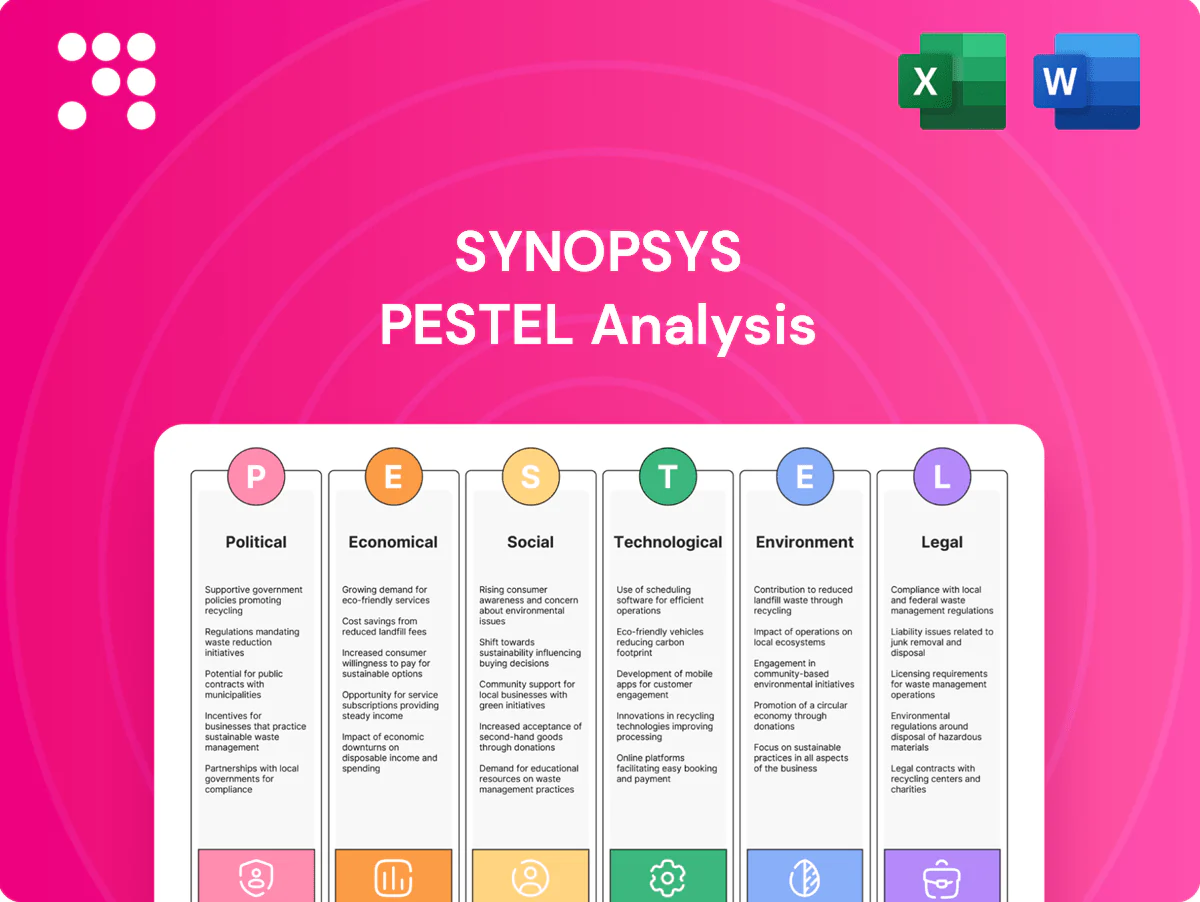
Synopsys PESTLE Analysis

Skip the Research. Get the Strategy.
Discover how political, economic, social, technological, legal and environmental forces are reshaping Synopsys's strategic outlook in our concise PESTLE snapshot. This expert brief highlights risks and opportunities that matter to investors, advisors, and executives. Purchase the full, editable PESTLE analysis to access detailed insights, data-driven recommendations, and ready-to-use slides for immediate decision-making.
Political factors

US–China export controls
US export controls tightened in 2022–2023 to limit advanced semiconductor tools and IP to China, directly constraining Synopsys’s ability to sell leading-edge EDA and IP into Chinese fabs and design houses. Compliance complexity has raised costs and lengthened sales cycles, requiring expanded export screening and legal reviews. Sudden policy shifts can rapidly shrink addressable markets and force Synopsys to develop China-specific product variants and strict customer screening.
Chips Acts and industrial policy
U.S. CHIPS and Science Act provides roughly $52 billion in semiconductor incentives and the EU Chips Act mobilizes about €43 billion, catalyzing new fabs and design activity and lifting EDA/IP demand. Funding criteria and localization rules often dictate partner selection and supply-chain footprint. Synopsys can align roadmaps to subsidized nodes and target domains. Political shifts may change timelines or grant terms, impacting deployment pacing.

Geopolitical supply-chain risk
Tensions in the Taiwan Strait or Middle East can derail foundry roadmaps and customer programs given Taiwan/Korea concentration of advanced-node capacity and TSMC's ~50% share of leading-edge wafers, causing schedule slips. Delays at advanced nodes directly increase EDA verification workloads and slow IP ramps. Onshoring incentives like the US CHIPS Act ($52.7B) and EU Chips funding (€43B) are shifting customer geographies. Synopsys must diversify partnerships and contingency-plan delivery to mitigate supply-chain risk.

Standards and sovereignty agendas
National security drives chip sovereignty and secure-by-design mandates, with the US CHIPS and Science Act committing about $52.7 billion to semiconductors and EU plans mobilizing up to €43 billion, pushing governments to shape cryptography, safety, and certification standards that flow into EDA/IP requirements; TSMC and Samsung still account for roughly 70% of leading-edge capacity, raising supply-chain risk. Engagement in standards bodies has become strategic as local content and data residency rules reshape deployment and IP licensing models.
- Policy: national security-led incentives (US $52.7B, EU up to €43B)
- Supply: ~70% leading-edge concentration (TSMC, Samsung)
- Standards: government-driven cryptography/safety/certification
- Compliance: local content and data residency affect deployment
Public procurement and defense
Government-funded AI, aerospace and defense programs demand advanced verification, safety and security tooling, aligning with Synopsys strengths; US defense spending was about $858B in 2024, underpinning sustained demand. Procurement cycles are long but sticky, enabling recurring revenue; compliance and security clearances raise high barriers to entry while budget reallocations can quickly swing project demand.
- Defense budget 2024: ~$858B
- Long procurement = recurring revenue
- Compliance/clearances = barrier to entry
- Budget shifts can rapidly change demand
Export controls shrink EDA market; CHIPS funding and US defense boost secure-tooling demand
US export controls (2022–23) and China restrictions limit Synopsys’s addressable market and raise compliance costs; sudden policy shifts lengthen sales cycles. US CHIPS $52.7B and EU chips ~€43B boost demand but tie projects to localization rules. TSMC holds ~50% of leading-edge wafers; delays raise verification workloads; US defense spending ~$858B (2024) supports secure-tooling demand.
| Item | Value |
|---|---|
| US CHIPS | $52.7B |
| EU Chips | ~€43B |
| TSMC share | ~50% leading-edge |
| US defense 2024 | $858B |
What is included in the product
 Detailed Word Document
Explores how external macro-environmental factors uniquely affect Synopsys across Political, Economic, Social, Technological, Environmental and Legal dimensions, with industry- and region-specific examples. Data-backed, forward-looking insights support executives, investors and strategists in scenario planning, risk mitigation and opportunity identification.

 Customizable Excel Spreadsheet
Concise, PESTLE-segmented summary of Synopsys’s external risks and opportunities for quick reference in meetings or presentations, easily shared and dropped into decks to align teams and support strategic planning.
Economic factors

Semiconductor cycle sensitivity
EDA/IP spend is relatively resilient but still tracks semiconductor capex and tape-out cycles; Synopsys reported FY2024 revenue of about $5.66B and cited roughly $2.7B in backlog, underscoring exposure to cycle swings.
AI model-driven design and growing automotive SoC content (auto semiconductor design starts up high in 2024) help soften downcycles by sustaining new design starts and tool usage.
Prolonged downturns, however, push customers to defer tool upgrades and new IP uptake, slowing license and design-win conversion rates.
Recurring revenue, multiyear backlogs and ARR materially mitigate spot volatility, giving Synopsys more predictable cash flow through cyclical troughs.
AI-driven demand surge
Explosive investment in AI accelerators and memory in 2024 drives verification complexity and IP demand, aligning with Synopsys scale after FY2024 revenue of about $5.6 billion; customers require richer IP and verification stacks. Higher compute and interconnect needs expand tool seats and runtime, boosting EDA consumption as AI systems spending climbed toward $200+ billion in 2024–25. Strong time-to-market emphasis supports pricing power, but bubble risk mandates disciplined capacity and licensing planning.

Interest rates and budgets
U.S. federal funds rate stood at 5.25–5.50% in July 2025, tightening capital availability; higher rates have compressed startup funding and enterprise budgets, disproportionately impacting smaller EDA customers. Large hyperscalers and auto OEMs remain primary spenders but demand rigorous ROI, raising discounting pressure on multi-year deals. A decline in rates would likely unlock deferred semiconductor and tooling projects.

Customer concentration
Revenue is concentrated among leading chipmakers, major cloud providers and Tier-1 OEMs, so wins or losses at a handful of accounts can materially swing Synopsys growth; multi-product bundling and lengthy licenses create high stickiness. Expansion into software security products broadens addressable market and reduces pure EDA customer concentration.
- Customer concentration: high
- Impact: few accounts drive growth
- Mitigant: bundling + long-term deals
- Diversification: software security exposure
Currency and global operations
USD strength compressed Synopsys reported revenue, with FY2024 revenue near $5.9B exposing pricing competitiveness in non-USD markets; global R&D and sales footprints create FX and wage-inflation risk across Asia and Europe. Hedging programs and localized pricing help blunt volatility, while strict cost discipline kept operating margins resilient in 2024.
Export controls shrink EDA market; CHIPS funding and US defense boost secure-tooling demand
EDA/IP demand ties to semiconductor capex and tape-outs; Synopsys FY2024 revenue ~$5.66B with ~$2.7B backlog, reducing spot volatility. AI/automotive design and $200B+ AI systems spend in 2024–25 sustain tool/IP demand despite higher rates (Fed 5.25–5.50% Jul 2025) and FX headwinds.
| Metric | Value |
|---|---|
| FY2024 revenue | $5.66B |
| Backlog | $2.7B |
| AI systems spend (2024–25) | $200B+ |
| Fed funds (Jul 2025) | 5.25–5.50% |
Full Version Awaits
Synopsys PESTLE Analysis
The preview shown here is the exact Synopsys PESTLE Analysis document you’ll receive after purchase—fully formatted and ready to use. The structure, content, and insights visible are identical to the downloadable file. No placeholders or surprises—this is the final, professionally prepared report.

Skip the Research. Get the Strategy.
Discover how political, economic, social, technological, legal and environmental forces are reshaping Synopsys's strategic outlook in our concise PESTLE snapshot. This expert brief highlights risks and opportunities that matter to investors, advisors, and executives. Purchase the full, editable PESTLE analysis to access detailed insights, data-driven recommendations, and ready-to-use slides for immediate decision-making.
Political factors
US–China export controls
US export controls tightened in 2022–2023 to limit advanced semiconductor tools and IP to China, directly constraining Synopsys’s ability to sell leading-edge EDA and IP into Chinese fabs and design houses. Compliance complexity has raised costs and lengthened sales cycles, requiring expanded export screening and legal reviews. Sudden policy shifts can rapidly shrink addressable markets and force Synopsys to develop China-specific product variants and strict customer screening.
Chips Acts and industrial policy
U.S. CHIPS and Science Act provides roughly $52 billion in semiconductor incentives and the EU Chips Act mobilizes about €43 billion, catalyzing new fabs and design activity and lifting EDA/IP demand. Funding criteria and localization rules often dictate partner selection and supply-chain footprint. Synopsys can align roadmaps to subsidized nodes and target domains. Political shifts may change timelines or grant terms, impacting deployment pacing.
Geopolitical supply-chain risk
Tensions in the Taiwan Strait or Middle East can derail foundry roadmaps and customer programs given Taiwan/Korea concentration of advanced-node capacity and TSMC's ~50% share of leading-edge wafers, causing schedule slips. Delays at advanced nodes directly increase EDA verification workloads and slow IP ramps. Onshoring incentives like the US CHIPS Act ($52.7B) and EU Chips funding (€43B) are shifting customer geographies. Synopsys must diversify partnerships and contingency-plan delivery to mitigate supply-chain risk.
Standards and sovereignty agendas
National security drives chip sovereignty and secure-by-design mandates, with the US CHIPS and Science Act committing about $52.7 billion to semiconductors and EU plans mobilizing up to €43 billion, pushing governments to shape cryptography, safety, and certification standards that flow into EDA/IP requirements; TSMC and Samsung still account for roughly 70% of leading-edge capacity, raising supply-chain risk. Engagement in standards bodies has become strategic as local content and data residency rules reshape deployment and IP licensing models.
- Policy: national security-led incentives (US $52.7B, EU up to €43B)
- Supply: ~70% leading-edge concentration (TSMC, Samsung)
- Standards: government-driven cryptography/safety/certification
- Compliance: local content and data residency affect deployment
Public procurement and defense
Government-funded AI, aerospace and defense programs demand advanced verification, safety and security tooling, aligning with Synopsys strengths; US defense spending was about $858B in 2024, underpinning sustained demand. Procurement cycles are long but sticky, enabling recurring revenue; compliance and security clearances raise high barriers to entry while budget reallocations can quickly swing project demand.
- Defense budget 2024: ~$858B
- Long procurement = recurring revenue
- Compliance/clearances = barrier to entry
- Budget shifts can rapidly change demand
Export controls shrink EDA market; CHIPS funding and US defense boost secure-tooling demand
US export controls (2022–23) and China restrictions limit Synopsys’s addressable market and raise compliance costs; sudden policy shifts lengthen sales cycles. US CHIPS $52.7B and EU chips ~€43B boost demand but tie projects to localization rules. TSMC holds ~50% of leading-edge wafers; delays raise verification workloads; US defense spending ~$858B (2024) supports secure-tooling demand.
| Item | Value |
|---|---|
| US CHIPS | $52.7B |
| EU Chips | ~€43B |
| TSMC share | ~50% leading-edge |
| US defense 2024 | $858B |
What is included in the product
Detailed Word Document
Explores how external macro-environmental factors uniquely affect Synopsys across Political, Economic, Social, Technological, Environmental and Legal dimensions, with industry- and region-specific examples. Data-backed, forward-looking insights support executives, investors and strategists in scenario planning, risk mitigation and opportunity identification.
Customizable Excel Spreadsheet
Concise, PESTLE-segmented summary of Synopsys’s external risks and opportunities for quick reference in meetings or presentations, easily shared and dropped into decks to align teams and support strategic planning.
Economic factors
Semiconductor cycle sensitivity
EDA/IP spend is relatively resilient but still tracks semiconductor capex and tape-out cycles; Synopsys reported FY2024 revenue of about $5.66B and cited roughly $2.7B in backlog, underscoring exposure to cycle swings.
AI model-driven design and growing automotive SoC content (auto semiconductor design starts up high in 2024) help soften downcycles by sustaining new design starts and tool usage.
Prolonged downturns, however, push customers to defer tool upgrades and new IP uptake, slowing license and design-win conversion rates.
Recurring revenue, multiyear backlogs and ARR materially mitigate spot volatility, giving Synopsys more predictable cash flow through cyclical troughs.
AI-driven demand surge
Explosive investment in AI accelerators and memory in 2024 drives verification complexity and IP demand, aligning with Synopsys scale after FY2024 revenue of about $5.6 billion; customers require richer IP and verification stacks. Higher compute and interconnect needs expand tool seats and runtime, boosting EDA consumption as AI systems spending climbed toward $200+ billion in 2024–25. Strong time-to-market emphasis supports pricing power, but bubble risk mandates disciplined capacity and licensing planning.
Interest rates and budgets
U.S. federal funds rate stood at 5.25–5.50% in July 2025, tightening capital availability; higher rates have compressed startup funding and enterprise budgets, disproportionately impacting smaller EDA customers. Large hyperscalers and auto OEMs remain primary spenders but demand rigorous ROI, raising discounting pressure on multi-year deals. A decline in rates would likely unlock deferred semiconductor and tooling projects.
Customer concentration
Revenue is concentrated among leading chipmakers, major cloud providers and Tier-1 OEMs, so wins or losses at a handful of accounts can materially swing Synopsys growth; multi-product bundling and lengthy licenses create high stickiness. Expansion into software security products broadens addressable market and reduces pure EDA customer concentration.
- Customer concentration: high
- Impact: few accounts drive growth
- Mitigant: bundling + long-term deals
- Diversification: software security exposure
Currency and global operations
USD strength compressed Synopsys reported revenue, with FY2024 revenue near $5.9B exposing pricing competitiveness in non-USD markets; global R&D and sales footprints create FX and wage-inflation risk across Asia and Europe. Hedging programs and localized pricing help blunt volatility, while strict cost discipline kept operating margins resilient in 2024.
Export controls shrink EDA market; CHIPS funding and US defense boost secure-tooling demand
EDA/IP demand ties to semiconductor capex and tape-outs; Synopsys FY2024 revenue ~$5.66B with ~$2.7B backlog, reducing spot volatility. AI/automotive design and $200B+ AI systems spend in 2024–25 sustain tool/IP demand despite higher rates (Fed 5.25–5.50% Jul 2025) and FX headwinds.
| Metric | Value |
|---|---|
| FY2024 revenue | $5.66B |
| Backlog | $2.7B |
| AI systems spend (2024–25) | $200B+ |
| Fed funds (Jul 2025) | 5.25–5.50% |
Full Version Awaits
Synopsys PESTLE Analysis
The preview shown here is the exact Synopsys PESTLE Analysis document you’ll receive after purchase—fully formatted and ready to use. The structure, content, and insights visible are identical to the downloadable file. No placeholders or surprises—this is the final, professionally prepared report.
Description
Skip the Research. Get the Strategy.
Discover how political, economic, social, technological, legal and environmental forces are reshaping Synopsys's strategic outlook in our concise PESTLE snapshot. This expert brief highlights risks and opportunities that matter to investors, advisors, and executives. Purchase the full, editable PESTLE analysis to access detailed insights, data-driven recommendations, and ready-to-use slides for immediate decision-making.
Political factors
US–China export controls
US export controls tightened in 2022–2023 to limit advanced semiconductor tools and IP to China, directly constraining Synopsys’s ability to sell leading-edge EDA and IP into Chinese fabs and design houses. Compliance complexity has raised costs and lengthened sales cycles, requiring expanded export screening and legal reviews. Sudden policy shifts can rapidly shrink addressable markets and force Synopsys to develop China-specific product variants and strict customer screening.
Chips Acts and industrial policy
U.S. CHIPS and Science Act provides roughly $52 billion in semiconductor incentives and the EU Chips Act mobilizes about €43 billion, catalyzing new fabs and design activity and lifting EDA/IP demand. Funding criteria and localization rules often dictate partner selection and supply-chain footprint. Synopsys can align roadmaps to subsidized nodes and target domains. Political shifts may change timelines or grant terms, impacting deployment pacing.
Geopolitical supply-chain risk
Tensions in the Taiwan Strait or Middle East can derail foundry roadmaps and customer programs given Taiwan/Korea concentration of advanced-node capacity and TSMC's ~50% share of leading-edge wafers, causing schedule slips. Delays at advanced nodes directly increase EDA verification workloads and slow IP ramps. Onshoring incentives like the US CHIPS Act ($52.7B) and EU Chips funding (€43B) are shifting customer geographies. Synopsys must diversify partnerships and contingency-plan delivery to mitigate supply-chain risk.
Standards and sovereignty agendas
National security drives chip sovereignty and secure-by-design mandates, with the US CHIPS and Science Act committing about $52.7 billion to semiconductors and EU plans mobilizing up to €43 billion, pushing governments to shape cryptography, safety, and certification standards that flow into EDA/IP requirements; TSMC and Samsung still account for roughly 70% of leading-edge capacity, raising supply-chain risk. Engagement in standards bodies has become strategic as local content and data residency rules reshape deployment and IP licensing models.
- Policy: national security-led incentives (US $52.7B, EU up to €43B)
- Supply: ~70% leading-edge concentration (TSMC, Samsung)
- Standards: government-driven cryptography/safety/certification
- Compliance: local content and data residency affect deployment
Public procurement and defense
Government-funded AI, aerospace and defense programs demand advanced verification, safety and security tooling, aligning with Synopsys strengths; US defense spending was about $858B in 2024, underpinning sustained demand. Procurement cycles are long but sticky, enabling recurring revenue; compliance and security clearances raise high barriers to entry while budget reallocations can quickly swing project demand.
- Defense budget 2024: ~$858B
- Long procurement = recurring revenue
- Compliance/clearances = barrier to entry
- Budget shifts can rapidly change demand
Export controls shrink EDA market; CHIPS funding and US defense boost secure-tooling demand
US export controls (2022–23) and China restrictions limit Synopsys’s addressable market and raise compliance costs; sudden policy shifts lengthen sales cycles. US CHIPS $52.7B and EU chips ~€43B boost demand but tie projects to localization rules. TSMC holds ~50% of leading-edge wafers; delays raise verification workloads; US defense spending ~$858B (2024) supports secure-tooling demand.
| Item | Value |
|---|---|
| US CHIPS | $52.7B |
| EU Chips | ~€43B |
| TSMC share | ~50% leading-edge |
| US defense 2024 | $858B |
What is included in the product
Detailed Word Document
Explores how external macro-environmental factors uniquely affect Synopsys across Political, Economic, Social, Technological, Environmental and Legal dimensions, with industry- and region-specific examples. Data-backed, forward-looking insights support executives, investors and strategists in scenario planning, risk mitigation and opportunity identification.
Customizable Excel Spreadsheet
Concise, PESTLE-segmented summary of Synopsys’s external risks and opportunities for quick reference in meetings or presentations, easily shared and dropped into decks to align teams and support strategic planning.
Economic factors
Semiconductor cycle sensitivity
EDA/IP spend is relatively resilient but still tracks semiconductor capex and tape-out cycles; Synopsys reported FY2024 revenue of about $5.66B and cited roughly $2.7B in backlog, underscoring exposure to cycle swings.
AI model-driven design and growing automotive SoC content (auto semiconductor design starts up high in 2024) help soften downcycles by sustaining new design starts and tool usage.
Prolonged downturns, however, push customers to defer tool upgrades and new IP uptake, slowing license and design-win conversion rates.
Recurring revenue, multiyear backlogs and ARR materially mitigate spot volatility, giving Synopsys more predictable cash flow through cyclical troughs.
AI-driven demand surge
Explosive investment in AI accelerators and memory in 2024 drives verification complexity and IP demand, aligning with Synopsys scale after FY2024 revenue of about $5.6 billion; customers require richer IP and verification stacks. Higher compute and interconnect needs expand tool seats and runtime, boosting EDA consumption as AI systems spending climbed toward $200+ billion in 2024–25. Strong time-to-market emphasis supports pricing power, but bubble risk mandates disciplined capacity and licensing planning.
Interest rates and budgets
U.S. federal funds rate stood at 5.25–5.50% in July 2025, tightening capital availability; higher rates have compressed startup funding and enterprise budgets, disproportionately impacting smaller EDA customers. Large hyperscalers and auto OEMs remain primary spenders but demand rigorous ROI, raising discounting pressure on multi-year deals. A decline in rates would likely unlock deferred semiconductor and tooling projects.
Customer concentration
Revenue is concentrated among leading chipmakers, major cloud providers and Tier-1 OEMs, so wins or losses at a handful of accounts can materially swing Synopsys growth; multi-product bundling and lengthy licenses create high stickiness. Expansion into software security products broadens addressable market and reduces pure EDA customer concentration.
- Customer concentration: high
- Impact: few accounts drive growth
- Mitigant: bundling + long-term deals
- Diversification: software security exposure
Currency and global operations
USD strength compressed Synopsys reported revenue, with FY2024 revenue near $5.9B exposing pricing competitiveness in non-USD markets; global R&D and sales footprints create FX and wage-inflation risk across Asia and Europe. Hedging programs and localized pricing help blunt volatility, while strict cost discipline kept operating margins resilient in 2024.
Export controls shrink EDA market; CHIPS funding and US defense boost secure-tooling demand
EDA/IP demand ties to semiconductor capex and tape-outs; Synopsys FY2024 revenue ~$5.66B with ~$2.7B backlog, reducing spot volatility. AI/automotive design and $200B+ AI systems spend in 2024–25 sustain tool/IP demand despite higher rates (Fed 5.25–5.50% Jul 2025) and FX headwinds.
| Metric | Value |
|---|---|
| FY2024 revenue | $5.66B |
| Backlog | $2.7B |
| AI systems spend (2024–25) | $200B+ |
| Fed funds (Jul 2025) | 5.25–5.50% |
Full Version Awaits
Synopsys PESTLE Analysis
The preview shown here is the exact Synopsys PESTLE Analysis document you’ll receive after purchase—fully formatted and ready to use. The structure, content, and insights visible are identical to the downloadable file. No placeholders or surprises—this is the final, professionally prepared report.











