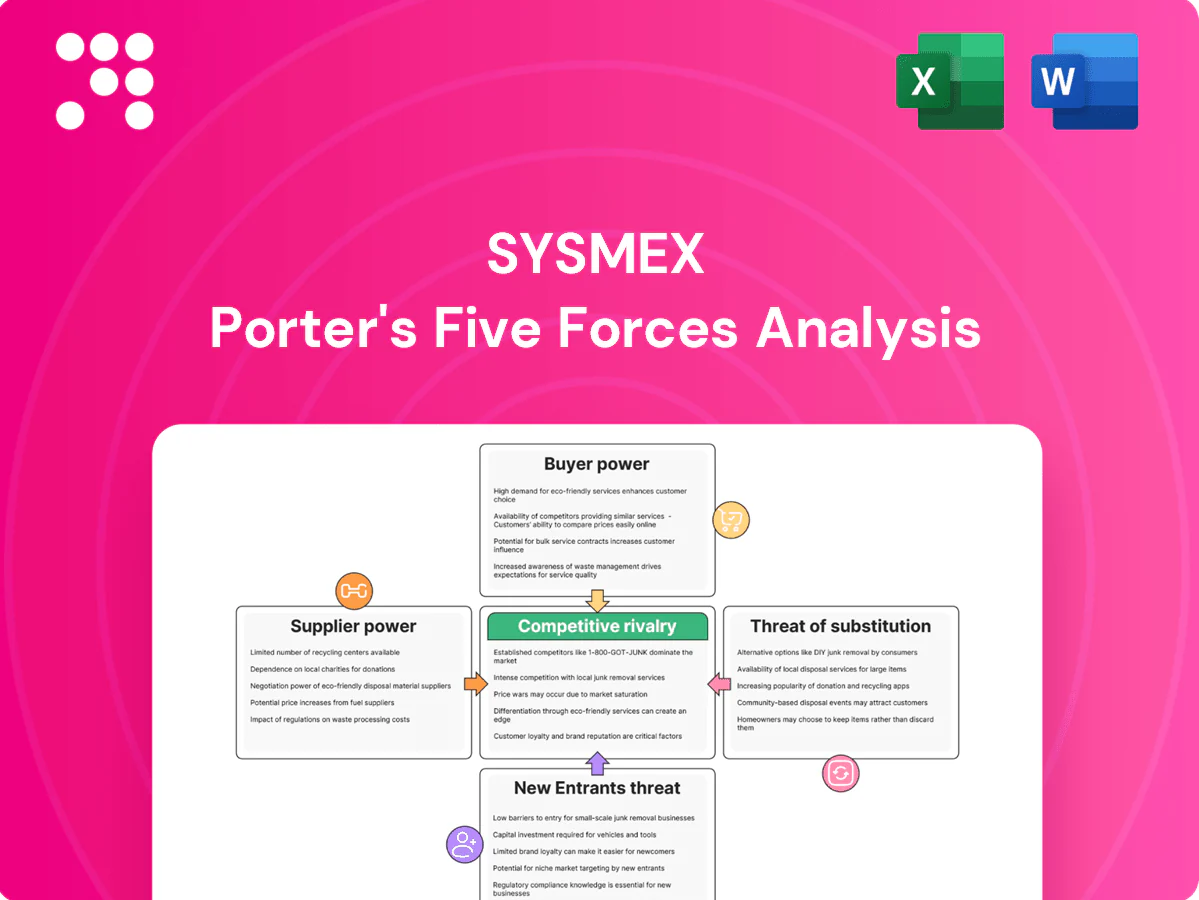
Sysmex Porter's Five Forces Analysis

Go Beyond the Preview—Access the Full Strategic Report
Sysmex faces moderate supplier power, strong buyer expectations for accuracy and service, high rivalry among diagnostics firms, moderate threat of new entrants due to regulatory barriers, and low-to-moderate substitute threats. This snapshot highlights strategic pressures on margins and growth. Unlock the full Porter's Five Forces Analysis to explore force-by-force ratings, visuals, and actionable insights tailored to Sysmex.
Suppliers Bargaining Power

Specialized reagent inputs
Many Sysmex assays rely on proprietary antibodies, enzymes, dyes and calibrators sourced from a concentrated supplier pool (often fewer than five qualified vendors), raising switching costs via validation and regulatory re-qualification. Sysmex’s scale (FY2024 revenue ≈ JPY 340bn; ~8,800 employees) enables dual-sourcing where feasible to extract better terms. Long-term supply agreements covering roughly 70% of critical inputs and inventory buffers of 3–6 months mitigate disruption risk.
Precision components and optics
As of 2024 core analyzers depend on high-spec lasers, detectors, microfluidics and OEM modules supplied by a handful of global vendors, giving suppliers notable leverage due to differentiation and tight tolerances. Sysmex mitigates this via design-for-multi-source and strong in-house engineering. Co-development programs lower unit costs but can deepen supplier dependency.

Regulatory-grade quality systems
Only suppliers with ISO 13485-level QMS and full traceability can serve IVD needs, sharply narrowing the vendor pool and amplifying supplier power. Sysmex’s rigorous audits and approved-vendor lists improve resilience but slow onboarding, with qualification timelines commonly 12–36 months. Multi-year validation cycles further lock in selections, increasing switching costs and exposure to supplier concentration risk.

Logistics and cold-chain constraints
Reagents’ cold-chain and time-sensitive delivery elevate logistics partners’ bargaining power, with industry reports in 2024 noting cold-chain logistics growing ~7% CAGR, increasing carrier leverage during disruptions. Regional transport or port outages can raise costs or cause stockouts; Sysmex mitigates this via regional distribution hubs and safety-stock planning. Freight diversification and predictive demand planning further reduce carrier concentration risk.
- Cold-chain dependence raises supplier leverage
- Regional disruptions → cost/stockout risk
- Mitigants: regional hubs, safety stock
- Controls: freight diversification, predictive planning
Commodity vs. proprietary mix
Standard parts such as plastics and packaging are commodity and confer low supplier power, while proprietary chemistries used in Sysmex reagents carry higher pricing leverage and margin impact; consumables accounted for over half of Sysmex revenue in 2024, producing concentrated demand for specialized chemistries and moderating overall supplier power. Strategic insourcing of key chemistries and multi-year volume commitments can shift leverage, secure priority allocation, and reduce input-cost volatility.
- Commodity parts: low supplier power
- Proprietary chemistries: high pricing power
- 2024: consumables >50% of revenue
- Insourcing + volume commitments = greater leverage
Concentrated vendors, 12-36 month lead times and ~7% cold-chain growth elevate supplier power
Sysmex faces elevated supplier power for proprietary reagents, OEM modules and cold-chain services due to concentrated, certified vendor pools and long validation cycles, but its FY2024 scale (revenue ≈ JPY 340bn; consumables >50% revenue) plus multi-year contracts, insourcing and 3–6 month inventory buffers reduce vulnerability. Critical supplier lead times commonly 12–36 months; cold-chain logistics grew ~7% CAGR in 2024, increasing carrier leverage.
| Metric | 2024 / Note |
|---|---|
| Revenue | ≈ JPY 340bn |
| Consumables share | >50% |
| Qualified vendors (critical) | <5 |
| Validation lead time | 12–36 months |
| Inventory buffer | 3–6 months |
| Cold-chain logistics CAGR | ~7% |
What is included in the product
 Detailed Word Document
Porter's Five Forces analysis for Sysmex uncovers competitive dynamics, supplier and buyer power, substitute threats, and entry barriers shaping its market position, highlighting disruptive technologies and strategic levers to protect margins and guide growth.

 Customizable Excel Spreadsheet
A concise, one-sheet Porter's Five Forces for Sysmex that instantly visualizes competitive pressure with a spider chart and customizable ratings, making strategic trade-offs clear. Easy to edit, export to slides, and integrate into reports—no coding required, ideal for fast boardroom decisions and scenario testing.
Customers Bargaining Power

Hospitals and reference labs
Large health systems and independent labs concentrate purchasing power—buying analyzers, reagents and service at scale and pressing for discounts and uptime SLAs. Sysmex’s 2024 installed base of over 60,000 systems and workflow integration reduces price sensitivity and eases switching. With consumables accounting for roughly 60% of group sales in 2024, outcome-focused value propositions help sustain premium pricing and retention.
GPOs and public tenders
GPOs and public tenders standardize specs and force competitive bidding; US GPOs cover over 90% of hospitals (2024), intensifying price transparency and concession pressure. Sysmex differentiates on total cost of ownership, proven reliability and high automation throughput to defend margins. Long-term reagent-rental models, with consumables driving recurring revenue, can win tenders despite initial equipment discounts.

High switching costs
Analyzer-reagent lock-in, bespoke LIS interfaces, staff retraining and method correlation requirements create meaningful exit barriers for hospital labs, so buyers in 2024 generally hesitate to switch absent clear clinical or economic gains. Sysmex leverages this stickiness to stabilize pricing and recurring consumables revenue, while competitive upgrade programs in 2024 eroded shares and capped pricing power to mid-single-digit concessions in some markets.

Reimbursement and budget pressure
Flat or declining reimbursement and budget pressure in 2024 squeeze labs to cut per-test cost, driving buyers to demand lower reagent prices and bundled service deals; Sysmex reported roughly 462 billion JPY revenue in FY2024 and counters by emphasizing efficiency, reduced repeat rates and automation that lowers labor per sample, while shifting toward value-based contracts that tie payment to outcomes rather than price alone.
- Reimbursement squeeze → buyers push price/bundles
- Sysmex FY2024 ~462 billion JPY
- Automation reduces labor and repeats
- Value-based contracts align incentives
Demand for menu breadth and uptime
Buyers demand broad test menus, scalable throughput and near-zero downtime, making service response and consumable availability key leverage points; Sysmex reported FY2024 revenue of JPY 392.4 billion and highlights global service coverage supporting retention.
Service reliability metrics, performance guarantees and remote monitoring reduce buyer switching risk and strengthen Sysmex bargaining position, while fast consumable supply chains limit customer leverage.
- FY2024 revenue: JPY 392.4 billion
- Service coverage: 120+ countries
- Key levers: uptime, consumables, SLAs
>60,000 analyzers; reagent lock-in, consumables ≈60%
Large health systems and GPO-driven tenders (US GPOs cover >90% hospitals) amplify buyer price pressure, yet Sysmex’s >60,000 installed analyzers and reagent lock-in (consumables ≈60% of sales) limit switching. FY2024 revenue ≈462 billion JPY; service in 120+ countries and uptime SLAs defend margins while value-based contracts shift negotiations toward outcomes.
| Metric | 2024 |
|---|---|
| Installed base | >60,000 |
| Revenue | ≈462 bn JPY |
| Consumables % | ≈60% |
| Service coverage | 120+ countries |
Full Version Awaits
Sysmex Porter's Five Forces Analysis
This preview shows the exact Sysmex Porter's Five Forces Analysis you'll receive—fully formatted, professionally written and ready for use. No placeholders or mockups: the content, data, charts and strategic conclusions are identical to the downloadable file. After purchase you get immediate access to this same document.

Go Beyond the Preview—Access the Full Strategic Report
Sysmex faces moderate supplier power, strong buyer expectations for accuracy and service, high rivalry among diagnostics firms, moderate threat of new entrants due to regulatory barriers, and low-to-moderate substitute threats. This snapshot highlights strategic pressures on margins and growth. Unlock the full Porter's Five Forces Analysis to explore force-by-force ratings, visuals, and actionable insights tailored to Sysmex.
Suppliers Bargaining Power
Specialized reagent inputs
Many Sysmex assays rely on proprietary antibodies, enzymes, dyes and calibrators sourced from a concentrated supplier pool (often fewer than five qualified vendors), raising switching costs via validation and regulatory re-qualification. Sysmex’s scale (FY2024 revenue ≈ JPY 340bn; ~8,800 employees) enables dual-sourcing where feasible to extract better terms. Long-term supply agreements covering roughly 70% of critical inputs and inventory buffers of 3–6 months mitigate disruption risk.
Precision components and optics
As of 2024 core analyzers depend on high-spec lasers, detectors, microfluidics and OEM modules supplied by a handful of global vendors, giving suppliers notable leverage due to differentiation and tight tolerances. Sysmex mitigates this via design-for-multi-source and strong in-house engineering. Co-development programs lower unit costs but can deepen supplier dependency.
Regulatory-grade quality systems
Only suppliers with ISO 13485-level QMS and full traceability can serve IVD needs, sharply narrowing the vendor pool and amplifying supplier power. Sysmex’s rigorous audits and approved-vendor lists improve resilience but slow onboarding, with qualification timelines commonly 12–36 months. Multi-year validation cycles further lock in selections, increasing switching costs and exposure to supplier concentration risk.
Logistics and cold-chain constraints
Reagents’ cold-chain and time-sensitive delivery elevate logistics partners’ bargaining power, with industry reports in 2024 noting cold-chain logistics growing ~7% CAGR, increasing carrier leverage during disruptions. Regional transport or port outages can raise costs or cause stockouts; Sysmex mitigates this via regional distribution hubs and safety-stock planning. Freight diversification and predictive demand planning further reduce carrier concentration risk.
- Cold-chain dependence raises supplier leverage
- Regional disruptions → cost/stockout risk
- Mitigants: regional hubs, safety stock
- Controls: freight diversification, predictive planning
Commodity vs. proprietary mix
Standard parts such as plastics and packaging are commodity and confer low supplier power, while proprietary chemistries used in Sysmex reagents carry higher pricing leverage and margin impact; consumables accounted for over half of Sysmex revenue in 2024, producing concentrated demand for specialized chemistries and moderating overall supplier power. Strategic insourcing of key chemistries and multi-year volume commitments can shift leverage, secure priority allocation, and reduce input-cost volatility.
- Commodity parts: low supplier power
- Proprietary chemistries: high pricing power
- 2024: consumables >50% of revenue
- Insourcing + volume commitments = greater leverage
Concentrated vendors, 12-36 month lead times and ~7% cold-chain growth elevate supplier power
Sysmex faces elevated supplier power for proprietary reagents, OEM modules and cold-chain services due to concentrated, certified vendor pools and long validation cycles, but its FY2024 scale (revenue ≈ JPY 340bn; consumables >50% revenue) plus multi-year contracts, insourcing and 3–6 month inventory buffers reduce vulnerability. Critical supplier lead times commonly 12–36 months; cold-chain logistics grew ~7% CAGR in 2024, increasing carrier leverage.
| Metric | 2024 / Note |
|---|---|
| Revenue | ≈ JPY 340bn |
| Consumables share | >50% |
| Qualified vendors (critical) | <5 |
| Validation lead time | 12–36 months |
| Inventory buffer | 3–6 months |
| Cold-chain logistics CAGR | ~7% |
What is included in the product
Detailed Word Document
Porter's Five Forces analysis for Sysmex uncovers competitive dynamics, supplier and buyer power, substitute threats, and entry barriers shaping its market position, highlighting disruptive technologies and strategic levers to protect margins and guide growth.
Customizable Excel Spreadsheet
A concise, one-sheet Porter's Five Forces for Sysmex that instantly visualizes competitive pressure with a spider chart and customizable ratings, making strategic trade-offs clear. Easy to edit, export to slides, and integrate into reports—no coding required, ideal for fast boardroom decisions and scenario testing.
Customers Bargaining Power
Hospitals and reference labs
Large health systems and independent labs concentrate purchasing power—buying analyzers, reagents and service at scale and pressing for discounts and uptime SLAs. Sysmex’s 2024 installed base of over 60,000 systems and workflow integration reduces price sensitivity and eases switching. With consumables accounting for roughly 60% of group sales in 2024, outcome-focused value propositions help sustain premium pricing and retention.
GPOs and public tenders
GPOs and public tenders standardize specs and force competitive bidding; US GPOs cover over 90% of hospitals (2024), intensifying price transparency and concession pressure. Sysmex differentiates on total cost of ownership, proven reliability and high automation throughput to defend margins. Long-term reagent-rental models, with consumables driving recurring revenue, can win tenders despite initial equipment discounts.
High switching costs
Analyzer-reagent lock-in, bespoke LIS interfaces, staff retraining and method correlation requirements create meaningful exit barriers for hospital labs, so buyers in 2024 generally hesitate to switch absent clear clinical or economic gains. Sysmex leverages this stickiness to stabilize pricing and recurring consumables revenue, while competitive upgrade programs in 2024 eroded shares and capped pricing power to mid-single-digit concessions in some markets.
Reimbursement and budget pressure
Flat or declining reimbursement and budget pressure in 2024 squeeze labs to cut per-test cost, driving buyers to demand lower reagent prices and bundled service deals; Sysmex reported roughly 462 billion JPY revenue in FY2024 and counters by emphasizing efficiency, reduced repeat rates and automation that lowers labor per sample, while shifting toward value-based contracts that tie payment to outcomes rather than price alone.
- Reimbursement squeeze → buyers push price/bundles
- Sysmex FY2024 ~462 billion JPY
- Automation reduces labor and repeats
- Value-based contracts align incentives
Demand for menu breadth and uptime
Buyers demand broad test menus, scalable throughput and near-zero downtime, making service response and consumable availability key leverage points; Sysmex reported FY2024 revenue of JPY 392.4 billion and highlights global service coverage supporting retention.
Service reliability metrics, performance guarantees and remote monitoring reduce buyer switching risk and strengthen Sysmex bargaining position, while fast consumable supply chains limit customer leverage.
- FY2024 revenue: JPY 392.4 billion
- Service coverage: 120+ countries
- Key levers: uptime, consumables, SLAs
>60,000 analyzers; reagent lock-in, consumables ≈60%
Large health systems and GPO-driven tenders (US GPOs cover >90% hospitals) amplify buyer price pressure, yet Sysmex’s >60,000 installed analyzers and reagent lock-in (consumables ≈60% of sales) limit switching. FY2024 revenue ≈462 billion JPY; service in 120+ countries and uptime SLAs defend margins while value-based contracts shift negotiations toward outcomes.
| Metric | 2024 |
|---|---|
| Installed base | >60,000 |
| Revenue | ≈462 bn JPY |
| Consumables % | ≈60% |
| Service coverage | 120+ countries |
Full Version Awaits
Sysmex Porter's Five Forces Analysis
This preview shows the exact Sysmex Porter's Five Forces Analysis you'll receive—fully formatted, professionally written and ready for use. No placeholders or mockups: the content, data, charts and strategic conclusions are identical to the downloadable file. After purchase you get immediate access to this same document.
Original: $10.00
-65%$10.00
$3.50Description
Go Beyond the Preview—Access the Full Strategic Report
Sysmex faces moderate supplier power, strong buyer expectations for accuracy and service, high rivalry among diagnostics firms, moderate threat of new entrants due to regulatory barriers, and low-to-moderate substitute threats. This snapshot highlights strategic pressures on margins and growth. Unlock the full Porter's Five Forces Analysis to explore force-by-force ratings, visuals, and actionable insights tailored to Sysmex.
Suppliers Bargaining Power
Specialized reagent inputs
Many Sysmex assays rely on proprietary antibodies, enzymes, dyes and calibrators sourced from a concentrated supplier pool (often fewer than five qualified vendors), raising switching costs via validation and regulatory re-qualification. Sysmex’s scale (FY2024 revenue ≈ JPY 340bn; ~8,800 employees) enables dual-sourcing where feasible to extract better terms. Long-term supply agreements covering roughly 70% of critical inputs and inventory buffers of 3–6 months mitigate disruption risk.
Precision components and optics
As of 2024 core analyzers depend on high-spec lasers, detectors, microfluidics and OEM modules supplied by a handful of global vendors, giving suppliers notable leverage due to differentiation and tight tolerances. Sysmex mitigates this via design-for-multi-source and strong in-house engineering. Co-development programs lower unit costs but can deepen supplier dependency.
Regulatory-grade quality systems
Only suppliers with ISO 13485-level QMS and full traceability can serve IVD needs, sharply narrowing the vendor pool and amplifying supplier power. Sysmex’s rigorous audits and approved-vendor lists improve resilience but slow onboarding, with qualification timelines commonly 12–36 months. Multi-year validation cycles further lock in selections, increasing switching costs and exposure to supplier concentration risk.
Logistics and cold-chain constraints
Reagents’ cold-chain and time-sensitive delivery elevate logistics partners’ bargaining power, with industry reports in 2024 noting cold-chain logistics growing ~7% CAGR, increasing carrier leverage during disruptions. Regional transport or port outages can raise costs or cause stockouts; Sysmex mitigates this via regional distribution hubs and safety-stock planning. Freight diversification and predictive demand planning further reduce carrier concentration risk.
- Cold-chain dependence raises supplier leverage
- Regional disruptions → cost/stockout risk
- Mitigants: regional hubs, safety stock
- Controls: freight diversification, predictive planning
Commodity vs. proprietary mix
Standard parts such as plastics and packaging are commodity and confer low supplier power, while proprietary chemistries used in Sysmex reagents carry higher pricing leverage and margin impact; consumables accounted for over half of Sysmex revenue in 2024, producing concentrated demand for specialized chemistries and moderating overall supplier power. Strategic insourcing of key chemistries and multi-year volume commitments can shift leverage, secure priority allocation, and reduce input-cost volatility.
- Commodity parts: low supplier power
- Proprietary chemistries: high pricing power
- 2024: consumables >50% of revenue
- Insourcing + volume commitments = greater leverage
Concentrated vendors, 12-36 month lead times and ~7% cold-chain growth elevate supplier power
Sysmex faces elevated supplier power for proprietary reagents, OEM modules and cold-chain services due to concentrated, certified vendor pools and long validation cycles, but its FY2024 scale (revenue ≈ JPY 340bn; consumables >50% revenue) plus multi-year contracts, insourcing and 3–6 month inventory buffers reduce vulnerability. Critical supplier lead times commonly 12–36 months; cold-chain logistics grew ~7% CAGR in 2024, increasing carrier leverage.
| Metric | 2024 / Note |
|---|---|
| Revenue | ≈ JPY 340bn |
| Consumables share | >50% |
| Qualified vendors (critical) | <5 |
| Validation lead time | 12–36 months |
| Inventory buffer | 3–6 months |
| Cold-chain logistics CAGR | ~7% |
What is included in the product
Detailed Word Document
Porter's Five Forces analysis for Sysmex uncovers competitive dynamics, supplier and buyer power, substitute threats, and entry barriers shaping its market position, highlighting disruptive technologies and strategic levers to protect margins and guide growth.
Customizable Excel Spreadsheet
A concise, one-sheet Porter's Five Forces for Sysmex that instantly visualizes competitive pressure with a spider chart and customizable ratings, making strategic trade-offs clear. Easy to edit, export to slides, and integrate into reports—no coding required, ideal for fast boardroom decisions and scenario testing.
Customers Bargaining Power
Hospitals and reference labs
Large health systems and independent labs concentrate purchasing power—buying analyzers, reagents and service at scale and pressing for discounts and uptime SLAs. Sysmex’s 2024 installed base of over 60,000 systems and workflow integration reduces price sensitivity and eases switching. With consumables accounting for roughly 60% of group sales in 2024, outcome-focused value propositions help sustain premium pricing and retention.
GPOs and public tenders
GPOs and public tenders standardize specs and force competitive bidding; US GPOs cover over 90% of hospitals (2024), intensifying price transparency and concession pressure. Sysmex differentiates on total cost of ownership, proven reliability and high automation throughput to defend margins. Long-term reagent-rental models, with consumables driving recurring revenue, can win tenders despite initial equipment discounts.
High switching costs
Analyzer-reagent lock-in, bespoke LIS interfaces, staff retraining and method correlation requirements create meaningful exit barriers for hospital labs, so buyers in 2024 generally hesitate to switch absent clear clinical or economic gains. Sysmex leverages this stickiness to stabilize pricing and recurring consumables revenue, while competitive upgrade programs in 2024 eroded shares and capped pricing power to mid-single-digit concessions in some markets.
Reimbursement and budget pressure
Flat or declining reimbursement and budget pressure in 2024 squeeze labs to cut per-test cost, driving buyers to demand lower reagent prices and bundled service deals; Sysmex reported roughly 462 billion JPY revenue in FY2024 and counters by emphasizing efficiency, reduced repeat rates and automation that lowers labor per sample, while shifting toward value-based contracts that tie payment to outcomes rather than price alone.
- Reimbursement squeeze → buyers push price/bundles
- Sysmex FY2024 ~462 billion JPY
- Automation reduces labor and repeats
- Value-based contracts align incentives
Demand for menu breadth and uptime
Buyers demand broad test menus, scalable throughput and near-zero downtime, making service response and consumable availability key leverage points; Sysmex reported FY2024 revenue of JPY 392.4 billion and highlights global service coverage supporting retention.
Service reliability metrics, performance guarantees and remote monitoring reduce buyer switching risk and strengthen Sysmex bargaining position, while fast consumable supply chains limit customer leverage.
- FY2024 revenue: JPY 392.4 billion
- Service coverage: 120+ countries
- Key levers: uptime, consumables, SLAs
>60,000 analyzers; reagent lock-in, consumables ≈60%
Large health systems and GPO-driven tenders (US GPOs cover >90% hospitals) amplify buyer price pressure, yet Sysmex’s >60,000 installed analyzers and reagent lock-in (consumables ≈60% of sales) limit switching. FY2024 revenue ≈462 billion JPY; service in 120+ countries and uptime SLAs defend margins while value-based contracts shift negotiations toward outcomes.
| Metric | 2024 |
|---|---|
| Installed base | >60,000 |
| Revenue | ≈462 bn JPY |
| Consumables % | ≈60% |
| Service coverage | 120+ countries |
Full Version Awaits
Sysmex Porter's Five Forces Analysis
This preview shows the exact Sysmex Porter's Five Forces Analysis you'll receive—fully formatted, professionally written and ready for use. No placeholders or mockups: the content, data, charts and strategic conclusions are identical to the downloadable file. After purchase you get immediate access to this same document.











