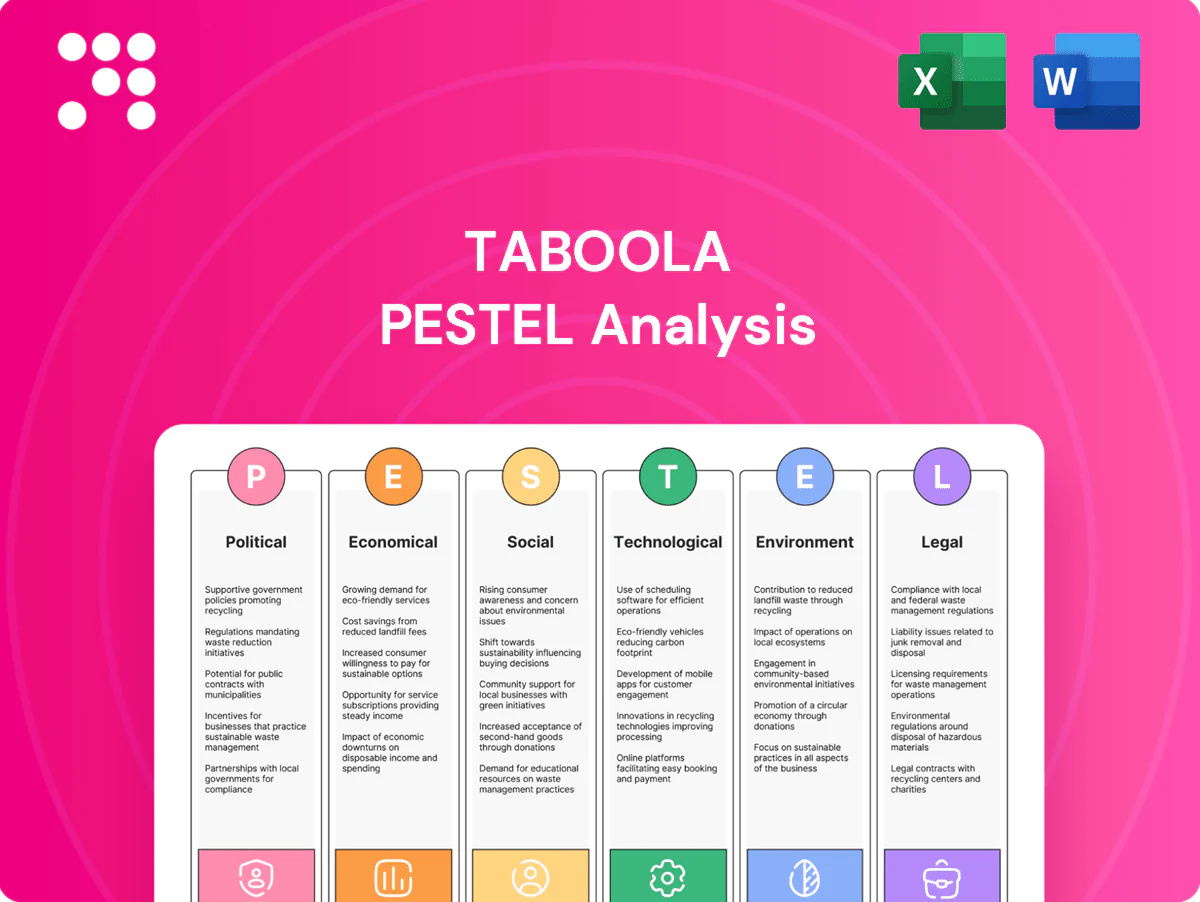
Taboola PESTLE Analysis

Your Shortcut to Market Insight Starts Here
Gain strategic advantage with our PESTLE Analysis of Taboola—3–5 pages of concise insights on political, economic, social, technological, legal, and environmental forces shaping its future. Perfect for investors and strategists, the full report delivers actionable intelligence and editable charts. Purchase the complete analysis to make faster, smarter decisions.
Political factors

Data sovereignty and cross-border flows
Governments are tightening rules: over 60 countries now impose data localization and 130+ have comprehensive data protection laws. Taboola must route traffic, logs and models regionally to comply. This raises infrastructure complexity and latency, complicating uniform product rollouts and boosting operational costs.
Content moderation and censorship pressures
Political pressures force removal or demotion of content, requiring Taboola to tailor recommendation surfaces to local laws while preserving engagement; Taboola reaches about 1.4 billion monthly users, so changes scale widely. Inconsistent enforcement risks regulatory action, e.g., EU Digital Services Act fines up to 6% of global turnover. Over-moderation can shrink available inventory and depress revenue per publisher, straining monetization.

Platform governance and media policy
State-backed media support and measures like Australia’s News Media Bargaining Code (2021) and the EU Digital Markets Act (2023) reshape publisher economics and can divert ad spend via subsidies or negotiated payouts. Taboola, which partners with over 9,000 publishers, may see partner mix and effective take-rates shift as favored local outlets capture more inventory. Preferential local treatment reduces available international inventory and can compress CPMs. Compliance often requires custom integrations and reporting changes for platform monetization.

Geopolitical risk and sanctions
Sanctions can restrict advertiser and publisher relationships in specific markets, blocking ad buys and partnerships. For a network reaching over 1 billion monthly users, blocked payment flows or ad-serving and enhanced screening raise compliance costs and can dent revenue. Supply-chain risks extend to adtech vendors and cloud providers, and rapid policy shifts demand agile traffic controls and real-time filtering.
- reach: over 1 billion monthly users
- impact: blocked ad-serving/payment flows, higher compliance costs
- need: real-time traffic controls, vendor/cloud supply-chain screening
Advertising transparency mandates
Governments increasingly mandate political ad labeling and registries, notably the EU Digital Services Act effective 2024 which allows fines up to 6% of global turnover. Taboola must implement auditable pipelines to classify and disclose ad provenance; non-compliance risks regulatory fines and partner churn. Transparency features can add measurable friction to campaign workflows.
- Regulation: EU DSA (2024) — fines up to 6% global turnover
- Requirement: auditable provenance for political ads
- Risk: fines and partner loss
- Tradeoff: increased workflow friction
Global ad network faces 130+ privacy laws, 60+ localization rules and 6% turnover fines
Taboola faces political risk from 130+ data-protection laws and 60+ data-localization regimes, forcing regional routing and higher ops costs; reach ~1.4 billion monthly users and partnerships with ~9,000 publishers amplify scale. EU DSA/2024 exposes platforms to fines up to 6% of global turnover and mandates political-ad provenance, raising compliance and workflow friction. Sanctions and local media rules (DMA, Australia code) can block flows and compress CPMs.
| Metric | Value |
|---|---|
| Monthly reach | ≈1.4 billion |
| Publishers | ≈9,000 |
| DSA fine | Up to 6% global turnover |
| Data-protection laws | 130+ |
| Data-localization | 60+ countries |
What is included in the product
 Detailed Word Document
Explores how external macro-environmental factors uniquely affect Taboola across six dimensions—Political, Economic, Social, Technological, Environmental, and Legal—linking each to industry-specific examples and recent data. Designed to support executives and investors with forward-looking insights for strategy, risk mitigation, and funding readiness.

 Customizable Excel Spreadsheet
A concise, visually segmented Taboola PESTLE analysis that highlights regulatory, technological, and market risks for quick strategic decisions. Easily shared and editable for rapid team alignment or client reporting.
Economic factors

Ad spend cyclicality
Native and performance budgets are highly cyclical: recessions historically compress CPMs (often 15–25%) and push buyers toward ROI-heavy direct response formats, while recoveries re-expand brand spend and open new verticals like travel and luxury. Taboola reaches over 1.4 billion monthly users and its diversified vertical mix across news, commerce and entertainment helps stabilize revenue through those cycles.
Publisher monetization pressure
Thin publisher margins, often single-digit, boost reliance on recommendation revenue and make Taboola's take-rate and RPM optimization central to publisher retention. Competitive bids from rival networks can compress economics, forcing RPM declines of several percentage points. Long-term contracts (commonly 1–3 years) hedge short-term volatility but limit publishers' flexibility to switch partners.

Currency and regional exposure
Global billings expose Taboola, listed on NASDAQ as TBLA, to FX swings since it invoices and earns revenue across multiple currencies. Mismatches between pricing, payables and receivables in different regions can compress margins when local currencies move against the dollar. Management uses hedging to mitigate volatility, though hedges incur costs that reduce net revenue, while faster regional growth can offset weakness in other markets.

Industry consolidation and bargaining power
Industry M&A among publishers and advertisers concentrates negotiating leverage, forcing Taboola to offer bespoke features and improved CPM guarantees as Google and Meta together control roughly 50% of global digital ad spend (2024), increasing pressure on independents.
Inflation and cost structure
Inflation (US CPI 2024 ~3.4%) pushed Taboola's cloud, talent and data costs higher while global cloud spend rose ~20% in 2024 to about $620B, making efficiency in model training and serving margin-critical; pricing power hinges on demonstrable performance lift to justify higher CPMs, and automation and algorithmic optimization reduce unit costs materially as scale grows.
- Cloud costs up with market (~$620B, 2024)
- Talent/data costs rise with CPI ~3.4% (2024)
- Efficiency in training/inference = margin-critical
- Automation cuts unit cost at scale; pricing needs proven lift
Global ad network faces 130+ privacy laws, 60+ localization rules and 6% turnover fines
CPM cyclicality (-15–25%) and a 1.4B monthly reach stabilize Taboola vs recessions; thin publisher margins and 1–3yr contracts make RPM/take-rate central. Market concentration (Google+Meta ~50% of ad spend, 2024) pressures fees; FX exposure and hedging costs plus US CPI 2024 ~3.4% and global cloud spend ~$620B raise operating costs.
| Metric | Value (2024) |
|---|---|
| Monthly users | 1.4B |
| CPM swing | -15–25% |
| Google+Meta share | ~50% |
| US CPI | 3.4% |
| Global cloud spend | $620B |
Preview the Actual Deliverable
Taboola PESTLE Analysis
The preview shown here is the exact Taboola PESTLE Analysis you’ll receive after purchase—fully formatted and ready to use. The layout, content, and structure visible are the same file you’ll download immediately after payment, with no placeholders or surprises. Use it straightaway for strategic planning, presentations, or research.

Your Shortcut to Market Insight Starts Here
Gain strategic advantage with our PESTLE Analysis of Taboola—3–5 pages of concise insights on political, economic, social, technological, legal, and environmental forces shaping its future. Perfect for investors and strategists, the full report delivers actionable intelligence and editable charts. Purchase the complete analysis to make faster, smarter decisions.
Political factors
Data sovereignty and cross-border flows
Governments are tightening rules: over 60 countries now impose data localization and 130+ have comprehensive data protection laws. Taboola must route traffic, logs and models regionally to comply. This raises infrastructure complexity and latency, complicating uniform product rollouts and boosting operational costs.
Content moderation and censorship pressures
Political pressures force removal or demotion of content, requiring Taboola to tailor recommendation surfaces to local laws while preserving engagement; Taboola reaches about 1.4 billion monthly users, so changes scale widely. Inconsistent enforcement risks regulatory action, e.g., EU Digital Services Act fines up to 6% of global turnover. Over-moderation can shrink available inventory and depress revenue per publisher, straining monetization.
Platform governance and media policy
State-backed media support and measures like Australia’s News Media Bargaining Code (2021) and the EU Digital Markets Act (2023) reshape publisher economics and can divert ad spend via subsidies or negotiated payouts. Taboola, which partners with over 9,000 publishers, may see partner mix and effective take-rates shift as favored local outlets capture more inventory. Preferential local treatment reduces available international inventory and can compress CPMs. Compliance often requires custom integrations and reporting changes for platform monetization.
Geopolitical risk and sanctions
Sanctions can restrict advertiser and publisher relationships in specific markets, blocking ad buys and partnerships. For a network reaching over 1 billion monthly users, blocked payment flows or ad-serving and enhanced screening raise compliance costs and can dent revenue. Supply-chain risks extend to adtech vendors and cloud providers, and rapid policy shifts demand agile traffic controls and real-time filtering.
- reach: over 1 billion monthly users
- impact: blocked ad-serving/payment flows, higher compliance costs
- need: real-time traffic controls, vendor/cloud supply-chain screening
Advertising transparency mandates
Governments increasingly mandate political ad labeling and registries, notably the EU Digital Services Act effective 2024 which allows fines up to 6% of global turnover. Taboola must implement auditable pipelines to classify and disclose ad provenance; non-compliance risks regulatory fines and partner churn. Transparency features can add measurable friction to campaign workflows.
- Regulation: EU DSA (2024) — fines up to 6% global turnover
- Requirement: auditable provenance for political ads
- Risk: fines and partner loss
- Tradeoff: increased workflow friction
Global ad network faces 130+ privacy laws, 60+ localization rules and 6% turnover fines
Taboola faces political risk from 130+ data-protection laws and 60+ data-localization regimes, forcing regional routing and higher ops costs; reach ~1.4 billion monthly users and partnerships with ~9,000 publishers amplify scale. EU DSA/2024 exposes platforms to fines up to 6% of global turnover and mandates political-ad provenance, raising compliance and workflow friction. Sanctions and local media rules (DMA, Australia code) can block flows and compress CPMs.
| Metric | Value |
|---|---|
| Monthly reach | ≈1.4 billion |
| Publishers | ≈9,000 |
| DSA fine | Up to 6% global turnover |
| Data-protection laws | 130+ |
| Data-localization | 60+ countries |
What is included in the product
Detailed Word Document
Explores how external macro-environmental factors uniquely affect Taboola across six dimensions—Political, Economic, Social, Technological, Environmental, and Legal—linking each to industry-specific examples and recent data. Designed to support executives and investors with forward-looking insights for strategy, risk mitigation, and funding readiness.
Customizable Excel Spreadsheet
A concise, visually segmented Taboola PESTLE analysis that highlights regulatory, technological, and market risks for quick strategic decisions. Easily shared and editable for rapid team alignment or client reporting.
Economic factors
Ad spend cyclicality
Native and performance budgets are highly cyclical: recessions historically compress CPMs (often 15–25%) and push buyers toward ROI-heavy direct response formats, while recoveries re-expand brand spend and open new verticals like travel and luxury. Taboola reaches over 1.4 billion monthly users and its diversified vertical mix across news, commerce and entertainment helps stabilize revenue through those cycles.
Publisher monetization pressure
Thin publisher margins, often single-digit, boost reliance on recommendation revenue and make Taboola's take-rate and RPM optimization central to publisher retention. Competitive bids from rival networks can compress economics, forcing RPM declines of several percentage points. Long-term contracts (commonly 1–3 years) hedge short-term volatility but limit publishers' flexibility to switch partners.
Currency and regional exposure
Global billings expose Taboola, listed on NASDAQ as TBLA, to FX swings since it invoices and earns revenue across multiple currencies. Mismatches between pricing, payables and receivables in different regions can compress margins when local currencies move against the dollar. Management uses hedging to mitigate volatility, though hedges incur costs that reduce net revenue, while faster regional growth can offset weakness in other markets.
Industry consolidation and bargaining power
Industry M&A among publishers and advertisers concentrates negotiating leverage, forcing Taboola to offer bespoke features and improved CPM guarantees as Google and Meta together control roughly 50% of global digital ad spend (2024), increasing pressure on independents.
Inflation and cost structure
Inflation (US CPI 2024 ~3.4%) pushed Taboola's cloud, talent and data costs higher while global cloud spend rose ~20% in 2024 to about $620B, making efficiency in model training and serving margin-critical; pricing power hinges on demonstrable performance lift to justify higher CPMs, and automation and algorithmic optimization reduce unit costs materially as scale grows.
- Cloud costs up with market (~$620B, 2024)
- Talent/data costs rise with CPI ~3.4% (2024)
- Efficiency in training/inference = margin-critical
- Automation cuts unit cost at scale; pricing needs proven lift
Global ad network faces 130+ privacy laws, 60+ localization rules and 6% turnover fines
CPM cyclicality (-15–25%) and a 1.4B monthly reach stabilize Taboola vs recessions; thin publisher margins and 1–3yr contracts make RPM/take-rate central. Market concentration (Google+Meta ~50% of ad spend, 2024) pressures fees; FX exposure and hedging costs plus US CPI 2024 ~3.4% and global cloud spend ~$620B raise operating costs.
| Metric | Value (2024) |
|---|---|
| Monthly users | 1.4B |
| CPM swing | -15–25% |
| Google+Meta share | ~50% |
| US CPI | 3.4% |
| Global cloud spend | $620B |
Preview the Actual Deliverable
Taboola PESTLE Analysis
The preview shown here is the exact Taboola PESTLE Analysis you’ll receive after purchase—fully formatted and ready to use. The layout, content, and structure visible are the same file you’ll download immediately after payment, with no placeholders or surprises. Use it straightaway for strategic planning, presentations, or research.
Original: $10.00
-65%$10.00
$3.50Description
Your Shortcut to Market Insight Starts Here
Gain strategic advantage with our PESTLE Analysis of Taboola—3–5 pages of concise insights on political, economic, social, technological, legal, and environmental forces shaping its future. Perfect for investors and strategists, the full report delivers actionable intelligence and editable charts. Purchase the complete analysis to make faster, smarter decisions.
Political factors
Data sovereignty and cross-border flows
Governments are tightening rules: over 60 countries now impose data localization and 130+ have comprehensive data protection laws. Taboola must route traffic, logs and models regionally to comply. This raises infrastructure complexity and latency, complicating uniform product rollouts and boosting operational costs.
Content moderation and censorship pressures
Political pressures force removal or demotion of content, requiring Taboola to tailor recommendation surfaces to local laws while preserving engagement; Taboola reaches about 1.4 billion monthly users, so changes scale widely. Inconsistent enforcement risks regulatory action, e.g., EU Digital Services Act fines up to 6% of global turnover. Over-moderation can shrink available inventory and depress revenue per publisher, straining monetization.
Platform governance and media policy
State-backed media support and measures like Australia’s News Media Bargaining Code (2021) and the EU Digital Markets Act (2023) reshape publisher economics and can divert ad spend via subsidies or negotiated payouts. Taboola, which partners with over 9,000 publishers, may see partner mix and effective take-rates shift as favored local outlets capture more inventory. Preferential local treatment reduces available international inventory and can compress CPMs. Compliance often requires custom integrations and reporting changes for platform monetization.
Geopolitical risk and sanctions
Sanctions can restrict advertiser and publisher relationships in specific markets, blocking ad buys and partnerships. For a network reaching over 1 billion monthly users, blocked payment flows or ad-serving and enhanced screening raise compliance costs and can dent revenue. Supply-chain risks extend to adtech vendors and cloud providers, and rapid policy shifts demand agile traffic controls and real-time filtering.
- reach: over 1 billion monthly users
- impact: blocked ad-serving/payment flows, higher compliance costs
- need: real-time traffic controls, vendor/cloud supply-chain screening
Advertising transparency mandates
Governments increasingly mandate political ad labeling and registries, notably the EU Digital Services Act effective 2024 which allows fines up to 6% of global turnover. Taboola must implement auditable pipelines to classify and disclose ad provenance; non-compliance risks regulatory fines and partner churn. Transparency features can add measurable friction to campaign workflows.
- Regulation: EU DSA (2024) — fines up to 6% global turnover
- Requirement: auditable provenance for political ads
- Risk: fines and partner loss
- Tradeoff: increased workflow friction
Global ad network faces 130+ privacy laws, 60+ localization rules and 6% turnover fines
Taboola faces political risk from 130+ data-protection laws and 60+ data-localization regimes, forcing regional routing and higher ops costs; reach ~1.4 billion monthly users and partnerships with ~9,000 publishers amplify scale. EU DSA/2024 exposes platforms to fines up to 6% of global turnover and mandates political-ad provenance, raising compliance and workflow friction. Sanctions and local media rules (DMA, Australia code) can block flows and compress CPMs.
| Metric | Value |
|---|---|
| Monthly reach | ≈1.4 billion |
| Publishers | ≈9,000 |
| DSA fine | Up to 6% global turnover |
| Data-protection laws | 130+ |
| Data-localization | 60+ countries |
What is included in the product
Detailed Word Document
Explores how external macro-environmental factors uniquely affect Taboola across six dimensions—Political, Economic, Social, Technological, Environmental, and Legal—linking each to industry-specific examples and recent data. Designed to support executives and investors with forward-looking insights for strategy, risk mitigation, and funding readiness.
Customizable Excel Spreadsheet
A concise, visually segmented Taboola PESTLE analysis that highlights regulatory, technological, and market risks for quick strategic decisions. Easily shared and editable for rapid team alignment or client reporting.
Economic factors
Ad spend cyclicality
Native and performance budgets are highly cyclical: recessions historically compress CPMs (often 15–25%) and push buyers toward ROI-heavy direct response formats, while recoveries re-expand brand spend and open new verticals like travel and luxury. Taboola reaches over 1.4 billion monthly users and its diversified vertical mix across news, commerce and entertainment helps stabilize revenue through those cycles.
Publisher monetization pressure
Thin publisher margins, often single-digit, boost reliance on recommendation revenue and make Taboola's take-rate and RPM optimization central to publisher retention. Competitive bids from rival networks can compress economics, forcing RPM declines of several percentage points. Long-term contracts (commonly 1–3 years) hedge short-term volatility but limit publishers' flexibility to switch partners.
Currency and regional exposure
Global billings expose Taboola, listed on NASDAQ as TBLA, to FX swings since it invoices and earns revenue across multiple currencies. Mismatches between pricing, payables and receivables in different regions can compress margins when local currencies move against the dollar. Management uses hedging to mitigate volatility, though hedges incur costs that reduce net revenue, while faster regional growth can offset weakness in other markets.
Industry consolidation and bargaining power
Industry M&A among publishers and advertisers concentrates negotiating leverage, forcing Taboola to offer bespoke features and improved CPM guarantees as Google and Meta together control roughly 50% of global digital ad spend (2024), increasing pressure on independents.
Inflation and cost structure
Inflation (US CPI 2024 ~3.4%) pushed Taboola's cloud, talent and data costs higher while global cloud spend rose ~20% in 2024 to about $620B, making efficiency in model training and serving margin-critical; pricing power hinges on demonstrable performance lift to justify higher CPMs, and automation and algorithmic optimization reduce unit costs materially as scale grows.
- Cloud costs up with market (~$620B, 2024)
- Talent/data costs rise with CPI ~3.4% (2024)
- Efficiency in training/inference = margin-critical
- Automation cuts unit cost at scale; pricing needs proven lift
Global ad network faces 130+ privacy laws, 60+ localization rules and 6% turnover fines
CPM cyclicality (-15–25%) and a 1.4B monthly reach stabilize Taboola vs recessions; thin publisher margins and 1–3yr contracts make RPM/take-rate central. Market concentration (Google+Meta ~50% of ad spend, 2024) pressures fees; FX exposure and hedging costs plus US CPI 2024 ~3.4% and global cloud spend ~$620B raise operating costs.
| Metric | Value (2024) |
|---|---|
| Monthly users | 1.4B |
| CPM swing | -15–25% |
| Google+Meta share | ~50% |
| US CPI | 3.4% |
| Global cloud spend | $620B |
Preview the Actual Deliverable
Taboola PESTLE Analysis
The preview shown here is the exact Taboola PESTLE Analysis you’ll receive after purchase—fully formatted and ready to use. The layout, content, and structure visible are the same file you’ll download immediately after payment, with no placeholders or surprises. Use it straightaway for strategic planning, presentations, or research.











