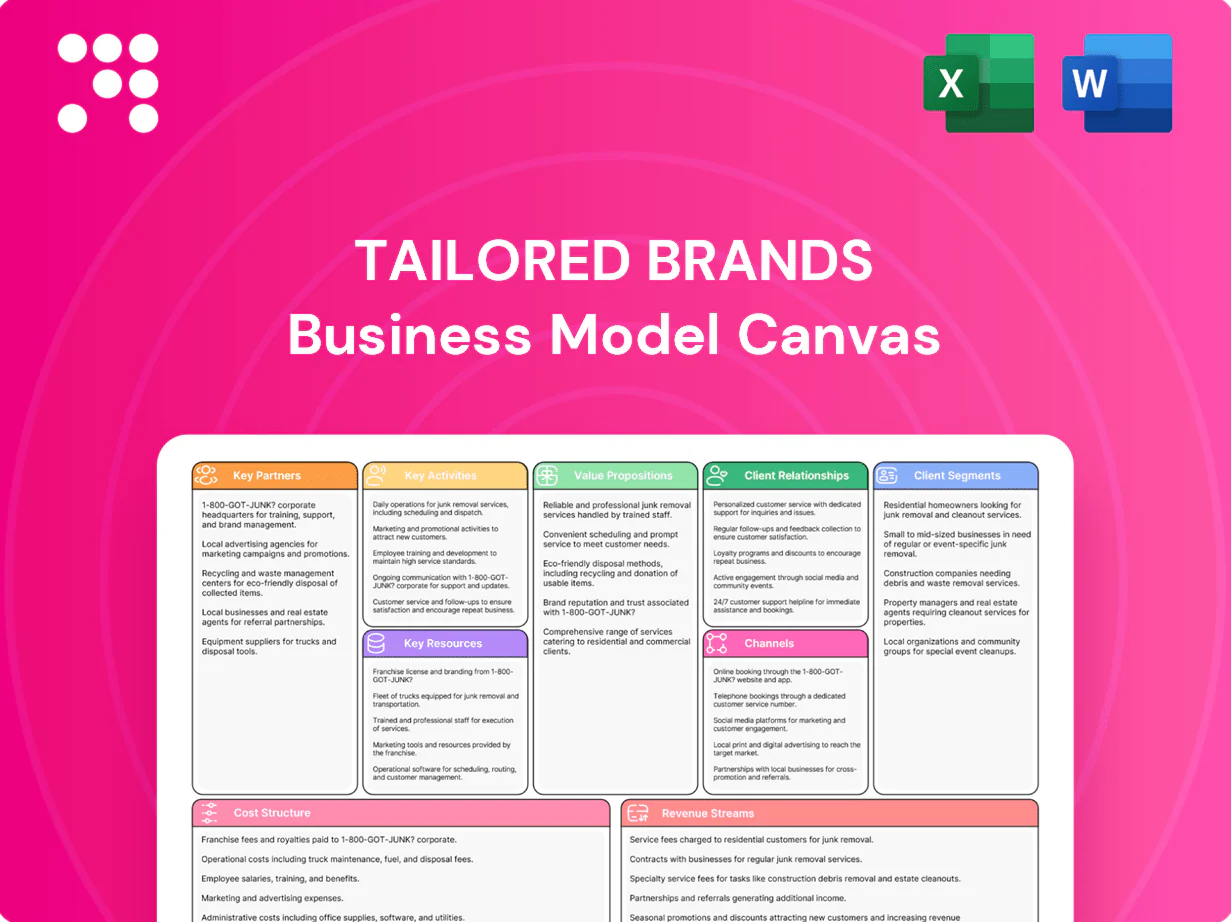
Tailored Brands Business Model Canvas

Unlock a concise Business Model Canvas: value propositions, customers, revenue drivers
Unlock the strategic blueprint behind Tailored Brands with a concise Business Model Canvas that highlights its value propositions, customer segments, and revenue drivers. See how the company scales through partnerships, omnichannel retail, and tailored services. Purchase the full, editable Canvas (Word & Excel) for all nine blocks, actionable insights, and benchmarking-ready analysis to inform investment or strategic planning.
Partnerships

Premium fabric mills & trim suppliers
Strategic sourcing relationships secure quality wool, cotton and performance blends at scale, aligning Tailored Brands with suppliers that serve the $1.58 trillion global apparel market in 2024. Preferred vendor status ensures continuity, color consistency and rapid replenishment across core SKUs. Long-term contracts stabilize input costs and mitigate supply volatility. Co-development enables exclusive fabrics for private labels and differentiation.
Contract manufacturers & alteration partners
OEM/ODM apparel factories produce Tailored Brands private-label suits, shirts and accessories, with industry data in 2024 showing over 60% of specialty apparel retailers outsourcing core production; flexible factory capacity enables rapid scaling for seasonal and event-driven spikes (often doubling throughput for peak weeks). Regional alteration partners augment in-house tailors during peaks, while QA and compliance vendors enforce fit and durability standards.

Logistics, 3PLs & last‑mile carriers
Distribution partners enable ship-to-home, ship-from-store and BOPIS to leverage store density and reduce lead times; apparel e‑commerce return rates remain elevated at ~20–30%, so fast ship-from-store and cross-dock returns processing speed inventory turns and cut markdown risk. Last‑mile carriers, who account for roughly 50–60% of delivery cost, provide time‑definite delivery for events, while regional freight partnerships optimize cost‑to‑serve.

Event ecosystem partners
Event ecosystem partners—venues, wedding planners, photographers and prom organizations—drive bundled bookings and coordinated purchases; The Knot reports the 2024 U.S. average wedding cost at about $34,000, highlighting high AOV opportunity for group rentals. Referral programs capture group rentals, streamline measurements and timelines, and unlock group discounts while seasonal campaigns co-market packages to maximize conversion.
- Venues
- Planners
- Photographers
- Prom orgs
- Referral programs
- Seasonal co-marketing
Digital, payments & retail tech providers
Digital, payments and retail tech partners enable Tailored Brands to execute true omnichannel—e-commerce platforms, POS and OMS vendors sync inventory and fulfillment so omnichannel shoppers, who spend up to 30% more, get seamless service; analytics, CRM and personalization engines can boost conversion by ~10–15% (McKinsey). Payment gateways, BNPL and fraud tools cut checkout friction and risk, while appointment, sizing and virtual styling tech raise lifetime value.
Suppliers lock pricing in $1.58T; OEMs >60% outsourced; tech +10-15% conv
Strategic suppliers lock volume pricing for wool/cotton blends in a $1.58T 2024 apparel market; OEMs handle >60% outsourced production enabling peak scaling; distribution and last‑mile partners cut lead times amid 20–30% return rates; event and tech partners lift AOVs and conversion (~10–15%).
| Partner | Metric 2024 | Impact |
|---|---|---|
| Suppliers | $1.58T market | Cost stability |
| OEM | >60% outsourced | Scale |
| Distribution | 20–30% returns | Faster turns |
| Tech | 10–15% conv. | Revenue |
What is included in the product
 Detailed Word Document
A comprehensive Business Model Canvas for Tailored Brands detailing customer segments, channels, value propositions, revenue streams, cost structure, key activities, partners, resources, and customer relationships aligned with its retail and services strategy. Ideal for investor presentations and strategic planning with SWOT-linked insights and competitive analysis.

 Customizable Excel Spreadsheet
High-level view of Tailored Brands’ business model with editable cells to pinpoint retail, wholesale, alterations and omnichannel pain points quickly.
Activities

Merchandising & private-label development
Line planning balances core suiting with seasonal trends and essentials, guiding a private‑label mix (about 35% of apparel sales in 2024) that supported Tailored Brands’ ~$1.2B revenue and ~1,100 stores; fit blocks, fabrics, and trims are curated to uphold brand positioning; vendor negotiations, costing, and QA target margin expansion (100–300 bps uplift versus branded goods); assortment localization aligns SKUs to store clusters and customer profiles.
Omni-channel retail operations
Store service, visual merchandising and tight inventory execution drive same-store sales; US e-commerce was 16.3% of retail sales in 2023 (US Census), underscoring omnichannel importance. OMS enables BOPIS, BORIS and ship-from-store—strategies shown to lift AOV ~30% and cut fulfillment costs ~20% (industry studies, 2023). Demand forecasting and allocation typically reduce stockouts 10–20% and optimize size curves/stock depth. KPI monitoring raises conversion, AUR and UPT through iterative fixes.

Formalwear rental lifecycle
Reservation, measurement, and group coordination drive on-time delivery and fit assurance for Tailored Brands formalwear rental operations. Centralized cleaning, inspection, and kitting uphold quality and reduce defects. Reverse logistics with targeted 48-hour quick turns maximize rental utilization and asset ROI. Seasonal capacity planning aligns inventory and labor to US demand peaks such as roughly 2 million weddings annually and prom seasons.

Tailoring, alterations & fitting
On-site and centralized tailoring deliver precise fit through trained tailors and standardized patterns, with 2024 retail pilots reporting ~25% faster turnaround before events. Standardized workflows reduce cycle time and enable last-minute orders while upsells for adjustments and enhancements lift average transaction value. Rigorous quality checks protect brand reputation and drive repeat business.
- Fit precision: on-site + centralized
- Cycle time: standardized workflows ≈25% faster
- Revenue upside: adjustments & enhancements
- Risk control: quality checks → repeat customers
Marketing, CRM & loyalty
Segmented campaigns target life events and wardrobe refreshes, using behavioral and demographic triggers to lift conversion; email/SMS, paid social and search drive traffic and bookings and prioritize appointment capture. Loyalty programs reward frequency and increase lifetime value, while reviews and referrals amplify social proof and lower acquisition cost.
- Segmented campaigns: life events & wardrobe refreshes
- Channels: Email/SMS, paid social, search
- Loyalty: reward frequency, boost LTV
- Reviews/referrals: amplify social proof
Omnichannel bridal ops: $1.2B, 35% private-label
Line planning/private‑label (35% apparel sales in 2024) and vendor cost/QA target 100–300 bps margin lift; omnichannel ops (US e‑commerce 16.3% 2023) with OMS, BOPIS and ship‑from‑store; rental logistics (peaks ~2M US weddings/year) and tailoring centers cut cycle times ~25% while driving AOV via upsells.
| Metric | Value | Impact |
|---|---|---|
| Revenue (2024) | $1.2B | Scale |
| Stores | ~1,100 | Fulfillment network |
| Private‑label | 35% | Margin |
| E‑comm (US, 2023) | 16.3% | Omnichannel |
| Tailor cycle time (2024) | ≈-25% | Speed/upsell |
| Wedding demand | ~2M/yr | Seasonal peak |
Delivered as Displayed
Business Model Canvas
The Tailored Brands Business Model Canvas shown here is a real, live preview of the exact file you will receive after purchase. It’s not a mockup—this same structured, editable document is delivered to you ready for presentation or editing. When you complete your order, you’ll download the full Canvas in the same format and content as pictured, with no surprises.

Unlock a concise Business Model Canvas: value propositions, customers, revenue drivers
Unlock the strategic blueprint behind Tailored Brands with a concise Business Model Canvas that highlights its value propositions, customer segments, and revenue drivers. See how the company scales through partnerships, omnichannel retail, and tailored services. Purchase the full, editable Canvas (Word & Excel) for all nine blocks, actionable insights, and benchmarking-ready analysis to inform investment or strategic planning.
Partnerships
Premium fabric mills & trim suppliers
Strategic sourcing relationships secure quality wool, cotton and performance blends at scale, aligning Tailored Brands with suppliers that serve the $1.58 trillion global apparel market in 2024. Preferred vendor status ensures continuity, color consistency and rapid replenishment across core SKUs. Long-term contracts stabilize input costs and mitigate supply volatility. Co-development enables exclusive fabrics for private labels and differentiation.
Contract manufacturers & alteration partners
OEM/ODM apparel factories produce Tailored Brands private-label suits, shirts and accessories, with industry data in 2024 showing over 60% of specialty apparel retailers outsourcing core production; flexible factory capacity enables rapid scaling for seasonal and event-driven spikes (often doubling throughput for peak weeks). Regional alteration partners augment in-house tailors during peaks, while QA and compliance vendors enforce fit and durability standards.
Logistics, 3PLs & last‑mile carriers
Distribution partners enable ship-to-home, ship-from-store and BOPIS to leverage store density and reduce lead times; apparel e‑commerce return rates remain elevated at ~20–30%, so fast ship-from-store and cross-dock returns processing speed inventory turns and cut markdown risk. Last‑mile carriers, who account for roughly 50–60% of delivery cost, provide time‑definite delivery for events, while regional freight partnerships optimize cost‑to‑serve.
Event ecosystem partners
Event ecosystem partners—venues, wedding planners, photographers and prom organizations—drive bundled bookings and coordinated purchases; The Knot reports the 2024 U.S. average wedding cost at about $34,000, highlighting high AOV opportunity for group rentals. Referral programs capture group rentals, streamline measurements and timelines, and unlock group discounts while seasonal campaigns co-market packages to maximize conversion.
- Venues
- Planners
- Photographers
- Prom orgs
- Referral programs
- Seasonal co-marketing
Digital, payments & retail tech providers
Digital, payments and retail tech partners enable Tailored Brands to execute true omnichannel—e-commerce platforms, POS and OMS vendors sync inventory and fulfillment so omnichannel shoppers, who spend up to 30% more, get seamless service; analytics, CRM and personalization engines can boost conversion by ~10–15% (McKinsey). Payment gateways, BNPL and fraud tools cut checkout friction and risk, while appointment, sizing and virtual styling tech raise lifetime value.
Suppliers lock pricing in $1.58T; OEMs >60% outsourced; tech +10-15% conv
Strategic suppliers lock volume pricing for wool/cotton blends in a $1.58T 2024 apparel market; OEMs handle >60% outsourced production enabling peak scaling; distribution and last‑mile partners cut lead times amid 20–30% return rates; event and tech partners lift AOVs and conversion (~10–15%).
| Partner | Metric 2024 | Impact |
|---|---|---|
| Suppliers | $1.58T market | Cost stability |
| OEM | >60% outsourced | Scale |
| Distribution | 20–30% returns | Faster turns |
| Tech | 10–15% conv. | Revenue |
What is included in the product
Detailed Word Document
A comprehensive Business Model Canvas for Tailored Brands detailing customer segments, channels, value propositions, revenue streams, cost structure, key activities, partners, resources, and customer relationships aligned with its retail and services strategy. Ideal for investor presentations and strategic planning with SWOT-linked insights and competitive analysis.
Customizable Excel Spreadsheet
High-level view of Tailored Brands’ business model with editable cells to pinpoint retail, wholesale, alterations and omnichannel pain points quickly.
Activities
Merchandising & private-label development
Line planning balances core suiting with seasonal trends and essentials, guiding a private‑label mix (about 35% of apparel sales in 2024) that supported Tailored Brands’ ~$1.2B revenue and ~1,100 stores; fit blocks, fabrics, and trims are curated to uphold brand positioning; vendor negotiations, costing, and QA target margin expansion (100–300 bps uplift versus branded goods); assortment localization aligns SKUs to store clusters and customer profiles.
Omni-channel retail operations
Store service, visual merchandising and tight inventory execution drive same-store sales; US e-commerce was 16.3% of retail sales in 2023 (US Census), underscoring omnichannel importance. OMS enables BOPIS, BORIS and ship-from-store—strategies shown to lift AOV ~30% and cut fulfillment costs ~20% (industry studies, 2023). Demand forecasting and allocation typically reduce stockouts 10–20% and optimize size curves/stock depth. KPI monitoring raises conversion, AUR and UPT through iterative fixes.
Formalwear rental lifecycle
Reservation, measurement, and group coordination drive on-time delivery and fit assurance for Tailored Brands formalwear rental operations. Centralized cleaning, inspection, and kitting uphold quality and reduce defects. Reverse logistics with targeted 48-hour quick turns maximize rental utilization and asset ROI. Seasonal capacity planning aligns inventory and labor to US demand peaks such as roughly 2 million weddings annually and prom seasons.
Tailoring, alterations & fitting
On-site and centralized tailoring deliver precise fit through trained tailors and standardized patterns, with 2024 retail pilots reporting ~25% faster turnaround before events. Standardized workflows reduce cycle time and enable last-minute orders while upsells for adjustments and enhancements lift average transaction value. Rigorous quality checks protect brand reputation and drive repeat business.
- Fit precision: on-site + centralized
- Cycle time: standardized workflows ≈25% faster
- Revenue upside: adjustments & enhancements
- Risk control: quality checks → repeat customers
Marketing, CRM & loyalty
Segmented campaigns target life events and wardrobe refreshes, using behavioral and demographic triggers to lift conversion; email/SMS, paid social and search drive traffic and bookings and prioritize appointment capture. Loyalty programs reward frequency and increase lifetime value, while reviews and referrals amplify social proof and lower acquisition cost.
- Segmented campaigns: life events & wardrobe refreshes
- Channels: Email/SMS, paid social, search
- Loyalty: reward frequency, boost LTV
- Reviews/referrals: amplify social proof
Omnichannel bridal ops: $1.2B, 35% private-label
Line planning/private‑label (35% apparel sales in 2024) and vendor cost/QA target 100–300 bps margin lift; omnichannel ops (US e‑commerce 16.3% 2023) with OMS, BOPIS and ship‑from‑store; rental logistics (peaks ~2M US weddings/year) and tailoring centers cut cycle times ~25% while driving AOV via upsells.
| Metric | Value | Impact |
|---|---|---|
| Revenue (2024) | $1.2B | Scale |
| Stores | ~1,100 | Fulfillment network |
| Private‑label | 35% | Margin |
| E‑comm (US, 2023) | 16.3% | Omnichannel |
| Tailor cycle time (2024) | ≈-25% | Speed/upsell |
| Wedding demand | ~2M/yr | Seasonal peak |
Delivered as Displayed
Business Model Canvas
The Tailored Brands Business Model Canvas shown here is a real, live preview of the exact file you will receive after purchase. It’s not a mockup—this same structured, editable document is delivered to you ready for presentation or editing. When you complete your order, you’ll download the full Canvas in the same format and content as pictured, with no surprises.
Description
Unlock a concise Business Model Canvas: value propositions, customers, revenue drivers
Unlock the strategic blueprint behind Tailored Brands with a concise Business Model Canvas that highlights its value propositions, customer segments, and revenue drivers. See how the company scales through partnerships, omnichannel retail, and tailored services. Purchase the full, editable Canvas (Word & Excel) for all nine blocks, actionable insights, and benchmarking-ready analysis to inform investment or strategic planning.
Partnerships
Premium fabric mills & trim suppliers
Strategic sourcing relationships secure quality wool, cotton and performance blends at scale, aligning Tailored Brands with suppliers that serve the $1.58 trillion global apparel market in 2024. Preferred vendor status ensures continuity, color consistency and rapid replenishment across core SKUs. Long-term contracts stabilize input costs and mitigate supply volatility. Co-development enables exclusive fabrics for private labels and differentiation.
Contract manufacturers & alteration partners
OEM/ODM apparel factories produce Tailored Brands private-label suits, shirts and accessories, with industry data in 2024 showing over 60% of specialty apparel retailers outsourcing core production; flexible factory capacity enables rapid scaling for seasonal and event-driven spikes (often doubling throughput for peak weeks). Regional alteration partners augment in-house tailors during peaks, while QA and compliance vendors enforce fit and durability standards.
Logistics, 3PLs & last‑mile carriers
Distribution partners enable ship-to-home, ship-from-store and BOPIS to leverage store density and reduce lead times; apparel e‑commerce return rates remain elevated at ~20–30%, so fast ship-from-store and cross-dock returns processing speed inventory turns and cut markdown risk. Last‑mile carriers, who account for roughly 50–60% of delivery cost, provide time‑definite delivery for events, while regional freight partnerships optimize cost‑to‑serve.
Event ecosystem partners
Event ecosystem partners—venues, wedding planners, photographers and prom organizations—drive bundled bookings and coordinated purchases; The Knot reports the 2024 U.S. average wedding cost at about $34,000, highlighting high AOV opportunity for group rentals. Referral programs capture group rentals, streamline measurements and timelines, and unlock group discounts while seasonal campaigns co-market packages to maximize conversion.
- Venues
- Planners
- Photographers
- Prom orgs
- Referral programs
- Seasonal co-marketing
Digital, payments & retail tech providers
Digital, payments and retail tech partners enable Tailored Brands to execute true omnichannel—e-commerce platforms, POS and OMS vendors sync inventory and fulfillment so omnichannel shoppers, who spend up to 30% more, get seamless service; analytics, CRM and personalization engines can boost conversion by ~10–15% (McKinsey). Payment gateways, BNPL and fraud tools cut checkout friction and risk, while appointment, sizing and virtual styling tech raise lifetime value.
Suppliers lock pricing in $1.58T; OEMs >60% outsourced; tech +10-15% conv
Strategic suppliers lock volume pricing for wool/cotton blends in a $1.58T 2024 apparel market; OEMs handle >60% outsourced production enabling peak scaling; distribution and last‑mile partners cut lead times amid 20–30% return rates; event and tech partners lift AOVs and conversion (~10–15%).
| Partner | Metric 2024 | Impact |
|---|---|---|
| Suppliers | $1.58T market | Cost stability |
| OEM | >60% outsourced | Scale |
| Distribution | 20–30% returns | Faster turns |
| Tech | 10–15% conv. | Revenue |
What is included in the product
Detailed Word Document
A comprehensive Business Model Canvas for Tailored Brands detailing customer segments, channels, value propositions, revenue streams, cost structure, key activities, partners, resources, and customer relationships aligned with its retail and services strategy. Ideal for investor presentations and strategic planning with SWOT-linked insights and competitive analysis.
Customizable Excel Spreadsheet
High-level view of Tailored Brands’ business model with editable cells to pinpoint retail, wholesale, alterations and omnichannel pain points quickly.
Activities
Merchandising & private-label development
Line planning balances core suiting with seasonal trends and essentials, guiding a private‑label mix (about 35% of apparel sales in 2024) that supported Tailored Brands’ ~$1.2B revenue and ~1,100 stores; fit blocks, fabrics, and trims are curated to uphold brand positioning; vendor negotiations, costing, and QA target margin expansion (100–300 bps uplift versus branded goods); assortment localization aligns SKUs to store clusters and customer profiles.
Omni-channel retail operations
Store service, visual merchandising and tight inventory execution drive same-store sales; US e-commerce was 16.3% of retail sales in 2023 (US Census), underscoring omnichannel importance. OMS enables BOPIS, BORIS and ship-from-store—strategies shown to lift AOV ~30% and cut fulfillment costs ~20% (industry studies, 2023). Demand forecasting and allocation typically reduce stockouts 10–20% and optimize size curves/stock depth. KPI monitoring raises conversion, AUR and UPT through iterative fixes.
Formalwear rental lifecycle
Reservation, measurement, and group coordination drive on-time delivery and fit assurance for Tailored Brands formalwear rental operations. Centralized cleaning, inspection, and kitting uphold quality and reduce defects. Reverse logistics with targeted 48-hour quick turns maximize rental utilization and asset ROI. Seasonal capacity planning aligns inventory and labor to US demand peaks such as roughly 2 million weddings annually and prom seasons.
Tailoring, alterations & fitting
On-site and centralized tailoring deliver precise fit through trained tailors and standardized patterns, with 2024 retail pilots reporting ~25% faster turnaround before events. Standardized workflows reduce cycle time and enable last-minute orders while upsells for adjustments and enhancements lift average transaction value. Rigorous quality checks protect brand reputation and drive repeat business.
- Fit precision: on-site + centralized
- Cycle time: standardized workflows ≈25% faster
- Revenue upside: adjustments & enhancements
- Risk control: quality checks → repeat customers
Marketing, CRM & loyalty
Segmented campaigns target life events and wardrobe refreshes, using behavioral and demographic triggers to lift conversion; email/SMS, paid social and search drive traffic and bookings and prioritize appointment capture. Loyalty programs reward frequency and increase lifetime value, while reviews and referrals amplify social proof and lower acquisition cost.
- Segmented campaigns: life events & wardrobe refreshes
- Channels: Email/SMS, paid social, search
- Loyalty: reward frequency, boost LTV
- Reviews/referrals: amplify social proof
Omnichannel bridal ops: $1.2B, 35% private-label
Line planning/private‑label (35% apparel sales in 2024) and vendor cost/QA target 100–300 bps margin lift; omnichannel ops (US e‑commerce 16.3% 2023) with OMS, BOPIS and ship‑from‑store; rental logistics (peaks ~2M US weddings/year) and tailoring centers cut cycle times ~25% while driving AOV via upsells.
| Metric | Value | Impact |
|---|---|---|
| Revenue (2024) | $1.2B | Scale |
| Stores | ~1,100 | Fulfillment network |
| Private‑label | 35% | Margin |
| E‑comm (US, 2023) | 16.3% | Omnichannel |
| Tailor cycle time (2024) | ≈-25% | Speed/upsell |
| Wedding demand | ~2M/yr | Seasonal peak |
Delivered as Displayed
Business Model Canvas
The Tailored Brands Business Model Canvas shown here is a real, live preview of the exact file you will receive after purchase. It’s not a mockup—this same structured, editable document is delivered to you ready for presentation or editing. When you complete your order, you’ll download the full Canvas in the same format and content as pictured, with no surprises.











