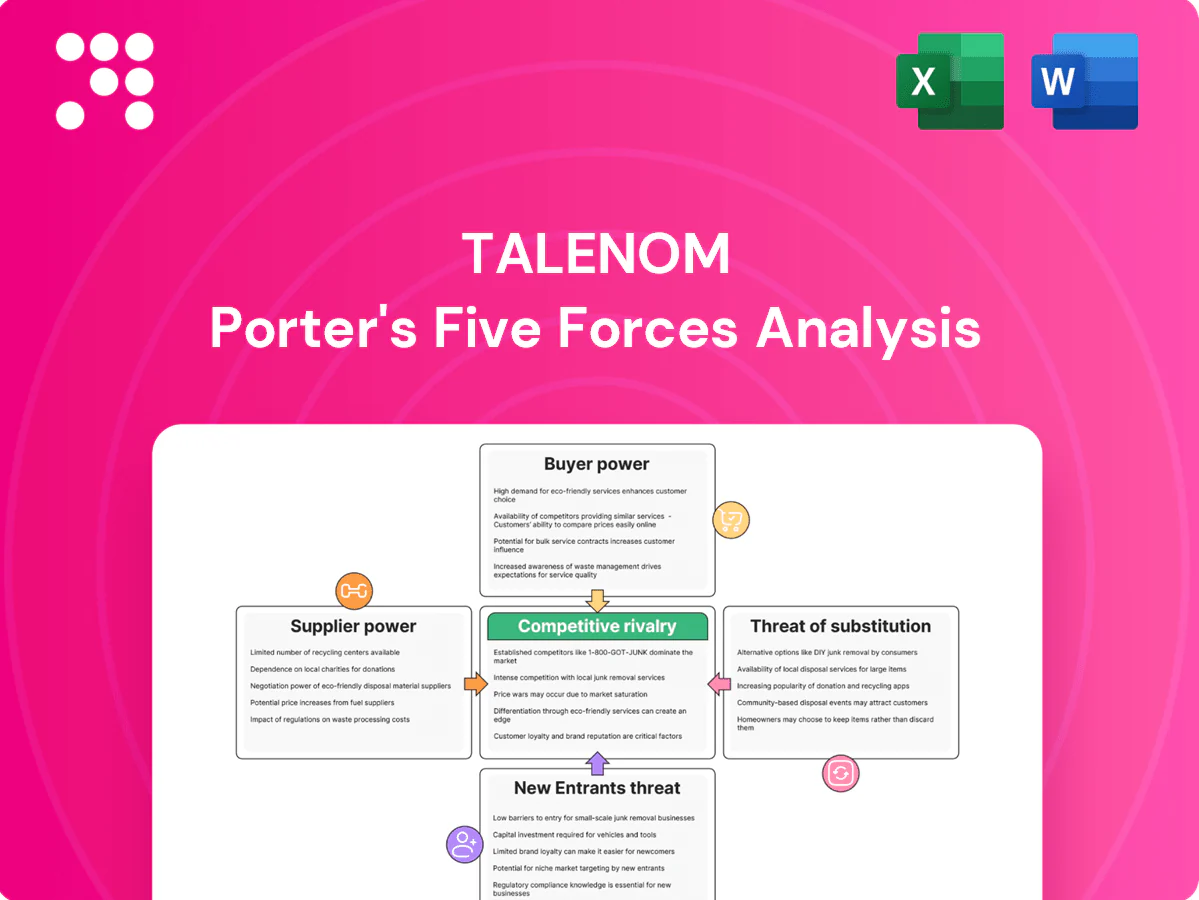
Talenom Porter's Five Forces Analysis

From Overview to Strategy Blueprint
Talenom operates in cloud accounting for SMEs where digital differentiation and regulatory compliance shape competition. Buyer price sensitivity, threat of low-cost entrants, and platform substitutes intensify rivalry while suppliers and partners moderate margins. This preview is just the beginning. The full analysis provides a complete strategic snapshot with force-by-force ratings and implications to inform investment or strategy.
Suppliers Bargaining Power

Dependence on cloud and SaaS vendors
Core digital platforms (cloud hosting, accounting engines, payroll software) are critical inputs for Talenom’s service delivery, and global hyperscalers accounted for roughly 65% of cloud market share in 2024 (Gartner), concentrating supplier power. Vendor concentration in hyperscale and niche SaaS creates switching frictions and price pass-through risk, compounded by long-term contracts and deep integrations. Multi-vendor strategies and open APIs can, however, soften supplier leverage and reduce single-vendor dependence.
Labor as a specialized supplier
Qualified accountants, payroll specialists and tax experts supply scarce expertise, with Finland's labor market tightness in 2024 putting upward pressure on wages and attrition risk. Certification requirements (KHT, ACCA) increase switching costs for employers. Hybrid delivery models and automation can cut peak human capacity needs by roughly 20–30% in accounting and payroll workflows. Employer brand and structured training pipelines mitigate talent bargaining power.

Data and compliance content providers
Access to regulatory updates, tax databases and banking feeds underpins Talenom's accuracy and timeliness; in 2024 few authoritative global and regional providers—often fewer than 10—dominate those feeds, giving niche suppliers leverage during rule changes. API access terms and per-call or subscription data fees can compress margins for cloud accounting players. Investing in proprietary rule engines and internal tax logic reduces dependency over time and mitigates supplier power.

Fintech and bank integrations
Software implementation partners
Software implementation partners deploy and maintain automation and analytics stacks for Talenom; their specialized know-how is not easily substitutable midstream, increasing supplier bargaining power. Fixed-price arrangements and internal capability build-out can rebalance commercial terms. Knowledge-transfer clauses reduce long-term dependency. Gartner projected global IT spending at $4.7 trillion in 2024, supporting strong implementer demand.
- Specialized know-how: high switching costs
- Mitigants: fixed-price contracts, internal upskilling
- Contracts: knowledge-transfer clauses lower dependency
- Market context: $4.7T global IT spend (Gartner 2024)
Hyperscaler dominance and talent scarcity force automation and multi-vendor resilience
Supplier power is high: hyperscalers held roughly 65% of cloud market share in 2024 (Gartner), concentrating pricing and switching risk. Skilled accounting/payroll talent is scarce, pushing wages up and making automation (reduces 20–30% capacity) a key mitigant. Data/API providers and bank rails exert niche leverage; multi-vendor integrations and proprietary rule engines lower dependence.
| Supplier | 2024 metric |
|---|---|
| Hyperscalers | 65% cloud share (Gartner 2024) |
| Automation impact | 20–30% capacity reduction |
| Global IT spend | $4.7T (Gartner 2024) |
What is included in the product
 Detailed Word Document
Tailored Porter's Five Forces analysis for Talenom that uncovers key drivers of competition, customer influence, and market entry risks specific to its Nordic cloud accounting niche. Evaluates supplier and buyer power, substitutes, rivalry intensity and barriers to entry, highlighting disruptive threats and strategic levers to protect market share.

 Customizable Excel Spreadsheet
Talenom Porter's Five Forces condenses competitive pressures into a one-sheet, letting you customize force levels, swap in your own data, and export clean visuals for decks—removing analysis friction and speeding strategic decisions.
Customers Bargaining Power

Fragmented SME customer base
Talenom's customer base is highly fragmented across SMEs, limiting individual buyer leverage as Finnish SMEs account for 99.8% of enterprises, so single clients have little clout. SMEs remain price-sensitive and cost-conscious, pressuring margins. Aggregated demand through associations or franchise networks can secure better terms and volume discounts. Tiered service packages allow Talenom to align price with perceived value and reduce churn.
Switching costs from data and workflows
Migrating ledgers, payroll histories and tax setups creates significant frictions that dampen buyer power for Talenom, as historical records and compliance configurations are costly to replicate. Embedded integrations with banks and ERPs raise exit hurdles by tying cashflow and reporting directly into Talenom workflows. Over time, standardized data formats and export tools can lower switching costs, but high-quality onboarding and localized tax expertise help lock in customer loyalty.

Service commoditization risk
Basic bookkeeping and payroll are often seen as interchangeable, encouraging price shopping; in 2024 buyers routinely benchmark fees across local firms and online providers. Demonstrated accuracy, responsiveness and advisory value shift decisions away from price-only comparisons. Adopting outcome-based SLAs reframes value toward measurable business outcomes, reducing commoditization risk for Talenom.

Demand for bundled digital solutions
SMEs increasingly demand one-stop suites covering accounting, payroll, tax, invoicing and analytics, enabling procurement to press for bundle discounts and flexible terms; deep cross-selling by providers like Talenom lowers per-module bargaining power while integrated ROI dashboards reinforce pricing integrity and reduce discount pressure.
- SME one-stop demand
- Bundle discounts & flexible terms
- Cross-sell reduces per-module leverage
- ROI dashboards strengthen pricing
Reviews and platform transparency
Online ratings and peer referrals amplify buyer influence on reputation; 93% of consumers consult reviews before purchase (BrightLocal 2024). Negative feedback can force concessions and raise churn risk. Proactive NPS management and 24–48h issue resolution blunt public leverage, while case studies and certifications command a measurable trust premium.
- Reviews: 93% consult (BrightLocal 2024)
- Concessions: negative feedback increases churn risk
- NPS: fast resolution 24–48h reduces impact
- Trust: case studies/certifications = premium
High switching costs and reviews protect margins in Finland SMEs — 99.8%
Talenom faces low individual buyer leverage as Finnish SMEs represent 99.8% of enterprises (Statistics Finland 2024), but price sensitivity remains strong. Migration friction, bank/ERP integrations and localized tax setups create high switching costs and reduce churn. Bundling and cross-sell lower per-module bargaining, while ROI dashboards and advisory services protect margins. Online reviews matter: 93% consult reviews (BrightLocal 2024); 24–48h SLAs mitigate reputation risk.
| Metric | Value | Impact |
|---|---|---|
| SME share (FI) | 99.8% (2024) | Low single-buyer power |
| Review influence | 93% consult (BrightLocal 2024) | High reputational leverage |
| Resolution SLA | 24–48h | Reduces churn |
Same Document Delivered
Talenom Porter's Five Forces Analysis
This preview shows the exact Talenom Porter’s Five Forces analysis you’ll receive—no placeholders or mockups. It covers competitive rivalry, supplier and buyer power, threat of substitutes and entry with practical implications for strategy and valuation. Purchase grants immediate download of this fully formatted, ready-to-use document.

From Overview to Strategy Blueprint
Talenom operates in cloud accounting for SMEs where digital differentiation and regulatory compliance shape competition. Buyer price sensitivity, threat of low-cost entrants, and platform substitutes intensify rivalry while suppliers and partners moderate margins. This preview is just the beginning. The full analysis provides a complete strategic snapshot with force-by-force ratings and implications to inform investment or strategy.
Suppliers Bargaining Power
Dependence on cloud and SaaS vendors
Core digital platforms (cloud hosting, accounting engines, payroll software) are critical inputs for Talenom’s service delivery, and global hyperscalers accounted for roughly 65% of cloud market share in 2024 (Gartner), concentrating supplier power. Vendor concentration in hyperscale and niche SaaS creates switching frictions and price pass-through risk, compounded by long-term contracts and deep integrations. Multi-vendor strategies and open APIs can, however, soften supplier leverage and reduce single-vendor dependence.
Labor as a specialized supplier
Qualified accountants, payroll specialists and tax experts supply scarce expertise, with Finland's labor market tightness in 2024 putting upward pressure on wages and attrition risk. Certification requirements (KHT, ACCA) increase switching costs for employers. Hybrid delivery models and automation can cut peak human capacity needs by roughly 20–30% in accounting and payroll workflows. Employer brand and structured training pipelines mitigate talent bargaining power.
Data and compliance content providers
Access to regulatory updates, tax databases and banking feeds underpins Talenom's accuracy and timeliness; in 2024 few authoritative global and regional providers—often fewer than 10—dominate those feeds, giving niche suppliers leverage during rule changes. API access terms and per-call or subscription data fees can compress margins for cloud accounting players. Investing in proprietary rule engines and internal tax logic reduces dependency over time and mitigates supplier power.
Fintech and bank integrations
Software implementation partners
Software implementation partners deploy and maintain automation and analytics stacks for Talenom; their specialized know-how is not easily substitutable midstream, increasing supplier bargaining power. Fixed-price arrangements and internal capability build-out can rebalance commercial terms. Knowledge-transfer clauses reduce long-term dependency. Gartner projected global IT spending at $4.7 trillion in 2024, supporting strong implementer demand.
- Specialized know-how: high switching costs
- Mitigants: fixed-price contracts, internal upskilling
- Contracts: knowledge-transfer clauses lower dependency
- Market context: $4.7T global IT spend (Gartner 2024)
Hyperscaler dominance and talent scarcity force automation and multi-vendor resilience
Supplier power is high: hyperscalers held roughly 65% of cloud market share in 2024 (Gartner), concentrating pricing and switching risk. Skilled accounting/payroll talent is scarce, pushing wages up and making automation (reduces 20–30% capacity) a key mitigant. Data/API providers and bank rails exert niche leverage; multi-vendor integrations and proprietary rule engines lower dependence.
| Supplier | 2024 metric |
|---|---|
| Hyperscalers | 65% cloud share (Gartner 2024) |
| Automation impact | 20–30% capacity reduction |
| Global IT spend | $4.7T (Gartner 2024) |
What is included in the product
Detailed Word Document
Tailored Porter's Five Forces analysis for Talenom that uncovers key drivers of competition, customer influence, and market entry risks specific to its Nordic cloud accounting niche. Evaluates supplier and buyer power, substitutes, rivalry intensity and barriers to entry, highlighting disruptive threats and strategic levers to protect market share.
Customizable Excel Spreadsheet
Talenom Porter's Five Forces condenses competitive pressures into a one-sheet, letting you customize force levels, swap in your own data, and export clean visuals for decks—removing analysis friction and speeding strategic decisions.
Customers Bargaining Power
Fragmented SME customer base
Talenom's customer base is highly fragmented across SMEs, limiting individual buyer leverage as Finnish SMEs account for 99.8% of enterprises, so single clients have little clout. SMEs remain price-sensitive and cost-conscious, pressuring margins. Aggregated demand through associations or franchise networks can secure better terms and volume discounts. Tiered service packages allow Talenom to align price with perceived value and reduce churn.
Switching costs from data and workflows
Migrating ledgers, payroll histories and tax setups creates significant frictions that dampen buyer power for Talenom, as historical records and compliance configurations are costly to replicate. Embedded integrations with banks and ERPs raise exit hurdles by tying cashflow and reporting directly into Talenom workflows. Over time, standardized data formats and export tools can lower switching costs, but high-quality onboarding and localized tax expertise help lock in customer loyalty.
Service commoditization risk
Basic bookkeeping and payroll are often seen as interchangeable, encouraging price shopping; in 2024 buyers routinely benchmark fees across local firms and online providers. Demonstrated accuracy, responsiveness and advisory value shift decisions away from price-only comparisons. Adopting outcome-based SLAs reframes value toward measurable business outcomes, reducing commoditization risk for Talenom.
Demand for bundled digital solutions
SMEs increasingly demand one-stop suites covering accounting, payroll, tax, invoicing and analytics, enabling procurement to press for bundle discounts and flexible terms; deep cross-selling by providers like Talenom lowers per-module bargaining power while integrated ROI dashboards reinforce pricing integrity and reduce discount pressure.
- SME one-stop demand
- Bundle discounts & flexible terms
- Cross-sell reduces per-module leverage
- ROI dashboards strengthen pricing
Reviews and platform transparency
Online ratings and peer referrals amplify buyer influence on reputation; 93% of consumers consult reviews before purchase (BrightLocal 2024). Negative feedback can force concessions and raise churn risk. Proactive NPS management and 24–48h issue resolution blunt public leverage, while case studies and certifications command a measurable trust premium.
- Reviews: 93% consult (BrightLocal 2024)
- Concessions: negative feedback increases churn risk
- NPS: fast resolution 24–48h reduces impact
- Trust: case studies/certifications = premium
High switching costs and reviews protect margins in Finland SMEs — 99.8%
Talenom faces low individual buyer leverage as Finnish SMEs represent 99.8% of enterprises (Statistics Finland 2024), but price sensitivity remains strong. Migration friction, bank/ERP integrations and localized tax setups create high switching costs and reduce churn. Bundling and cross-sell lower per-module bargaining, while ROI dashboards and advisory services protect margins. Online reviews matter: 93% consult reviews (BrightLocal 2024); 24–48h SLAs mitigate reputation risk.
| Metric | Value | Impact |
|---|---|---|
| SME share (FI) | 99.8% (2024) | Low single-buyer power |
| Review influence | 93% consult (BrightLocal 2024) | High reputational leverage |
| Resolution SLA | 24–48h | Reduces churn |
Same Document Delivered
Talenom Porter's Five Forces Analysis
This preview shows the exact Talenom Porter’s Five Forces analysis you’ll receive—no placeholders or mockups. It covers competitive rivalry, supplier and buyer power, threat of substitutes and entry with practical implications for strategy and valuation. Purchase grants immediate download of this fully formatted, ready-to-use document.
Original: $10.00
-65%$10.00
$3.50Description
From Overview to Strategy Blueprint
Talenom operates in cloud accounting for SMEs where digital differentiation and regulatory compliance shape competition. Buyer price sensitivity, threat of low-cost entrants, and platform substitutes intensify rivalry while suppliers and partners moderate margins. This preview is just the beginning. The full analysis provides a complete strategic snapshot with force-by-force ratings and implications to inform investment or strategy.
Suppliers Bargaining Power
Dependence on cloud and SaaS vendors
Core digital platforms (cloud hosting, accounting engines, payroll software) are critical inputs for Talenom’s service delivery, and global hyperscalers accounted for roughly 65% of cloud market share in 2024 (Gartner), concentrating supplier power. Vendor concentration in hyperscale and niche SaaS creates switching frictions and price pass-through risk, compounded by long-term contracts and deep integrations. Multi-vendor strategies and open APIs can, however, soften supplier leverage and reduce single-vendor dependence.
Labor as a specialized supplier
Qualified accountants, payroll specialists and tax experts supply scarce expertise, with Finland's labor market tightness in 2024 putting upward pressure on wages and attrition risk. Certification requirements (KHT, ACCA) increase switching costs for employers. Hybrid delivery models and automation can cut peak human capacity needs by roughly 20–30% in accounting and payroll workflows. Employer brand and structured training pipelines mitigate talent bargaining power.
Data and compliance content providers
Access to regulatory updates, tax databases and banking feeds underpins Talenom's accuracy and timeliness; in 2024 few authoritative global and regional providers—often fewer than 10—dominate those feeds, giving niche suppliers leverage during rule changes. API access terms and per-call or subscription data fees can compress margins for cloud accounting players. Investing in proprietary rule engines and internal tax logic reduces dependency over time and mitigates supplier power.
Fintech and bank integrations
Software implementation partners
Software implementation partners deploy and maintain automation and analytics stacks for Talenom; their specialized know-how is not easily substitutable midstream, increasing supplier bargaining power. Fixed-price arrangements and internal capability build-out can rebalance commercial terms. Knowledge-transfer clauses reduce long-term dependency. Gartner projected global IT spending at $4.7 trillion in 2024, supporting strong implementer demand.
- Specialized know-how: high switching costs
- Mitigants: fixed-price contracts, internal upskilling
- Contracts: knowledge-transfer clauses lower dependency
- Market context: $4.7T global IT spend (Gartner 2024)
Hyperscaler dominance and talent scarcity force automation and multi-vendor resilience
Supplier power is high: hyperscalers held roughly 65% of cloud market share in 2024 (Gartner), concentrating pricing and switching risk. Skilled accounting/payroll talent is scarce, pushing wages up and making automation (reduces 20–30% capacity) a key mitigant. Data/API providers and bank rails exert niche leverage; multi-vendor integrations and proprietary rule engines lower dependence.
| Supplier | 2024 metric |
|---|---|
| Hyperscalers | 65% cloud share (Gartner 2024) |
| Automation impact | 20–30% capacity reduction |
| Global IT spend | $4.7T (Gartner 2024) |
What is included in the product
Detailed Word Document
Tailored Porter's Five Forces analysis for Talenom that uncovers key drivers of competition, customer influence, and market entry risks specific to its Nordic cloud accounting niche. Evaluates supplier and buyer power, substitutes, rivalry intensity and barriers to entry, highlighting disruptive threats and strategic levers to protect market share.
Customizable Excel Spreadsheet
Talenom Porter's Five Forces condenses competitive pressures into a one-sheet, letting you customize force levels, swap in your own data, and export clean visuals for decks—removing analysis friction and speeding strategic decisions.
Customers Bargaining Power
Fragmented SME customer base
Talenom's customer base is highly fragmented across SMEs, limiting individual buyer leverage as Finnish SMEs account for 99.8% of enterprises, so single clients have little clout. SMEs remain price-sensitive and cost-conscious, pressuring margins. Aggregated demand through associations or franchise networks can secure better terms and volume discounts. Tiered service packages allow Talenom to align price with perceived value and reduce churn.
Switching costs from data and workflows
Migrating ledgers, payroll histories and tax setups creates significant frictions that dampen buyer power for Talenom, as historical records and compliance configurations are costly to replicate. Embedded integrations with banks and ERPs raise exit hurdles by tying cashflow and reporting directly into Talenom workflows. Over time, standardized data formats and export tools can lower switching costs, but high-quality onboarding and localized tax expertise help lock in customer loyalty.
Service commoditization risk
Basic bookkeeping and payroll are often seen as interchangeable, encouraging price shopping; in 2024 buyers routinely benchmark fees across local firms and online providers. Demonstrated accuracy, responsiveness and advisory value shift decisions away from price-only comparisons. Adopting outcome-based SLAs reframes value toward measurable business outcomes, reducing commoditization risk for Talenom.
Demand for bundled digital solutions
SMEs increasingly demand one-stop suites covering accounting, payroll, tax, invoicing and analytics, enabling procurement to press for bundle discounts and flexible terms; deep cross-selling by providers like Talenom lowers per-module bargaining power while integrated ROI dashboards reinforce pricing integrity and reduce discount pressure.
- SME one-stop demand
- Bundle discounts & flexible terms
- Cross-sell reduces per-module leverage
- ROI dashboards strengthen pricing
Reviews and platform transparency
Online ratings and peer referrals amplify buyer influence on reputation; 93% of consumers consult reviews before purchase (BrightLocal 2024). Negative feedback can force concessions and raise churn risk. Proactive NPS management and 24–48h issue resolution blunt public leverage, while case studies and certifications command a measurable trust premium.
- Reviews: 93% consult (BrightLocal 2024)
- Concessions: negative feedback increases churn risk
- NPS: fast resolution 24–48h reduces impact
- Trust: case studies/certifications = premium
High switching costs and reviews protect margins in Finland SMEs — 99.8%
Talenom faces low individual buyer leverage as Finnish SMEs represent 99.8% of enterprises (Statistics Finland 2024), but price sensitivity remains strong. Migration friction, bank/ERP integrations and localized tax setups create high switching costs and reduce churn. Bundling and cross-sell lower per-module bargaining, while ROI dashboards and advisory services protect margins. Online reviews matter: 93% consult reviews (BrightLocal 2024); 24–48h SLAs mitigate reputation risk.
| Metric | Value | Impact |
|---|---|---|
| SME share (FI) | 99.8% (2024) | Low single-buyer power |
| Review influence | 93% consult (BrightLocal 2024) | High reputational leverage |
| Resolution SLA | 24–48h | Reduces churn |
Same Document Delivered
Talenom Porter's Five Forces Analysis
This preview shows the exact Talenom Porter’s Five Forces analysis you’ll receive—no placeholders or mockups. It covers competitive rivalry, supplier and buyer power, threat of substitutes and entry with practical implications for strategy and valuation. Purchase grants immediate download of this fully formatted, ready-to-use document.











