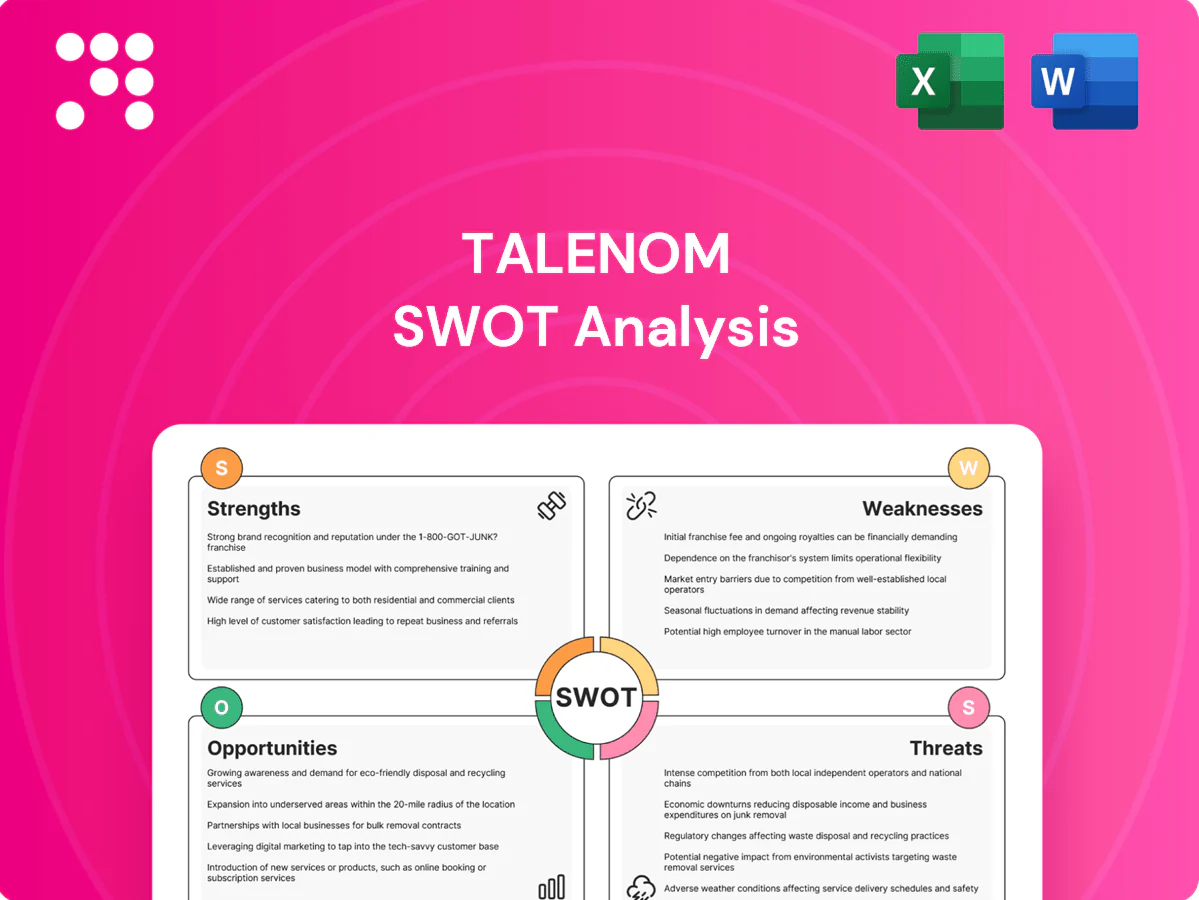
Talenom SWOT Analysis

Make Insightful Decisions Backed by Expert Research
Talenom’s strong SaaS accounting platform, recurring revenue model, and Nordic market foothold position it well for scalable growth, while regulatory shifts, competition, and margin pressure are notable risks. Our full SWOT delves into financial context, strategic options, and actionable recommendations. Purchase the complete, editable Word+Excel package to plan, pitch, and invest with confidence.
Strengths

Digital-first automation engine
Proprietary digital workflows cut manual bookkeeping and accelerate payroll and tax cycles, serving over 18,000 SMEs through automated pipelines. Automation lowers error rates and ensures consistent service quality at scale, enabling Talenom to handle high volumes efficiently. Real-time dashboards embed Talenom in daily decisions, increasing client stickiness and creating a tech backbone hard for traditional firms to replicate.
SME specialization and process know-how
Talenom's SME-focused playbook standardizes onboarding, templates and industry playbooks, shortening time-to-value for clients. Repetition across similar profiles boosts operational efficiency and margins through lower cost-to-serve. Deep familiarity with common SME pain points enables proactive advisory and upsell. Specialization sharpens marketing and conversion in a market where 99.8% of Finnish firms are SMEs and SMEs account for ~67% of EU employment.

Integrated service bundle
Integrated bundle combining accounting, payroll and tax gives clients a one-stop experience; Talenom, listed on Nasdaq Helsinki, markets these combined services to small and mid-sized firms. Bundles simplify vendor management and lower churn through consolidated service lines. Shared data improves compliance accuracy and enables advisory upsells, supporting tiered pricing and clear upgrade paths.

Real-time financial visibility
Clients access up-to-date numbers for cash flow, payroll and tax through Talenom’s cloud dashboards, enabling faster insights that support better decision-making and operational agility; real-time views increase perceived value versus periodic accounting and can justify premium pricing for time-sensitive SMEs.
- Real-time dashboards
- Improved decision speed
- Higher perceived value
- Supports premium pricing for SMEs
Hybrid model: tech + expert advisors
Combining software with human accountants balances automation and judgment, with McKinsey finding automation can cut finance-process time 60–80%, while advisors resolve edge cases, regulatory nuance and strategic questions.
The human layer deepens trust in sensitive financial work and creates a pipeline for advisory revenue beyond compliance.
- Hybrid model: automation + expert judgment
- Edge-case handling: regulatory & strategic
- Trust driver in sensitive domain
- Advisory revenue upsell potential
Automated accounting for 18,000+ SMEs: dashboards, payroll, 60-80% finance time cut
Talenom combines proprietary automated workflows serving 18,000+ SMEs with real-time dashboards and bundled accounting+payroll, boosting efficiency and client stickiness. SME specialization (Finland: 99.8% firms SMEs; EU: SMEs ~67% employment) improves margins and upsell; hybrid human+automation (McKinsey: 60–80% finance time cut) handles edge cases and drives advisory revenue.
| Metric | Value |
|---|---|
| Clients (SMEs) | 18,000+ |
| Finland SMEs | 99.8% |
| EU employment by SMEs | ~67% |
| Automation time cut | 60–80% |
What is included in the product
 Detailed Word Document
Provides a concise SWOT analysis of Talenom, highlighting internal strengths and weaknesses and external opportunities and threats to its accounting software and service-led business model.

 Customizable Excel Spreadsheet
Provides a concise Talenom SWOT matrix tailored for fast, visual strategy alignment and executive snapshots; editable format enables quick updates to reflect regulatory or market shifts.
Weaknesses

Concentration in SME segment
Concentration in the SME segment exposes Talenom to greater cyclicality and price sensitivity, raising churn and downselling risk during slowdowns. Smaller average contract values compress sales efficiency and lift per-customer acquisition costs. Credit risk and failure rates are structurally higher among SMEs; SMEs represent 99.8% of EU enterprises and 67% of employment (Eurostat).
High ongoing tech investment
High ongoing tech investment forces continuous R&D and upkeep for automation and real-time platforms, driving recurring development expenses. Cloud, security, and compliance updates add to fixed operational costs and increase cost predictability risks. ROI is contingent on sustained client growth and high utilization of services, so delays or missteps in rollout or adoption can quickly compress margins.

Service scalability and localization
Accounting rules, payroll laws and tax regimes vary widely by country and sector, increasing localization burden; for example Finland’s corporate tax rate is 20% while neighboring jurisdictions differ materially. Adapting product features and delivery to each regime raises development and compliance costs. Maintaining consistent advisory quality across regions is operationally hard, which can slow geographic expansion and raise per-customer costs.

Talent dependency in advisory
Expert advisory services hinge on recruiting and retaining qualified accountants, making Talenom vulnerable to wage inflation and talent scarcity that raise cost-to-serve and compress margins. Turnover risks knowledge loss that can degrade client experience and slow adoption of digital advisory workflows. Ongoing training to align staff with automated tools adds measurable overhead and delays scalability.
- Talent dependency
- Wage inflation → higher costs
- Turnover → knowledge loss
- Training overhead for digital tools
Perceived commoditization risk
Basic bookkeeping and payroll are often seen as interchangeable services, prompting buyers to focus on price rather than features and undermining Talenom’s premium positioning if value is not clearly demonstrated; this drives longer sales cycles through extended comparison shopping for alternatives despite Talenom being Nasdaq Helsinki-listed.
- Price-driven purchasing
- Commoditization risk
- Longer sales cycles
SME concentration raises cyclicality, price sensitivity and credit risk amid R&D cost pressure
Concentration in the SME segment raises cyclicality, price sensitivity and credit risk; SMEs are 99.8% of EU enterprises and employ 67% (Eurostat). Continuous R&D, cloud/security and localization for varied tax/payroll regimes (Finland corporate tax 20%) drive recurring costs. Talent dependence and commoditization threaten margins and sales cycles despite Nasdaq Helsinki listing.
| Metric | Value |
|---|---|
| EU SMEs share | 99.8% enterprises / 67% employment |
| Finland corporate tax | 20% |
Full Version Awaits
Talenom SWOT Analysis
This is the actual Talenom SWOT analysis document you’ll receive upon purchase—no surprises, just professional quality and structured findings. The preview below is taken directly from the full report, so what you see reflects the final editable file. Buy now to unlock the complete, detailed version for download and use.

Make Insightful Decisions Backed by Expert Research
Talenom’s strong SaaS accounting platform, recurring revenue model, and Nordic market foothold position it well for scalable growth, while regulatory shifts, competition, and margin pressure are notable risks. Our full SWOT delves into financial context, strategic options, and actionable recommendations. Purchase the complete, editable Word+Excel package to plan, pitch, and invest with confidence.
Strengths
Digital-first automation engine
Proprietary digital workflows cut manual bookkeeping and accelerate payroll and tax cycles, serving over 18,000 SMEs through automated pipelines. Automation lowers error rates and ensures consistent service quality at scale, enabling Talenom to handle high volumes efficiently. Real-time dashboards embed Talenom in daily decisions, increasing client stickiness and creating a tech backbone hard for traditional firms to replicate.
SME specialization and process know-how
Talenom's SME-focused playbook standardizes onboarding, templates and industry playbooks, shortening time-to-value for clients. Repetition across similar profiles boosts operational efficiency and margins through lower cost-to-serve. Deep familiarity with common SME pain points enables proactive advisory and upsell. Specialization sharpens marketing and conversion in a market where 99.8% of Finnish firms are SMEs and SMEs account for ~67% of EU employment.
Integrated service bundle
Integrated bundle combining accounting, payroll and tax gives clients a one-stop experience; Talenom, listed on Nasdaq Helsinki, markets these combined services to small and mid-sized firms. Bundles simplify vendor management and lower churn through consolidated service lines. Shared data improves compliance accuracy and enables advisory upsells, supporting tiered pricing and clear upgrade paths.
Real-time financial visibility
Clients access up-to-date numbers for cash flow, payroll and tax through Talenom’s cloud dashboards, enabling faster insights that support better decision-making and operational agility; real-time views increase perceived value versus periodic accounting and can justify premium pricing for time-sensitive SMEs.
- Real-time dashboards
- Improved decision speed
- Higher perceived value
- Supports premium pricing for SMEs
Hybrid model: tech + expert advisors
Combining software with human accountants balances automation and judgment, with McKinsey finding automation can cut finance-process time 60–80%, while advisors resolve edge cases, regulatory nuance and strategic questions.
The human layer deepens trust in sensitive financial work and creates a pipeline for advisory revenue beyond compliance.
- Hybrid model: automation + expert judgment
- Edge-case handling: regulatory & strategic
- Trust driver in sensitive domain
- Advisory revenue upsell potential
Automated accounting for 18,000+ SMEs: dashboards, payroll, 60-80% finance time cut
Talenom combines proprietary automated workflows serving 18,000+ SMEs with real-time dashboards and bundled accounting+payroll, boosting efficiency and client stickiness. SME specialization (Finland: 99.8% firms SMEs; EU: SMEs ~67% employment) improves margins and upsell; hybrid human+automation (McKinsey: 60–80% finance time cut) handles edge cases and drives advisory revenue.
| Metric | Value |
|---|---|
| Clients (SMEs) | 18,000+ |
| Finland SMEs | 99.8% |
| EU employment by SMEs | ~67% |
| Automation time cut | 60–80% |
What is included in the product
Detailed Word Document
Provides a concise SWOT analysis of Talenom, highlighting internal strengths and weaknesses and external opportunities and threats to its accounting software and service-led business model.
Customizable Excel Spreadsheet
Provides a concise Talenom SWOT matrix tailored for fast, visual strategy alignment and executive snapshots; editable format enables quick updates to reflect regulatory or market shifts.
Weaknesses
Concentration in SME segment
Concentration in the SME segment exposes Talenom to greater cyclicality and price sensitivity, raising churn and downselling risk during slowdowns. Smaller average contract values compress sales efficiency and lift per-customer acquisition costs. Credit risk and failure rates are structurally higher among SMEs; SMEs represent 99.8% of EU enterprises and 67% of employment (Eurostat).
High ongoing tech investment
High ongoing tech investment forces continuous R&D and upkeep for automation and real-time platforms, driving recurring development expenses. Cloud, security, and compliance updates add to fixed operational costs and increase cost predictability risks. ROI is contingent on sustained client growth and high utilization of services, so delays or missteps in rollout or adoption can quickly compress margins.
Service scalability and localization
Accounting rules, payroll laws and tax regimes vary widely by country and sector, increasing localization burden; for example Finland’s corporate tax rate is 20% while neighboring jurisdictions differ materially. Adapting product features and delivery to each regime raises development and compliance costs. Maintaining consistent advisory quality across regions is operationally hard, which can slow geographic expansion and raise per-customer costs.
Talent dependency in advisory
Expert advisory services hinge on recruiting and retaining qualified accountants, making Talenom vulnerable to wage inflation and talent scarcity that raise cost-to-serve and compress margins. Turnover risks knowledge loss that can degrade client experience and slow adoption of digital advisory workflows. Ongoing training to align staff with automated tools adds measurable overhead and delays scalability.
- Talent dependency
- Wage inflation → higher costs
- Turnover → knowledge loss
- Training overhead for digital tools
Perceived commoditization risk
Basic bookkeeping and payroll are often seen as interchangeable services, prompting buyers to focus on price rather than features and undermining Talenom’s premium positioning if value is not clearly demonstrated; this drives longer sales cycles through extended comparison shopping for alternatives despite Talenom being Nasdaq Helsinki-listed.
- Price-driven purchasing
- Commoditization risk
- Longer sales cycles
SME concentration raises cyclicality, price sensitivity and credit risk amid R&D cost pressure
Concentration in the SME segment raises cyclicality, price sensitivity and credit risk; SMEs are 99.8% of EU enterprises and employ 67% (Eurostat). Continuous R&D, cloud/security and localization for varied tax/payroll regimes (Finland corporate tax 20%) drive recurring costs. Talent dependence and commoditization threaten margins and sales cycles despite Nasdaq Helsinki listing.
| Metric | Value |
|---|---|
| EU SMEs share | 99.8% enterprises / 67% employment |
| Finland corporate tax | 20% |
Full Version Awaits
Talenom SWOT Analysis
This is the actual Talenom SWOT analysis document you’ll receive upon purchase—no surprises, just professional quality and structured findings. The preview below is taken directly from the full report, so what you see reflects the final editable file. Buy now to unlock the complete, detailed version for download and use.
Original: $10.00
-65%$10.00
$3.50Description
Make Insightful Decisions Backed by Expert Research
Talenom’s strong SaaS accounting platform, recurring revenue model, and Nordic market foothold position it well for scalable growth, while regulatory shifts, competition, and margin pressure are notable risks. Our full SWOT delves into financial context, strategic options, and actionable recommendations. Purchase the complete, editable Word+Excel package to plan, pitch, and invest with confidence.
Strengths
Digital-first automation engine
Proprietary digital workflows cut manual bookkeeping and accelerate payroll and tax cycles, serving over 18,000 SMEs through automated pipelines. Automation lowers error rates and ensures consistent service quality at scale, enabling Talenom to handle high volumes efficiently. Real-time dashboards embed Talenom in daily decisions, increasing client stickiness and creating a tech backbone hard for traditional firms to replicate.
SME specialization and process know-how
Talenom's SME-focused playbook standardizes onboarding, templates and industry playbooks, shortening time-to-value for clients. Repetition across similar profiles boosts operational efficiency and margins through lower cost-to-serve. Deep familiarity with common SME pain points enables proactive advisory and upsell. Specialization sharpens marketing and conversion in a market where 99.8% of Finnish firms are SMEs and SMEs account for ~67% of EU employment.
Integrated service bundle
Integrated bundle combining accounting, payroll and tax gives clients a one-stop experience; Talenom, listed on Nasdaq Helsinki, markets these combined services to small and mid-sized firms. Bundles simplify vendor management and lower churn through consolidated service lines. Shared data improves compliance accuracy and enables advisory upsells, supporting tiered pricing and clear upgrade paths.
Real-time financial visibility
Clients access up-to-date numbers for cash flow, payroll and tax through Talenom’s cloud dashboards, enabling faster insights that support better decision-making and operational agility; real-time views increase perceived value versus periodic accounting and can justify premium pricing for time-sensitive SMEs.
- Real-time dashboards
- Improved decision speed
- Higher perceived value
- Supports premium pricing for SMEs
Hybrid model: tech + expert advisors
Combining software with human accountants balances automation and judgment, with McKinsey finding automation can cut finance-process time 60–80%, while advisors resolve edge cases, regulatory nuance and strategic questions.
The human layer deepens trust in sensitive financial work and creates a pipeline for advisory revenue beyond compliance.
- Hybrid model: automation + expert judgment
- Edge-case handling: regulatory & strategic
- Trust driver in sensitive domain
- Advisory revenue upsell potential
Automated accounting for 18,000+ SMEs: dashboards, payroll, 60-80% finance time cut
Talenom combines proprietary automated workflows serving 18,000+ SMEs with real-time dashboards and bundled accounting+payroll, boosting efficiency and client stickiness. SME specialization (Finland: 99.8% firms SMEs; EU: SMEs ~67% employment) improves margins and upsell; hybrid human+automation (McKinsey: 60–80% finance time cut) handles edge cases and drives advisory revenue.
| Metric | Value |
|---|---|
| Clients (SMEs) | 18,000+ |
| Finland SMEs | 99.8% |
| EU employment by SMEs | ~67% |
| Automation time cut | 60–80% |
What is included in the product
Detailed Word Document
Provides a concise SWOT analysis of Talenom, highlighting internal strengths and weaknesses and external opportunities and threats to its accounting software and service-led business model.
Customizable Excel Spreadsheet
Provides a concise Talenom SWOT matrix tailored for fast, visual strategy alignment and executive snapshots; editable format enables quick updates to reflect regulatory or market shifts.
Weaknesses
Concentration in SME segment
Concentration in the SME segment exposes Talenom to greater cyclicality and price sensitivity, raising churn and downselling risk during slowdowns. Smaller average contract values compress sales efficiency and lift per-customer acquisition costs. Credit risk and failure rates are structurally higher among SMEs; SMEs represent 99.8% of EU enterprises and 67% of employment (Eurostat).
High ongoing tech investment
High ongoing tech investment forces continuous R&D and upkeep for automation and real-time platforms, driving recurring development expenses. Cloud, security, and compliance updates add to fixed operational costs and increase cost predictability risks. ROI is contingent on sustained client growth and high utilization of services, so delays or missteps in rollout or adoption can quickly compress margins.
Service scalability and localization
Accounting rules, payroll laws and tax regimes vary widely by country and sector, increasing localization burden; for example Finland’s corporate tax rate is 20% while neighboring jurisdictions differ materially. Adapting product features and delivery to each regime raises development and compliance costs. Maintaining consistent advisory quality across regions is operationally hard, which can slow geographic expansion and raise per-customer costs.
Talent dependency in advisory
Expert advisory services hinge on recruiting and retaining qualified accountants, making Talenom vulnerable to wage inflation and talent scarcity that raise cost-to-serve and compress margins. Turnover risks knowledge loss that can degrade client experience and slow adoption of digital advisory workflows. Ongoing training to align staff with automated tools adds measurable overhead and delays scalability.
- Talent dependency
- Wage inflation → higher costs
- Turnover → knowledge loss
- Training overhead for digital tools
Perceived commoditization risk
Basic bookkeeping and payroll are often seen as interchangeable services, prompting buyers to focus on price rather than features and undermining Talenom’s premium positioning if value is not clearly demonstrated; this drives longer sales cycles through extended comparison shopping for alternatives despite Talenom being Nasdaq Helsinki-listed.
- Price-driven purchasing
- Commoditization risk
- Longer sales cycles
SME concentration raises cyclicality, price sensitivity and credit risk amid R&D cost pressure
Concentration in the SME segment raises cyclicality, price sensitivity and credit risk; SMEs are 99.8% of EU enterprises and employ 67% (Eurostat). Continuous R&D, cloud/security and localization for varied tax/payroll regimes (Finland corporate tax 20%) drive recurring costs. Talent dependence and commoditization threaten margins and sales cycles despite Nasdaq Helsinki listing.
| Metric | Value |
|---|---|
| EU SMEs share | 99.8% enterprises / 67% employment |
| Finland corporate tax | 20% |
Full Version Awaits
Talenom SWOT Analysis
This is the actual Talenom SWOT analysis document you’ll receive upon purchase—no surprises, just professional quality and structured findings. The preview below is taken directly from the full report, so what you see reflects the final editable file. Buy now to unlock the complete, detailed version for download and use.











