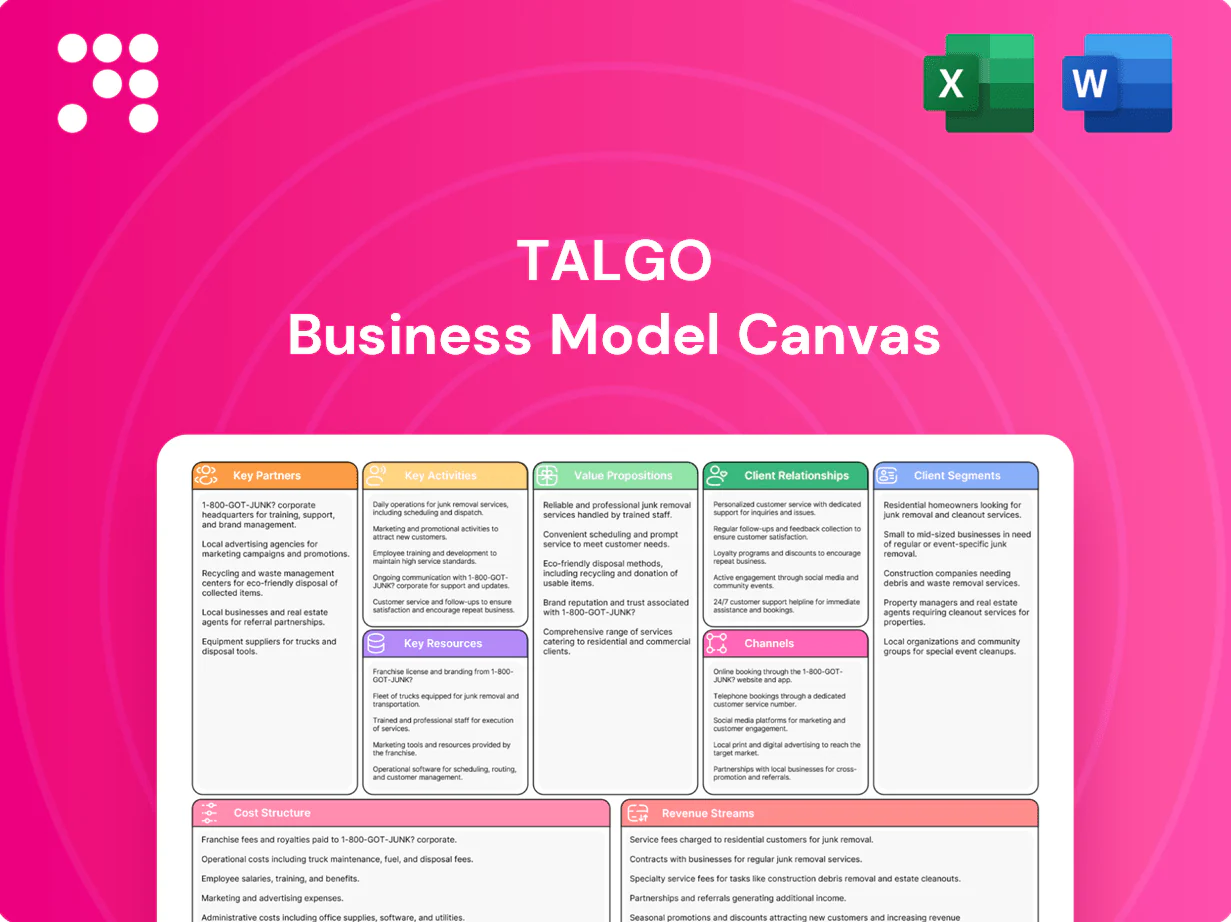
Talgo Business Model Canvas

Rail innovation business model canvas: strategic blueprint for investors and founders
Unlock the full strategic blueprint behind Talgo's business model. This in-depth Business Model Canvas reveals how Talgo creates value, scales through partnerships, and monetizes rail innovation. Ideal for investors, consultants, and founders—download the complete Word & Excel canvas to benchmark and act.
Partnerships

Rail operators and transport ministries
Strategic alliances with national rail operators and transport ministries secure multi-year fleet and maintenance contracts (typically 5–15 years) and co-develop specifications, homologation, and safety certifications to enable long-term planning, localized support, and political alignment; such partnerships for orders of 20–200 vehicles improve bid competitiveness and can boost lifecycle value delivery by ~10–20%.
Component and technology suppliers
Partnerships with bogie, traction, braking and digital subsystem suppliers ensure Talgo trains meet strict performance and reliability targets, underpinning its 2024 production ramp tied to roughly €330m in annual revenues. Joint R&D programs with key vendors reduce integration risk and accelerated innovations in lightweight materials and predictive maintenance. Multi-sourcing balances cost, quality and availability, while strategic long-term agreements secure critical parts across multi-decade asset lifecycles.

Infrastructure and signaling providers
Collaboration with track, electrification and signaling firms ensures system-level compatibility and aligns Talgo with the EU mandate to equip core TEN-T corridors with ERTMS by 2030. Early interoperability testing with ERTMS and country-specific standards de-risks projects; joint testing accelerates commissioning and boosts safety, punctuality and operational efficiency for cross-border services.

Maintenance and MRO ecosystems
Alliances with depot operators, tooling vendors and logistics partners create a Talgo MRO ecosystem that reinforces through-life support and spare-part flow; service contracts with operators improve fleet availability. Shared data platforms enable predictive maintenance, which PwC (2024) reports can cut unplanned failures by up to 50% and maintenance costs by 10–40%. Training partners scale local technical capabilities, improving uptime, lowering TCO and tightening service-level adherence.
- Alliances: depot, tooling, logistics
- Data: predictive maintenance, PwC 2024 stats
- Training: local technician scaling
- Outcomes: higher uptime, lower TCO, SLR compliance
Academic and R&D institutions
Universities and labs advance Talgo's lightweight materials, aerodynamics and tilting-dynamics R&D via joint programs and access to wind tunnels and rolling-stock test rigs. Horizon Europe (€95.5bn 2021–27) grants and co-funded projects de-risk early-stage tech and subsidize prototyping. These partnerships build graduate talent pipelines and jointly owned IP, strengthening product differentiation and speeding validation.
- Research: lightweight, aero, tilting
- Facilities: wind tunnels, test rigs
- Funding: Horizon Europe €95.5bn
- Assets: talent pipelines & joint IP
5-15yr contracts + alliances add 10-20% lifecycle value
Long-term contracts with national operators (5–15 years) secure fleet orders (20–200 vehicles) and add ~10–20% lifecycle value; tied to Talgo's 2024 ~€330m revenue ramp.
Supplier alliances for bogies, traction, braking and software lower integration risk, enable multi-sourcing and joint R&D to cut time-to-market.
MRO, signaling, and research partners (Horizon Europe €95.5bn 2021–27) boost uptime, predictive maintenance (PwC 2024: −50% failures) and local skills.
| Partner | Metric | 2024 |
|---|---|---|
| Operators | Contract length | 5–15 yrs |
| Revenue | Annual | ~€330m |
| Horizon | Program funding | €95.5bn |
What is included in the product
 Detailed Word Document
A comprehensive Business Model Canvas for Talgo that maps the company’s nine strategic blocks—customers, value propositions, channels, customer relations, revenue streams, key resources, key activities, key partners, and cost structure—reflecting real-world rolling-stock operations and expansion plans. Ideal for investors and analysts, it includes competitive advantages, SWOT-linked insights, and polished narratives for presentations and funding discussions.

 Customizable Excel Spreadsheet
High-level view of Talgo’s business model with editable cells—quickly identify revenue drivers, partnerships, and operational efficiencies to streamline rail project decisions and stakeholder alignment.
Activities

Train design and engineering
End-to-end vehicle architecture integrates Talgo's lightweight articulated bearings, tilting systems and weight-optimized structures, designed to meet EN 12663 and EN 15227 structural and crashworthiness standards. Simulation, prototyping and certification engineering use multibody dynamics, FEA and hardware prototypes with iterative validation paths to satisfy ISO 9001 and ISO/TS 22163 quality regimes. Compliance targets functional safety to SIL 2/3 levels and customer specifications, while continuous performance and safety optimization is driven by field data and lifecycle engineering.
Manufacturing and assembly
Manufacturing and assembly center on lean production of car bodies, Talgo bogies and traction integration, supporting modular lines that cut cycle times and align with a 2023 order backlog exceeding €500m. Quality assurance and factory acceptance testing follow EN standards with in-line metrology and documented FATs; Talgo reported €304.7m revenue in 2023. Supply chain coordination emphasizes local sourcing in key markets and JIT logistics, enabling on-time delivery for complex multi-train orders.

Maintenance and lifecycle services
Talgo runs preventive, corrective and predictive maintenance programs that target life-cycle cost reduction, with predictive analytics typically cutting unscheduled failures ~30% and downtime up to 25% in rail fleets.
Spare parts management and obsolescence control use pooled inventories and lifecycle forecasts to limit capital tie-up and reduce part obsolescence risk.
Depot operations and field service teams support rapid turnarounds and on-site repairs to meet tight timetables.
Performance-based contracts link fees to availability and reliability, commonly targeting >95% fleet availability.

Project management and commissioning
Project management and commissioning coordinate bid-to-build execution, risk and stakeholder management, ensuring on-site testing, homologation and driver training align with regulatory and operator requirements while interfacing with infrastructure and signaling stakeholders to de-risk operations. Handover includes formal acceptance, warranty tracking and corrective action plans to protect lifecycle performance.
- Bid-to-build governance
- Testing & homologation
- Infrastructure interface
- Handover & warranty
R&D and digital solutions
Talgo advances natural-tilting systems, lightweight bogies and energy-efficient propulsion to cut energy use and track wear, with 2024 pilot integrations across 10 trains reducing consumption by up to 15% in trials.
Digital platforms combine IoT sensors, analytics and condition monitoring to lift fleet availability; 2024 remote-diagnostics rollouts enabled 12% faster fault resolution in pilot fleets.
Cybersecurity and OTA remote-diagnostics development follow EN 50129/62443 practices, and continuous improvement uses fleet data feedback loops to prioritize upgrades and lower lifecycle costs.
- tilting-tech
- lightweight-energy
- condition-monitoring
- IoT-analytics
- cybersecurity-OTA
- data-feedback
Modular trains: €304.7m revenue, >€500m backlog, maintenance cuts failures ~30%
Talgo integrates design, certification, lean manufacturing and field services to deliver modular trains; 2023 revenue €304.7m and >€500m order backlog. Maintenance and IoT-based predictive analytics reduce unscheduled failures ~30% and achieved 12% faster fault resolution in 2024 pilots; energy pilots cut consumption up to 15%. Performance contracts target >95% availability.
| Metric | Value | Year |
|---|---|---|
| Revenue | €304.7m | 2023 |
| Order backlog | >€500m | 2023 |
| Unscheduled failure reduction | ~30% | 2024 pilots |
| Fault resolution improvement | 12% | 2024 pilots |
| Energy reduction | up to 15% | 2024 pilots |
| Target availability | >95% | Ongoing |
Preview Before You Purchase
Business Model Canvas
The Talgo Business Model Canvas you’re previewing is the actual deliverable, not a mockup or sample; it’s a direct snapshot of the full file you’ll receive after purchase. Upon completion of your order you’ll get this same professional, ready-to-edit document in Word and Excel formats, with all content and pages included. What you see is what you’ll download—no surprises, fully editable and presentation-ready.

Rail innovation business model canvas: strategic blueprint for investors and founders
Unlock the full strategic blueprint behind Talgo's business model. This in-depth Business Model Canvas reveals how Talgo creates value, scales through partnerships, and monetizes rail innovation. Ideal for investors, consultants, and founders—download the complete Word & Excel canvas to benchmark and act.
Partnerships
Rail operators and transport ministries
Strategic alliances with national rail operators and transport ministries secure multi-year fleet and maintenance contracts (typically 5–15 years) and co-develop specifications, homologation, and safety certifications to enable long-term planning, localized support, and political alignment; such partnerships for orders of 20–200 vehicles improve bid competitiveness and can boost lifecycle value delivery by ~10–20%.
Component and technology suppliers
Partnerships with bogie, traction, braking and digital subsystem suppliers ensure Talgo trains meet strict performance and reliability targets, underpinning its 2024 production ramp tied to roughly €330m in annual revenues. Joint R&D programs with key vendors reduce integration risk and accelerated innovations in lightweight materials and predictive maintenance. Multi-sourcing balances cost, quality and availability, while strategic long-term agreements secure critical parts across multi-decade asset lifecycles.
Infrastructure and signaling providers
Collaboration with track, electrification and signaling firms ensures system-level compatibility and aligns Talgo with the EU mandate to equip core TEN-T corridors with ERTMS by 2030. Early interoperability testing with ERTMS and country-specific standards de-risks projects; joint testing accelerates commissioning and boosts safety, punctuality and operational efficiency for cross-border services.
Maintenance and MRO ecosystems
Alliances with depot operators, tooling vendors and logistics partners create a Talgo MRO ecosystem that reinforces through-life support and spare-part flow; service contracts with operators improve fleet availability. Shared data platforms enable predictive maintenance, which PwC (2024) reports can cut unplanned failures by up to 50% and maintenance costs by 10–40%. Training partners scale local technical capabilities, improving uptime, lowering TCO and tightening service-level adherence.
- Alliances: depot, tooling, logistics
- Data: predictive maintenance, PwC 2024 stats
- Training: local technician scaling
- Outcomes: higher uptime, lower TCO, SLR compliance
Academic and R&D institutions
Universities and labs advance Talgo's lightweight materials, aerodynamics and tilting-dynamics R&D via joint programs and access to wind tunnels and rolling-stock test rigs. Horizon Europe (€95.5bn 2021–27) grants and co-funded projects de-risk early-stage tech and subsidize prototyping. These partnerships build graduate talent pipelines and jointly owned IP, strengthening product differentiation and speeding validation.
- Research: lightweight, aero, tilting
- Facilities: wind tunnels, test rigs
- Funding: Horizon Europe €95.5bn
- Assets: talent pipelines & joint IP
5-15yr contracts + alliances add 10-20% lifecycle value
Long-term contracts with national operators (5–15 years) secure fleet orders (20–200 vehicles) and add ~10–20% lifecycle value; tied to Talgo's 2024 ~€330m revenue ramp.
Supplier alliances for bogies, traction, braking and software lower integration risk, enable multi-sourcing and joint R&D to cut time-to-market.
MRO, signaling, and research partners (Horizon Europe €95.5bn 2021–27) boost uptime, predictive maintenance (PwC 2024: −50% failures) and local skills.
| Partner | Metric | 2024 |
|---|---|---|
| Operators | Contract length | 5–15 yrs |
| Revenue | Annual | ~€330m |
| Horizon | Program funding | €95.5bn |
What is included in the product
Detailed Word Document
A comprehensive Business Model Canvas for Talgo that maps the company’s nine strategic blocks—customers, value propositions, channels, customer relations, revenue streams, key resources, key activities, key partners, and cost structure—reflecting real-world rolling-stock operations and expansion plans. Ideal for investors and analysts, it includes competitive advantages, SWOT-linked insights, and polished narratives for presentations and funding discussions.
Customizable Excel Spreadsheet
High-level view of Talgo’s business model with editable cells—quickly identify revenue drivers, partnerships, and operational efficiencies to streamline rail project decisions and stakeholder alignment.
Activities
Train design and engineering
End-to-end vehicle architecture integrates Talgo's lightweight articulated bearings, tilting systems and weight-optimized structures, designed to meet EN 12663 and EN 15227 structural and crashworthiness standards. Simulation, prototyping and certification engineering use multibody dynamics, FEA and hardware prototypes with iterative validation paths to satisfy ISO 9001 and ISO/TS 22163 quality regimes. Compliance targets functional safety to SIL 2/3 levels and customer specifications, while continuous performance and safety optimization is driven by field data and lifecycle engineering.
Manufacturing and assembly
Manufacturing and assembly center on lean production of car bodies, Talgo bogies and traction integration, supporting modular lines that cut cycle times and align with a 2023 order backlog exceeding €500m. Quality assurance and factory acceptance testing follow EN standards with in-line metrology and documented FATs; Talgo reported €304.7m revenue in 2023. Supply chain coordination emphasizes local sourcing in key markets and JIT logistics, enabling on-time delivery for complex multi-train orders.
Maintenance and lifecycle services
Talgo runs preventive, corrective and predictive maintenance programs that target life-cycle cost reduction, with predictive analytics typically cutting unscheduled failures ~30% and downtime up to 25% in rail fleets.
Spare parts management and obsolescence control use pooled inventories and lifecycle forecasts to limit capital tie-up and reduce part obsolescence risk.
Depot operations and field service teams support rapid turnarounds and on-site repairs to meet tight timetables.
Performance-based contracts link fees to availability and reliability, commonly targeting >95% fleet availability.
Project management and commissioning
Project management and commissioning coordinate bid-to-build execution, risk and stakeholder management, ensuring on-site testing, homologation and driver training align with regulatory and operator requirements while interfacing with infrastructure and signaling stakeholders to de-risk operations. Handover includes formal acceptance, warranty tracking and corrective action plans to protect lifecycle performance.
- Bid-to-build governance
- Testing & homologation
- Infrastructure interface
- Handover & warranty
R&D and digital solutions
Talgo advances natural-tilting systems, lightweight bogies and energy-efficient propulsion to cut energy use and track wear, with 2024 pilot integrations across 10 trains reducing consumption by up to 15% in trials.
Digital platforms combine IoT sensors, analytics and condition monitoring to lift fleet availability; 2024 remote-diagnostics rollouts enabled 12% faster fault resolution in pilot fleets.
Cybersecurity and OTA remote-diagnostics development follow EN 50129/62443 practices, and continuous improvement uses fleet data feedback loops to prioritize upgrades and lower lifecycle costs.
- tilting-tech
- lightweight-energy
- condition-monitoring
- IoT-analytics
- cybersecurity-OTA
- data-feedback
Modular trains: €304.7m revenue, >€500m backlog, maintenance cuts failures ~30%
Talgo integrates design, certification, lean manufacturing and field services to deliver modular trains; 2023 revenue €304.7m and >€500m order backlog. Maintenance and IoT-based predictive analytics reduce unscheduled failures ~30% and achieved 12% faster fault resolution in 2024 pilots; energy pilots cut consumption up to 15%. Performance contracts target >95% availability.
| Metric | Value | Year |
|---|---|---|
| Revenue | €304.7m | 2023 |
| Order backlog | >€500m | 2023 |
| Unscheduled failure reduction | ~30% | 2024 pilots |
| Fault resolution improvement | 12% | 2024 pilots |
| Energy reduction | up to 15% | 2024 pilots |
| Target availability | >95% | Ongoing |
Preview Before You Purchase
Business Model Canvas
The Talgo Business Model Canvas you’re previewing is the actual deliverable, not a mockup or sample; it’s a direct snapshot of the full file you’ll receive after purchase. Upon completion of your order you’ll get this same professional, ready-to-edit document in Word and Excel formats, with all content and pages included. What you see is what you’ll download—no surprises, fully editable and presentation-ready.
Original: $10.00
-65%$10.00
$3.50Description
Rail innovation business model canvas: strategic blueprint for investors and founders
Unlock the full strategic blueprint behind Talgo's business model. This in-depth Business Model Canvas reveals how Talgo creates value, scales through partnerships, and monetizes rail innovation. Ideal for investors, consultants, and founders—download the complete Word & Excel canvas to benchmark and act.
Partnerships
Rail operators and transport ministries
Strategic alliances with national rail operators and transport ministries secure multi-year fleet and maintenance contracts (typically 5–15 years) and co-develop specifications, homologation, and safety certifications to enable long-term planning, localized support, and political alignment; such partnerships for orders of 20–200 vehicles improve bid competitiveness and can boost lifecycle value delivery by ~10–20%.
Component and technology suppliers
Partnerships with bogie, traction, braking and digital subsystem suppliers ensure Talgo trains meet strict performance and reliability targets, underpinning its 2024 production ramp tied to roughly €330m in annual revenues. Joint R&D programs with key vendors reduce integration risk and accelerated innovations in lightweight materials and predictive maintenance. Multi-sourcing balances cost, quality and availability, while strategic long-term agreements secure critical parts across multi-decade asset lifecycles.
Infrastructure and signaling providers
Collaboration with track, electrification and signaling firms ensures system-level compatibility and aligns Talgo with the EU mandate to equip core TEN-T corridors with ERTMS by 2030. Early interoperability testing with ERTMS and country-specific standards de-risks projects; joint testing accelerates commissioning and boosts safety, punctuality and operational efficiency for cross-border services.
Maintenance and MRO ecosystems
Alliances with depot operators, tooling vendors and logistics partners create a Talgo MRO ecosystem that reinforces through-life support and spare-part flow; service contracts with operators improve fleet availability. Shared data platforms enable predictive maintenance, which PwC (2024) reports can cut unplanned failures by up to 50% and maintenance costs by 10–40%. Training partners scale local technical capabilities, improving uptime, lowering TCO and tightening service-level adherence.
- Alliances: depot, tooling, logistics
- Data: predictive maintenance, PwC 2024 stats
- Training: local technician scaling
- Outcomes: higher uptime, lower TCO, SLR compliance
Academic and R&D institutions
Universities and labs advance Talgo's lightweight materials, aerodynamics and tilting-dynamics R&D via joint programs and access to wind tunnels and rolling-stock test rigs. Horizon Europe (€95.5bn 2021–27) grants and co-funded projects de-risk early-stage tech and subsidize prototyping. These partnerships build graduate talent pipelines and jointly owned IP, strengthening product differentiation and speeding validation.
- Research: lightweight, aero, tilting
- Facilities: wind tunnels, test rigs
- Funding: Horizon Europe €95.5bn
- Assets: talent pipelines & joint IP
5-15yr contracts + alliances add 10-20% lifecycle value
Long-term contracts with national operators (5–15 years) secure fleet orders (20–200 vehicles) and add ~10–20% lifecycle value; tied to Talgo's 2024 ~€330m revenue ramp.
Supplier alliances for bogies, traction, braking and software lower integration risk, enable multi-sourcing and joint R&D to cut time-to-market.
MRO, signaling, and research partners (Horizon Europe €95.5bn 2021–27) boost uptime, predictive maintenance (PwC 2024: −50% failures) and local skills.
| Partner | Metric | 2024 |
|---|---|---|
| Operators | Contract length | 5–15 yrs |
| Revenue | Annual | ~€330m |
| Horizon | Program funding | €95.5bn |
What is included in the product
Detailed Word Document
A comprehensive Business Model Canvas for Talgo that maps the company’s nine strategic blocks—customers, value propositions, channels, customer relations, revenue streams, key resources, key activities, key partners, and cost structure—reflecting real-world rolling-stock operations and expansion plans. Ideal for investors and analysts, it includes competitive advantages, SWOT-linked insights, and polished narratives for presentations and funding discussions.
Customizable Excel Spreadsheet
High-level view of Talgo’s business model with editable cells—quickly identify revenue drivers, partnerships, and operational efficiencies to streamline rail project decisions and stakeholder alignment.
Activities
Train design and engineering
End-to-end vehicle architecture integrates Talgo's lightweight articulated bearings, tilting systems and weight-optimized structures, designed to meet EN 12663 and EN 15227 structural and crashworthiness standards. Simulation, prototyping and certification engineering use multibody dynamics, FEA and hardware prototypes with iterative validation paths to satisfy ISO 9001 and ISO/TS 22163 quality regimes. Compliance targets functional safety to SIL 2/3 levels and customer specifications, while continuous performance and safety optimization is driven by field data and lifecycle engineering.
Manufacturing and assembly
Manufacturing and assembly center on lean production of car bodies, Talgo bogies and traction integration, supporting modular lines that cut cycle times and align with a 2023 order backlog exceeding €500m. Quality assurance and factory acceptance testing follow EN standards with in-line metrology and documented FATs; Talgo reported €304.7m revenue in 2023. Supply chain coordination emphasizes local sourcing in key markets and JIT logistics, enabling on-time delivery for complex multi-train orders.
Maintenance and lifecycle services
Talgo runs preventive, corrective and predictive maintenance programs that target life-cycle cost reduction, with predictive analytics typically cutting unscheduled failures ~30% and downtime up to 25% in rail fleets.
Spare parts management and obsolescence control use pooled inventories and lifecycle forecasts to limit capital tie-up and reduce part obsolescence risk.
Depot operations and field service teams support rapid turnarounds and on-site repairs to meet tight timetables.
Performance-based contracts link fees to availability and reliability, commonly targeting >95% fleet availability.
Project management and commissioning
Project management and commissioning coordinate bid-to-build execution, risk and stakeholder management, ensuring on-site testing, homologation and driver training align with regulatory and operator requirements while interfacing with infrastructure and signaling stakeholders to de-risk operations. Handover includes formal acceptance, warranty tracking and corrective action plans to protect lifecycle performance.
- Bid-to-build governance
- Testing & homologation
- Infrastructure interface
- Handover & warranty
R&D and digital solutions
Talgo advances natural-tilting systems, lightweight bogies and energy-efficient propulsion to cut energy use and track wear, with 2024 pilot integrations across 10 trains reducing consumption by up to 15% in trials.
Digital platforms combine IoT sensors, analytics and condition monitoring to lift fleet availability; 2024 remote-diagnostics rollouts enabled 12% faster fault resolution in pilot fleets.
Cybersecurity and OTA remote-diagnostics development follow EN 50129/62443 practices, and continuous improvement uses fleet data feedback loops to prioritize upgrades and lower lifecycle costs.
- tilting-tech
- lightweight-energy
- condition-monitoring
- IoT-analytics
- cybersecurity-OTA
- data-feedback
Modular trains: €304.7m revenue, >€500m backlog, maintenance cuts failures ~30%
Talgo integrates design, certification, lean manufacturing and field services to deliver modular trains; 2023 revenue €304.7m and >€500m order backlog. Maintenance and IoT-based predictive analytics reduce unscheduled failures ~30% and achieved 12% faster fault resolution in 2024 pilots; energy pilots cut consumption up to 15%. Performance contracts target >95% availability.
| Metric | Value | Year |
|---|---|---|
| Revenue | €304.7m | 2023 |
| Order backlog | >€500m | 2023 |
| Unscheduled failure reduction | ~30% | 2024 pilots |
| Fault resolution improvement | 12% | 2024 pilots |
| Energy reduction | up to 15% | 2024 pilots |
| Target availability | >95% | Ongoing |
Preview Before You Purchase
Business Model Canvas
The Talgo Business Model Canvas you’re previewing is the actual deliverable, not a mockup or sample; it’s a direct snapshot of the full file you’ll receive after purchase. Upon completion of your order you’ll get this same professional, ready-to-edit document in Word and Excel formats, with all content and pages included. What you see is what you’ll download—no surprises, fully editable and presentation-ready.











