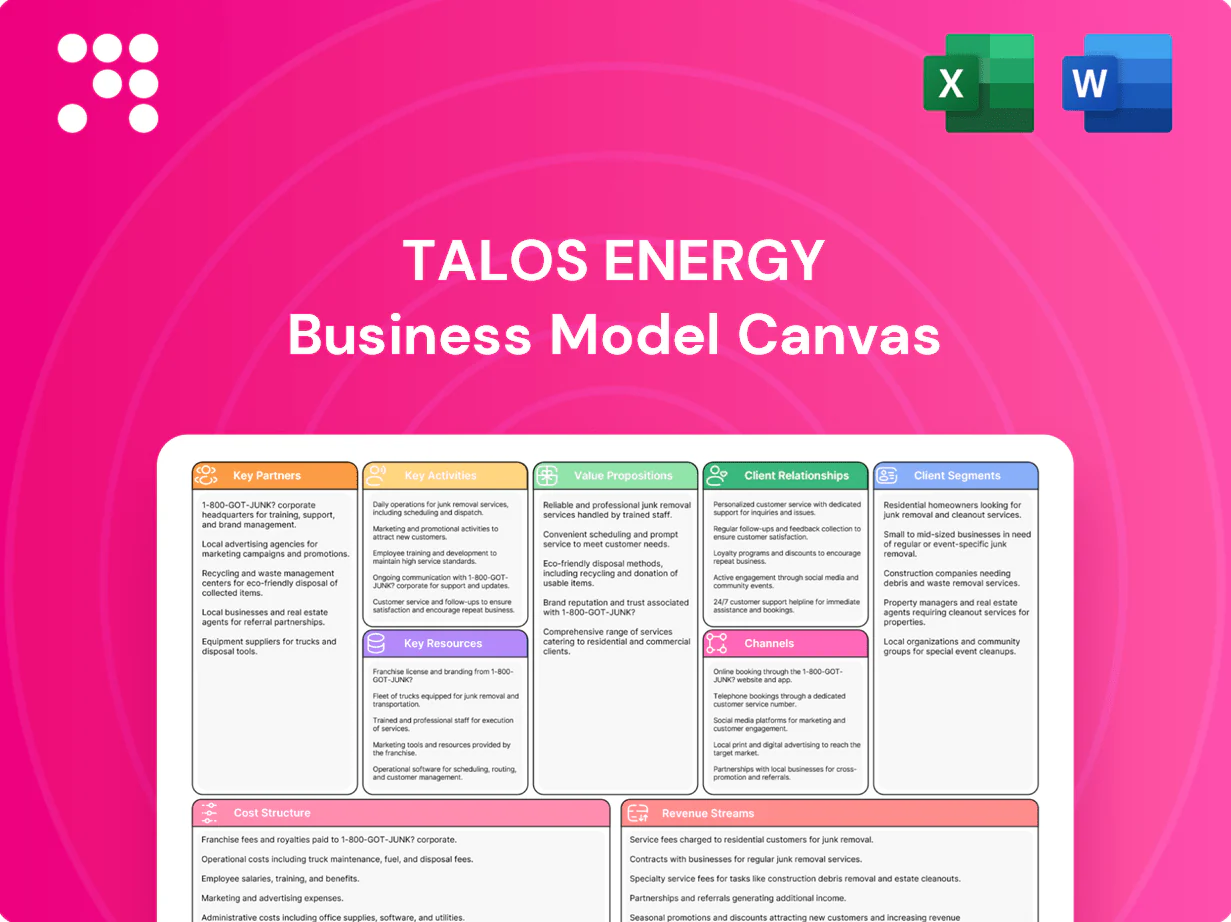
Talos Energy Business Model Canvas

Unlock the strategic blueprint of an upstream energy business model
Unlock the full strategic blueprint behind Talos Energy's business model. This in-depth Business Model Canvas reveals how Talos creates value, scales operations, and mitigates commodity and regulatory risk—perfect for investors, consultants, and executives. Download the complete Word & Excel canvas for a section-by-section playbook you can use for benchmarking and strategic planning.
Partnerships

Offshore JV and farm-out partners
Offshore JV and farm-out partners fund a majority of exploration, appraisal and development costs in the Gulf of Mexico and offshore Mexico, enabling Talos to scale activity while limiting capex; Talos reported ~60,000 boe/d net production in 2024. These alliances expand acreage access and diversify geological exposure across shallow and deepwater plays. Joint operating agreements streamline decision-making and cost-sharing. Partner portfolios create pathways to swap or rationalize assets to optimize value.
Oilfield services and equipment providers
Drilling contractors, subsea vendors and well services are critical to Talos Energy’s safe, efficient offshore execution in the Gulf of Mexico; 2024 SEC filings cite coordinated contractor frameworks to manage operations. Preferred vendor frameworks improve cost certainty and cycle times, while access to specialty equipment reduces downtime and HSE risk. Collaborative planning with contractors drives continuous improvement and lessons learned.

Midstream, pipeline, and offtake counterparties
Pipeline and terminal partners ensure flow assurance and market access for crude, gas, and NGLs, enabling Talos to move volumes from Gulf of Mexico platforms to shore and export hubs. Long-term transport and processing agreements underpin production economics by locking capacity and tolling rates. Offtake buyers provide demand stability and pricing transparency, while tight coordination with midstream minimizes bottlenecks and shrinkage.

CCS technology, industrial emitters, and storage alliances
Talos partners with capture-technology providers, industrial emitters seeking decarbonization, and pore-space/lease holders to align capture, transport and storage timelines via multi-party agreements; monitoring and verification partners ensure permanence and regulatory compliance while shared infrastructure reduces per-ton abatement costs.
- Partners: capture tech, emitters, pore-space owners
- Contracts: multi-party timelines for capture→transport→storage
- Compliance: independent monitoring & verification
- Economics: cluster/shared infrastructure can cut unit costs by ~20–30% (IEA/Global CCS Institute 2023–24)
Regulators, communities, and academic/research bodies
Regulators provide permitting, safety oversight and CCS Class VI approvals that enabled commercial-scale projects to advance in 2024, supporting Talos Energys Gulf of Mexico operations and emissions-reduction roadmap.
Community stakeholders secure social license and workforce access, while universities and labs supply reservoir modeling, continuous monitoring and innovation; coordinated partnerships speed best-practice adoption and transparency.
JV funding, contractors & CCS enable ~60k boe/d, -20-30% abatement
JV/farm-out partners fund exploration and development, enabling Talos to scale to ~60,000 boe/d net (2024). Drilling, subsea and well‑service contractors via preferred frameworks cut cycle times and HSE risk. Midstream/offtake agreements lock capacity and tolls, supporting economics. CCS, pore‑space and monitoring partners plus 2024 Class VI approvals aim to lower unit abatement ~20–30%.
| Partnership | Role | 2024 metric |
|---|---|---|
| JV/farm-outs | Funding & access | ~60,000 boe/d net |
| Contractors | Execution & uptime | Preferred frameworks |
| Midstream | Transport & offtake | Long‑term tolls |
| CCS partners | Capture→storage | −20–30% unit cost |
| Regulators | Permits/Class VI | 2024 approvals |
What is included in the product
 Detailed Word Document
A concise, pre-built Business Model Canvas for Talos Energy outlining customer segments, channels, value propositions and revenue streams across the 9 BMC blocks with real-world operational detail. Designed for presentations and investor discussions, it includes competitive advantages and linked SWOT insights to support strategic decisions and funding validation.

 Customizable Excel Spreadsheet
High-level view of Talos Energy’s business model with editable cells, condensing offshore operations, asset development, and JV structures into a single-page snapshot for quick review, comparison, and team collaboration.
Activities

Subsurface exploration and appraisal
Geophysical acquisition and dense seismic interpretation drive prospect maturation, underpinning Talos Energy’s 2024 exploration program with an exploration budget of about $200 million to capture high-value resources. Appraisal wells in 2024 lowered reservoir uncertainty, narrowing size and quality ranges and increasing project certainty. Portfolio ranking directs capital to top risked-return prospects, targeting IRRs above 25%. Integrated data workflows refine development plans and lift modeled recovery factors.
Offshore development and production operations
Drilling, completions, and tie-backs bring reserves online efficiently, supporting offshore production that accounted for roughly 30% of global oil output in 2024. Facility operations focus on >95% uptime, flow assurance, and artificial lift to maximize recovery. Continuous production surveillance and targeted workovers sustain output and margins. Rigorous integrity management protects people, assets, and the environment.

Health, safety, and environmental management
Robust HSE systems at Talos Energy reduce incident rates and nonproductive time, supporting operations across the Gulf of Mexico and Mexico; Talos is listed on NYSE as TALO. Regulatory compliance is embedded across planning and execution to meet federal and local standards. Emissions management and spill prevention protect the companys license to operate. Continuous training and routine audits drive a measurable culture of safety.

Marketing, logistics, and risk management
In 2024 Talos marketed crude, gas, and NGLs to secure competitive netbacks via direct offtakes and spot sales, while pipeline nominations and scheduling minimized constraints and penalties through active logistics management; hedging programs stabilized cash flows and funded development, and strict counterparty and credit controls safeguarded receivables.
- Netback-focused sales
- Active pipeline nominations/scheduling
- Hedge-backed cash stability
- Counterparty & credit controls
CCS project development and monitoring
- Site screening: seismic, well integrity, pore volume
- Pore-space eval: storage estimates, injectivity
- Permitting: regulatory timelines, liability
- Commercial structuring: emitter-transport-storage contracts
- M&V: monitoring plans to meet credit standards
- Cluster integration: shared infrastructure, cost reduction
Seismic-led prospects, $200M exploration; drilling to production, CCS scale-up
Seismic acquisition and dense interpretation mature prospects; 2024 exploration budget ~$200M. Drilling, completions and tie-backs convert prospects to production while operations prioritize uptime and flow assurance. Robust HSE and regulatory compliance support Gulf of Mexico and Mexico activity; Talos trades on NYSE as TALO. Marketing of crude, gas and NGLs plus hedging stabilizes cash flow; CCS development leverages 45Q amid ~40 Mt/yr global capture capacity (2024).
| Activity | 2024 metric | Note |
|---|---|---|
| Exploration | $200M budget | Seismic-driven prospecting |
| Operations | Uptime focus | Flow assurance, tie-backs |
| Commercial | Hedging & offtakes | Netback optimization |
| CCS | ~40 Mt/yr global | 45Q & cluster integration |
Preview Before You Purchase
Business Model Canvas
The document you're previewing is the actual Talos Energy Business Model Canvas you will receive—it's not a mockup or sample. When you purchase, you’ll get the full, editable file structured and formatted exactly as shown. Delivered instantly in Word and Excel, ready to present, edit, and share with no surprises.

Unlock the strategic blueprint of an upstream energy business model
Unlock the full strategic blueprint behind Talos Energy's business model. This in-depth Business Model Canvas reveals how Talos creates value, scales operations, and mitigates commodity and regulatory risk—perfect for investors, consultants, and executives. Download the complete Word & Excel canvas for a section-by-section playbook you can use for benchmarking and strategic planning.
Partnerships
Offshore JV and farm-out partners
Offshore JV and farm-out partners fund a majority of exploration, appraisal and development costs in the Gulf of Mexico and offshore Mexico, enabling Talos to scale activity while limiting capex; Talos reported ~60,000 boe/d net production in 2024. These alliances expand acreage access and diversify geological exposure across shallow and deepwater plays. Joint operating agreements streamline decision-making and cost-sharing. Partner portfolios create pathways to swap or rationalize assets to optimize value.
Oilfield services and equipment providers
Drilling contractors, subsea vendors and well services are critical to Talos Energy’s safe, efficient offshore execution in the Gulf of Mexico; 2024 SEC filings cite coordinated contractor frameworks to manage operations. Preferred vendor frameworks improve cost certainty and cycle times, while access to specialty equipment reduces downtime and HSE risk. Collaborative planning with contractors drives continuous improvement and lessons learned.
Midstream, pipeline, and offtake counterparties
Pipeline and terminal partners ensure flow assurance and market access for crude, gas, and NGLs, enabling Talos to move volumes from Gulf of Mexico platforms to shore and export hubs. Long-term transport and processing agreements underpin production economics by locking capacity and tolling rates. Offtake buyers provide demand stability and pricing transparency, while tight coordination with midstream minimizes bottlenecks and shrinkage.
CCS technology, industrial emitters, and storage alliances
Talos partners with capture-technology providers, industrial emitters seeking decarbonization, and pore-space/lease holders to align capture, transport and storage timelines via multi-party agreements; monitoring and verification partners ensure permanence and regulatory compliance while shared infrastructure reduces per-ton abatement costs.
- Partners: capture tech, emitters, pore-space owners
- Contracts: multi-party timelines for capture→transport→storage
- Compliance: independent monitoring & verification
- Economics: cluster/shared infrastructure can cut unit costs by ~20–30% (IEA/Global CCS Institute 2023–24)
Regulators, communities, and academic/research bodies
Regulators provide permitting, safety oversight and CCS Class VI approvals that enabled commercial-scale projects to advance in 2024, supporting Talos Energys Gulf of Mexico operations and emissions-reduction roadmap.
Community stakeholders secure social license and workforce access, while universities and labs supply reservoir modeling, continuous monitoring and innovation; coordinated partnerships speed best-practice adoption and transparency.
JV funding, contractors & CCS enable ~60k boe/d, -20-30% abatement
JV/farm-out partners fund exploration and development, enabling Talos to scale to ~60,000 boe/d net (2024). Drilling, subsea and well‑service contractors via preferred frameworks cut cycle times and HSE risk. Midstream/offtake agreements lock capacity and tolls, supporting economics. CCS, pore‑space and monitoring partners plus 2024 Class VI approvals aim to lower unit abatement ~20–30%.
| Partnership | Role | 2024 metric |
|---|---|---|
| JV/farm-outs | Funding & access | ~60,000 boe/d net |
| Contractors | Execution & uptime | Preferred frameworks |
| Midstream | Transport & offtake | Long‑term tolls |
| CCS partners | Capture→storage | −20–30% unit cost |
| Regulators | Permits/Class VI | 2024 approvals |
What is included in the product
Detailed Word Document
A concise, pre-built Business Model Canvas for Talos Energy outlining customer segments, channels, value propositions and revenue streams across the 9 BMC blocks with real-world operational detail. Designed for presentations and investor discussions, it includes competitive advantages and linked SWOT insights to support strategic decisions and funding validation.
Customizable Excel Spreadsheet
High-level view of Talos Energy’s business model with editable cells, condensing offshore operations, asset development, and JV structures into a single-page snapshot for quick review, comparison, and team collaboration.
Activities
Subsurface exploration and appraisal
Geophysical acquisition and dense seismic interpretation drive prospect maturation, underpinning Talos Energy’s 2024 exploration program with an exploration budget of about $200 million to capture high-value resources. Appraisal wells in 2024 lowered reservoir uncertainty, narrowing size and quality ranges and increasing project certainty. Portfolio ranking directs capital to top risked-return prospects, targeting IRRs above 25%. Integrated data workflows refine development plans and lift modeled recovery factors.
Offshore development and production operations
Drilling, completions, and tie-backs bring reserves online efficiently, supporting offshore production that accounted for roughly 30% of global oil output in 2024. Facility operations focus on >95% uptime, flow assurance, and artificial lift to maximize recovery. Continuous production surveillance and targeted workovers sustain output and margins. Rigorous integrity management protects people, assets, and the environment.
Health, safety, and environmental management
Robust HSE systems at Talos Energy reduce incident rates and nonproductive time, supporting operations across the Gulf of Mexico and Mexico; Talos is listed on NYSE as TALO. Regulatory compliance is embedded across planning and execution to meet federal and local standards. Emissions management and spill prevention protect the companys license to operate. Continuous training and routine audits drive a measurable culture of safety.
Marketing, logistics, and risk management
In 2024 Talos marketed crude, gas, and NGLs to secure competitive netbacks via direct offtakes and spot sales, while pipeline nominations and scheduling minimized constraints and penalties through active logistics management; hedging programs stabilized cash flows and funded development, and strict counterparty and credit controls safeguarded receivables.
- Netback-focused sales
- Active pipeline nominations/scheduling
- Hedge-backed cash stability
- Counterparty & credit controls
CCS project development and monitoring
- Site screening: seismic, well integrity, pore volume
- Pore-space eval: storage estimates, injectivity
- Permitting: regulatory timelines, liability
- Commercial structuring: emitter-transport-storage contracts
- M&V: monitoring plans to meet credit standards
- Cluster integration: shared infrastructure, cost reduction
Seismic-led prospects, $200M exploration; drilling to production, CCS scale-up
Seismic acquisition and dense interpretation mature prospects; 2024 exploration budget ~$200M. Drilling, completions and tie-backs convert prospects to production while operations prioritize uptime and flow assurance. Robust HSE and regulatory compliance support Gulf of Mexico and Mexico activity; Talos trades on NYSE as TALO. Marketing of crude, gas and NGLs plus hedging stabilizes cash flow; CCS development leverages 45Q amid ~40 Mt/yr global capture capacity (2024).
| Activity | 2024 metric | Note |
|---|---|---|
| Exploration | $200M budget | Seismic-driven prospecting |
| Operations | Uptime focus | Flow assurance, tie-backs |
| Commercial | Hedging & offtakes | Netback optimization |
| CCS | ~40 Mt/yr global | 45Q & cluster integration |
Preview Before You Purchase
Business Model Canvas
The document you're previewing is the actual Talos Energy Business Model Canvas you will receive—it's not a mockup or sample. When you purchase, you’ll get the full, editable file structured and formatted exactly as shown. Delivered instantly in Word and Excel, ready to present, edit, and share with no surprises.
Description
Unlock the strategic blueprint of an upstream energy business model
Unlock the full strategic blueprint behind Talos Energy's business model. This in-depth Business Model Canvas reveals how Talos creates value, scales operations, and mitigates commodity and regulatory risk—perfect for investors, consultants, and executives. Download the complete Word & Excel canvas for a section-by-section playbook you can use for benchmarking and strategic planning.
Partnerships
Offshore JV and farm-out partners
Offshore JV and farm-out partners fund a majority of exploration, appraisal and development costs in the Gulf of Mexico and offshore Mexico, enabling Talos to scale activity while limiting capex; Talos reported ~60,000 boe/d net production in 2024. These alliances expand acreage access and diversify geological exposure across shallow and deepwater plays. Joint operating agreements streamline decision-making and cost-sharing. Partner portfolios create pathways to swap or rationalize assets to optimize value.
Oilfield services and equipment providers
Drilling contractors, subsea vendors and well services are critical to Talos Energy’s safe, efficient offshore execution in the Gulf of Mexico; 2024 SEC filings cite coordinated contractor frameworks to manage operations. Preferred vendor frameworks improve cost certainty and cycle times, while access to specialty equipment reduces downtime and HSE risk. Collaborative planning with contractors drives continuous improvement and lessons learned.
Midstream, pipeline, and offtake counterparties
Pipeline and terminal partners ensure flow assurance and market access for crude, gas, and NGLs, enabling Talos to move volumes from Gulf of Mexico platforms to shore and export hubs. Long-term transport and processing agreements underpin production economics by locking capacity and tolling rates. Offtake buyers provide demand stability and pricing transparency, while tight coordination with midstream minimizes bottlenecks and shrinkage.
CCS technology, industrial emitters, and storage alliances
Talos partners with capture-technology providers, industrial emitters seeking decarbonization, and pore-space/lease holders to align capture, transport and storage timelines via multi-party agreements; monitoring and verification partners ensure permanence and regulatory compliance while shared infrastructure reduces per-ton abatement costs.
- Partners: capture tech, emitters, pore-space owners
- Contracts: multi-party timelines for capture→transport→storage
- Compliance: independent monitoring & verification
- Economics: cluster/shared infrastructure can cut unit costs by ~20–30% (IEA/Global CCS Institute 2023–24)
Regulators, communities, and academic/research bodies
Regulators provide permitting, safety oversight and CCS Class VI approvals that enabled commercial-scale projects to advance in 2024, supporting Talos Energys Gulf of Mexico operations and emissions-reduction roadmap.
Community stakeholders secure social license and workforce access, while universities and labs supply reservoir modeling, continuous monitoring and innovation; coordinated partnerships speed best-practice adoption and transparency.
JV funding, contractors & CCS enable ~60k boe/d, -20-30% abatement
JV/farm-out partners fund exploration and development, enabling Talos to scale to ~60,000 boe/d net (2024). Drilling, subsea and well‑service contractors via preferred frameworks cut cycle times and HSE risk. Midstream/offtake agreements lock capacity and tolls, supporting economics. CCS, pore‑space and monitoring partners plus 2024 Class VI approvals aim to lower unit abatement ~20–30%.
| Partnership | Role | 2024 metric |
|---|---|---|
| JV/farm-outs | Funding & access | ~60,000 boe/d net |
| Contractors | Execution & uptime | Preferred frameworks |
| Midstream | Transport & offtake | Long‑term tolls |
| CCS partners | Capture→storage | −20–30% unit cost |
| Regulators | Permits/Class VI | 2024 approvals |
What is included in the product
Detailed Word Document
A concise, pre-built Business Model Canvas for Talos Energy outlining customer segments, channels, value propositions and revenue streams across the 9 BMC blocks with real-world operational detail. Designed for presentations and investor discussions, it includes competitive advantages and linked SWOT insights to support strategic decisions and funding validation.
Customizable Excel Spreadsheet
High-level view of Talos Energy’s business model with editable cells, condensing offshore operations, asset development, and JV structures into a single-page snapshot for quick review, comparison, and team collaboration.
Activities
Subsurface exploration and appraisal
Geophysical acquisition and dense seismic interpretation drive prospect maturation, underpinning Talos Energy’s 2024 exploration program with an exploration budget of about $200 million to capture high-value resources. Appraisal wells in 2024 lowered reservoir uncertainty, narrowing size and quality ranges and increasing project certainty. Portfolio ranking directs capital to top risked-return prospects, targeting IRRs above 25%. Integrated data workflows refine development plans and lift modeled recovery factors.
Offshore development and production operations
Drilling, completions, and tie-backs bring reserves online efficiently, supporting offshore production that accounted for roughly 30% of global oil output in 2024. Facility operations focus on >95% uptime, flow assurance, and artificial lift to maximize recovery. Continuous production surveillance and targeted workovers sustain output and margins. Rigorous integrity management protects people, assets, and the environment.
Health, safety, and environmental management
Robust HSE systems at Talos Energy reduce incident rates and nonproductive time, supporting operations across the Gulf of Mexico and Mexico; Talos is listed on NYSE as TALO. Regulatory compliance is embedded across planning and execution to meet federal and local standards. Emissions management and spill prevention protect the companys license to operate. Continuous training and routine audits drive a measurable culture of safety.
Marketing, logistics, and risk management
In 2024 Talos marketed crude, gas, and NGLs to secure competitive netbacks via direct offtakes and spot sales, while pipeline nominations and scheduling minimized constraints and penalties through active logistics management; hedging programs stabilized cash flows and funded development, and strict counterparty and credit controls safeguarded receivables.
- Netback-focused sales
- Active pipeline nominations/scheduling
- Hedge-backed cash stability
- Counterparty & credit controls
CCS project development and monitoring
- Site screening: seismic, well integrity, pore volume
- Pore-space eval: storage estimates, injectivity
- Permitting: regulatory timelines, liability
- Commercial structuring: emitter-transport-storage contracts
- M&V: monitoring plans to meet credit standards
- Cluster integration: shared infrastructure, cost reduction
Seismic-led prospects, $200M exploration; drilling to production, CCS scale-up
Seismic acquisition and dense interpretation mature prospects; 2024 exploration budget ~$200M. Drilling, completions and tie-backs convert prospects to production while operations prioritize uptime and flow assurance. Robust HSE and regulatory compliance support Gulf of Mexico and Mexico activity; Talos trades on NYSE as TALO. Marketing of crude, gas and NGLs plus hedging stabilizes cash flow; CCS development leverages 45Q amid ~40 Mt/yr global capture capacity (2024).
| Activity | 2024 metric | Note |
|---|---|---|
| Exploration | $200M budget | Seismic-driven prospecting |
| Operations | Uptime focus | Flow assurance, tie-backs |
| Commercial | Hedging & offtakes | Netback optimization |
| CCS | ~40 Mt/yr global | 45Q & cluster integration |
Preview Before You Purchase
Business Model Canvas
The document you're previewing is the actual Talos Energy Business Model Canvas you will receive—it's not a mockup or sample. When you purchase, you’ll get the full, editable file structured and formatted exactly as shown. Delivered instantly in Word and Excel, ready to present, edit, and share with no surprises.











