TaskUs Porter's Five Forces Analysis

A Must-Have Tool for Decision-Makers
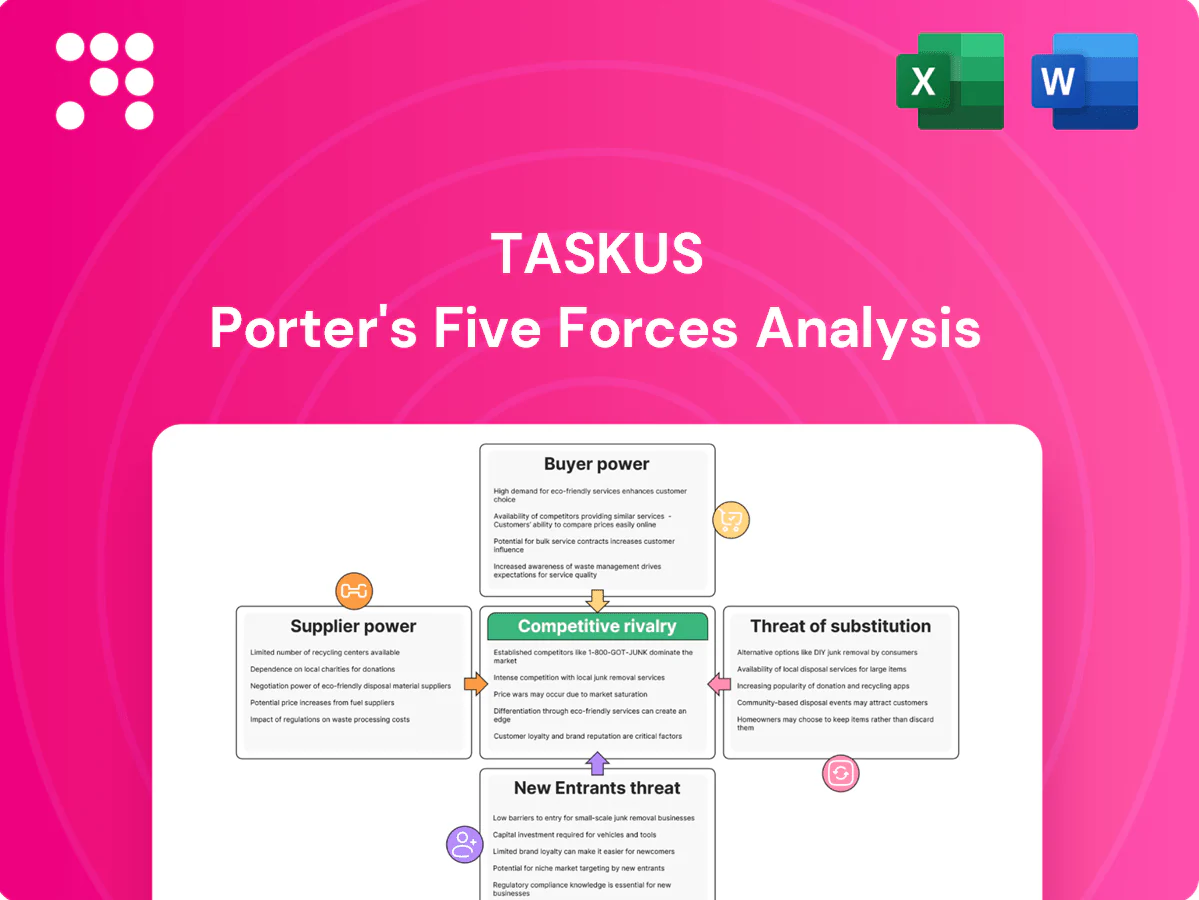
This snapshot highlights TaskUs’s competitive dynamics and key pressures but only scratches the surface. Unlock the full Porter's Five Forces Analysis to explore supplier and buyer power, threat of entrants and substitutes, and competitive rivalry in depth. Ready to move beyond the basics? Purchase the complete report for force-by-force ratings, visuals, and actionable strategy insights.
Suppliers Bargaining Power

Talent pool and wage dynamics
Agents, moderators and data labelers are the core supplier base; in 2024 BPO agent pay in the Philippines averaged roughly USD 400–600/month and regional hubs (India, LATAM) saw wage pressure from tight labor markets and regulatory hikes. TaskUs-style scale and training academies dilute individual worker power, but local unionization or talent scarcity in specific cities can still compress margins.
Cloud and CCaaS vendor leverage
TaskUs depends on hyperscalers and CX tech stacks (cloud, WFM, QA, CCaaS), creating meaningful switching costs. Hyperscaler market shares in 2024 were roughly AWS 33%, Microsoft Azure 24% and Google Cloud 10%, concentrating platform leverage. Vendor ecosystems remain competitive, limiting unilateral pricing power, but integrations, compliance and retraining create exploitable friction. Multi-vendor strategies and open architectures mitigate lock-in.

Real estate and telecom dependencies
Facilities, ISPs, and telco carriers directly affect uptime and site economics for hybrid/on-site delivery, with supply concentration in Tier‑1 cities elevating landlord and carrier leverage; in 2024, major metro clusters still hosted the majority of enterprise sites. Remote work and diversified site footprints—with roughly 30% of knowledge workers in hybrid schedules in 2024—reduce exposure. Long‑term leases can temporarily raise supplier power during downcycles.

Specialized skills and language supply
Niche skills in safety, medical, fintech KYC and multilingual support are scarcer in 2024 and command premiums; specialist roles can cost 15–35% more than baseline BPO wages, boosting supplier leverage. Certified training providers and specialist recruiters gain bargaining power as clients demand compliance and language coverage. TaskUs and peers offset pressure by building in-house academies and expanding nearshore/onshore hubs while many clients remain willing to pay a premium for specialization.
- Skill premium: 15–35% (2024)
- Certified trainers: higher bargaining power
- Mitigation: in-house academies, nearshore/onshore
- Client willingness to pay: supports margin recovery
Tooling, labeling, and AI ops platforms
AI data ops rely heavily on annotation, QA, and model-ops platforms, which keeps supplier leverage moderate: vendor competition caps pricing but workflow lock-in and integration costs preserve switching frictions. Growing use of open-source and in-house tooling in 2024 reduced external dependence, and co-developing platforms with clients further weakens supplier bargaining power.
- Competition limits pricing
- Workflow lock-in raises switching costs
- Open-source/in-house tools cut reliance
- Client co-development reduces supplier leverage
Supplier power moderate: USD 400–600/mo, 15–35%
Supplier power is moderate: labor costs (Philippines BPO pay USD 400–600/mo in 2024) and specialist premiums (15–35%) increase leverage, but TaskUs scale and in‑house academies dilute worker bargaining. Hyperscaler/platform concentration (AWS 33%, Azure 24%, GCP 10% in 2024) raises switching costs while vendor competition limits pricing. Hybrid work (~30% knowledge workers in 2024) and open‑source tooling reduce site and tech supplier risk.
| Metric | 2024 Value |
|---|---|
| Philippines BPO pay | USD 400–600/mo |
| Specialist premium | 15–35% |
| Hyperscaler share | AWS 33% / Azure 24% / GCP 10% |
| Hybrid work | ~30% |
What is included in the product
 Detailed Word Document
Uncovers key drivers of competition, buyer and supplier power, entry barriers, substitutes, and rivalry specific to TaskUs, identifying emerging threats and strategic levers to protect margin and market share for use in investor materials, strategy decks, or academic work.

 Customizable Excel Spreadsheet
A one-sheet TaskUs Porter's Five Forces summary that clarifies competitive pressure, buyer/supplier risks, and entrant threats—customizable and deck-ready to eliminate analysis bottlenecks.
Customers Bargaining Power

Concentrated tech client base
Large brand-name tech clients wield strong negotiating leverage via scale and referenceability. Their budgets and multi-region volumes—backed by 2024 global IT spending of $4.6 trillion (Gartner)—drive pricing concessions. Dependence on a few logos raises revenue concentration risk; diversifying into other verticals and the mid-market reduces buyer power.
RFP-driven, outcome-based contracting
Procurement-heavy clients push competitive RFPs with strict SLAs and penalties that compress margins, and TaskUs reported $1.7B revenue in 2024 while facing rising price pressure. Outcome- or unit-economics benchmarks make switching vendors more attractive by quantifying savings. TaskUs’ strong past performance and domain IP raise perceived switching costs. Co-innovation and embedded workflows temper buyer leverage by increasing migration friction.

Moderate switching costs
Process know-how, training data requirements and security approvals create meaningful friction — TaskUs reported roughly $1.6B revenue in 2023 and serves 300+ clients, indicating complex onboarding that raises switching costs. Still, standardized CX and content workflows enable competitors to bid aggressively, compressing price premium. Transition assistance and shadowing can shorten swaps to months, while deep integrations and data pipelines increase stickiness and curb buyer power.

Price sensitivity in growth cycles
High-growth clients prioritize speed-to-scale but, per 2024 industry trends, shift to cost focus during downturns, driving rate renegotiations and ramp-downs as volume variability rises; TaskUs' 2024 revenue cadence amplified pressure on contract flexibility. Flexible staffing models and productivity levers defend margins while value narratives tied to CSAT, safety, and risk reduction reduce discount demands.
- Volume-driven renegotiation
- Flexible staffing preserves margin
- CSAT/safety reduce discounts
Demand for compliance and security
Demand for compliance and security forces buyers to insist on stringent certifications and audits, raising the bar and creating supplier lock-in; Gartner projected global security and risk management spending at about $188.3 billion in 2024, underscoring how material this risk is. Meeting high compliance narrows eligible suppliers, enabling premium pricing while transparent governance and reporting further reduce buyer leverage.
- Certifications: drive lock-in
- Supplier pool: constrained
- Pricing: justifies premiums
- Transparency: lowers buyer leverage
Large tech buyers squeeze pricing amid $4.6T IT spend and rising security-driven switching costs
Large tech clients hold strong leverage via scale and referenceability; 2024 global IT spend hit $4.6T (Gartner), pressuring pricing while TaskUs reported $1.7B revenue in 2024 and serves 300+ clients. Compliance/security demand (2024 security spend $188.3B) raises switching costs, but standardized CX workflows and aggressive RFPs compress premiums and drive renegotiations.
| Metric | 2024 Value |
|---|---|
| TaskUs revenue | $1.7B |
| Clients | 300+ |
| Global IT spend | $4.6T |
| Security spend | $188.3B |
Preview Before You Purchase
TaskUs Porter's Five Forces Analysis
This preview shows the exact TaskUs Porter's Five Forces Analysis you'll receive after purchase—no placeholders or mockups. The file is fully formatted, professionally written, and ready for immediate download and use. You're viewing the final deliverable; completion of payment grants instant access to this identical document.

A Must-Have Tool for Decision-Makers
This snapshot highlights TaskUs’s competitive dynamics and key pressures but only scratches the surface. Unlock the full Porter's Five Forces Analysis to explore supplier and buyer power, threat of entrants and substitutes, and competitive rivalry in depth. Ready to move beyond the basics? Purchase the complete report for force-by-force ratings, visuals, and actionable strategy insights.
Suppliers Bargaining Power
Talent pool and wage dynamics
Agents, moderators and data labelers are the core supplier base; in 2024 BPO agent pay in the Philippines averaged roughly USD 400–600/month and regional hubs (India, LATAM) saw wage pressure from tight labor markets and regulatory hikes. TaskUs-style scale and training academies dilute individual worker power, but local unionization or talent scarcity in specific cities can still compress margins.
Cloud and CCaaS vendor leverage
TaskUs depends on hyperscalers and CX tech stacks (cloud, WFM, QA, CCaaS), creating meaningful switching costs. Hyperscaler market shares in 2024 were roughly AWS 33%, Microsoft Azure 24% and Google Cloud 10%, concentrating platform leverage. Vendor ecosystems remain competitive, limiting unilateral pricing power, but integrations, compliance and retraining create exploitable friction. Multi-vendor strategies and open architectures mitigate lock-in.
Real estate and telecom dependencies
Facilities, ISPs, and telco carriers directly affect uptime and site economics for hybrid/on-site delivery, with supply concentration in Tier‑1 cities elevating landlord and carrier leverage; in 2024, major metro clusters still hosted the majority of enterprise sites. Remote work and diversified site footprints—with roughly 30% of knowledge workers in hybrid schedules in 2024—reduce exposure. Long‑term leases can temporarily raise supplier power during downcycles.
Specialized skills and language supply
Niche skills in safety, medical, fintech KYC and multilingual support are scarcer in 2024 and command premiums; specialist roles can cost 15–35% more than baseline BPO wages, boosting supplier leverage. Certified training providers and specialist recruiters gain bargaining power as clients demand compliance and language coverage. TaskUs and peers offset pressure by building in-house academies and expanding nearshore/onshore hubs while many clients remain willing to pay a premium for specialization.
- Skill premium: 15–35% (2024)
- Certified trainers: higher bargaining power
- Mitigation: in-house academies, nearshore/onshore
- Client willingness to pay: supports margin recovery
Tooling, labeling, and AI ops platforms
AI data ops rely heavily on annotation, QA, and model-ops platforms, which keeps supplier leverage moderate: vendor competition caps pricing but workflow lock-in and integration costs preserve switching frictions. Growing use of open-source and in-house tooling in 2024 reduced external dependence, and co-developing platforms with clients further weakens supplier bargaining power.
- Competition limits pricing
- Workflow lock-in raises switching costs
- Open-source/in-house tools cut reliance
- Client co-development reduces supplier leverage
Supplier power moderate: USD 400–600/mo, 15–35%
Supplier power is moderate: labor costs (Philippines BPO pay USD 400–600/mo in 2024) and specialist premiums (15–35%) increase leverage, but TaskUs scale and in‑house academies dilute worker bargaining. Hyperscaler/platform concentration (AWS 33%, Azure 24%, GCP 10% in 2024) raises switching costs while vendor competition limits pricing. Hybrid work (~30% knowledge workers in 2024) and open‑source tooling reduce site and tech supplier risk.
| Metric | 2024 Value |
|---|---|
| Philippines BPO pay | USD 400–600/mo |
| Specialist premium | 15–35% |
| Hyperscaler share | AWS 33% / Azure 24% / GCP 10% |
| Hybrid work | ~30% |
What is included in the product
Detailed Word Document
Uncovers key drivers of competition, buyer and supplier power, entry barriers, substitutes, and rivalry specific to TaskUs, identifying emerging threats and strategic levers to protect margin and market share for use in investor materials, strategy decks, or academic work.
Customizable Excel Spreadsheet
A one-sheet TaskUs Porter's Five Forces summary that clarifies competitive pressure, buyer/supplier risks, and entrant threats—customizable and deck-ready to eliminate analysis bottlenecks.
Customers Bargaining Power
Concentrated tech client base
Large brand-name tech clients wield strong negotiating leverage via scale and referenceability. Their budgets and multi-region volumes—backed by 2024 global IT spending of $4.6 trillion (Gartner)—drive pricing concessions. Dependence on a few logos raises revenue concentration risk; diversifying into other verticals and the mid-market reduces buyer power.
RFP-driven, outcome-based contracting
Procurement-heavy clients push competitive RFPs with strict SLAs and penalties that compress margins, and TaskUs reported $1.7B revenue in 2024 while facing rising price pressure. Outcome- or unit-economics benchmarks make switching vendors more attractive by quantifying savings. TaskUs’ strong past performance and domain IP raise perceived switching costs. Co-innovation and embedded workflows temper buyer leverage by increasing migration friction.
Moderate switching costs
Process know-how, training data requirements and security approvals create meaningful friction — TaskUs reported roughly $1.6B revenue in 2023 and serves 300+ clients, indicating complex onboarding that raises switching costs. Still, standardized CX and content workflows enable competitors to bid aggressively, compressing price premium. Transition assistance and shadowing can shorten swaps to months, while deep integrations and data pipelines increase stickiness and curb buyer power.
Price sensitivity in growth cycles
High-growth clients prioritize speed-to-scale but, per 2024 industry trends, shift to cost focus during downturns, driving rate renegotiations and ramp-downs as volume variability rises; TaskUs' 2024 revenue cadence amplified pressure on contract flexibility. Flexible staffing models and productivity levers defend margins while value narratives tied to CSAT, safety, and risk reduction reduce discount demands.
- Volume-driven renegotiation
- Flexible staffing preserves margin
- CSAT/safety reduce discounts
Demand for compliance and security
Demand for compliance and security forces buyers to insist on stringent certifications and audits, raising the bar and creating supplier lock-in; Gartner projected global security and risk management spending at about $188.3 billion in 2024, underscoring how material this risk is. Meeting high compliance narrows eligible suppliers, enabling premium pricing while transparent governance and reporting further reduce buyer leverage.
- Certifications: drive lock-in
- Supplier pool: constrained
- Pricing: justifies premiums
- Transparency: lowers buyer leverage
Large tech buyers squeeze pricing amid $4.6T IT spend and rising security-driven switching costs
Large tech clients hold strong leverage via scale and referenceability; 2024 global IT spend hit $4.6T (Gartner), pressuring pricing while TaskUs reported $1.7B revenue in 2024 and serves 300+ clients. Compliance/security demand (2024 security spend $188.3B) raises switching costs, but standardized CX workflows and aggressive RFPs compress premiums and drive renegotiations.
| Metric | 2024 Value |
|---|---|
| TaskUs revenue | $1.7B |
| Clients | 300+ |
| Global IT spend | $4.6T |
| Security spend | $188.3B |
Preview Before You Purchase
TaskUs Porter's Five Forces Analysis
This preview shows the exact TaskUs Porter's Five Forces Analysis you'll receive after purchase—no placeholders or mockups. The file is fully formatted, professionally written, and ready for immediate download and use. You're viewing the final deliverable; completion of payment grants instant access to this identical document.
Original: $10.00
-65%$10.00
$3.50Description
A Must-Have Tool for Decision-Makers
This snapshot highlights TaskUs’s competitive dynamics and key pressures but only scratches the surface. Unlock the full Porter's Five Forces Analysis to explore supplier and buyer power, threat of entrants and substitutes, and competitive rivalry in depth. Ready to move beyond the basics? Purchase the complete report for force-by-force ratings, visuals, and actionable strategy insights.
Suppliers Bargaining Power
Talent pool and wage dynamics
Agents, moderators and data labelers are the core supplier base; in 2024 BPO agent pay in the Philippines averaged roughly USD 400–600/month and regional hubs (India, LATAM) saw wage pressure from tight labor markets and regulatory hikes. TaskUs-style scale and training academies dilute individual worker power, but local unionization or talent scarcity in specific cities can still compress margins.
Cloud and CCaaS vendor leverage
TaskUs depends on hyperscalers and CX tech stacks (cloud, WFM, QA, CCaaS), creating meaningful switching costs. Hyperscaler market shares in 2024 were roughly AWS 33%, Microsoft Azure 24% and Google Cloud 10%, concentrating platform leverage. Vendor ecosystems remain competitive, limiting unilateral pricing power, but integrations, compliance and retraining create exploitable friction. Multi-vendor strategies and open architectures mitigate lock-in.
Real estate and telecom dependencies
Facilities, ISPs, and telco carriers directly affect uptime and site economics for hybrid/on-site delivery, with supply concentration in Tier‑1 cities elevating landlord and carrier leverage; in 2024, major metro clusters still hosted the majority of enterprise sites. Remote work and diversified site footprints—with roughly 30% of knowledge workers in hybrid schedules in 2024—reduce exposure. Long‑term leases can temporarily raise supplier power during downcycles.
Specialized skills and language supply
Niche skills in safety, medical, fintech KYC and multilingual support are scarcer in 2024 and command premiums; specialist roles can cost 15–35% more than baseline BPO wages, boosting supplier leverage. Certified training providers and specialist recruiters gain bargaining power as clients demand compliance and language coverage. TaskUs and peers offset pressure by building in-house academies and expanding nearshore/onshore hubs while many clients remain willing to pay a premium for specialization.
- Skill premium: 15–35% (2024)
- Certified trainers: higher bargaining power
- Mitigation: in-house academies, nearshore/onshore
- Client willingness to pay: supports margin recovery
Tooling, labeling, and AI ops platforms
AI data ops rely heavily on annotation, QA, and model-ops platforms, which keeps supplier leverage moderate: vendor competition caps pricing but workflow lock-in and integration costs preserve switching frictions. Growing use of open-source and in-house tooling in 2024 reduced external dependence, and co-developing platforms with clients further weakens supplier bargaining power.
- Competition limits pricing
- Workflow lock-in raises switching costs
- Open-source/in-house tools cut reliance
- Client co-development reduces supplier leverage
Supplier power moderate: USD 400–600/mo, 15–35%
Supplier power is moderate: labor costs (Philippines BPO pay USD 400–600/mo in 2024) and specialist premiums (15–35%) increase leverage, but TaskUs scale and in‑house academies dilute worker bargaining. Hyperscaler/platform concentration (AWS 33%, Azure 24%, GCP 10% in 2024) raises switching costs while vendor competition limits pricing. Hybrid work (~30% knowledge workers in 2024) and open‑source tooling reduce site and tech supplier risk.
| Metric | 2024 Value |
|---|---|
| Philippines BPO pay | USD 400–600/mo |
| Specialist premium | 15–35% |
| Hyperscaler share | AWS 33% / Azure 24% / GCP 10% |
| Hybrid work | ~30% |
What is included in the product
Detailed Word Document
Uncovers key drivers of competition, buyer and supplier power, entry barriers, substitutes, and rivalry specific to TaskUs, identifying emerging threats and strategic levers to protect margin and market share for use in investor materials, strategy decks, or academic work.
Customizable Excel Spreadsheet
A one-sheet TaskUs Porter's Five Forces summary that clarifies competitive pressure, buyer/supplier risks, and entrant threats—customizable and deck-ready to eliminate analysis bottlenecks.
Customers Bargaining Power
Concentrated tech client base
Large brand-name tech clients wield strong negotiating leverage via scale and referenceability. Their budgets and multi-region volumes—backed by 2024 global IT spending of $4.6 trillion (Gartner)—drive pricing concessions. Dependence on a few logos raises revenue concentration risk; diversifying into other verticals and the mid-market reduces buyer power.
RFP-driven, outcome-based contracting
Procurement-heavy clients push competitive RFPs with strict SLAs and penalties that compress margins, and TaskUs reported $1.7B revenue in 2024 while facing rising price pressure. Outcome- or unit-economics benchmarks make switching vendors more attractive by quantifying savings. TaskUs’ strong past performance and domain IP raise perceived switching costs. Co-innovation and embedded workflows temper buyer leverage by increasing migration friction.
Moderate switching costs
Process know-how, training data requirements and security approvals create meaningful friction — TaskUs reported roughly $1.6B revenue in 2023 and serves 300+ clients, indicating complex onboarding that raises switching costs. Still, standardized CX and content workflows enable competitors to bid aggressively, compressing price premium. Transition assistance and shadowing can shorten swaps to months, while deep integrations and data pipelines increase stickiness and curb buyer power.
Price sensitivity in growth cycles
High-growth clients prioritize speed-to-scale but, per 2024 industry trends, shift to cost focus during downturns, driving rate renegotiations and ramp-downs as volume variability rises; TaskUs' 2024 revenue cadence amplified pressure on contract flexibility. Flexible staffing models and productivity levers defend margins while value narratives tied to CSAT, safety, and risk reduction reduce discount demands.
- Volume-driven renegotiation
- Flexible staffing preserves margin
- CSAT/safety reduce discounts
Demand for compliance and security
Demand for compliance and security forces buyers to insist on stringent certifications and audits, raising the bar and creating supplier lock-in; Gartner projected global security and risk management spending at about $188.3 billion in 2024, underscoring how material this risk is. Meeting high compliance narrows eligible suppliers, enabling premium pricing while transparent governance and reporting further reduce buyer leverage.
- Certifications: drive lock-in
- Supplier pool: constrained
- Pricing: justifies premiums
- Transparency: lowers buyer leverage
Large tech buyers squeeze pricing amid $4.6T IT spend and rising security-driven switching costs
Large tech clients hold strong leverage via scale and referenceability; 2024 global IT spend hit $4.6T (Gartner), pressuring pricing while TaskUs reported $1.7B revenue in 2024 and serves 300+ clients. Compliance/security demand (2024 security spend $188.3B) raises switching costs, but standardized CX workflows and aggressive RFPs compress premiums and drive renegotiations.
| Metric | 2024 Value |
|---|---|
| TaskUs revenue | $1.7B |
| Clients | 300+ |
| Global IT spend | $4.6T |
| Security spend | $188.3B |
Preview Before You Purchase
TaskUs Porter's Five Forces Analysis
This preview shows the exact TaskUs Porter's Five Forces Analysis you'll receive after purchase—no placeholders or mockups. The file is fully formatted, professionally written, and ready for immediate download and use. You're viewing the final deliverable; completion of payment grants instant access to this identical document.











