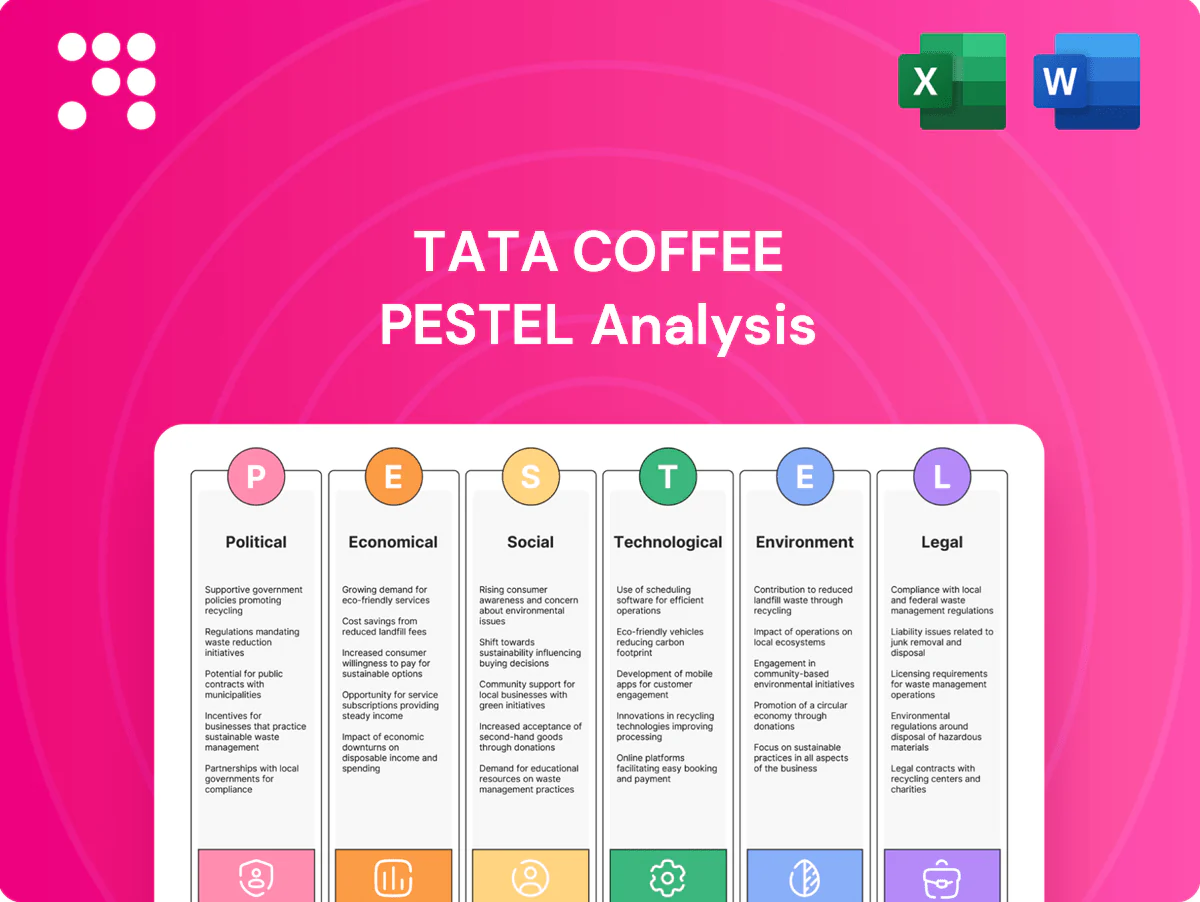
Tata Coffee PESTLE Analysis

Make Smarter Strategic Decisions with a Complete PESTEL View
Discover how political shifts, economic cycles, social trends, technological advances, legal changes and environmental pressures are reshaping Tata Coffee’s strategic outlook; our PESTLE pinpoints risks and growth levers in plain language. Ideal for investors and strategists, this expert analysis saves hours of research. Buy the full PESTLE for the complete, ready-to-use report and actionable recommendations.
Political factors

Agri-policy and subsidies
Government support for plantation crops, irrigation and agri-inputs directly affects Tata Coffee’s cost base and yields; India’s coffee output was about 5.8 lakh tonnes in 2023–24, so policy moves have sector-wide impact. Changes in fertilizer subsidy allocations (roughly Rs 1.84 lakh crore budgeted in 2024–25) or MSP-style interventions for related crops can materially shift input economics. Stability of state agricultural extension services determines uptake of yield-enhancing practices. Policy continuity underpins multi-year estate planning and replanting cycles.
Trade policy and export incentives
Export incentives under RoDTEP (rates published by DGFT) and zero-rating under GST directly affect Tata Coffee's margins on instant and green coffee, especially given India exported about 272,000 tonnes of coffee in 2023–24 (Coffee Board). Tariffs and quotas in EU/US/Japan can shift product-mix and routing to value-added lines. Stricter export documentation or quality norms raise compliance costs. Bilateral FTAs can unlock preferential access for value-added coffee.

State-level governance in plantation hubs
State policies in Karnataka, Tamil Nadu and Kerala on land use, irrigation and local taxation directly affect Tata Coffee estates; Karnataka accounts for about 70% of India’s coffee output (India ~310,000 tonnes in 2023/24), concentrating regulatory impact. State investment in rural infrastructure reduces logistics bottlenecks and spoilage, improving margin recovery. Political stability influences labor availability and estate security, while regional incentives can catalyze capex in processing facilities.

Geopolitics and logistics security
Conflicts, sanctions and late-2023 Red Sea maritime attacks have forced rerouting and convoying, increasing voyage times by days to weeks and pushing spot freight premiums sharply higher for coffee exporters.
Tata Coffee’s exports to the US, EU and Asia rely on freight reliability; container and bulk shipping disruptions raise costs and can delay seasonal shipments critical for quality and price realization.
Political volatility in buyer markets alters demand patterns and certification requirements, making logistics hedges, diversified routes and inventory buffers essential for just-in-time customers.
- shipping disruption: rerouting adds days–weeks to voyages
- export dependence: US, EU, Asia freight reliability critical
- market risk: importer volatility shifts demand and certifications
- risk mitigation: route diversity, buffers, freight hedging
Sustainability directives and public procurement
Government drives on sustainable agriculture and India’s net-zero by 2070 pledge push Tata Coffee estates toward low-carbon farming and precision irrigation; policy carrots like afforestation grants and water-management subsidies can cut estate capex and boost yields. Public procurement standards—with government sourcing roughly 20% of GDP—favor certified, traceable beans, shaping Tata Coffee’s sourcing and certification investments. Policy sticks and incentives accelerate adoption of climate-smart techniques across estates.
- Net-zero target: 2070
- Public procurement share: ~20% of GDP
- Grants reduce estate capex, support reforestation/water projects
- Higher demand for certified, traceable coffee
Agri-input policy, Rs 1.84 lakh crore fertilizer and Karnataka risks hit India coffee trade
Policy on agri-inputs, subsidies (fertilizer budget Rs 1.84 lakh crore 2024–25) and state land/irrigation laws shape Tata Coffee’s costs and replanting cycles; India produced ~580,000 t (2023–24) with exports ~272,000 t. Karnataka (~70% ≈310,000 t) concentrates regulatory risk. Export rules, RoDTEP, shipping disruptions and India’s net-zero 2070 goal drive certification, logistics and capex choices.
| Metric | Value (2023/24–25) |
|---|---|
| India coffee output | ~580,000 t |
| Exports | ~272,000 t |
| Karnataka share | ~70% (~310,000 t) |
| Fertilizer budget | Rs 1.84 lakh crore (2024–25) |
| Net-zero target | 2070 |
What is included in the product
 Detailed Word Document
Explores how Political, Economic, Social, Technological, Environmental and Legal factors uniquely affect Tata Coffee, combining data-backed trends and region-specific examples to identify risks, opportunities and forward-looking scenarios; designed for executives and investors to inform strategy, funding and operational decisions.

 Customizable Excel Spreadsheet
A concise, visually segmented Tata Coffee PESTLE summary that simplifies external risk and market positioning for quick insertion into presentations or planning sessions, enabling teams to align fast and address strategic pain points efficiently.
Economic factors

Global coffee price volatility
Arabica and Robusta swings (ICE Arabica ~$1.80/lb June 2025; Robusta ~$2,200/tonne) directly alter Tata Coffee plantation revenues and inventory valuation. Brazil/Vietnam weather shocks and ETF/fund flows have driven 30–40% price cycles recently. Stronger hedging reduced margin volatility; weak cover forces shorter customer contract tenors and tighter pricing clauses.
Currency movements (INR/USD)
INR depreciation versus USD (around 82–83 in 2024–25) boosts Tata Coffee export realizations but raises costs for imported equipment and inputs. FX volatility complicates pricing of long-dated offtake contracts and can squeeze margins if unhedged. Natural hedges exist between dollar revenues and foreign-currency costs, and active treasury hedging and forward cover preserve operating margins.

Inflation, wages, and interest rates
Input inflation pushed fertiliser, fuel and packaging costs up roughly 8–12% in 2024, squeezing margins on estate operations; wage inflation of about 8–10% raised plantation labour bills materially. A repo rate of ~6.5% increases working-capital and capex financing costs, tightening cashflow for seasonal harvests. Ability to pass through costs varies by customer mix and brand strength, with branded sales showing higher pricing power than commodity channels.

Demand cycle in instant and premium coffee
Rising disposable incomes in India and urban markets are shifting consumers to premium and specialty coffee, boosting demand for value-added mixes, while economic downcycles push volume toward economy SKUs and private labels; HoReCa recovery since 2022 has rebalanced volumes across instant, roast-and-ground and out-of-home formats, and Tata Coffee’s broad portfolio across instant, specialty and origin coffee helps cushion demand shocks.
- Premium shift: higher-income urban households
- Downcycle behavior: move to economy/private labels
- HoReCa recovery: reallocation across formats
- Portfolio resilience: diversification across segments
Logistics and energy costs
Freight and container swings—container rates that peaked near USD 10,000 per FEU in 2021–22 versus pre-COVID ~USD 1,500—plus energy tariffs materially change landed costs and delivery reliability; sustained spikes erode Tata Coffees export competitiveness. Nearshoring and multiport routing reduce disruption risk, while boiler and dryer efficiency projects (typical fuel savings 10–15%) boost cost resilience.
- Freight volatility: peak vs pre-COVID
- Container availability: delivery reliability risk
- Energy tariffs: impact on landed cost
- Mitigation: nearshoring/multiport
- Efficiency gains: boilers/dryers 10–15% fuel savings
Agri-input policy, Rs 1.84 lakh crore fertilizer and Karnataka risks hit India coffee trade
Commodity price swings (ICE Arabica ~1.80$/lb June 2025; Robusta ~2,200$/t) drive revenue and inventory revaluation; hedging reduces but does not eliminate margin volatility. INR ~82–83 in 2024–25 raises export realizations but increases imported input costs; repo ~6.5% tightens working capital. Input inflation 8–12% and freight volatility (peak ~10,000$/FEU vs pre-COVID ~1,500$) pressure margins while premium demand cushions volumes.
| Metric | 2024–25 / Jun‑2025 |
|---|---|
| ICE Arabica | ~1.80 $/lb |
| Robusta | ~2,200 $/t |
| INR/USD | ~82–83 |
| Repo rate | ~6.5% |
| Input inflation | 8–12% |
| Container peak | ~10,000 $/FEU |
Full Version Awaits
Tata Coffee PESTLE Analysis
This Tata Coffee PESTLE Analysis provides a concise, professional assessment of political, economic, social, technological, legal and environmental factors affecting the company. The preview shown here is the exact document you’ll receive after purchase—fully formatted and ready to use. Use it for strategy, investment or academic purposes.

Make Smarter Strategic Decisions with a Complete PESTEL View
Discover how political shifts, economic cycles, social trends, technological advances, legal changes and environmental pressures are reshaping Tata Coffee’s strategic outlook; our PESTLE pinpoints risks and growth levers in plain language. Ideal for investors and strategists, this expert analysis saves hours of research. Buy the full PESTLE for the complete, ready-to-use report and actionable recommendations.
Political factors
Agri-policy and subsidies
Government support for plantation crops, irrigation and agri-inputs directly affects Tata Coffee’s cost base and yields; India’s coffee output was about 5.8 lakh tonnes in 2023–24, so policy moves have sector-wide impact. Changes in fertilizer subsidy allocations (roughly Rs 1.84 lakh crore budgeted in 2024–25) or MSP-style interventions for related crops can materially shift input economics. Stability of state agricultural extension services determines uptake of yield-enhancing practices. Policy continuity underpins multi-year estate planning and replanting cycles.
Trade policy and export incentives
Export incentives under RoDTEP (rates published by DGFT) and zero-rating under GST directly affect Tata Coffee's margins on instant and green coffee, especially given India exported about 272,000 tonnes of coffee in 2023–24 (Coffee Board). Tariffs and quotas in EU/US/Japan can shift product-mix and routing to value-added lines. Stricter export documentation or quality norms raise compliance costs. Bilateral FTAs can unlock preferential access for value-added coffee.
State-level governance in plantation hubs
State policies in Karnataka, Tamil Nadu and Kerala on land use, irrigation and local taxation directly affect Tata Coffee estates; Karnataka accounts for about 70% of India’s coffee output (India ~310,000 tonnes in 2023/24), concentrating regulatory impact. State investment in rural infrastructure reduces logistics bottlenecks and spoilage, improving margin recovery. Political stability influences labor availability and estate security, while regional incentives can catalyze capex in processing facilities.
Geopolitics and logistics security
Conflicts, sanctions and late-2023 Red Sea maritime attacks have forced rerouting and convoying, increasing voyage times by days to weeks and pushing spot freight premiums sharply higher for coffee exporters.
Tata Coffee’s exports to the US, EU and Asia rely on freight reliability; container and bulk shipping disruptions raise costs and can delay seasonal shipments critical for quality and price realization.
Political volatility in buyer markets alters demand patterns and certification requirements, making logistics hedges, diversified routes and inventory buffers essential for just-in-time customers.
- shipping disruption: rerouting adds days–weeks to voyages
- export dependence: US, EU, Asia freight reliability critical
- market risk: importer volatility shifts demand and certifications
- risk mitigation: route diversity, buffers, freight hedging
Sustainability directives and public procurement
Government drives on sustainable agriculture and India’s net-zero by 2070 pledge push Tata Coffee estates toward low-carbon farming and precision irrigation; policy carrots like afforestation grants and water-management subsidies can cut estate capex and boost yields. Public procurement standards—with government sourcing roughly 20% of GDP—favor certified, traceable beans, shaping Tata Coffee’s sourcing and certification investments. Policy sticks and incentives accelerate adoption of climate-smart techniques across estates.
- Net-zero target: 2070
- Public procurement share: ~20% of GDP
- Grants reduce estate capex, support reforestation/water projects
- Higher demand for certified, traceable coffee
Agri-input policy, Rs 1.84 lakh crore fertilizer and Karnataka risks hit India coffee trade
Policy on agri-inputs, subsidies (fertilizer budget Rs 1.84 lakh crore 2024–25) and state land/irrigation laws shape Tata Coffee’s costs and replanting cycles; India produced ~580,000 t (2023–24) with exports ~272,000 t. Karnataka (~70% ≈310,000 t) concentrates regulatory risk. Export rules, RoDTEP, shipping disruptions and India’s net-zero 2070 goal drive certification, logistics and capex choices.
| Metric | Value (2023/24–25) |
|---|---|
| India coffee output | ~580,000 t |
| Exports | ~272,000 t |
| Karnataka share | ~70% (~310,000 t) |
| Fertilizer budget | Rs 1.84 lakh crore (2024–25) |
| Net-zero target | 2070 |
What is included in the product
Detailed Word Document
Explores how Political, Economic, Social, Technological, Environmental and Legal factors uniquely affect Tata Coffee, combining data-backed trends and region-specific examples to identify risks, opportunities and forward-looking scenarios; designed for executives and investors to inform strategy, funding and operational decisions.
Customizable Excel Spreadsheet
A concise, visually segmented Tata Coffee PESTLE summary that simplifies external risk and market positioning for quick insertion into presentations or planning sessions, enabling teams to align fast and address strategic pain points efficiently.
Economic factors
Global coffee price volatility
Arabica and Robusta swings (ICE Arabica ~$1.80/lb June 2025; Robusta ~$2,200/tonne) directly alter Tata Coffee plantation revenues and inventory valuation. Brazil/Vietnam weather shocks and ETF/fund flows have driven 30–40% price cycles recently. Stronger hedging reduced margin volatility; weak cover forces shorter customer contract tenors and tighter pricing clauses.
Currency movements (INR/USD)
INR depreciation versus USD (around 82–83 in 2024–25) boosts Tata Coffee export realizations but raises costs for imported equipment and inputs. FX volatility complicates pricing of long-dated offtake contracts and can squeeze margins if unhedged. Natural hedges exist between dollar revenues and foreign-currency costs, and active treasury hedging and forward cover preserve operating margins.
Inflation, wages, and interest rates
Input inflation pushed fertiliser, fuel and packaging costs up roughly 8–12% in 2024, squeezing margins on estate operations; wage inflation of about 8–10% raised plantation labour bills materially. A repo rate of ~6.5% increases working-capital and capex financing costs, tightening cashflow for seasonal harvests. Ability to pass through costs varies by customer mix and brand strength, with branded sales showing higher pricing power than commodity channels.
Demand cycle in instant and premium coffee
Rising disposable incomes in India and urban markets are shifting consumers to premium and specialty coffee, boosting demand for value-added mixes, while economic downcycles push volume toward economy SKUs and private labels; HoReCa recovery since 2022 has rebalanced volumes across instant, roast-and-ground and out-of-home formats, and Tata Coffee’s broad portfolio across instant, specialty and origin coffee helps cushion demand shocks.
- Premium shift: higher-income urban households
- Downcycle behavior: move to economy/private labels
- HoReCa recovery: reallocation across formats
- Portfolio resilience: diversification across segments
Logistics and energy costs
Freight and container swings—container rates that peaked near USD 10,000 per FEU in 2021–22 versus pre-COVID ~USD 1,500—plus energy tariffs materially change landed costs and delivery reliability; sustained spikes erode Tata Coffees export competitiveness. Nearshoring and multiport routing reduce disruption risk, while boiler and dryer efficiency projects (typical fuel savings 10–15%) boost cost resilience.
- Freight volatility: peak vs pre-COVID
- Container availability: delivery reliability risk
- Energy tariffs: impact on landed cost
- Mitigation: nearshoring/multiport
- Efficiency gains: boilers/dryers 10–15% fuel savings
Agri-input policy, Rs 1.84 lakh crore fertilizer and Karnataka risks hit India coffee trade
Commodity price swings (ICE Arabica ~1.80$/lb June 2025; Robusta ~2,200$/t) drive revenue and inventory revaluation; hedging reduces but does not eliminate margin volatility. INR ~82–83 in 2024–25 raises export realizations but increases imported input costs; repo ~6.5% tightens working capital. Input inflation 8–12% and freight volatility (peak ~10,000$/FEU vs pre-COVID ~1,500$) pressure margins while premium demand cushions volumes.
| Metric | 2024–25 / Jun‑2025 |
|---|---|
| ICE Arabica | ~1.80 $/lb |
| Robusta | ~2,200 $/t |
| INR/USD | ~82–83 |
| Repo rate | ~6.5% |
| Input inflation | 8–12% |
| Container peak | ~10,000 $/FEU |
Full Version Awaits
Tata Coffee PESTLE Analysis
This Tata Coffee PESTLE Analysis provides a concise, professional assessment of political, economic, social, technological, legal and environmental factors affecting the company. The preview shown here is the exact document you’ll receive after purchase—fully formatted and ready to use. Use it for strategy, investment or academic purposes.
Original: $10.00
-65%$10.00
$3.50Description
Make Smarter Strategic Decisions with a Complete PESTEL View
Discover how political shifts, economic cycles, social trends, technological advances, legal changes and environmental pressures are reshaping Tata Coffee’s strategic outlook; our PESTLE pinpoints risks and growth levers in plain language. Ideal for investors and strategists, this expert analysis saves hours of research. Buy the full PESTLE for the complete, ready-to-use report and actionable recommendations.
Political factors
Agri-policy and subsidies
Government support for plantation crops, irrigation and agri-inputs directly affects Tata Coffee’s cost base and yields; India’s coffee output was about 5.8 lakh tonnes in 2023–24, so policy moves have sector-wide impact. Changes in fertilizer subsidy allocations (roughly Rs 1.84 lakh crore budgeted in 2024–25) or MSP-style interventions for related crops can materially shift input economics. Stability of state agricultural extension services determines uptake of yield-enhancing practices. Policy continuity underpins multi-year estate planning and replanting cycles.
Trade policy and export incentives
Export incentives under RoDTEP (rates published by DGFT) and zero-rating under GST directly affect Tata Coffee's margins on instant and green coffee, especially given India exported about 272,000 tonnes of coffee in 2023–24 (Coffee Board). Tariffs and quotas in EU/US/Japan can shift product-mix and routing to value-added lines. Stricter export documentation or quality norms raise compliance costs. Bilateral FTAs can unlock preferential access for value-added coffee.
State-level governance in plantation hubs
State policies in Karnataka, Tamil Nadu and Kerala on land use, irrigation and local taxation directly affect Tata Coffee estates; Karnataka accounts for about 70% of India’s coffee output (India ~310,000 tonnes in 2023/24), concentrating regulatory impact. State investment in rural infrastructure reduces logistics bottlenecks and spoilage, improving margin recovery. Political stability influences labor availability and estate security, while regional incentives can catalyze capex in processing facilities.
Geopolitics and logistics security
Conflicts, sanctions and late-2023 Red Sea maritime attacks have forced rerouting and convoying, increasing voyage times by days to weeks and pushing spot freight premiums sharply higher for coffee exporters.
Tata Coffee’s exports to the US, EU and Asia rely on freight reliability; container and bulk shipping disruptions raise costs and can delay seasonal shipments critical for quality and price realization.
Political volatility in buyer markets alters demand patterns and certification requirements, making logistics hedges, diversified routes and inventory buffers essential for just-in-time customers.
- shipping disruption: rerouting adds days–weeks to voyages
- export dependence: US, EU, Asia freight reliability critical
- market risk: importer volatility shifts demand and certifications
- risk mitigation: route diversity, buffers, freight hedging
Sustainability directives and public procurement
Government drives on sustainable agriculture and India’s net-zero by 2070 pledge push Tata Coffee estates toward low-carbon farming and precision irrigation; policy carrots like afforestation grants and water-management subsidies can cut estate capex and boost yields. Public procurement standards—with government sourcing roughly 20% of GDP—favor certified, traceable beans, shaping Tata Coffee’s sourcing and certification investments. Policy sticks and incentives accelerate adoption of climate-smart techniques across estates.
- Net-zero target: 2070
- Public procurement share: ~20% of GDP
- Grants reduce estate capex, support reforestation/water projects
- Higher demand for certified, traceable coffee
Agri-input policy, Rs 1.84 lakh crore fertilizer and Karnataka risks hit India coffee trade
Policy on agri-inputs, subsidies (fertilizer budget Rs 1.84 lakh crore 2024–25) and state land/irrigation laws shape Tata Coffee’s costs and replanting cycles; India produced ~580,000 t (2023–24) with exports ~272,000 t. Karnataka (~70% ≈310,000 t) concentrates regulatory risk. Export rules, RoDTEP, shipping disruptions and India’s net-zero 2070 goal drive certification, logistics and capex choices.
| Metric | Value (2023/24–25) |
|---|---|
| India coffee output | ~580,000 t |
| Exports | ~272,000 t |
| Karnataka share | ~70% (~310,000 t) |
| Fertilizer budget | Rs 1.84 lakh crore (2024–25) |
| Net-zero target | 2070 |
What is included in the product
Detailed Word Document
Explores how Political, Economic, Social, Technological, Environmental and Legal factors uniquely affect Tata Coffee, combining data-backed trends and region-specific examples to identify risks, opportunities and forward-looking scenarios; designed for executives and investors to inform strategy, funding and operational decisions.
Customizable Excel Spreadsheet
A concise, visually segmented Tata Coffee PESTLE summary that simplifies external risk and market positioning for quick insertion into presentations or planning sessions, enabling teams to align fast and address strategic pain points efficiently.
Economic factors
Global coffee price volatility
Arabica and Robusta swings (ICE Arabica ~$1.80/lb June 2025; Robusta ~$2,200/tonne) directly alter Tata Coffee plantation revenues and inventory valuation. Brazil/Vietnam weather shocks and ETF/fund flows have driven 30–40% price cycles recently. Stronger hedging reduced margin volatility; weak cover forces shorter customer contract tenors and tighter pricing clauses.
Currency movements (INR/USD)
INR depreciation versus USD (around 82–83 in 2024–25) boosts Tata Coffee export realizations but raises costs for imported equipment and inputs. FX volatility complicates pricing of long-dated offtake contracts and can squeeze margins if unhedged. Natural hedges exist between dollar revenues and foreign-currency costs, and active treasury hedging and forward cover preserve operating margins.
Inflation, wages, and interest rates
Input inflation pushed fertiliser, fuel and packaging costs up roughly 8–12% in 2024, squeezing margins on estate operations; wage inflation of about 8–10% raised plantation labour bills materially. A repo rate of ~6.5% increases working-capital and capex financing costs, tightening cashflow for seasonal harvests. Ability to pass through costs varies by customer mix and brand strength, with branded sales showing higher pricing power than commodity channels.
Demand cycle in instant and premium coffee
Rising disposable incomes in India and urban markets are shifting consumers to premium and specialty coffee, boosting demand for value-added mixes, while economic downcycles push volume toward economy SKUs and private labels; HoReCa recovery since 2022 has rebalanced volumes across instant, roast-and-ground and out-of-home formats, and Tata Coffee’s broad portfolio across instant, specialty and origin coffee helps cushion demand shocks.
- Premium shift: higher-income urban households
- Downcycle behavior: move to economy/private labels
- HoReCa recovery: reallocation across formats
- Portfolio resilience: diversification across segments
Logistics and energy costs
Freight and container swings—container rates that peaked near USD 10,000 per FEU in 2021–22 versus pre-COVID ~USD 1,500—plus energy tariffs materially change landed costs and delivery reliability; sustained spikes erode Tata Coffees export competitiveness. Nearshoring and multiport routing reduce disruption risk, while boiler and dryer efficiency projects (typical fuel savings 10–15%) boost cost resilience.
- Freight volatility: peak vs pre-COVID
- Container availability: delivery reliability risk
- Energy tariffs: impact on landed cost
- Mitigation: nearshoring/multiport
- Efficiency gains: boilers/dryers 10–15% fuel savings
Agri-input policy, Rs 1.84 lakh crore fertilizer and Karnataka risks hit India coffee trade
Commodity price swings (ICE Arabica ~1.80$/lb June 2025; Robusta ~2,200$/t) drive revenue and inventory revaluation; hedging reduces but does not eliminate margin volatility. INR ~82–83 in 2024–25 raises export realizations but increases imported input costs; repo ~6.5% tightens working capital. Input inflation 8–12% and freight volatility (peak ~10,000$/FEU vs pre-COVID ~1,500$) pressure margins while premium demand cushions volumes.
| Metric | 2024–25 / Jun‑2025 |
|---|---|
| ICE Arabica | ~1.80 $/lb |
| Robusta | ~2,200 $/t |
| INR/USD | ~82–83 |
| Repo rate | ~6.5% |
| Input inflation | 8–12% |
| Container peak | ~10,000 $/FEU |
Full Version Awaits
Tata Coffee PESTLE Analysis
This Tata Coffee PESTLE Analysis provides a concise, professional assessment of political, economic, social, technological, legal and environmental factors affecting the company. The preview shown here is the exact document you’ll receive after purchase—fully formatted and ready to use. Use it for strategy, investment or academic purposes.











