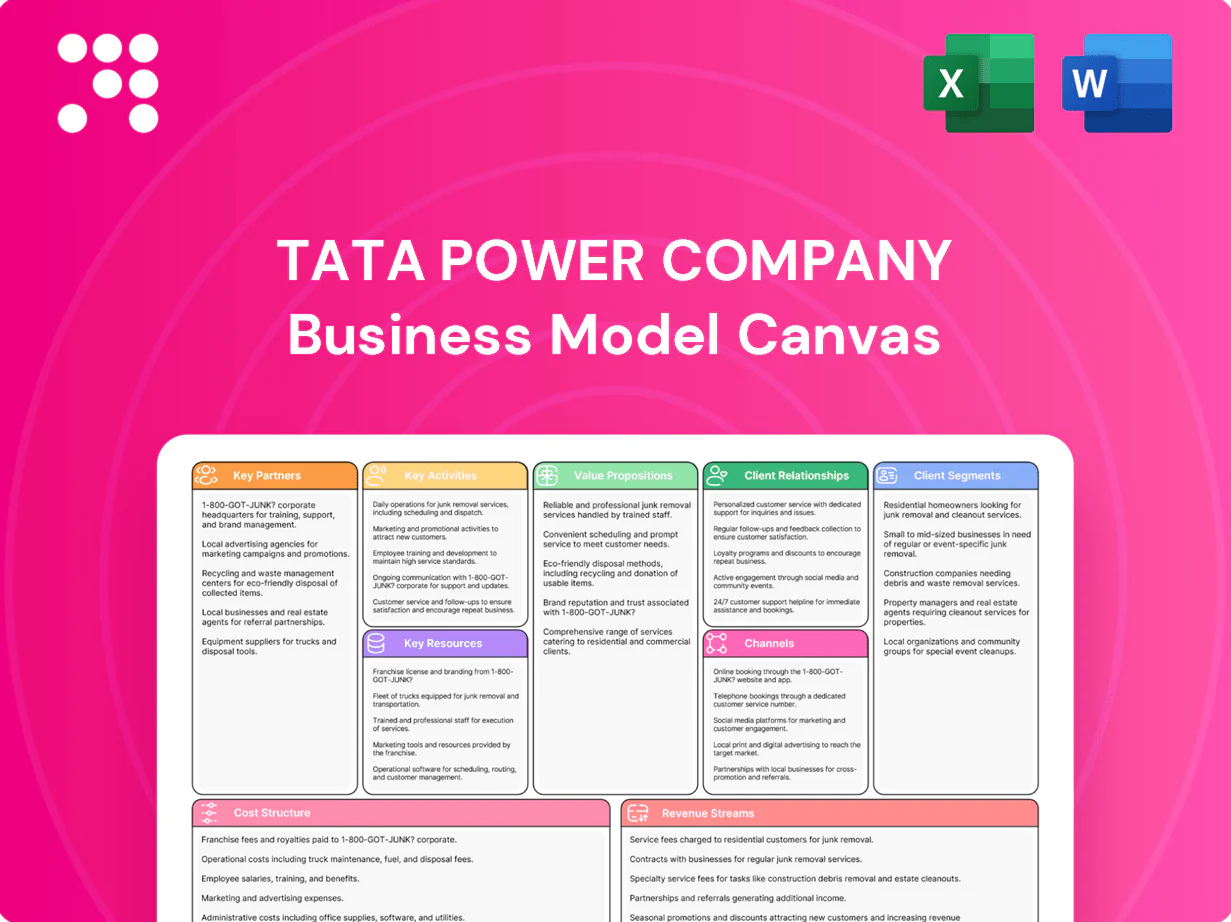
Tata Power Company Business Model Canvas

Strategic Business Model Canvas: Energy Company Growth Levers & Revenue Blueprint
Unlock the full strategic blueprint behind Tata Power Company with our Business Model Canvas that maps value propositions, customer segments, channels, and revenue streams. This concise, actionable snapshot reveals growth levers and competitive advantages. Ideal for investors, consultants, and founders. Purchase the complete, editable Canvas to apply these insights directly.
Partnerships

Government and regulators
Collaborations with central and state bodies secure licensing, tariff approvals and grid access, supporting Tata Power’s over 11 GW renewable portfolio (2024) and large-scale distribution operations. Policy alignment unlocks incentives for renewables and manufacturing, aiding project viability and capex planning. Active regulatory engagement reduces compliance risk and stabilizes returns, while strategic MoUs expedite permits and land acquisition.
Fuel and resource suppliers
Tata Power secures baseload reliability through coal, gas and biomass linkages across its roughly 13 GW consolidated generation portfolio. Long-term fuel contracts and logistics partners mitigate price and supply volatility via multi-year offtake and rail/port arrangements. Water rights and land banks are coordinated with local authorities, and supplier diversification across domestic and imported fuels strengthens energy security.

OEMs, EPCs, and technology firms
Partnerships with turbine, boiler, inverter, and battery OEMs lift plant efficiency and uptime, reducing forced outages and O&M costs for Tata Power while supporting rapid asset scale-up aligned with India’s 500 GW non-fossil capacity target by 2030. EPC alliances accelerate project execution and capex control, shortening build cycles for utility-scale and distributed projects. Digital partners deliver smart metering, SCADA, and analytics; innovation tie-ups advance storage, green hydrogen, and hybrid plants.

DISCOMs and large offtakers
DISCOMs and large offtakers anchor Tata Power via long-term PPAs that underpin predictable cash flows; Tata Power's renewable portfolio exceeded 4 GW by 2024, strengthening PPA-backed revenue. Open access and group captive deals deepen C&I penetration, while joint loss-reduction and grid-modernization programs align incentives and reduce system costs. Co-designed tariffs enable demand response and faster green uptake.
- PPAs: predictable cash flows, debt service security
- Open access/group captive: higher C&I share, scale-up
- Joint programs: AT&C loss reduction, improved reliability
- Tariff co-design: demand response, green adoption
Banks, DFIs, and capital markets
Long-tenor project finance and green bonds lower Tata Power’s blended WACC, enabling competitive tariffs; DFIs such as ADB, KfW and JICA continued 2024 support for large renewable and transmission builds. Hedging counterparties manage interest-rate and commodity exposure, while equity partners fund platform scaling and M&A.
- DFIs: ADB, KfW, JICA (2024 support)
- Green bonds: reduce WACC
- Hedging counterparties: rate/commodity risk
- Equity partners: scaling & M&A
Partnerships lock permits, PPAs and DFI finance for ~13 GW gen and >11 GW renewables
Strategic ties with central/state agencies, DISCOMs, OEMs, DFIs and fuel/logistics partners secure permits, PPAs and supply for Tata Power’s ~13 GW consolidated generation and >11 GW renewables (2024), stabilizing cashflows and lowering WACC. EPC, tech and storage partners accelerate scale-up toward India’s 500 GW non-fossil goal; DFIs (ADB, KfW, JICA) backed 2024 projects.
| Partner | Role | 2024 metric |
|---|---|---|
| DISCOMs/PPAs | Revenue security | ~4 GW PPA-backed renewables |
| DFIs | Finance | ADB/KfW/JICA support 2024 |
What is included in the product
 Detailed Word Document
A concise, investor-ready Business Model Canvas for Tata Power covering customer segments, channels, value propositions, key resources, partners, activities, cost structure, and revenue streams, reflecting real-world operations, competitive advantages, SWOT-linked insights, and strategic growth levers for presentations and decision-making.

 Customizable Excel Spreadsheet
High-level view of Tata Power’s business model with editable cells — quickly identify how integrated generation, renewables, distribution and customer solutions relieve operational and regulatory pain points.
Activities

Power generation O&M
In 2024 Tata Power operates thermal, hydro, solar and wind fleets to maximize availability and efficiency, using predictive maintenance and outage planning to cut forced outages. Operations focus on optimizing heat rate, plant load factor and auxiliary consumption while enforcing strict safety and ESG standards. Emissions control aligns with the company’s net-zero by 2045 commitment.
Grid and distribution operations
Maintain transmission and distribution assets to keep AT&C losses low (Mumbai franchise ~9% in 2024), roll out smart meters (over 1 million deployed by 2024) and automation to improve collections, manage load forecasting and outage restoration (average restoration targets ~45 minutes) and coordinate continuously with system operators to ensure grid stability and frequency control.

Renewable project development
Originate, bid, finance and construct utility-scale solar and wind projects, targeting 10 GW renewables capacity by 2025 through competitive auctions and captive deals. Secure land, permits and interconnection on tight timelines to meet commissioning schedules and avoid curtailment. Structure long-term PPAs and open‑access or captive models with typical tenors of 15–25 years. Integrate storage and hybridization to boost capacity factors, with utility battery costs near $120/kWh in 2024.

Energy trading and portfolio mgmt
Energy trading and portfolio management optimizes dispatch across markets and contracts to maximize margin, hedges fuel, price and imbalance risks through derivatives and bilateral covers, trades on exchanges and OTC routes for spread capture, and balances renewable variability using flexible thermal, gas and storage assets to maintain system reliability.
- Optimize dispatch
- Hedge fuel/price/imbalance
- Exchange & bilateral trading
- Balance renewables with flexible assets
EV charging and solar manufacturing
Tata Power deploys and operates public and fleet EV charging networks with thousands of chargers nationwide (2024), while Tata Power Solar manufactures solar cells and modules to secure supply and lower costs. The company provides software, payments and roaming services for seamless EV use and integrates EV products with utility offerings to cross-sell energy and grid services.
- EV charging: thousands of chargers (2024)
- Solar manufacturing: integrated cells & modules via Tata Power Solar
- Software & payments: roaming and billing platforms
- Integration: cross-sell with utility tariffs and grid services
Integrated utility: over 1M smart meters, 10 GW by 2025, net-zero 2045
In 2024 Tata Power runs thermal, hydro, solar and wind fleets with predictive maintenance to cut outages and pursue net-zero by 2045. It maintains T&D (Mumbai AT&C ~9%), >1M smart meters and ~45 min restoration targets while stabilizing the grid. It targets 10 GW renewables by 2025, integrates storage (utility batteries ~$120/kWh in 2024) and operates thousands of EV chargers nationwide.
| Metric | 2024 |
|---|---|
| Mumbai AT&C losses | ~9% |
| Smart meters deployed | >1,000,000 |
| Renewables target | 10 GW by 2025 |
| Utility battery cost | ~$120/kWh |
| EV chargers | Thousands |
Preview Before You Purchase
Business Model Canvas
The Tata Power Business Model Canvas shown here is the exact document you’ll receive after purchase, not a mockup. It contains the full strategic layout—value propositions, key partners, revenue streams and cost structure—formatted and ready to use. Upon payment you’ll download this identical file in editable Word and Excel formats.

Strategic Business Model Canvas: Energy Company Growth Levers & Revenue Blueprint
Unlock the full strategic blueprint behind Tata Power Company with our Business Model Canvas that maps value propositions, customer segments, channels, and revenue streams. This concise, actionable snapshot reveals growth levers and competitive advantages. Ideal for investors, consultants, and founders. Purchase the complete, editable Canvas to apply these insights directly.
Partnerships
Government and regulators
Collaborations with central and state bodies secure licensing, tariff approvals and grid access, supporting Tata Power’s over 11 GW renewable portfolio (2024) and large-scale distribution operations. Policy alignment unlocks incentives for renewables and manufacturing, aiding project viability and capex planning. Active regulatory engagement reduces compliance risk and stabilizes returns, while strategic MoUs expedite permits and land acquisition.
Fuel and resource suppliers
Tata Power secures baseload reliability through coal, gas and biomass linkages across its roughly 13 GW consolidated generation portfolio. Long-term fuel contracts and logistics partners mitigate price and supply volatility via multi-year offtake and rail/port arrangements. Water rights and land banks are coordinated with local authorities, and supplier diversification across domestic and imported fuels strengthens energy security.
OEMs, EPCs, and technology firms
Partnerships with turbine, boiler, inverter, and battery OEMs lift plant efficiency and uptime, reducing forced outages and O&M costs for Tata Power while supporting rapid asset scale-up aligned with India’s 500 GW non-fossil capacity target by 2030. EPC alliances accelerate project execution and capex control, shortening build cycles for utility-scale and distributed projects. Digital partners deliver smart metering, SCADA, and analytics; innovation tie-ups advance storage, green hydrogen, and hybrid plants.
DISCOMs and large offtakers
DISCOMs and large offtakers anchor Tata Power via long-term PPAs that underpin predictable cash flows; Tata Power's renewable portfolio exceeded 4 GW by 2024, strengthening PPA-backed revenue. Open access and group captive deals deepen C&I penetration, while joint loss-reduction and grid-modernization programs align incentives and reduce system costs. Co-designed tariffs enable demand response and faster green uptake.
- PPAs: predictable cash flows, debt service security
- Open access/group captive: higher C&I share, scale-up
- Joint programs: AT&C loss reduction, improved reliability
- Tariff co-design: demand response, green adoption
Banks, DFIs, and capital markets
Long-tenor project finance and green bonds lower Tata Power’s blended WACC, enabling competitive tariffs; DFIs such as ADB, KfW and JICA continued 2024 support for large renewable and transmission builds. Hedging counterparties manage interest-rate and commodity exposure, while equity partners fund platform scaling and M&A.
- DFIs: ADB, KfW, JICA (2024 support)
- Green bonds: reduce WACC
- Hedging counterparties: rate/commodity risk
- Equity partners: scaling & M&A
Partnerships lock permits, PPAs and DFI finance for ~13 GW gen and >11 GW renewables
Strategic ties with central/state agencies, DISCOMs, OEMs, DFIs and fuel/logistics partners secure permits, PPAs and supply for Tata Power’s ~13 GW consolidated generation and >11 GW renewables (2024), stabilizing cashflows and lowering WACC. EPC, tech and storage partners accelerate scale-up toward India’s 500 GW non-fossil goal; DFIs (ADB, KfW, JICA) backed 2024 projects.
| Partner | Role | 2024 metric |
|---|---|---|
| DISCOMs/PPAs | Revenue security | ~4 GW PPA-backed renewables |
| DFIs | Finance | ADB/KfW/JICA support 2024 |
What is included in the product
Detailed Word Document
A concise, investor-ready Business Model Canvas for Tata Power covering customer segments, channels, value propositions, key resources, partners, activities, cost structure, and revenue streams, reflecting real-world operations, competitive advantages, SWOT-linked insights, and strategic growth levers for presentations and decision-making.
Customizable Excel Spreadsheet
High-level view of Tata Power’s business model with editable cells — quickly identify how integrated generation, renewables, distribution and customer solutions relieve operational and regulatory pain points.
Activities
Power generation O&M
In 2024 Tata Power operates thermal, hydro, solar and wind fleets to maximize availability and efficiency, using predictive maintenance and outage planning to cut forced outages. Operations focus on optimizing heat rate, plant load factor and auxiliary consumption while enforcing strict safety and ESG standards. Emissions control aligns with the company’s net-zero by 2045 commitment.
Grid and distribution operations
Maintain transmission and distribution assets to keep AT&C losses low (Mumbai franchise ~9% in 2024), roll out smart meters (over 1 million deployed by 2024) and automation to improve collections, manage load forecasting and outage restoration (average restoration targets ~45 minutes) and coordinate continuously with system operators to ensure grid stability and frequency control.
Renewable project development
Originate, bid, finance and construct utility-scale solar and wind projects, targeting 10 GW renewables capacity by 2025 through competitive auctions and captive deals. Secure land, permits and interconnection on tight timelines to meet commissioning schedules and avoid curtailment. Structure long-term PPAs and open‑access or captive models with typical tenors of 15–25 years. Integrate storage and hybridization to boost capacity factors, with utility battery costs near $120/kWh in 2024.
Energy trading and portfolio mgmt
Energy trading and portfolio management optimizes dispatch across markets and contracts to maximize margin, hedges fuel, price and imbalance risks through derivatives and bilateral covers, trades on exchanges and OTC routes for spread capture, and balances renewable variability using flexible thermal, gas and storage assets to maintain system reliability.
- Optimize dispatch
- Hedge fuel/price/imbalance
- Exchange & bilateral trading
- Balance renewables with flexible assets
EV charging and solar manufacturing
Tata Power deploys and operates public and fleet EV charging networks with thousands of chargers nationwide (2024), while Tata Power Solar manufactures solar cells and modules to secure supply and lower costs. The company provides software, payments and roaming services for seamless EV use and integrates EV products with utility offerings to cross-sell energy and grid services.
- EV charging: thousands of chargers (2024)
- Solar manufacturing: integrated cells & modules via Tata Power Solar
- Software & payments: roaming and billing platforms
- Integration: cross-sell with utility tariffs and grid services
Integrated utility: over 1M smart meters, 10 GW by 2025, net-zero 2045
In 2024 Tata Power runs thermal, hydro, solar and wind fleets with predictive maintenance to cut outages and pursue net-zero by 2045. It maintains T&D (Mumbai AT&C ~9%), >1M smart meters and ~45 min restoration targets while stabilizing the grid. It targets 10 GW renewables by 2025, integrates storage (utility batteries ~$120/kWh in 2024) and operates thousands of EV chargers nationwide.
| Metric | 2024 |
|---|---|
| Mumbai AT&C losses | ~9% |
| Smart meters deployed | >1,000,000 |
| Renewables target | 10 GW by 2025 |
| Utility battery cost | ~$120/kWh |
| EV chargers | Thousands |
Preview Before You Purchase
Business Model Canvas
The Tata Power Business Model Canvas shown here is the exact document you’ll receive after purchase, not a mockup. It contains the full strategic layout—value propositions, key partners, revenue streams and cost structure—formatted and ready to use. Upon payment you’ll download this identical file in editable Word and Excel formats.
Description
Strategic Business Model Canvas: Energy Company Growth Levers & Revenue Blueprint
Unlock the full strategic blueprint behind Tata Power Company with our Business Model Canvas that maps value propositions, customer segments, channels, and revenue streams. This concise, actionable snapshot reveals growth levers and competitive advantages. Ideal for investors, consultants, and founders. Purchase the complete, editable Canvas to apply these insights directly.
Partnerships
Government and regulators
Collaborations with central and state bodies secure licensing, tariff approvals and grid access, supporting Tata Power’s over 11 GW renewable portfolio (2024) and large-scale distribution operations. Policy alignment unlocks incentives for renewables and manufacturing, aiding project viability and capex planning. Active regulatory engagement reduces compliance risk and stabilizes returns, while strategic MoUs expedite permits and land acquisition.
Fuel and resource suppliers
Tata Power secures baseload reliability through coal, gas and biomass linkages across its roughly 13 GW consolidated generation portfolio. Long-term fuel contracts and logistics partners mitigate price and supply volatility via multi-year offtake and rail/port arrangements. Water rights and land banks are coordinated with local authorities, and supplier diversification across domestic and imported fuels strengthens energy security.
OEMs, EPCs, and technology firms
Partnerships with turbine, boiler, inverter, and battery OEMs lift plant efficiency and uptime, reducing forced outages and O&M costs for Tata Power while supporting rapid asset scale-up aligned with India’s 500 GW non-fossil capacity target by 2030. EPC alliances accelerate project execution and capex control, shortening build cycles for utility-scale and distributed projects. Digital partners deliver smart metering, SCADA, and analytics; innovation tie-ups advance storage, green hydrogen, and hybrid plants.
DISCOMs and large offtakers
DISCOMs and large offtakers anchor Tata Power via long-term PPAs that underpin predictable cash flows; Tata Power's renewable portfolio exceeded 4 GW by 2024, strengthening PPA-backed revenue. Open access and group captive deals deepen C&I penetration, while joint loss-reduction and grid-modernization programs align incentives and reduce system costs. Co-designed tariffs enable demand response and faster green uptake.
- PPAs: predictable cash flows, debt service security
- Open access/group captive: higher C&I share, scale-up
- Joint programs: AT&C loss reduction, improved reliability
- Tariff co-design: demand response, green adoption
Banks, DFIs, and capital markets
Long-tenor project finance and green bonds lower Tata Power’s blended WACC, enabling competitive tariffs; DFIs such as ADB, KfW and JICA continued 2024 support for large renewable and transmission builds. Hedging counterparties manage interest-rate and commodity exposure, while equity partners fund platform scaling and M&A.
- DFIs: ADB, KfW, JICA (2024 support)
- Green bonds: reduce WACC
- Hedging counterparties: rate/commodity risk
- Equity partners: scaling & M&A
Partnerships lock permits, PPAs and DFI finance for ~13 GW gen and >11 GW renewables
Strategic ties with central/state agencies, DISCOMs, OEMs, DFIs and fuel/logistics partners secure permits, PPAs and supply for Tata Power’s ~13 GW consolidated generation and >11 GW renewables (2024), stabilizing cashflows and lowering WACC. EPC, tech and storage partners accelerate scale-up toward India’s 500 GW non-fossil goal; DFIs (ADB, KfW, JICA) backed 2024 projects.
| Partner | Role | 2024 metric |
|---|---|---|
| DISCOMs/PPAs | Revenue security | ~4 GW PPA-backed renewables |
| DFIs | Finance | ADB/KfW/JICA support 2024 |
What is included in the product
Detailed Word Document
A concise, investor-ready Business Model Canvas for Tata Power covering customer segments, channels, value propositions, key resources, partners, activities, cost structure, and revenue streams, reflecting real-world operations, competitive advantages, SWOT-linked insights, and strategic growth levers for presentations and decision-making.
Customizable Excel Spreadsheet
High-level view of Tata Power’s business model with editable cells — quickly identify how integrated generation, renewables, distribution and customer solutions relieve operational and regulatory pain points.
Activities
Power generation O&M
In 2024 Tata Power operates thermal, hydro, solar and wind fleets to maximize availability and efficiency, using predictive maintenance and outage planning to cut forced outages. Operations focus on optimizing heat rate, plant load factor and auxiliary consumption while enforcing strict safety and ESG standards. Emissions control aligns with the company’s net-zero by 2045 commitment.
Grid and distribution operations
Maintain transmission and distribution assets to keep AT&C losses low (Mumbai franchise ~9% in 2024), roll out smart meters (over 1 million deployed by 2024) and automation to improve collections, manage load forecasting and outage restoration (average restoration targets ~45 minutes) and coordinate continuously with system operators to ensure grid stability and frequency control.
Renewable project development
Originate, bid, finance and construct utility-scale solar and wind projects, targeting 10 GW renewables capacity by 2025 through competitive auctions and captive deals. Secure land, permits and interconnection on tight timelines to meet commissioning schedules and avoid curtailment. Structure long-term PPAs and open‑access or captive models with typical tenors of 15–25 years. Integrate storage and hybridization to boost capacity factors, with utility battery costs near $120/kWh in 2024.
Energy trading and portfolio mgmt
Energy trading and portfolio management optimizes dispatch across markets and contracts to maximize margin, hedges fuel, price and imbalance risks through derivatives and bilateral covers, trades on exchanges and OTC routes for spread capture, and balances renewable variability using flexible thermal, gas and storage assets to maintain system reliability.
- Optimize dispatch
- Hedge fuel/price/imbalance
- Exchange & bilateral trading
- Balance renewables with flexible assets
EV charging and solar manufacturing
Tata Power deploys and operates public and fleet EV charging networks with thousands of chargers nationwide (2024), while Tata Power Solar manufactures solar cells and modules to secure supply and lower costs. The company provides software, payments and roaming services for seamless EV use and integrates EV products with utility offerings to cross-sell energy and grid services.
- EV charging: thousands of chargers (2024)
- Solar manufacturing: integrated cells & modules via Tata Power Solar
- Software & payments: roaming and billing platforms
- Integration: cross-sell with utility tariffs and grid services
Integrated utility: over 1M smart meters, 10 GW by 2025, net-zero 2045
In 2024 Tata Power runs thermal, hydro, solar and wind fleets with predictive maintenance to cut outages and pursue net-zero by 2045. It maintains T&D (Mumbai AT&C ~9%), >1M smart meters and ~45 min restoration targets while stabilizing the grid. It targets 10 GW renewables by 2025, integrates storage (utility batteries ~$120/kWh in 2024) and operates thousands of EV chargers nationwide.
| Metric | 2024 |
|---|---|
| Mumbai AT&C losses | ~9% |
| Smart meters deployed | >1,000,000 |
| Renewables target | 10 GW by 2025 |
| Utility battery cost | ~$120/kWh |
| EV chargers | Thousands |
Preview Before You Purchase
Business Model Canvas
The Tata Power Business Model Canvas shown here is the exact document you’ll receive after purchase, not a mockup. It contains the full strategic layout—value propositions, key partners, revenue streams and cost structure—formatted and ready to use. Upon payment you’ll download this identical file in editable Word and Excel formats.











