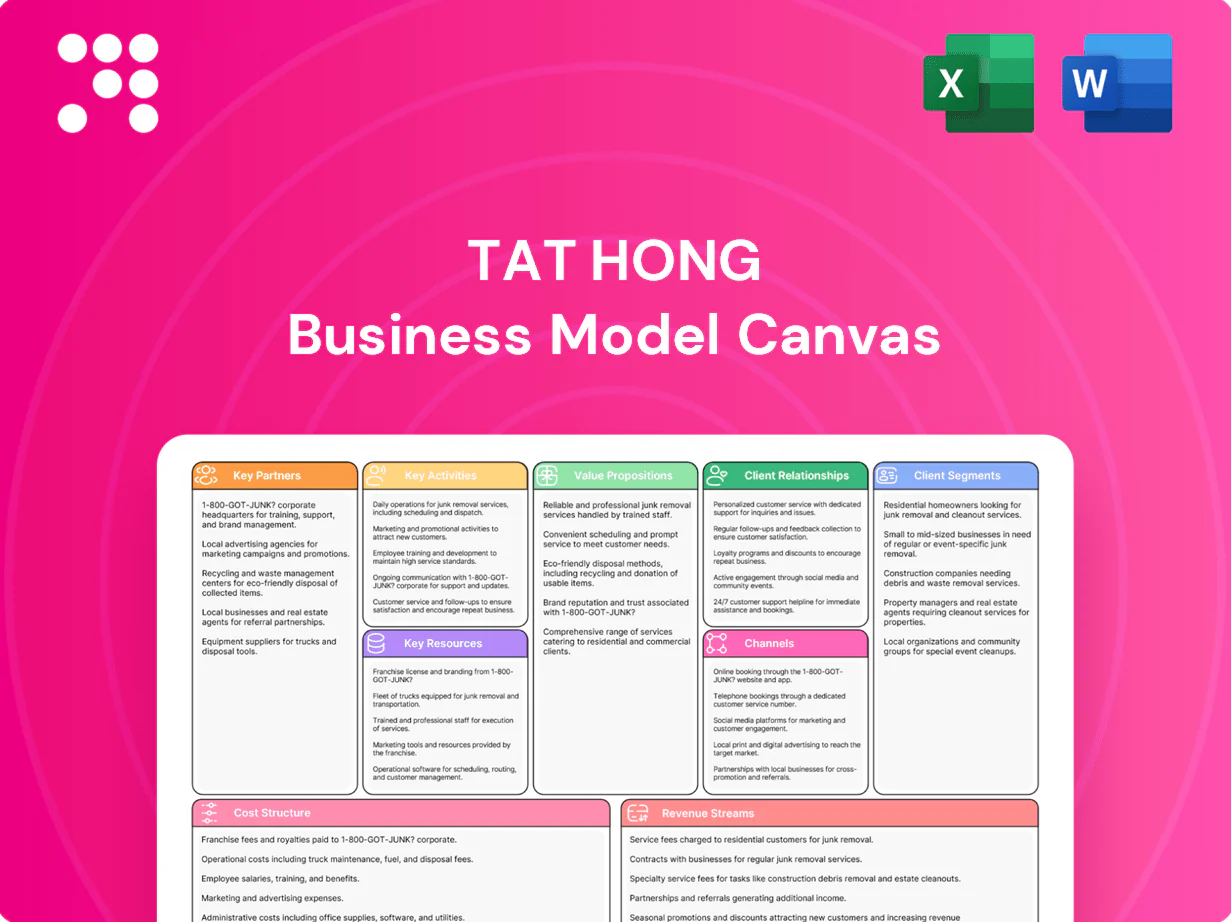
Tat Hong Business Model Canvas

Business Model Canvas: equipment-services leader — value, partners, revenue streams
Unlock the strategic blueprint behind Tat Hong with our Business Model Canvas, showing how the company creates value and scales in a competitive equipment-services market. It maps value propositions, customer segments, key partners, revenue streams and cost drivers in a clear, actionable format. Purchase the full downloadable Canvas (Word & Excel) to benchmark, plan strategically, and prepare investor-grade analysis.
Partnerships

OEM crane manufacturers
Partnering with OEMs such as Liebherr and Manitowoc secures supply chains, manufacturer warranties and technical bulletins to maximize uptime, leveraging Tat Hong’s 55-year industry presence (founded 1969). Joint R&D and retrofit programs with OEMs keep the fleet compliant and efficient, shortening upgrade cycles and meeting 2024 emissions and safety standards. Priority parts availability and service agreements cut turnaround time, while co-marketing with OEMs strengthens credibility in large bids.
EPCs and prime contractors
Framework agreements with EPCs create predictable demand and early project visibility, enabling Tat Hong to schedule assets and reduce idle time; the global construction equipment rental market reached about USD 71.2 billion in 2024, underpinning steady sector demand. Collaborative planning aligns lifting scopes and site logistics, lowering mobilization costs and safety risks. Preferred-vendor status streamlines tendering and mobilization, while feedback loops with EPCs improve execution standards and uptime.

Heavy transport and rigging specialists
Alliances with heavy transport and rigging specialists enable Tat Hong to offer end-to-end heavy lift and haul solutions, integrating cranes, trailers and engineering in single contracts to meet 2024 project demands. Shared equipment and crews optimize mobilization for complex moves, reducing handover points and improving fleet utilization. Coordinated permits and route surveys lower regulatory and transit risks, while joint execution enhances safety performance and schedule certainty.

Financial institutions and insurers
Financial institutions provide capex financing that enables fleet renewal and scaling, while insurers craft policies for high-tonnage lifts and cross-border projects. Joint risk-engineering programs reduce incidents, improve safety protocols and can lower premiums. Structured lease solutions align cash flows with equipment utilization, supporting predictable operating leverage.
- capex financing supports fleet renewal
- insurance for high-tonnage & international work
- risk engineering lowers incidents & premiums
- structured leases align cash flow with utilization
Technology, telematics, and HSE partners
Technology, telematics, and HSE partners enable Tat Hong to track assets, deliver utilization analytics and support predictive maintenance while HSE consultants strengthen training and compliance with international safety standards; software partners digitize scheduling and documentation to streamline operations and reporting, and integrated systems increase transparency for clients.
- telemetrics: asset tracking & utilization
- predictive maintenance & downtime reduction
- HSE: training, compliance to global standards
- software: digital scheduling & documentation
- integrated systems: client transparency
Partnerships secure uptime, demand and safety in the USD 71.2B 2024 market
Key partnerships with OEMs, EPCs, transport specialists, financiers and tech/HSE firms secure supply, predictable demand, end-to-end execution and digitalized uptime—leveraging Tat Hong’s 55-year industry presence (founded 1969) and aligning with 2024 emissions/safety standards; the global construction equipment rental market reached about USD 71.2 billion in 2024.
| Partner | Benefit | 2024 metric |
|---|---|---|
| OEMs | Warranties & R&D | 55-year presence |
| Market | Demand visibility | USD 71.2B |
What is included in the product
 Detailed Word Document
A comprehensive Business Model Canvas for Tat Hong detailing customer segments, channels, value propositions and revenue streams across the 9 BMC blocks, with linked SWOT, competitive advantages and operational insights—designed for investor presentations, strategic planning and validation using real-company context.

 Customizable Excel Spreadsheet
Condenses Tat Hong’s equipment rental and services strategy into a digestible one-page snapshot with editable cells, saving hours on structuring business logic and enabling quick comparisons, board-ready summaries, and collaborative adaptation.
Activities

Fleet acquisition and lifecycle management
Select, procure, and standardize cranes across tonnage classes and applications to optimize utilization and reduce maintenance complexity for SGX-listed Tat Hong (ticker 5RU). Plan overhauls and replacements on established service cycles, with statutory inspections and certifications typically performed annually per jurisdictional requirements. Dispose of end-of-life assets through remarketing or recycling to free capital and sustain fleet efficiency.
Maintenance, repairs, and inspections
Execute preventive maintenance using OEM schedules and telematics-driven intervals, reducing downtime by about 25%; rapid field-service teams aim for sub-4-hour on-site response to critical faults. Maintain spare-parts stock covering roughly 95% of fast-moving SKUs to accelerate repairs and limit rental revenue loss. Log and retain inspection records for 7 years to meet regulatory and client audit requirements.

Project engineering and lift planning
Develop detailed method statements, rigging plans and ground pressure calculations to validate bearing capacity and lift loads; designs reference ISO 9001 quality systems and ASME B30 standards (ASME B30 current through 2024). Coordinate with site teams to sequence lifts, identify constraints and mitigate clashes. Use CAD and dynamic simulation to validate feasibility and safety before mobilization. Secure permits from local authorities and ensure regulatory compliance.

Mobilization, logistics, and site assembly
Plan transport with route surveys and standardized crane disassembly/assembly sequences to cut transit delays; coordinate escorts, staging and engineered crane pads to meet 2024 regulatory and safety benchmarks, optimizing fleet deployment to lift utilization and revenue per asset while de-mobilizing rapidly to minimize idle time.
Sales, tendering, and account management
Sales, tendering and account management at Tat Hong focus on qualifying opportunities and preparing competitive bids, negotiating commercial terms, SLAs and scope boundaries, managing customer relationships and forecasting the pipeline, and monitoring performance against contract KPIs; in 2024 typical SLA compliance targets are >=98% with weekly pipeline updates to support revenue visibility.
Standardize cranes to cut downtime ~25%, ensure sub-4-hr response and 95% parts coverage
Select, procure and standardize cranes to reduce maintenance complexity; ASME B30 current through 2024 guides designs. Preventive maintenance and telematics cut downtime ~25% with sub-4-hour critical response; spare parts cover ~95% fast-moving SKUs. Tendering targets SLA >=98% (2024) with weekly pipeline updates; end-of-life assets remarketed or recycled to free capital.
| Activity | KPI 2024 | Target |
|---|---|---|
| Maintenance | Downtime −25% | Sub-4-hr response |
| Parts | Coverage 95% | 95%+ |
| Contracts | SLA ≥98% | ≥98% |
Full Version Awaits
Business Model Canvas
The document you're previewing is the actual Tat Hong Business Model Canvas, not a mockup or sample. When you purchase, you'll receive this exact file—complete and ready to edit, present, or share. Formats include Word and Excel for immediate use. No surprises: what you see is what you'll download.

Business Model Canvas: equipment-services leader — value, partners, revenue streams
Unlock the strategic blueprint behind Tat Hong with our Business Model Canvas, showing how the company creates value and scales in a competitive equipment-services market. It maps value propositions, customer segments, key partners, revenue streams and cost drivers in a clear, actionable format. Purchase the full downloadable Canvas (Word & Excel) to benchmark, plan strategically, and prepare investor-grade analysis.
Partnerships
OEM crane manufacturers
Partnering with OEMs such as Liebherr and Manitowoc secures supply chains, manufacturer warranties and technical bulletins to maximize uptime, leveraging Tat Hong’s 55-year industry presence (founded 1969). Joint R&D and retrofit programs with OEMs keep the fleet compliant and efficient, shortening upgrade cycles and meeting 2024 emissions and safety standards. Priority parts availability and service agreements cut turnaround time, while co-marketing with OEMs strengthens credibility in large bids.
EPCs and prime contractors
Framework agreements with EPCs create predictable demand and early project visibility, enabling Tat Hong to schedule assets and reduce idle time; the global construction equipment rental market reached about USD 71.2 billion in 2024, underpinning steady sector demand. Collaborative planning aligns lifting scopes and site logistics, lowering mobilization costs and safety risks. Preferred-vendor status streamlines tendering and mobilization, while feedback loops with EPCs improve execution standards and uptime.
Heavy transport and rigging specialists
Alliances with heavy transport and rigging specialists enable Tat Hong to offer end-to-end heavy lift and haul solutions, integrating cranes, trailers and engineering in single contracts to meet 2024 project demands. Shared equipment and crews optimize mobilization for complex moves, reducing handover points and improving fleet utilization. Coordinated permits and route surveys lower regulatory and transit risks, while joint execution enhances safety performance and schedule certainty.
Financial institutions and insurers
Financial institutions provide capex financing that enables fleet renewal and scaling, while insurers craft policies for high-tonnage lifts and cross-border projects. Joint risk-engineering programs reduce incidents, improve safety protocols and can lower premiums. Structured lease solutions align cash flows with equipment utilization, supporting predictable operating leverage.
- capex financing supports fleet renewal
- insurance for high-tonnage & international work
- risk engineering lowers incidents & premiums
- structured leases align cash flow with utilization
Technology, telematics, and HSE partners
Technology, telematics, and HSE partners enable Tat Hong to track assets, deliver utilization analytics and support predictive maintenance while HSE consultants strengthen training and compliance with international safety standards; software partners digitize scheduling and documentation to streamline operations and reporting, and integrated systems increase transparency for clients.
- telemetrics: asset tracking & utilization
- predictive maintenance & downtime reduction
- HSE: training, compliance to global standards
- software: digital scheduling & documentation
- integrated systems: client transparency
Partnerships secure uptime, demand and safety in the USD 71.2B 2024 market
Key partnerships with OEMs, EPCs, transport specialists, financiers and tech/HSE firms secure supply, predictable demand, end-to-end execution and digitalized uptime—leveraging Tat Hong’s 55-year industry presence (founded 1969) and aligning with 2024 emissions/safety standards; the global construction equipment rental market reached about USD 71.2 billion in 2024.
| Partner | Benefit | 2024 metric |
|---|---|---|
| OEMs | Warranties & R&D | 55-year presence |
| Market | Demand visibility | USD 71.2B |
What is included in the product
Detailed Word Document
A comprehensive Business Model Canvas for Tat Hong detailing customer segments, channels, value propositions and revenue streams across the 9 BMC blocks, with linked SWOT, competitive advantages and operational insights—designed for investor presentations, strategic planning and validation using real-company context.
Customizable Excel Spreadsheet
Condenses Tat Hong’s equipment rental and services strategy into a digestible one-page snapshot with editable cells, saving hours on structuring business logic and enabling quick comparisons, board-ready summaries, and collaborative adaptation.
Activities
Fleet acquisition and lifecycle management
Select, procure, and standardize cranes across tonnage classes and applications to optimize utilization and reduce maintenance complexity for SGX-listed Tat Hong (ticker 5RU). Plan overhauls and replacements on established service cycles, with statutory inspections and certifications typically performed annually per jurisdictional requirements. Dispose of end-of-life assets through remarketing or recycling to free capital and sustain fleet efficiency.
Maintenance, repairs, and inspections
Execute preventive maintenance using OEM schedules and telematics-driven intervals, reducing downtime by about 25%; rapid field-service teams aim for sub-4-hour on-site response to critical faults. Maintain spare-parts stock covering roughly 95% of fast-moving SKUs to accelerate repairs and limit rental revenue loss. Log and retain inspection records for 7 years to meet regulatory and client audit requirements.
Project engineering and lift planning
Develop detailed method statements, rigging plans and ground pressure calculations to validate bearing capacity and lift loads; designs reference ISO 9001 quality systems and ASME B30 standards (ASME B30 current through 2024). Coordinate with site teams to sequence lifts, identify constraints and mitigate clashes. Use CAD and dynamic simulation to validate feasibility and safety before mobilization. Secure permits from local authorities and ensure regulatory compliance.
Mobilization, logistics, and site assembly
Plan transport with route surveys and standardized crane disassembly/assembly sequences to cut transit delays; coordinate escorts, staging and engineered crane pads to meet 2024 regulatory and safety benchmarks, optimizing fleet deployment to lift utilization and revenue per asset while de-mobilizing rapidly to minimize idle time.
Sales, tendering, and account management
Sales, tendering and account management at Tat Hong focus on qualifying opportunities and preparing competitive bids, negotiating commercial terms, SLAs and scope boundaries, managing customer relationships and forecasting the pipeline, and monitoring performance against contract KPIs; in 2024 typical SLA compliance targets are >=98% with weekly pipeline updates to support revenue visibility.
Standardize cranes to cut downtime ~25%, ensure sub-4-hr response and 95% parts coverage
Select, procure and standardize cranes to reduce maintenance complexity; ASME B30 current through 2024 guides designs. Preventive maintenance and telematics cut downtime ~25% with sub-4-hour critical response; spare parts cover ~95% fast-moving SKUs. Tendering targets SLA >=98% (2024) with weekly pipeline updates; end-of-life assets remarketed or recycled to free capital.
| Activity | KPI 2024 | Target |
|---|---|---|
| Maintenance | Downtime −25% | Sub-4-hr response |
| Parts | Coverage 95% | 95%+ |
| Contracts | SLA ≥98% | ≥98% |
Full Version Awaits
Business Model Canvas
The document you're previewing is the actual Tat Hong Business Model Canvas, not a mockup or sample. When you purchase, you'll receive this exact file—complete and ready to edit, present, or share. Formats include Word and Excel for immediate use. No surprises: what you see is what you'll download.
Original: $10.00
-65%$10.00
$3.50Description
Business Model Canvas: equipment-services leader — value, partners, revenue streams
Unlock the strategic blueprint behind Tat Hong with our Business Model Canvas, showing how the company creates value and scales in a competitive equipment-services market. It maps value propositions, customer segments, key partners, revenue streams and cost drivers in a clear, actionable format. Purchase the full downloadable Canvas (Word & Excel) to benchmark, plan strategically, and prepare investor-grade analysis.
Partnerships
OEM crane manufacturers
Partnering with OEMs such as Liebherr and Manitowoc secures supply chains, manufacturer warranties and technical bulletins to maximize uptime, leveraging Tat Hong’s 55-year industry presence (founded 1969). Joint R&D and retrofit programs with OEMs keep the fleet compliant and efficient, shortening upgrade cycles and meeting 2024 emissions and safety standards. Priority parts availability and service agreements cut turnaround time, while co-marketing with OEMs strengthens credibility in large bids.
EPCs and prime contractors
Framework agreements with EPCs create predictable demand and early project visibility, enabling Tat Hong to schedule assets and reduce idle time; the global construction equipment rental market reached about USD 71.2 billion in 2024, underpinning steady sector demand. Collaborative planning aligns lifting scopes and site logistics, lowering mobilization costs and safety risks. Preferred-vendor status streamlines tendering and mobilization, while feedback loops with EPCs improve execution standards and uptime.
Heavy transport and rigging specialists
Alliances with heavy transport and rigging specialists enable Tat Hong to offer end-to-end heavy lift and haul solutions, integrating cranes, trailers and engineering in single contracts to meet 2024 project demands. Shared equipment and crews optimize mobilization for complex moves, reducing handover points and improving fleet utilization. Coordinated permits and route surveys lower regulatory and transit risks, while joint execution enhances safety performance and schedule certainty.
Financial institutions and insurers
Financial institutions provide capex financing that enables fleet renewal and scaling, while insurers craft policies for high-tonnage lifts and cross-border projects. Joint risk-engineering programs reduce incidents, improve safety protocols and can lower premiums. Structured lease solutions align cash flows with equipment utilization, supporting predictable operating leverage.
- capex financing supports fleet renewal
- insurance for high-tonnage & international work
- risk engineering lowers incidents & premiums
- structured leases align cash flow with utilization
Technology, telematics, and HSE partners
Technology, telematics, and HSE partners enable Tat Hong to track assets, deliver utilization analytics and support predictive maintenance while HSE consultants strengthen training and compliance with international safety standards; software partners digitize scheduling and documentation to streamline operations and reporting, and integrated systems increase transparency for clients.
- telemetrics: asset tracking & utilization
- predictive maintenance & downtime reduction
- HSE: training, compliance to global standards
- software: digital scheduling & documentation
- integrated systems: client transparency
Partnerships secure uptime, demand and safety in the USD 71.2B 2024 market
Key partnerships with OEMs, EPCs, transport specialists, financiers and tech/HSE firms secure supply, predictable demand, end-to-end execution and digitalized uptime—leveraging Tat Hong’s 55-year industry presence (founded 1969) and aligning with 2024 emissions/safety standards; the global construction equipment rental market reached about USD 71.2 billion in 2024.
| Partner | Benefit | 2024 metric |
|---|---|---|
| OEMs | Warranties & R&D | 55-year presence |
| Market | Demand visibility | USD 71.2B |
What is included in the product
Detailed Word Document
A comprehensive Business Model Canvas for Tat Hong detailing customer segments, channels, value propositions and revenue streams across the 9 BMC blocks, with linked SWOT, competitive advantages and operational insights—designed for investor presentations, strategic planning and validation using real-company context.
Customizable Excel Spreadsheet
Condenses Tat Hong’s equipment rental and services strategy into a digestible one-page snapshot with editable cells, saving hours on structuring business logic and enabling quick comparisons, board-ready summaries, and collaborative adaptation.
Activities
Fleet acquisition and lifecycle management
Select, procure, and standardize cranes across tonnage classes and applications to optimize utilization and reduce maintenance complexity for SGX-listed Tat Hong (ticker 5RU). Plan overhauls and replacements on established service cycles, with statutory inspections and certifications typically performed annually per jurisdictional requirements. Dispose of end-of-life assets through remarketing or recycling to free capital and sustain fleet efficiency.
Maintenance, repairs, and inspections
Execute preventive maintenance using OEM schedules and telematics-driven intervals, reducing downtime by about 25%; rapid field-service teams aim for sub-4-hour on-site response to critical faults. Maintain spare-parts stock covering roughly 95% of fast-moving SKUs to accelerate repairs and limit rental revenue loss. Log and retain inspection records for 7 years to meet regulatory and client audit requirements.
Project engineering and lift planning
Develop detailed method statements, rigging plans and ground pressure calculations to validate bearing capacity and lift loads; designs reference ISO 9001 quality systems and ASME B30 standards (ASME B30 current through 2024). Coordinate with site teams to sequence lifts, identify constraints and mitigate clashes. Use CAD and dynamic simulation to validate feasibility and safety before mobilization. Secure permits from local authorities and ensure regulatory compliance.
Mobilization, logistics, and site assembly
Plan transport with route surveys and standardized crane disassembly/assembly sequences to cut transit delays; coordinate escorts, staging and engineered crane pads to meet 2024 regulatory and safety benchmarks, optimizing fleet deployment to lift utilization and revenue per asset while de-mobilizing rapidly to minimize idle time.
Sales, tendering, and account management
Sales, tendering and account management at Tat Hong focus on qualifying opportunities and preparing competitive bids, negotiating commercial terms, SLAs and scope boundaries, managing customer relationships and forecasting the pipeline, and monitoring performance against contract KPIs; in 2024 typical SLA compliance targets are >=98% with weekly pipeline updates to support revenue visibility.
Standardize cranes to cut downtime ~25%, ensure sub-4-hr response and 95% parts coverage
Select, procure and standardize cranes to reduce maintenance complexity; ASME B30 current through 2024 guides designs. Preventive maintenance and telematics cut downtime ~25% with sub-4-hour critical response; spare parts cover ~95% fast-moving SKUs. Tendering targets SLA >=98% (2024) with weekly pipeline updates; end-of-life assets remarketed or recycled to free capital.
| Activity | KPI 2024 | Target |
|---|---|---|
| Maintenance | Downtime −25% | Sub-4-hr response |
| Parts | Coverage 95% | 95%+ |
| Contracts | SLA ≥98% | ≥98% |
Full Version Awaits
Business Model Canvas
The document you're previewing is the actual Tat Hong Business Model Canvas, not a mockup or sample. When you purchase, you'll receive this exact file—complete and ready to edit, present, or share. Formats include Word and Excel for immediate use. No surprises: what you see is what you'll download.











