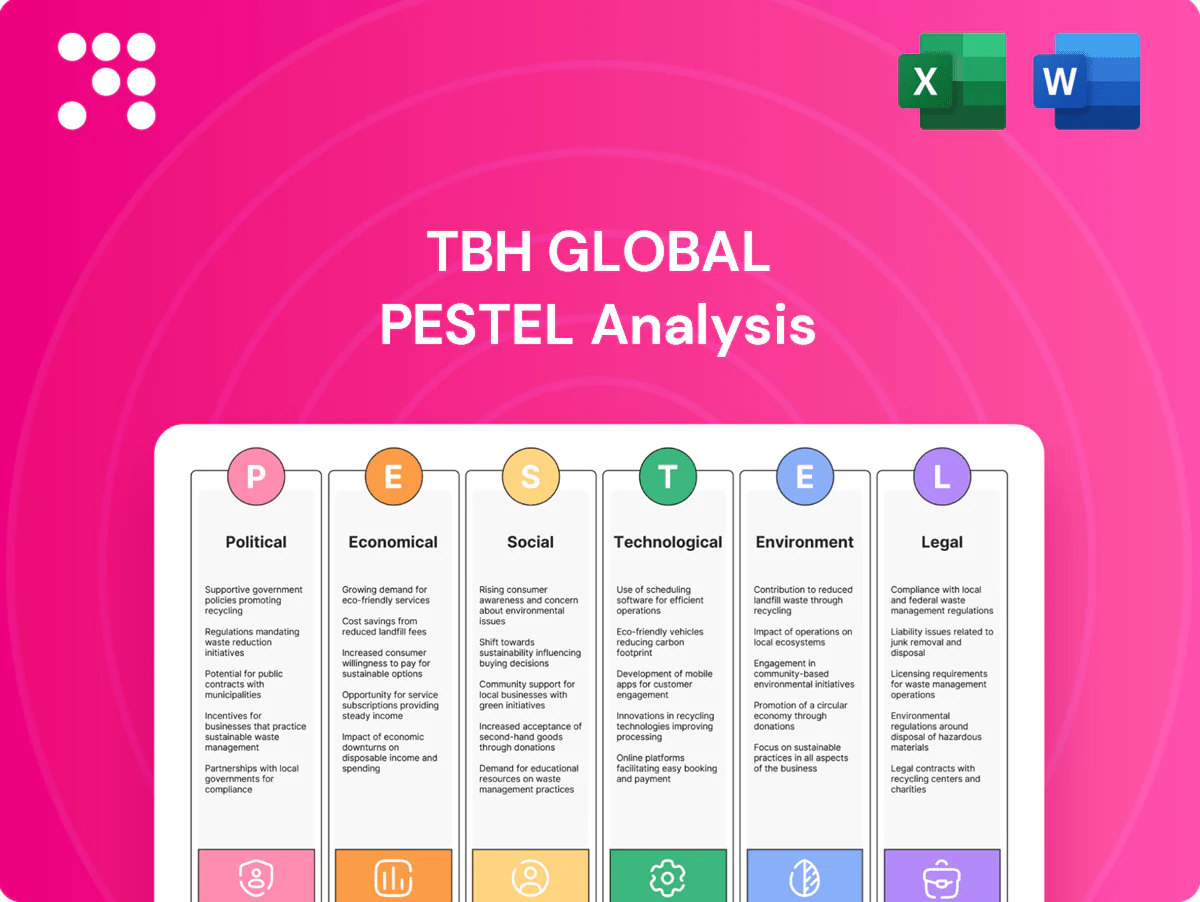
TBH Global PESTLE Analysis

Your Shortcut to Market Insight Starts Here
Unlock how political shifts, economic trends, and technological change are reshaping TBH Global with our concise PESTLE summary—designed to inform investors and strategists. Use these insights to spot risks and growth opportunities quickly. Purchase the full, editable PESTLE for the complete, actionable breakdown.
Political factors

Trade policy and RCEP
South Korea's participation in RCEP (in force since Jan 2022) reduces tariffs across the 15-member bloc covering roughly 30% of global GDP and 29% of trade, accelerating apparel export competitiveness and lowering input costs. TBH Global can reconfigure sourcing across RCEP countries for fabrics and trims to capture tariff cuts—RCEP targets elimination of tariffs on about 92% of goods. Harmonized rules of origin ease access to preferences, while vigilant monitoring of non-tariff barriers remains critical for smooth cross-border operations.
Geopolitical tensions
US–China rivalry (US–China goods trade ~690 billion USD in 2023) plus Korea–Japan frictions and frequent North Korea launches risk disrupting logistics and sentiment; US export controls on advanced chips were expanded in 2023–24, and sanctions/export controls can hit materials, machinery or platforms. Freight rerouting has been shown to raise costs by up to 25% and add 2–6 weeks to lead times, so TBH Global needs contingency sourcing and inventory buffers.

Industrial policy and incentives
Korean industrial policy—backed by record R&D intensity (~4.6% of GDP, highest in the OECD)—offers grants and export-promotion support that can offset TBH Global’s tech and market-entry costs; fashion-tech and SME branding programs are administered via the Ministry of SMEs and Startups and KOCCA. Infrastructure investments in local manufacturing clusters under the Korean New Deal have lowered capex for onshoring, while potential policy shifts could reallocate subsidies between sectors.

Public health and border controls
- Retail footfall drop: up to 60%
- Container rates spike: >300%
- Transit delays: +20–30%
- Mitigants: flexible production, omnichannel, diversified logistics, insurance
Trade compliance and sanctions
Evolving sanctions lists and tightened dual-use controls affect TBH Global materials sourcing, payments, and partner networks; regulatory actions in 2024 saw authorities levy roughly $1.2 billion in sanctions-related fines globally, underscoring seizure and fine risk for missteps. Strong screening, robust documentation, continuous staff training, and automated checks materially reduce exposure.
- Screen partners against updated lists daily
- Maintain chain-of-custody docs for all shipments
- Automate payment and export checks
- Quarterly staff training and audit logs
RCEP cuts (covers ~30% GDP) boost apparel; US-China risks supply shocks
RCEP (in force Jan 2022) opens tariff cuts across ~30% of global GDP and 29% of trade, aiding apparel exports and sourcing. Geopolitical tensions (US–China goods trade ~690bn USD in 2023) and sanctions risk supply shocks; 2024 sanctions fines ~1.2bn USD. Korea R&D ~4.6% of GDP supports tech subsidies; logistics shocks can raise container rates >300%.
| Metric | Value |
|---|---|
| RCEP coverage | ~30% GDP / 29% trade |
| US–China trade 2023 | ~690bn USD |
| Korea R&D | 4.6% GDP |
| Sanctions fines 2024 | ~1.2bn USD |
| Container spike | >300% |
What is included in the product
 Detailed Word Document
Explores how Political, Economic, Social, Technological, Environmental and Legal forces uniquely affect TBH Global, with data-backed trends, market/regulatory context and concrete sub-points; designed for executives and investors, delivered in clean, insert-ready format with forward-looking insights to inform strategy and funding decisions.

 Customizable Excel Spreadsheet
Visually segmented by PESTLE categories for quick interpretation, the TBH Global PESTLE Analysis streamlines meeting prep and supports focused discussions on external risks and market positioning.
Economic factors

KRW volatility
KRW volatility (roughly 1,300–1,400 KRW/USD across 2024–H1 2025 with annualized FX swings near 10%) raises import fabric costs and erodes export pricing competitiveness, so TBH should use hedging and currency clauses to stabilize margins. Multi-currency cash management (USD, EUR, CNY) improves working-capital flexibility, and dynamic pricing tied to measured FX pass-through tolerance preserves margin and market share.
Consumer demand cycles
Household sentiment in Korea and key export markets drives discretionary apparel spend; South Korea CPI averaged 2.6% in 2024 and the Bank of Korea policy rate was 3.5% (end-2024), while US CPI was 3.4% in 2024, compressing real budgets and encouraging trading-down. TBH Global can rebalance assortments toward value lines and promos in downturns. Premium capsule launches can be phased back as consumer confidence rebounds.

Labor and input costs
Minimum wage hikes in key sourcing markets and energy costs pressure manufacturing: Brent averaged about $85/bbl in 2024, lifting utilities and transport spend. Volatility in cotton and polyester feedstocks plus freight — global container spot rates averaged near $2,000/FEU in 2024 — directly inflate COGS. Nearshoring and mixing ODM/OEM partners can defend margins, while automation and productivity investments offset wage pressure.

E-commerce growth
E-commerce penetration (about 24% of global retail sales in 2024) expands TBH Global’s addressable demand well beyond store footprints, but marketplace fees (commonly 8–15%) and high returns in apparel (18–30%) squeeze unit economics and margin.
- Online penetration ~24% (2024)
- Marketplace fees 8–15%
- Returns 18–30%, add 10–20% cost
- Data-driven merchandising +10–30% conversion
- Omnichannel +10–20% AOV, +15% repeat
Global expansion ROI
Market-entry costs for branding, localization and distribution typically range from $0.5–10M per market and must clear internal hurdle rates, commonly 15–25% IRR. Test-and-learn rollouts (pilot markets) can reduce implementation overruns by ~30% and improve scaling success. Partner models (franchise, JV) can cut capital intensity by up to 70%. Portfolio brands across premium, mid and value tiers can boost revenue diversification by ~10–20%.
- Market-entry costs: $0.5–10M
- Target hurdle: 15–25% IRR
- Pilots cut overruns: ~30%
- Franchise/JV capex cut: up to 70%
- Revenue diversification lift: ~10–20%
RCEP cuts (covers ~30% GDP) boost apparel; US-China risks supply shocks
KRW volatility (1,300–1,400 KRW/USD in 2024–H1 2025) raises imported fabric costs; hedge and currency clauses stabilise margins. Slower consumer real incomes (KOR CPI 2.6% in 2024; BOK rate 3.5% end-2024) compress apparel spend—shift to value lines. Rising input/freight costs (Brent ~$85/bbl; container spot ≈ $2,000/FEU in 2024) pressure COGS; nearshoring and automation mitigate.
| Metric | 2024/2025 |
|---|---|
| KRW/USD | 1,300–1,400 |
| KOR CPI | 2.6% |
| Brent | $~85/bbl |
| e‑commerce | 24% |
Same Document Delivered
TBH Global PESTLE Analysis
The preview shown here is the exact TBH Global PESTLE Analysis you’ll receive after purchase—fully formatted, professionally structured, and ready to use. The layout, content, and structure visible now are identical to the downloadable file you’ll get immediately after payment. No placeholders or teasers—this is the real, final document you’ll own upon checkout.

Your Shortcut to Market Insight Starts Here
Unlock how political shifts, economic trends, and technological change are reshaping TBH Global with our concise PESTLE summary—designed to inform investors and strategists. Use these insights to spot risks and growth opportunities quickly. Purchase the full, editable PESTLE for the complete, actionable breakdown.
Political factors
Trade policy and RCEP
South Korea's participation in RCEP (in force since Jan 2022) reduces tariffs across the 15-member bloc covering roughly 30% of global GDP and 29% of trade, accelerating apparel export competitiveness and lowering input costs. TBH Global can reconfigure sourcing across RCEP countries for fabrics and trims to capture tariff cuts—RCEP targets elimination of tariffs on about 92% of goods. Harmonized rules of origin ease access to preferences, while vigilant monitoring of non-tariff barriers remains critical for smooth cross-border operations.
Geopolitical tensions
US–China rivalry (US–China goods trade ~690 billion USD in 2023) plus Korea–Japan frictions and frequent North Korea launches risk disrupting logistics and sentiment; US export controls on advanced chips were expanded in 2023–24, and sanctions/export controls can hit materials, machinery or platforms. Freight rerouting has been shown to raise costs by up to 25% and add 2–6 weeks to lead times, so TBH Global needs contingency sourcing and inventory buffers.
Industrial policy and incentives
Korean industrial policy—backed by record R&D intensity (~4.6% of GDP, highest in the OECD)—offers grants and export-promotion support that can offset TBH Global’s tech and market-entry costs; fashion-tech and SME branding programs are administered via the Ministry of SMEs and Startups and KOCCA. Infrastructure investments in local manufacturing clusters under the Korean New Deal have lowered capex for onshoring, while potential policy shifts could reallocate subsidies between sectors.
Public health and border controls
- Retail footfall drop: up to 60%
- Container rates spike: >300%
- Transit delays: +20–30%
- Mitigants: flexible production, omnichannel, diversified logistics, insurance
Trade compliance and sanctions
Evolving sanctions lists and tightened dual-use controls affect TBH Global materials sourcing, payments, and partner networks; regulatory actions in 2024 saw authorities levy roughly $1.2 billion in sanctions-related fines globally, underscoring seizure and fine risk for missteps. Strong screening, robust documentation, continuous staff training, and automated checks materially reduce exposure.
- Screen partners against updated lists daily
- Maintain chain-of-custody docs for all shipments
- Automate payment and export checks
- Quarterly staff training and audit logs
RCEP cuts (covers ~30% GDP) boost apparel; US-China risks supply shocks
RCEP (in force Jan 2022) opens tariff cuts across ~30% of global GDP and 29% of trade, aiding apparel exports and sourcing. Geopolitical tensions (US–China goods trade ~690bn USD in 2023) and sanctions risk supply shocks; 2024 sanctions fines ~1.2bn USD. Korea R&D ~4.6% of GDP supports tech subsidies; logistics shocks can raise container rates >300%.
| Metric | Value |
|---|---|
| RCEP coverage | ~30% GDP / 29% trade |
| US–China trade 2023 | ~690bn USD |
| Korea R&D | 4.6% GDP |
| Sanctions fines 2024 | ~1.2bn USD |
| Container spike | >300% |
What is included in the product
Detailed Word Document
Explores how Political, Economic, Social, Technological, Environmental and Legal forces uniquely affect TBH Global, with data-backed trends, market/regulatory context and concrete sub-points; designed for executives and investors, delivered in clean, insert-ready format with forward-looking insights to inform strategy and funding decisions.
Customizable Excel Spreadsheet
Visually segmented by PESTLE categories for quick interpretation, the TBH Global PESTLE Analysis streamlines meeting prep and supports focused discussions on external risks and market positioning.
Economic factors
KRW volatility
KRW volatility (roughly 1,300–1,400 KRW/USD across 2024–H1 2025 with annualized FX swings near 10%) raises import fabric costs and erodes export pricing competitiveness, so TBH should use hedging and currency clauses to stabilize margins. Multi-currency cash management (USD, EUR, CNY) improves working-capital flexibility, and dynamic pricing tied to measured FX pass-through tolerance preserves margin and market share.
Consumer demand cycles
Household sentiment in Korea and key export markets drives discretionary apparel spend; South Korea CPI averaged 2.6% in 2024 and the Bank of Korea policy rate was 3.5% (end-2024), while US CPI was 3.4% in 2024, compressing real budgets and encouraging trading-down. TBH Global can rebalance assortments toward value lines and promos in downturns. Premium capsule launches can be phased back as consumer confidence rebounds.
Labor and input costs
Minimum wage hikes in key sourcing markets and energy costs pressure manufacturing: Brent averaged about $85/bbl in 2024, lifting utilities and transport spend. Volatility in cotton and polyester feedstocks plus freight — global container spot rates averaged near $2,000/FEU in 2024 — directly inflate COGS. Nearshoring and mixing ODM/OEM partners can defend margins, while automation and productivity investments offset wage pressure.
E-commerce growth
E-commerce penetration (about 24% of global retail sales in 2024) expands TBH Global’s addressable demand well beyond store footprints, but marketplace fees (commonly 8–15%) and high returns in apparel (18–30%) squeeze unit economics and margin.
- Online penetration ~24% (2024)
- Marketplace fees 8–15%
- Returns 18–30%, add 10–20% cost
- Data-driven merchandising +10–30% conversion
- Omnichannel +10–20% AOV, +15% repeat
Global expansion ROI
Market-entry costs for branding, localization and distribution typically range from $0.5–10M per market and must clear internal hurdle rates, commonly 15–25% IRR. Test-and-learn rollouts (pilot markets) can reduce implementation overruns by ~30% and improve scaling success. Partner models (franchise, JV) can cut capital intensity by up to 70%. Portfolio brands across premium, mid and value tiers can boost revenue diversification by ~10–20%.
- Market-entry costs: $0.5–10M
- Target hurdle: 15–25% IRR
- Pilots cut overruns: ~30%
- Franchise/JV capex cut: up to 70%
- Revenue diversification lift: ~10–20%
RCEP cuts (covers ~30% GDP) boost apparel; US-China risks supply shocks
KRW volatility (1,300–1,400 KRW/USD in 2024–H1 2025) raises imported fabric costs; hedge and currency clauses stabilise margins. Slower consumer real incomes (KOR CPI 2.6% in 2024; BOK rate 3.5% end-2024) compress apparel spend—shift to value lines. Rising input/freight costs (Brent ~$85/bbl; container spot ≈ $2,000/FEU in 2024) pressure COGS; nearshoring and automation mitigate.
| Metric | 2024/2025 |
|---|---|
| KRW/USD | 1,300–1,400 |
| KOR CPI | 2.6% |
| Brent | $~85/bbl |
| e‑commerce | 24% |
Same Document Delivered
TBH Global PESTLE Analysis
The preview shown here is the exact TBH Global PESTLE Analysis you’ll receive after purchase—fully formatted, professionally structured, and ready to use. The layout, content, and structure visible now are identical to the downloadable file you’ll get immediately after payment. No placeholders or teasers—this is the real, final document you’ll own upon checkout.
Original: $10.00
-65%$10.00
$3.50Description
Your Shortcut to Market Insight Starts Here
Unlock how political shifts, economic trends, and technological change are reshaping TBH Global with our concise PESTLE summary—designed to inform investors and strategists. Use these insights to spot risks and growth opportunities quickly. Purchase the full, editable PESTLE for the complete, actionable breakdown.
Political factors
Trade policy and RCEP
South Korea's participation in RCEP (in force since Jan 2022) reduces tariffs across the 15-member bloc covering roughly 30% of global GDP and 29% of trade, accelerating apparel export competitiveness and lowering input costs. TBH Global can reconfigure sourcing across RCEP countries for fabrics and trims to capture tariff cuts—RCEP targets elimination of tariffs on about 92% of goods. Harmonized rules of origin ease access to preferences, while vigilant monitoring of non-tariff barriers remains critical for smooth cross-border operations.
Geopolitical tensions
US–China rivalry (US–China goods trade ~690 billion USD in 2023) plus Korea–Japan frictions and frequent North Korea launches risk disrupting logistics and sentiment; US export controls on advanced chips were expanded in 2023–24, and sanctions/export controls can hit materials, machinery or platforms. Freight rerouting has been shown to raise costs by up to 25% and add 2–6 weeks to lead times, so TBH Global needs contingency sourcing and inventory buffers.
Industrial policy and incentives
Korean industrial policy—backed by record R&D intensity (~4.6% of GDP, highest in the OECD)—offers grants and export-promotion support that can offset TBH Global’s tech and market-entry costs; fashion-tech and SME branding programs are administered via the Ministry of SMEs and Startups and KOCCA. Infrastructure investments in local manufacturing clusters under the Korean New Deal have lowered capex for onshoring, while potential policy shifts could reallocate subsidies between sectors.
Public health and border controls
- Retail footfall drop: up to 60%
- Container rates spike: >300%
- Transit delays: +20–30%
- Mitigants: flexible production, omnichannel, diversified logistics, insurance
Trade compliance and sanctions
Evolving sanctions lists and tightened dual-use controls affect TBH Global materials sourcing, payments, and partner networks; regulatory actions in 2024 saw authorities levy roughly $1.2 billion in sanctions-related fines globally, underscoring seizure and fine risk for missteps. Strong screening, robust documentation, continuous staff training, and automated checks materially reduce exposure.
- Screen partners against updated lists daily
- Maintain chain-of-custody docs for all shipments
- Automate payment and export checks
- Quarterly staff training and audit logs
RCEP cuts (covers ~30% GDP) boost apparel; US-China risks supply shocks
RCEP (in force Jan 2022) opens tariff cuts across ~30% of global GDP and 29% of trade, aiding apparel exports and sourcing. Geopolitical tensions (US–China goods trade ~690bn USD in 2023) and sanctions risk supply shocks; 2024 sanctions fines ~1.2bn USD. Korea R&D ~4.6% of GDP supports tech subsidies; logistics shocks can raise container rates >300%.
| Metric | Value |
|---|---|
| RCEP coverage | ~30% GDP / 29% trade |
| US–China trade 2023 | ~690bn USD |
| Korea R&D | 4.6% GDP |
| Sanctions fines 2024 | ~1.2bn USD |
| Container spike | >300% |
What is included in the product
Detailed Word Document
Explores how Political, Economic, Social, Technological, Environmental and Legal forces uniquely affect TBH Global, with data-backed trends, market/regulatory context and concrete sub-points; designed for executives and investors, delivered in clean, insert-ready format with forward-looking insights to inform strategy and funding decisions.
Customizable Excel Spreadsheet
Visually segmented by PESTLE categories for quick interpretation, the TBH Global PESTLE Analysis streamlines meeting prep and supports focused discussions on external risks and market positioning.
Economic factors
KRW volatility
KRW volatility (roughly 1,300–1,400 KRW/USD across 2024–H1 2025 with annualized FX swings near 10%) raises import fabric costs and erodes export pricing competitiveness, so TBH should use hedging and currency clauses to stabilize margins. Multi-currency cash management (USD, EUR, CNY) improves working-capital flexibility, and dynamic pricing tied to measured FX pass-through tolerance preserves margin and market share.
Consumer demand cycles
Household sentiment in Korea and key export markets drives discretionary apparel spend; South Korea CPI averaged 2.6% in 2024 and the Bank of Korea policy rate was 3.5% (end-2024), while US CPI was 3.4% in 2024, compressing real budgets and encouraging trading-down. TBH Global can rebalance assortments toward value lines and promos in downturns. Premium capsule launches can be phased back as consumer confidence rebounds.
Labor and input costs
Minimum wage hikes in key sourcing markets and energy costs pressure manufacturing: Brent averaged about $85/bbl in 2024, lifting utilities and transport spend. Volatility in cotton and polyester feedstocks plus freight — global container spot rates averaged near $2,000/FEU in 2024 — directly inflate COGS. Nearshoring and mixing ODM/OEM partners can defend margins, while automation and productivity investments offset wage pressure.
E-commerce growth
E-commerce penetration (about 24% of global retail sales in 2024) expands TBH Global’s addressable demand well beyond store footprints, but marketplace fees (commonly 8–15%) and high returns in apparel (18–30%) squeeze unit economics and margin.
- Online penetration ~24% (2024)
- Marketplace fees 8–15%
- Returns 18–30%, add 10–20% cost
- Data-driven merchandising +10–30% conversion
- Omnichannel +10–20% AOV, +15% repeat
Global expansion ROI
Market-entry costs for branding, localization and distribution typically range from $0.5–10M per market and must clear internal hurdle rates, commonly 15–25% IRR. Test-and-learn rollouts (pilot markets) can reduce implementation overruns by ~30% and improve scaling success. Partner models (franchise, JV) can cut capital intensity by up to 70%. Portfolio brands across premium, mid and value tiers can boost revenue diversification by ~10–20%.
- Market-entry costs: $0.5–10M
- Target hurdle: 15–25% IRR
- Pilots cut overruns: ~30%
- Franchise/JV capex cut: up to 70%
- Revenue diversification lift: ~10–20%
RCEP cuts (covers ~30% GDP) boost apparel; US-China risks supply shocks
KRW volatility (1,300–1,400 KRW/USD in 2024–H1 2025) raises imported fabric costs; hedge and currency clauses stabilise margins. Slower consumer real incomes (KOR CPI 2.6% in 2024; BOK rate 3.5% end-2024) compress apparel spend—shift to value lines. Rising input/freight costs (Brent ~$85/bbl; container spot ≈ $2,000/FEU in 2024) pressure COGS; nearshoring and automation mitigate.
| Metric | 2024/2025 |
|---|---|
| KRW/USD | 1,300–1,400 |
| KOR CPI | 2.6% |
| Brent | $~85/bbl |
| e‑commerce | 24% |
Same Document Delivered
TBH Global PESTLE Analysis
The preview shown here is the exact TBH Global PESTLE Analysis you’ll receive after purchase—fully formatted, professionally structured, and ready to use. The layout, content, and structure visible now are identical to the downloadable file you’ll get immediately after payment. No placeholders or teasers—this is the real, final document you’ll own upon checkout.











