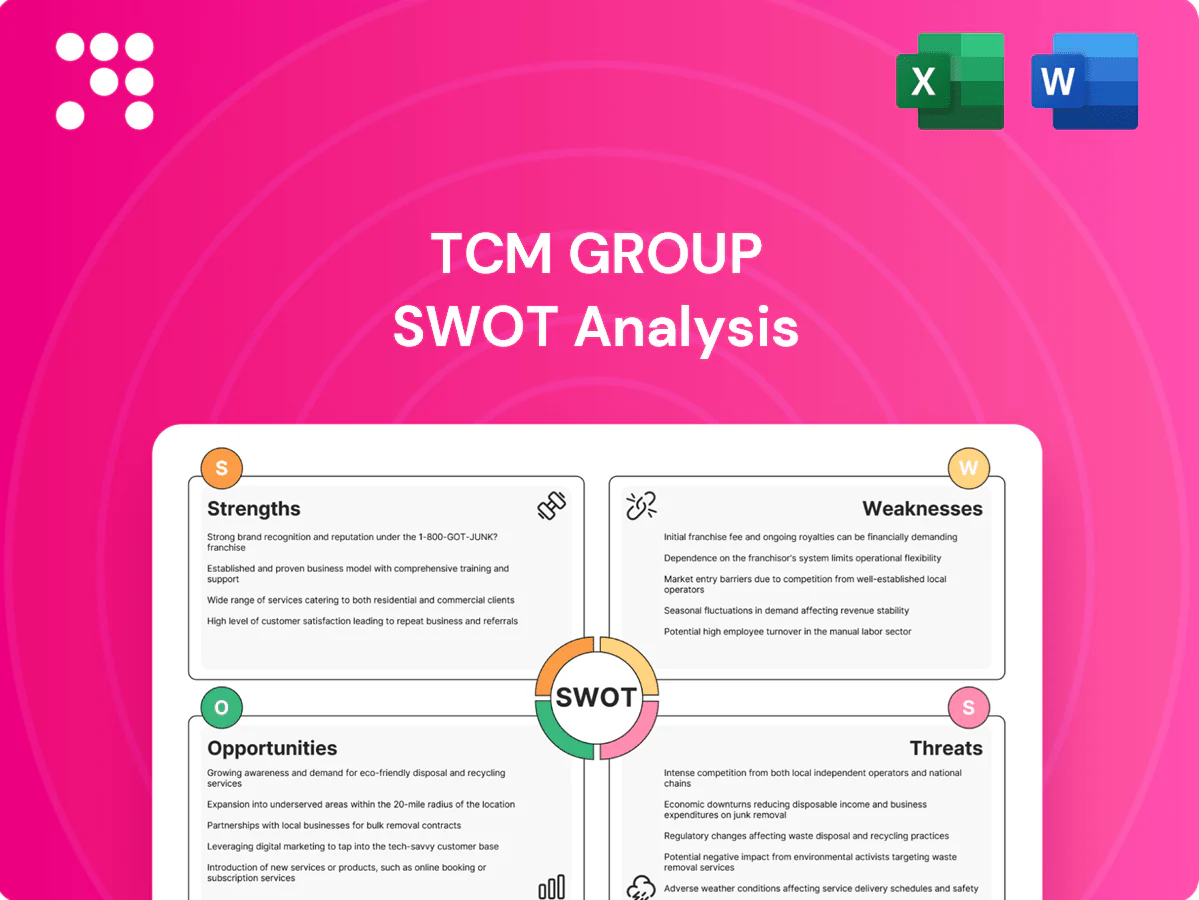
TCM Group SWOT Analysis

Make Insightful Decisions Backed by Expert Research
Explore TCM Group’s competitive edge, market risks, and growth levers with our concise SWOT preview—highlighting strengths in diversified services, emerging market opportunities, and key operational threats. Want the full strategic playbook? Purchase the complete SWOT analysis for a professionally written, editable report and Excel model to support investment, planning, and presentations.
Strengths

Multi-brand portfolio across price points
Operating Svane Køkkenet, Tvis Køkkener, Nettoline and kitchn lets TCM Group cover premium, mid-market and value segments, lowering reliance on any single brand and cushioning demand swings. Shared components and cross-brand sourcing drive scale efficiencies and cost leverage. A broader catalog strengthens retailer bargaining power by offering wider price and product options.
Strong Nordic brand recognition
Established Scandinavian design credentials bolster pricing power and trust, allowing TCM Group to sustain higher margins on core ranges. Local market familiarity enables tailored assortments and faster trend response, shortening product development cycles. Long-standing retail partnerships and strong word-of-mouth deepen loyalty, creating brand equity that is difficult for new entrants to replicate quickly.

Franchise and independent retailer network
TCM Group’s asset-light franchise and independent retailer network lets the company expand market coverage without heavy capex, aligning with the trend where franchises drove 42% of retail sales in emerging markets in 2023. Local retailers offer tailored customization advice and coordinate installations, improving conversion and aftersales routes. The network extends geographic reach into secondary cities and generates recurring showroom traffic for new launches.

Customization and modular manufacturing
Modular made-to-order capabilities support varied designs and dimensions, enabling quicker inventory turns and reduced obsolescence. Customers value fit, finish and functionality tailored to space constraints. Engineering commonality lowers unit costs while preserving choice, often delivering double-digit improvements in inventory turnover and per-unit cost efficiency.
- Modular customization
- Reduced obsolescence
- Tailored fit & finish
- Engineering commonality
Comprehensive kitchen and bathroom offering
Offering both kitchen and bathroom ranges lets TCM Group increase share-of-wallet through bundled projects and higher average order values, while cross-selling accessories, worktops and storage shifts the margin mix toward higher-margin add-ons. Unified aesthetics across rooms differentiates the brand for renovators and simplifies procurement for builders and multi-unit developers, reducing lead times and coordination costs.
- Bundled projects drive higher AOV
- Cross-sell boosts margin mix
- Unified design differentiator
- Simplified procurement for builders
Multi-brand Scandinavian design; franchises 42% expand reach; modular MTO raises AOVs
Multi-brand coverage (premium to value) diversifies demand risk and drives sourcing scale; shared components lower unit costs. Strong Scandinavian design and local retail ties support pricing power and repeat sales. Asset-light franchise network (franchises drove 42% of retail sales in emerging markets, 2023) boosts reach with limited capex. Modular made-to-order yields double-digit inventory-turn improvements and higher AOVs.
| Metric | Value |
|---|---|
| Franchise share (emerging mkts) | 42% (2023) |
| Inventory turn impact | Double-digit improvement |
| Segments covered | Premium / Mid / Value |
What is included in the product
 Detailed Word Document
Provides a concise SWOT analysis of TCM Group, outlining internal strengths and weaknesses alongside external opportunities and threats to inform strategic decisions and competitive positioning.

 Customizable Excel Spreadsheet
Provides a concise, visual SWOT matrix tailored to TCM Group for rapid strategy alignment and quick stakeholder-ready summaries, easing strategic review pain points.
Weaknesses

Geographic concentration in the Nordics
Heavy exposure to Denmark and nearby Nordic markets left TCM Group with over 75% of revenue sourced from the region in 2024, limiting geographic diversification. Regional housing and renovation cycles—with Nordic home sales and construction activity down in 2024—directly pressure volumes and margins. Macro shocks in 2024 were less offset by other regions and brand awareness remains constrained outside core geographies.
Reliance on cyclical home improvement demand
Kitchen and bath are discretionary and rate-sensitive; 30-year US mortgage rates rose to about 7% in 2024–25 (Freddie Mac), delaying projects as financing costs climbed. Consumer confidence softness and higher rates push homeowners to defer remodels, making order pipelines volatile quarter to quarter. High fixed manufacturing overheads create operating leverage, magnifying revenue shortfalls into larger margin declines.

Variable franchise and retailer execution
Independent outlets create uneven service quality and lead times, reducing predictability across the network and increasing customer complaints. TCM’s limited direct control over in-store experience and upselling constrains revenue capture and consistency. Ongoing training and compliance impose recurring operational costs. Isolated service failures can disproportionately damage brand reputation.

Mid-to-premium pricing exposure
Mid-to-premium pricing leaves TCM vulnerable as price-sensitive customers often switch to DIY or flat-pack alternatives; IKEA reported about €44.6bn in 2023, underscoring scale pressure from low-cost rivals. Promotional pressure in downturns can erode margins, so value must be defended through distinctive design and proven durability while online entry-level brands intensify competition.
- Customer churn to DIY/flat-pack
- Promotional margin erosion
- Need to prove design & durability
- Online entry-level competitor pressure
Supply chain and production concentration
Dependence on a few suppliers for boards, hinges and fittings heightens single-source risk; supply disruptions can extend lead times and lift input costs, squeezing margins. Limited in-country capacity creates bottlenecks during demand spikes, slowing revenue scaling. Single-country production raises exposure to local energy and wage shocks—China represented about 28% of global manufacturing output in 2023, amplifying systemic risk.
- Concentration: heavy reliance on few component suppliers
- Lead-time risk: disruptions → longer delivery, higher costs
- Capacity cap: bottlenecks limit rapid growth
- Geographic risk: single-country production; 28% of global manufacturing (2023)
Nordic concentration, mortgage headwinds and China supply risk threaten mid-prem furniture margins
TCM Group is overly concentrated: 75% revenue from Nordics in 2024, exposing it to regional housing downturns; 30-year US mortgage ~7% (2024–25) reduces remodel demand. Mid-premium positioning faces IKEA-scale low-cost pressure (€44.6bn sales 2023) and DIY churn; single-country production (China ~28% global manufacturing 2023) raises supply and energy risk.
| Metric | Value |
|---|---|
| Nordic revenue share (2024) | 75% |
| 30-yr mortgage (2024–25) | ~7% |
| IKEA sales (2023) | €44.6bn |
| China share manufacturing (2023) | 28% |
Same Document Delivered
TCM Group SWOT Analysis
This is the actual TCM Group SWOT analysis document you’ll receive upon purchase—no surprises, just professional quality. The preview below is pulled directly from the full report you'll download after payment. Buy now to unlock the complete, editable version with full detail and structured insights.

Make Insightful Decisions Backed by Expert Research
Explore TCM Group’s competitive edge, market risks, and growth levers with our concise SWOT preview—highlighting strengths in diversified services, emerging market opportunities, and key operational threats. Want the full strategic playbook? Purchase the complete SWOT analysis for a professionally written, editable report and Excel model to support investment, planning, and presentations.
Strengths
Multi-brand portfolio across price points
Operating Svane Køkkenet, Tvis Køkkener, Nettoline and kitchn lets TCM Group cover premium, mid-market and value segments, lowering reliance on any single brand and cushioning demand swings. Shared components and cross-brand sourcing drive scale efficiencies and cost leverage. A broader catalog strengthens retailer bargaining power by offering wider price and product options.
Strong Nordic brand recognition
Established Scandinavian design credentials bolster pricing power and trust, allowing TCM Group to sustain higher margins on core ranges. Local market familiarity enables tailored assortments and faster trend response, shortening product development cycles. Long-standing retail partnerships and strong word-of-mouth deepen loyalty, creating brand equity that is difficult for new entrants to replicate quickly.
Franchise and independent retailer network
TCM Group’s asset-light franchise and independent retailer network lets the company expand market coverage without heavy capex, aligning with the trend where franchises drove 42% of retail sales in emerging markets in 2023. Local retailers offer tailored customization advice and coordinate installations, improving conversion and aftersales routes. The network extends geographic reach into secondary cities and generates recurring showroom traffic for new launches.
Customization and modular manufacturing
Modular made-to-order capabilities support varied designs and dimensions, enabling quicker inventory turns and reduced obsolescence. Customers value fit, finish and functionality tailored to space constraints. Engineering commonality lowers unit costs while preserving choice, often delivering double-digit improvements in inventory turnover and per-unit cost efficiency.
- Modular customization
- Reduced obsolescence
- Tailored fit & finish
- Engineering commonality
Comprehensive kitchen and bathroom offering
Offering both kitchen and bathroom ranges lets TCM Group increase share-of-wallet through bundled projects and higher average order values, while cross-selling accessories, worktops and storage shifts the margin mix toward higher-margin add-ons. Unified aesthetics across rooms differentiates the brand for renovators and simplifies procurement for builders and multi-unit developers, reducing lead times and coordination costs.
- Bundled projects drive higher AOV
- Cross-sell boosts margin mix
- Unified design differentiator
- Simplified procurement for builders
Multi-brand Scandinavian design; franchises 42% expand reach; modular MTO raises AOVs
Multi-brand coverage (premium to value) diversifies demand risk and drives sourcing scale; shared components lower unit costs. Strong Scandinavian design and local retail ties support pricing power and repeat sales. Asset-light franchise network (franchises drove 42% of retail sales in emerging markets, 2023) boosts reach with limited capex. Modular made-to-order yields double-digit inventory-turn improvements and higher AOVs.
| Metric | Value |
|---|---|
| Franchise share (emerging mkts) | 42% (2023) |
| Inventory turn impact | Double-digit improvement |
| Segments covered | Premium / Mid / Value |
What is included in the product
Detailed Word Document
Provides a concise SWOT analysis of TCM Group, outlining internal strengths and weaknesses alongside external opportunities and threats to inform strategic decisions and competitive positioning.
Customizable Excel Spreadsheet
Provides a concise, visual SWOT matrix tailored to TCM Group for rapid strategy alignment and quick stakeholder-ready summaries, easing strategic review pain points.
Weaknesses
Geographic concentration in the Nordics
Heavy exposure to Denmark and nearby Nordic markets left TCM Group with over 75% of revenue sourced from the region in 2024, limiting geographic diversification. Regional housing and renovation cycles—with Nordic home sales and construction activity down in 2024—directly pressure volumes and margins. Macro shocks in 2024 were less offset by other regions and brand awareness remains constrained outside core geographies.
Reliance on cyclical home improvement demand
Kitchen and bath are discretionary and rate-sensitive; 30-year US mortgage rates rose to about 7% in 2024–25 (Freddie Mac), delaying projects as financing costs climbed. Consumer confidence softness and higher rates push homeowners to defer remodels, making order pipelines volatile quarter to quarter. High fixed manufacturing overheads create operating leverage, magnifying revenue shortfalls into larger margin declines.
Variable franchise and retailer execution
Independent outlets create uneven service quality and lead times, reducing predictability across the network and increasing customer complaints. TCM’s limited direct control over in-store experience and upselling constrains revenue capture and consistency. Ongoing training and compliance impose recurring operational costs. Isolated service failures can disproportionately damage brand reputation.
Mid-to-premium pricing exposure
Mid-to-premium pricing leaves TCM vulnerable as price-sensitive customers often switch to DIY or flat-pack alternatives; IKEA reported about €44.6bn in 2023, underscoring scale pressure from low-cost rivals. Promotional pressure in downturns can erode margins, so value must be defended through distinctive design and proven durability while online entry-level brands intensify competition.
- Customer churn to DIY/flat-pack
- Promotional margin erosion
- Need to prove design & durability
- Online entry-level competitor pressure
Supply chain and production concentration
Dependence on a few suppliers for boards, hinges and fittings heightens single-source risk; supply disruptions can extend lead times and lift input costs, squeezing margins. Limited in-country capacity creates bottlenecks during demand spikes, slowing revenue scaling. Single-country production raises exposure to local energy and wage shocks—China represented about 28% of global manufacturing output in 2023, amplifying systemic risk.
- Concentration: heavy reliance on few component suppliers
- Lead-time risk: disruptions → longer delivery, higher costs
- Capacity cap: bottlenecks limit rapid growth
- Geographic risk: single-country production; 28% of global manufacturing (2023)
Nordic concentration, mortgage headwinds and China supply risk threaten mid-prem furniture margins
TCM Group is overly concentrated: 75% revenue from Nordics in 2024, exposing it to regional housing downturns; 30-year US mortgage ~7% (2024–25) reduces remodel demand. Mid-premium positioning faces IKEA-scale low-cost pressure (€44.6bn sales 2023) and DIY churn; single-country production (China ~28% global manufacturing 2023) raises supply and energy risk.
| Metric | Value |
|---|---|
| Nordic revenue share (2024) | 75% |
| 30-yr mortgage (2024–25) | ~7% |
| IKEA sales (2023) | €44.6bn |
| China share manufacturing (2023) | 28% |
Same Document Delivered
TCM Group SWOT Analysis
This is the actual TCM Group SWOT analysis document you’ll receive upon purchase—no surprises, just professional quality. The preview below is pulled directly from the full report you'll download after payment. Buy now to unlock the complete, editable version with full detail and structured insights.
Original: $10.00
-65%$10.00
$3.50Description
Make Insightful Decisions Backed by Expert Research
Explore TCM Group’s competitive edge, market risks, and growth levers with our concise SWOT preview—highlighting strengths in diversified services, emerging market opportunities, and key operational threats. Want the full strategic playbook? Purchase the complete SWOT analysis for a professionally written, editable report and Excel model to support investment, planning, and presentations.
Strengths
Multi-brand portfolio across price points
Operating Svane Køkkenet, Tvis Køkkener, Nettoline and kitchn lets TCM Group cover premium, mid-market and value segments, lowering reliance on any single brand and cushioning demand swings. Shared components and cross-brand sourcing drive scale efficiencies and cost leverage. A broader catalog strengthens retailer bargaining power by offering wider price and product options.
Strong Nordic brand recognition
Established Scandinavian design credentials bolster pricing power and trust, allowing TCM Group to sustain higher margins on core ranges. Local market familiarity enables tailored assortments and faster trend response, shortening product development cycles. Long-standing retail partnerships and strong word-of-mouth deepen loyalty, creating brand equity that is difficult for new entrants to replicate quickly.
Franchise and independent retailer network
TCM Group’s asset-light franchise and independent retailer network lets the company expand market coverage without heavy capex, aligning with the trend where franchises drove 42% of retail sales in emerging markets in 2023. Local retailers offer tailored customization advice and coordinate installations, improving conversion and aftersales routes. The network extends geographic reach into secondary cities and generates recurring showroom traffic for new launches.
Customization and modular manufacturing
Modular made-to-order capabilities support varied designs and dimensions, enabling quicker inventory turns and reduced obsolescence. Customers value fit, finish and functionality tailored to space constraints. Engineering commonality lowers unit costs while preserving choice, often delivering double-digit improvements in inventory turnover and per-unit cost efficiency.
- Modular customization
- Reduced obsolescence
- Tailored fit & finish
- Engineering commonality
Comprehensive kitchen and bathroom offering
Offering both kitchen and bathroom ranges lets TCM Group increase share-of-wallet through bundled projects and higher average order values, while cross-selling accessories, worktops and storage shifts the margin mix toward higher-margin add-ons. Unified aesthetics across rooms differentiates the brand for renovators and simplifies procurement for builders and multi-unit developers, reducing lead times and coordination costs.
- Bundled projects drive higher AOV
- Cross-sell boosts margin mix
- Unified design differentiator
- Simplified procurement for builders
Multi-brand Scandinavian design; franchises 42% expand reach; modular MTO raises AOVs
Multi-brand coverage (premium to value) diversifies demand risk and drives sourcing scale; shared components lower unit costs. Strong Scandinavian design and local retail ties support pricing power and repeat sales. Asset-light franchise network (franchises drove 42% of retail sales in emerging markets, 2023) boosts reach with limited capex. Modular made-to-order yields double-digit inventory-turn improvements and higher AOVs.
| Metric | Value |
|---|---|
| Franchise share (emerging mkts) | 42% (2023) |
| Inventory turn impact | Double-digit improvement |
| Segments covered | Premium / Mid / Value |
What is included in the product
Detailed Word Document
Provides a concise SWOT analysis of TCM Group, outlining internal strengths and weaknesses alongside external opportunities and threats to inform strategic decisions and competitive positioning.
Customizable Excel Spreadsheet
Provides a concise, visual SWOT matrix tailored to TCM Group for rapid strategy alignment and quick stakeholder-ready summaries, easing strategic review pain points.
Weaknesses
Geographic concentration in the Nordics
Heavy exposure to Denmark and nearby Nordic markets left TCM Group with over 75% of revenue sourced from the region in 2024, limiting geographic diversification. Regional housing and renovation cycles—with Nordic home sales and construction activity down in 2024—directly pressure volumes and margins. Macro shocks in 2024 were less offset by other regions and brand awareness remains constrained outside core geographies.
Reliance on cyclical home improvement demand
Kitchen and bath are discretionary and rate-sensitive; 30-year US mortgage rates rose to about 7% in 2024–25 (Freddie Mac), delaying projects as financing costs climbed. Consumer confidence softness and higher rates push homeowners to defer remodels, making order pipelines volatile quarter to quarter. High fixed manufacturing overheads create operating leverage, magnifying revenue shortfalls into larger margin declines.
Variable franchise and retailer execution
Independent outlets create uneven service quality and lead times, reducing predictability across the network and increasing customer complaints. TCM’s limited direct control over in-store experience and upselling constrains revenue capture and consistency. Ongoing training and compliance impose recurring operational costs. Isolated service failures can disproportionately damage brand reputation.
Mid-to-premium pricing exposure
Mid-to-premium pricing leaves TCM vulnerable as price-sensitive customers often switch to DIY or flat-pack alternatives; IKEA reported about €44.6bn in 2023, underscoring scale pressure from low-cost rivals. Promotional pressure in downturns can erode margins, so value must be defended through distinctive design and proven durability while online entry-level brands intensify competition.
- Customer churn to DIY/flat-pack
- Promotional margin erosion
- Need to prove design & durability
- Online entry-level competitor pressure
Supply chain and production concentration
Dependence on a few suppliers for boards, hinges and fittings heightens single-source risk; supply disruptions can extend lead times and lift input costs, squeezing margins. Limited in-country capacity creates bottlenecks during demand spikes, slowing revenue scaling. Single-country production raises exposure to local energy and wage shocks—China represented about 28% of global manufacturing output in 2023, amplifying systemic risk.
- Concentration: heavy reliance on few component suppliers
- Lead-time risk: disruptions → longer delivery, higher costs
- Capacity cap: bottlenecks limit rapid growth
- Geographic risk: single-country production; 28% of global manufacturing (2023)
Nordic concentration, mortgage headwinds and China supply risk threaten mid-prem furniture margins
TCM Group is overly concentrated: 75% revenue from Nordics in 2024, exposing it to regional housing downturns; 30-year US mortgage ~7% (2024–25) reduces remodel demand. Mid-premium positioning faces IKEA-scale low-cost pressure (€44.6bn sales 2023) and DIY churn; single-country production (China ~28% global manufacturing 2023) raises supply and energy risk.
| Metric | Value |
|---|---|
| Nordic revenue share (2024) | 75% |
| 30-yr mortgage (2024–25) | ~7% |
| IKEA sales (2023) | €44.6bn |
| China share manufacturing (2023) | 28% |
Same Document Delivered
TCM Group SWOT Analysis
This is the actual TCM Group SWOT analysis document you’ll receive upon purchase—no surprises, just professional quality. The preview below is pulled directly from the full report you'll download after payment. Buy now to unlock the complete, editable version with full detail and structured insights.











