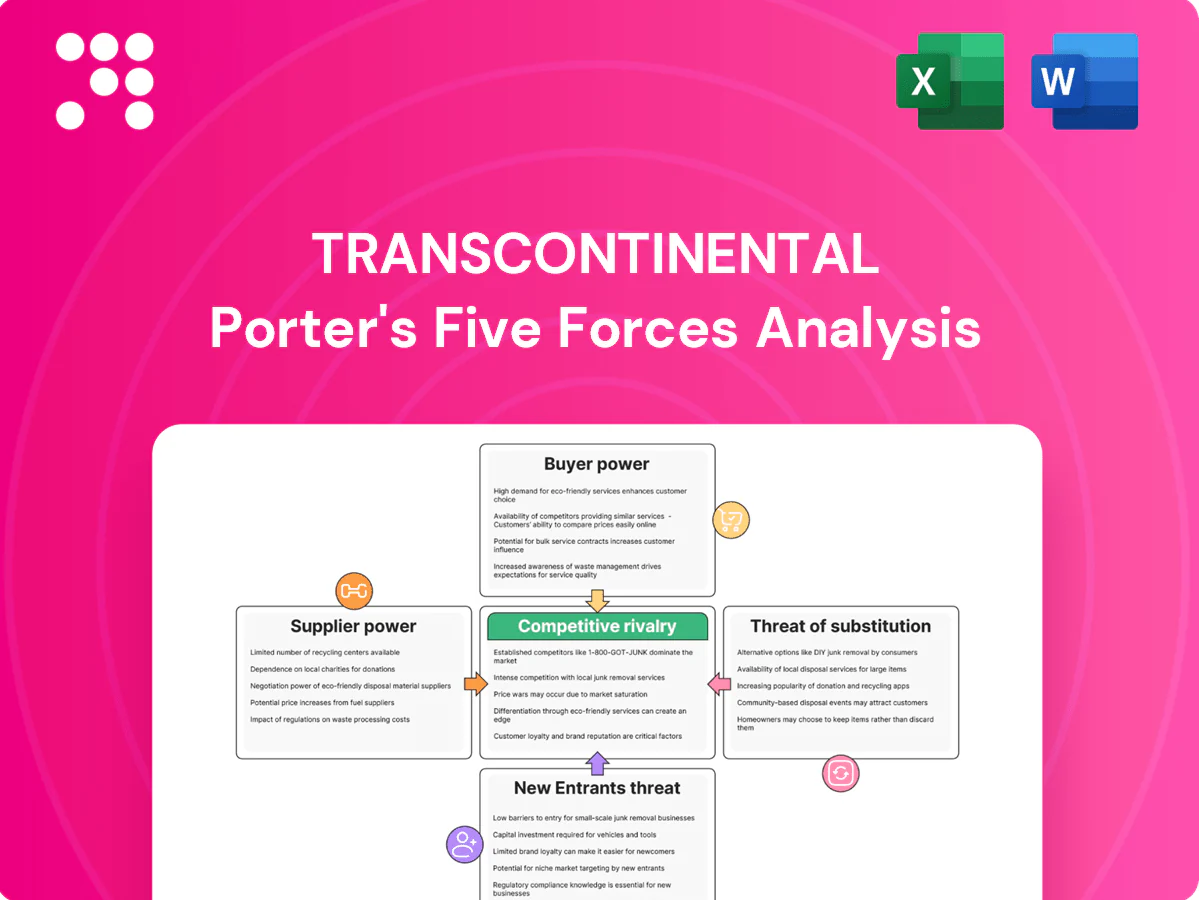
Transcontinental Porter's Five Forces Analysis

Don't Miss the Bigger Picture
Transcontinental faces moderate rivalry from scale-focused peers and digital disruption, with supplier power limited but printing and logistics costs as vulnerabilities. Buyer bargaining is growing as advertisers consolidate and digital substitutes expand. This brief snapshot only scratches the surface. Unlock the full Porter's Five Forces Analysis to explore Transcontinental’s competitive dynamics, market pressures, and strategic advantages in detail.
Suppliers Bargaining Power

Concentrated resin and film inputs
Flexible packaging relies on polyethylene, polypropylene, PET and specialty films supplied by a relatively concentrated set of global petrochemical firms, giving suppliers notable leverage. Oil/naphtha volatility—Brent averaged about $84/barrel in 2024—can shift margin capture toward suppliers. TC mitigates this through hedging and multi-sourcing, while long-term contracts and increasing recycled-content sourcing partially blunt price spikes.
Paper, pulp, and ink exposure
Printing relies heavily on paper/pulp mills and specialty ink suppliers; in 2024 tight mill capacity and periodic curtailments pushed lead times higher and raised input costs across the industry. Index-linked pricing mitigates cost swings but often lags 1–2 quarters. Rigorous vendor qualification and 4–8 week inventory buffers are standard to reduce disruption risk.

Capital equipment OEM dependence
Capital equipment OEM dependence is high in 2024, with high-speed presses, extruders and converting lines supplied by a concentrated OEM base, allowing parts, maintenance and upgrades to command premium pricing; robust service-level agreements and diversified multi-OEM fleets strengthen Transcontinental’s negotiating stance, while in-house engineering and retrofit capability lower switching frictions and total cost of ownership.

Logistics and energy constraints
Logistics and energy constraints tighten supplier power: freight and warehousing capacity squeezes compress margins while carriers and utilities extract premiums during crunches. In 2024 Brent averaged roughly $85/barrel, keeping energy costs a persistent input shock for transcontinental operations. Network optimization and nearshoring reduce exposure, and energy-efficiency investments plus demand hedges limit volatility risk.
- Freight: tight capacity raises rates, lifting COGS
- Warehousing: low regional vacancy amplifies price leverage
- Energy: $85/bbl Brent in 2024 sustains input pressure
- Mitigants: nearshoring, route optimization, efficiency, hedges
Sustainability and compliance inputs
Food-grade films, barrier chemistries and recycled resins demand certified suppliers; FDA, CFIA and the EU PPWR 2024 requirements narrow qualified vendor pools and raise supplier leverage. ESG mandates for PCR content increase scarcity and cost, while early supplier collaboration and long-term contracts secure allocation and mitigate price volatility.
- Compliance: FDA/CFIA/EU PPWR 2024
- Supplier concentration: higher bargaining power
- PCR/ESG: raises cost and limits availability
- Mitigation: early collaboration, long-term contracts
Elevated supplier leverage; Brent averaged $84/bbl in 2024
Supplier power is elevated: concentrated petrochemical and OEM bases plus certified food-grade suppliers limit switching. Brent averaged about $84/bbl in 2024, keeping energy-driven input risk high. Mitigants: multi-sourcing, hedges, long-term contracts and nearshoring reduce but do not eliminate supplier leverage.
| Metric | 2024 |
|---|---|
| Brent | $84/bbl |
| Lead times (paper/inks) | +4–8 weeks |
| OEM concentration | High |
What is included in the product
 Detailed Word Document
Comprehensive Porter's Five Forces analysis for Transcontinental that uncovers competition drivers, buyer and supplier power, entry barriers, substitutes and disruptive threats, with strategic commentary to assess pricing power, profitability and defensive opportunities.

 Customizable Excel Spreadsheet
A concise, one-sheet Transcontinental Porter's Five Forces snapshot—visual spider chart, customizable pressure levels, copy-ready layout for decks, duplicate scenario tabs (pre/post regulation), no macros, easy swap-in data and labels, integrates with Excel dashboards and Word reports for fast, boardroom-ready strategic decisions.
Customers Bargaining Power

Large CPG and retailer consolidation
Major food and beverage brands and consolidated retailers exert strong bargaining power over Transcontinental, representing the largest packaging volumes and using dual-sourcing and frequent RFQs to intensify price pressure. In Canada the top three grocers control about 67% of the grocery market (2023), increasing buyer leverage. They demand service reliability and innovation at competitive cost. Volume commitments are routinely exchanged for lower pricing and strategic partnerships.
Price sensitivity and indexation
Packaging buyers benchmark suppliers globally and push pass-throughs tied to resin indexes (eg IHS/Platts), a practice that surged in 2024 as resin cost normalization followed 2021–22 spikes. Indexation reduces volatility disputes and keeps pricing transparent, but conversion margins hinge on conversion value and product mix. Differentiated barriers and design-win stickiness sustain premium pricing and customer retention.

Switching costs and qualification
For regulated food packaging, requalification, tooling and exacting specs typically extend switching timelines to 6–12 months and materially raise cost barriers, tempering buyer power once a spec is locked. Multi-sourcing remains common and sustains pressure on incumbents by enabling buyers to split volumes. Service KPIs—lead time, defect rates—and OTIF performance above 95% are critical retainers for suppliers.

Print and media budget flexibility
Print customers can reallocate spend to digital when print prices rise, with 2024 industry data showing digital advertising and content channels outsize print spend by multiple-fold, strengthening buyer elasticity and negotiating leverage in commercial printing. TC Transcontinental mitigates churn by selling premedia and distribution, increasing switching costs and lifetime value. Bundled contracts help stabilize volumes and margins.
- Buyer elasticity: digital vs print spending gap (2024)
- Value-added services: premedia, distribution reduce churn
- Bundling: stabilizes volumes, protects margins
Education adoption cycles
Top-3 grocers 67%: buyer leverage, resin indexation tightens margins; digital RFPs lift elasticity
Buyers (large FMCG, retailers) hold strong leverage—top‑3 grocers ~67% share (Canada, 2023) and dual‑sourcing/volume deals compress margins. Resin indexation adoption rose in 2024, anchoring pass‑through pricing; food packaging switching ~6–12 months reduces churn. Print buyers shift to digital, and ~70% of K‑12 RFPs required digital components in 2024, raising buyer elasticity.
| Metric | 2023/24 | Implication |
|---|---|---|
| Top‑3 grocers (CA) | 67% (2023) | High buyer power |
| Resin indexation | Surged (2024) | Transparent pass‑throughs |
| Food packaging switch | 6–12 months | Higher switching cost |
| K‑12 RFPs digital | ~70% (2024) | Increases elasticity |
What You See Is What You Get
Transcontinental Porter's Five Forces Analysis
This preview shows the exact Transcontinental Porter's Five Forces Analysis you'll receive after purchase—no mockups, no placeholders. The document is fully formatted, professionally written, and ready for immediate download and use. What you see here is the deliverable you’ll get instantly upon payment.

Don't Miss the Bigger Picture
Transcontinental faces moderate rivalry from scale-focused peers and digital disruption, with supplier power limited but printing and logistics costs as vulnerabilities. Buyer bargaining is growing as advertisers consolidate and digital substitutes expand. This brief snapshot only scratches the surface. Unlock the full Porter's Five Forces Analysis to explore Transcontinental’s competitive dynamics, market pressures, and strategic advantages in detail.
Suppliers Bargaining Power
Concentrated resin and film inputs
Flexible packaging relies on polyethylene, polypropylene, PET and specialty films supplied by a relatively concentrated set of global petrochemical firms, giving suppliers notable leverage. Oil/naphtha volatility—Brent averaged about $84/barrel in 2024—can shift margin capture toward suppliers. TC mitigates this through hedging and multi-sourcing, while long-term contracts and increasing recycled-content sourcing partially blunt price spikes.
Paper, pulp, and ink exposure
Printing relies heavily on paper/pulp mills and specialty ink suppliers; in 2024 tight mill capacity and periodic curtailments pushed lead times higher and raised input costs across the industry. Index-linked pricing mitigates cost swings but often lags 1–2 quarters. Rigorous vendor qualification and 4–8 week inventory buffers are standard to reduce disruption risk.
Capital equipment OEM dependence
Capital equipment OEM dependence is high in 2024, with high-speed presses, extruders and converting lines supplied by a concentrated OEM base, allowing parts, maintenance and upgrades to command premium pricing; robust service-level agreements and diversified multi-OEM fleets strengthen Transcontinental’s negotiating stance, while in-house engineering and retrofit capability lower switching frictions and total cost of ownership.
Logistics and energy constraints
Logistics and energy constraints tighten supplier power: freight and warehousing capacity squeezes compress margins while carriers and utilities extract premiums during crunches. In 2024 Brent averaged roughly $85/barrel, keeping energy costs a persistent input shock for transcontinental operations. Network optimization and nearshoring reduce exposure, and energy-efficiency investments plus demand hedges limit volatility risk.
- Freight: tight capacity raises rates, lifting COGS
- Warehousing: low regional vacancy amplifies price leverage
- Energy: $85/bbl Brent in 2024 sustains input pressure
- Mitigants: nearshoring, route optimization, efficiency, hedges
Sustainability and compliance inputs
Food-grade films, barrier chemistries and recycled resins demand certified suppliers; FDA, CFIA and the EU PPWR 2024 requirements narrow qualified vendor pools and raise supplier leverage. ESG mandates for PCR content increase scarcity and cost, while early supplier collaboration and long-term contracts secure allocation and mitigate price volatility.
- Compliance: FDA/CFIA/EU PPWR 2024
- Supplier concentration: higher bargaining power
- PCR/ESG: raises cost and limits availability
- Mitigation: early collaboration, long-term contracts
Elevated supplier leverage; Brent averaged $84/bbl in 2024
Supplier power is elevated: concentrated petrochemical and OEM bases plus certified food-grade suppliers limit switching. Brent averaged about $84/bbl in 2024, keeping energy-driven input risk high. Mitigants: multi-sourcing, hedges, long-term contracts and nearshoring reduce but do not eliminate supplier leverage.
| Metric | 2024 |
|---|---|
| Brent | $84/bbl |
| Lead times (paper/inks) | +4–8 weeks |
| OEM concentration | High |
What is included in the product
Detailed Word Document
Comprehensive Porter's Five Forces analysis for Transcontinental that uncovers competition drivers, buyer and supplier power, entry barriers, substitutes and disruptive threats, with strategic commentary to assess pricing power, profitability and defensive opportunities.
Customizable Excel Spreadsheet
A concise, one-sheet Transcontinental Porter's Five Forces snapshot—visual spider chart, customizable pressure levels, copy-ready layout for decks, duplicate scenario tabs (pre/post regulation), no macros, easy swap-in data and labels, integrates with Excel dashboards and Word reports for fast, boardroom-ready strategic decisions.
Customers Bargaining Power
Large CPG and retailer consolidation
Major food and beverage brands and consolidated retailers exert strong bargaining power over Transcontinental, representing the largest packaging volumes and using dual-sourcing and frequent RFQs to intensify price pressure. In Canada the top three grocers control about 67% of the grocery market (2023), increasing buyer leverage. They demand service reliability and innovation at competitive cost. Volume commitments are routinely exchanged for lower pricing and strategic partnerships.
Price sensitivity and indexation
Packaging buyers benchmark suppliers globally and push pass-throughs tied to resin indexes (eg IHS/Platts), a practice that surged in 2024 as resin cost normalization followed 2021–22 spikes. Indexation reduces volatility disputes and keeps pricing transparent, but conversion margins hinge on conversion value and product mix. Differentiated barriers and design-win stickiness sustain premium pricing and customer retention.
Switching costs and qualification
For regulated food packaging, requalification, tooling and exacting specs typically extend switching timelines to 6–12 months and materially raise cost barriers, tempering buyer power once a spec is locked. Multi-sourcing remains common and sustains pressure on incumbents by enabling buyers to split volumes. Service KPIs—lead time, defect rates—and OTIF performance above 95% are critical retainers for suppliers.
Print and media budget flexibility
Print customers can reallocate spend to digital when print prices rise, with 2024 industry data showing digital advertising and content channels outsize print spend by multiple-fold, strengthening buyer elasticity and negotiating leverage in commercial printing. TC Transcontinental mitigates churn by selling premedia and distribution, increasing switching costs and lifetime value. Bundled contracts help stabilize volumes and margins.
- Buyer elasticity: digital vs print spending gap (2024)
- Value-added services: premedia, distribution reduce churn
- Bundling: stabilizes volumes, protects margins
Education adoption cycles
Top-3 grocers 67%: buyer leverage, resin indexation tightens margins; digital RFPs lift elasticity
Buyers (large FMCG, retailers) hold strong leverage—top‑3 grocers ~67% share (Canada, 2023) and dual‑sourcing/volume deals compress margins. Resin indexation adoption rose in 2024, anchoring pass‑through pricing; food packaging switching ~6–12 months reduces churn. Print buyers shift to digital, and ~70% of K‑12 RFPs required digital components in 2024, raising buyer elasticity.
| Metric | 2023/24 | Implication |
|---|---|---|
| Top‑3 grocers (CA) | 67% (2023) | High buyer power |
| Resin indexation | Surged (2024) | Transparent pass‑throughs |
| Food packaging switch | 6–12 months | Higher switching cost |
| K‑12 RFPs digital | ~70% (2024) | Increases elasticity |
What You See Is What You Get
Transcontinental Porter's Five Forces Analysis
This preview shows the exact Transcontinental Porter's Five Forces Analysis you'll receive after purchase—no mockups, no placeholders. The document is fully formatted, professionally written, and ready for immediate download and use. What you see here is the deliverable you’ll get instantly upon payment.
Original: $10.00
-65%$10.00
$3.50Description
Don't Miss the Bigger Picture
Transcontinental faces moderate rivalry from scale-focused peers and digital disruption, with supplier power limited but printing and logistics costs as vulnerabilities. Buyer bargaining is growing as advertisers consolidate and digital substitutes expand. This brief snapshot only scratches the surface. Unlock the full Porter's Five Forces Analysis to explore Transcontinental’s competitive dynamics, market pressures, and strategic advantages in detail.
Suppliers Bargaining Power
Concentrated resin and film inputs
Flexible packaging relies on polyethylene, polypropylene, PET and specialty films supplied by a relatively concentrated set of global petrochemical firms, giving suppliers notable leverage. Oil/naphtha volatility—Brent averaged about $84/barrel in 2024—can shift margin capture toward suppliers. TC mitigates this through hedging and multi-sourcing, while long-term contracts and increasing recycled-content sourcing partially blunt price spikes.
Paper, pulp, and ink exposure
Printing relies heavily on paper/pulp mills and specialty ink suppliers; in 2024 tight mill capacity and periodic curtailments pushed lead times higher and raised input costs across the industry. Index-linked pricing mitigates cost swings but often lags 1–2 quarters. Rigorous vendor qualification and 4–8 week inventory buffers are standard to reduce disruption risk.
Capital equipment OEM dependence
Capital equipment OEM dependence is high in 2024, with high-speed presses, extruders and converting lines supplied by a concentrated OEM base, allowing parts, maintenance and upgrades to command premium pricing; robust service-level agreements and diversified multi-OEM fleets strengthen Transcontinental’s negotiating stance, while in-house engineering and retrofit capability lower switching frictions and total cost of ownership.
Logistics and energy constraints
Logistics and energy constraints tighten supplier power: freight and warehousing capacity squeezes compress margins while carriers and utilities extract premiums during crunches. In 2024 Brent averaged roughly $85/barrel, keeping energy costs a persistent input shock for transcontinental operations. Network optimization and nearshoring reduce exposure, and energy-efficiency investments plus demand hedges limit volatility risk.
- Freight: tight capacity raises rates, lifting COGS
- Warehousing: low regional vacancy amplifies price leverage
- Energy: $85/bbl Brent in 2024 sustains input pressure
- Mitigants: nearshoring, route optimization, efficiency, hedges
Sustainability and compliance inputs
Food-grade films, barrier chemistries and recycled resins demand certified suppliers; FDA, CFIA and the EU PPWR 2024 requirements narrow qualified vendor pools and raise supplier leverage. ESG mandates for PCR content increase scarcity and cost, while early supplier collaboration and long-term contracts secure allocation and mitigate price volatility.
- Compliance: FDA/CFIA/EU PPWR 2024
- Supplier concentration: higher bargaining power
- PCR/ESG: raises cost and limits availability
- Mitigation: early collaboration, long-term contracts
Elevated supplier leverage; Brent averaged $84/bbl in 2024
Supplier power is elevated: concentrated petrochemical and OEM bases plus certified food-grade suppliers limit switching. Brent averaged about $84/bbl in 2024, keeping energy-driven input risk high. Mitigants: multi-sourcing, hedges, long-term contracts and nearshoring reduce but do not eliminate supplier leverage.
| Metric | 2024 |
|---|---|
| Brent | $84/bbl |
| Lead times (paper/inks) | +4–8 weeks |
| OEM concentration | High |
What is included in the product
Detailed Word Document
Comprehensive Porter's Five Forces analysis for Transcontinental that uncovers competition drivers, buyer and supplier power, entry barriers, substitutes and disruptive threats, with strategic commentary to assess pricing power, profitability and defensive opportunities.
Customizable Excel Spreadsheet
A concise, one-sheet Transcontinental Porter's Five Forces snapshot—visual spider chart, customizable pressure levels, copy-ready layout for decks, duplicate scenario tabs (pre/post regulation), no macros, easy swap-in data and labels, integrates with Excel dashboards and Word reports for fast, boardroom-ready strategic decisions.
Customers Bargaining Power
Large CPG and retailer consolidation
Major food and beverage brands and consolidated retailers exert strong bargaining power over Transcontinental, representing the largest packaging volumes and using dual-sourcing and frequent RFQs to intensify price pressure. In Canada the top three grocers control about 67% of the grocery market (2023), increasing buyer leverage. They demand service reliability and innovation at competitive cost. Volume commitments are routinely exchanged for lower pricing and strategic partnerships.
Price sensitivity and indexation
Packaging buyers benchmark suppliers globally and push pass-throughs tied to resin indexes (eg IHS/Platts), a practice that surged in 2024 as resin cost normalization followed 2021–22 spikes. Indexation reduces volatility disputes and keeps pricing transparent, but conversion margins hinge on conversion value and product mix. Differentiated barriers and design-win stickiness sustain premium pricing and customer retention.
Switching costs and qualification
For regulated food packaging, requalification, tooling and exacting specs typically extend switching timelines to 6–12 months and materially raise cost barriers, tempering buyer power once a spec is locked. Multi-sourcing remains common and sustains pressure on incumbents by enabling buyers to split volumes. Service KPIs—lead time, defect rates—and OTIF performance above 95% are critical retainers for suppliers.
Print and media budget flexibility
Print customers can reallocate spend to digital when print prices rise, with 2024 industry data showing digital advertising and content channels outsize print spend by multiple-fold, strengthening buyer elasticity and negotiating leverage in commercial printing. TC Transcontinental mitigates churn by selling premedia and distribution, increasing switching costs and lifetime value. Bundled contracts help stabilize volumes and margins.
- Buyer elasticity: digital vs print spending gap (2024)
- Value-added services: premedia, distribution reduce churn
- Bundling: stabilizes volumes, protects margins
Education adoption cycles
Top-3 grocers 67%: buyer leverage, resin indexation tightens margins; digital RFPs lift elasticity
Buyers (large FMCG, retailers) hold strong leverage—top‑3 grocers ~67% share (Canada, 2023) and dual‑sourcing/volume deals compress margins. Resin indexation adoption rose in 2024, anchoring pass‑through pricing; food packaging switching ~6–12 months reduces churn. Print buyers shift to digital, and ~70% of K‑12 RFPs required digital components in 2024, raising buyer elasticity.
| Metric | 2023/24 | Implication |
|---|---|---|
| Top‑3 grocers (CA) | 67% (2023) | High buyer power |
| Resin indexation | Surged (2024) | Transparent pass‑throughs |
| Food packaging switch | 6–12 months | Higher switching cost |
| K‑12 RFPs digital | ~70% (2024) | Increases elasticity |
What You See Is What You Get
Transcontinental Porter's Five Forces Analysis
This preview shows the exact Transcontinental Porter's Five Forces Analysis you'll receive after purchase—no mockups, no placeholders. The document is fully formatted, professionally written, and ready for immediate download and use. What you see here is the deliverable you’ll get instantly upon payment.











