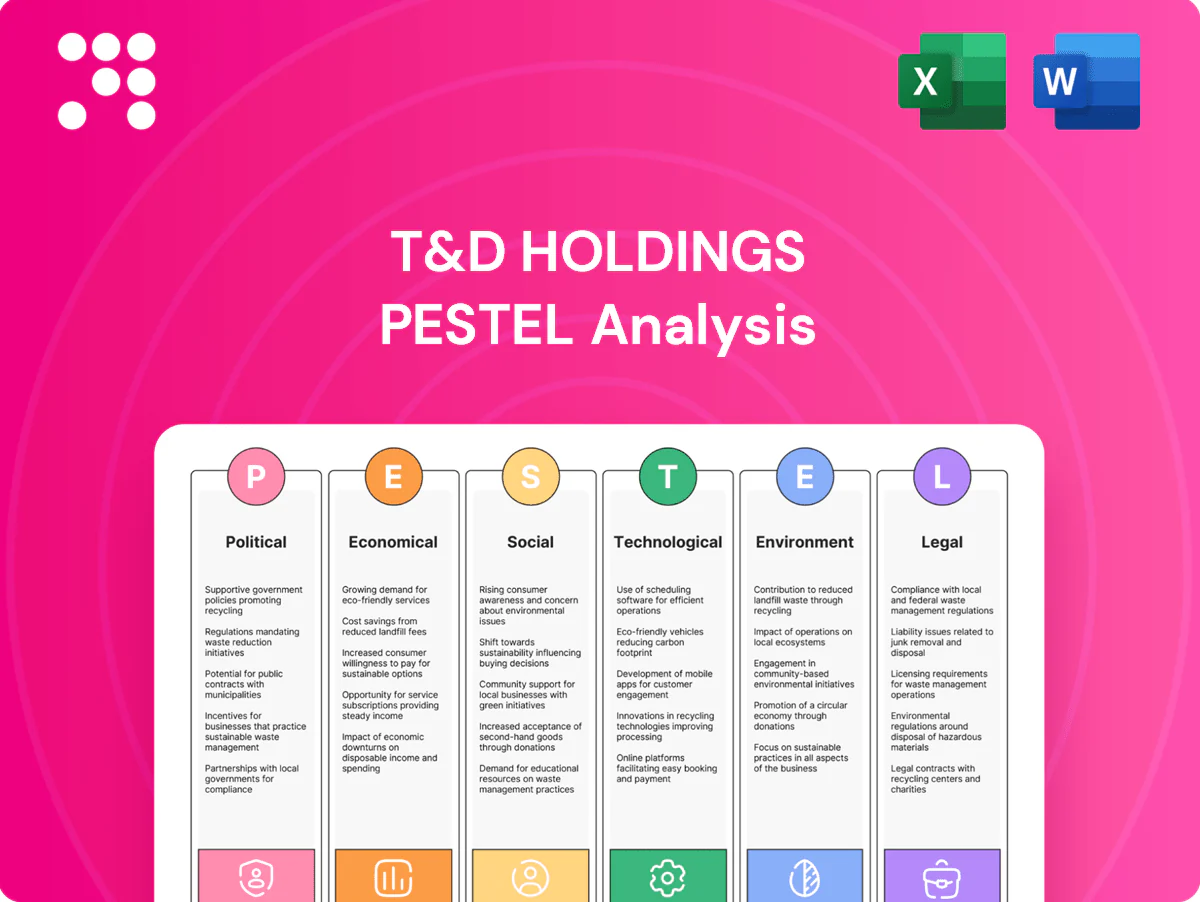
T&D Holdings PESTLE Analysis

Skip the Research. Get the Strategy.
Discover how political shifts, economic trends, social change, technological advances, and regulatory pressures are shaping T&D Holdings' strategic outlook in this concise PESTLE snapshot. Designed for investors and strategists, it highlights risks and opportunities you need to know. Purchase the full PESTLE for a detailed, actionable roadmap to inform decisions and drive competitive advantage.
Political factors

Regulatory oversight (FSA)
Japan’s Financial Services Agency tightly supervises life insurers, enforcing a solvency margin ratio regulatory threshold of 200% and broadening stress-testing and governance scrutiny in 2023–24. Shifts in solvency standards, mandated scenario tests and higher governance expectations directly influence capital allocation at Taiyo Life, Daido Life and T&D Financial Life. Stable oversight underpins long-term product promises but raises measurable compliance costs. Early engagement with the FSA helps shape feasible timelines and methodologies.
Public health & pension policy
Government reforms to national healthcare and pensions directly affect T&D Holdings by shifting demand for private medical and annuity products; Japan’s 65+ share was 29.1% in 2023 (UN) and public health spending ≈11% of GDP (OECD 2022). If public benefits tighten, demand for supplemental coverage from individuals and SMEs typically rises; expanded public support can compress private margins, so monitoring reform signals enables timely product redesign.

SME support programs
Policy incentives for SMEs—OECD reports SMEs make ~99% of firms and ~60% of employment—tax breaks, subsidies and digitalisation grants raise SME profitability, supporting T&D’s SME life and benefits uptake and persistency; policy reversals or reduced support could increase lapse rates, while tailored offerings aligned with subsidy frameworks improve conversion and cross-sell.

Disaster preparedness spending
Rising national budgets for disaster resilience shape risk awareness and insurance uptake; World Bank estimates adaptation finance needs of US$140–300 billion per year by 2030, which can drive demand for protection products. Strong public campaigns lift retail interest, while government-backed schemes may crowd out private lines; coordinating riders with public initiatives creates market access and complementary cover.
Geopolitical investment risk
Geopolitical investment risk drives T&D Holdings’ overseas allocations as Japan, the world’s third-largest economy (IMF, 2024), navigates sanctions and rising US-China tech frictions; sanctions on Russia since 2022 and 2024 export controls have already reshaped capital flows and supply chains. Such political shocks widen credit spreads and equity volatility, raising political risk premiums, hedging costs and required returns. Diversification and scenario planning reduce tail-risk exposure in the general account.
- Impact channels: sanctions, trade frictions, supply-chain shifts
- Financial effects: wider credit spreads, higher equity volatility, increased hedging costs
- Risk response: geographic diversification, stress tests, scenario planning
FSA 200% solvency, aging demand & disaster finance reshape T&D
Tight FSA supervision (200% solvency threshold) and expanded stress tests raise capital and compliance costs for T&D, while healthcare/pension reforms (Japan 65+ = 29.1% in 2023) shift demand for annuities and supplemental cover. SME incentives (SMEs ≈99% firms, ≈60% employment) affect group product uptake; disaster resilience spending (adaptation need US$140–300bn/yr) boosts protection demand.
| Factor | 2023–25 metric | Impact on T&D |
|---|---|---|
| Regulation | Solvency margin ≥200% (FSA) | Higher capital, governance costs |
| Demographics | 65+ = 29.1% (UN 2023) | More annuity demand |
| SMEs | ≈99% firms; ≈60% employment (OECD) | SME product growth |
| Disaster finance | US$140–300bn/yr need | Higher protection uptake |
What is included in the product
 Detailed Word Document
Explores how Political, Economic, Social, Technological, Environmental and Legal factors uniquely affect T&D Holdings, with data-driven, region- and industry-specific insights, actionable forward-looking scenarios and clear formatting to support executives, consultants and investors in spotting risks, opportunities and strategy levers.

 Customizable Excel Spreadsheet
A concise PESTLE summary for T&D Holdings that distills regulatory, economic, social and technological risks into a single-slide-ready brief to speed decision-making. Perfectly formatted for presentations or team alignment, it highlights external threats and opportunities to simplify planning and client reporting.
Economic factors

Interest rate trajectory
BOJ policy normalization has lifted 10-year JGB yields from near 0% to around 0.6–0.9% in 2024–25, raising liability discount rates and boosting investment income for insurers. Higher rates improve new-money yields and ease guaranteed-rate strain on T&D Holdings, while rapid spikes risk large unrealized losses on legacy bond books. Active product repricing and ALM hedging are therefore critical to manage duration gaps.
Inflation and wages
Moderate inflation in Japan (~3% CPI in 2024) and wage growth (around 3% average increases in 2024) support premium affordability and in-force upgrading for T&D Holdings, enabling higher-priced products to persist. Persistent cost-of-living pressure can raise lapses and cut discretionary savings-type policies. Healthcare inflation (roughly 4–5% in recent years) may lift medical claims, while indexation and flexible-premium features help sustain persistency.

Demographics & longevity
Japan's aging population—about 29% aged 65+ in 2024—plus life expectancy roughly 87.5 years for women and 81.6 for men (latest official data) boosts demand for annuities and medical protection, while raising longevity risk and cumulative claim outflows. Insurers must update mortality/morbidity tables, adjust pricing, expand reinsurance and capital buffers, and scale health-management services to bend the claims curve.

SME business cycle
SME health tracks domestic demand and credit conditions, with OECD data (2023) showing SMEs account for ~99% of firms and ~60% of employment, so downturns compress new sales and raise premium holidays for group coverage. IMF (2024) noted SME lending growth slowed to low single digits, constraining penetration; recoveries lift cross-sell into benefits and executive plans; segmenting by industry cyclicality improves resilience.
- SME share: ~99% firms, ~60% employment (OECD 2023)
- SME lending growth: low single digits (IMF 2024)
- Downturns: fewer new policies, more premium holidays
- Recovery: higher cross-sell potential
FX and asset market volatility
Yen volatility (peaked at JPY 156.97/USD in Oct 2022) and elevated VIX (around 36 in 2022) have raised hedging costs and moved overseas asset returns, while wider credit spreads since 2022 created both reinvestment yields and mark-to-market valuation hits; S&P 500 fell 19.44% in 2022, denting fee income. Dynamic hedging and strict risk budgets have been used to stabilize economic capital.
- FX swings: JPY 156.97/USD (Oct 2022)
- Volatility: VIX ~36 (2022)
- Equity drawdown: S&P 500 -19.44% (2022)
- Mitigation: dynamic hedging + risk budgets
FSA 200% solvency, aging demand & disaster finance reshape T&D
Rising 10‑yr JGBs (~0.6–0.9% in 2024–25) lift discount rates and new‑money yields but create mark‑to‑market risk on legacy bonds. Moderate CPI (~3% in 2024) and ~3% wage growth support premium affordability, while healthcare inflation (~4–5%) raises claims. Aging (65+ ~29% in 2024) boosts annuity demand and longevity risk; FX/market shocks (JPY 156.97/USD peak, S&P500 -19.4% in 2022) raise hedging costs.
| Metric | Value | Year |
|---|---|---|
| 10‑yr JGB | 0.6–0.9% | 2024–25 |
| CPI | ~3% | 2024 |
| 65+ share | ~29% | 2024 |
| JPY/USD peak | 156.97 | 2022 |
Preview the Actual Deliverable
T&D Holdings PESTLE Analysis
The preview shown here is the exact PESTLE analysis of T&D Holdings you’ll receive after purchase—fully formatted and ready to use. It covers political, economic, social, technological, legal and environmental factors with clear insights and strategic implications. No placeholders, no surprises.

Skip the Research. Get the Strategy.
Discover how political shifts, economic trends, social change, technological advances, and regulatory pressures are shaping T&D Holdings' strategic outlook in this concise PESTLE snapshot. Designed for investors and strategists, it highlights risks and opportunities you need to know. Purchase the full PESTLE for a detailed, actionable roadmap to inform decisions and drive competitive advantage.
Political factors
Regulatory oversight (FSA)
Japan’s Financial Services Agency tightly supervises life insurers, enforcing a solvency margin ratio regulatory threshold of 200% and broadening stress-testing and governance scrutiny in 2023–24. Shifts in solvency standards, mandated scenario tests and higher governance expectations directly influence capital allocation at Taiyo Life, Daido Life and T&D Financial Life. Stable oversight underpins long-term product promises but raises measurable compliance costs. Early engagement with the FSA helps shape feasible timelines and methodologies.
Public health & pension policy
Government reforms to national healthcare and pensions directly affect T&D Holdings by shifting demand for private medical and annuity products; Japan’s 65+ share was 29.1% in 2023 (UN) and public health spending ≈11% of GDP (OECD 2022). If public benefits tighten, demand for supplemental coverage from individuals and SMEs typically rises; expanded public support can compress private margins, so monitoring reform signals enables timely product redesign.
SME support programs
Policy incentives for SMEs—OECD reports SMEs make ~99% of firms and ~60% of employment—tax breaks, subsidies and digitalisation grants raise SME profitability, supporting T&D’s SME life and benefits uptake and persistency; policy reversals or reduced support could increase lapse rates, while tailored offerings aligned with subsidy frameworks improve conversion and cross-sell.
Disaster preparedness spending
Rising national budgets for disaster resilience shape risk awareness and insurance uptake; World Bank estimates adaptation finance needs of US$140–300 billion per year by 2030, which can drive demand for protection products. Strong public campaigns lift retail interest, while government-backed schemes may crowd out private lines; coordinating riders with public initiatives creates market access and complementary cover.
Geopolitical investment risk
Geopolitical investment risk drives T&D Holdings’ overseas allocations as Japan, the world’s third-largest economy (IMF, 2024), navigates sanctions and rising US-China tech frictions; sanctions on Russia since 2022 and 2024 export controls have already reshaped capital flows and supply chains. Such political shocks widen credit spreads and equity volatility, raising political risk premiums, hedging costs and required returns. Diversification and scenario planning reduce tail-risk exposure in the general account.
- Impact channels: sanctions, trade frictions, supply-chain shifts
- Financial effects: wider credit spreads, higher equity volatility, increased hedging costs
- Risk response: geographic diversification, stress tests, scenario planning
FSA 200% solvency, aging demand & disaster finance reshape T&D
Tight FSA supervision (200% solvency threshold) and expanded stress tests raise capital and compliance costs for T&D, while healthcare/pension reforms (Japan 65+ = 29.1% in 2023) shift demand for annuities and supplemental cover. SME incentives (SMEs ≈99% firms, ≈60% employment) affect group product uptake; disaster resilience spending (adaptation need US$140–300bn/yr) boosts protection demand.
| Factor | 2023–25 metric | Impact on T&D |
|---|---|---|
| Regulation | Solvency margin ≥200% (FSA) | Higher capital, governance costs |
| Demographics | 65+ = 29.1% (UN 2023) | More annuity demand |
| SMEs | ≈99% firms; ≈60% employment (OECD) | SME product growth |
| Disaster finance | US$140–300bn/yr need | Higher protection uptake |
What is included in the product
Detailed Word Document
Explores how Political, Economic, Social, Technological, Environmental and Legal factors uniquely affect T&D Holdings, with data-driven, region- and industry-specific insights, actionable forward-looking scenarios and clear formatting to support executives, consultants and investors in spotting risks, opportunities and strategy levers.
Customizable Excel Spreadsheet
A concise PESTLE summary for T&D Holdings that distills regulatory, economic, social and technological risks into a single-slide-ready brief to speed decision-making. Perfectly formatted for presentations or team alignment, it highlights external threats and opportunities to simplify planning and client reporting.
Economic factors
Interest rate trajectory
BOJ policy normalization has lifted 10-year JGB yields from near 0% to around 0.6–0.9% in 2024–25, raising liability discount rates and boosting investment income for insurers. Higher rates improve new-money yields and ease guaranteed-rate strain on T&D Holdings, while rapid spikes risk large unrealized losses on legacy bond books. Active product repricing and ALM hedging are therefore critical to manage duration gaps.
Inflation and wages
Moderate inflation in Japan (~3% CPI in 2024) and wage growth (around 3% average increases in 2024) support premium affordability and in-force upgrading for T&D Holdings, enabling higher-priced products to persist. Persistent cost-of-living pressure can raise lapses and cut discretionary savings-type policies. Healthcare inflation (roughly 4–5% in recent years) may lift medical claims, while indexation and flexible-premium features help sustain persistency.
Demographics & longevity
Japan's aging population—about 29% aged 65+ in 2024—plus life expectancy roughly 87.5 years for women and 81.6 for men (latest official data) boosts demand for annuities and medical protection, while raising longevity risk and cumulative claim outflows. Insurers must update mortality/morbidity tables, adjust pricing, expand reinsurance and capital buffers, and scale health-management services to bend the claims curve.
SME business cycle
SME health tracks domestic demand and credit conditions, with OECD data (2023) showing SMEs account for ~99% of firms and ~60% of employment, so downturns compress new sales and raise premium holidays for group coverage. IMF (2024) noted SME lending growth slowed to low single digits, constraining penetration; recoveries lift cross-sell into benefits and executive plans; segmenting by industry cyclicality improves resilience.
- SME share: ~99% firms, ~60% employment (OECD 2023)
- SME lending growth: low single digits (IMF 2024)
- Downturns: fewer new policies, more premium holidays
- Recovery: higher cross-sell potential
FX and asset market volatility
Yen volatility (peaked at JPY 156.97/USD in Oct 2022) and elevated VIX (around 36 in 2022) have raised hedging costs and moved overseas asset returns, while wider credit spreads since 2022 created both reinvestment yields and mark-to-market valuation hits; S&P 500 fell 19.44% in 2022, denting fee income. Dynamic hedging and strict risk budgets have been used to stabilize economic capital.
- FX swings: JPY 156.97/USD (Oct 2022)
- Volatility: VIX ~36 (2022)
- Equity drawdown: S&P 500 -19.44% (2022)
- Mitigation: dynamic hedging + risk budgets
FSA 200% solvency, aging demand & disaster finance reshape T&D
Rising 10‑yr JGBs (~0.6–0.9% in 2024–25) lift discount rates and new‑money yields but create mark‑to‑market risk on legacy bonds. Moderate CPI (~3% in 2024) and ~3% wage growth support premium affordability, while healthcare inflation (~4–5%) raises claims. Aging (65+ ~29% in 2024) boosts annuity demand and longevity risk; FX/market shocks (JPY 156.97/USD peak, S&P500 -19.4% in 2022) raise hedging costs.
| Metric | Value | Year |
|---|---|---|
| 10‑yr JGB | 0.6–0.9% | 2024–25 |
| CPI | ~3% | 2024 |
| 65+ share | ~29% | 2024 |
| JPY/USD peak | 156.97 | 2022 |
Preview the Actual Deliverable
T&D Holdings PESTLE Analysis
The preview shown here is the exact PESTLE analysis of T&D Holdings you’ll receive after purchase—fully formatted and ready to use. It covers political, economic, social, technological, legal and environmental factors with clear insights and strategic implications. No placeholders, no surprises.
Original: $10.00
-65%$10.00
$3.50Description
Skip the Research. Get the Strategy.
Discover how political shifts, economic trends, social change, technological advances, and regulatory pressures are shaping T&D Holdings' strategic outlook in this concise PESTLE snapshot. Designed for investors and strategists, it highlights risks and opportunities you need to know. Purchase the full PESTLE for a detailed, actionable roadmap to inform decisions and drive competitive advantage.
Political factors
Regulatory oversight (FSA)
Japan’s Financial Services Agency tightly supervises life insurers, enforcing a solvency margin ratio regulatory threshold of 200% and broadening stress-testing and governance scrutiny in 2023–24. Shifts in solvency standards, mandated scenario tests and higher governance expectations directly influence capital allocation at Taiyo Life, Daido Life and T&D Financial Life. Stable oversight underpins long-term product promises but raises measurable compliance costs. Early engagement with the FSA helps shape feasible timelines and methodologies.
Public health & pension policy
Government reforms to national healthcare and pensions directly affect T&D Holdings by shifting demand for private medical and annuity products; Japan’s 65+ share was 29.1% in 2023 (UN) and public health spending ≈11% of GDP (OECD 2022). If public benefits tighten, demand for supplemental coverage from individuals and SMEs typically rises; expanded public support can compress private margins, so monitoring reform signals enables timely product redesign.
SME support programs
Policy incentives for SMEs—OECD reports SMEs make ~99% of firms and ~60% of employment—tax breaks, subsidies and digitalisation grants raise SME profitability, supporting T&D’s SME life and benefits uptake and persistency; policy reversals or reduced support could increase lapse rates, while tailored offerings aligned with subsidy frameworks improve conversion and cross-sell.
Disaster preparedness spending
Rising national budgets for disaster resilience shape risk awareness and insurance uptake; World Bank estimates adaptation finance needs of US$140–300 billion per year by 2030, which can drive demand for protection products. Strong public campaigns lift retail interest, while government-backed schemes may crowd out private lines; coordinating riders with public initiatives creates market access and complementary cover.
Geopolitical investment risk
Geopolitical investment risk drives T&D Holdings’ overseas allocations as Japan, the world’s third-largest economy (IMF, 2024), navigates sanctions and rising US-China tech frictions; sanctions on Russia since 2022 and 2024 export controls have already reshaped capital flows and supply chains. Such political shocks widen credit spreads and equity volatility, raising political risk premiums, hedging costs and required returns. Diversification and scenario planning reduce tail-risk exposure in the general account.
- Impact channels: sanctions, trade frictions, supply-chain shifts
- Financial effects: wider credit spreads, higher equity volatility, increased hedging costs
- Risk response: geographic diversification, stress tests, scenario planning
FSA 200% solvency, aging demand & disaster finance reshape T&D
Tight FSA supervision (200% solvency threshold) and expanded stress tests raise capital and compliance costs for T&D, while healthcare/pension reforms (Japan 65+ = 29.1% in 2023) shift demand for annuities and supplemental cover. SME incentives (SMEs ≈99% firms, ≈60% employment) affect group product uptake; disaster resilience spending (adaptation need US$140–300bn/yr) boosts protection demand.
| Factor | 2023–25 metric | Impact on T&D |
|---|---|---|
| Regulation | Solvency margin ≥200% (FSA) | Higher capital, governance costs |
| Demographics | 65+ = 29.1% (UN 2023) | More annuity demand |
| SMEs | ≈99% firms; ≈60% employment (OECD) | SME product growth |
| Disaster finance | US$140–300bn/yr need | Higher protection uptake |
What is included in the product
Detailed Word Document
Explores how Political, Economic, Social, Technological, Environmental and Legal factors uniquely affect T&D Holdings, with data-driven, region- and industry-specific insights, actionable forward-looking scenarios and clear formatting to support executives, consultants and investors in spotting risks, opportunities and strategy levers.
Customizable Excel Spreadsheet
A concise PESTLE summary for T&D Holdings that distills regulatory, economic, social and technological risks into a single-slide-ready brief to speed decision-making. Perfectly formatted for presentations or team alignment, it highlights external threats and opportunities to simplify planning and client reporting.
Economic factors
Interest rate trajectory
BOJ policy normalization has lifted 10-year JGB yields from near 0% to around 0.6–0.9% in 2024–25, raising liability discount rates and boosting investment income for insurers. Higher rates improve new-money yields and ease guaranteed-rate strain on T&D Holdings, while rapid spikes risk large unrealized losses on legacy bond books. Active product repricing and ALM hedging are therefore critical to manage duration gaps.
Inflation and wages
Moderate inflation in Japan (~3% CPI in 2024) and wage growth (around 3% average increases in 2024) support premium affordability and in-force upgrading for T&D Holdings, enabling higher-priced products to persist. Persistent cost-of-living pressure can raise lapses and cut discretionary savings-type policies. Healthcare inflation (roughly 4–5% in recent years) may lift medical claims, while indexation and flexible-premium features help sustain persistency.
Demographics & longevity
Japan's aging population—about 29% aged 65+ in 2024—plus life expectancy roughly 87.5 years for women and 81.6 for men (latest official data) boosts demand for annuities and medical protection, while raising longevity risk and cumulative claim outflows. Insurers must update mortality/morbidity tables, adjust pricing, expand reinsurance and capital buffers, and scale health-management services to bend the claims curve.
SME business cycle
SME health tracks domestic demand and credit conditions, with OECD data (2023) showing SMEs account for ~99% of firms and ~60% of employment, so downturns compress new sales and raise premium holidays for group coverage. IMF (2024) noted SME lending growth slowed to low single digits, constraining penetration; recoveries lift cross-sell into benefits and executive plans; segmenting by industry cyclicality improves resilience.
- SME share: ~99% firms, ~60% employment (OECD 2023)
- SME lending growth: low single digits (IMF 2024)
- Downturns: fewer new policies, more premium holidays
- Recovery: higher cross-sell potential
FX and asset market volatility
Yen volatility (peaked at JPY 156.97/USD in Oct 2022) and elevated VIX (around 36 in 2022) have raised hedging costs and moved overseas asset returns, while wider credit spreads since 2022 created both reinvestment yields and mark-to-market valuation hits; S&P 500 fell 19.44% in 2022, denting fee income. Dynamic hedging and strict risk budgets have been used to stabilize economic capital.
- FX swings: JPY 156.97/USD (Oct 2022)
- Volatility: VIX ~36 (2022)
- Equity drawdown: S&P 500 -19.44% (2022)
- Mitigation: dynamic hedging + risk budgets
FSA 200% solvency, aging demand & disaster finance reshape T&D
Rising 10‑yr JGBs (~0.6–0.9% in 2024–25) lift discount rates and new‑money yields but create mark‑to‑market risk on legacy bonds. Moderate CPI (~3% in 2024) and ~3% wage growth support premium affordability, while healthcare inflation (~4–5%) raises claims. Aging (65+ ~29% in 2024) boosts annuity demand and longevity risk; FX/market shocks (JPY 156.97/USD peak, S&P500 -19.4% in 2022) raise hedging costs.
| Metric | Value | Year |
|---|---|---|
| 10‑yr JGB | 0.6–0.9% | 2024–25 |
| CPI | ~3% | 2024 |
| 65+ share | ~29% | 2024 |
| JPY/USD peak | 156.97 | 2022 |
Preview the Actual Deliverable
T&D Holdings PESTLE Analysis
The preview shown here is the exact PESTLE analysis of T&D Holdings you’ll receive after purchase—fully formatted and ready to use. It covers political, economic, social, technological, legal and environmental factors with clear insights and strategic implications. No placeholders, no surprises.











