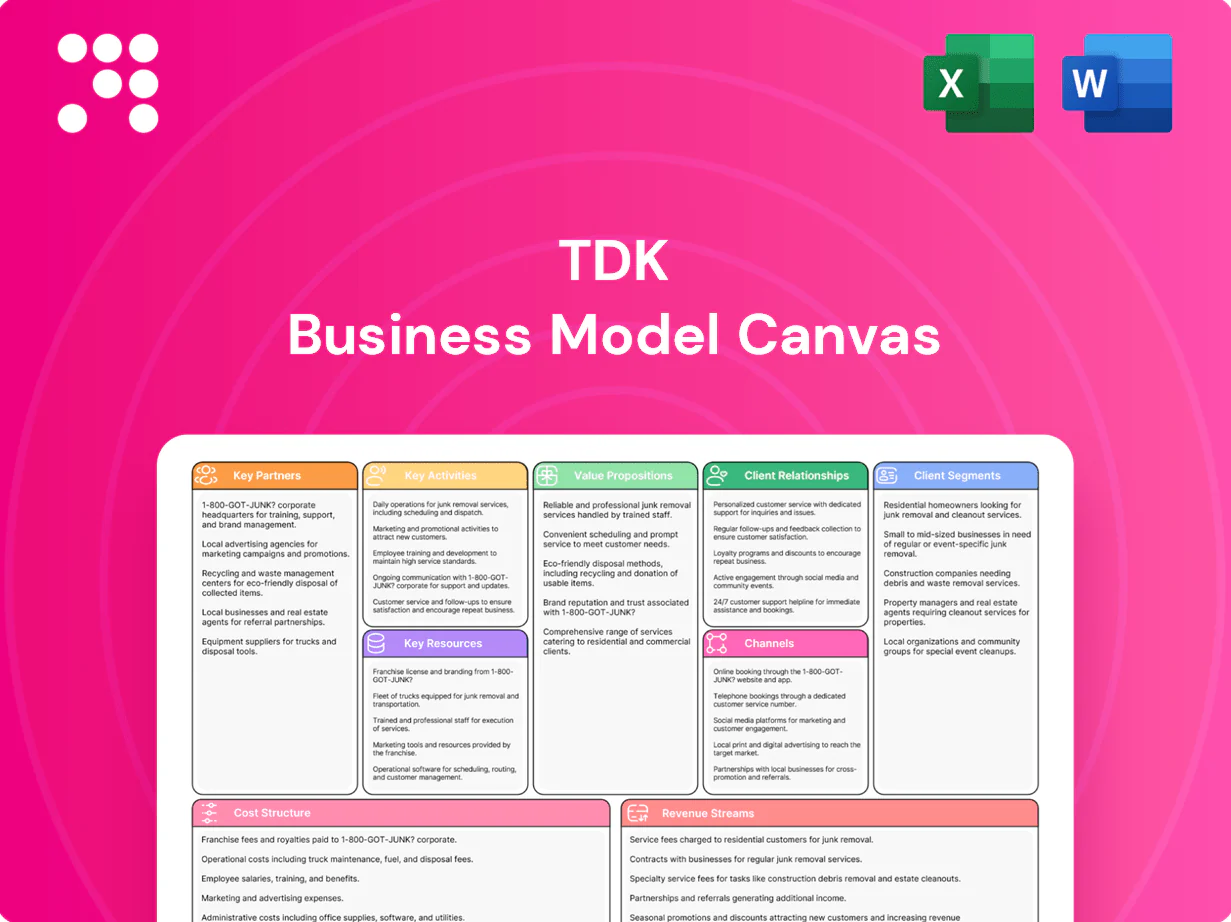
TDK Business Model Canvas

Business Model Canvas: Actionable blueprint for value, partners, revenue and costs
Unlock the full strategic blueprint behind TDK’s business model in a concise, actionable Business Model Canvas—detailing value propositions, key partners, revenue streams and cost structure. Ideal for investors, consultants and founders, the downloadable Word/Excel files let you benchmark, adapt and execute proven industry strategies with ease—get the complete canvas now.
Partnerships

Automotive OEMs and Tier-1 suppliers
Co-develop components for ADAS, EV powertrains and battery management with leading OEMs and Tier-1s, ensuring AEC-Q qualification and ISO 26262 functional safety through joint validation. Typical design-in cycles of 18–36 months secure multi-year volumes and program loyalty. Collaboration shortens roadmaps for e-mobility and autonomy as global EV adoption continued rising after 2023’s >10 million sales.
Semiconductor and IC ecosystem partners
Partner with chipmakers on reference designs that integrate TDK sensors, passive components and power modules to accelerate board bring-up and reduce BOM risk. Rigorous co-design ensures signal integrity, EMI/EMC performance and thermal compatibility for production-scale platforms. Early engagement wins sockets in high-volume platforms as the IoT universe surpassed 14 billion endpoints in 2024, and shared go-to-market drives faster adoption in IoT and AI edge devices.

Manufacturing and materials suppliers
TDK secures advanced ceramics, ferrites, rare-earths and specialty polymers at scale to support its JPY 1.56 trillion revenue (FY2023) footprint. It co-innovates with suppliers on MLCC miniaturization and high-reliability inductors to meet shrinking form factors and higher performance. A diversified supplier base across Japan, Southeast Asia and North America mitigates geopolitical and commodity risk. Close quality partnerships sustain automotive-grade yields and traceability.

Research institutions and universities
Collaborate with research institutions and universities on materials science, magnetics, energy storage, and sensor technologies to accelerate device performance and reliability. Access to academic talent and licensed IP shortens development cycles and enables breakthrough performance in components and modules. Joint labs pilot new processes and standardized test methods while grants and consortia—for example Horizon Europe’s 95.5 billion EUR 2021–2027 budget—lower R&D cost and share technical risk.
- Open innovation partnerships
- Joint labs for pilot validation
- Access to IP and graduate talent
- Consortia/grants reduce cost and risk
Channel distributors and EMS/ODM partners
TDK leverages global channel distributors to reach long-tail customers and provide local design support, while aligning with EMS/ODM partners for design-in and stable production ramps; 2024 industry surveys show VMI and supplier forecasting lift fill rates to above 95% and can cut lead times by up to 30%.
- Channel reach: long-tail coverage and design support
- EMS/ODM: design-in, ramp stability
- Forecasting & VMI: >95% fill, -30% lead time
- Joint demand creation: expanded market coverage
Co-developing ADAS, EV powertrain and sensors to secure multi-year production volumes
TDK partners with OEMs, Tier‑1s and chipmakers to co-develop ADAS, EV powertrain and sensor modules (design‑in cycles 18–36 months), leveraging JPY 1.56 trillion FY2023 scale to secure multi‑year volumes. Supplier ties ensure ceramics, ferrites and polymers at scale while R&D consortia and universities accelerate materials and BMS innovation. Channel, EMS and VMI partnerships drive >95% fill and ~30% lower lead times.
| Metric | Value |
|---|---|
| Revenue (FY2023) | JPY 1.56 trillion |
| Global EV sales (2023) | >10 million |
| IoT endpoints (2024) | ~14 billion |
| VMI performance | >95% fill, −30% lead time |
What is included in the product
 Detailed Word Document
A comprehensive, pre-written Business Model Canvas for TDK that maps customer segments, channels, value propositions, key activities, resources, partners, cost structure and revenue streams with practical, real-world detail. Ideal for presentations and funding discussions, it includes SWOT-linked insights and competitive advantages to support strategic decisions and validation.

 Customizable Excel Spreadsheet
High-level view of TDK’s business model with editable cells, relieving the pain of scattered strategy documents and misaligned teams. Shareable and editable for team collaboration and rapid adaptation.
Activities

Advanced materials R&D
Advanced materials R&D focuses on ceramic dielectrics, ferrites and magnetic composites to drive performance gains and miniaturization, optimizing temperature stability, reliability and cost. TDK translates formulations and process IP into scalable manufacturing recipes, aligning with the 2024 advanced ceramics market (~$24.6B) to capture growth. Differentiated patents and process IP increase barriers to entry and margin expansion.
High-volume precision manufacturing
Produce MLCCs, inductors, sensors and power supplies to tight tolerances using automated lines with inline inspection and electrical test. Leverage global plants in Japan, China, Malaysia, Philippines, Hungary and the US to scale capacity regionally. Maintain full traceability and automotive-grade certifications such as IATF 16949 and ISO 9001. Continuous automation drives throughput and consistent quality.

Application engineering and co-design
Application engineering and co-design engages customers to tailor components precisely to system requirements, with collaborative workshops and prototype iterations. We provide simulations, reference designs and EMI/EMC solutions to validate performance and reduce redesign risk. These services shorten time-to-market and secure sockets across four platforms: automotive, industrial, ICT and consumer.

Quality assurance and compliance
Quality assurance and compliance ensure TDK meets AEC-Q (AEC‑Q100/AEC‑Q200), ISO (9001/14001), functional safety (ISO 26262) and environmental standards while running reliability testing, failure analysis and continuous improvement to sustain product lifecycles.
- Manage PPAP and supplier quality per AIAG requirements
- Ensure consistent performance across lifecycles
- Use root‑cause failure analysis and CI
Global supply chain and lifecycle management
- global footprint: Asia, Americas, EMEA
- FY2023 sales: ~1.94 trillion yen
- risk controls: dual-sourcing, regionalization
- lifecycle: last-time buy, PCN management
- goal: lower cost-to-serve, maintain service
R&D-led advanced ceramics scale: 6 global plants, automotive-ready, FY2023 sales ~1.94T JPY
Advanced materials R&D, scalable ceramic/ferrite manufacturing, automated high‑precision assembly and application co‑design drive product performance and margins; QA/compliance (AEC‑Q, ISO, ISO 26262) and global plants (JP, CN, MY, PH, HU, US) ensure automotive/industrial readiness. FY2023 sales ~1.94 trillion yen; 2024 advanced ceramics market ~$24.6B.
| Metric | Value |
|---|---|
| FY2023 sales | ~1.94T JPY |
| Adv ceramics market 2024 | $24.6B |
| Plants | 6 countries |
Full Version Awaits
Business Model Canvas
The TDK Business Model Canvas you’re previewing is the actual deliverable, not a mockup or sample. When you purchase, you’ll receive this same document—fully formatted and complete—in editable Word and Excel files. No hidden pages or altered layouts: what you see is what you’ll download. It’s ready to edit, present, and apply immediately.

Business Model Canvas: Actionable blueprint for value, partners, revenue and costs
Unlock the full strategic blueprint behind TDK’s business model in a concise, actionable Business Model Canvas—detailing value propositions, key partners, revenue streams and cost structure. Ideal for investors, consultants and founders, the downloadable Word/Excel files let you benchmark, adapt and execute proven industry strategies with ease—get the complete canvas now.
Partnerships
Automotive OEMs and Tier-1 suppliers
Co-develop components for ADAS, EV powertrains and battery management with leading OEMs and Tier-1s, ensuring AEC-Q qualification and ISO 26262 functional safety through joint validation. Typical design-in cycles of 18–36 months secure multi-year volumes and program loyalty. Collaboration shortens roadmaps for e-mobility and autonomy as global EV adoption continued rising after 2023’s >10 million sales.
Semiconductor and IC ecosystem partners
Partner with chipmakers on reference designs that integrate TDK sensors, passive components and power modules to accelerate board bring-up and reduce BOM risk. Rigorous co-design ensures signal integrity, EMI/EMC performance and thermal compatibility for production-scale platforms. Early engagement wins sockets in high-volume platforms as the IoT universe surpassed 14 billion endpoints in 2024, and shared go-to-market drives faster adoption in IoT and AI edge devices.
Manufacturing and materials suppliers
TDK secures advanced ceramics, ferrites, rare-earths and specialty polymers at scale to support its JPY 1.56 trillion revenue (FY2023) footprint. It co-innovates with suppliers on MLCC miniaturization and high-reliability inductors to meet shrinking form factors and higher performance. A diversified supplier base across Japan, Southeast Asia and North America mitigates geopolitical and commodity risk. Close quality partnerships sustain automotive-grade yields and traceability.
Research institutions and universities
Collaborate with research institutions and universities on materials science, magnetics, energy storage, and sensor technologies to accelerate device performance and reliability. Access to academic talent and licensed IP shortens development cycles and enables breakthrough performance in components and modules. Joint labs pilot new processes and standardized test methods while grants and consortia—for example Horizon Europe’s 95.5 billion EUR 2021–2027 budget—lower R&D cost and share technical risk.
- Open innovation partnerships
- Joint labs for pilot validation
- Access to IP and graduate talent
- Consortia/grants reduce cost and risk
Channel distributors and EMS/ODM partners
TDK leverages global channel distributors to reach long-tail customers and provide local design support, while aligning with EMS/ODM partners for design-in and stable production ramps; 2024 industry surveys show VMI and supplier forecasting lift fill rates to above 95% and can cut lead times by up to 30%.
- Channel reach: long-tail coverage and design support
- EMS/ODM: design-in, ramp stability
- Forecasting & VMI: >95% fill, -30% lead time
- Joint demand creation: expanded market coverage
Co-developing ADAS, EV powertrain and sensors to secure multi-year production volumes
TDK partners with OEMs, Tier‑1s and chipmakers to co-develop ADAS, EV powertrain and sensor modules (design‑in cycles 18–36 months), leveraging JPY 1.56 trillion FY2023 scale to secure multi‑year volumes. Supplier ties ensure ceramics, ferrites and polymers at scale while R&D consortia and universities accelerate materials and BMS innovation. Channel, EMS and VMI partnerships drive >95% fill and ~30% lower lead times.
| Metric | Value |
|---|---|
| Revenue (FY2023) | JPY 1.56 trillion |
| Global EV sales (2023) | >10 million |
| IoT endpoints (2024) | ~14 billion |
| VMI performance | >95% fill, −30% lead time |
What is included in the product
Detailed Word Document
A comprehensive, pre-written Business Model Canvas for TDK that maps customer segments, channels, value propositions, key activities, resources, partners, cost structure and revenue streams with practical, real-world detail. Ideal for presentations and funding discussions, it includes SWOT-linked insights and competitive advantages to support strategic decisions and validation.
Customizable Excel Spreadsheet
High-level view of TDK’s business model with editable cells, relieving the pain of scattered strategy documents and misaligned teams. Shareable and editable for team collaboration and rapid adaptation.
Activities
Advanced materials R&D
Advanced materials R&D focuses on ceramic dielectrics, ferrites and magnetic composites to drive performance gains and miniaturization, optimizing temperature stability, reliability and cost. TDK translates formulations and process IP into scalable manufacturing recipes, aligning with the 2024 advanced ceramics market (~$24.6B) to capture growth. Differentiated patents and process IP increase barriers to entry and margin expansion.
High-volume precision manufacturing
Produce MLCCs, inductors, sensors and power supplies to tight tolerances using automated lines with inline inspection and electrical test. Leverage global plants in Japan, China, Malaysia, Philippines, Hungary and the US to scale capacity regionally. Maintain full traceability and automotive-grade certifications such as IATF 16949 and ISO 9001. Continuous automation drives throughput and consistent quality.
Application engineering and co-design
Application engineering and co-design engages customers to tailor components precisely to system requirements, with collaborative workshops and prototype iterations. We provide simulations, reference designs and EMI/EMC solutions to validate performance and reduce redesign risk. These services shorten time-to-market and secure sockets across four platforms: automotive, industrial, ICT and consumer.
Quality assurance and compliance
Quality assurance and compliance ensure TDK meets AEC-Q (AEC‑Q100/AEC‑Q200), ISO (9001/14001), functional safety (ISO 26262) and environmental standards while running reliability testing, failure analysis and continuous improvement to sustain product lifecycles.
- Manage PPAP and supplier quality per AIAG requirements
- Ensure consistent performance across lifecycles
- Use root‑cause failure analysis and CI
Global supply chain and lifecycle management
- global footprint: Asia, Americas, EMEA
- FY2023 sales: ~1.94 trillion yen
- risk controls: dual-sourcing, regionalization
- lifecycle: last-time buy, PCN management
- goal: lower cost-to-serve, maintain service
R&D-led advanced ceramics scale: 6 global plants, automotive-ready, FY2023 sales ~1.94T JPY
Advanced materials R&D, scalable ceramic/ferrite manufacturing, automated high‑precision assembly and application co‑design drive product performance and margins; QA/compliance (AEC‑Q, ISO, ISO 26262) and global plants (JP, CN, MY, PH, HU, US) ensure automotive/industrial readiness. FY2023 sales ~1.94 trillion yen; 2024 advanced ceramics market ~$24.6B.
| Metric | Value |
|---|---|
| FY2023 sales | ~1.94T JPY |
| Adv ceramics market 2024 | $24.6B |
| Plants | 6 countries |
Full Version Awaits
Business Model Canvas
The TDK Business Model Canvas you’re previewing is the actual deliverable, not a mockup or sample. When you purchase, you’ll receive this same document—fully formatted and complete—in editable Word and Excel files. No hidden pages or altered layouts: what you see is what you’ll download. It’s ready to edit, present, and apply immediately.
Original: $10.00
-65%$10.00
$3.50Description
Business Model Canvas: Actionable blueprint for value, partners, revenue and costs
Unlock the full strategic blueprint behind TDK’s business model in a concise, actionable Business Model Canvas—detailing value propositions, key partners, revenue streams and cost structure. Ideal for investors, consultants and founders, the downloadable Word/Excel files let you benchmark, adapt and execute proven industry strategies with ease—get the complete canvas now.
Partnerships
Automotive OEMs and Tier-1 suppliers
Co-develop components for ADAS, EV powertrains and battery management with leading OEMs and Tier-1s, ensuring AEC-Q qualification and ISO 26262 functional safety through joint validation. Typical design-in cycles of 18–36 months secure multi-year volumes and program loyalty. Collaboration shortens roadmaps for e-mobility and autonomy as global EV adoption continued rising after 2023’s >10 million sales.
Semiconductor and IC ecosystem partners
Partner with chipmakers on reference designs that integrate TDK sensors, passive components and power modules to accelerate board bring-up and reduce BOM risk. Rigorous co-design ensures signal integrity, EMI/EMC performance and thermal compatibility for production-scale platforms. Early engagement wins sockets in high-volume platforms as the IoT universe surpassed 14 billion endpoints in 2024, and shared go-to-market drives faster adoption in IoT and AI edge devices.
Manufacturing and materials suppliers
TDK secures advanced ceramics, ferrites, rare-earths and specialty polymers at scale to support its JPY 1.56 trillion revenue (FY2023) footprint. It co-innovates with suppliers on MLCC miniaturization and high-reliability inductors to meet shrinking form factors and higher performance. A diversified supplier base across Japan, Southeast Asia and North America mitigates geopolitical and commodity risk. Close quality partnerships sustain automotive-grade yields and traceability.
Research institutions and universities
Collaborate with research institutions and universities on materials science, magnetics, energy storage, and sensor technologies to accelerate device performance and reliability. Access to academic talent and licensed IP shortens development cycles and enables breakthrough performance in components and modules. Joint labs pilot new processes and standardized test methods while grants and consortia—for example Horizon Europe’s 95.5 billion EUR 2021–2027 budget—lower R&D cost and share technical risk.
- Open innovation partnerships
- Joint labs for pilot validation
- Access to IP and graduate talent
- Consortia/grants reduce cost and risk
Channel distributors and EMS/ODM partners
TDK leverages global channel distributors to reach long-tail customers and provide local design support, while aligning with EMS/ODM partners for design-in and stable production ramps; 2024 industry surveys show VMI and supplier forecasting lift fill rates to above 95% and can cut lead times by up to 30%.
- Channel reach: long-tail coverage and design support
- EMS/ODM: design-in, ramp stability
- Forecasting & VMI: >95% fill, -30% lead time
- Joint demand creation: expanded market coverage
Co-developing ADAS, EV powertrain and sensors to secure multi-year production volumes
TDK partners with OEMs, Tier‑1s and chipmakers to co-develop ADAS, EV powertrain and sensor modules (design‑in cycles 18–36 months), leveraging JPY 1.56 trillion FY2023 scale to secure multi‑year volumes. Supplier ties ensure ceramics, ferrites and polymers at scale while R&D consortia and universities accelerate materials and BMS innovation. Channel, EMS and VMI partnerships drive >95% fill and ~30% lower lead times.
| Metric | Value |
|---|---|
| Revenue (FY2023) | JPY 1.56 trillion |
| Global EV sales (2023) | >10 million |
| IoT endpoints (2024) | ~14 billion |
| VMI performance | >95% fill, −30% lead time |
What is included in the product
Detailed Word Document
A comprehensive, pre-written Business Model Canvas for TDK that maps customer segments, channels, value propositions, key activities, resources, partners, cost structure and revenue streams with practical, real-world detail. Ideal for presentations and funding discussions, it includes SWOT-linked insights and competitive advantages to support strategic decisions and validation.
Customizable Excel Spreadsheet
High-level view of TDK’s business model with editable cells, relieving the pain of scattered strategy documents and misaligned teams. Shareable and editable for team collaboration and rapid adaptation.
Activities
Advanced materials R&D
Advanced materials R&D focuses on ceramic dielectrics, ferrites and magnetic composites to drive performance gains and miniaturization, optimizing temperature stability, reliability and cost. TDK translates formulations and process IP into scalable manufacturing recipes, aligning with the 2024 advanced ceramics market (~$24.6B) to capture growth. Differentiated patents and process IP increase barriers to entry and margin expansion.
High-volume precision manufacturing
Produce MLCCs, inductors, sensors and power supplies to tight tolerances using automated lines with inline inspection and electrical test. Leverage global plants in Japan, China, Malaysia, Philippines, Hungary and the US to scale capacity regionally. Maintain full traceability and automotive-grade certifications such as IATF 16949 and ISO 9001. Continuous automation drives throughput and consistent quality.
Application engineering and co-design
Application engineering and co-design engages customers to tailor components precisely to system requirements, with collaborative workshops and prototype iterations. We provide simulations, reference designs and EMI/EMC solutions to validate performance and reduce redesign risk. These services shorten time-to-market and secure sockets across four platforms: automotive, industrial, ICT and consumer.
Quality assurance and compliance
Quality assurance and compliance ensure TDK meets AEC-Q (AEC‑Q100/AEC‑Q200), ISO (9001/14001), functional safety (ISO 26262) and environmental standards while running reliability testing, failure analysis and continuous improvement to sustain product lifecycles.
- Manage PPAP and supplier quality per AIAG requirements
- Ensure consistent performance across lifecycles
- Use root‑cause failure analysis and CI
Global supply chain and lifecycle management
- global footprint: Asia, Americas, EMEA
- FY2023 sales: ~1.94 trillion yen
- risk controls: dual-sourcing, regionalization
- lifecycle: last-time buy, PCN management
- goal: lower cost-to-serve, maintain service
R&D-led advanced ceramics scale: 6 global plants, automotive-ready, FY2023 sales ~1.94T JPY
Advanced materials R&D, scalable ceramic/ferrite manufacturing, automated high‑precision assembly and application co‑design drive product performance and margins; QA/compliance (AEC‑Q, ISO, ISO 26262) and global plants (JP, CN, MY, PH, HU, US) ensure automotive/industrial readiness. FY2023 sales ~1.94 trillion yen; 2024 advanced ceramics market ~$24.6B.
| Metric | Value |
|---|---|
| FY2023 sales | ~1.94T JPY |
| Adv ceramics market 2024 | $24.6B |
| Plants | 6 countries |
Full Version Awaits
Business Model Canvas
The TDK Business Model Canvas you’re previewing is the actual deliverable, not a mockup or sample. When you purchase, you’ll receive this same document—fully formatted and complete—in editable Word and Excel files. No hidden pages or altered layouts: what you see is what you’ll download. It’s ready to edit, present, and apply immediately.











